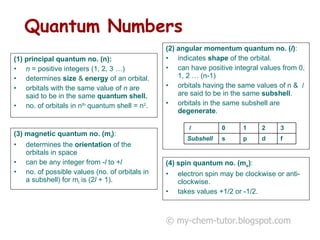
Quantum Numbers   © my-chem-tutor.blogspot.com (1) principal quantum no. (n):  n  = positive integers (1, 2, 3 …) determines  size  &  energy  of an orbital. orbitals with the same value of  n  are said to be in the same  quantum shell. no. of orbitals in n th  quantum shell = n 2 . (2)   angular momentum quantum no. ( l ) : indicates  shape  of the orbital. can have positive integral values from 0, 1, 2 … (n-1) orbitals having the same values of n &  l  are said to be in the same  subshell . orbitals in the same subshell are  degenerate . (3) magnetic quantum no. (m l ) : determines the  orientation  of the orbitals in space can be any integer from - l  to + l no. of possible values (no. of orbitals in a subshell) for m l  is (2 l  + 1). (4)   spin quantum no. (m s ) : electron spin may be clockwise or anti-clockwise. takes values +1/2 or -1/2. f d p s Subshell 3 2 1 0 l
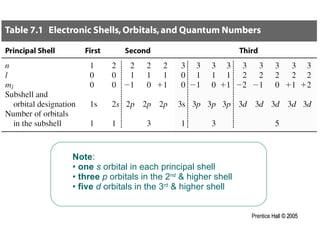
Note :  one   s  orbital in each principal shell three   p  orbitals in the 2 nd  & higher shell  five   d  orbitals in the 3 rd  & higher shell Prentice   Hall © 2005
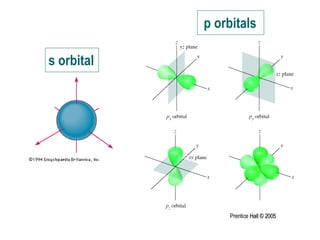
p orbitals s orbital Prentice   Hall © 2005
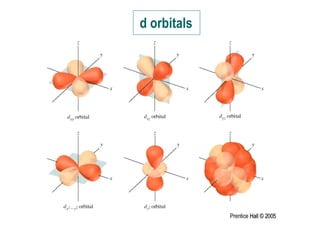
d orbitals Prentice   Hall © 2005
Order of filling orbitals   © my-chem-tutor.blogspot.com [1]  Fill orbitals with lower energy 1st   [Aufbau Principle] [2]  Each orbital can accommodate 2 electrons  [Pauli Exclusion Principle] [3]  Where there is a choice between orbitals of equal energy, fill the orbitals singly 1st  [Hund’s Rule]  (minimise electron repulsion) 4s orbital is lower in E than 3d ( when unfilled )!
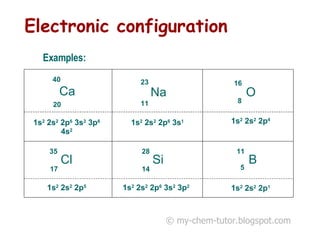
Electronic configuration   © my-chem-tutor.blogspot.com Examples: Ca O Cl Si Na 20 40 11 23 8 35 16 17 28 14 B 5 11 1s 2  2s 2  2p 6  3s 2  3p 6  4s 2 1s 2  2s 2  2p 6  3s 1 1s 2  2s 2  2p 4 1s 2  2s 2  2p 5 1s 2  2s 2  2p 6  3s 2  3p 2 1s 2  2s 2  2p 1

Atomic Structure (II)

  • 1.
    Quantum Numbers © my-chem-tutor.blogspot.com (1) principal quantum no. (n): n = positive integers (1, 2, 3 …) determines size & energy of an orbital. orbitals with the same value of n are said to be in the same quantum shell. no. of orbitals in n th quantum shell = n 2 . (2) angular momentum quantum no. ( l ) : indicates shape of the orbital. can have positive integral values from 0, 1, 2 … (n-1) orbitals having the same values of n & l are said to be in the same subshell . orbitals in the same subshell are degenerate . (3) magnetic quantum no. (m l ) : determines the orientation of the orbitals in space can be any integer from - l to + l no. of possible values (no. of orbitals in a subshell) for m l is (2 l + 1). (4) spin quantum no. (m s ) : electron spin may be clockwise or anti-clockwise. takes values +1/2 or -1/2. f d p s Subshell 3 2 1 0 l
  • 2.
    Note : one s orbital in each principal shell three p orbitals in the 2 nd & higher shell five d orbitals in the 3 rd & higher shell Prentice Hall © 2005
  • 3.
    p orbitals sorbital Prentice Hall © 2005
  • 4.
    d orbitals Prentice Hall © 2005
  • 5.
    Order of fillingorbitals © my-chem-tutor.blogspot.com [1] Fill orbitals with lower energy 1st [Aufbau Principle] [2] Each orbital can accommodate 2 electrons [Pauli Exclusion Principle] [3] Where there is a choice between orbitals of equal energy, fill the orbitals singly 1st [Hund’s Rule] (minimise electron repulsion) 4s orbital is lower in E than 3d ( when unfilled )!
  • 6.
    Electronic configuration © my-chem-tutor.blogspot.com Examples: Ca O Cl Si Na 20 40 11 23 8 35 16 17 28 14 B 5 11 1s 2 2s 2 2p 6 3s 2 3p 6 4s 2 1s 2 2s 2 2p 6 3s 1 1s 2 2s 2 2p 4 1s 2 2s 2 2p 5 1s 2 2s 2 2p 6 3s 2 3p 2 1s 2 2s 2 2p 1