PHARMACEUTICAL INORGANIC
CHEMISTRY
MODULE CODE : PST 04210
MODULE CREDIT : 12
PREPARED BY PHILIPO RAPHAEL
ELECTRONIC CONFIGURATION OF
ATOM
LEARNING
 Define the term electronic configuration
 Describe quantum numbers
 Describe atomic orbitals
 Explain rules used in filling electrons in
orbital
 Write the electronic configuration of
different elements
ELECTRONIC CONFIGURATION
 The electron configuration of an element
describes how electrons are distributed in its
atomic orbitals.
 An orbital is a region whereby the electrons are
likely to be found in an atom
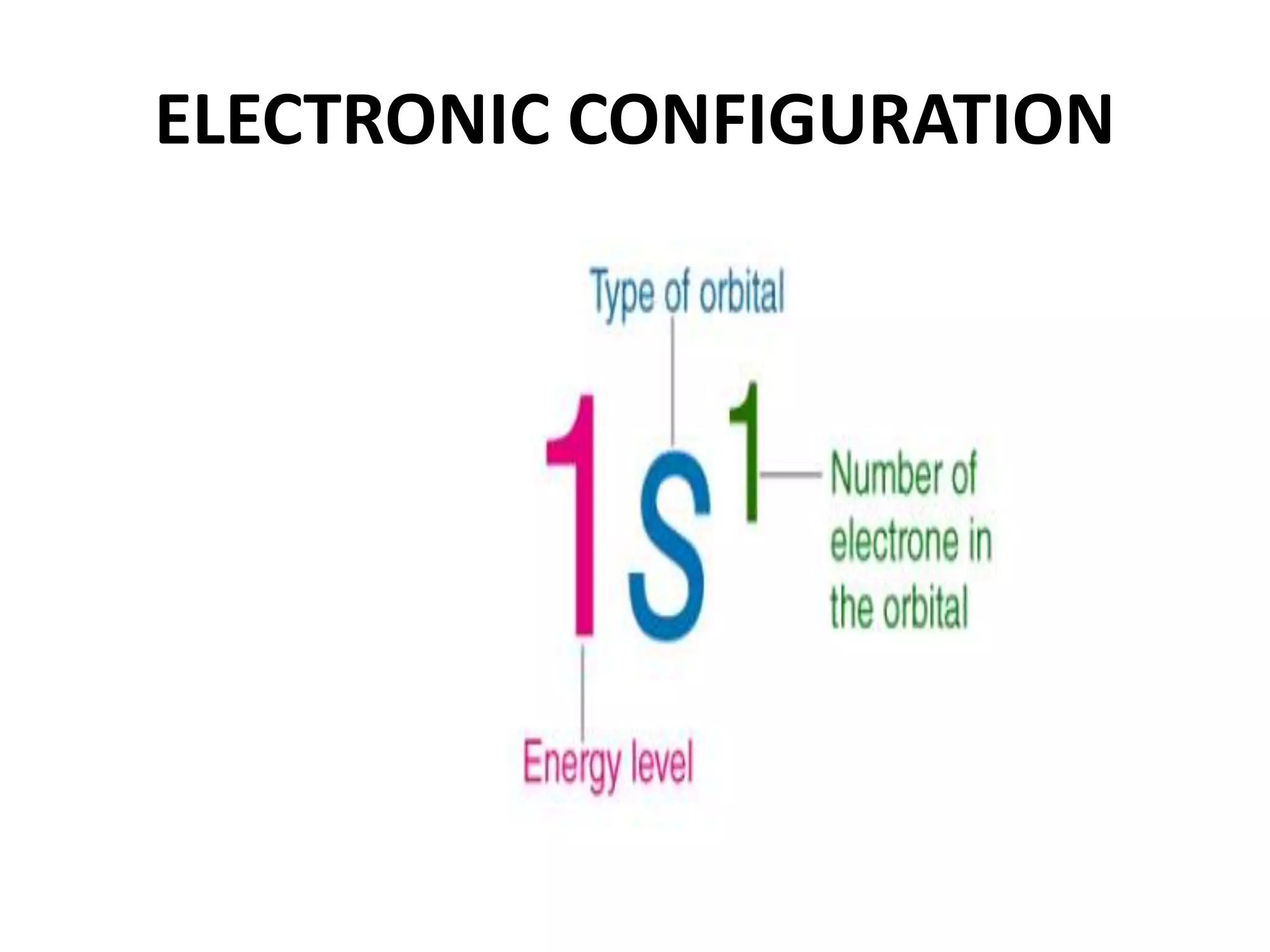
 The standard notation for the indication of the
electronic configuration of atoms is written in a
sequence of the label names of each atomic
subshell with the number of electrons assigned
to that specific subshell written in superscript.
ELECTRONIC CONFIGURATION
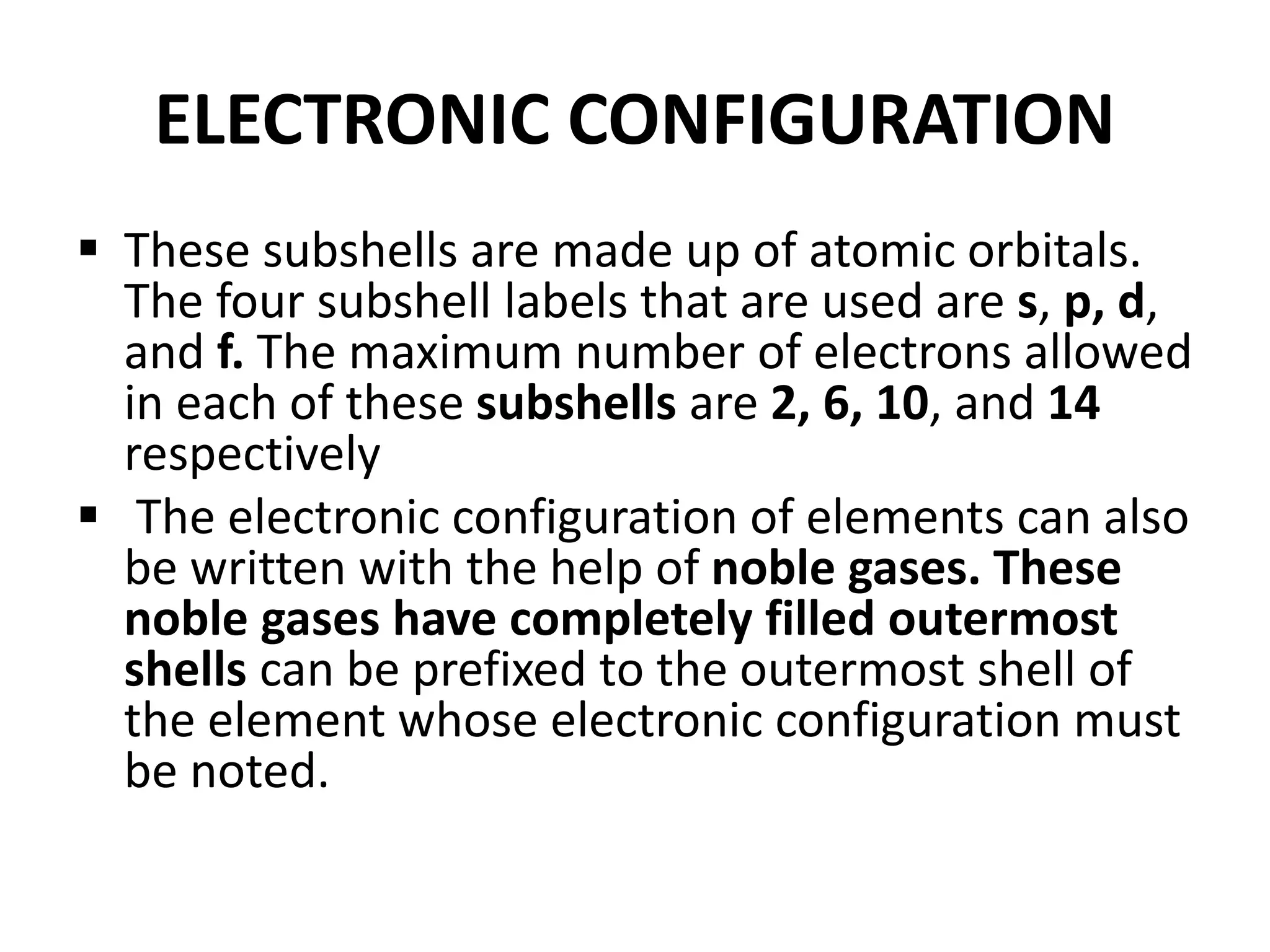
 These subshells are made up of atomic orbitals.
The four subshell labels that are used are s, p, d,
and f. The maximum number of electrons allowed
in each of these subshells are 2, 6, 10, and 14
respectively
 The electronic configuration of elements can also
be written with the help of noble gases. These
noble gases have completely filled outermost
shells can be prefixed to the outermost shell of
the element whose electronic configuration must
be noted.
ELECTRONIC CONFIGURATION
NOTATION
 However, the standard notation often yields
lengthy electron configurations (especially for
elements having a relatively large atomic
number).
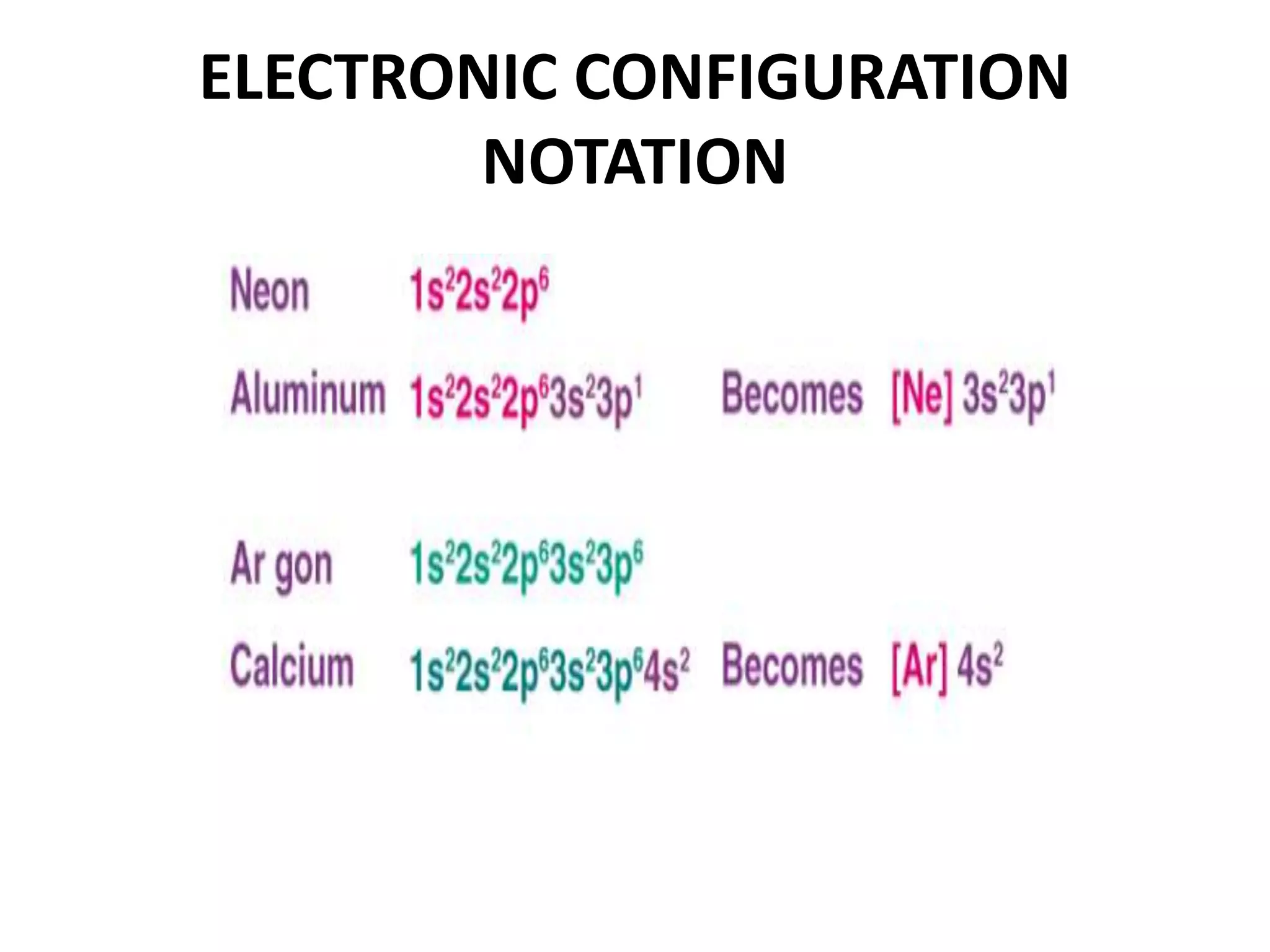
 In such cases, an abbreviated or condensed
notation may be used instead of the standard
notation. In the abbreviated notation, the
sequence of completely filled subshells that
correspond to the electronic configuration of a
noble gas is replaced with the symbol of
that noble gas in square brackets
ELECTRONIC CONFIGURATION
NOTATION
ELECTRONIC CONFIGURATION
 The maximum number of electrons that can
be accommodated in a shell is based on the
principal quantum number (n). It is
represented by the formula 2n2, where ‘n’ is
the shell number
 The subshells into which electrons are
distributed are based on the azimuthal
quantum number (denoted by ‘l’).
ELECTRONIC CONFIGURATION
 This quantum number is dependent on the value
of the principal quantum number, n. Therefore,
when n has a value of 4, four different subshells
are possible.
 When n=4. The subshells correspond to l=0, l=1,
l=2, and l=3 and are named the s, p, d, and f
subshells, respectively.
 The maximum number of electrons that can be
accommodated by a subshell is given by the
formula 2*(2l + 1).
QUANTUM NUMBER
Quantum numbers are numbers used to
describe atomic orbitals and to label
electrons that reside in them
 These numbers are derived from the
mathematical solution of the Schrödinger
equation for the hydrogen atom
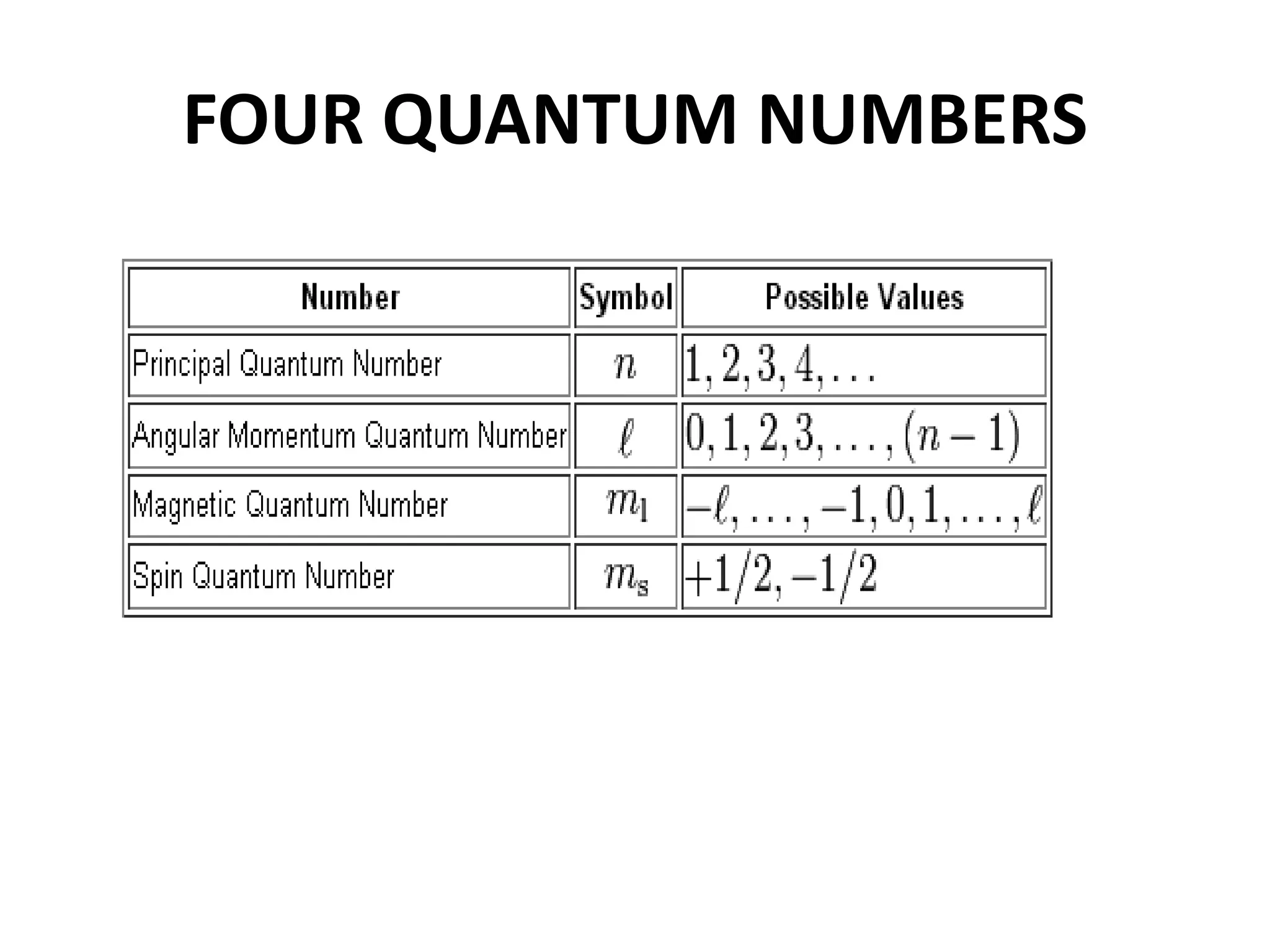
4 QUANTUM NUMBERS
 Principle quantum number (n)
 Angular momentun quantum number (l)
 Magnetic quantum number (ml)
 Spin quantum number (ms)
PRINCIPAL QUANTUM NUMBER
 The first quantum number describes the
electron shell, or energy level, of an atom.
The value of n ranges from 1 to the shell
containing the outermost electron of that
atom
AZIMUTHAL QUANTUM NUMBER
 The second quantum number, known as the
angular or orbital quantum number, describes
the subshell and gives the magnitude of the
orbital angular momentum through the relation.
In chemistry and spectroscopy, ℓ = 0 is called an s
orbital, ℓ = 1 a p orbital, ℓ = 2 a d orbital, and ℓ =
3 an f orbital. The value of ℓ ranges from 0 to n −
1 because the first p orbital (ℓ = 1) appears in the
second electron shell (n = 2), the first d orbital (ℓ
= 2) appears in the third shell (n = 3), and so on
MAGNETIC QUANTUM NUMBER
 The magnetic quantum number describes the energy
levels available within a subshell and yields the projection
of the orbital angular momentum along a specified axis.
The values of mℓ range from − l to ℓ, with integer steps
between them. The s subshell (ℓ = 0) contains one orbital,
and therefore the mℓ of an electron in an S subshell will
always be 0. The p subshell (ℓ = 1) contains three orbitals
(in some systems depicted as three “dumbbell-shaped”
clouds), so the mℓ of an electron in a p subshell will be −1,
0, or 1. The d subshell (ℓ = 2) contains five orbitals, with
mℓ values of −2, −1, 0, 1, and 2. The value of the
mℓ quantum number is associated with the orbital
orientation.
SPIN QUANTUM NUMBER
The fourth quantum number describes the spin
(intrinsic angular momentum) of the electron within
that orbital and gives the projection of the spin angular
momentum (s) along the specified axis. Analogously,
the values of ms range from −s to s, where s is the spin
quantum number, an intrinsic property of particles. An
electron has spin s = ½, consequently ms will be ±,
corresponding with spin and opposite spin. Each
electron in any individual orbital must have different
spins because of the Pauli exclusion principle,
therefore an orbital never contains more than two
electrons.
FOUR QUANTUM NUMBERS
RULES GOVERNING FILLING OF
ELECTRONS IN THE ORBITAL
RULES GOVERNING FILLING OF
ELECTRONIC CONFIGURATION
WRITING
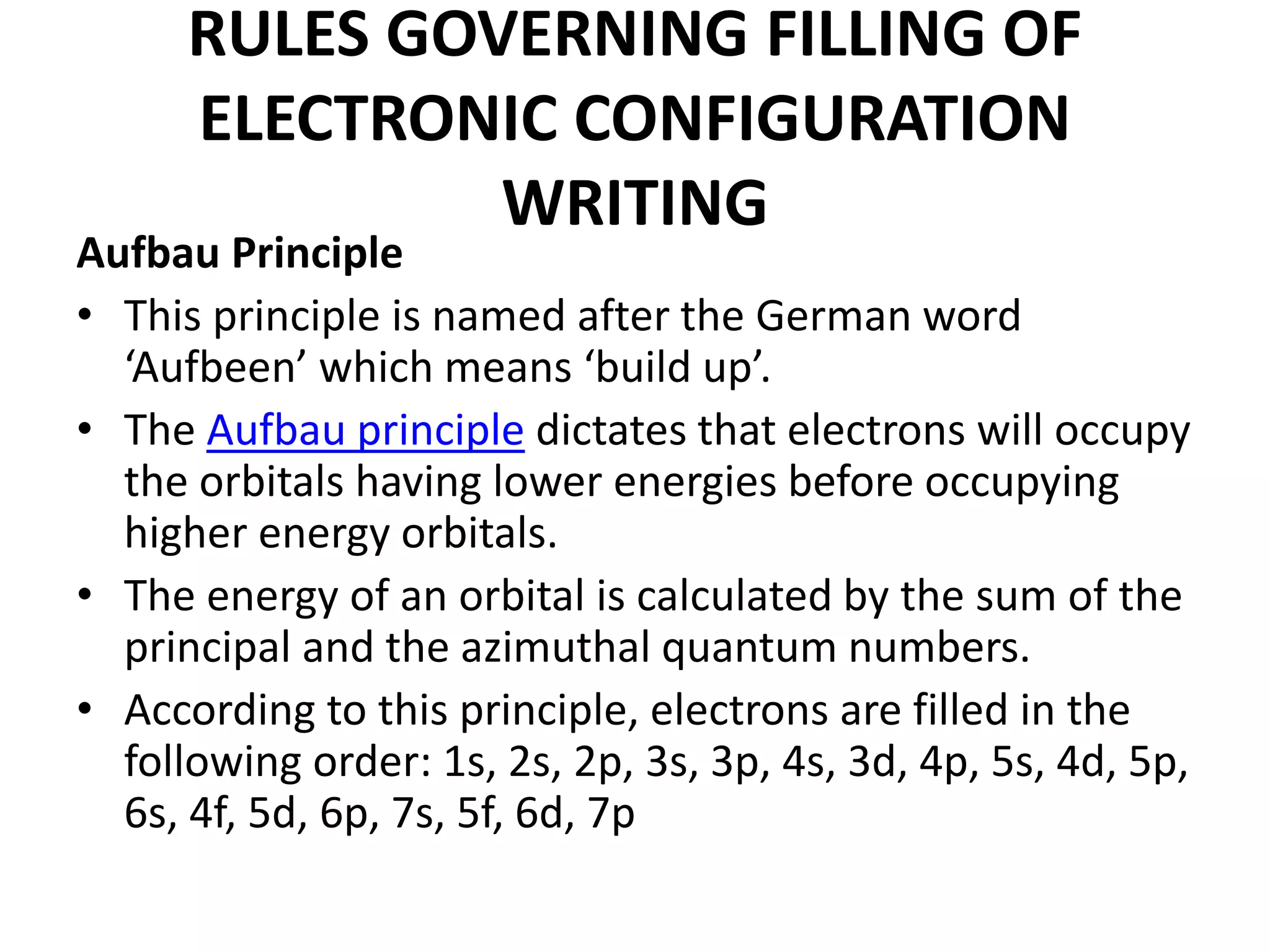
Aufbau Principle
• This principle is named after the German word
‘Aufbeen’ which means ‘build up’.
• The Aufbau principle dictates that electrons will occupy
the orbitals having lower energies before occupying
higher energy orbitals.
• The energy of an orbital is calculated by the sum of the
principal and the azimuthal quantum numbers.
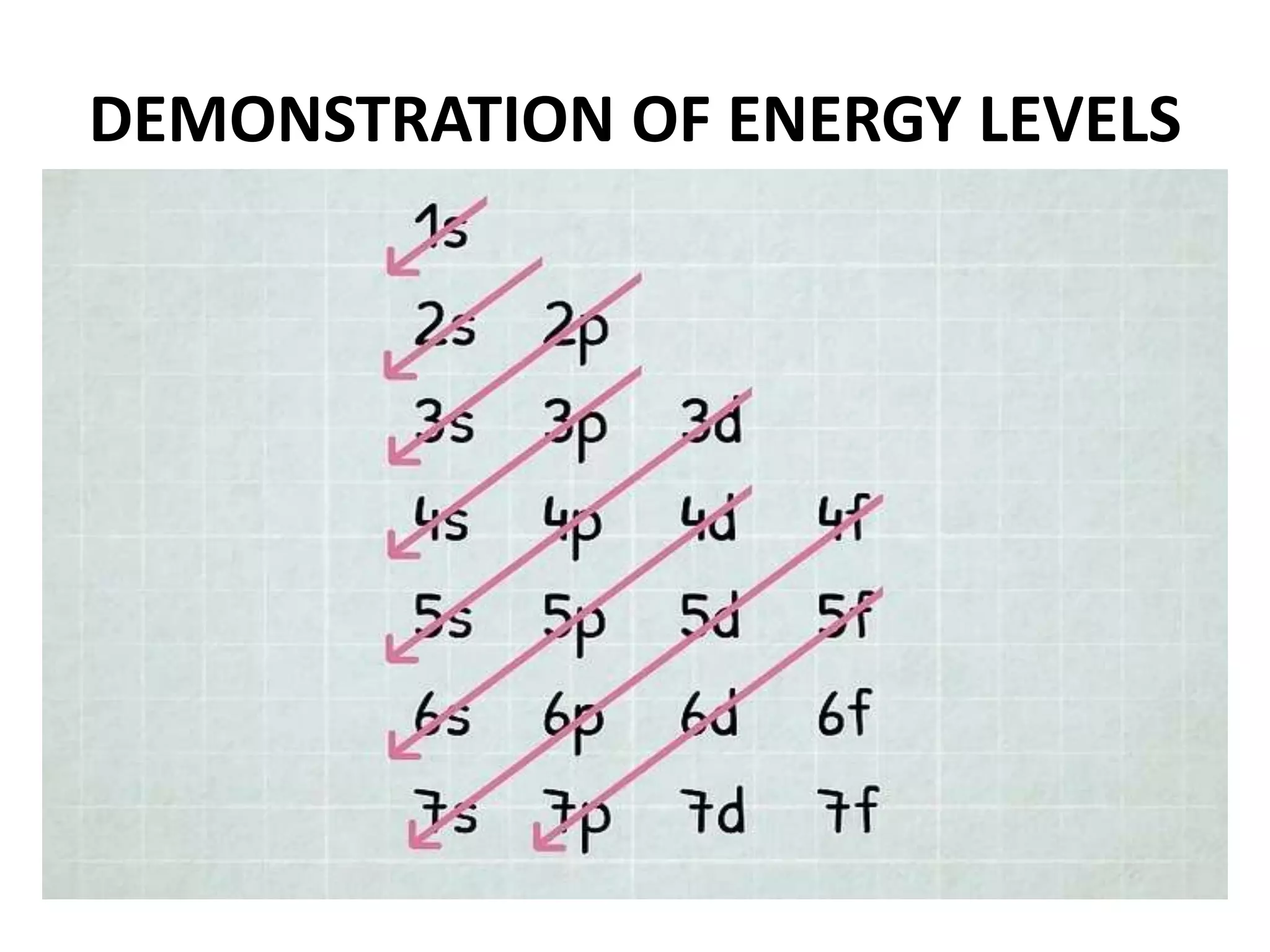
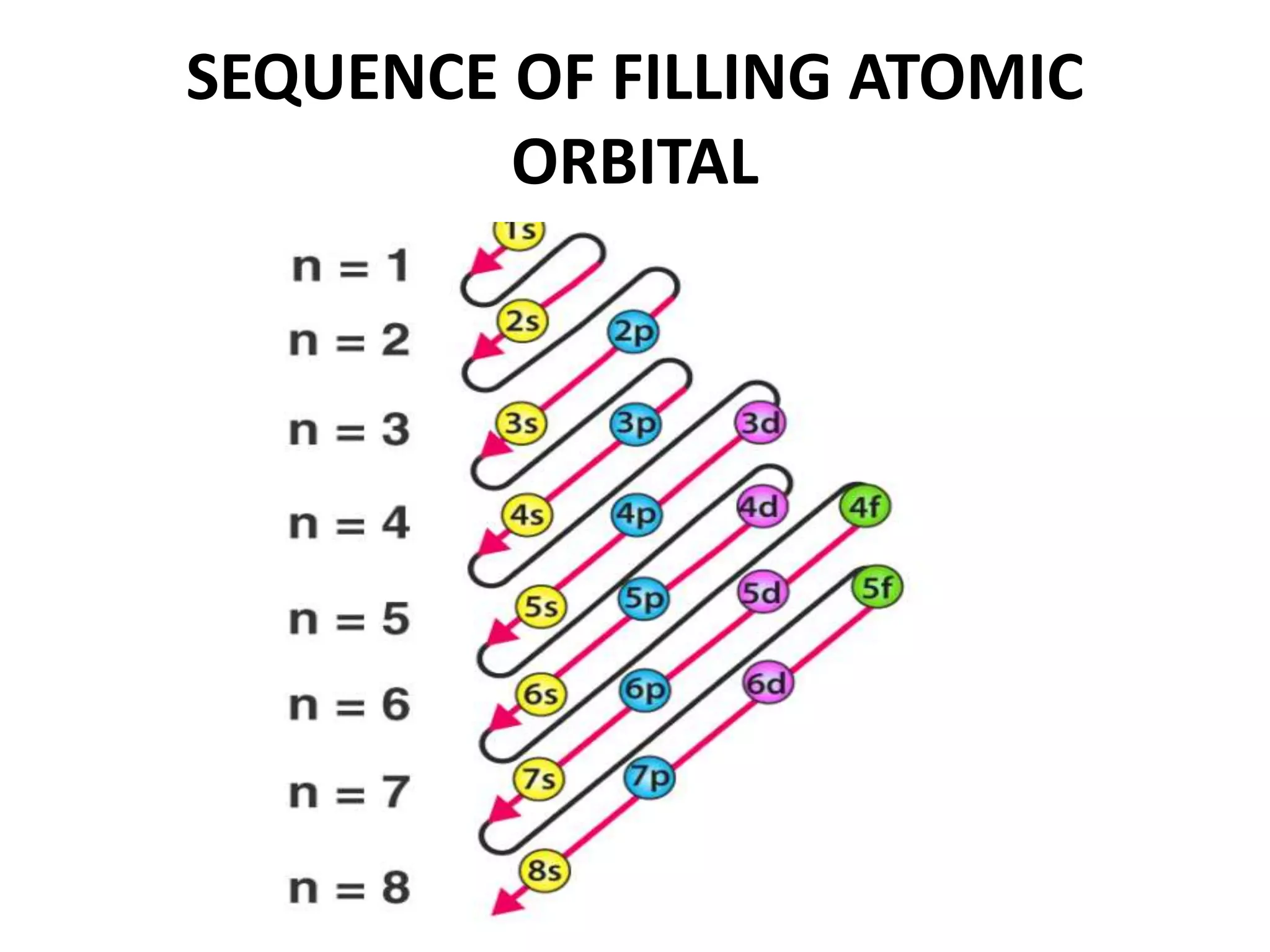
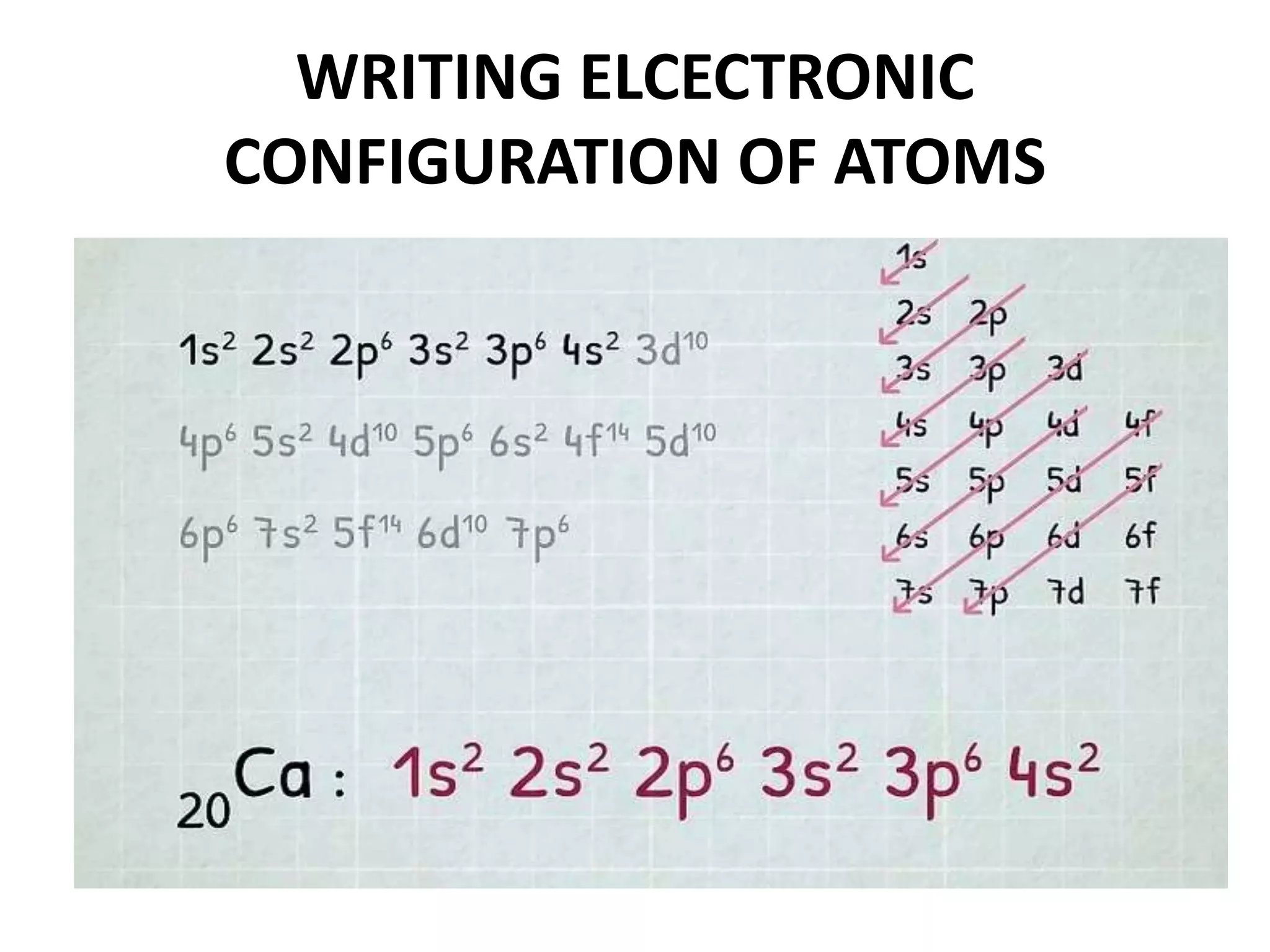
• According to this principle, electrons are filled in the
following order: 1s, 2s, 2p, 3s, 3p, 4s, 3d, 4p, 5s, 4d, 5p,
6s, 4f, 5d, 6p, 7s, 5f, 6d, 7p
DEMONSTRATION OF ENERGY LEVELS
SEQUENCE OF FILLING ATOMIC
ORBITAL
RULES GOVERNING OF ELECTRONIC
CONFIGURATION WRITING
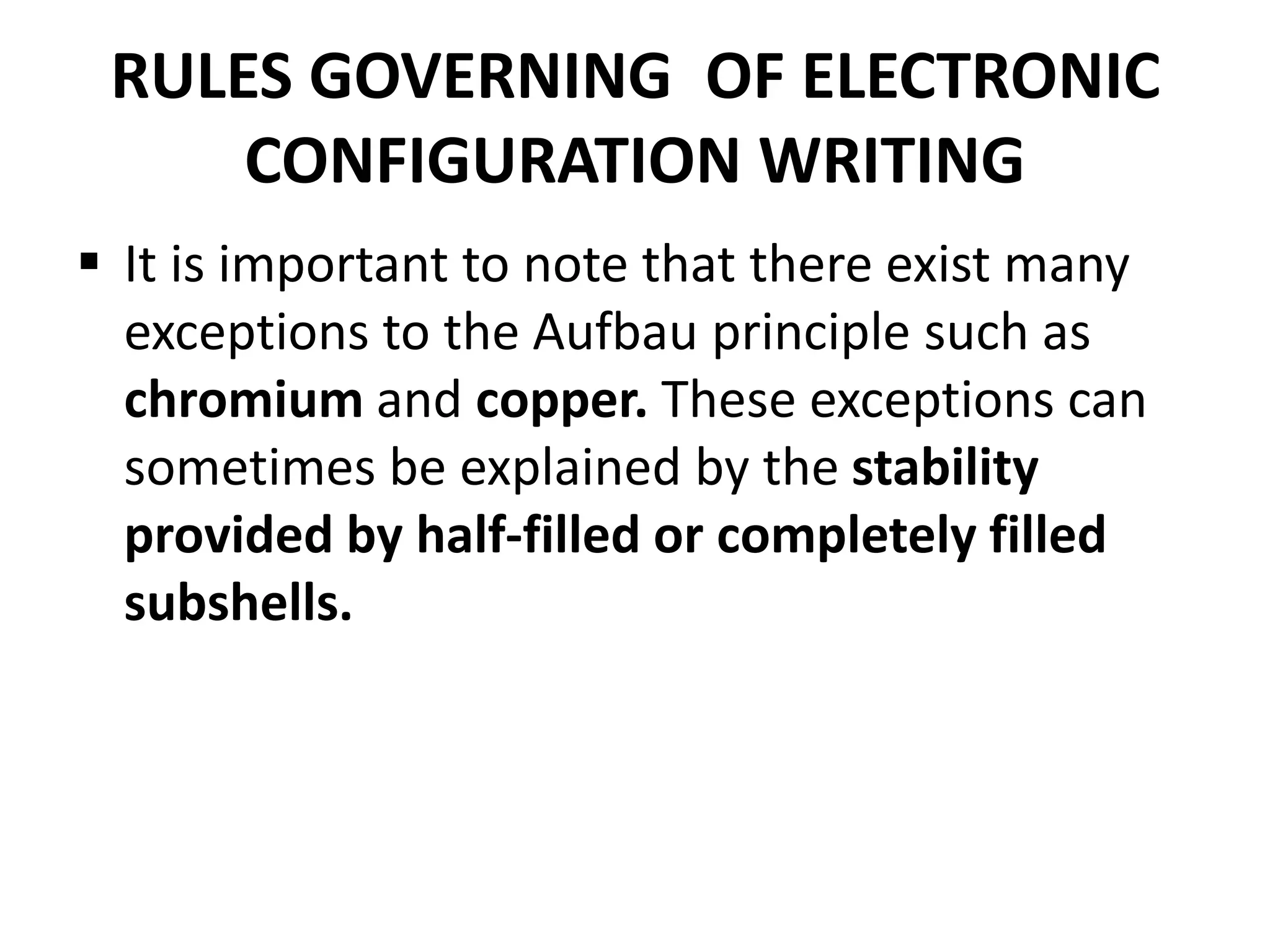
 It is important to note that there exist many
exceptions to the Aufbau principle such as
chromium and copper. These exceptions can
sometimes be explained by the stability
provided by half-filled or completely filled
subshells.
RULES GOVERNING ELECTRONIC
CONFIGURATION WRITING
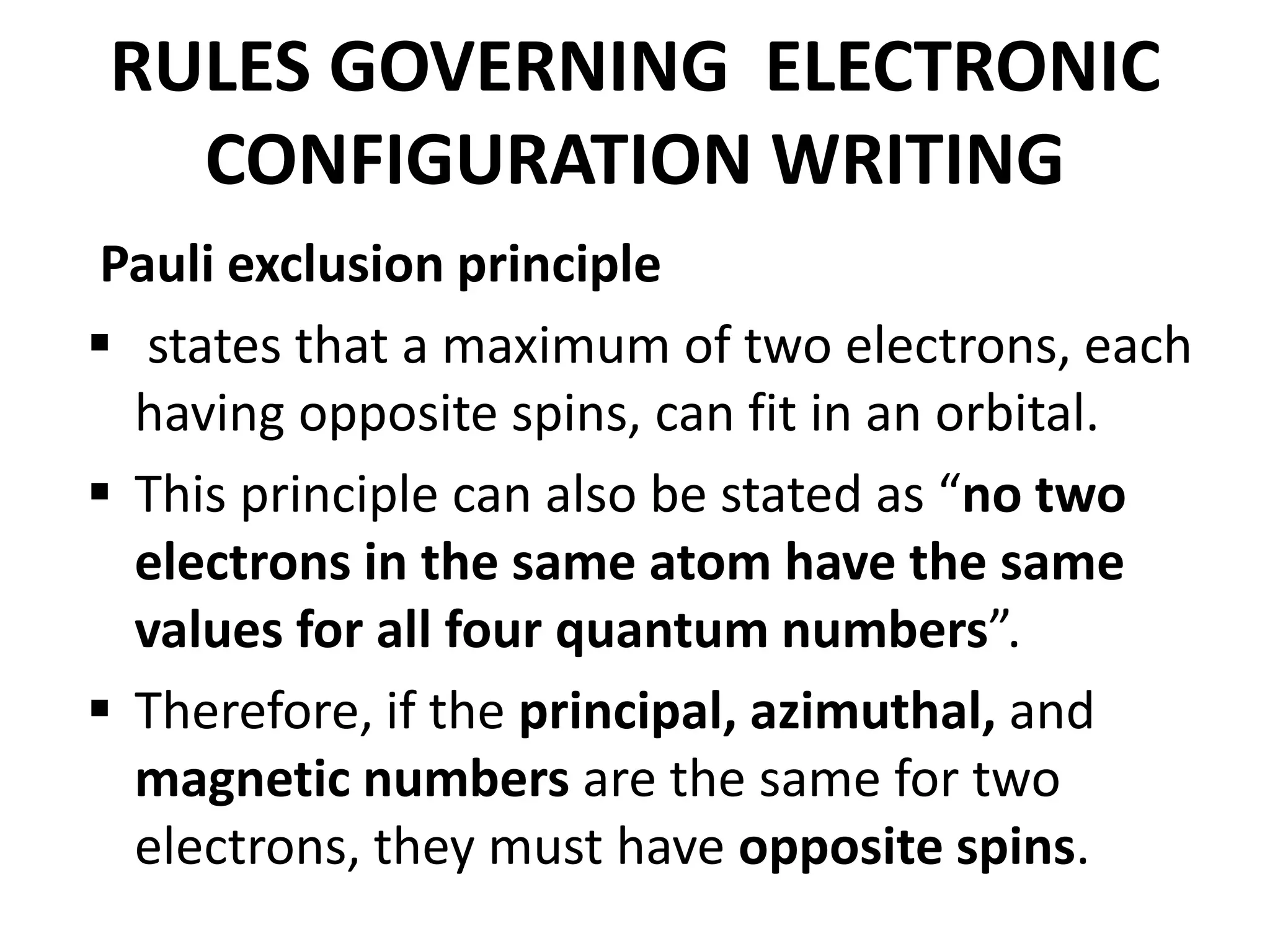
Pauli exclusion principle
 states that a maximum of two electrons, each
having opposite spins, can fit in an orbital.
 This principle can also be stated as “no two
electrons in the same atom have the same
values for all four quantum numbers”.
 Therefore, if the principal, azimuthal, and
magnetic numbers are the same for two
electrons, they must have opposite spins.
RULES GOVERNING ELECTRONIC
CONFIGURATION WRITING
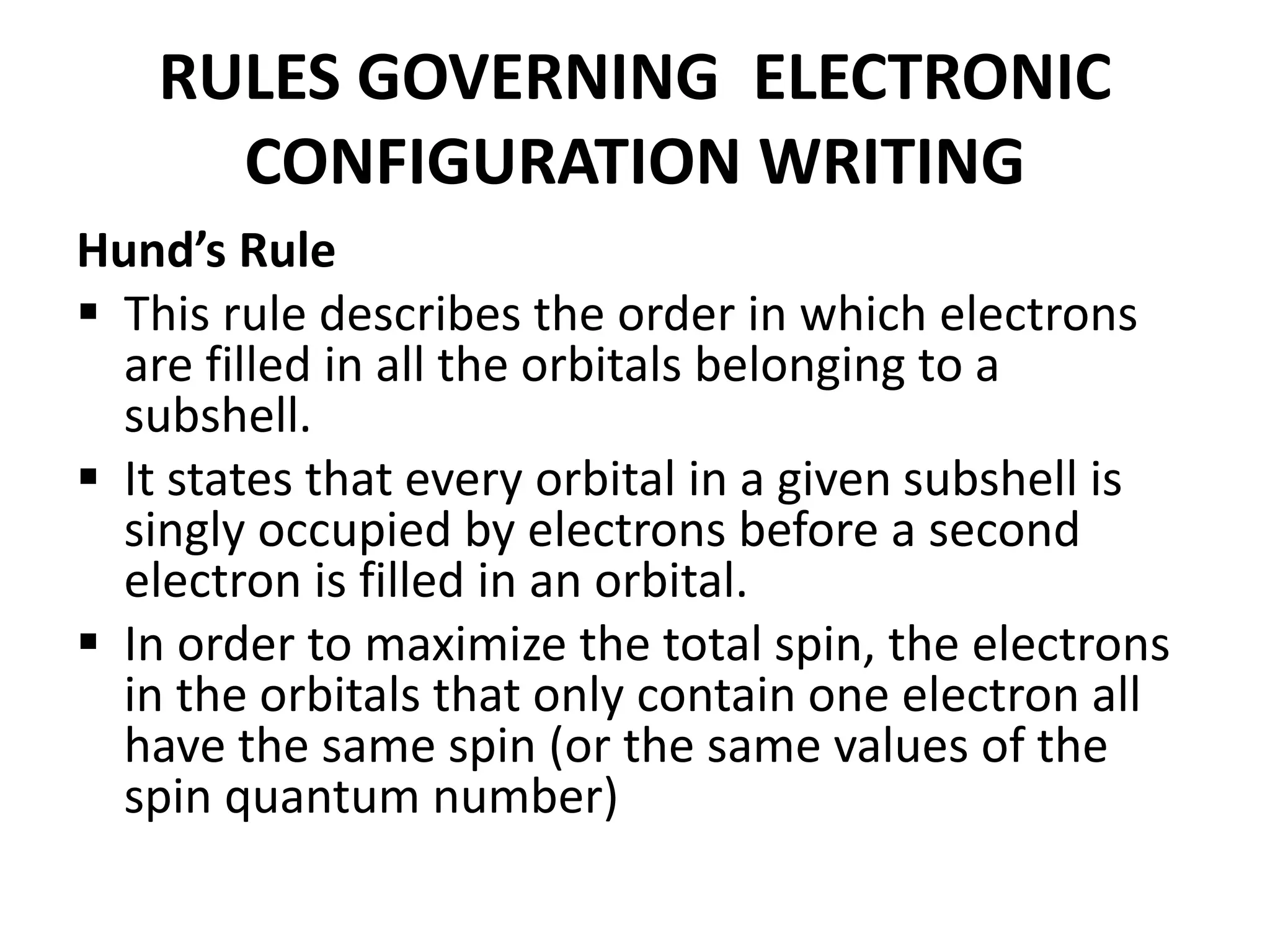
Hund’s Rule
 This rule describes the order in which electrons
are filled in all the orbitals belonging to a
subshell.
 It states that every orbital in a given subshell is
singly occupied by electrons before a second
electron is filled in an orbital.
 In order to maximize the total spin, the electrons
in the orbitals that only contain one electron all
have the same spin (or the same values of the
spin quantum number)
WRITING ELCECTRONIC
CONFIGURATION OF ATOMS
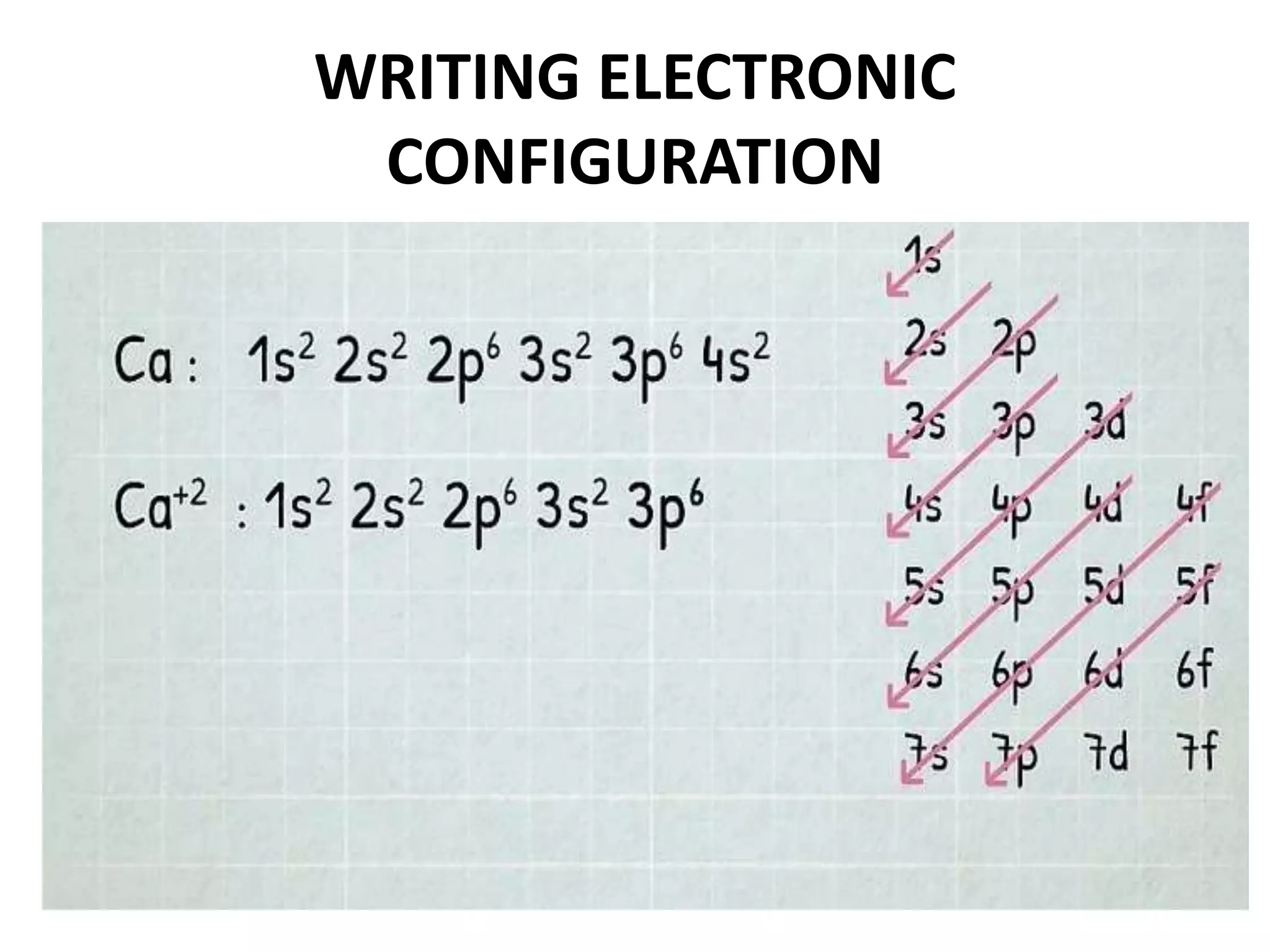
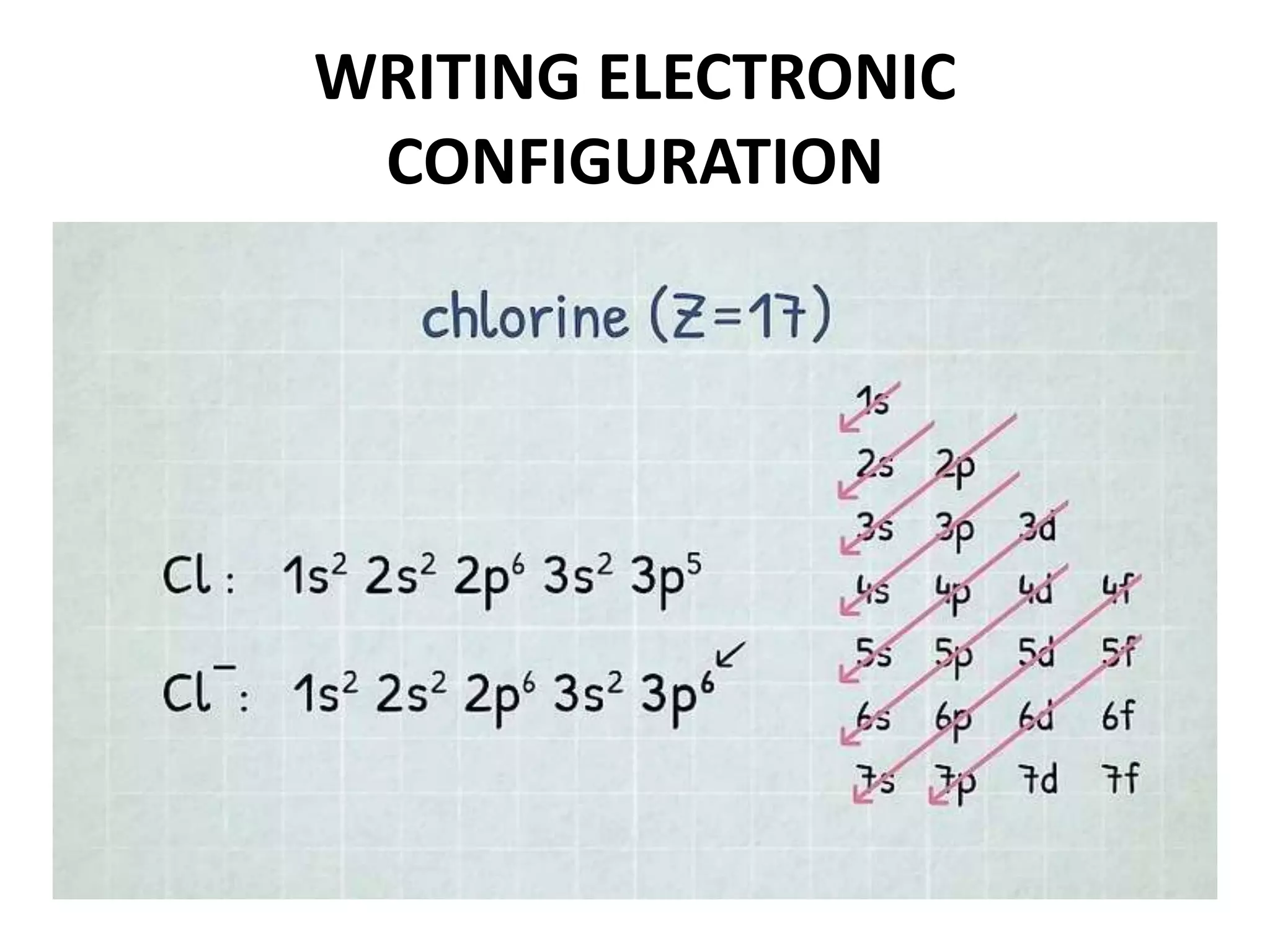
WRITING ELECTRONIC
CONFIGURATION
WRITING ELECTRONIC
CONFIGURATION
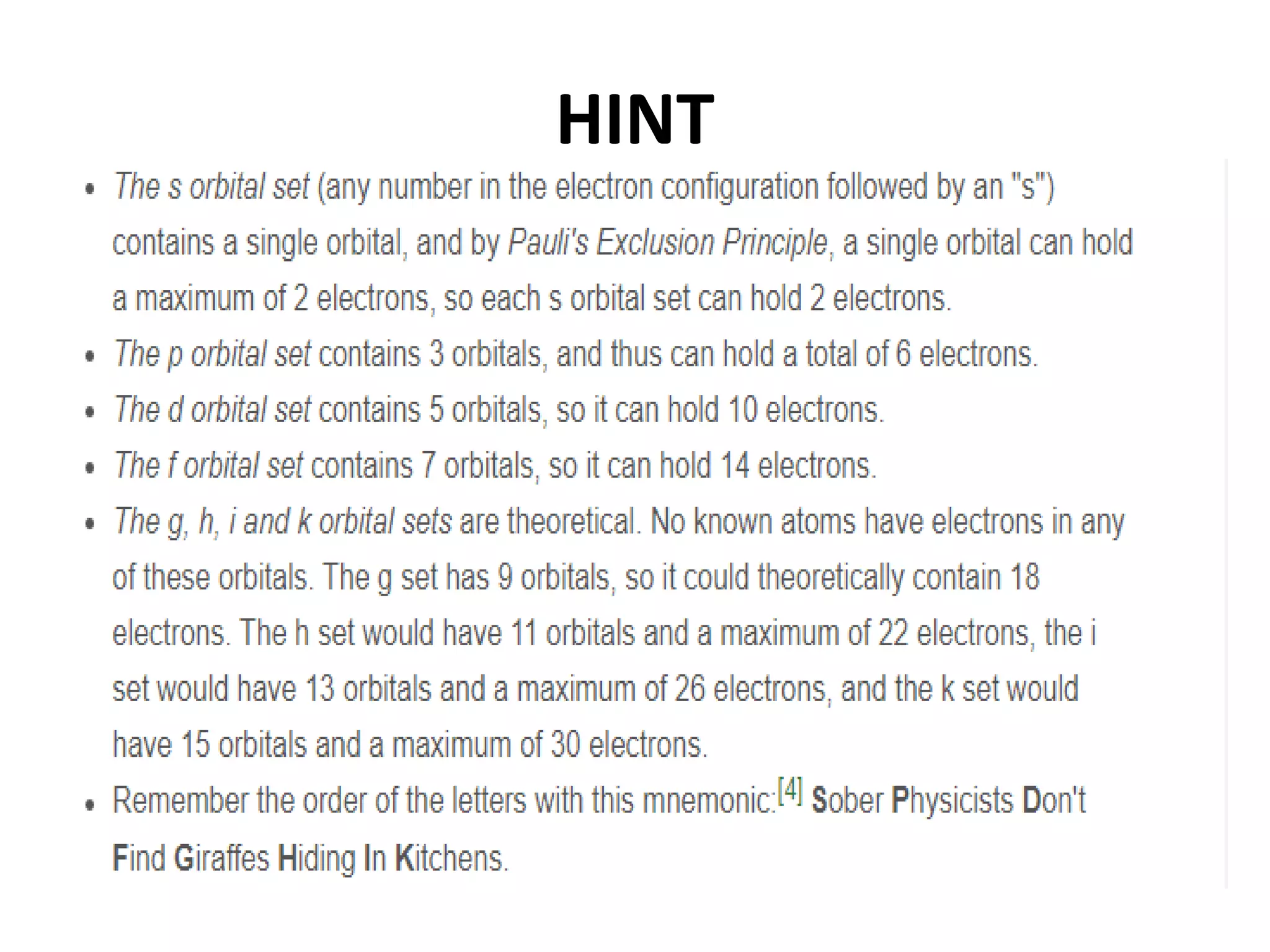
HINT
END OF SESSION
HAPPY STUDYING , BEST REGARDS

Electronic configuration

  • 1.
    PHARMACEUTICAL INORGANIC CHEMISTRY MODULE CODE: PST 04210 MODULE CREDIT : 12 PREPARED BY PHILIPO RAPHAEL
  • 2.
    ELECTRONIC CONFIGURATION OF ATOM LEARNING Define the term electronic configuration  Describe quantum numbers  Describe atomic orbitals  Explain rules used in filling electrons in orbital  Write the electronic configuration of different elements
  • 3.
    ELECTRONIC CONFIGURATION  Theelectron configuration of an element describes how electrons are distributed in its atomic orbitals.  An orbital is a region whereby the electrons are likely to be found in an atom  The standard notation for the indication of the electronic configuration of atoms is written in a sequence of the label names of each atomic subshell with the number of electrons assigned to that specific subshell written in superscript.
  • 4.
  • 5.
    ELECTRONIC CONFIGURATION  Thesesubshells are made up of atomic orbitals. The four subshell labels that are used are s, p, d, and f. The maximum number of electrons allowed in each of these subshells are 2, 6, 10, and 14 respectively  The electronic configuration of elements can also be written with the help of noble gases. These noble gases have completely filled outermost shells can be prefixed to the outermost shell of the element whose electronic configuration must be noted.
  • 6.
    ELECTRONIC CONFIGURATION NOTATION  However,the standard notation often yields lengthy electron configurations (especially for elements having a relatively large atomic number).  In such cases, an abbreviated or condensed notation may be used instead of the standard notation. In the abbreviated notation, the sequence of completely filled subshells that correspond to the electronic configuration of a noble gas is replaced with the symbol of that noble gas in square brackets
  • 7.
  • 8.
    ELECTRONIC CONFIGURATION  Themaximum number of electrons that can be accommodated in a shell is based on the principal quantum number (n). It is represented by the formula 2n2, where ‘n’ is the shell number  The subshells into which electrons are distributed are based on the azimuthal quantum number (denoted by ‘l’).
  • 9.
    ELECTRONIC CONFIGURATION  Thisquantum number is dependent on the value of the principal quantum number, n. Therefore, when n has a value of 4, four different subshells are possible.  When n=4. The subshells correspond to l=0, l=1, l=2, and l=3 and are named the s, p, d, and f subshells, respectively.  The maximum number of electrons that can be accommodated by a subshell is given by the formula 2*(2l + 1).
  • 10.
    QUANTUM NUMBER Quantum numbersare numbers used to describe atomic orbitals and to label electrons that reside in them  These numbers are derived from the mathematical solution of the Schrödinger equation for the hydrogen atom
  • 11.
    4 QUANTUM NUMBERS Principle quantum number (n)  Angular momentun quantum number (l)  Magnetic quantum number (ml)  Spin quantum number (ms)
  • 12.
    PRINCIPAL QUANTUM NUMBER The first quantum number describes the electron shell, or energy level, of an atom. The value of n ranges from 1 to the shell containing the outermost electron of that atom
  • 13.
    AZIMUTHAL QUANTUM NUMBER The second quantum number, known as the angular or orbital quantum number, describes the subshell and gives the magnitude of the orbital angular momentum through the relation. In chemistry and spectroscopy, ℓ = 0 is called an s orbital, ℓ = 1 a p orbital, ℓ = 2 a d orbital, and ℓ = 3 an f orbital. The value of ℓ ranges from 0 to n − 1 because the first p orbital (ℓ = 1) appears in the second electron shell (n = 2), the first d orbital (ℓ = 2) appears in the third shell (n = 3), and so on
  • 14.
    MAGNETIC QUANTUM NUMBER The magnetic quantum number describes the energy levels available within a subshell and yields the projection of the orbital angular momentum along a specified axis. The values of mℓ range from − l to ℓ, with integer steps between them. The s subshell (ℓ = 0) contains one orbital, and therefore the mℓ of an electron in an S subshell will always be 0. The p subshell (ℓ = 1) contains three orbitals (in some systems depicted as three “dumbbell-shaped” clouds), so the mℓ of an electron in a p subshell will be −1, 0, or 1. The d subshell (ℓ = 2) contains five orbitals, with mℓ values of −2, −1, 0, 1, and 2. The value of the mℓ quantum number is associated with the orbital orientation.
  • 15.
    SPIN QUANTUM NUMBER Thefourth quantum number describes the spin (intrinsic angular momentum) of the electron within that orbital and gives the projection of the spin angular momentum (s) along the specified axis. Analogously, the values of ms range from −s to s, where s is the spin quantum number, an intrinsic property of particles. An electron has spin s = ½, consequently ms will be ±, corresponding with spin and opposite spin. Each electron in any individual orbital must have different spins because of the Pauli exclusion principle, therefore an orbital never contains more than two electrons.
  • 16.
  • 17.
    RULES GOVERNING FILLINGOF ELECTRONS IN THE ORBITAL
  • 18.
    RULES GOVERNING FILLINGOF ELECTRONIC CONFIGURATION WRITING Aufbau Principle • This principle is named after the German word ‘Aufbeen’ which means ‘build up’. • The Aufbau principle dictates that electrons will occupy the orbitals having lower energies before occupying higher energy orbitals. • The energy of an orbital is calculated by the sum of the principal and the azimuthal quantum numbers. • According to this principle, electrons are filled in the following order: 1s, 2s, 2p, 3s, 3p, 4s, 3d, 4p, 5s, 4d, 5p, 6s, 4f, 5d, 6p, 7s, 5f, 6d, 7p
  • 19.
  • 20.
    SEQUENCE OF FILLINGATOMIC ORBITAL
  • 21.
    RULES GOVERNING OFELECTRONIC CONFIGURATION WRITING  It is important to note that there exist many exceptions to the Aufbau principle such as chromium and copper. These exceptions can sometimes be explained by the stability provided by half-filled or completely filled subshells.
  • 22.
    RULES GOVERNING ELECTRONIC CONFIGURATIONWRITING Pauli exclusion principle  states that a maximum of two electrons, each having opposite spins, can fit in an orbital.  This principle can also be stated as “no two electrons in the same atom have the same values for all four quantum numbers”.  Therefore, if the principal, azimuthal, and magnetic numbers are the same for two electrons, they must have opposite spins.
  • 23.
    RULES GOVERNING ELECTRONIC CONFIGURATIONWRITING Hund’s Rule  This rule describes the order in which electrons are filled in all the orbitals belonging to a subshell.  It states that every orbital in a given subshell is singly occupied by electrons before a second electron is filled in an orbital.  In order to maximize the total spin, the electrons in the orbitals that only contain one electron all have the same spin (or the same values of the spin quantum number)
  • 24.
  • 25.
  • 26.
  • 27.
  • 28.
    END OF SESSION HAPPYSTUDYING , BEST REGARDS