CHEMISTRY
UNIT # 2
ATOMIC STRUCTURE
(REVIEW LECTURE)
• Discovery and Properties of Positive rays
• Planck’s Quantum Theory
• Quantum Numbers
• Shapes of s, p and d- Orbitals
• Rule for Electronic Distribution
• Electronic Configuration
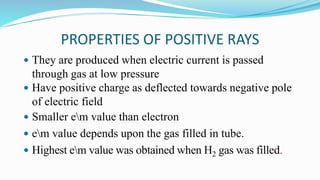
PROPERTIES OF POSITIVE RAYS
 They are produced when electric current is passed
through gas at low pressure
 Have positive charge as deflected towards negative pole
of electric field
 Smaller em value than electron
 em value depends upon the gas filled in tube.
 Highest em value was obtained when H2 gas was filled.
Planck’s Quantum Theory
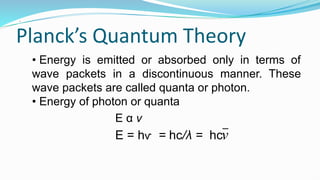
• Energy is emitted or absorbed only in terms of
wave packets in a discontinuous manner. These
wave packets are called quanta or photon.
• Energy of photon or quanta
E α v
E = h = hc/λ = hc
.
ѵ v
Quantum numbers: The Set of numbers that describe the complete
behavior of an electron in an atom [2,1,–1, +1/2]
Principle Quantum number: A non-zero, positive integer that describe the
number of shell size of atom and energy of electron in an atom. It is
denoted by ‘n’, n = 1, 2,3 …… also called as K, L, M and N shell
Azimuthal quantum number: it describe the number of sub shell in a shell
also describe the shapes of sub shell represented by ‘l’, l = n – 1
 n = 1  l = 0  s-subshell  sharp (spherical shape)
 n = 2  l = 1  p-subshell  principle (dumbbell shape)
 n = 3  l = 2  d-subshell  diffused (sausage shape)
 n = 4  l = 3  f-subshell  fundamental (complicated shape)
NOTE: Finely divided spectral lines seen by spectrometer in Bohr’s spectrum
give him about an other energy level that is explained by this quantum number
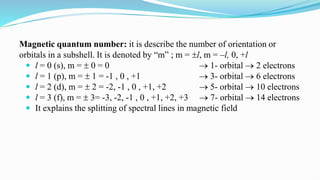
Magnetic quantum number: it is describe the number of orientation or
orbitals in a subshell. It is denoted by “m” ; m = l, m = –l, 0, +l
 l = 0 (s), m =  0 = 0  1- orbital  2 electrons
 l = 1 (p), m =  1 = -1 , 0 , +1  3- orbital  6 electrons
 l = 2 (d), m =  2 = -2, -1 , 0 , +1, +2  5- orbital  10 electrons
 l = 3 (f), m =  3= -3, -2, -1 , 0 , +1, +2, +3  7- orbital  14 electrons
 It explains the splitting of spectral lines in magnetic field
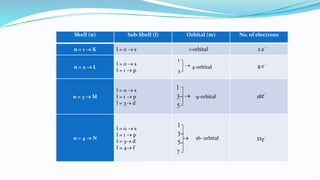
Shell (n) Sub-Shell (l) Orbital (m) No. of electrons
n = 1  K l = 0  s 1-orbital 2
n = 2  L
l = 0  s
l = 1  p
4-orbital 8
n = 3  M
l = 0  s
l = 1  p
l = 3 d
9-orbital 18
n = 4  N
l = 0  s
l = 1  p
l = 3 d
l = 4 f
16- orbital 32e
1
3




e
1
3
5





e
1
3
5
7







e
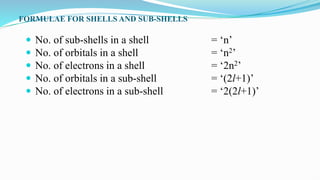
FORMULAE FOR SHELLS AND SUB-SHELLS
 No. of sub-shells in a shell = ‘n’
 No. of orbitals in a shell = ‘n2’
 No. of electrons in a shell = ‘2n2’
 No. of orbitals in a sub-shell = ‘(2l+1)’
 No. of electrons in a sub-shell = ‘2(2l+1)’
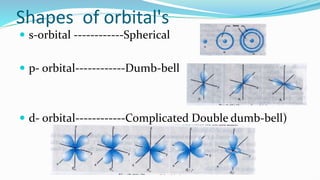
Shapes of orbital's
 s-orbital ------------Spherical
 p- orbital------------Dumb-bell
 d- orbital------------Complicated Double dumb-bell)
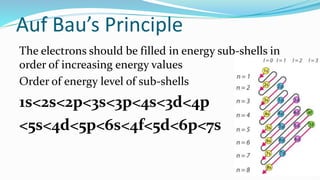
Auf Bau’s Principle
The electrons should be filled in energy sub-shells in
order of increasing energy values
Order of energy level of sub-shells
1s<2s<2p<3s<3p<4s<3d<4p
<5s<4d<5p<6s<4f<5d<6p<7s
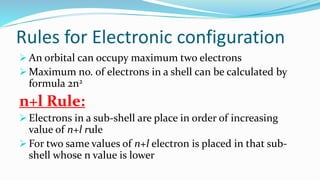
Rules for Electronic configuration
 An orbital can occupy maximum two electrons
 Maximum no. of electrons in a shell can be calculated by
formula 2n2
n+l Rule:
 Electrons in a sub-shell are place in order of increasing
value of n+l rule
 For two same values of n+l electron is placed in that sub-
shell whose n value is lower
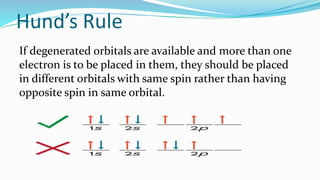
Hund’s Rule
If degenerated orbitals are available and more than one
electron is to be placed in them, they should be placed
in different orbitals with same spin rather than having
opposite spin in same orbital.
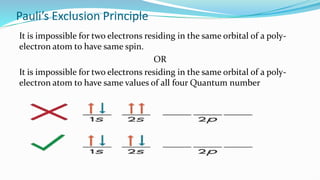
Pauli’s Exclusion Principle
It is impossible for two electrons residing in the same orbital of a poly-
electron atom to have same spin.
OR
It is impossible for two electrons residing in the same orbital of a poly-
electron atom to have same values of all four Quantum number
MCQ # 1
The lightest fundamental particle is
a. Electron
b. Proton
c. Neutron
d. All are equal
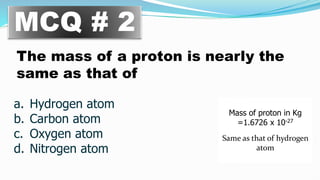
MCQ # 2
The mass of a proton is nearly the
same as that of
a. Hydrogen atom
b. Carbon atom
c. Oxygen atom
d. Nitrogen atom
Mass of proton in Kg
=1.6726 x 10⁻²⁷
Same as that of hydrogen
atom
MCQ # 3
Electronic configuration of unknown
element M+2 = 2,8,18 the element is
a. Al
b. P
c. Zn
d. K
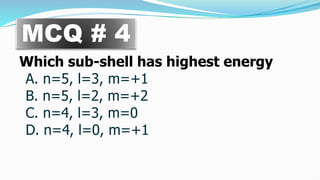
Which sub-shell has highest energy
A. n=5, l=3, m=+1
B. n=5, l=2, m=+2
C. n=4, l=3, m=0
D. n=4, l=0, m=+1
MCQ # 4
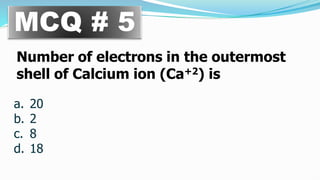
MCQ # 5
Number of electrons in the outermost
shell of Calcium ion (Ca+2) is
a. 20
b. 2
c. 8
d. 18
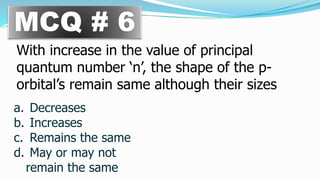
MCQ # 6
With increase in the value of principal
quantum number ‘n’, the shape of the p-
orbital’s remain same although their sizes
a. Decreases
b. Increases
c. Remains the same
d. May or may not
remain the same
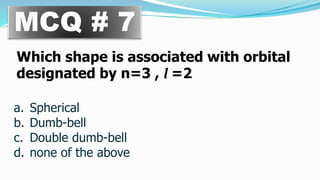
MCQ # 7
Which shape is associated with orbital
designated by n=3 , l =2
a. Spherical
b. Dumb-bell
c. Double dumb-bell
d. none of the above
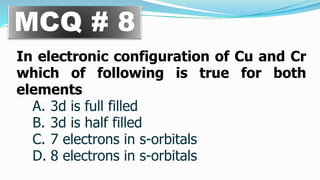
MCQ # 8
In electronic configuration of Cu and Cr
which of following is true for both
elements
A. 3d is full filled
B. 3d is half filled
C. 7 electrons in s-orbitals
D. 8 electrons in s-orbitals
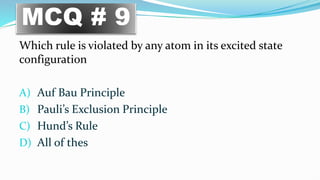
Which rule is violated by any atom in its excited state
configuration
A) Auf Bau Principle
B) Pauli’s Exclusion Principle
C) Hund’s Rule
D) All of thes
MCQ # 9
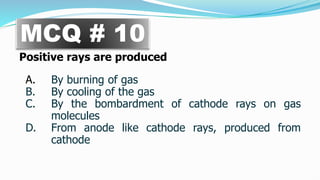
Positive rays are produced
A. By burning of gas
B. By cooling of the gas
C. By the bombardment of cathode rays on gas
molecules
D. From anode like cathode rays, produced from
cathode
MCQ # 10

UNIT No-2 Atomic Structure of atoms.pptx

  • 1.
    CHEMISTRY UNIT # 2 ATOMICSTRUCTURE (REVIEW LECTURE)
  • 2.
    • Discovery andProperties of Positive rays • Planck’s Quantum Theory • Quantum Numbers • Shapes of s, p and d- Orbitals • Rule for Electronic Distribution • Electronic Configuration
  • 3.
    PROPERTIES OF POSITIVERAYS  They are produced when electric current is passed through gas at low pressure  Have positive charge as deflected towards negative pole of electric field  Smaller em value than electron  em value depends upon the gas filled in tube.  Highest em value was obtained when H2 gas was filled.
  • 4.
    Planck’s Quantum Theory •Energy is emitted or absorbed only in terms of wave packets in a discontinuous manner. These wave packets are called quanta or photon. • Energy of photon or quanta E α v E = h = hc/λ = hc . ѵ v
  • 5.
    Quantum numbers: TheSet of numbers that describe the complete behavior of an electron in an atom [2,1,–1, +1/2] Principle Quantum number: A non-zero, positive integer that describe the number of shell size of atom and energy of electron in an atom. It is denoted by ‘n’, n = 1, 2,3 …… also called as K, L, M and N shell Azimuthal quantum number: it describe the number of sub shell in a shell also describe the shapes of sub shell represented by ‘l’, l = n – 1  n = 1  l = 0  s-subshell  sharp (spherical shape)  n = 2  l = 1  p-subshell  principle (dumbbell shape)  n = 3  l = 2  d-subshell  diffused (sausage shape)  n = 4  l = 3  f-subshell  fundamental (complicated shape) NOTE: Finely divided spectral lines seen by spectrometer in Bohr’s spectrum give him about an other energy level that is explained by this quantum number
  • 6.
    Magnetic quantum number:it is describe the number of orientation or orbitals in a subshell. It is denoted by “m” ; m = l, m = –l, 0, +l  l = 0 (s), m =  0 = 0  1- orbital  2 electrons  l = 1 (p), m =  1 = -1 , 0 , +1  3- orbital  6 electrons  l = 2 (d), m =  2 = -2, -1 , 0 , +1, +2  5- orbital  10 electrons  l = 3 (f), m =  3= -3, -2, -1 , 0 , +1, +2, +3  7- orbital  14 electrons  It explains the splitting of spectral lines in magnetic field
  • 7.
    Shell (n) Sub-Shell(l) Orbital (m) No. of electrons n = 1  K l = 0  s 1-orbital 2 n = 2  L l = 0  s l = 1  p 4-orbital 8 n = 3  M l = 0  s l = 1  p l = 3 d 9-orbital 18 n = 4  N l = 0  s l = 1  p l = 3 d l = 4 f 16- orbital 32e 1 3     e 1 3 5      e 1 3 5 7        e
  • 8.
    FORMULAE FOR SHELLSAND SUB-SHELLS  No. of sub-shells in a shell = ‘n’  No. of orbitals in a shell = ‘n2’  No. of electrons in a shell = ‘2n2’  No. of orbitals in a sub-shell = ‘(2l+1)’  No. of electrons in a sub-shell = ‘2(2l+1)’
  • 9.
    Shapes of orbital's s-orbital ------------Spherical  p- orbital------------Dumb-bell  d- orbital------------Complicated Double dumb-bell)
  • 10.
    Auf Bau’s Principle Theelectrons should be filled in energy sub-shells in order of increasing energy values Order of energy level of sub-shells 1s<2s<2p<3s<3p<4s<3d<4p <5s<4d<5p<6s<4f<5d<6p<7s
  • 11.
    Rules for Electronicconfiguration  An orbital can occupy maximum two electrons  Maximum no. of electrons in a shell can be calculated by formula 2n2 n+l Rule:  Electrons in a sub-shell are place in order of increasing value of n+l rule  For two same values of n+l electron is placed in that sub- shell whose n value is lower
  • 12.
    Hund’s Rule If degeneratedorbitals are available and more than one electron is to be placed in them, they should be placed in different orbitals with same spin rather than having opposite spin in same orbital.
  • 13.
    Pauli’s Exclusion Principle Itis impossible for two electrons residing in the same orbital of a poly- electron atom to have same spin. OR It is impossible for two electrons residing in the same orbital of a poly- electron atom to have same values of all four Quantum number
  • 14.
    MCQ # 1 Thelightest fundamental particle is a. Electron b. Proton c. Neutron d. All are equal
  • 15.
    MCQ # 2 Themass of a proton is nearly the same as that of a. Hydrogen atom b. Carbon atom c. Oxygen atom d. Nitrogen atom Mass of proton in Kg =1.6726 x 10⁻²⁷ Same as that of hydrogen atom
  • 16.
    MCQ # 3 Electronicconfiguration of unknown element M+2 = 2,8,18 the element is a. Al b. P c. Zn d. K
  • 17.
    Which sub-shell hashighest energy A. n=5, l=3, m=+1 B. n=5, l=2, m=+2 C. n=4, l=3, m=0 D. n=4, l=0, m=+1 MCQ # 4
  • 18.
    MCQ # 5 Numberof electrons in the outermost shell of Calcium ion (Ca+2) is a. 20 b. 2 c. 8 d. 18
  • 19.
    MCQ # 6 Withincrease in the value of principal quantum number ‘n’, the shape of the p- orbital’s remain same although their sizes a. Decreases b. Increases c. Remains the same d. May or may not remain the same
  • 20.
    MCQ # 7 Whichshape is associated with orbital designated by n=3 , l =2 a. Spherical b. Dumb-bell c. Double dumb-bell d. none of the above
  • 21.
    MCQ # 8 Inelectronic configuration of Cu and Cr which of following is true for both elements A. 3d is full filled B. 3d is half filled C. 7 electrons in s-orbitals D. 8 electrons in s-orbitals
  • 22.
    Which rule isviolated by any atom in its excited state configuration A) Auf Bau Principle B) Pauli’s Exclusion Principle C) Hund’s Rule D) All of thes MCQ # 9
  • 23.
    Positive rays areproduced A. By burning of gas B. By cooling of the gas C. By the bombardment of cathode rays on gas molecules D. From anode like cathode rays, produced from cathode MCQ # 10