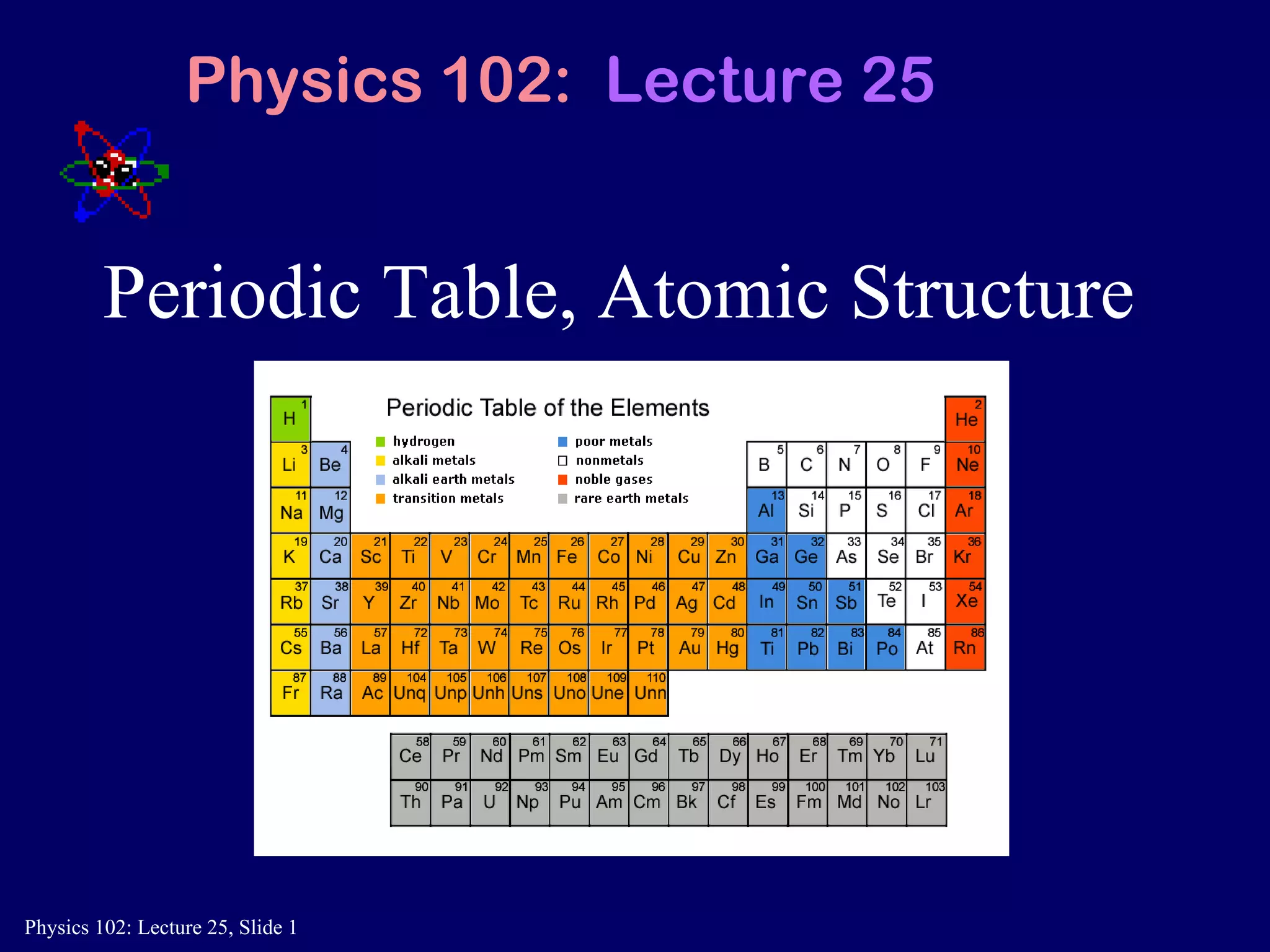
Periodic Table, Atomic Structure Physics 102:  Lecture 25
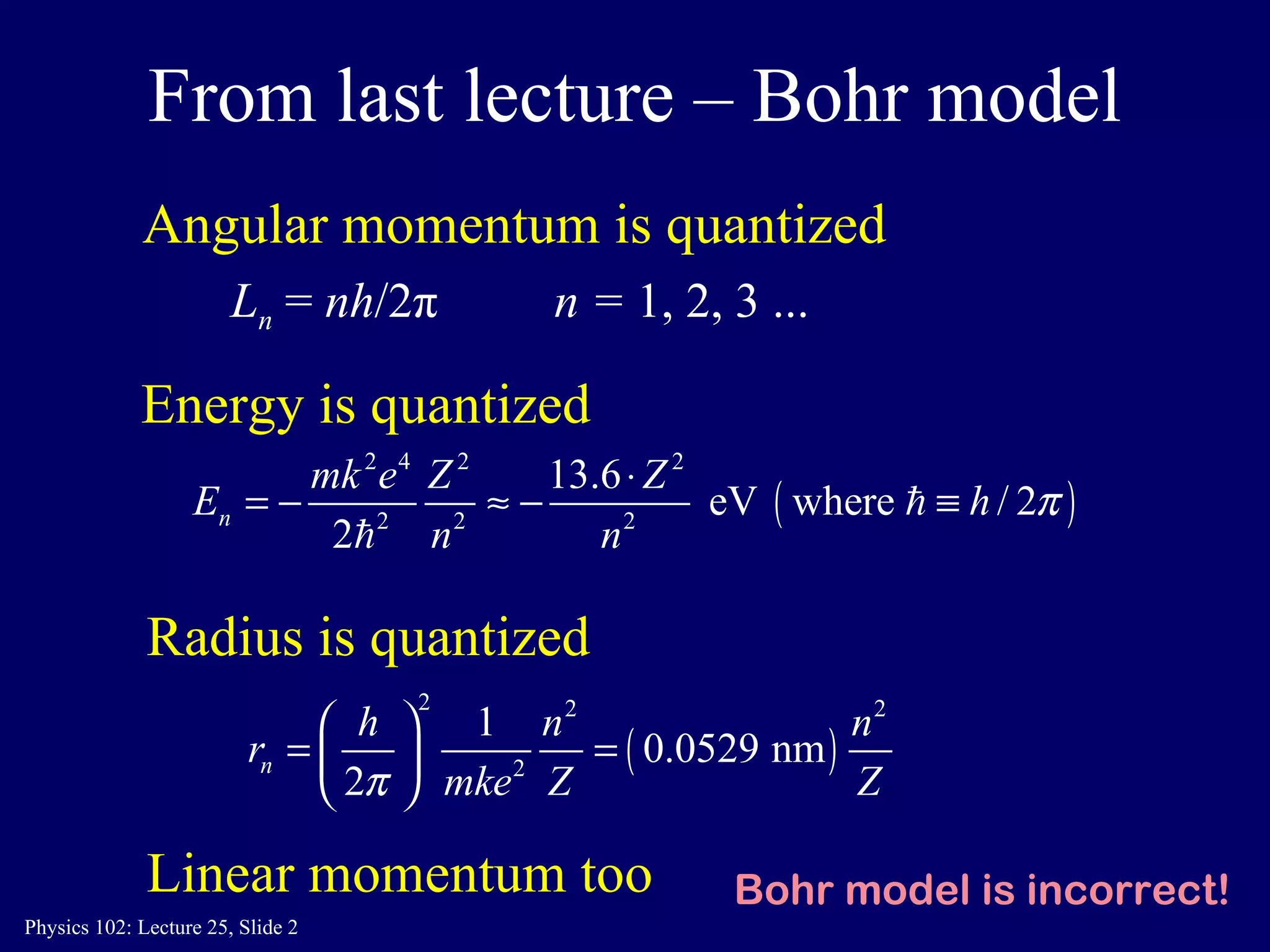
From last lecture – Bohr model L n  =  nh /2 π   Angular momentum is quantized Energy is quantized Radius is quantized n =  1, 2, 3 ...  Linear momentum too Bohr model is incorrect!
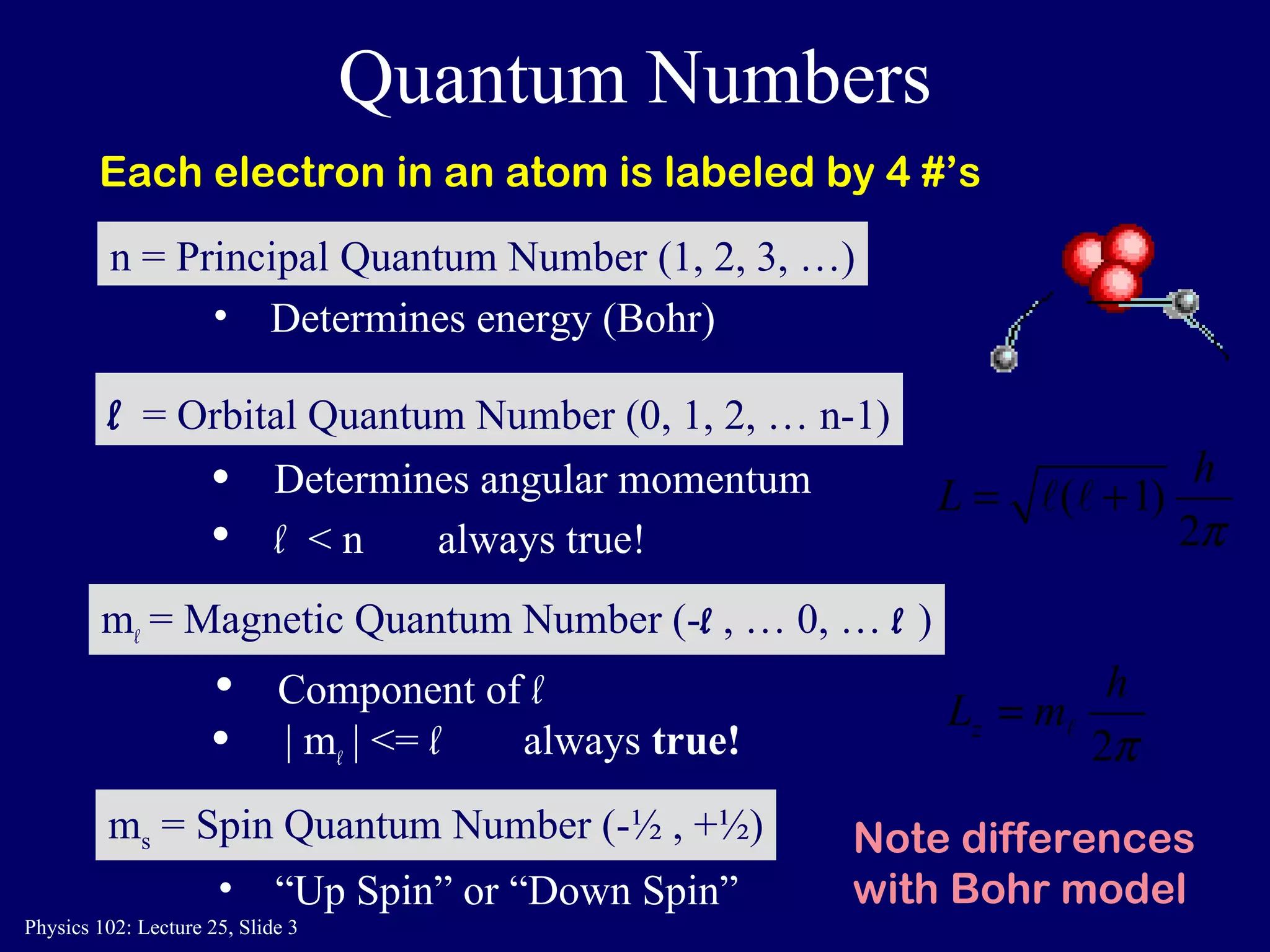
Quantum Numbers Each electron in an atom is labeled by 4 #’s Note differences with Bohr model n = Principal Quantum Number (1, 2, 3, …) Determines energy (Bohr) m s  = Spin Quantum Number (-½ , +½) “ Up Spin” or “Down Spin”  l   = Orbital Quantum Number (0, 1, 2, … n-1) Determines angular momentum l  < n  always true! m l  = Magnetic Quantum Number (- l  , … 0, …  l  ) Component of  l   | m l   | <=  l   always  true!
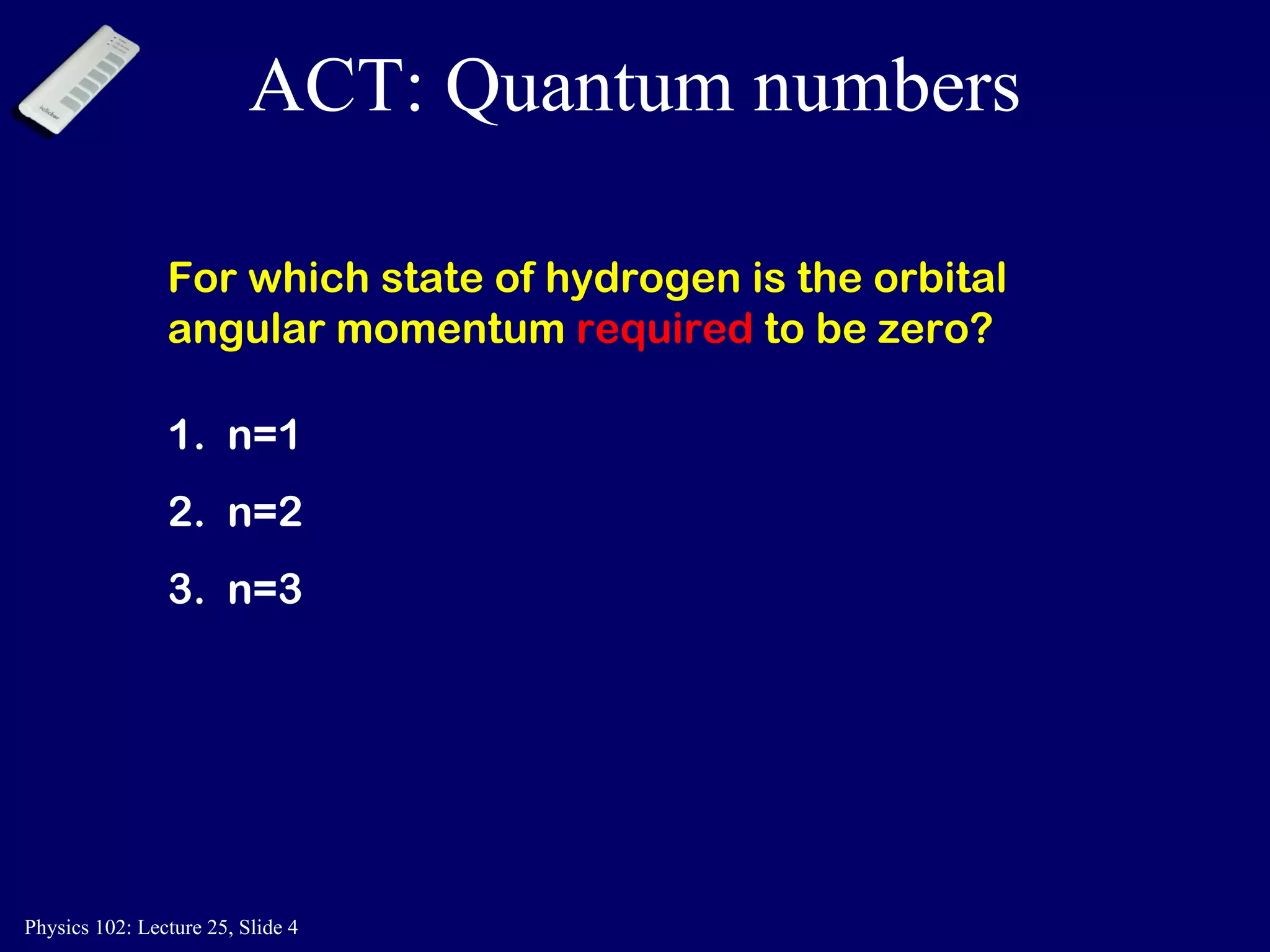
ACT: Quantum numbers For which state of hydrogen is the orbital  angular momentum  required  to be zero? 1.  n=1  2.  n=2  3.  n=3
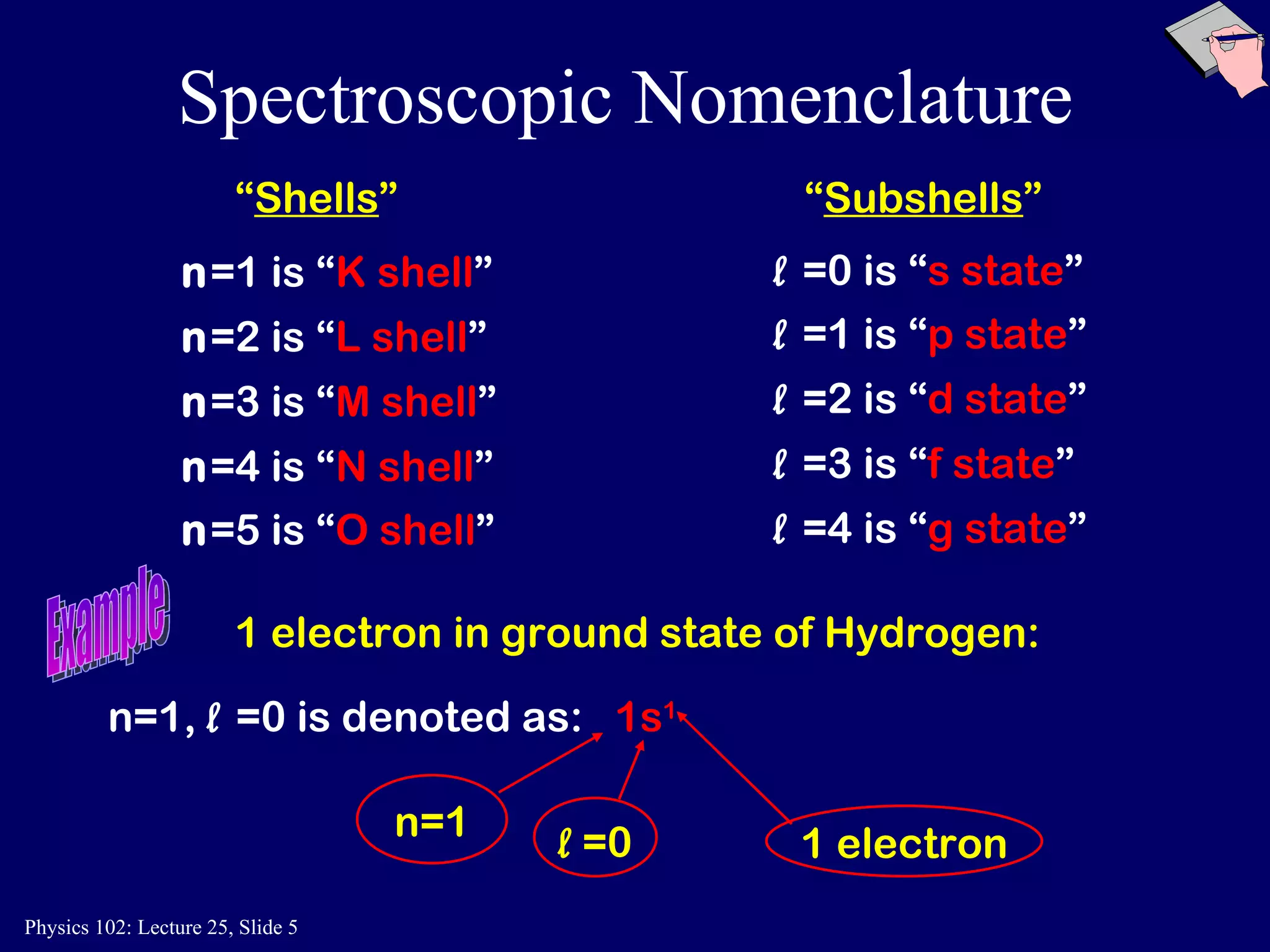
Spectroscopic Nomenclature  l   =0 is “ s state ” l   =1 is “ p state ” l   =2 is “ d state ” l   =3 is “ f state ” l   =4 is “ g state ” 1 electron in ground state of Hydrogen:   n=1,  l   =0 is denoted as:   1s 1 “ Subshells ” “ Shells ” n =1 is “ K shell ” n =2 is “ L shell ” n =3 is “ M shell ” n =4 is “ N shell ” n =5 is “ O shell ” Example n=1 l  =0 1 electron
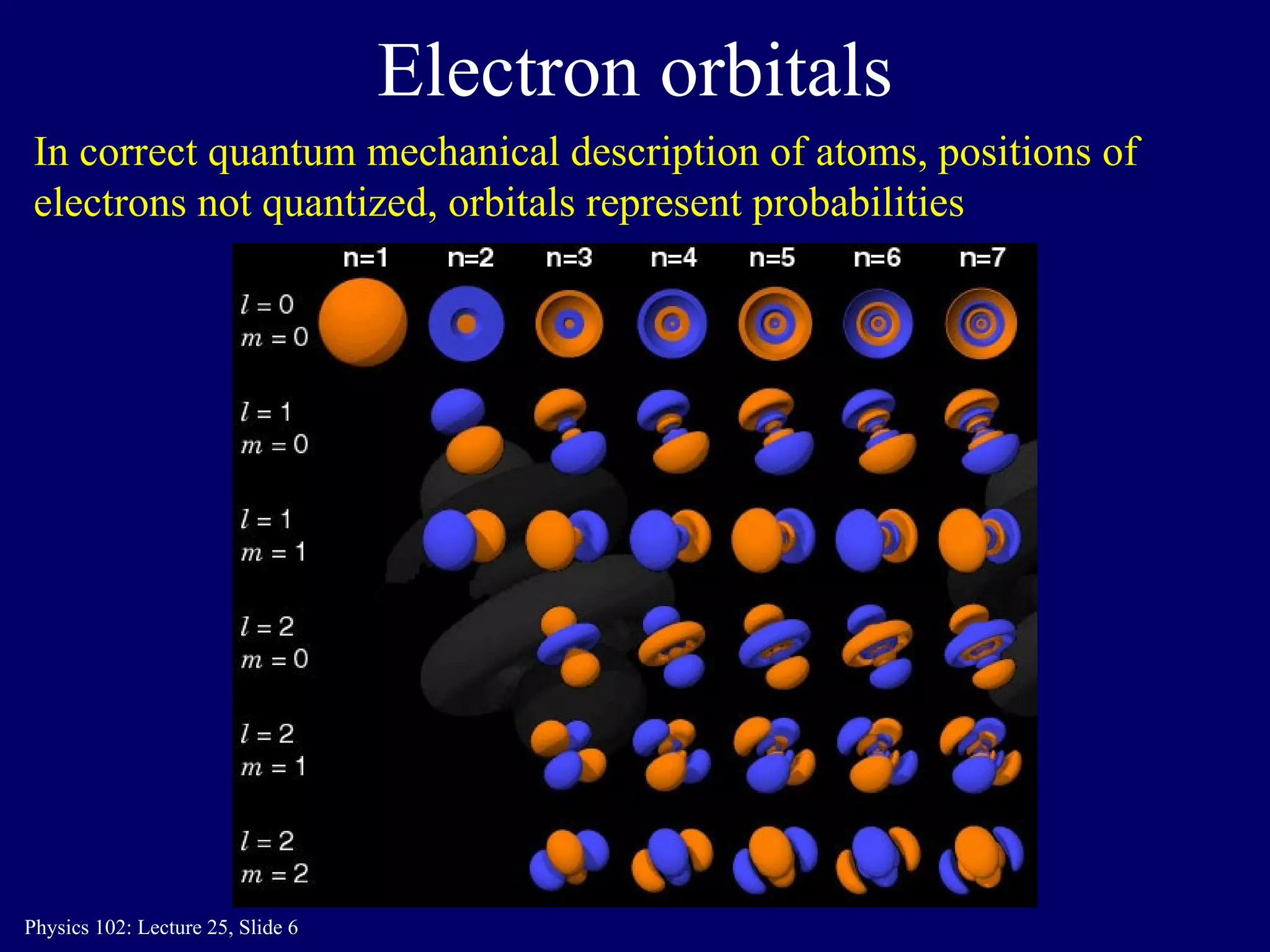
Electron orbitals In correct quantum mechanical description of atoms, positions of electrons not quantized, orbitals represent probabilities
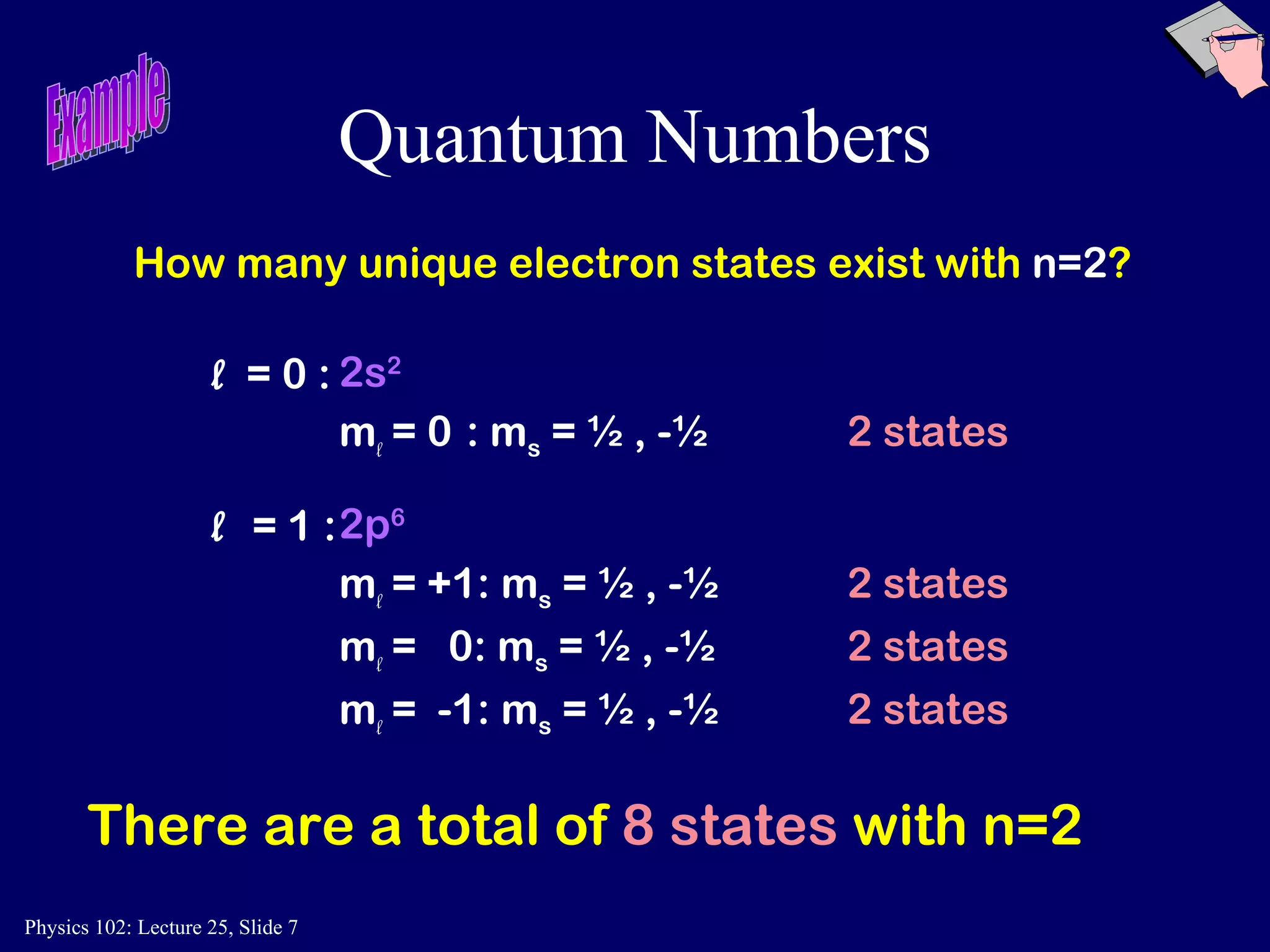
Quantum Numbers How many unique electron states exist with  n=2 ? l   = 0 : m l  = 0 : m s  = ½ , -½  2 states l  = 1 : m l  = +1: m s  = ½ , -½  2 states m l  =  0: m s  = ½ , -½  2 states m l  =  -1: m s  = ½ , -½  2 states 2s 2 2p 6 There are a total of   8 states   with n=2 Example
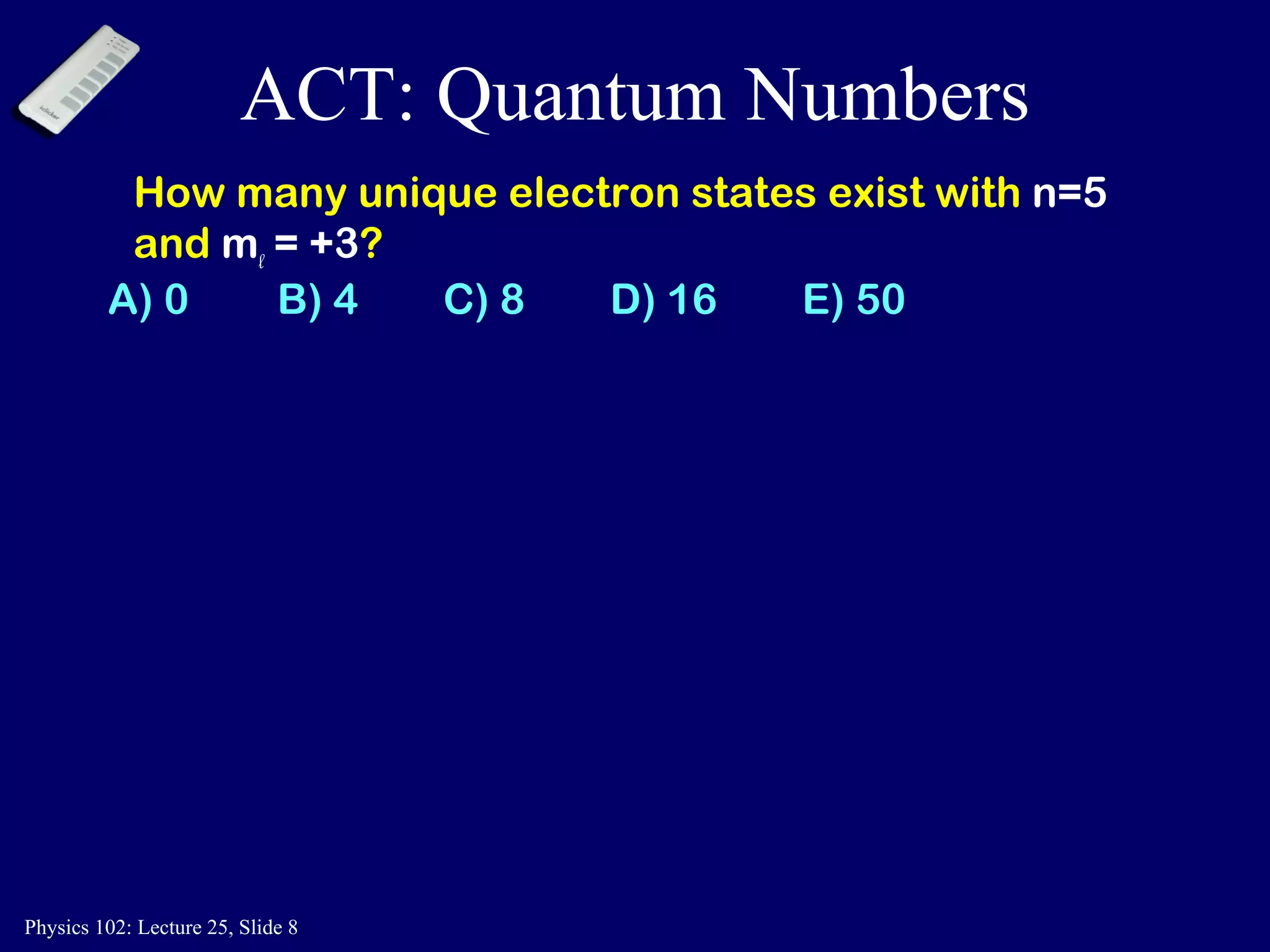
ACT: Quantum Numbers How many unique electron states exist with  n=5  and  m l  = +3 ? A) 0   B) 4  C) 8  D) 16  E) 50
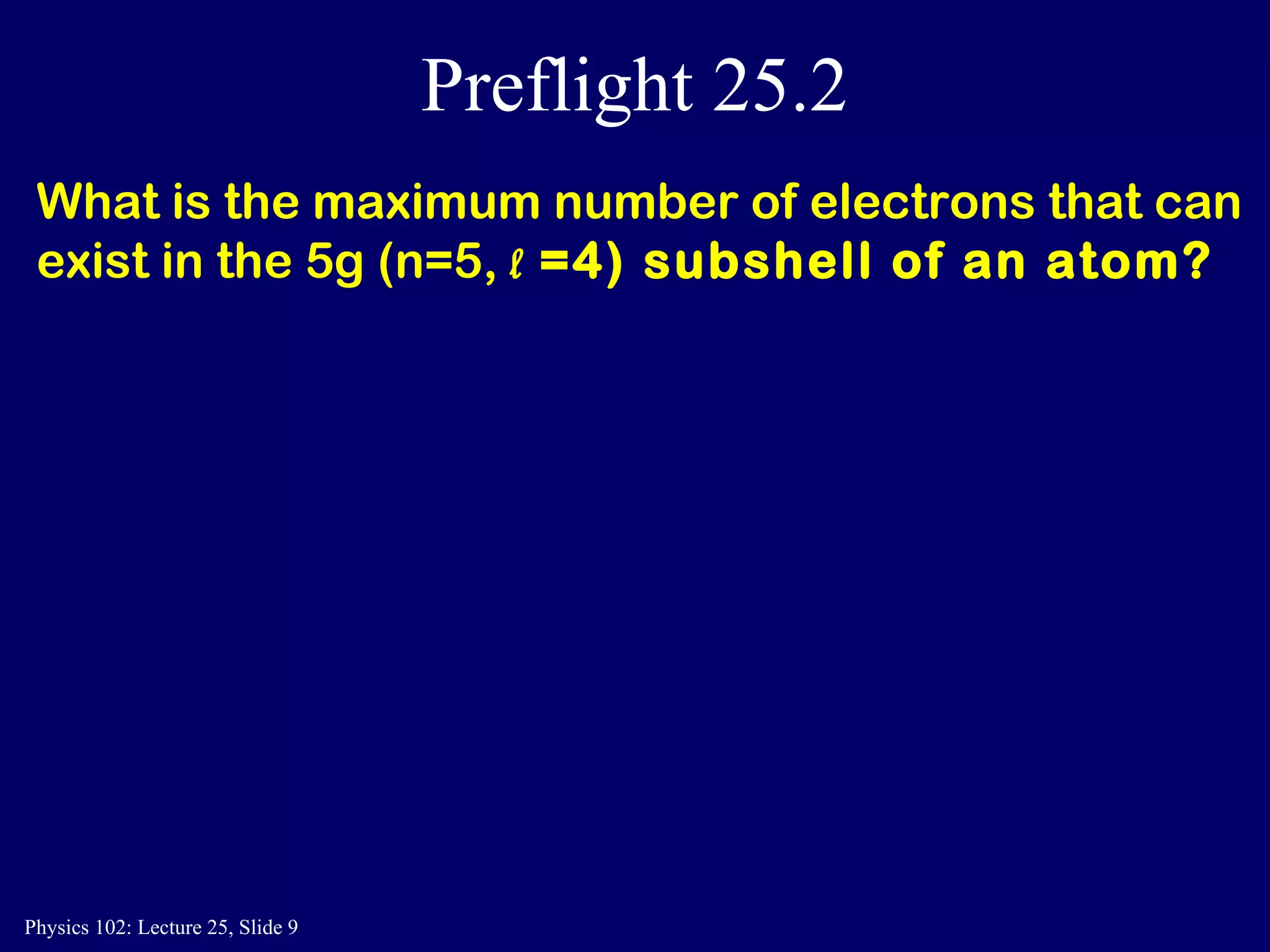
Preflight 25.2 What is the maximum number of electrons that can exist in the 5g (n=5,  l  =4) subshell of an atom?
Pauli Exclusion Principle In an atom with many electrons only one electron is allowed in each quantum state (n,  l , m l , m s ). This explains the  periodic table!
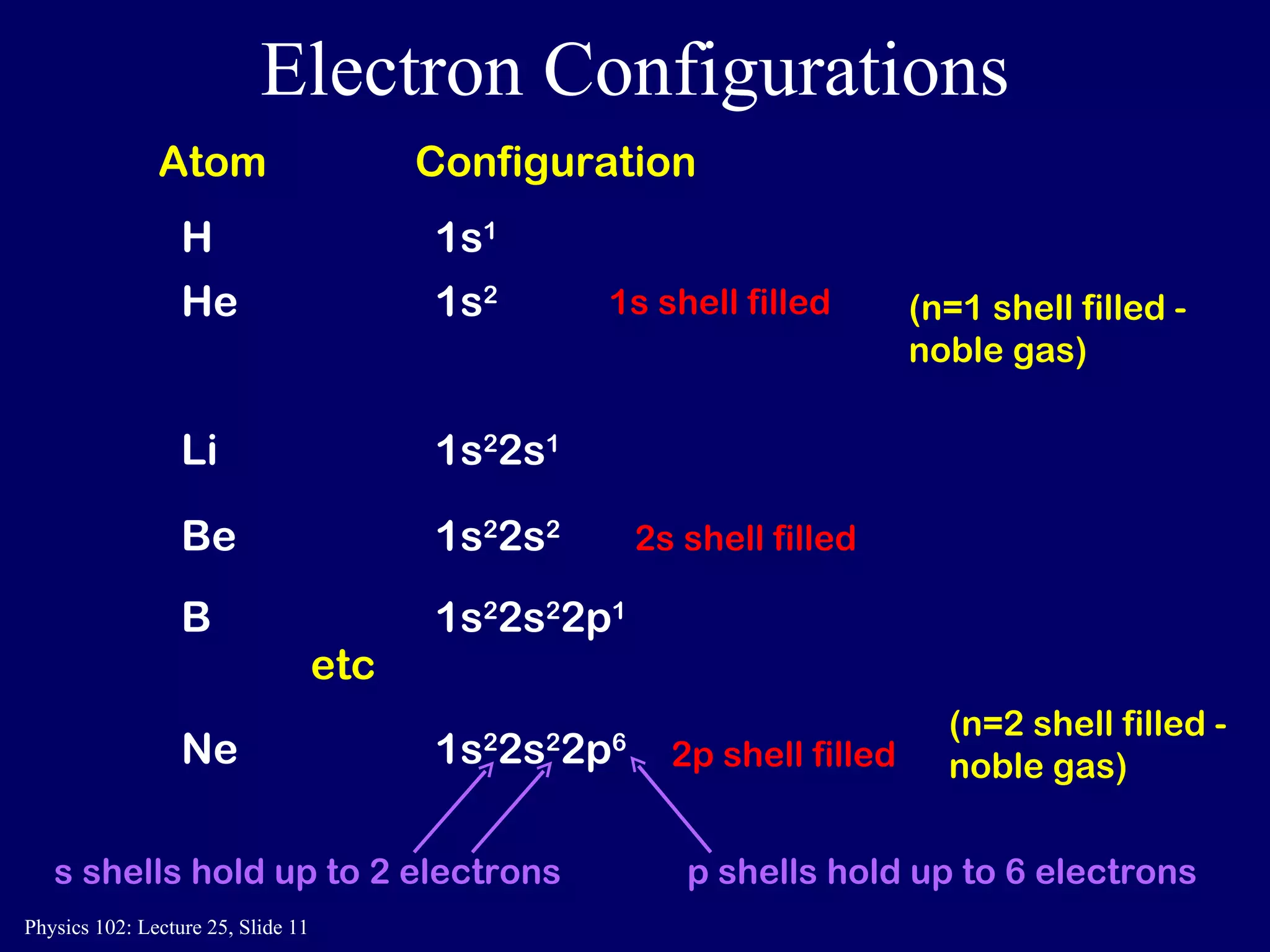
Electron Configurations Atom  Configuration  H 1s 1 He 1s 2 Li 1s 2 2s 1 Be 1s 2 2s 2 B 1s 2 2s 2 2p 1 Ne 1s 2 2s 2 2p 6 1s shell filled 2s shell filled 2p shell filled   etc (n=1 shell filled - noble gas) (n=2 shell filled - noble gas) p shells hold up to 6 electrons s shells hold up to 2 electrons
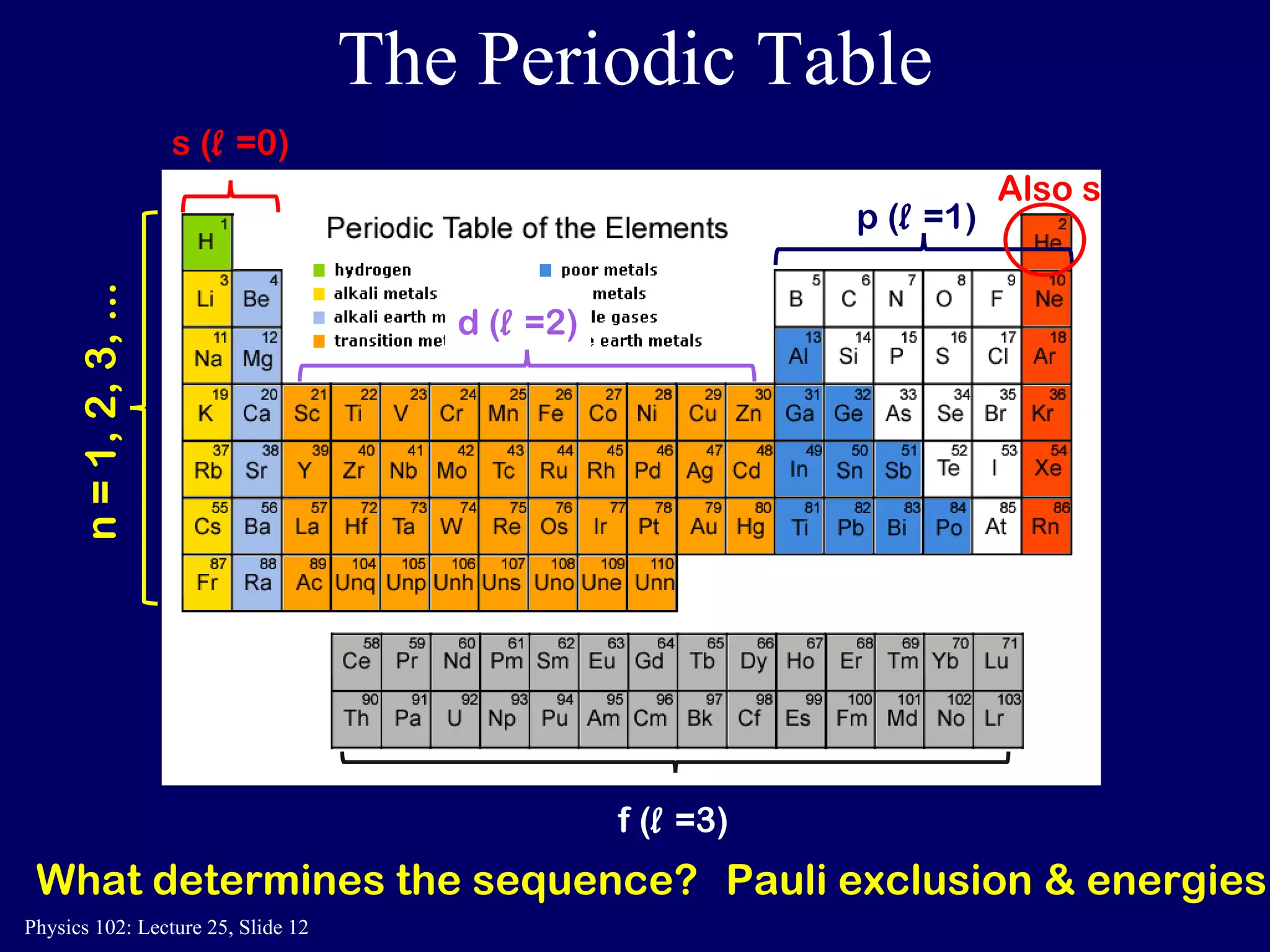
The Periodic Table What determines the sequence? Pauli exclusion & energies s ( l   =0) p ( l   =1) d ( l   =2) f ( l   =3) n = 1, 2, 3, ... Also s
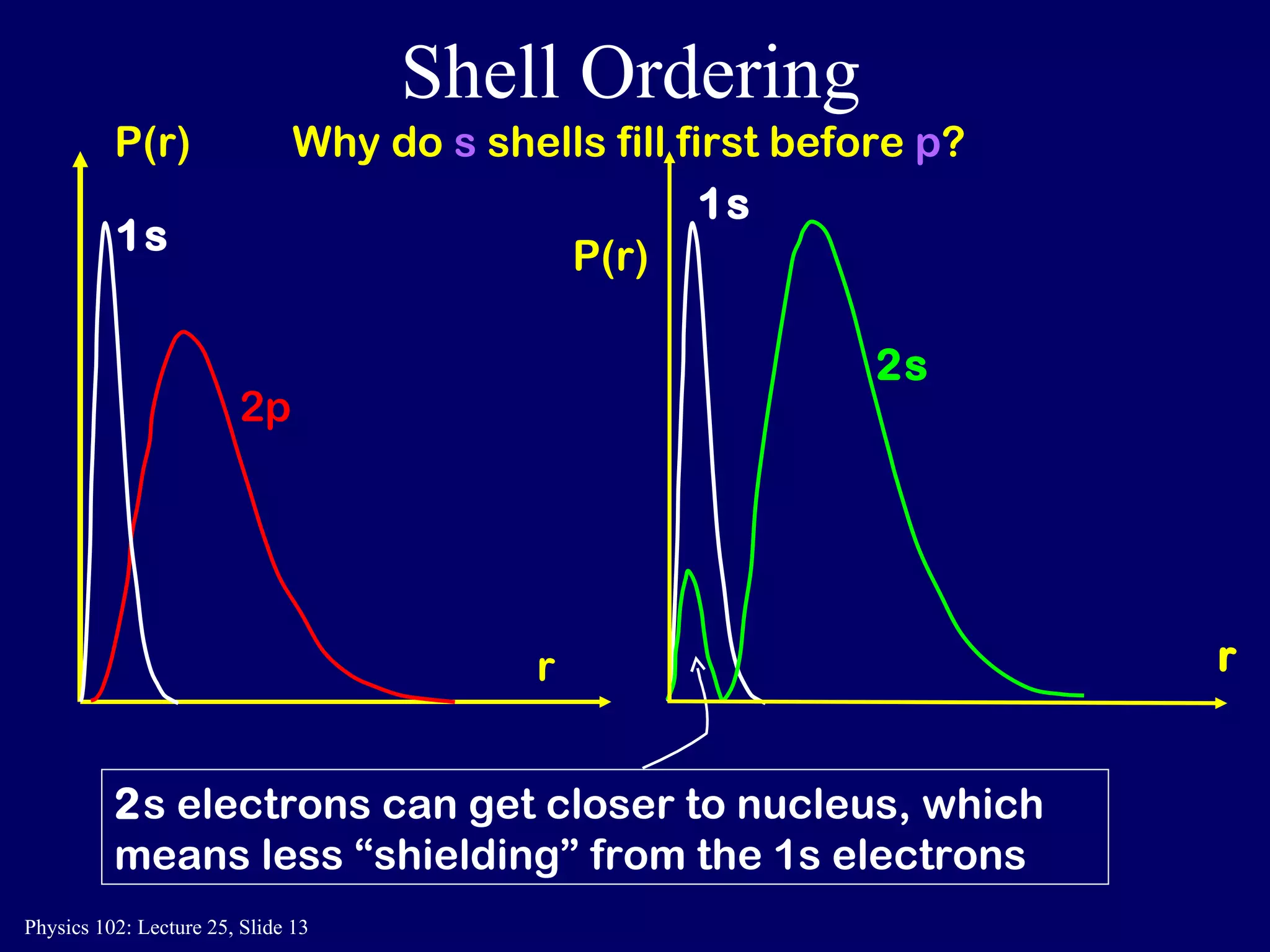
Shell Ordering Why do  s  shells fill first before  p ? r 2p P(r) 2 s electrons can get closer to nucleus, which means less “shielding” from the 1s electrons r 2s P(r) 1s 1s
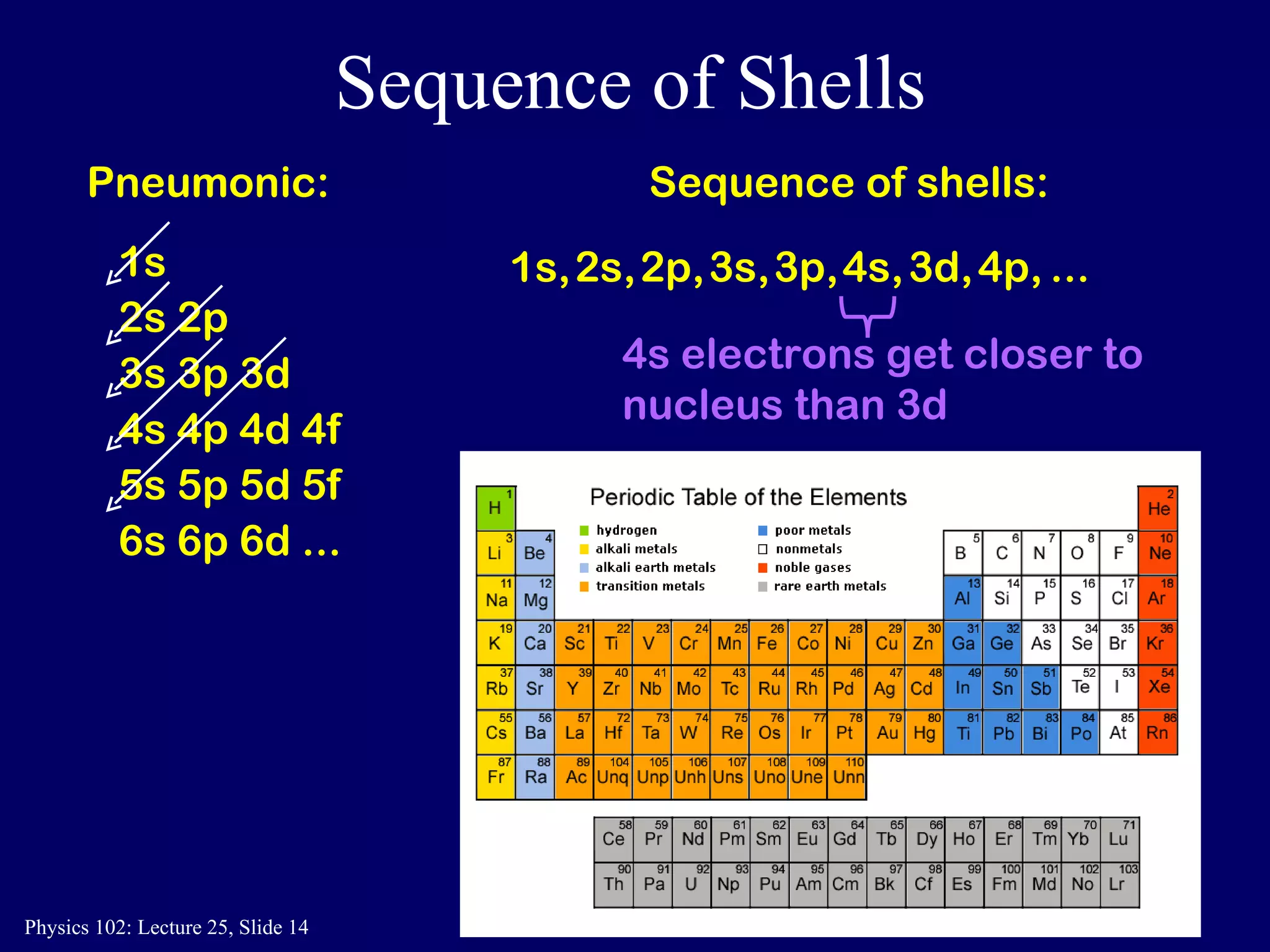
Sequence of Shells Sequence of shells: 1s 2s 2p 3s 3p 3d 4s 4p 4d 4f 5s 5p 5d 5f 6s 6p 6d ... 1s, 2s, 2p, 3s, 3p, 4s, 3d, 4p, Pneumonic: ... 4s electrons get closer to nucleus than 3d
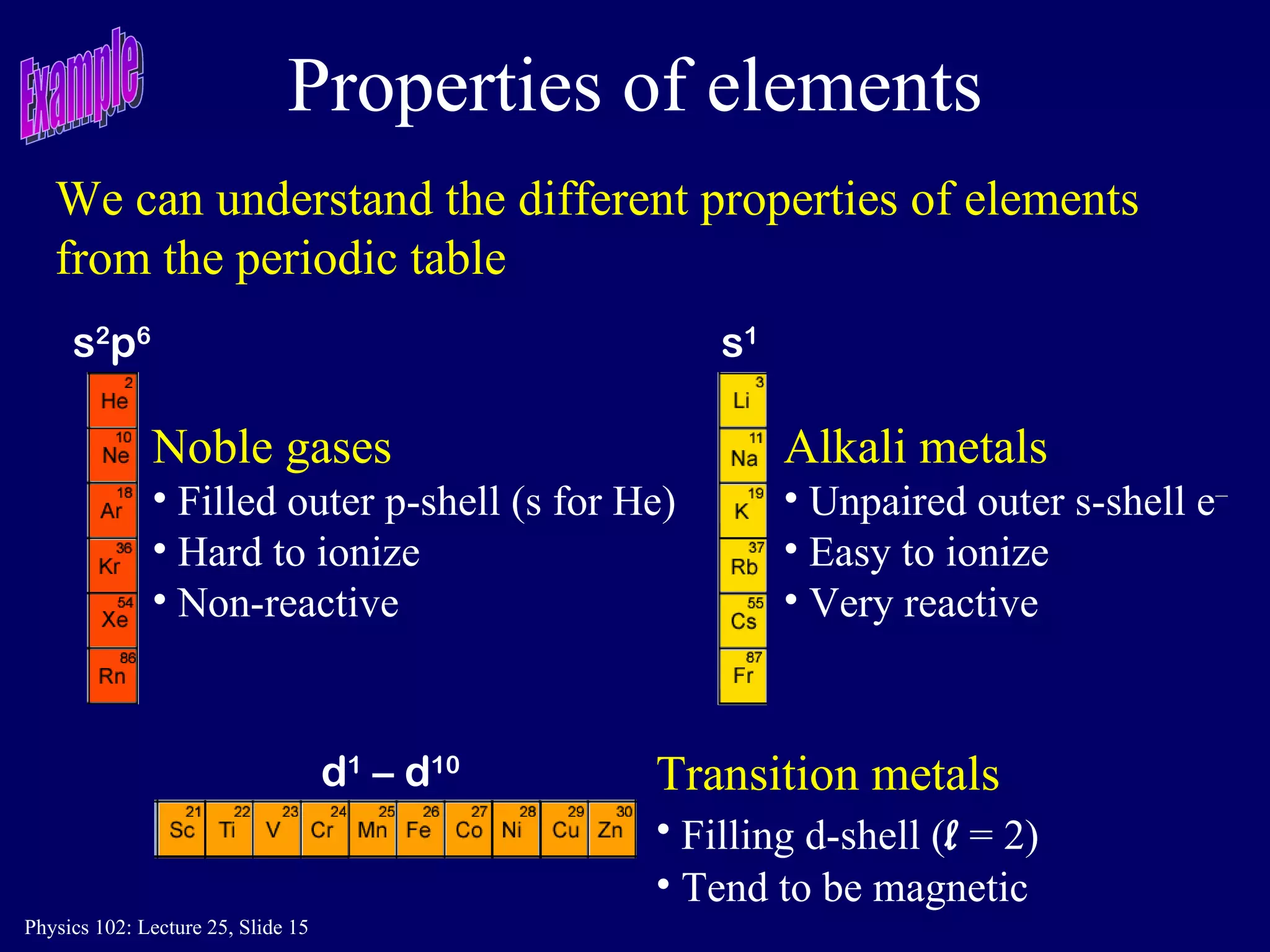
Properties of elements We can understand the different properties of elements from the periodic table Example Noble gases Filled outer p-shell (s for He) Hard to ionize Non-reactive Alkali metals Unpaired outer s-shell e – Easy to ionize Very reactive Transition metals Filling d-shell ( l  = 2) Tend to be magnetic s 2 p 6 s 1 d 1  – d 10
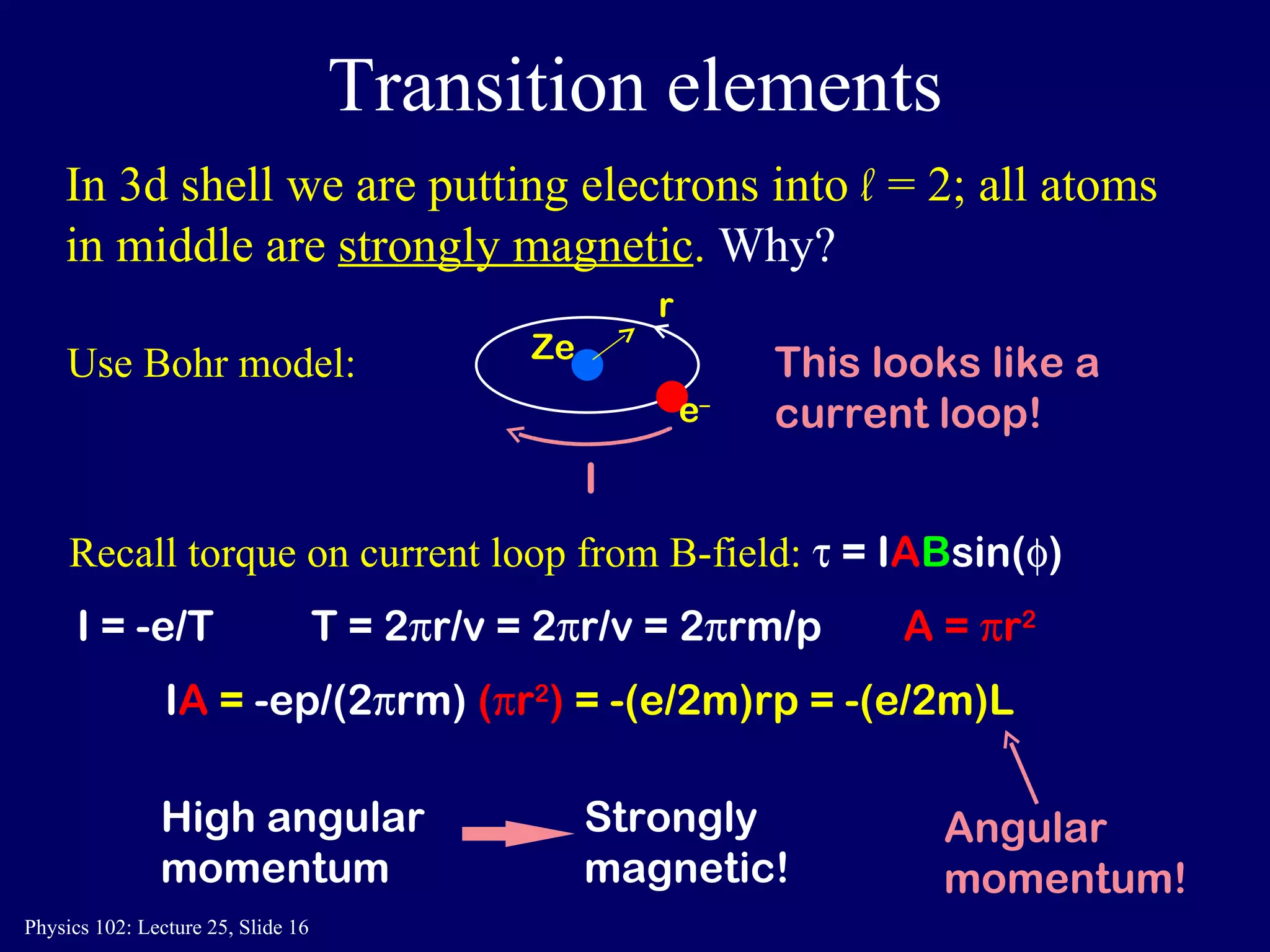
Transition elements Recall torque on current loop from B-field:    = I A B sin(  ) I A  =  -ep/(2  rm)  (  r 2 )  = -(e/2m)rp = -(e/2m)L  T = 2  r/v = 2  r/v = 2  rm/p In 3d shell we are putting electrons into  l   = 2; all atoms in middle are  strongly magnetic .  Why? High angular momentum Strongly magnetic! Use Bohr model:  Ze e – This looks like a current loop! I = -e/T A =   r 2 r I Angular momentum!
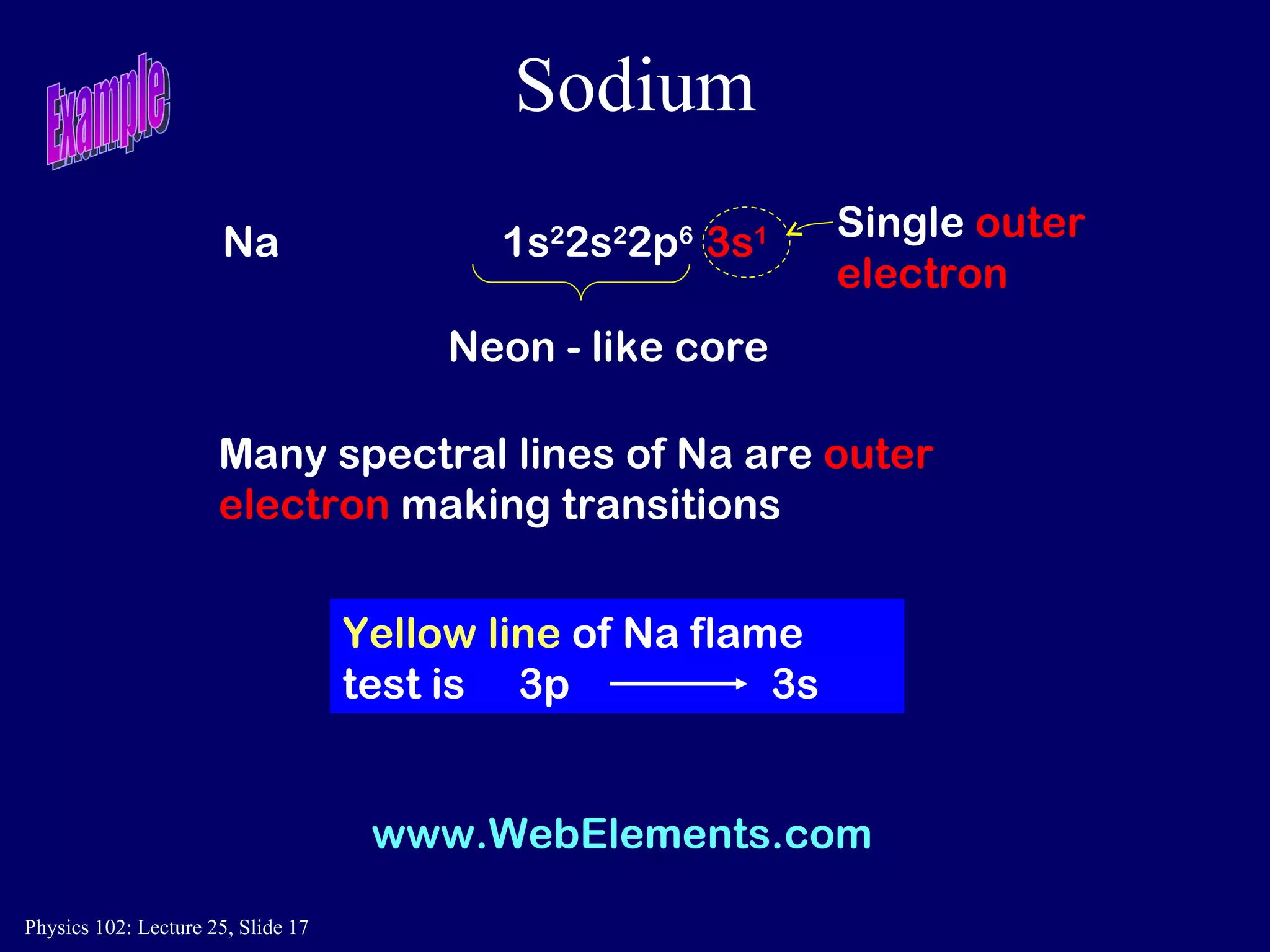
Sodium Na   1s 2 2s 2 2p 6  3s 1 Many spectral lines of Na are  outer electron  making transitions www.WebElements.com Example Yellow line   of Na flame test is  3p  3s Neon - like core Single  outer electron
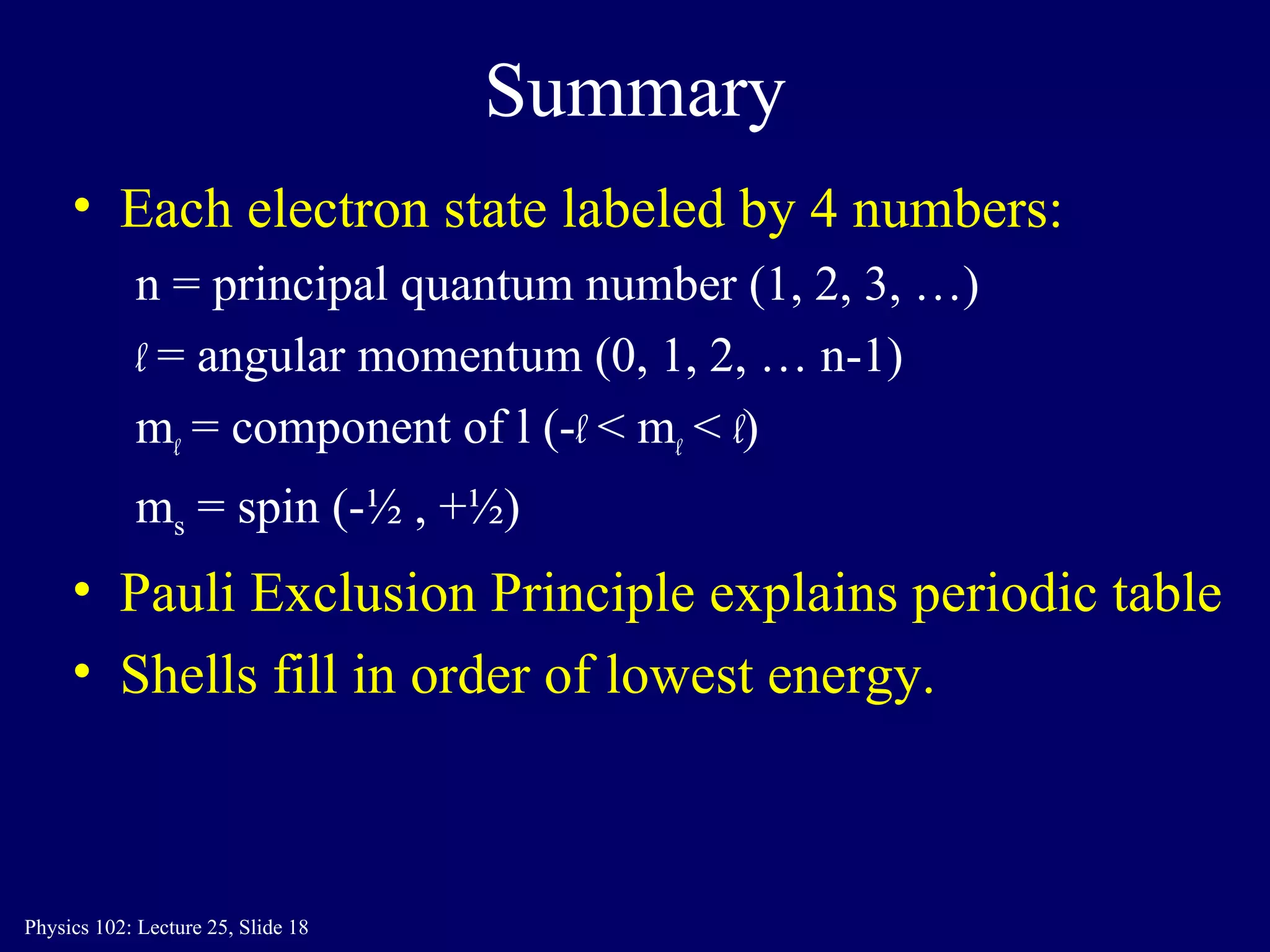
Summary Each electron state labeled by 4 numbers: n = principal quantum number (1, 2, 3, …) l  = angular momentum (0, 1, 2, … n-1) m l  = component of l (- l  < m l  <  l ) m s  = spin (-½ , +½) Pauli Exclusion Principle explains periodic table Shells fill in order of lowest energy.

Lect25 handout

  • 1.
    Periodic Table, AtomicStructure Physics 102: Lecture 25
  • 2.
    From last lecture– Bohr model L n = nh /2 π Angular momentum is quantized Energy is quantized Radius is quantized n = 1, 2, 3 ... Linear momentum too Bohr model is incorrect!
  • 3.
    Quantum Numbers Eachelectron in an atom is labeled by 4 #’s Note differences with Bohr model n = Principal Quantum Number (1, 2, 3, …) Determines energy (Bohr) m s = Spin Quantum Number (-½ , +½) “ Up Spin” or “Down Spin” l = Orbital Quantum Number (0, 1, 2, … n-1) Determines angular momentum l < n always true! m l = Magnetic Quantum Number (- l , … 0, … l ) Component of l | m l | <= l always true!
  • 4.
    ACT: Quantum numbersFor which state of hydrogen is the orbital angular momentum required to be zero? 1. n=1 2. n=2 3. n=3
  • 5.
    Spectroscopic Nomenclature l =0 is “ s state ” l =1 is “ p state ” l =2 is “ d state ” l =3 is “ f state ” l =4 is “ g state ” 1 electron in ground state of Hydrogen: n=1, l =0 is denoted as: 1s 1 “ Subshells ” “ Shells ” n =1 is “ K shell ” n =2 is “ L shell ” n =3 is “ M shell ” n =4 is “ N shell ” n =5 is “ O shell ” Example n=1 l =0 1 electron
  • 6.
    Electron orbitals Incorrect quantum mechanical description of atoms, positions of electrons not quantized, orbitals represent probabilities
  • 7.
    Quantum Numbers Howmany unique electron states exist with n=2 ? l = 0 : m l = 0 : m s = ½ , -½ 2 states l = 1 : m l = +1: m s = ½ , -½ 2 states m l = 0: m s = ½ , -½ 2 states m l = -1: m s = ½ , -½ 2 states 2s 2 2p 6 There are a total of 8 states with n=2 Example
  • 8.
    ACT: Quantum NumbersHow many unique electron states exist with n=5 and m l = +3 ? A) 0 B) 4 C) 8 D) 16 E) 50
  • 9.
    Preflight 25.2 Whatis the maximum number of electrons that can exist in the 5g (n=5, l =4) subshell of an atom?
  • 10.
    Pauli Exclusion PrincipleIn an atom with many electrons only one electron is allowed in each quantum state (n, l , m l , m s ). This explains the periodic table!
  • 11.
    Electron Configurations Atom Configuration H 1s 1 He 1s 2 Li 1s 2 2s 1 Be 1s 2 2s 2 B 1s 2 2s 2 2p 1 Ne 1s 2 2s 2 2p 6 1s shell filled 2s shell filled 2p shell filled etc (n=1 shell filled - noble gas) (n=2 shell filled - noble gas) p shells hold up to 6 electrons s shells hold up to 2 electrons
  • 12.
    The Periodic TableWhat determines the sequence? Pauli exclusion & energies s ( l =0) p ( l =1) d ( l =2) f ( l =3) n = 1, 2, 3, ... Also s
  • 13.
    Shell Ordering Whydo s shells fill first before p ? r 2p P(r) 2 s electrons can get closer to nucleus, which means less “shielding” from the 1s electrons r 2s P(r) 1s 1s
  • 14.
    Sequence of ShellsSequence of shells: 1s 2s 2p 3s 3p 3d 4s 4p 4d 4f 5s 5p 5d 5f 6s 6p 6d ... 1s, 2s, 2p, 3s, 3p, 4s, 3d, 4p, Pneumonic: ... 4s electrons get closer to nucleus than 3d
  • 15.
    Properties of elementsWe can understand the different properties of elements from the periodic table Example Noble gases Filled outer p-shell (s for He) Hard to ionize Non-reactive Alkali metals Unpaired outer s-shell e – Easy to ionize Very reactive Transition metals Filling d-shell ( l = 2) Tend to be magnetic s 2 p 6 s 1 d 1 – d 10
  • 16.
    Transition elements Recalltorque on current loop from B-field:  = I A B sin(  ) I A = -ep/(2  rm) (  r 2 ) = -(e/2m)rp = -(e/2m)L T = 2  r/v = 2  r/v = 2  rm/p In 3d shell we are putting electrons into l = 2; all atoms in middle are strongly magnetic . Why? High angular momentum Strongly magnetic! Use Bohr model: Ze e – This looks like a current loop! I = -e/T A =  r 2 r I Angular momentum!
  • 17.
    Sodium Na 1s 2 2s 2 2p 6 3s 1 Many spectral lines of Na are outer electron making transitions www.WebElements.com Example Yellow line of Na flame test is 3p 3s Neon - like core Single outer electron
  • 18.
    Summary Each electronstate labeled by 4 numbers: n = principal quantum number (1, 2, 3, …) l = angular momentum (0, 1, 2, … n-1) m l = component of l (- l < m l < l ) m s = spin (-½ , +½) Pauli Exclusion Principle explains periodic table Shells fill in order of lowest energy.

Editor's Notes

  • #4 Start by asking students to name seat (use row and number) make analogy with Quantum numbers. Why Lz? HUP tells us we can know one (and only one) component of L
  • #11 Note it isn’t electron charge that keeps them from being in the same state!
  • #14 Show models
  • #15 4p(Kr) 5s(Rb),4d,5p(Xe) 6s(Cs),4f(Ce),5d(La),6p(Rn)
  • #17 Recall Magnetism lecture 8. Note, electron spin is also a form of angular momentum. It too is magnetic. So are protons -&gt; NMR/MRI!