Chapter 8 electron configuration and periodicity (1)
The document discusses electron configurations and periodic trends in atomic properties. It describes how electrons fill atomic orbitals according to the building-up principle and Hund's rule. Trends in atomic radius, ionization energy, and electron affinity across the periodic table are also explained, with atomic radius generally decreasing and ionization energy and electron affinity (becoming more negative) generally increasing within a period. Exceptions to trends are seen for some p-block elements.
Introduction to electron configurations; historical context of electron spin magnetism.
Definitions of electron configurations and orbitals, including Pauli exclusion principle, subshell limits.
Concepts of ground state vs excited state configurations; Aufbau principle for filling electron subshells.
Detailed sequence of subshell filling; energetics information presented in order: 1s, 2s, 2p, etc.
Correlation of subshells with periodic table positions; exceptions in configurations for Chromium and Copper.
Complete, noble-gas, and pseudo-noble-gas configurations and their significance.
Valence configurations of main-group elements focusing on their group numbers and representative elements.
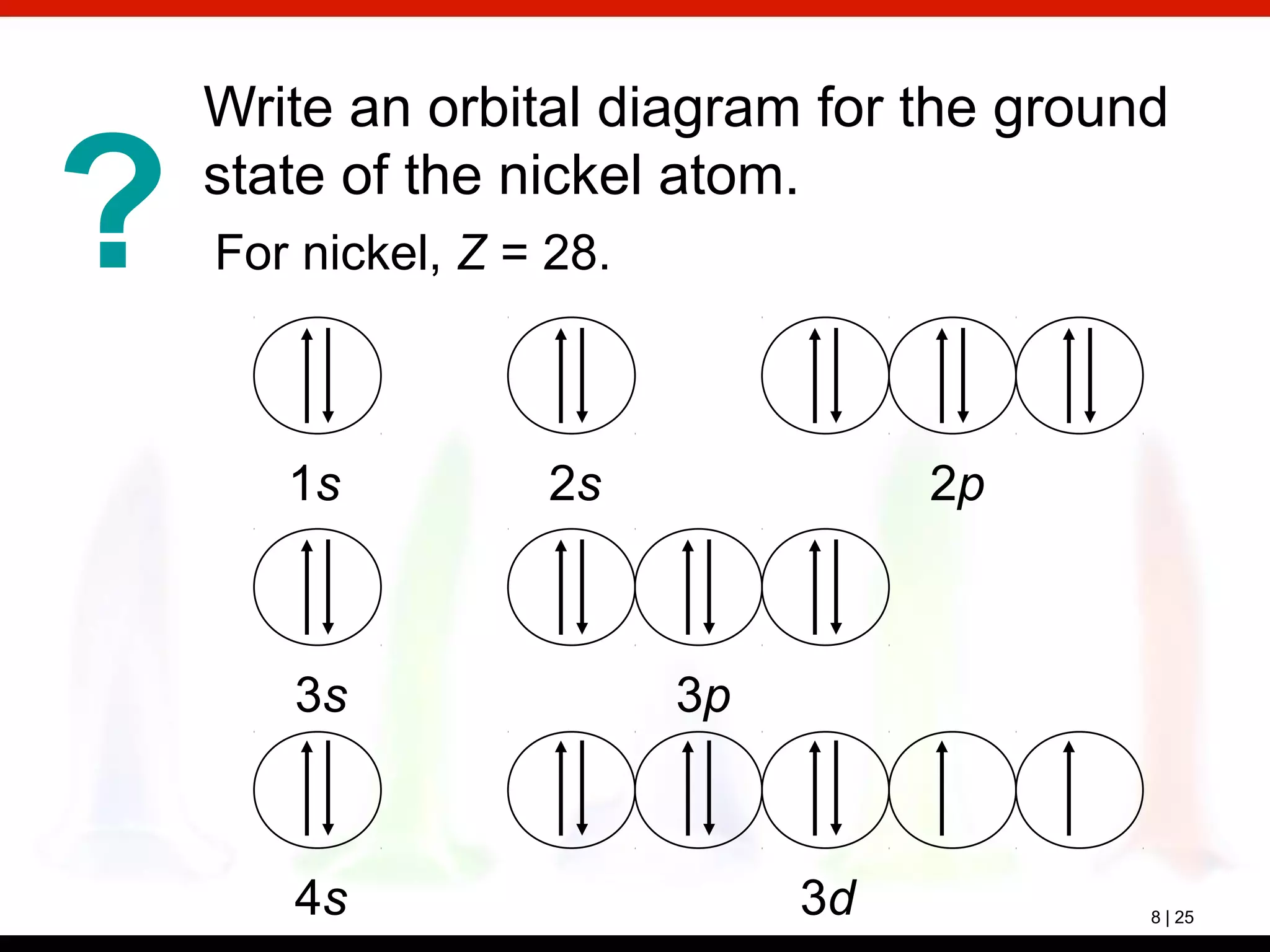
Hund's rule for lowest-energy orbital filling; practical examples using orbital diagrams for nitrogen and nickel.
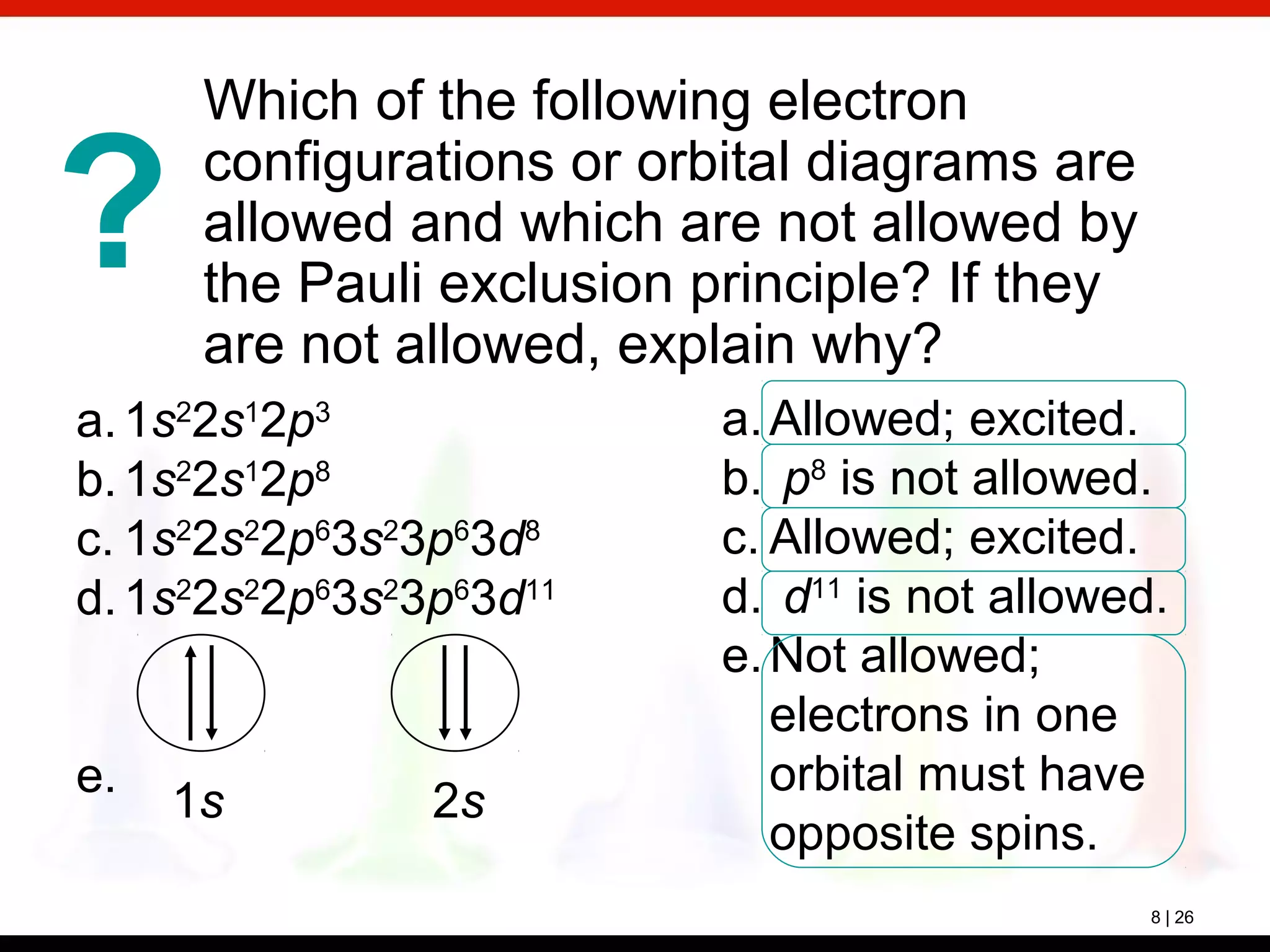
Evaluation of electron configurations according to the Pauli exclusion principle; magnetic properties of atoms.
Definitions and distinctions between paramagnetic and diamagnetic substances with respect to unpaired electrons.
History of the periodic table; definition of periodic law and development of atomic radius concepts.
Trends of atomic radius within groups and periods; explanation of effective nuclear charge.
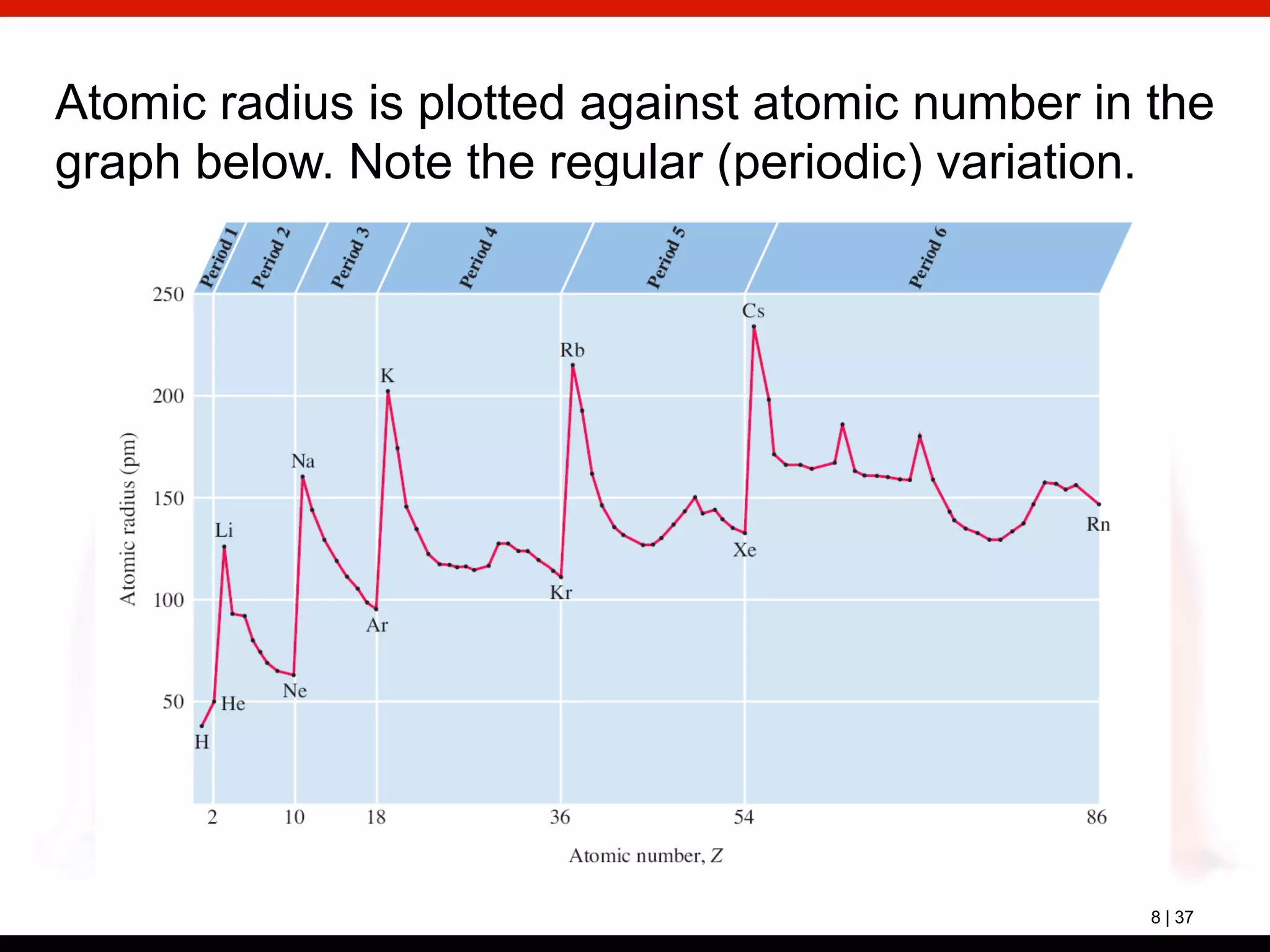
Visual graphs of atomic radius against atomic number showing periodic trends.
Description of first ionization energy; essential trends in ionization energy across groups and periods.
Relationship between atomic number, effective nuclear charge, and ionization energy; graphical analysis.
Understanding changes in ionization energy upon successive removals of electrons.
Compare ionization energies of different elements based on periodic table placements.Definition of electron affinity; trends and characteristics of electron affinity across groups.
Observations of electron affinity changes across periods and groups in the periodic table.
Trends in metallic character among elements; characteristics of basic, acidic, and amphoteric oxides.
Behavior of elements across groups including reactivity and oxide formation characteristics.
8 | 2
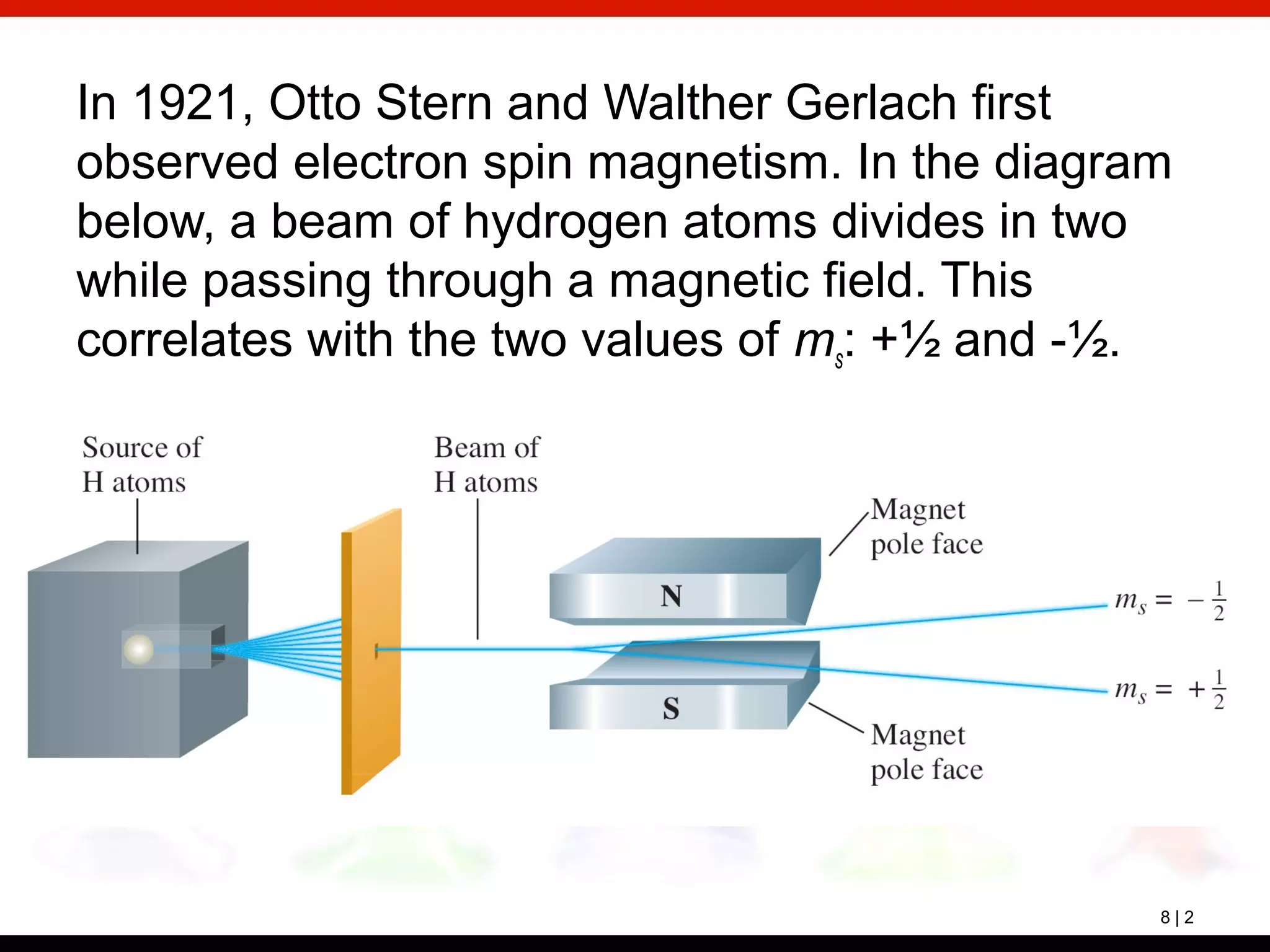
In1921, Otto Stern and Walther Gerlach first
observed electron spin magnetism. In the diagram
below, a beam of hydrogen atoms divides in two
while passing through a magnetic field. This
correlates with the two values of ms: +½ and -½.
3.
8 | 3
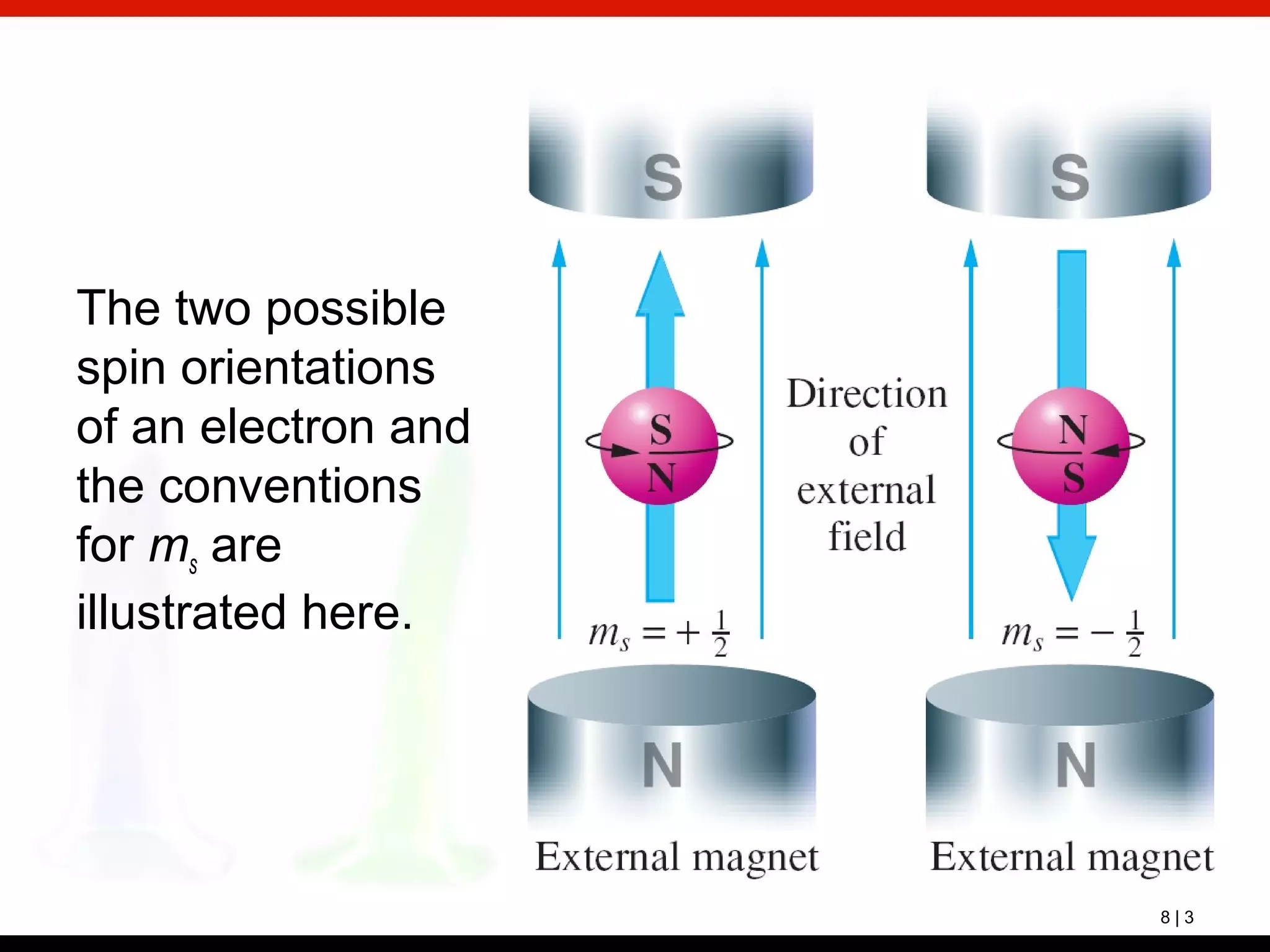
Thetwo possible
spin orientations
of an electron and
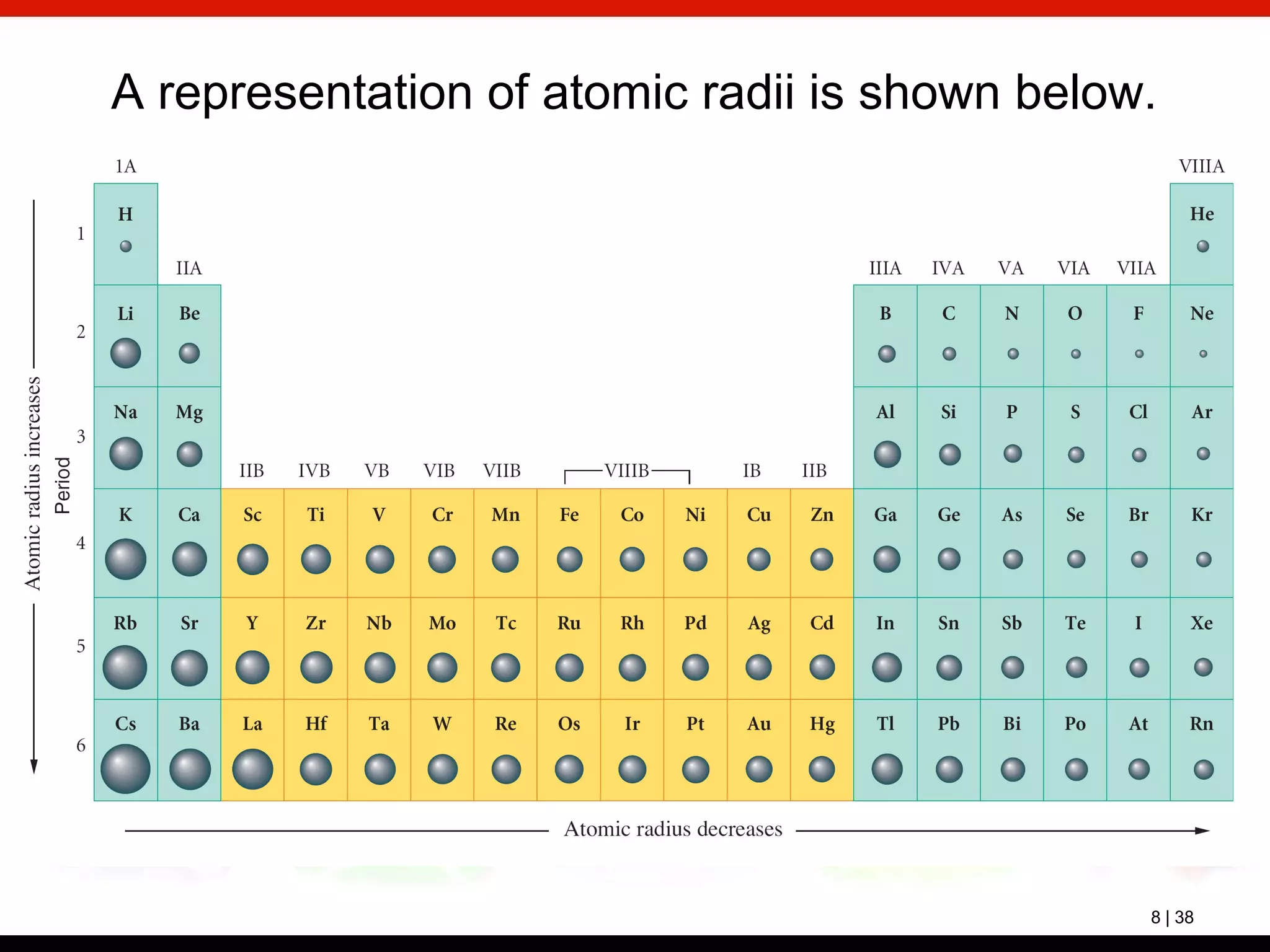
the conventions
for ms are
illustrated here.
4.
8 | 4
Anelectron configuration of an atom is a
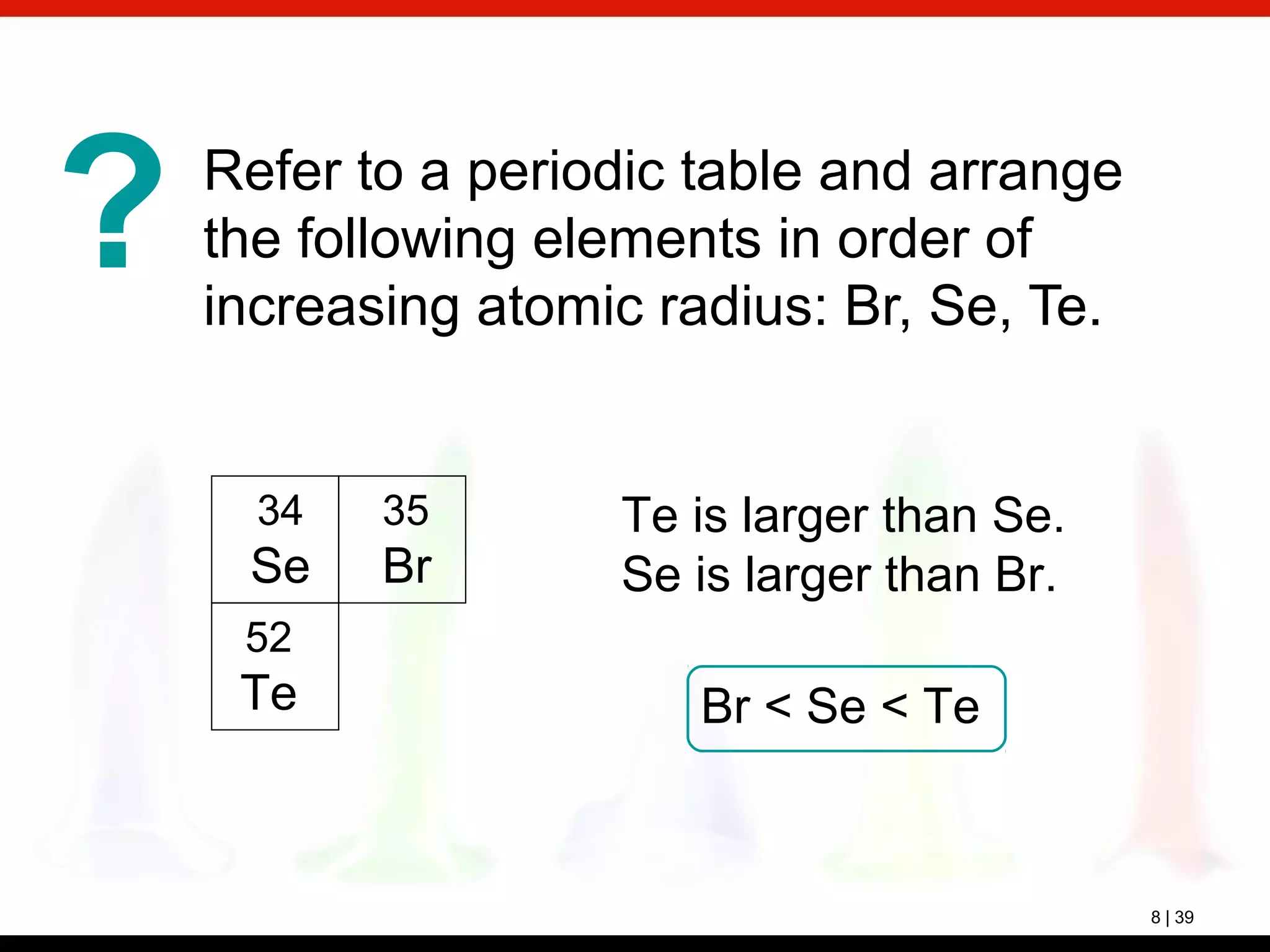
particular distribution of electrons among available
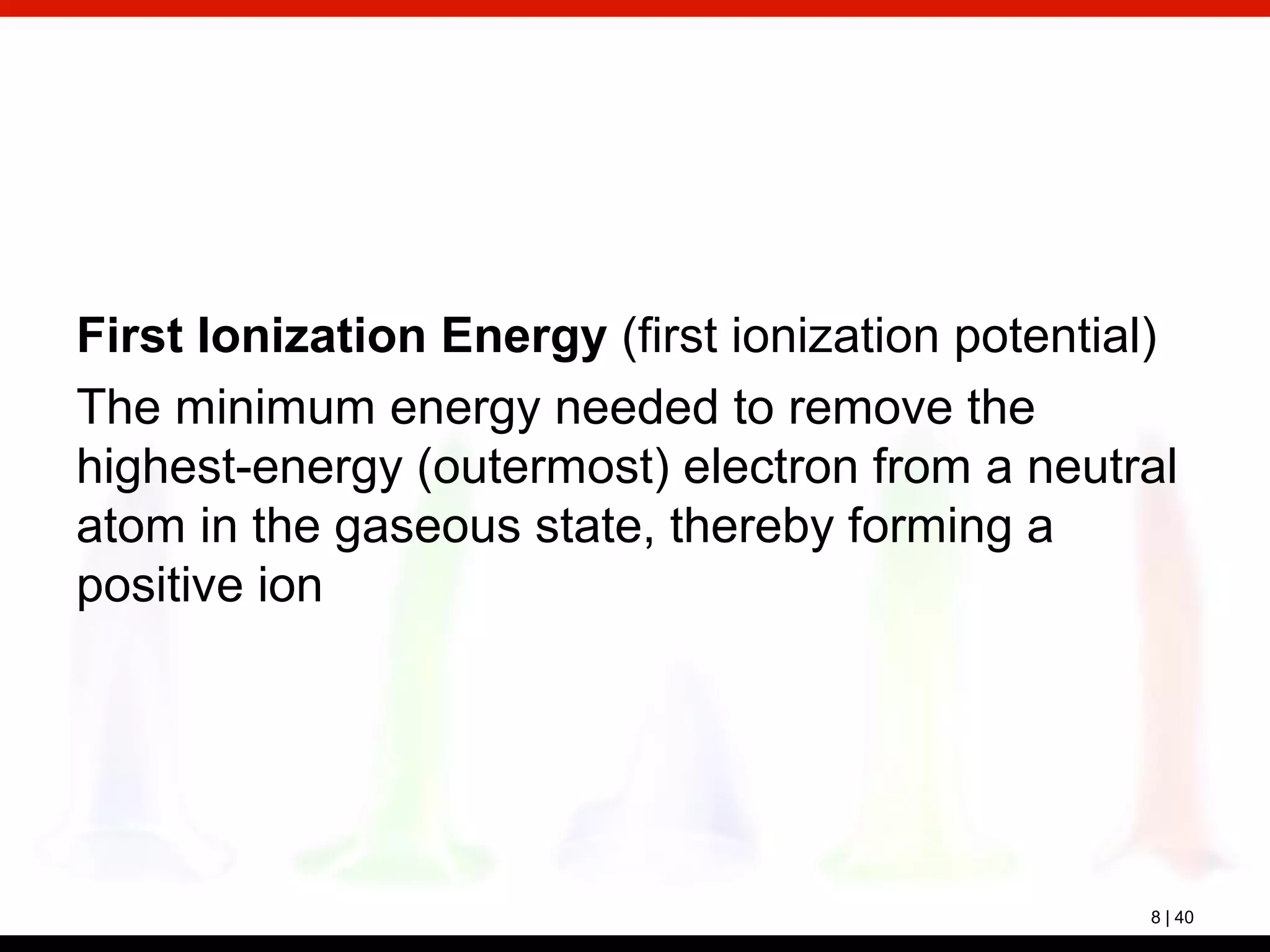
subshells.
An orbital diagram of an atom shows how the
orbitals of a subshell are occupied by electrons.
Orbitals are represented with a circle; electrons
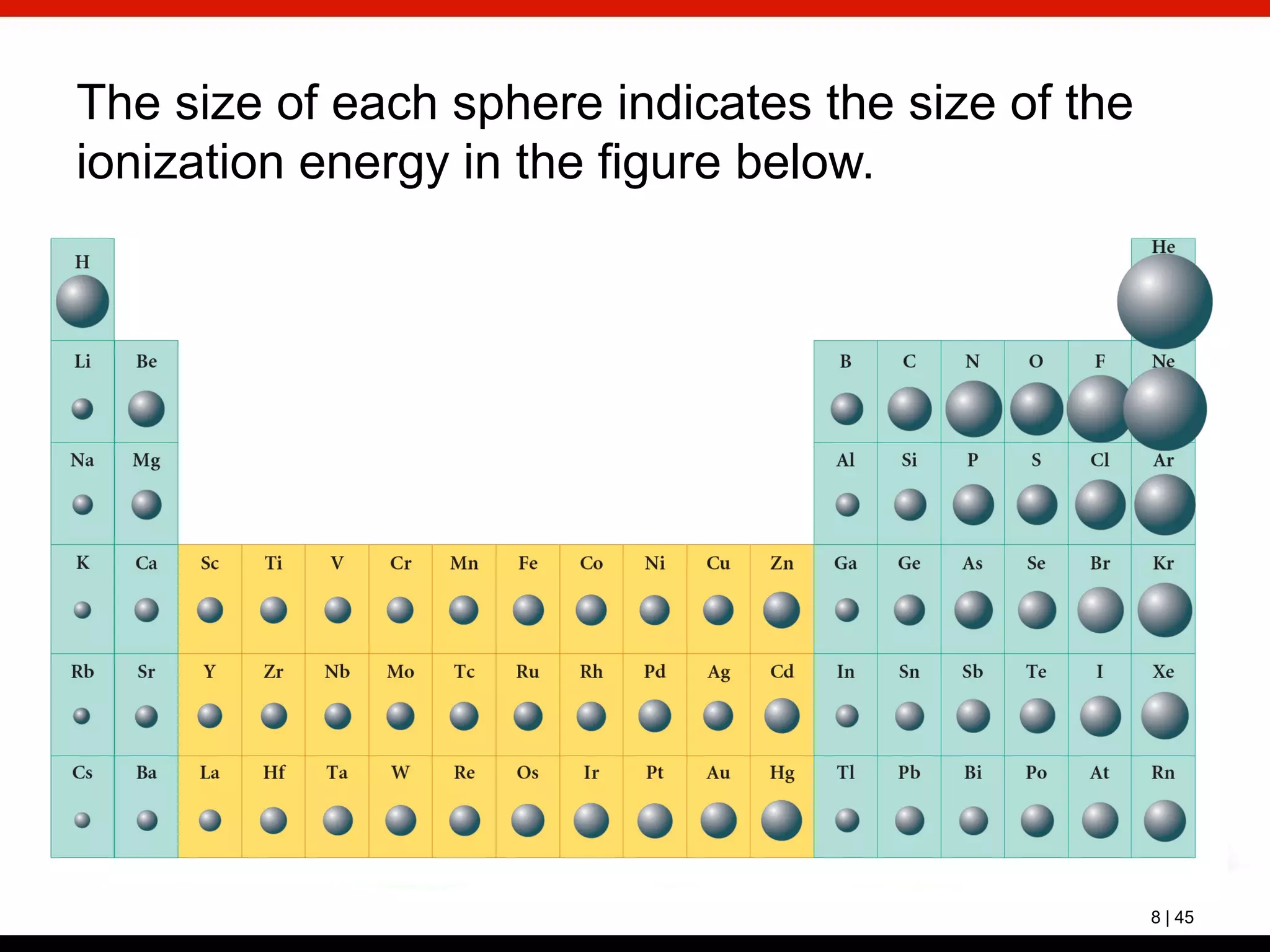
are represented with arrows up for ms= +½ or
down for ms= -½.
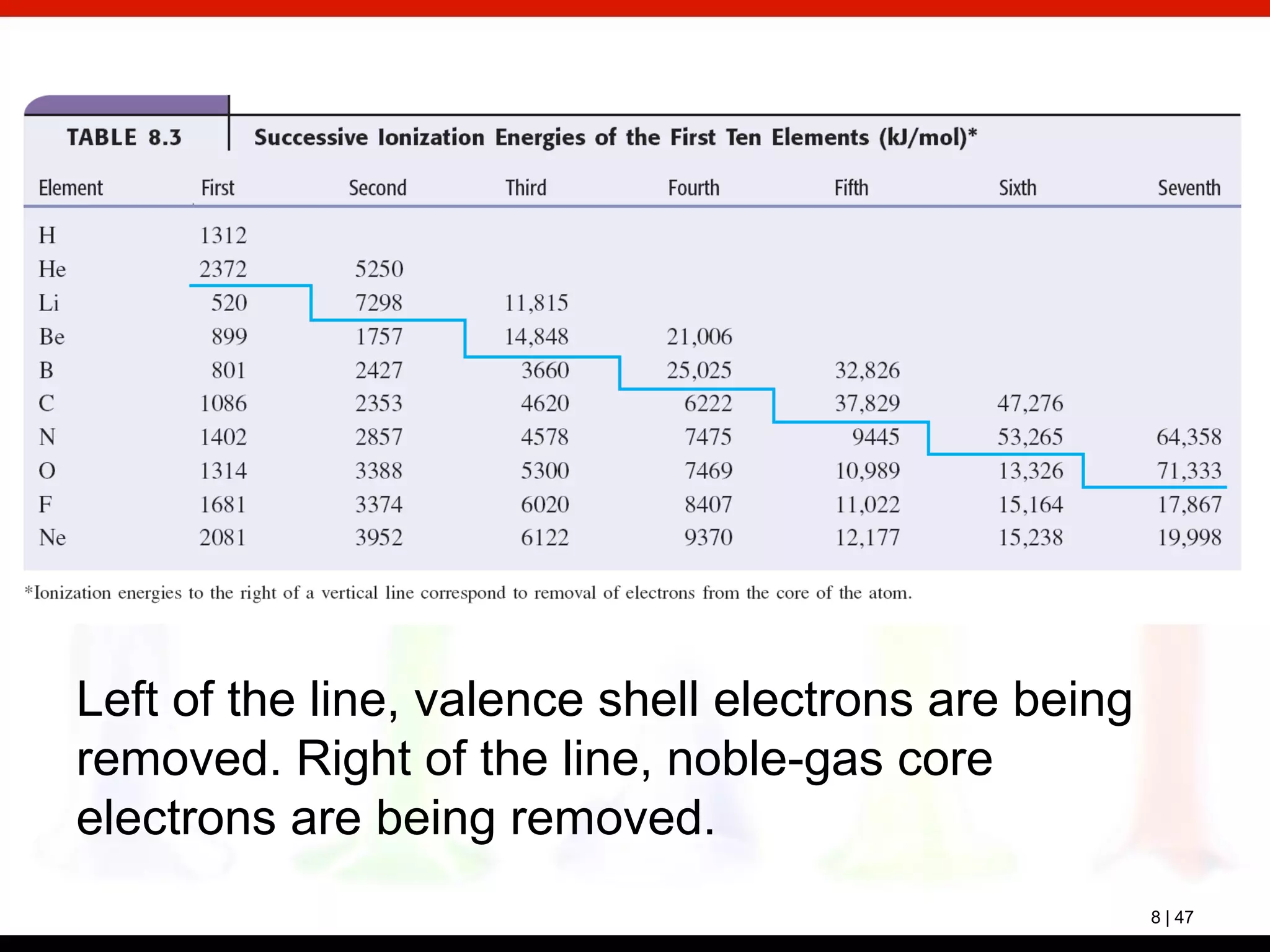
5.
8 | 5
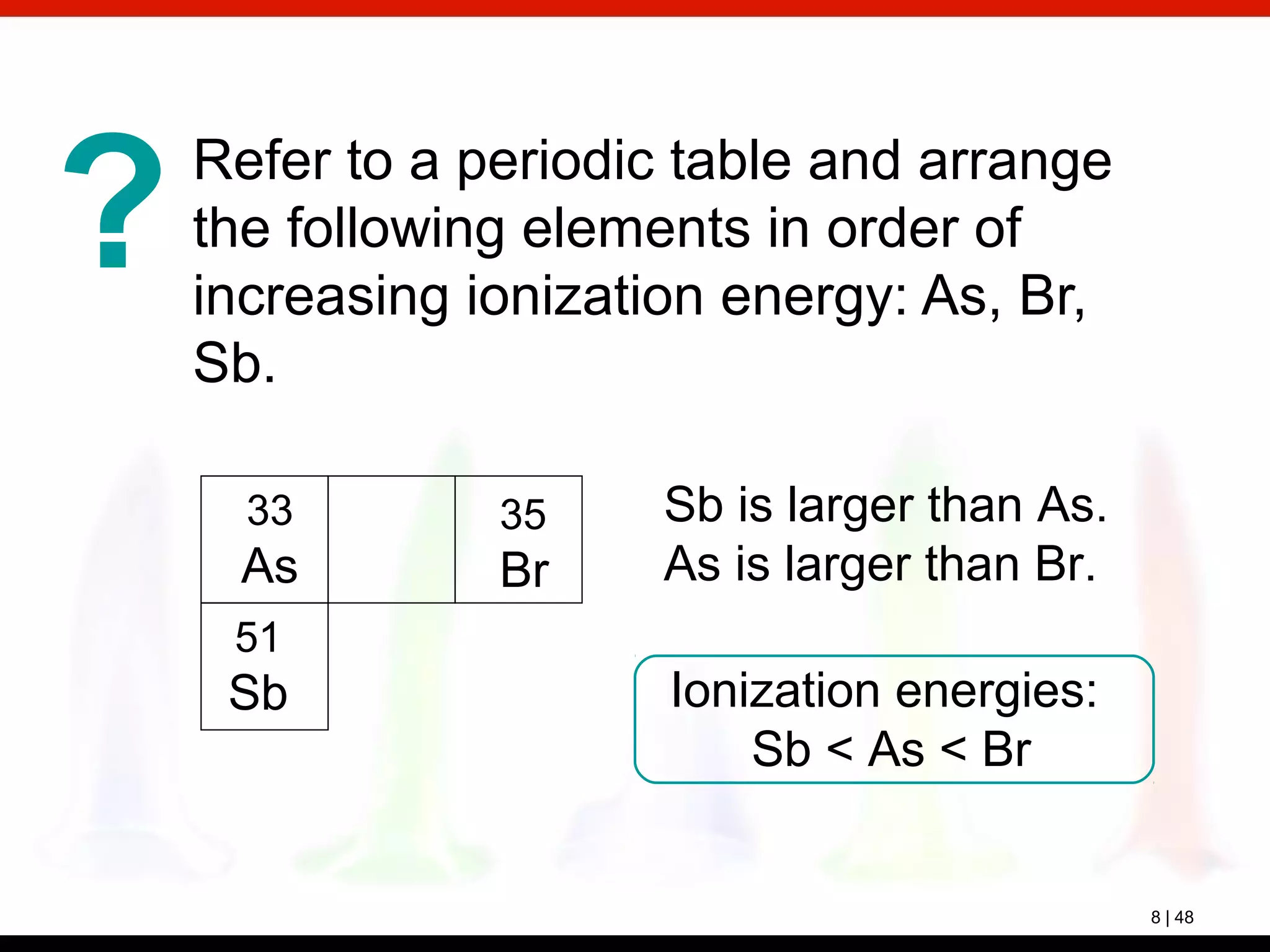
ThePauli exclusion principle summarizes
experimental observations that no two electrons in
one atom can have the same four quantum
numbers.
That means that within one orbital, electrons must
have opposite spin. It also means that one orbital
can hold a maximum of two electrons (with
opposite spin).
6.
8 | 6
Ans subshell, with one orbital, can hold a
maximum of 2 electrons.
A p subshell, with three orbitals, can hold a
maximum of 6 electrons.
A d subshell, with five orbitals, can hold a
maximum of 10 electrons.
An f subshell, with seven orbitals, can hold a
maximum of 14 electrons.
7.
8 | 7
Thelowest-energy configuration of an atom is
called its ground state.
Any other configuration represents an excited
state.
8.
8 | 8
Thebuilding-up principle (or aufbau principle) is
a scheme used to reproduce the ground-state
electron configurations by successively filling
subshells with electrons in a specific order (the
building-up order).
This order generally corresponds to filling the
orbitals from lowest to highest energy. Note that
these energies are the total energy of the atom
rather than the energy of the subshells alone.
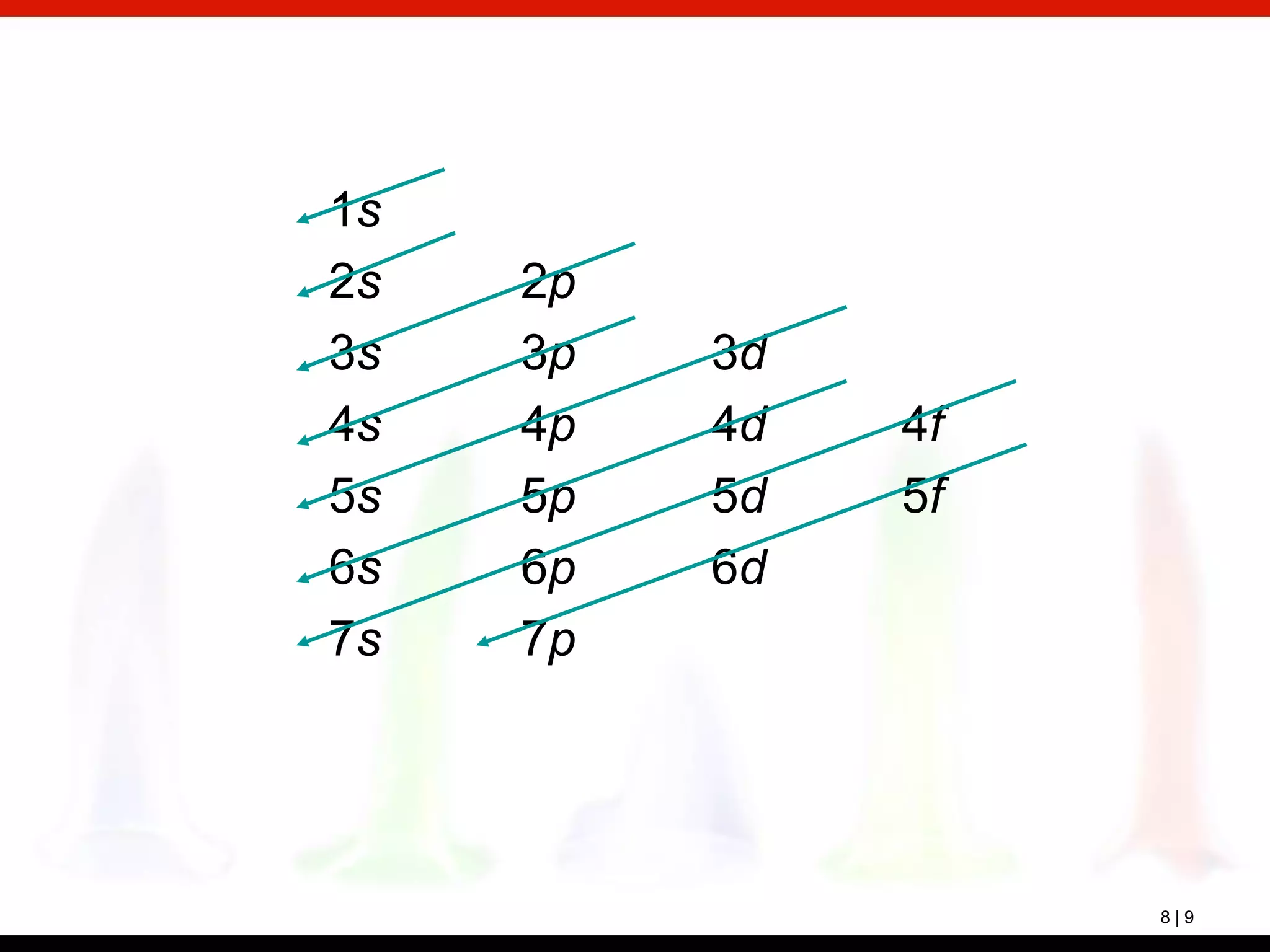
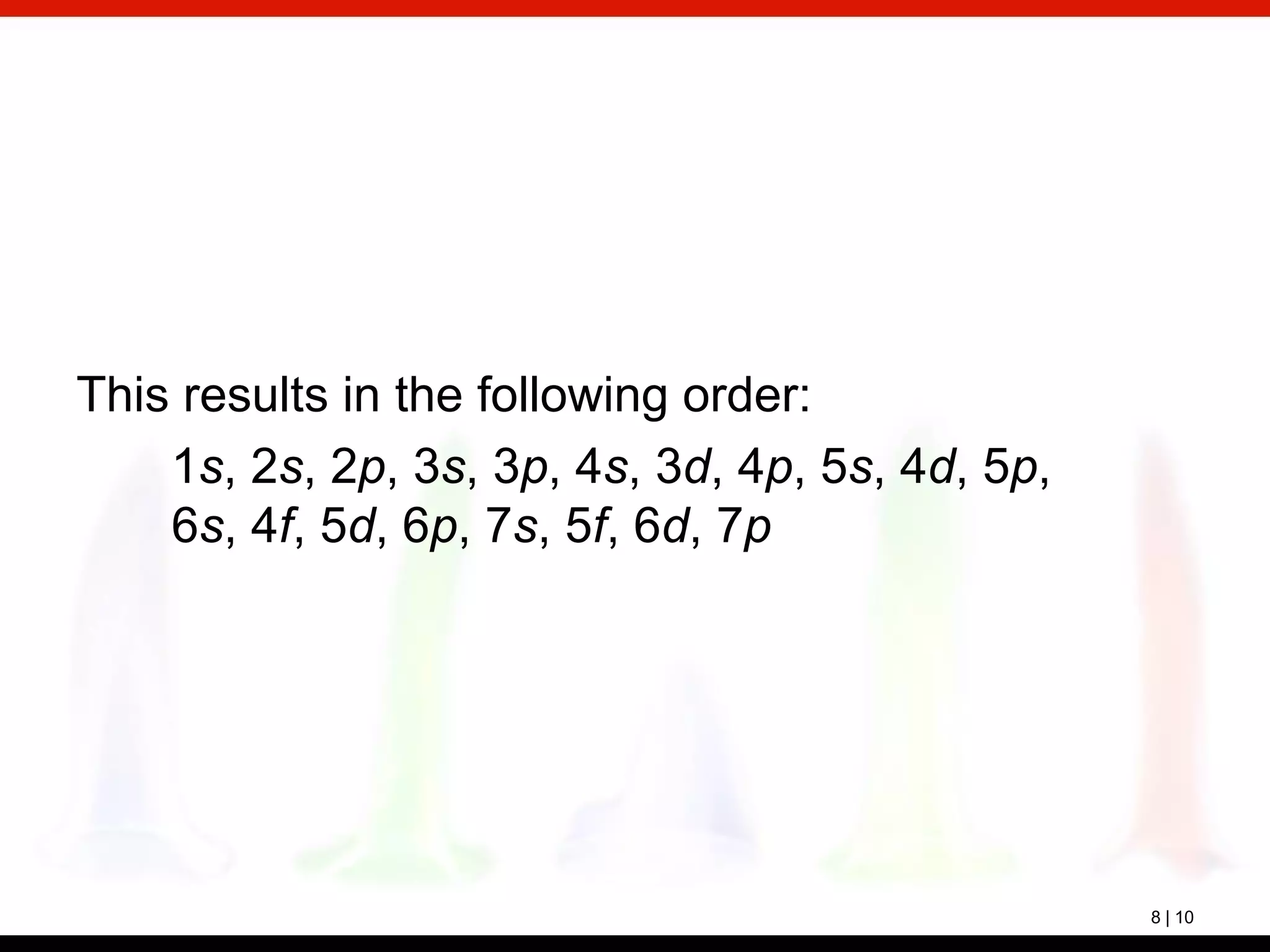
8 | 10
Thisresults in the following order:
1s, 2s, 2p, 3s, 3p, 4s, 3d, 4p, 5s, 4d, 5p,
6s, 4f, 5d, 6p, 7s, 5f, 6d, 7p
11.
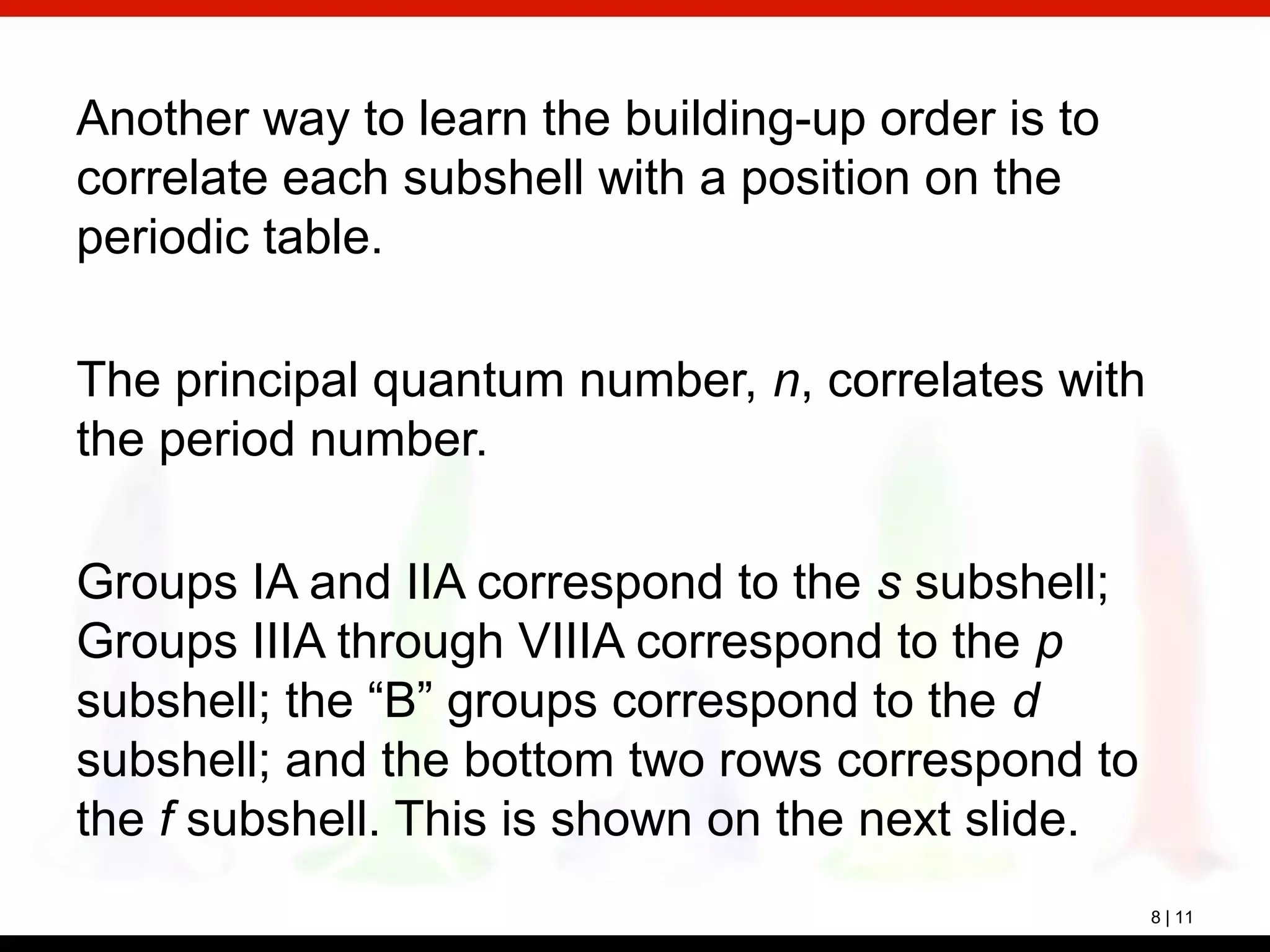
8 | 11
Anotherway to learn the building-up order is to
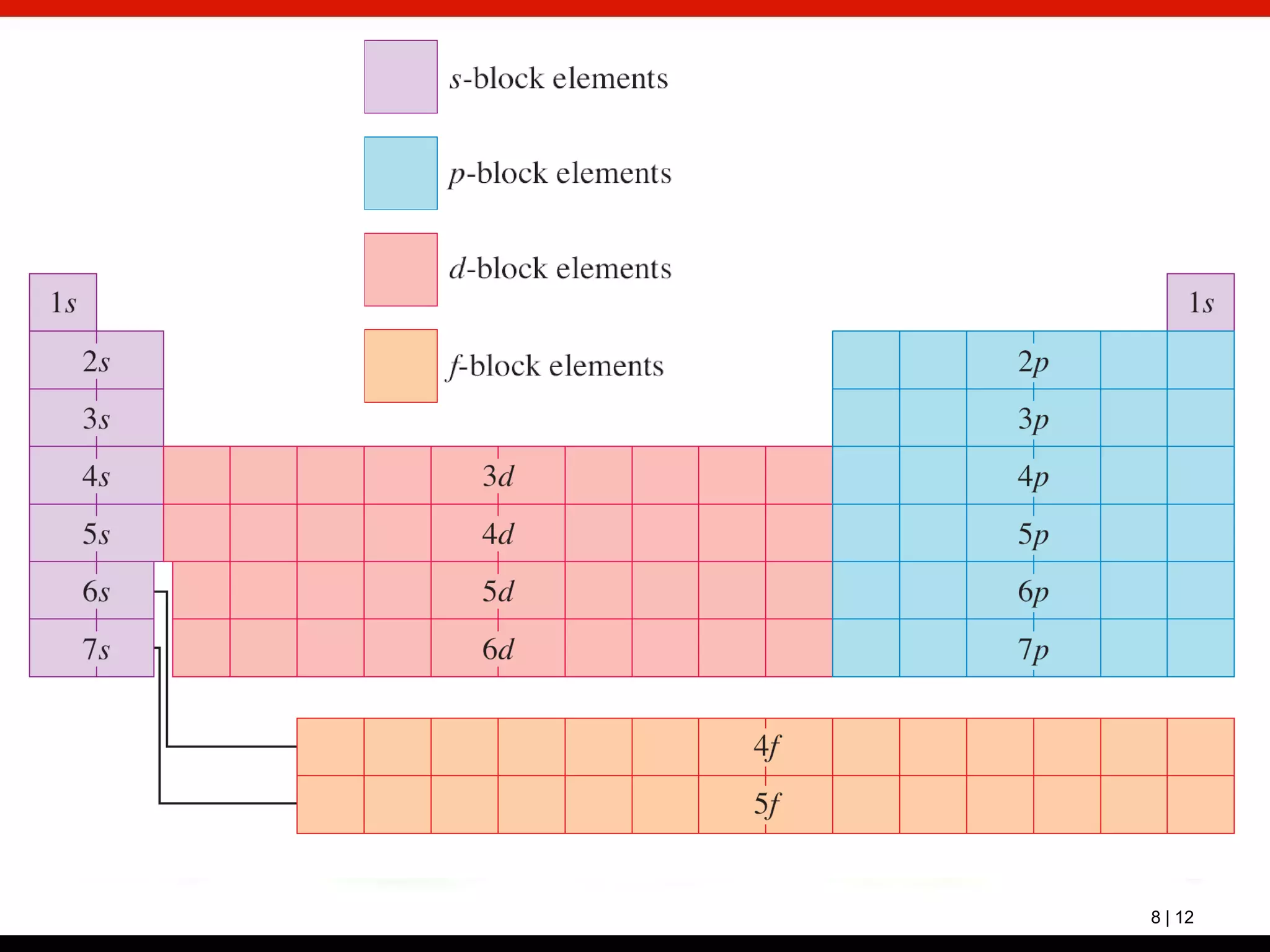
correlate each subshell with a position on the
periodic table.
The principal quantum number, n, correlates with
the period number.
Groups IA and IIA correspond to the s subshell;
Groups IIIA through VIIIA correspond to the p
subshell; the “B” groups correspond to the d
subshell; and the bottom two rows correspond to
the f subshell. This is shown on the next slide.
8 | 13
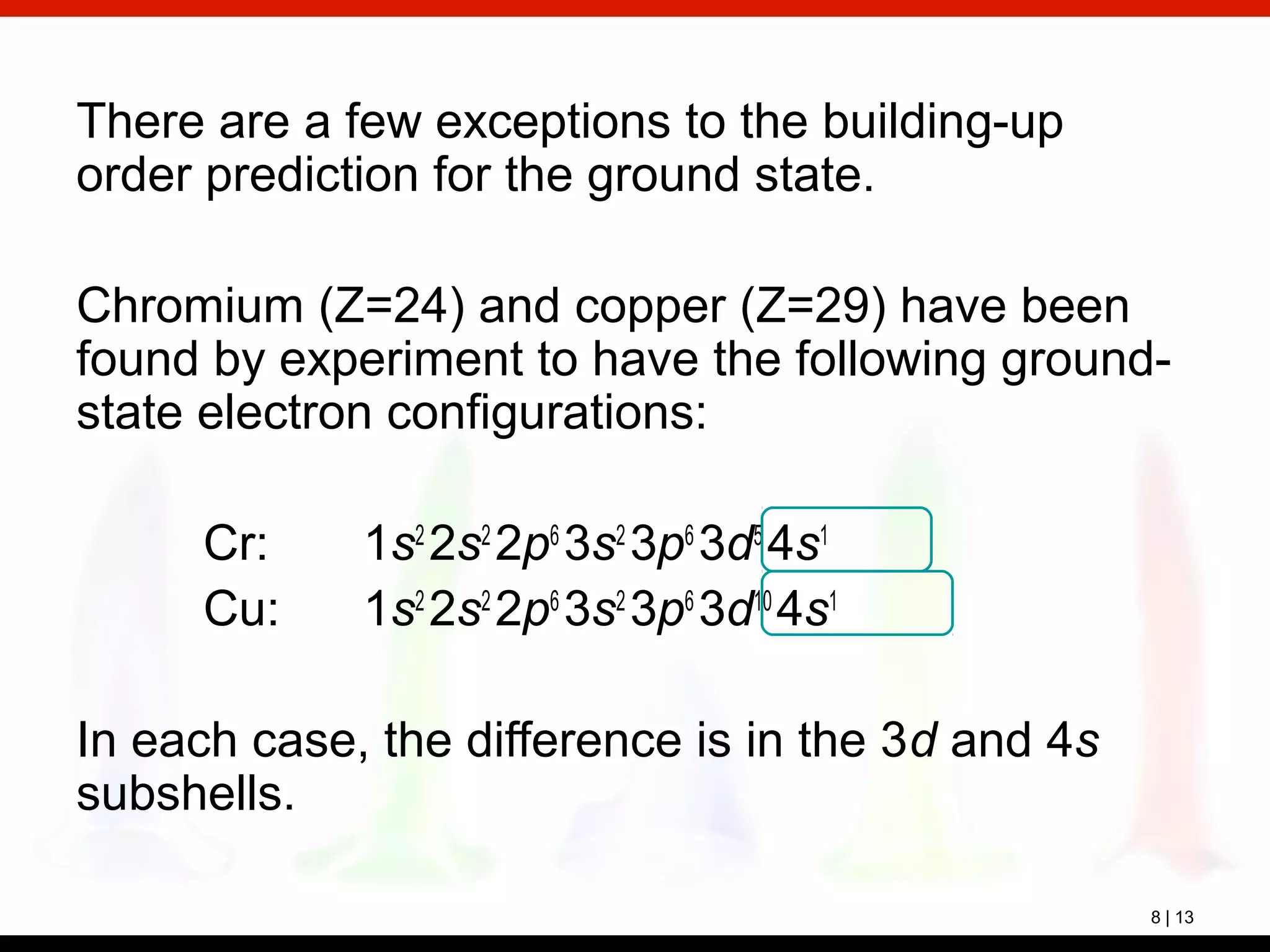
Thereare a few exceptions to the building-up
order prediction for the ground state.
Chromium (Z=24) and copper (Z=29) have been
found by experiment to have the following ground-
state electron configurations:
Cr: 1s2
2s2
2p6
3s2
3p6
3d5
4s1
Cu: 1s2
2s2
2p6
3s2
3p6
3d10
4s1
In each case, the difference is in the 3d and 4s
subshells.
14.
8 | 14
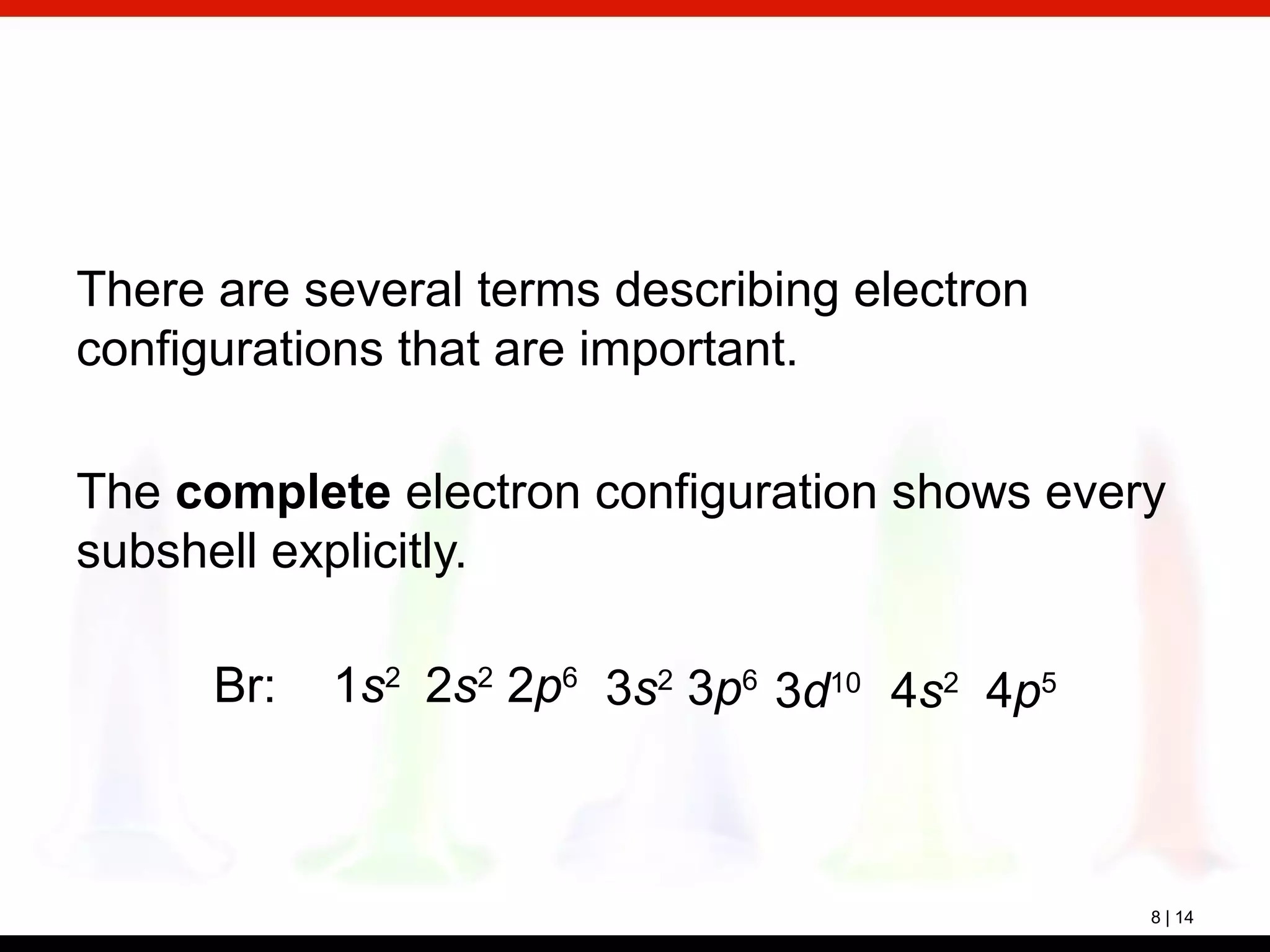
Thereare several terms describing electron
configurations that are important.
The complete electron configuration shows every
subshell explicitly.
Br: 1s2
4p52s2
2p6
3s2
3p6
4s2
3d10
15.
8 | 15
Thenoble-gas configuration substitutes the
preceding noble gas for the core configuration and
explicitly shows subshells beyond that.
Br: [Ar]3d10
4s2
4p5
16.
8 | 16
Thepseudo-noble-gas core includes the noble-
gas subshells and the filled inner, (n – 1), d
subshell.
For bromine, the pseudo-noble-gas core is
[Ar]3d10
17.
8 | 17
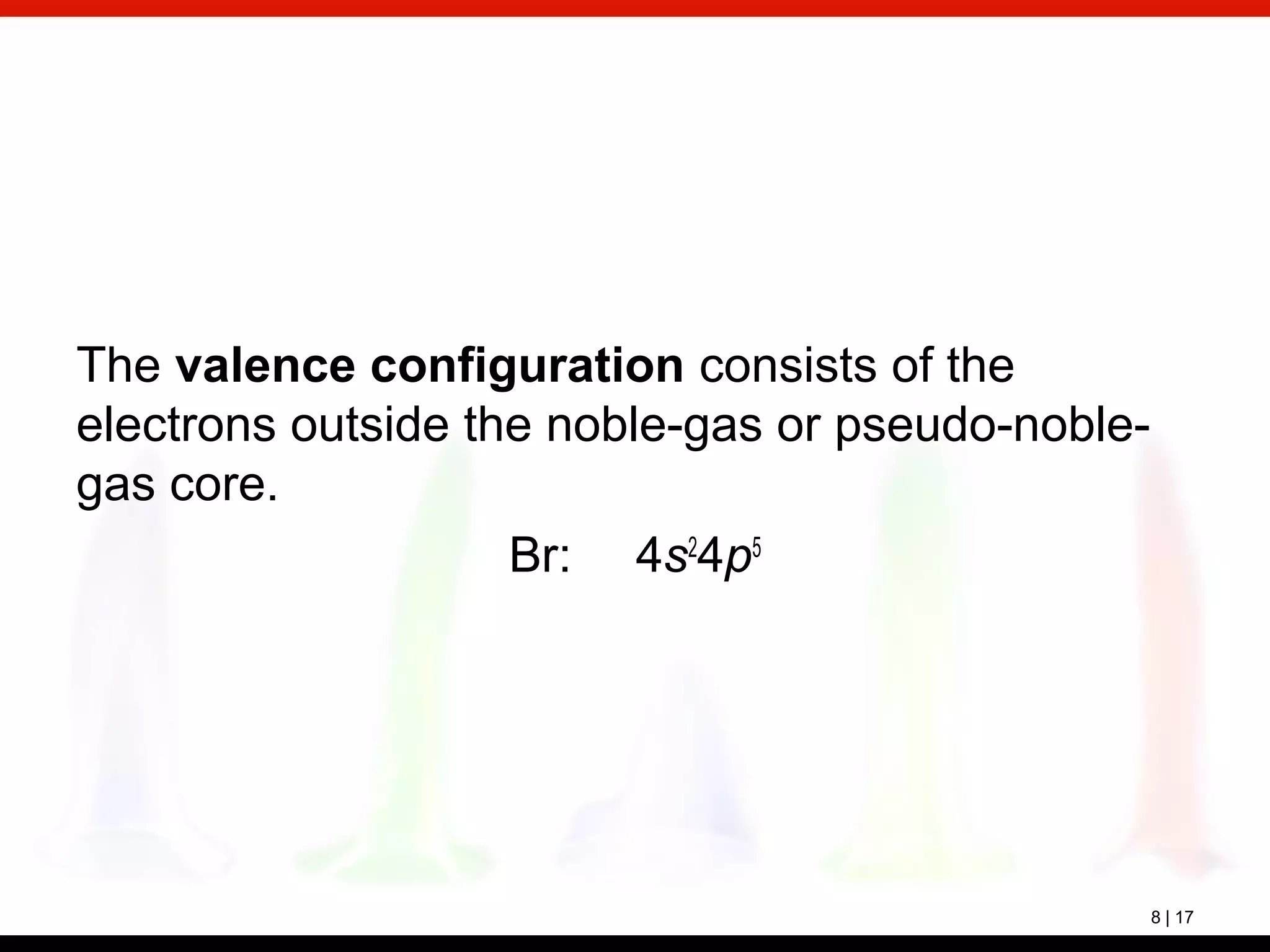
Thevalence configuration consists of the
electrons outside the noble-gas or pseudo-noble-
gas core.
Br: 4s2
4p5
18.
8 | 18
Formain-group (representative) elements, an s or
a p subshell is being filled.
For d-block transition elements, a d subshell is
being filled.
For f-block transition elements, an f subshell is
being filled.
19.
8 | 19
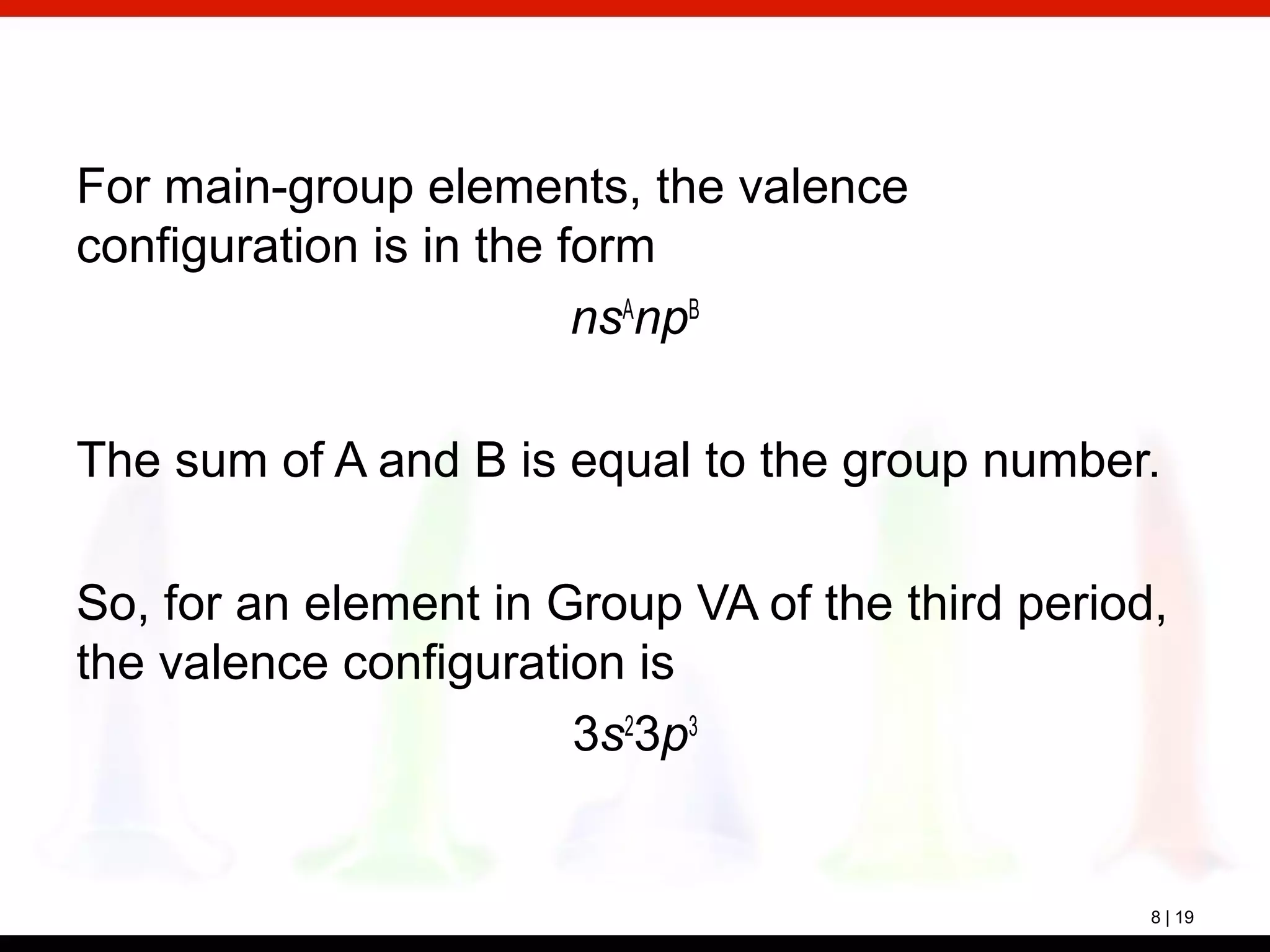
Formain-group elements, the valence
configuration is in the form
nsA
npB
The sum of A and B is equal to the group number.
So, for an element in Group VA of the third period,
the valence configuration is
3s2
3p3
20.
?
8 | 20
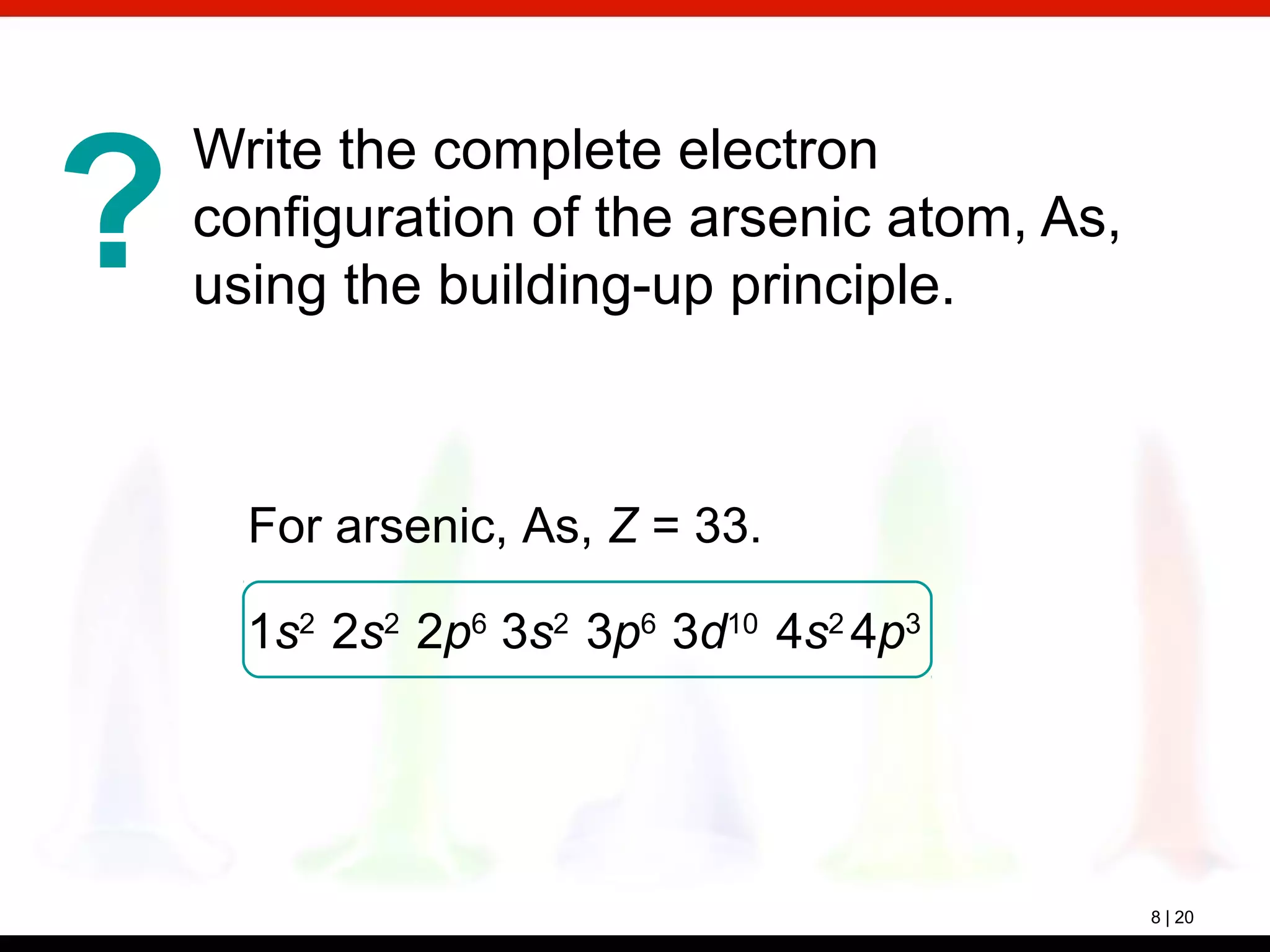
Writethe complete electron
configuration of the arsenic atom, As,
using the building-up principle.
1s2
2s2
2p6
3s2
3p6
3d10
4s2
4p3
For arsenic, As, Z = 33.
21.
?
8 | 21
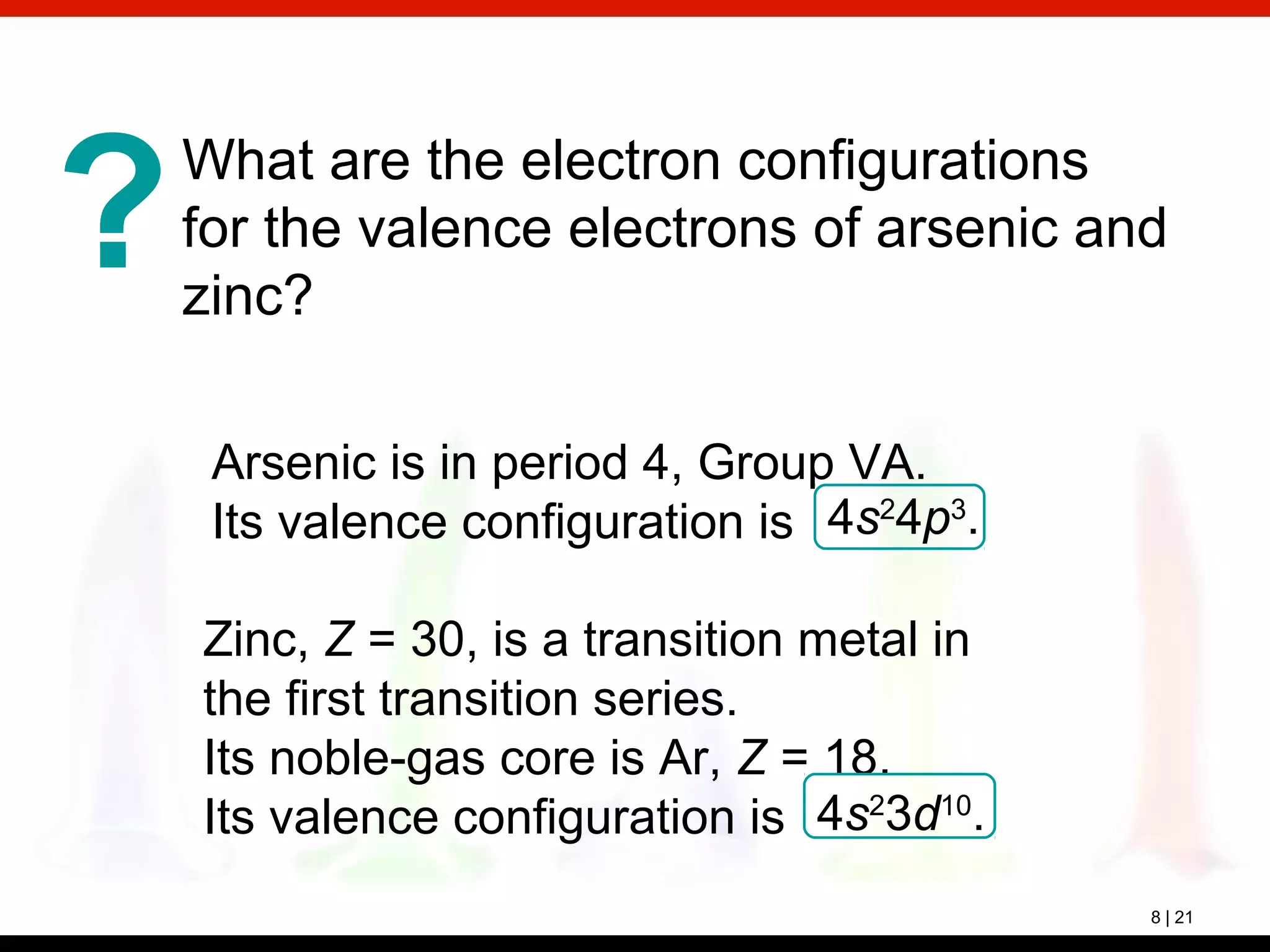
Whatare the electron configurations
for the valence electrons of arsenic and
zinc?
Arsenic is in period 4, Group VA.
Its valence configuration is 4s2
4p3
.
Zinc, Z = 30, is a transition metal in
the first transition series.
Its noble-gas core is Ar, Z = 18.
Its valence configuration is 4s2
3d10
.
22.
8 | 22
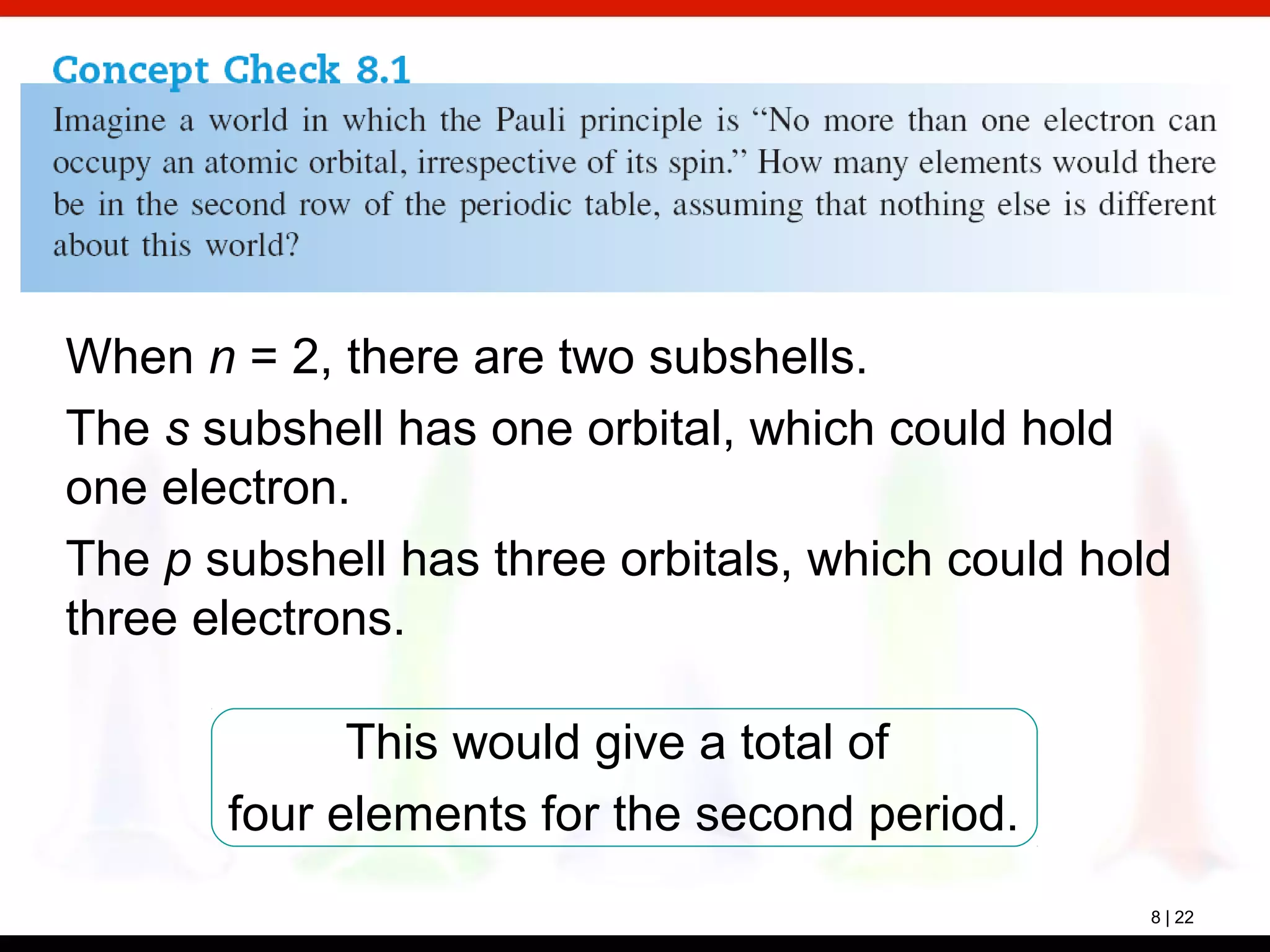
Thiswould give a total of
four elements for the second period.
When n = 2, there are two subshells.
The s subshell has one orbital, which could hold
one electron.
The p subshell has three orbitals, which could hold
three electrons.
23.
8 | 23
In1927, Friedrich Hund discovered, by
experiment, a rule for determining the lowest-
energy configuration of electrons in orbitals of a
subshell.
Hund’s rule states that the lowest-energy
arrangement of electrons in a subshell is obtained
by putting electrons into separate orbitals of the
subshell with the same spin before pairing
electrons.
24.
8 | 24
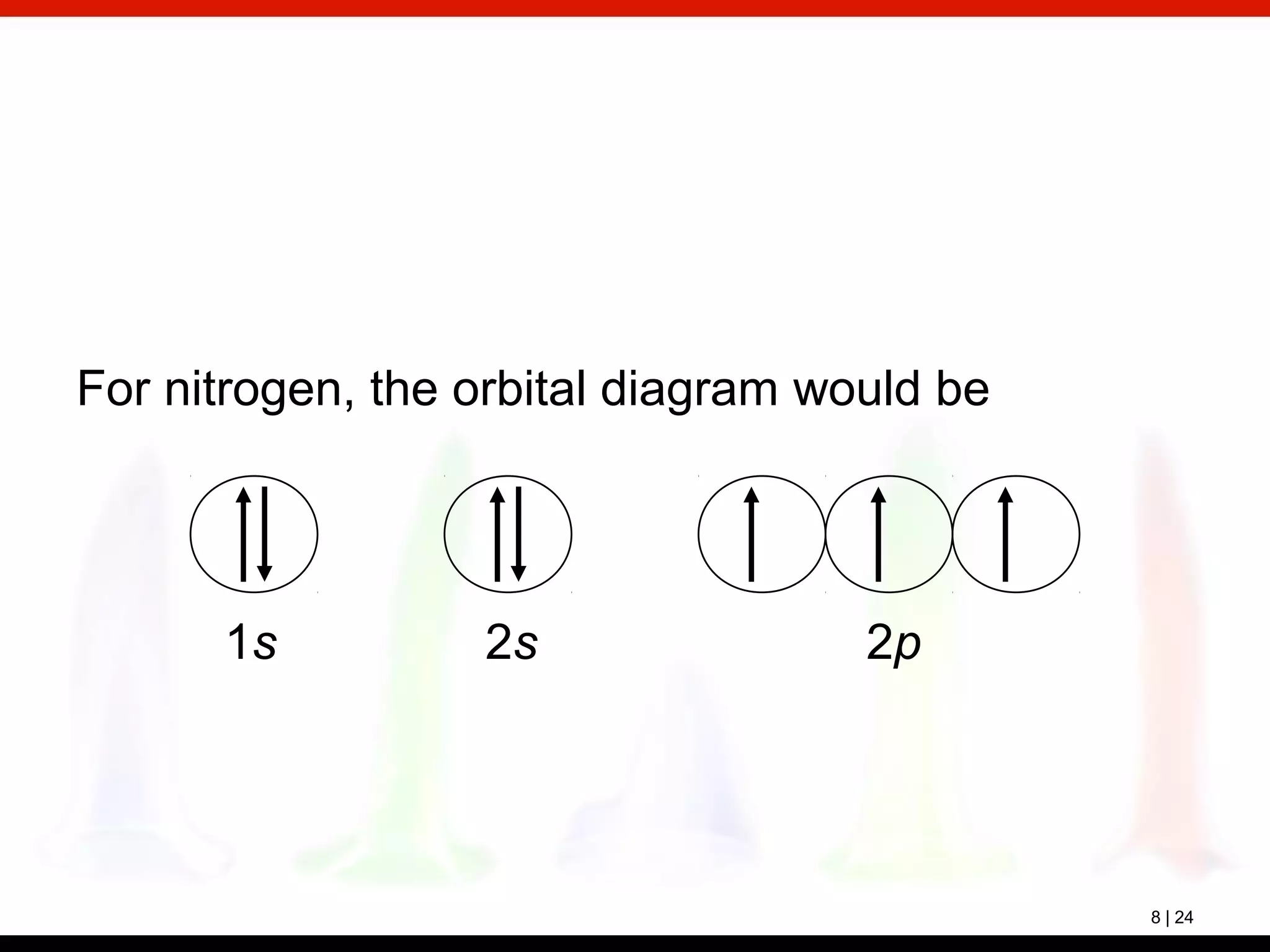
Fornitrogen, the orbital diagram would be
1s 2s 2p
25.
?
8 | 25
Writean orbital diagram for the ground
state of the nickel atom.
3s 3p
1s 2s 2p
4s 3d
For nickel, Z = 28.
26.
?
8 | 26
Whichof the following electron
configurations or orbital diagrams are
allowed and which are not allowed by
the Pauli exclusion principle? If they
are not allowed, explain why?
a.1s2
2s1
2p3
b.1s2
2s1
2p8
c. 1s2
2s2
2p6
3s2
3p6
3d8
d.1s2
2s2
2p6
3s2
3p6
3d11
e.
1s 2s
a.Allowed; excited.
b. p8
is not allowed.
c. Allowed; excited.
d. d11
is not allowed.
e.Not allowed;
electrons in one
orbital must have
opposite spins.
27.
8 | 27
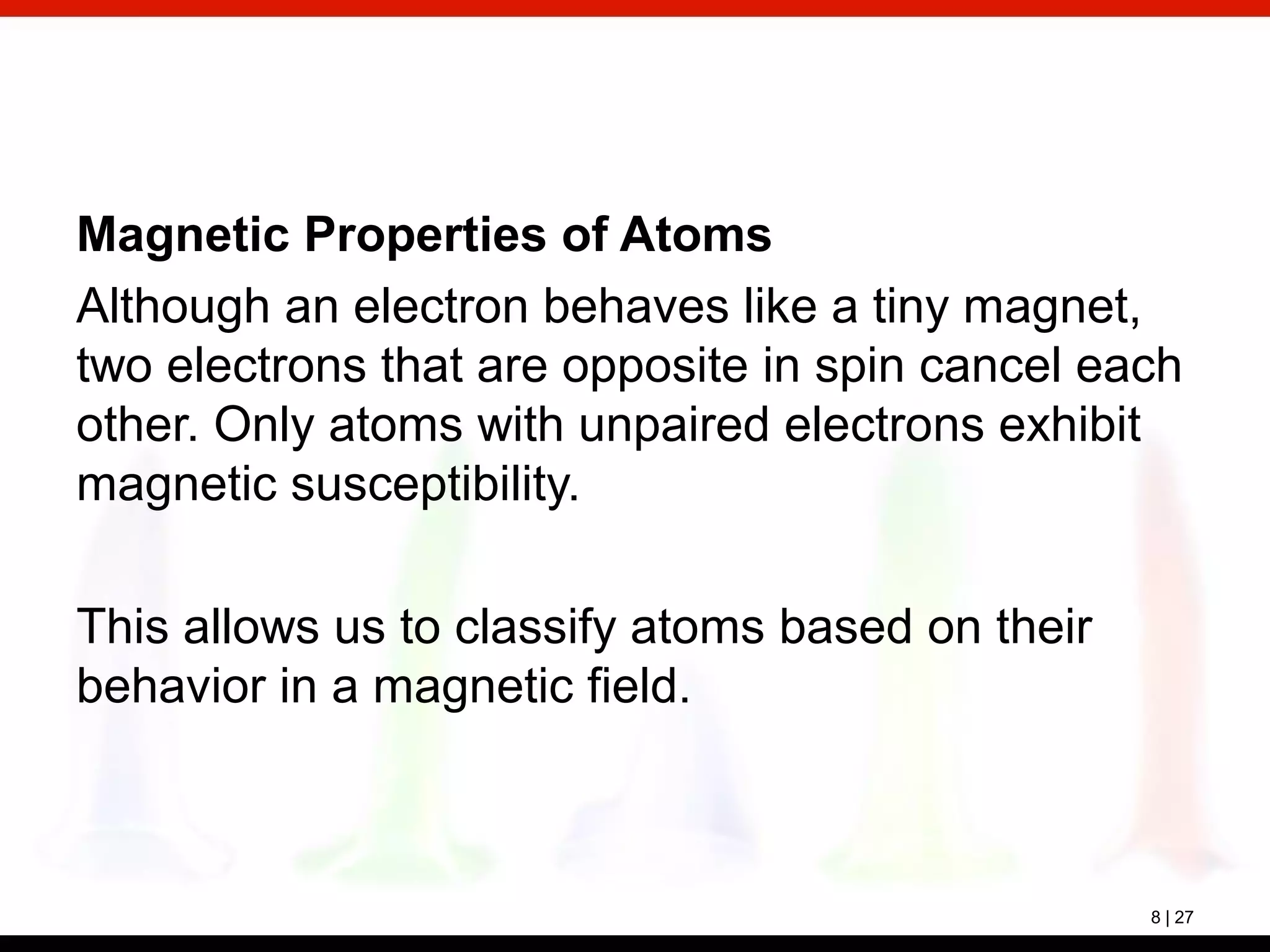
MagneticProperties of Atoms
Although an electron behaves like a tiny magnet,
two electrons that are opposite in spin cancel each
other. Only atoms with unpaired electrons exhibit
magnetic susceptibility.
This allows us to classify atoms based on their
behavior in a magnetic field.
28.
8 | 28
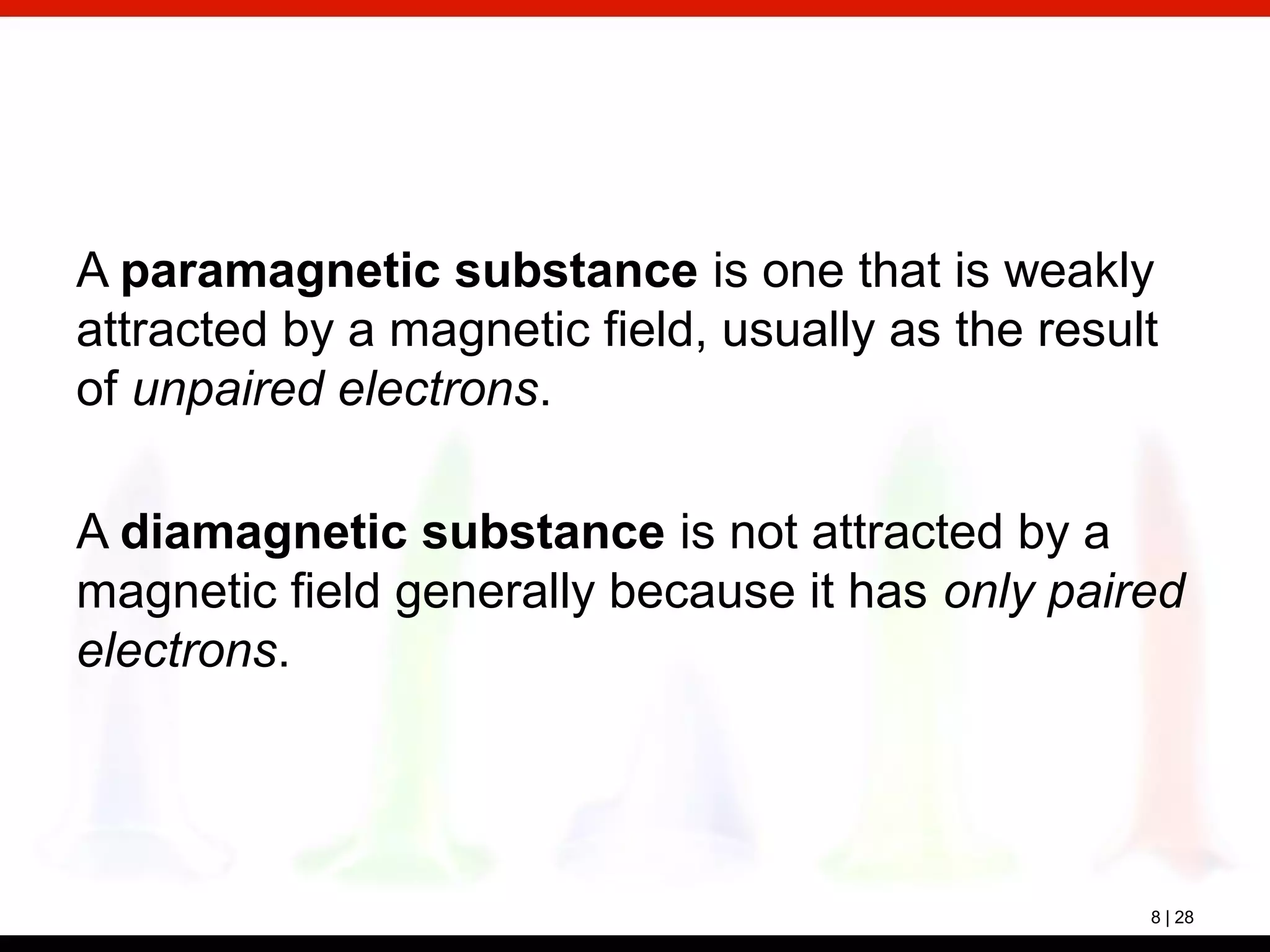
Aparamagnetic substance is one that is weakly
attracted by a magnetic field, usually as the result
of unpaired electrons.
A diamagnetic substance is not attracted by a
magnetic field generally because it has only paired
electrons.
29.
8 | 29
Youlearned how the organization of the periodic
table can be explained by the periodicity of the
ground-state configurations of the elements. Now
we will look at various aspects of the periodicity of
the elements.
30.
8 | 30
Mendeleev’speriodic table generally organized
elements by increasing atomic mass and with
similar properties in columns. In some places,
there were missing elements whose properties he
predicted.
When gallium, scandium, and germanium were
isolated and characterized, their properties were
almost identical to those predicted by Mendeleev
for eka-aluminum, eka-boron, and eka-silicon,
respectively.
31.
8 | 31
Periodiclaw states that when the elements are
arranged by atomic number, their physical and
chemical properties vary periodically.
We will look in more detail at three periodic
properties: atomic radius, ionization energy, and
electron affinity.
32.
8 | 32
AtomicRadius
While an atom does not have a definite size, we
can define it in terms of covalent radii (the radius in
covalent compounds).
33.
8 | 33
Trends
Withineach group (vertical column), the atomic
radius increases with the period number.
This trend is explained by the fact that each
successive shell is larger than the previous shell.
34.
8 | 34
Withineach period (horizontal row), the atomic
radius tends to decrease with increasing atomic
number (nuclear charge).
35.
8 | 35
EffectiveNuclear Charge
Effective nuclear charge is the positive charge that
an electron experiences from the nucleus. It is
equal to the nuclear charge, but is reduced by
shielding or screening from any intervening
electron distribution (inner shell electrons).
36.
8 | 36
Effectivenuclear charge increases across a
period. Because the shell number (n) is the same
across a period, each successive atom
experiences a stronger nuclear charge. As a result,
the atomic size decreases across a period.
37.
8 | 37
Atomicradius is plotted against atomic number in the
graph below. Note the regular (periodic) variation.
38.
8 | 38
Arepresentation of atomic radii is shown below.
39.
?
8 | 39
Referto a periodic table and arrange
the following elements in order of
increasing atomic radius: Br, Se, Te.
35
Br
34
Se
52
Te
Te is larger than Se.
Se is larger than Br.
Br < Se < Te
40.
8 | 40
FirstIonization Energy (first ionization potential)
The minimum energy needed to remove the
highest-energy (outermost) electron from a neutral
atom in the gaseous state, thereby forming a
positive ion
41.
8 | 41
Trends
Goingdown a group, first ionization energy
decreases.
This trend is explained by understanding that the
smaller an atom, the harder it is to remove an
electron, so the larger the ionization energy.
42.
8 | 42
Generally,ionization energy increases with atomic
number.
Ionization energy is proportional to the effective
nuclear charge divided by the average distance
between the electron and the nucleus. Because
the distance between the electron and the nucleus
is inversely proportional to the effective nuclear
charge, ionization energy is inversely proportional
to the square of the effective nuclear charge.
43.
8 | 43
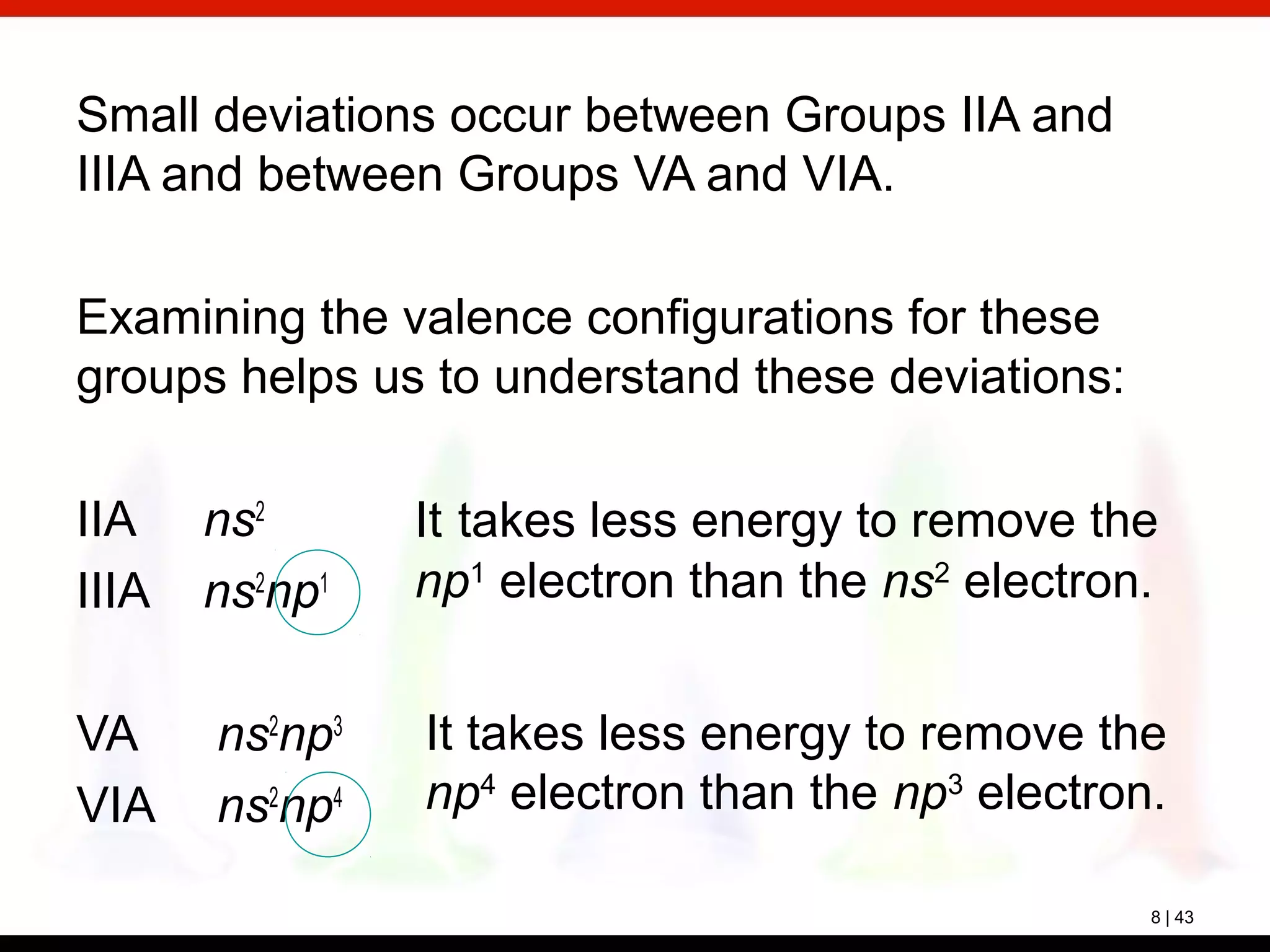
Smalldeviations occur between Groups IIA and
IIIA and between Groups VA and VIA.
Examining the valence configurations for these
groups helps us to understand these deviations:
IIA ns2
IIIA ns2
np1
VA ns2
np3
VIA ns2
np4
It takes less energy to remove the
np1
electron than the ns2
electron.
It takes less energy to remove the
np4
electron than the np3
electron.
44.
8 | 44
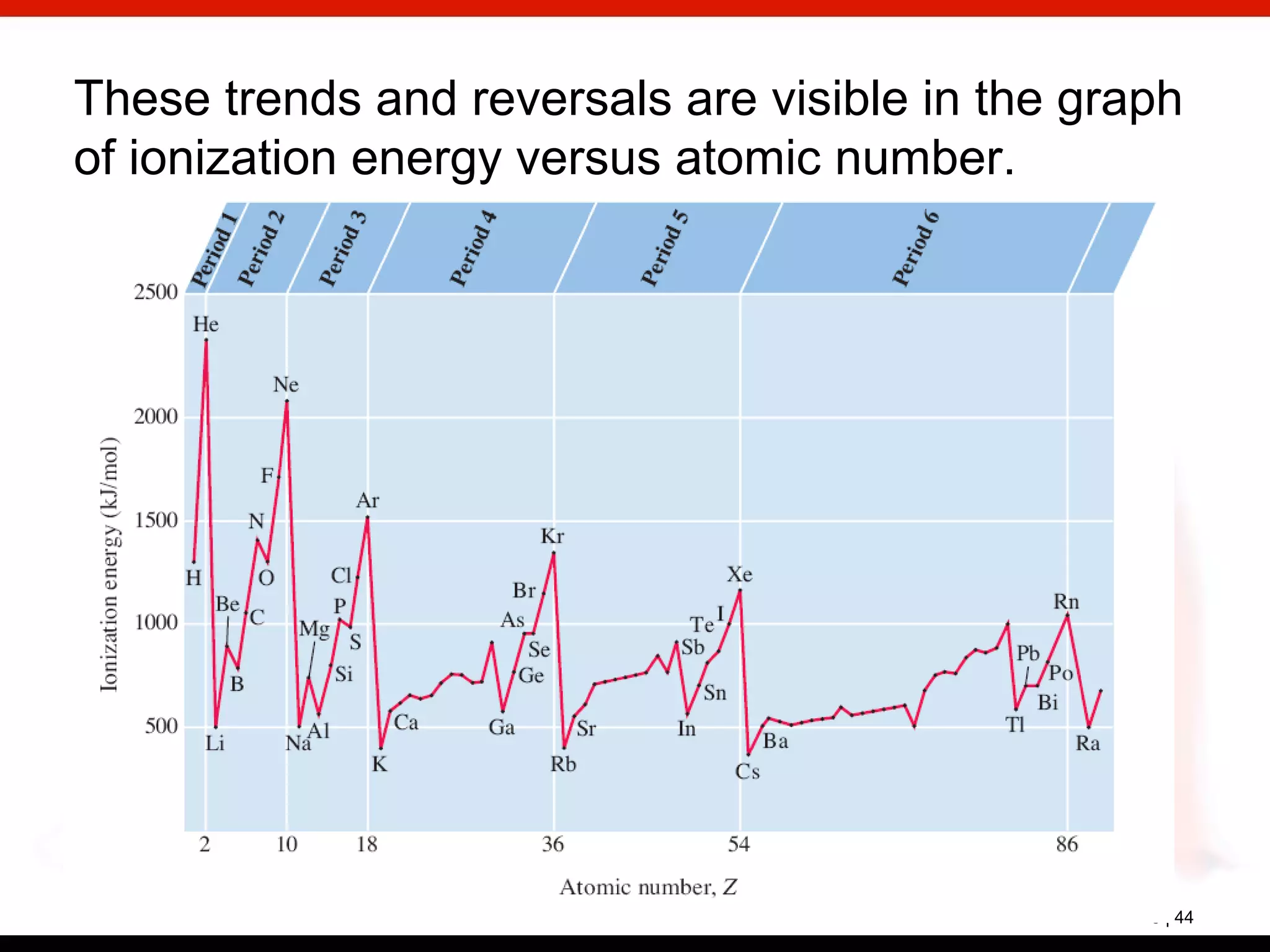
Thesetrends and reversals are visible in the graph
of ionization energy versus atomic number.
45.
8 | 45
Thesize of each sphere indicates the size of the
ionization energy in the figure below.
46.
8 | 46
Electronscan be successively removed from an
atom. Each successive ionization energy
increases, because the electron is removed from a
positive ion of increasing charge.
A dramatic increase occurs when the first electron
from the noble-gas core is removed.
47.
8 | 47
Leftof the line, valence shell electrons are being
removed. Right of the line, noble-gas core
electrons are being removed.
48.
?
8 | 48
Referto a periodic table and arrange
the following elements in order of
increasing ionization energy: As, Br,
Sb.
Sb is larger than As.
As is larger than Br.
Ionization energies:
Sb < As < Br
35
Br
33
As
51
Sb
49.
8 | 49
Electronaffinity (E.A.)
The energy change for the process of adding an
electron to a neutral atom in the gaseous state to
form a negative ion
A negative energy change (exothermic) indicates a
stable anion is formed. The larger the negative
number, the more stable the anion. Small negative
energies indicate a less stable anion.
A positive energy change (endothermic) indicates
the anion is unstable.
8 | 51
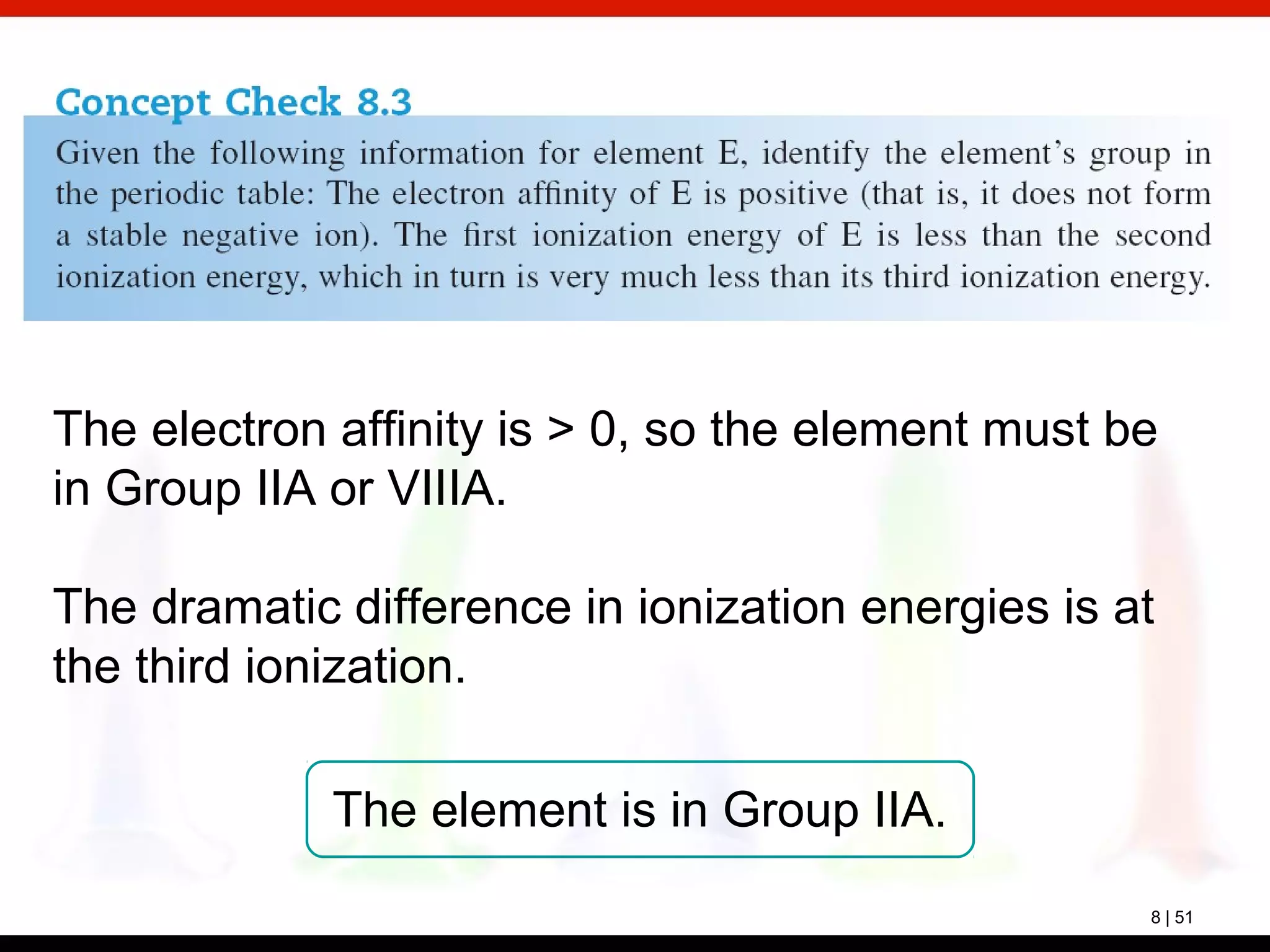
Theelement is in Group IIA.
The electron affinity is > 0, so the element must be
in Group IIA or VIIIA.
The dramatic difference in ionization energies is at
the third ionization.
52.
8 | 52
Broadlyspeaking, the trend is toward more
negative electron affinities going from left to right in
a period.
Let’s explore the periodic table by group.
53.
8 | 53
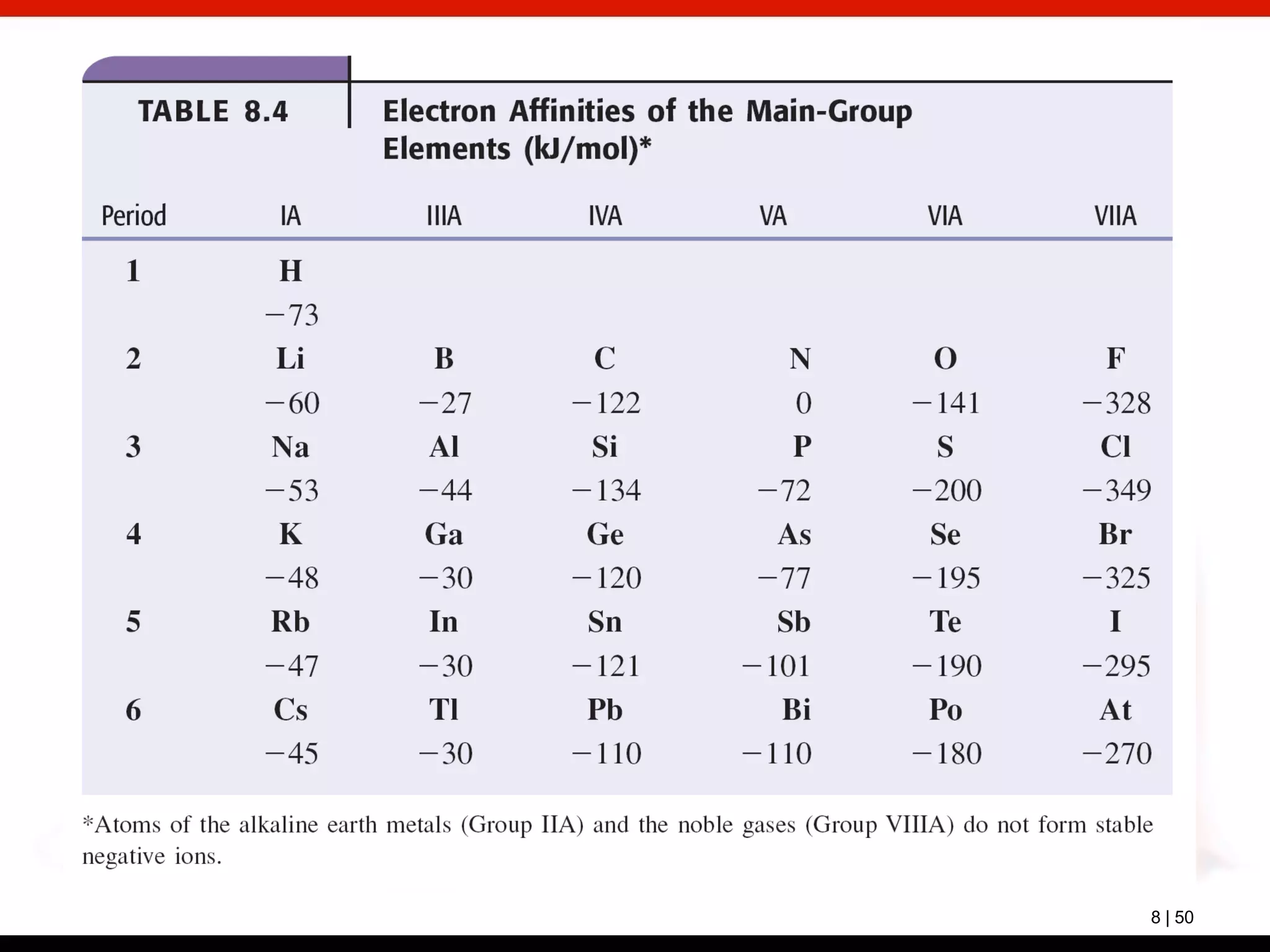
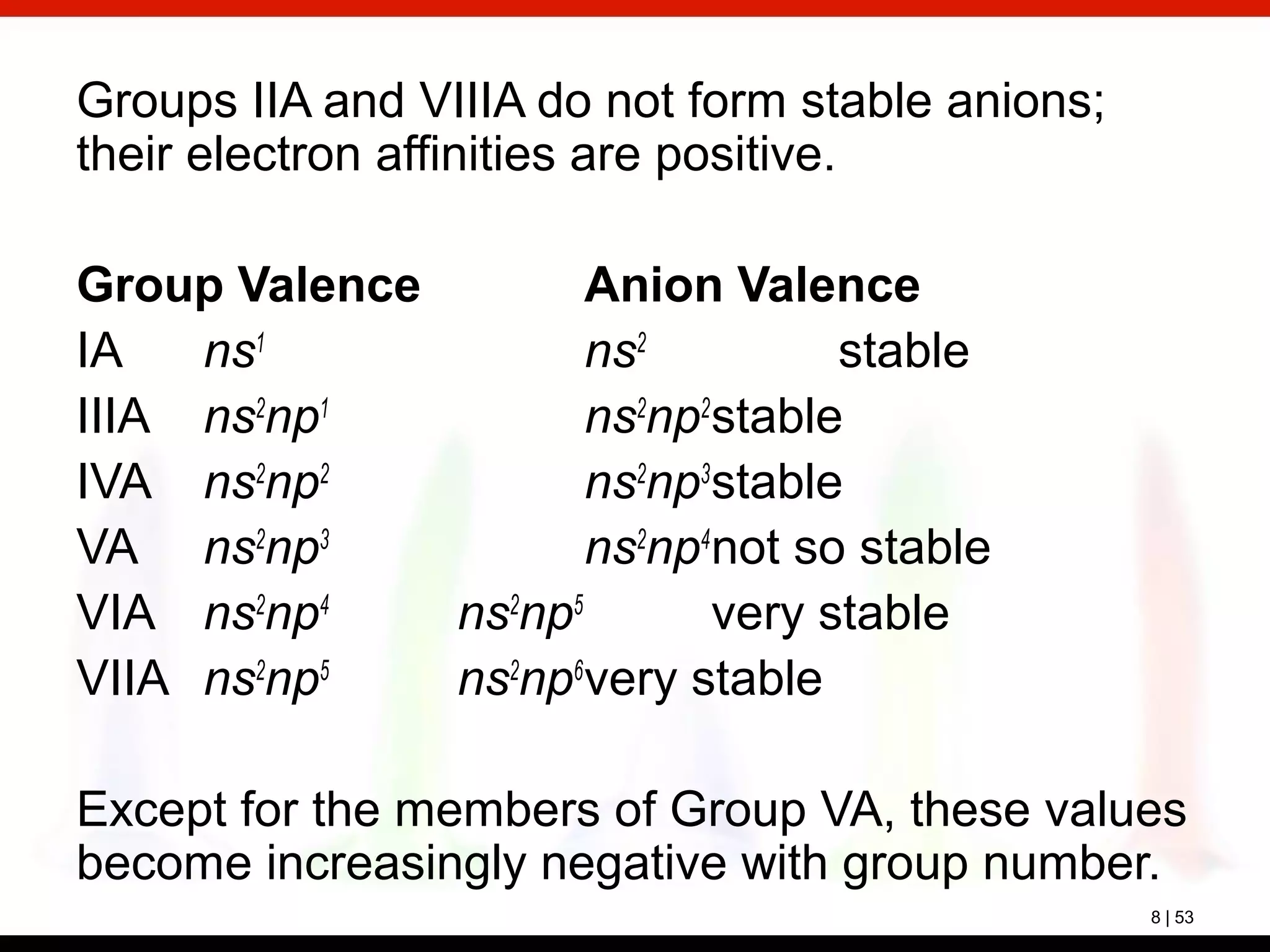
GroupsIIA and VIIIA do not form stable anions;
their electron affinities are positive.
Group Valence Anion Valence
IA ns1
ns2
stable
IIIA ns2
np1
ns2
np2
stable
IVA ns2
np2
ns2
np3
stable
VA ns2
np3
ns2
np4
not so stable
VIA ns2
np4
ns2
np5
very stable
VIIA ns2
np5
ns2
np6
very stable
Except for the members of Group VA, these values
become increasingly negative with group number.
54.
8 | 54
MetallicCharacter
Elements with low ionization energies tend to be
metals. Those with high ionization energies tend to
be nonmetals. This can vary within a group as well
as within a period.
55.
8 | 55
Oxides
Abasic oxide reacts with acids. Most metal
oxides are basic. If soluble, their water solutions
are basic.
An acidic oxide reacts with bases. Most nonmetal
oxides are acidic. If soluble, their water solutions
are acidic.
An amphoteric oxide reacts with both acids and
bases.
56.
8 | 56
GroupIA, Alkali Metals (ns1
)
These elements are metals; their reactivity
increases down the group.
The oxides have the formula M2O.
Hydrogen is a special case. It usually behaves as
a nonmetal, but at very high pressures it can
exhibit metallic properties.
57.
8 | 57
GroupIIA, Alkaline Earth Metals (ns2
)
These elements are metals; their reactivity
increases down the group.
The oxides have the formula MO.
58.
8 | 58
GroupIIIA (ns2
np1
)
Boron is a metalloid; all other members of Group
IIIA are metals.
The oxide formula is R2O3.
B2O3 is acidic; Al2O3 and Ga2O3 are amphoteric; the
others are basic.
59.
8 | 59
GroupIVA (ns2
np2
)
Carbon is a nonmetal; silicon and germanium are
metalloids; tin and lead are metals.
The oxide formula is RO2 and, for carbon and lead,
RO.
CO2, SiO2, and GeO2 are acidic (decreasingly so).
SnO2 and PbO2 are amphoteric.
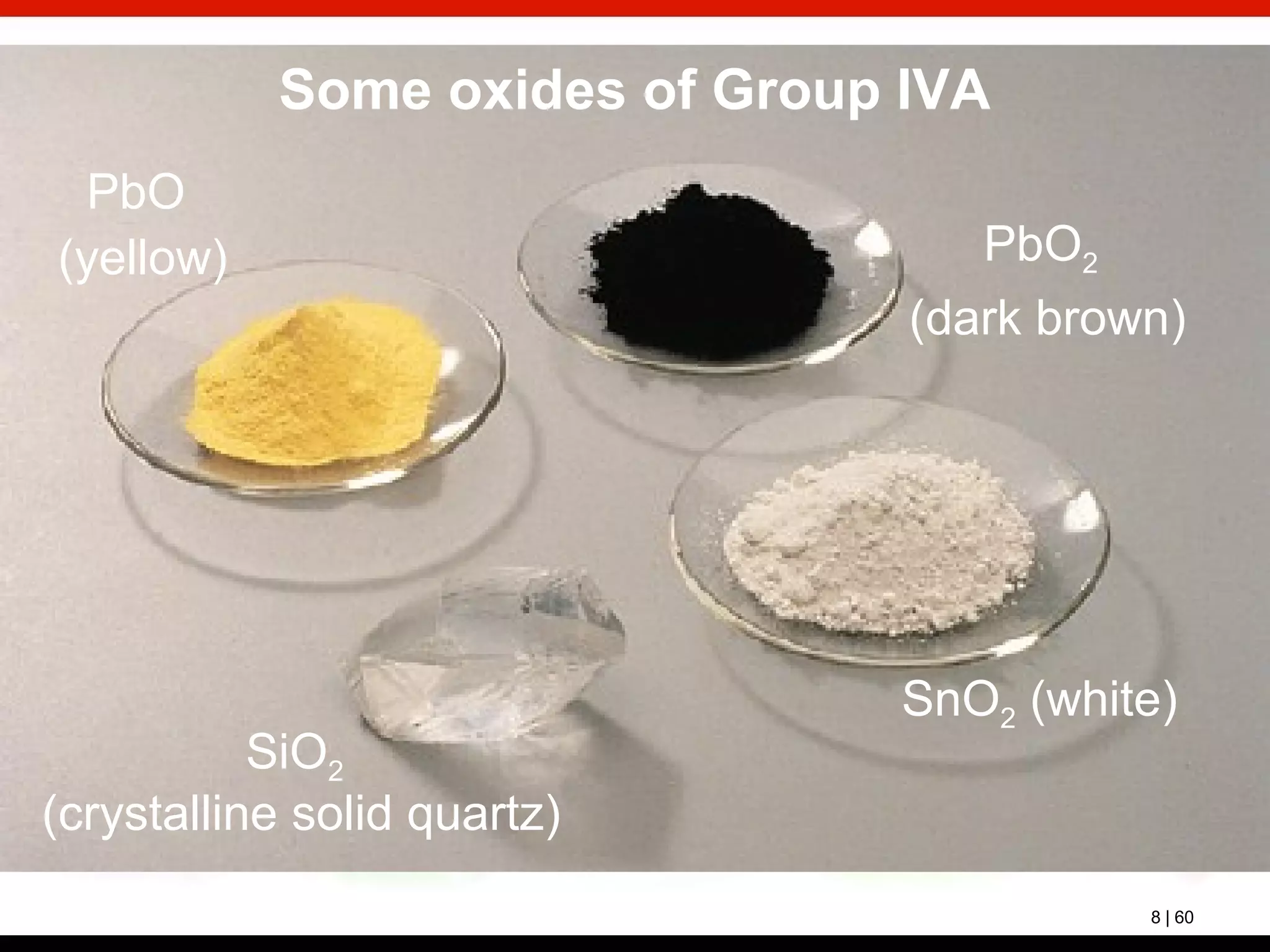
60.
8 | 60
PbO
(yellow)PbO2
(dark brown)
SiO2
(crystalline solid quartz)
SnO2 (white)
Some oxides of Group IVA
61.
8 | 61
GroupVA (ns2
np3
)
Nitrogen and phosphorus are nonmetals; arsenic
and antimony are metalloids; bismuth is a metal.
The oxide formulas are R2O3 and R2O5, with some
molecular formulas being double these.
Nitrogen, phosphorus, and arsenic oxides are
acidic; antimony oxides are amphoteric; bismuth
oxide is basic.
62.
8 | 62
GroupVIA, Chalcogens (ns2
np4
)
Oxygen, sulfur, and selenium are nonmetals;
tellurium is a metalloid; polonium is a metal.
The oxide formulas are RO2 and RO3.
Sulfur, selenium, and tellurium oxides are acidic
except for TeO2, which is amphoteric. PoO2 is also
amphoteric.
63.
8 | 63
GroupVIIA, Halogens (ns2
np5
)
These elements are reactive nonmetals, with the
general molecular formula being X2. All isotopes of
astatine are radioactive with short half-lives. This
element might be expected to be a metalloid.
Each halogen forms several acidic oxides that are
generally unstable.
64.
8 | 64
GroupVIIIA, Noble Gases (ns2
np6
)
These elements are generally unreactive, with only
the heavier elements forming unstable
compounds. They exist as gaseous atoms.
65.
8 | 65
Ris arsenic, As.
For R2O5 oxides, R must be in Group VA.
R is a metalloid, so R could be As or Sb.
The oxide is acidic, so
![8 | 15
The noble-gas configuration substitutes the
preceding noble gas for the core configuration and
explicitly shows subshells beyond that.
Br: [Ar]3d10
4s2
4p5](https://image.slidesharecdn.com/chapter8electronconfigurationandperiodicity1-180813185905/75/Chapter-8-electron-configuration-and-periodicity-1-15-2048.jpg)
![8 | 16
The pseudo-noble-gas core includes the noble-
gas subshells and the filled inner, (n – 1), d
subshell.
For bromine, the pseudo-noble-gas core is
[Ar]3d10](https://image.slidesharecdn.com/chapter8electronconfigurationandperiodicity1-180813185905/75/Chapter-8-electron-configuration-and-periodicity-1-16-2048.jpg)