Downloaded 76 times




![REFERENCES
^ G.L. Miessler and D.A.Tarr, Inorganic Chemistry
(Prentice-Hall, 2nd edn 1999)
[ISBN 0138418918], pp. 358-360](https://image.slidesharecdn.com/alyssamikaelafacun-hundsrule-161219051237/85/hund-s-rule-8-320.jpg)


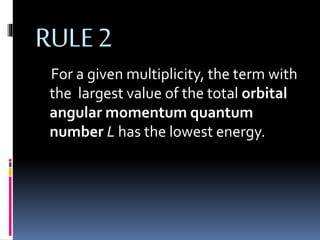
Hund's rules describe the ground state of multielectron atoms and ions. Rule 1 states that the atomic state with the highest total spin S will have the lowest energy. Rule 2 states that for a given spin multiplicity, the term with the largest orbital angular momentum L has the lowest energy. Rule 3 considers energy shifts due to spin-orbit coupling, where the splitting is determined by the spin-orbit coupling constant λ and the quantum numbers J, L, and S. Examples are provided to illustrate the application of Hund's rules to determine the ground states of silicon and titanium.


![The Heisenberg Uncertainty Principle[1]](https://cdn.slidesharecdn.com/ss_thumbnails/theheisenberguncertaintyprinciple1-091020215730-phpapp01-thumbnail.jpg?width=640&height=640&fit=bounds)


