Shruba Gangopadhyay
Email: shruba@gmail.com
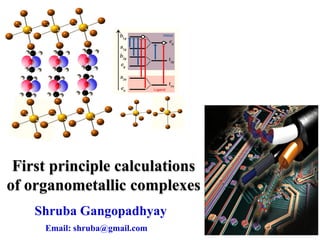
First principle calculations
of organometallic complexes
In this talk
 Molecular Magnet as qubit
implementation
 Use of DFT+U method to predict J
coupling
 Benchmarking Study
 Two qubit system: Mn12
(antiferromagnetic wheel)
 Spin frustrated system: Mn9
 Magnetic anisotropy predictions
 Future plans
2
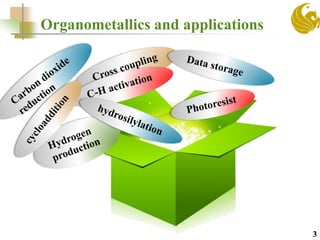
Organometallics and applications
3
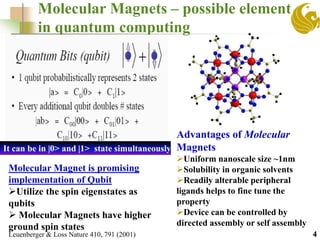
Molecular Magnets – possible element
in quantum computing
4Leuenberger & Loss Nature 410, 791 (2001)
Molecular Magnet is promising
implementation of Qubit
Utilize the spin eigenstates as
qubits
 Molecular Magnets have higher
ground spin states
It can be in |0> and |1> state simultaneously
Advantages of Molecular
Magnets
Uniform nanoscale size ~1nm
Solubility in organic solvents
Readily alterable peripheral
ligands helps to fine tune the
property
Device can be controlled by
directed assembly or self assembly
2-qubit system: Molecular Magnet [Mn12(Rdea)]
contains two weakly coupled subsystems
5
M=Methyl diethanolamine M=allyl diethanolamine
Subsystem spin should not be identical
Ion substitution may be used to redesign MM
6
Cr8 Molecular Ring
Cr7Ni Molecular Ring
[1] M. Affronte et al., Chemical Communications, 1789 (2007).
[2] M. Affronte et al., Polyhedron 24, 2562 (2005).
[3] G. A. Timco et al., Nature Nanotechnology 4, 173 (2009).
[4] F. Troiani et al., Phys Rev Lett 94, 207208 (2005).
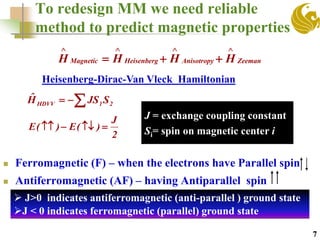
To redesign MM we need reliable
method to predict magnetic properties
 Ferromagnetic (F) – when the electrons have Parallel spin
 Antiferromagnetic (AF) – having Antiparallel spin
2
J
)(E)(E 
ZeemanAnisotropyHeisenbergMagnetic HHHH


7
Heisenberg-Dirac-Van Vleck Hamiltonian
J = exchange coupling constant
Si= spin on magnetic center i
 21HDVV SJSHˆ
 J>0 indicates antiferromagnetic (anti-parallel ) ground state
J < 0 indicates ferromagnetic (parallel) ground state
iiieff rV  





 )(
2
1 2
(1)

i
i rrn
2
)()(  (2)
Kohn-Sham equations
 
 
][)()(
][][][)]([
nFdrrvrn
nVnVnTrnE
HKext
eeext
Hohenberg-Kohn functional
Electronic density n(r) determines all ground state
properties of multi-electron system. Energy of the
ground state is a functional of electronic density:
Density Functional Theory (DFT)
prediction of J from first principles
8
Where  are KS orbitals, is the system of N effective one-particle equations
Energy can be predicted
for high and low spin states
9
Density Functional Theory (DFT)
E=E[ρ]
to simplify Kinetic part, total electron density is separated
into KS orbitals, describing 1e each:
Electron interaction accounted for self-consistently via
exchange-correlation potential
)()()'
|'|
)'(
( 2
2
1
rrVdr
rr
r
V iiixcext 



 
2
1
|)(|)( rr i
N
i
i  

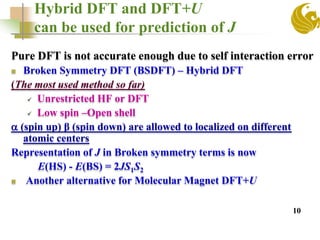
Hybrid DFT and DFT+U
can be used for prediction of J
Pure DFT is not accurate enough due to self interaction error
 Broken Symmetry DFT (BSDFT) – Hybrid DFT
(The most used method so far)
 Unrestricted HF or DFT
 Low spin –Open shell
 (spin up) β (spin down) are allowed to localized on different
atomic centers
Representation of J in Broken symmetry terms is now
E(HS) - E(BS) = 2JS1S2
 Another alternative for Molecular Magnet DFT+U
10
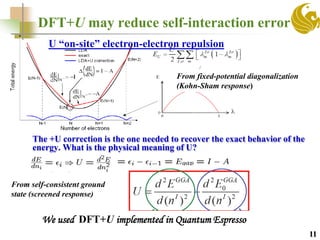
DFT+U may reduce self-interaction error
The +U correction is the one needed to recover the exact behavior of the
energy. What is the physical meaning of U?
From self-consistent ground
state (screened response)
From fixed-potential diagonalization
(Kohn-Sham response)
U “on-site” electron-electron repulsion
We used DFT+U implemented in Quantum Espresso
11
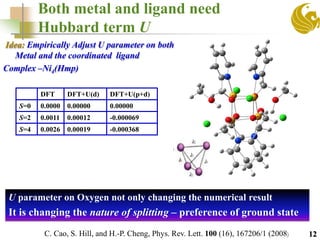
Both metal and ligand need
Hubbard term U
Idea: Empirically Adjust U parameter on both
Metal and the coordinated ligand
Complex –Ni4(Hmp)
DFT DFT+U(d) DFT+U(p+d)
S=0 0.0000 0.00000 0.00000
S=2 0.0011 0.00012 -0.000069
S=4 0.0026 0.00019 -0.000368
12
U parameter on Oxygen not only changing the numerical result
It is changing the nature of splitting – preference of ground state
C. Cao, S. Hill, and H.-P. Cheng, Phys. Rev. Lett. 100 (16), 167206/1 (2008)
Numeric values of U parameters for
different atom types are fitted using
benchmark set
Chemical formula
J (cm-1)
Plane Wave
calculations
BS-DFT Expt
DFT+U
metal+ligand
DFT+U
metal only
[Mn2 (IV)(μO)2 (phen)4]4+ -143.6 -166.6 -131.9 -147.0
[Mn2(IV)(μO)2((ac))(Me4dtne)]3+ -74.9 -87.4 -37.5 -100.0
[Mn2(III) (μO)(ac)2(tacn)2]2+ 5.6 -3.64 -40.0 10.0
[Mn2(II) (ac)3(bpea)2]+ -7.7 -18.8 - -1.3
[Mn(III)Mn(IV)(μO)2(ac)(tacn)2]2+ -234.0 -247.6 -405 -220
13
U (Mn)=2.1 eV, U(O)=1.0 eV, U(N)=0.2 eV
(Mn(IV))2 (OAc)
Exp BSDFT DFT+U
-100 -37 -74.9
Computational Details
Cutoff
25 Ryd
Smearing
Marzari-Vanderbilt cold smearing
Smearing Factor
0.0008
For better convergence
Local Thomas Fermi screening
14
Evaluation of J(cm-1)
We modify the source code of Quantum ESPRESSO to incorporate
U on Nitrogen
[Mn2(IV)(μO)2((ac))(Me4dtne)]3+
Mn(IV)- no acetate bridge
Exp BSDFT DFT+U
-147 -131 -164
15
Evaluation of J(cm-1)
[Mn2 (IV)(μO)2 (phen)4]4+
Exp BSDFT DFT+U
10 -40 29
16
Mn(III)
two acetate bridges
Evaluation of J(cm-1)
Exp BSDFT DFT+U
-1.5 -8
Mn(II)
three acetate bridges
[Mn2(II) (ac)3(bpea)2]+
[Mn2(III) (μO)(ac)2(tacn)2]2+
17
J cm-1 (MnIII-MnIV)
Exp BSDFT DFT+U
-220 -155 -234
Mixed valence Mn(III)-Mn(IV)
[Mn(III)Mn(IV)(μO)2(ac)(tacn)2]2+
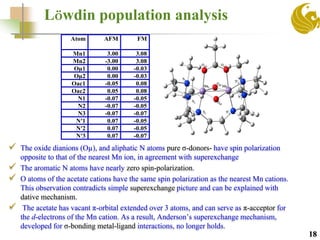
Löwdin population analysis
 The oxide dianions (Oµ), and aliphatic N atoms pure σ-donors- have spin polarization
opposite to that of the nearest Mn ion, in agreement with superexchange
 The aromatic N atoms have nearly zero spin-polarization.
 O atoms of the acetate cations have the same spin polarization as the nearest Mn cations.
This observation contradicts simple superexchange picture and can be explained with
dative mechanism.
 The acetate has vacant π-orbital extended over 3 atoms, and can serve as π-acceptor for
the d-electrons of the Mn cation. As a result, Anderson’s superexchange mechanism,
developed for σ-bonding metal-ligand interactions, no longer holds.
18
Atom AFM FM
Mn1 3.00 3.08
Mn2 -3.00 3.08
Oµ1 0.00 -0.03
Oµ2 0.00 -0.03
Oac1 -0.05 0.08
Oac2 0.05 0.08
N1 -0.07 -0.05
N2 -0.07 -0.05
N3 -0.07 -0.07
N′1 0.07 -0.05
N′2 0.07 -0.05
N′3 0.07 -0.07
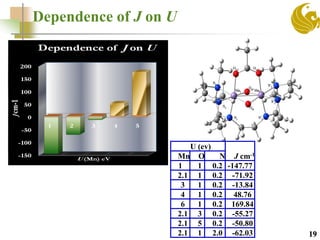
Dependence of J on U
19
U (ev)
J cm-1Mn O N
1 1 0.2 -147.77
2.1 1 0.2 -71.92
3 1 0.2 -13.84
4 1 0.2 48.76
6 1 0.2 169.84
2.1 3 0.2 -55.27
2.1 5 0.2 -50.80
2.1 1 2.0 -62.03
Failure of BSDFT
 Bimetallic complexes with Acetate Bridging ligand
 Complexes with Ferromagnetic Coupling
 Mix valence complexes
20
Chemical formula
J (cm-1)
Plane Wave
calculations
BS-DFT Expt
DFT+U
metal+ligand
DFT+U
metal only
[Mn2(IV)(μO)2((ac))(Me4dtne)]3+ -74.9 -87.4 -37.5 -100.0
[Mn2(III) (μO)(ac)2(tacn)2]2+ 5.6 -3.64 -40.0 10.0
[Mn(III)Mn(IV)(μO)2(ac)(tacn)2]2+ -234.0 -247.6 -405 -220
Two qubit system-[Mn12(Reda)] complex with
weakly coupled subsystems
21
Predict J for two
coupled sub system
Previous DFT Study predicted J=0
Whereas the J>0 experimentally
Methyl diethanolamine Allyl diethanolamine
22
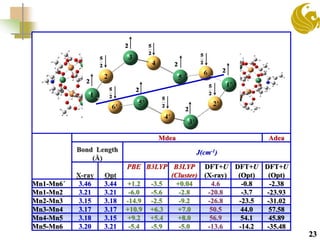
23
Mdea Adea
Bond Length
(Å)
J(cm-1)
X-ray Opt
PBE B3LYP B3LYP
(Cluster)
DFT+U
(X-ray)
DFT+U
(Opt)
DFT+U
(Opt)
Mn1-Mn6΄ 3.46 3.44 +1.2 -3.5 +0.04 4.6 -0.8 -2.38
Mn1-Mn2 3.21 3.21 -6.0 -5.6 -2.8 -20.8 -3.7 -23.93
Mn2-Mn3 3.15 3.18 -14.9 -2.5 -9.2 -26.8 -23.5 -31.02
Mn3-Mn4 3.17 3.17 +10.9 +6.3 +7.0 50.5 44.0 57.58
Mn4-Mn5 3.18 3.15 +9.2 +5.4 +8.0 56.9 54.1 45.89
Mn5-Mn6 3.20 3.21 -5.4 -5.9 -5.0 -13.6 -14.2 -35.48
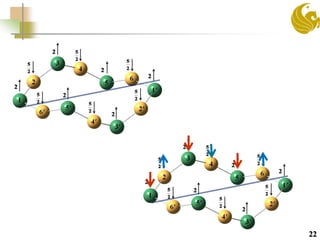
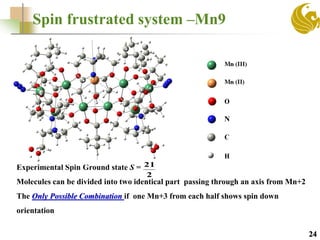
Spin frustrated system –Mn9
24
Experimental Spin Ground state S =
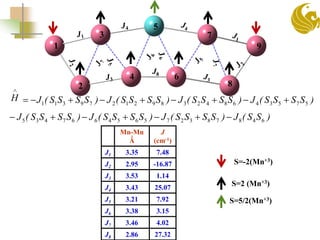
Molecules can be divided into two identical part passing through an axis from Mn+2
The Only Possible Combination if one Mn+3 from each half shows spin down
orientation
2
21
J8
S=-2(Mn+3)
S=2 (Mn+3)
S=5/2(Mn+3)
)SS(J)SSSS(J)SSSS(J)SSSS(J
)SSSS(J)SSSS(J)SSSS(J)SSSS(JH
648783275654667435
57534684238921279311



Mn-Mn
Ǻ
J
(cm-1)
J1 3.35 7.48
J2 2.95 -16.87
J3 3.53 1.14
J4 3.43 25.07
J5 3.21 7.92
J6 3.38 3.15
J7 3.46 4.02
J8 2.86 27.32
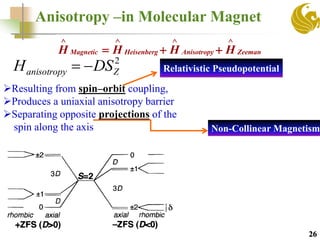
Anisotropy –in Molecular Magnet
ZeemanAnisotropyHeisenbergMagnetic HHHH


26
2
Zanisotropy DSH 
Resulting from spin–orbit coupling,
Produces a uniaxial anisotropy barrier
Separating opposite projections of the
spin along the axis
Relativistic Pseudopotential
Non-Collinear Magnetism
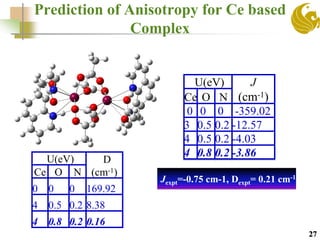
Prediction of Anisotropy for Ce based
Complex
27
U(eV) J
(cm-1)Ce O N
0 0 0 -359.02
3 0.5 0.2 -12.57
4 0.5 0.2 -4.03
4 0.8 0.2 -3.86
U(eV) D
(cm-1)Ce O N
0 0 0 169.92
4 0.5 0.2 8.38
4 0.8 0.2 0.16
Jexpt=-0.75 cm-1, Dexpt= 0.21 cm-1
Summary
 To predict correct J values we need to include U
parameters on both metal and ligand
 Geometry Optimization of ground state is extremely
important for correct prediction of J values
 Exclusion of U Parameters on ligand atoms leads
incorrect ferromagnetic ground state
 Anisoptropy prediction needs relativistic pseudopotential
 For Anisotropy we need good starting wave function for
ground spin state of the molecule
28
Acknowledgements
29
 Prof. Artem Masunov
 Prof. Michael Leuenberger
 Eliza Poalelungi
 Prof. George Christou
 Arpita Pal
 NERSC Supercomputing Facilities (m990)
 ACS Supercomputing Award for Teragrid
30

Magnetism of organometallics with DFT (an alternate approach)

  • 1.
    Shruba Gangopadhyay Email: shruba@gmail.com Firstprinciple calculations of organometallic complexes
  • 2.
    In this talk Molecular Magnet as qubit implementation  Use of DFT+U method to predict J coupling  Benchmarking Study  Two qubit system: Mn12 (antiferromagnetic wheel)  Spin frustrated system: Mn9  Magnetic anisotropy predictions  Future plans 2
  • 3.
  • 4.
    Molecular Magnets –possible element in quantum computing 4Leuenberger & Loss Nature 410, 791 (2001) Molecular Magnet is promising implementation of Qubit Utilize the spin eigenstates as qubits  Molecular Magnets have higher ground spin states It can be in |0> and |1> state simultaneously Advantages of Molecular Magnets Uniform nanoscale size ~1nm Solubility in organic solvents Readily alterable peripheral ligands helps to fine tune the property Device can be controlled by directed assembly or self assembly
  • 5.
    2-qubit system: MolecularMagnet [Mn12(Rdea)] contains two weakly coupled subsystems 5 M=Methyl diethanolamine M=allyl diethanolamine Subsystem spin should not be identical
  • 6.
    Ion substitution maybe used to redesign MM 6 Cr8 Molecular Ring Cr7Ni Molecular Ring [1] M. Affronte et al., Chemical Communications, 1789 (2007). [2] M. Affronte et al., Polyhedron 24, 2562 (2005). [3] G. A. Timco et al., Nature Nanotechnology 4, 173 (2009). [4] F. Troiani et al., Phys Rev Lett 94, 207208 (2005).
  • 7.
    To redesign MMwe need reliable method to predict magnetic properties  Ferromagnetic (F) – when the electrons have Parallel spin  Antiferromagnetic (AF) – having Antiparallel spin 2 J )(E)(E  ZeemanAnisotropyHeisenbergMagnetic HHHH   7 Heisenberg-Dirac-Van Vleck Hamiltonian J = exchange coupling constant Si= spin on magnetic center i  21HDVV SJSHˆ  J>0 indicates antiferromagnetic (anti-parallel ) ground state J < 0 indicates ferromagnetic (parallel) ground state
  • 8.
    iiieff rV        )( 2 1 2 (1)  i i rrn 2 )()(  (2) Kohn-Sham equations     ][)()( ][][][)]([ nFdrrvrn nVnVnTrnE HKext eeext Hohenberg-Kohn functional Electronic density n(r) determines all ground state properties of multi-electron system. Energy of the ground state is a functional of electronic density: Density Functional Theory (DFT) prediction of J from first principles 8 Where  are KS orbitals, is the system of N effective one-particle equations
  • 9.
    Energy can bepredicted for high and low spin states 9 Density Functional Theory (DFT) E=E[ρ] to simplify Kinetic part, total electron density is separated into KS orbitals, describing 1e each: Electron interaction accounted for self-consistently via exchange-correlation potential )()()' |'| )'( ( 2 2 1 rrVdr rr r V iiixcext       2 1 |)(|)( rr i N i i   
  • 10.
    Hybrid DFT andDFT+U can be used for prediction of J Pure DFT is not accurate enough due to self interaction error  Broken Symmetry DFT (BSDFT) – Hybrid DFT (The most used method so far)  Unrestricted HF or DFT  Low spin –Open shell  (spin up) β (spin down) are allowed to localized on different atomic centers Representation of J in Broken symmetry terms is now E(HS) - E(BS) = 2JS1S2  Another alternative for Molecular Magnet DFT+U 10
  • 11.
    DFT+U may reduceself-interaction error The +U correction is the one needed to recover the exact behavior of the energy. What is the physical meaning of U? From self-consistent ground state (screened response) From fixed-potential diagonalization (Kohn-Sham response) U “on-site” electron-electron repulsion We used DFT+U implemented in Quantum Espresso 11
  • 12.
    Both metal andligand need Hubbard term U Idea: Empirically Adjust U parameter on both Metal and the coordinated ligand Complex –Ni4(Hmp) DFT DFT+U(d) DFT+U(p+d) S=0 0.0000 0.00000 0.00000 S=2 0.0011 0.00012 -0.000069 S=4 0.0026 0.00019 -0.000368 12 U parameter on Oxygen not only changing the numerical result It is changing the nature of splitting – preference of ground state C. Cao, S. Hill, and H.-P. Cheng, Phys. Rev. Lett. 100 (16), 167206/1 (2008)
  • 13.
    Numeric values ofU parameters for different atom types are fitted using benchmark set Chemical formula J (cm-1) Plane Wave calculations BS-DFT Expt DFT+U metal+ligand DFT+U metal only [Mn2 (IV)(μO)2 (phen)4]4+ -143.6 -166.6 -131.9 -147.0 [Mn2(IV)(μO)2((ac))(Me4dtne)]3+ -74.9 -87.4 -37.5 -100.0 [Mn2(III) (μO)(ac)2(tacn)2]2+ 5.6 -3.64 -40.0 10.0 [Mn2(II) (ac)3(bpea)2]+ -7.7 -18.8 - -1.3 [Mn(III)Mn(IV)(μO)2(ac)(tacn)2]2+ -234.0 -247.6 -405 -220 13 U (Mn)=2.1 eV, U(O)=1.0 eV, U(N)=0.2 eV
  • 14.
    (Mn(IV))2 (OAc) Exp BSDFTDFT+U -100 -37 -74.9 Computational Details Cutoff 25 Ryd Smearing Marzari-Vanderbilt cold smearing Smearing Factor 0.0008 For better convergence Local Thomas Fermi screening 14 Evaluation of J(cm-1) We modify the source code of Quantum ESPRESSO to incorporate U on Nitrogen [Mn2(IV)(μO)2((ac))(Me4dtne)]3+
  • 15.
    Mn(IV)- no acetatebridge Exp BSDFT DFT+U -147 -131 -164 15 Evaluation of J(cm-1) [Mn2 (IV)(μO)2 (phen)4]4+
  • 16.
    Exp BSDFT DFT+U 10-40 29 16 Mn(III) two acetate bridges Evaluation of J(cm-1) Exp BSDFT DFT+U -1.5 -8 Mn(II) three acetate bridges [Mn2(II) (ac)3(bpea)2]+ [Mn2(III) (μO)(ac)2(tacn)2]2+
  • 17.
    17 J cm-1 (MnIII-MnIV) ExpBSDFT DFT+U -220 -155 -234 Mixed valence Mn(III)-Mn(IV) [Mn(III)Mn(IV)(μO)2(ac)(tacn)2]2+
  • 18.
    Löwdin population analysis The oxide dianions (Oµ), and aliphatic N atoms pure σ-donors- have spin polarization opposite to that of the nearest Mn ion, in agreement with superexchange  The aromatic N atoms have nearly zero spin-polarization.  O atoms of the acetate cations have the same spin polarization as the nearest Mn cations. This observation contradicts simple superexchange picture and can be explained with dative mechanism.  The acetate has vacant π-orbital extended over 3 atoms, and can serve as π-acceptor for the d-electrons of the Mn cation. As a result, Anderson’s superexchange mechanism, developed for σ-bonding metal-ligand interactions, no longer holds. 18 Atom AFM FM Mn1 3.00 3.08 Mn2 -3.00 3.08 Oµ1 0.00 -0.03 Oµ2 0.00 -0.03 Oac1 -0.05 0.08 Oac2 0.05 0.08 N1 -0.07 -0.05 N2 -0.07 -0.05 N3 -0.07 -0.07 N′1 0.07 -0.05 N′2 0.07 -0.05 N′3 0.07 -0.07
  • 19.
    Dependence of Jon U 19 U (ev) J cm-1Mn O N 1 1 0.2 -147.77 2.1 1 0.2 -71.92 3 1 0.2 -13.84 4 1 0.2 48.76 6 1 0.2 169.84 2.1 3 0.2 -55.27 2.1 5 0.2 -50.80 2.1 1 2.0 -62.03
  • 20.
    Failure of BSDFT Bimetallic complexes with Acetate Bridging ligand  Complexes with Ferromagnetic Coupling  Mix valence complexes 20 Chemical formula J (cm-1) Plane Wave calculations BS-DFT Expt DFT+U metal+ligand DFT+U metal only [Mn2(IV)(μO)2((ac))(Me4dtne)]3+ -74.9 -87.4 -37.5 -100.0 [Mn2(III) (μO)(ac)2(tacn)2]2+ 5.6 -3.64 -40.0 10.0 [Mn(III)Mn(IV)(μO)2(ac)(tacn)2]2+ -234.0 -247.6 -405 -220
  • 21.
    Two qubit system-[Mn12(Reda)]complex with weakly coupled subsystems 21 Predict J for two coupled sub system Previous DFT Study predicted J=0 Whereas the J>0 experimentally Methyl diethanolamine Allyl diethanolamine
  • 22.
  • 23.
    23 Mdea Adea Bond Length (Å) J(cm-1) X-rayOpt PBE B3LYP B3LYP (Cluster) DFT+U (X-ray) DFT+U (Opt) DFT+U (Opt) Mn1-Mn6΄ 3.46 3.44 +1.2 -3.5 +0.04 4.6 -0.8 -2.38 Mn1-Mn2 3.21 3.21 -6.0 -5.6 -2.8 -20.8 -3.7 -23.93 Mn2-Mn3 3.15 3.18 -14.9 -2.5 -9.2 -26.8 -23.5 -31.02 Mn3-Mn4 3.17 3.17 +10.9 +6.3 +7.0 50.5 44.0 57.58 Mn4-Mn5 3.18 3.15 +9.2 +5.4 +8.0 56.9 54.1 45.89 Mn5-Mn6 3.20 3.21 -5.4 -5.9 -5.0 -13.6 -14.2 -35.48
  • 24.
    Spin frustrated system–Mn9 24 Experimental Spin Ground state S = Molecules can be divided into two identical part passing through an axis from Mn+2 The Only Possible Combination if one Mn+3 from each half shows spin down orientation 2 21
  • 25.
  • 26.
    Anisotropy –in MolecularMagnet ZeemanAnisotropyHeisenbergMagnetic HHHH   26 2 Zanisotropy DSH  Resulting from spin–orbit coupling, Produces a uniaxial anisotropy barrier Separating opposite projections of the spin along the axis Relativistic Pseudopotential Non-Collinear Magnetism
  • 27.
    Prediction of Anisotropyfor Ce based Complex 27 U(eV) J (cm-1)Ce O N 0 0 0 -359.02 3 0.5 0.2 -12.57 4 0.5 0.2 -4.03 4 0.8 0.2 -3.86 U(eV) D (cm-1)Ce O N 0 0 0 169.92 4 0.5 0.2 8.38 4 0.8 0.2 0.16 Jexpt=-0.75 cm-1, Dexpt= 0.21 cm-1
  • 28.
    Summary  To predictcorrect J values we need to include U parameters on both metal and ligand  Geometry Optimization of ground state is extremely important for correct prediction of J values  Exclusion of U Parameters on ligand atoms leads incorrect ferromagnetic ground state  Anisoptropy prediction needs relativistic pseudopotential  For Anisotropy we need good starting wave function for ground spin state of the molecule 28
  • 29.
    Acknowledgements 29  Prof. ArtemMasunov  Prof. Michael Leuenberger  Eliza Poalelungi  Prof. George Christou  Arpita Pal  NERSC Supercomputing Facilities (m990)  ACS Supercomputing Award for Teragrid
  • 30.