Group VII
Group VII
The focus for Inorganic Chem (Gp II, VII, Transition
Elements) is the trends for the physical and

chemical properties of the elements.
Physical Properties
Colour/ State
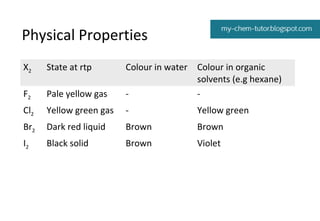
It is important to memorise the colour/ state of halogens
as it is often needed for identification of unknown
halogens.
Physical Properties
X2

State at rtp

F2

Pale yellow gas

Colour in water Colour in organic
solvents (e.g hexane)
-

Cl2

Yellow green gas

-

Yellow green

Br2

Dark red liquid

Brown

Brown

I2

Black solid

Brown

Violet
Physical Properties
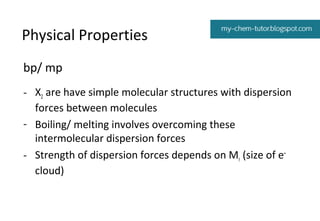
bp/ mp
- X2 are have simple molecular structures with dispersion
forces between molecules
- Boiling/ melting involves overcoming these
intermolecular dispersion forces
- Strength of dispersion forces depends on Mr (size of e–
cloud)
Physical Properties
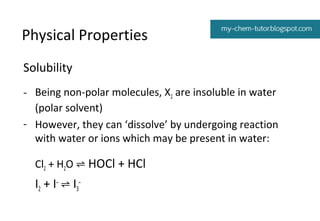
Solubility
- Being non-polar molecules, X2 are insoluble in water
(polar solvent)
- However, they can ‘dissolve’ by undergoing reaction
with water or ions which may be present in water:
Cl2 + H2O ⇌ HOCl + HCl

I2 + I– ⇌ I3–
Chemical Properties
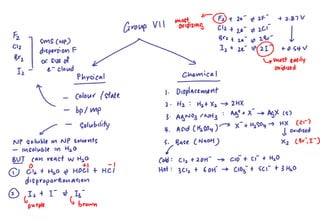
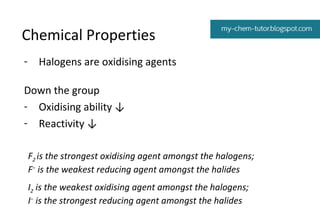
- Halogens are oxidising agents
Down the group
- Oxidising ability ↓
- Reactivity ↓
F2 is the strongest oxidising agent amongst the halogens;
F− is the weakest reducing agent amongst the halides
I2 is the weakest oxidising agent amongst the halogens;
I− is the strongest reducing agent amongst the halides
Chemical Properties
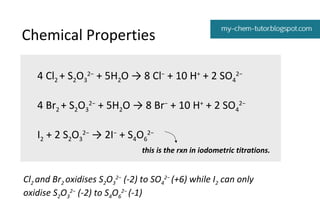
4 Cl2 + S2O32− + 5H2O → 8 Cl− + 10 H+ + 2 SO42−
4 Br2 + S2O32− + 5H2O → 8 Br− + 10 H+ + 2 SO42−
I2 + 2 S2O32− → 2I− + S4O62−
this is the rxn in iodometric titrations.

Cl2 and Br2 oxidises S2O32− (-2) to SO42− (+6) while I2 can only
oxidise S2O32− (-2) to S4O62− (-1)
Chemical Properties
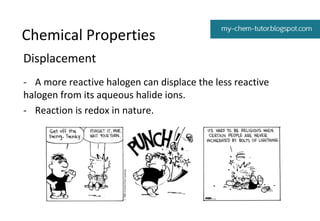
Displacement
- A more reactive halogen can displace the less reactive
halogen from its aqueous halide ions.
- Reaction is redox in nature.
Chemical Properties
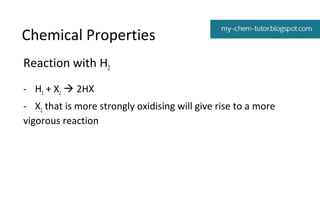
Reaction with H2
- H2 + X2  2HX
- X2 that is more strongly oxidising will give rise to a more
vigorous reaction
Chemical Properties
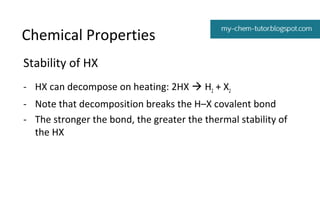
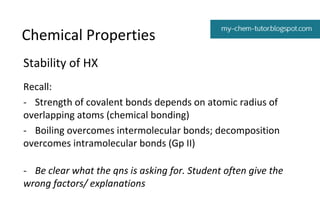
Stability of HX
- HX can decompose on heating: 2HX  H2 + X2
- Note that decomposition breaks the H–X covalent bond
- The stronger the bond, the greater the thermal stability of
the HX
Chemical Properties
Stability of HX
Recall:
- Strength of covalent bonds depends on atomic radius of
overlapping atoms (chemical bonding)
- Boiling overcomes intermolecular bonds; decomposition
overcomes intramolecular bonds (Gp II)
- Be clear what the qns is asking for. Student often give the
wrong factors/ explanations
Chemical Properties
Halide

+ AgNO3 (aq)

+ NH3

Cl– (aq)

white ppt

soluble in aq NH3

Br– (aq)

cream ppt

insoluble in aq NH3; soluble in conc
NH3

I– (aq)

yellow ppt

insoluble in aq NH3 and conc NH3

Ag+ + X–  AgX
(s)

AgX (s) ⇌ Ag+ + X–
Ag+ + 2NH3 ⇌ [Ag(NH3)2]+
Chemical Properties
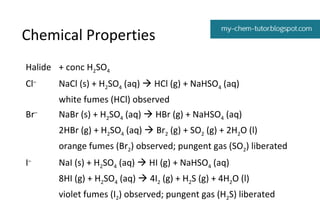
Halide + conc H2SO4
Cl–

NaCl (s) + H2SO4 (aq)  HCl (g) + NaHSO4 (aq)
white fumes (HCl) observed

Br–

NaBr (s) + H2SO4 (aq)  HBr (g) + NaHSO4 (aq)
2HBr (g) + H2SO4 (aq)  Br2 (g) + SO2 (g) + 2H2O (l)
orange fumes (Br2) observed; pungent gas (SO2) liberated

I–

NaI (s) + H2SO4 (aq)  HI (g) + NaHSO4 (aq)
8HI (g) + H2SO4 (aq)  4I2 (g) + H2S (g) + 4H2O (l)
violet fumes (I2) observed; pungent gas (H2S) liberated
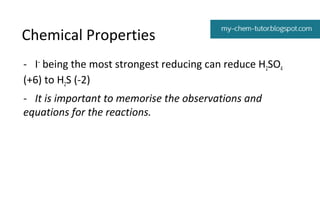
Chemical Properties
- I– being the most strongest reducing can reduce H2SO4
(+6) to H2S (-2)
- It is important to memorise the observations and
equations for the reactions.

Group VII

  • 1.
  • 2.
    Group VII The focusfor Inorganic Chem (Gp II, VII, Transition Elements) is the trends for the physical and chemical properties of the elements.
  • 4.
    Physical Properties Colour/ State Itis important to memorise the colour/ state of halogens as it is often needed for identification of unknown halogens.
  • 5.
    Physical Properties X2 State atrtp F2 Pale yellow gas Colour in water Colour in organic solvents (e.g hexane) - Cl2 Yellow green gas - Yellow green Br2 Dark red liquid Brown Brown I2 Black solid Brown Violet
  • 6.
    Physical Properties bp/ mp -X2 are have simple molecular structures with dispersion forces between molecules - Boiling/ melting involves overcoming these intermolecular dispersion forces - Strength of dispersion forces depends on Mr (size of e– cloud)
  • 7.
    Physical Properties Solubility - Beingnon-polar molecules, X2 are insoluble in water (polar solvent) - However, they can ‘dissolve’ by undergoing reaction with water or ions which may be present in water: Cl2 + H2O ⇌ HOCl + HCl I2 + I– ⇌ I3–
  • 8.
    Chemical Properties - Halogensare oxidising agents Down the group - Oxidising ability ↓ - Reactivity ↓ F2 is the strongest oxidising agent amongst the halogens; F− is the weakest reducing agent amongst the halides I2 is the weakest oxidising agent amongst the halogens; I− is the strongest reducing agent amongst the halides
  • 9.
    Chemical Properties 4 Cl2+ S2O32− + 5H2O → 8 Cl− + 10 H+ + 2 SO42− 4 Br2 + S2O32− + 5H2O → 8 Br− + 10 H+ + 2 SO42− I2 + 2 S2O32− → 2I− + S4O62− this is the rxn in iodometric titrations. Cl2 and Br2 oxidises S2O32− (-2) to SO42− (+6) while I2 can only oxidise S2O32− (-2) to S4O62− (-1)
  • 10.
    Chemical Properties Displacement - Amore reactive halogen can displace the less reactive halogen from its aqueous halide ions. - Reaction is redox in nature.
  • 11.
    Chemical Properties Reaction withH2 - H2 + X2  2HX - X2 that is more strongly oxidising will give rise to a more vigorous reaction
  • 12.
    Chemical Properties Stability ofHX - HX can decompose on heating: 2HX  H2 + X2 - Note that decomposition breaks the H–X covalent bond - The stronger the bond, the greater the thermal stability of the HX
  • 13.
    Chemical Properties Stability ofHX Recall: - Strength of covalent bonds depends on atomic radius of overlapping atoms (chemical bonding) - Boiling overcomes intermolecular bonds; decomposition overcomes intramolecular bonds (Gp II) - Be clear what the qns is asking for. Student often give the wrong factors/ explanations
  • 14.
    Chemical Properties Halide + AgNO3(aq) + NH3 Cl– (aq) white ppt soluble in aq NH3 Br– (aq) cream ppt insoluble in aq NH3; soluble in conc NH3 I– (aq) yellow ppt insoluble in aq NH3 and conc NH3 Ag+ + X–  AgX (s) AgX (s) ⇌ Ag+ + X– Ag+ + 2NH3 ⇌ [Ag(NH3)2]+
  • 15.
    Chemical Properties Halide +conc H2SO4 Cl– NaCl (s) + H2SO4 (aq)  HCl (g) + NaHSO4 (aq) white fumes (HCl) observed Br– NaBr (s) + H2SO4 (aq)  HBr (g) + NaHSO4 (aq) 2HBr (g) + H2SO4 (aq)  Br2 (g) + SO2 (g) + 2H2O (l) orange fumes (Br2) observed; pungent gas (SO2) liberated I– NaI (s) + H2SO4 (aq)  HI (g) + NaHSO4 (aq) 8HI (g) + H2SO4 (aq)  4I2 (g) + H2S (g) + 4H2O (l) violet fumes (I2) observed; pungent gas (H2S) liberated
  • 16.
    Chemical Properties - I–being the most strongest reducing can reduce H2SO4 (+6) to H2S (-2) - It is important to memorise the observations and equations for the reactions.