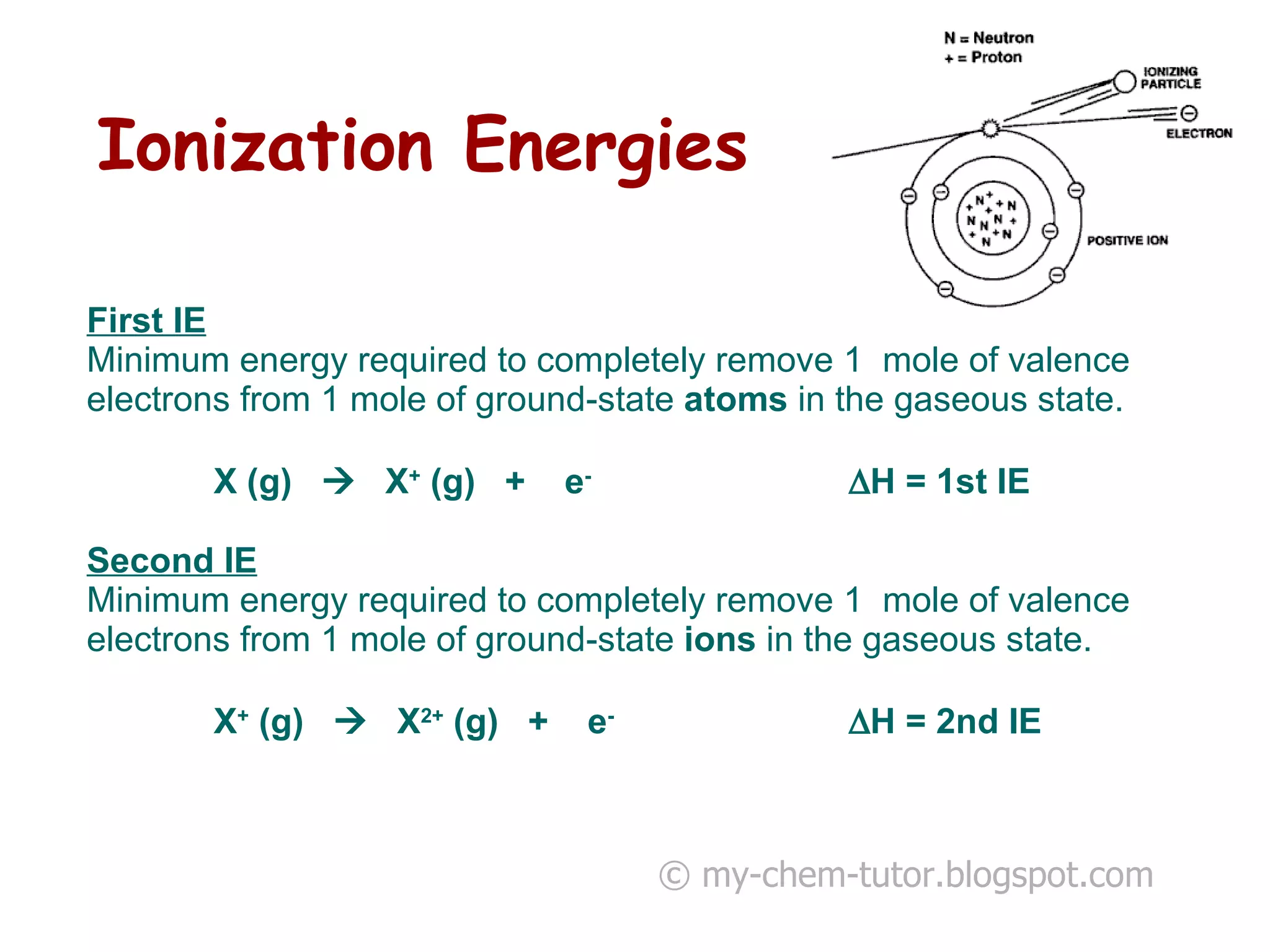
Ionization Energies   © my-chem-tutor.blogspot.com First IE Minimum energy required to completely remove 1  mole of valence electrons from 1 mole of ground-state  atoms  in the gaseous state. X (g)     X +  (g)  +  e -    H = 1st IE Second IE   Minimum energy required to completely remove 1  mole of valence electrons from 1 mole of ground-state  ions  in the gaseous state. X +  (g)     X 2+  (g)  +  e -     H = 2nd IE
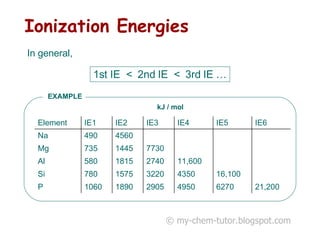
Ionization Energies   © my-chem-tutor.blogspot.com In general, 1st IE  <  2nd IE  <  3rd IE … EXAMPLE kJ / mol 21,200 6270 4950 2905 1890 1060 P    16,100 4350 3220 1575 780 Si       11,600 2740 1815 580 Al          7730 1445 735 Mg             4560 490 Na IE6 IE5 IE4 IE3 IE2 IE1 Element
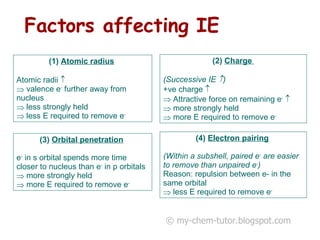
Factors affecting IE (4)  Electron pairing   (Within a subshell, paired e -  are easier to remove than unpaired e - ) Reason: repulsion between e- in the same orbital less E required to remove e - Atomic radius   Atomic radii     valence e -  further away from nucleus  less strongly held  less E required to remove e - (2)  Charge  (Successive IE   ) +ve charge     Attractive force on remaining e -    more strongly held  more E required to remove e - (3)  Orbital penetration   e -  in s orbital spends more time closer to nucleus than e -  in p orbitals  more strongly held more E required to remove e - © my-chem-tutor.blogspot.com
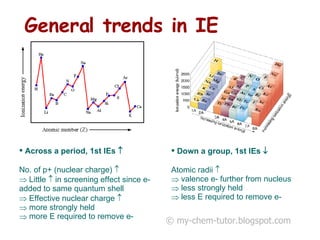
General trends in IE © my-chem-tutor.blogspot.com Down a group, 1st IEs     Atomic radii     valence e- further from nucleus less strongly held  less E required to remove e- Across a period, 1st IEs   No. of p+ (nuclear charge)     Little     in screening effect since e- added to same quantum shell  Effective nuclear charge   more strongly held more E required to remove e-
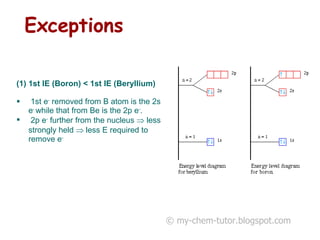
Exceptions © my-chem-tutor.blogspot.com 1st IE (Boron) < 1st IE (Beryllium) 1st e -  removed from B atom is the 2s e -   while that from Be is the 2p e - . 2p e -  further from the nucleus      less strongly held    less E required to remove e -
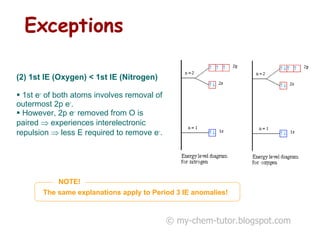
Exceptions © my-chem-tutor.blogspot.com (2) 1st IE (Oxygen) < 1st IE (Nitrogen) 1st e -  of both atoms involves removal of outermost 2p e - . However, 2p e -  removed from O is paired      experiences interelectronic repulsion    less E required to remove e - . The same explanations apply to Period 3 IE anomalies! NOTE!

Atomic Structure (III)

  • 1.
    Ionization Energies © my-chem-tutor.blogspot.com First IE Minimum energy required to completely remove 1 mole of valence electrons from 1 mole of ground-state atoms in the gaseous state. X (g)  X + (g) + e -  H = 1st IE Second IE Minimum energy required to completely remove 1 mole of valence electrons from 1 mole of ground-state ions in the gaseous state. X + (g)  X 2+ (g) + e -  H = 2nd IE
  • 2.
    Ionization Energies © my-chem-tutor.blogspot.com In general, 1st IE < 2nd IE < 3rd IE … EXAMPLE kJ / mol 21,200 6270 4950 2905 1890 1060 P   16,100 4350 3220 1575 780 Si     11,600 2740 1815 580 Al       7730 1445 735 Mg         4560 490 Na IE6 IE5 IE4 IE3 IE2 IE1 Element
  • 3.
    Factors affecting IE(4) Electron pairing (Within a subshell, paired e - are easier to remove than unpaired e - ) Reason: repulsion between e- in the same orbital less E required to remove e - Atomic radius Atomic radii  valence e - further away from nucleus less strongly held less E required to remove e - (2) Charge (Successive IE  ) +ve charge  Attractive force on remaining e -  more strongly held more E required to remove e - (3) Orbital penetration e - in s orbital spends more time closer to nucleus than e - in p orbitals more strongly held more E required to remove e - © my-chem-tutor.blogspot.com
  • 4.
    General trends inIE © my-chem-tutor.blogspot.com Down a group, 1st IEs  Atomic radii  valence e- further from nucleus less strongly held less E required to remove e- Across a period, 1st IEs  No. of p+ (nuclear charge)  Little  in screening effect since e- added to same quantum shell Effective nuclear charge  more strongly held more E required to remove e-
  • 5.
    Exceptions © my-chem-tutor.blogspot.com1st IE (Boron) < 1st IE (Beryllium) 1st e - removed from B atom is the 2s e - while that from Be is the 2p e - . 2p e - further from the nucleus  less strongly held  less E required to remove e -
  • 6.
    Exceptions © my-chem-tutor.blogspot.com(2) 1st IE (Oxygen) < 1st IE (Nitrogen) 1st e - of both atoms involves removal of outermost 2p e - . However, 2p e - removed from O is paired  experiences interelectronic repulsion  less E required to remove e - . The same explanations apply to Period 3 IE anomalies! NOTE!