Atomic structure
Omit qst 5, 7, 8 - in notes
Omit qst 2,20 - in examples
Dalton’s Atomic Theory
• All elements are composed of tiny indivisible particles
called atoms.
• Atoms of the same element are identical. The atoms of any
one element are different from those of any other element.
• Atoms of different elements can combine with another in
simple whole number ratios to form compounds.
• Chemical reactions occur when atoms are separated,
joined, or rearranged. However, atoms of one element
cannot be changed into atoms of another element by a
chemical reaction.
Dalton’s Atomic Theory
• All elements are composed of tiny indivisible particles
called atoms.
• Atoms of the same element are identical. The atoms of any
one element are different from those of any other element.
• Atoms of different elements can combine with another in
simple whole number ratios to form compounds.
• Chemical reactions occur when atoms are separated,
joined, or rearranged. However, atoms of one element
cannot be changed into atoms of another element by a
chemical reaction.
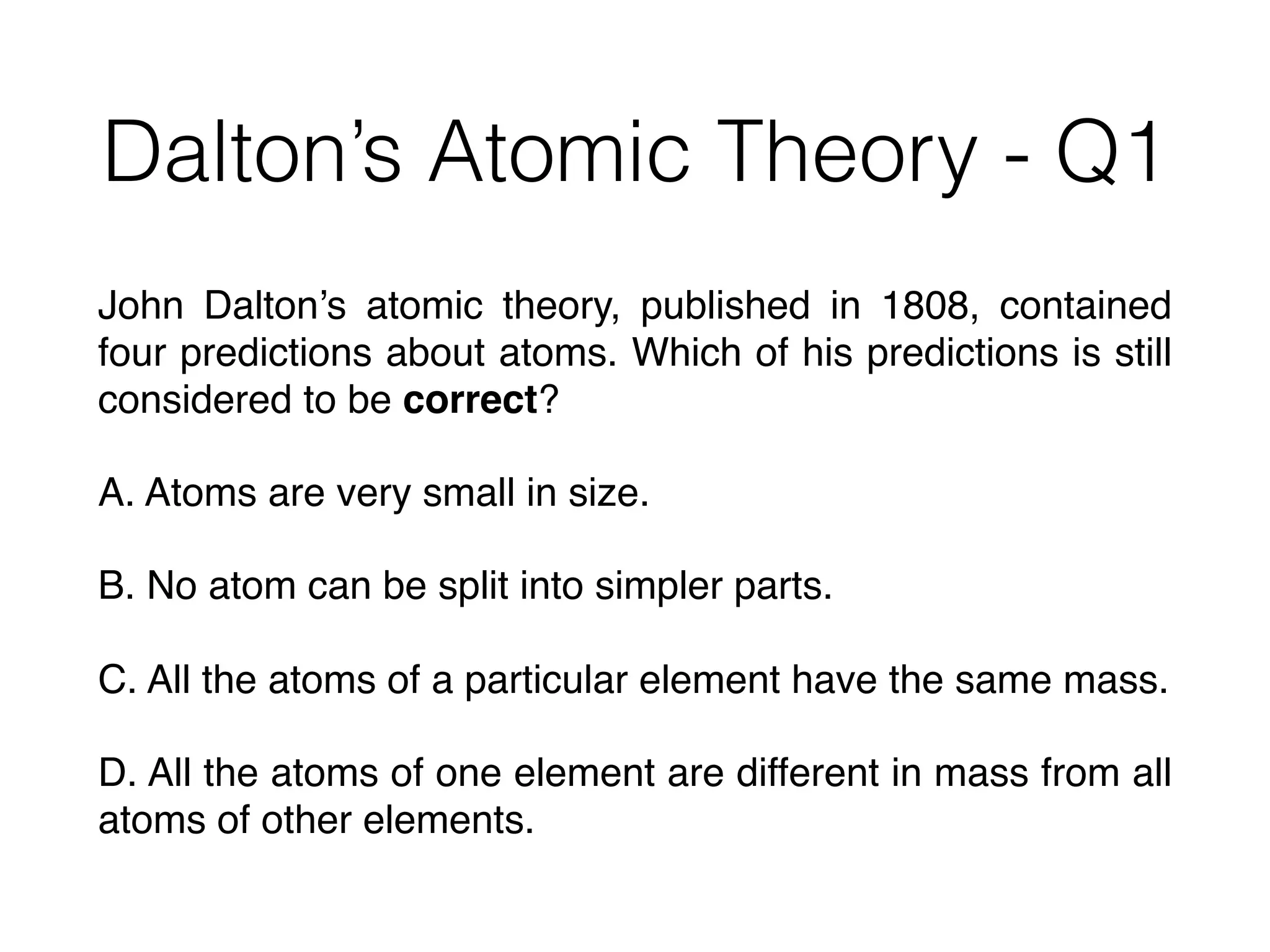
Dalton’s Atomic Theory - Q1
John Dalton’s atomic theory, published in 1808, contained
four predictions about atoms. Which of his predictions is still
considered to be correct?
A. Atoms are very small in size.
B. No atom can be split into simpler parts.
C. All the atoms of a particular element have the same mass.
D. All the atoms of one element are different in mass from all
atoms of other elements.
Radioactivity
• Radioactivity - a result of unstable nuclei
• (Review history?)
• The Periodic Table arranges elements in order of
increasing proton (or atomic) number, NOT mass
number.
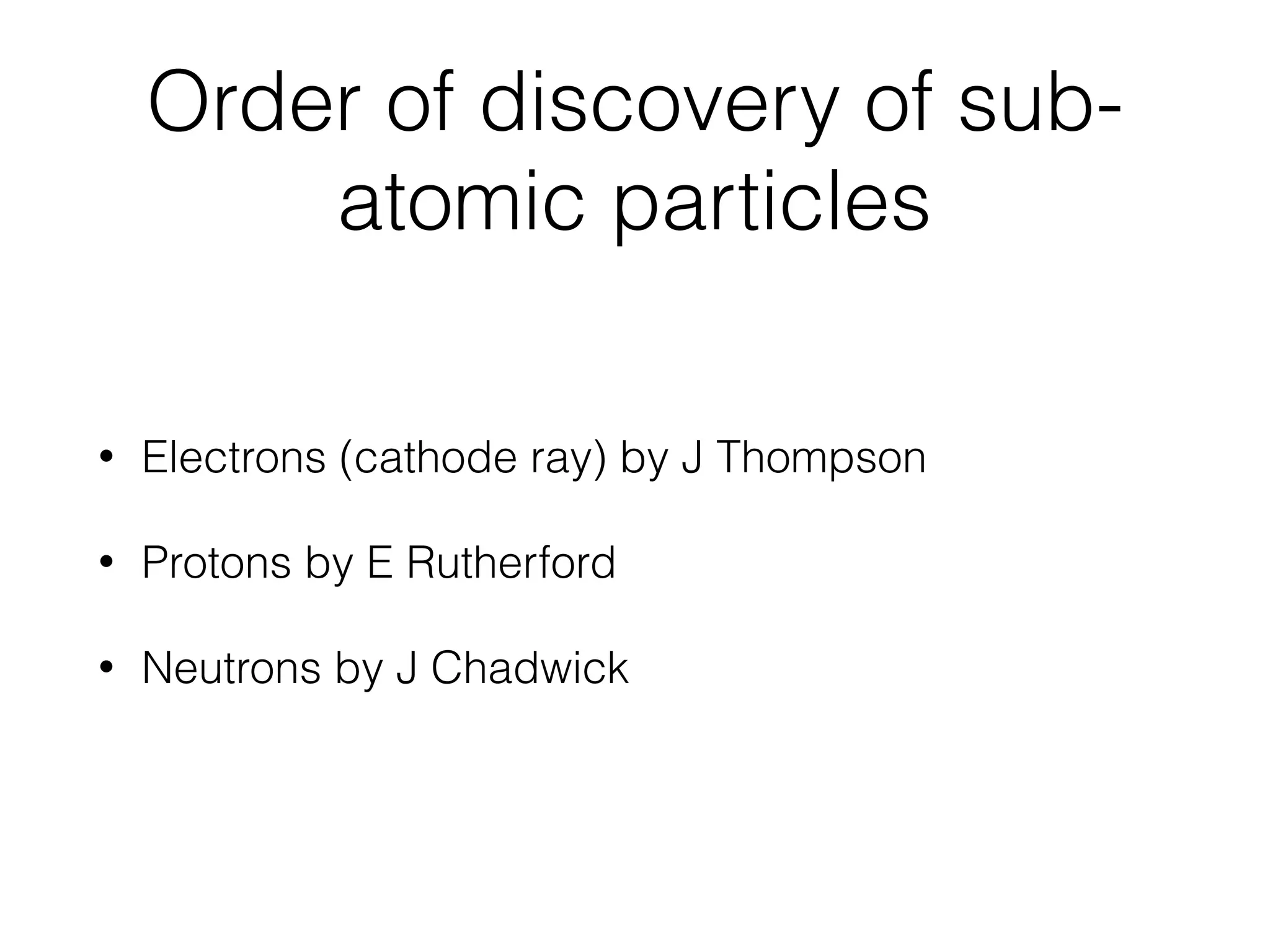
Order of discovery of sub-
atomic particles
• Electrons (cathode ray) by J Thompson
• Protons by E Rutherford
• Neutrons by J Chadwick
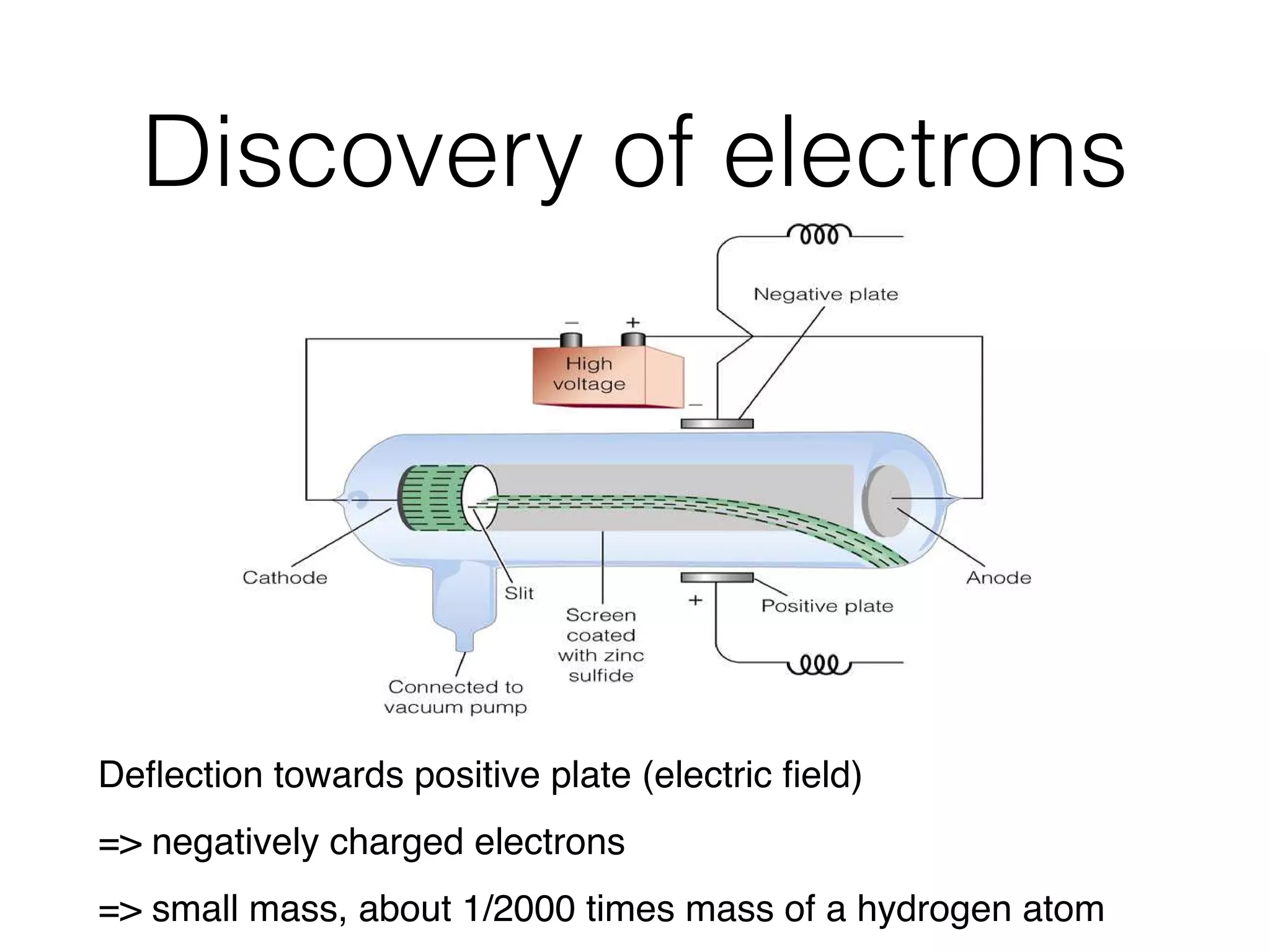
Discovery of electrons
2. Atoms of the same element are identical.
Isotopes are atoms of the same element that have different
mass numbers because of different numbers of neutrons,
therefore, all atoms of the same element are NOT identical.
3. Thomson’s Model of the Atom – Joseph John Thomson (1856 – 1940)
a. Describe and diagram the apparatus Thomson used in his experiments
L. Farrell – Chemistry 11– Atomic Structure – Answers – Page 3 of 7Deflection towards positive plate (electric field)
=> negatively charged electrons
=> small mass, about 1/2000 times mass of a hydrogen atom
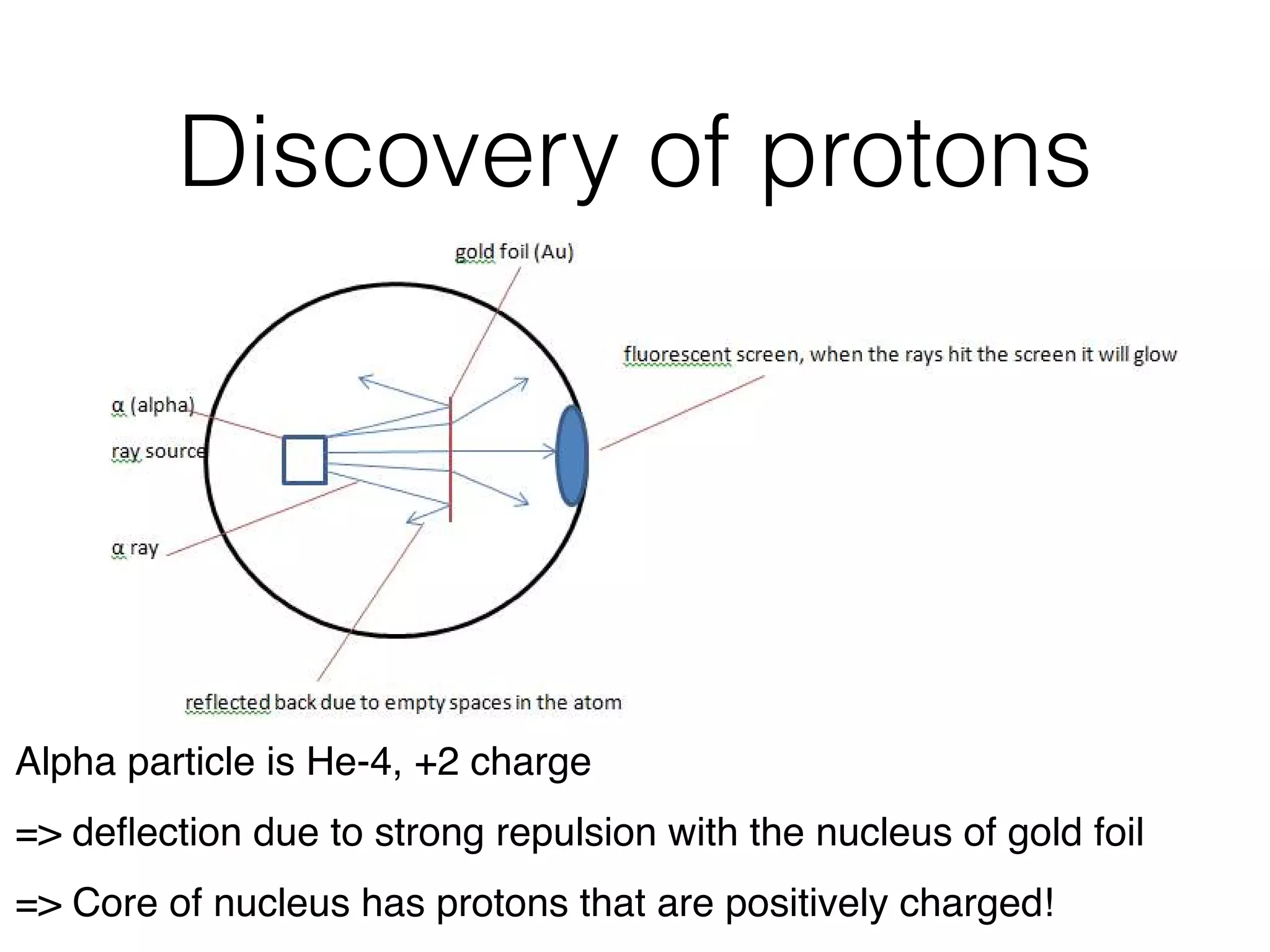
Discovery of protons
The  “Plum-Pudding”  model  couldn’t  explain  the  surprising observations. However, Rutherford
suggested that atoms consist of largely empty space and that the mass is largely concentrated into
a very small, positively charged nucleus.
Most alpha particles pass through the empty space in the atom with very little deflection. When
the alpha particle approaches on a path close to the nucleus, however, the positive charges
strongly repel each other, and the alpha particle is deflected through a large angle.
www.studyguide.pk
Alpha particle is He-4, +2 charge
=> deflection due to strong repulsion with the nucleus of gold foil
=> Core of nucleus has protons that are positively charged!
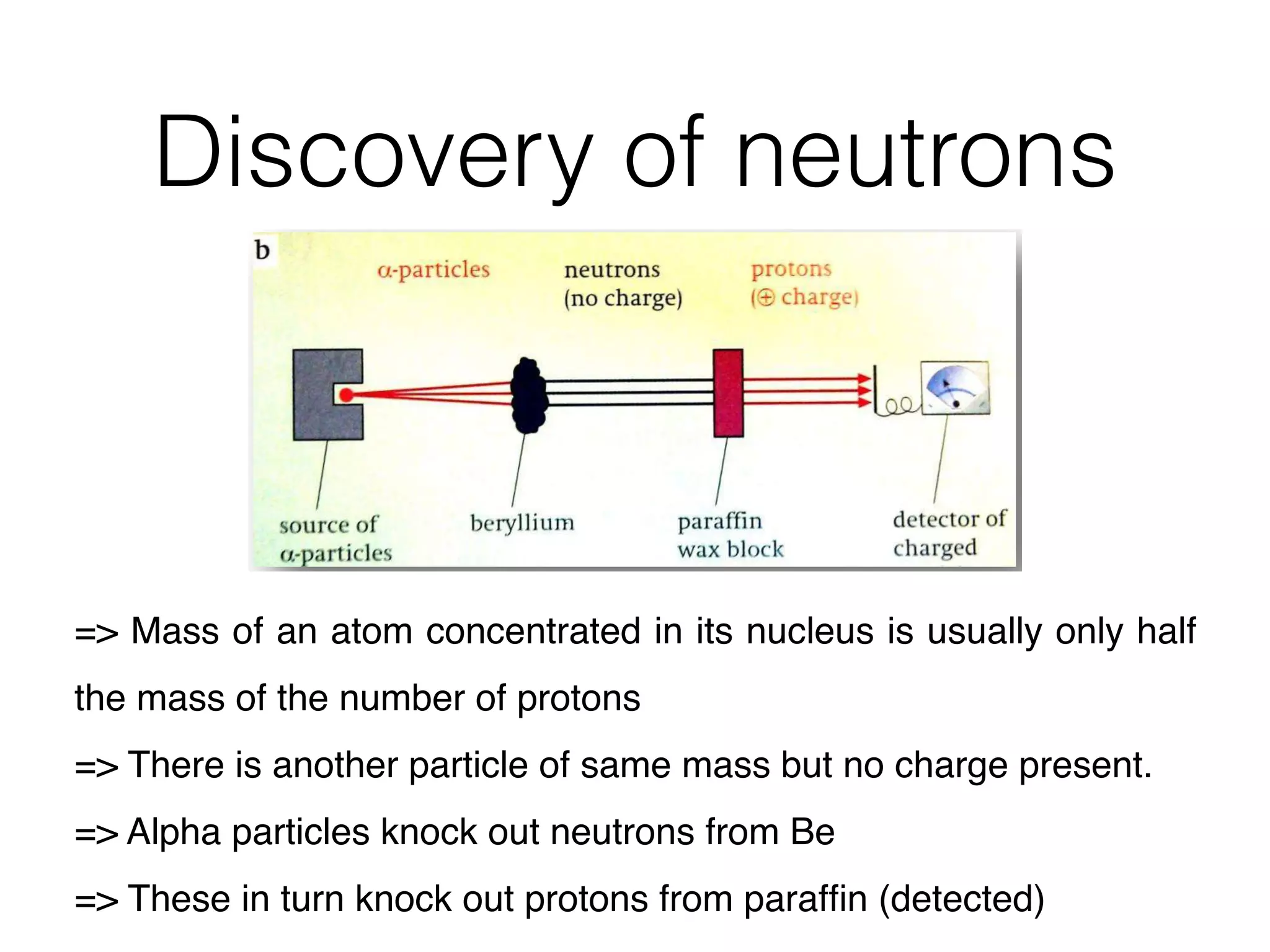
Discovery of neutrons
hadwick
beryllium
No charged
ed on the
k. However,
fin wax was
ium, charged
ed and
d knocked out neutrons from the beryllium, and in turn these knocked out
x.
subatomic particles
ode ray)
www.studyguide.pk
=> Mass of an atom concentrated in its nucleus is usually only half
the mass of the number of protons
=> There is another particle of same mass but no charge present.
=> Alpha particles knock out neutrons from Be
=> These in turn knock out protons from paraffin (detected)
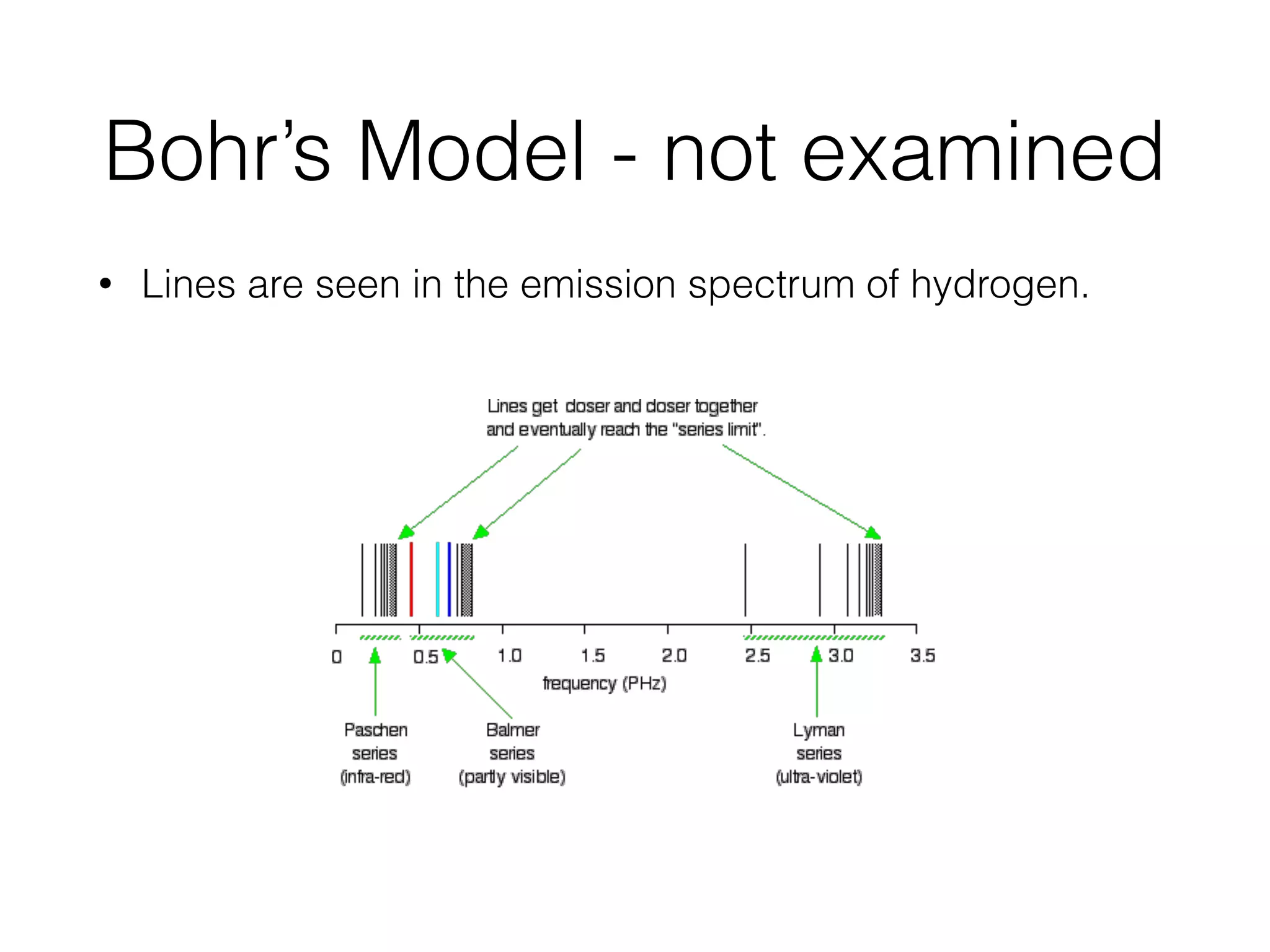
Bohr’s Model - not examined
• Lines are seen in the emission spectrum of hydrogen.
Bohr’s model
• Electrons can only have energy in quanta => they can
only exist in quantised levels of energy
• These energy levels are most commonly called as shells
or orbitals.
Assignment
• Q1, 3, 4, 6
• Skip qst 2, 5, 7 & 8
• Set on ?
• Submit on ?
Orbitals
• An atomic orbital is a region in space where there is a high
possibility that electrons on an atom can be found. It has a fixed
energy level.
• Quantum numbers “describe” the state of a confined electron.
• There are four types of quantum numbers,
• a) the principal quantum number (n)
• b) the angular momentum quantum number (l)
• c) the magnetic quantum number (ml)
• d) the spin quantum number (ms)
Sub-orbital/sub-shell
• A subshell is a group of orbitals with the same energy
level but different orientation in space.
• These subshells are represented by the letters,
• a) s (sharp)
• b) p (principal)
• c) d (diffuse)
• d) f (fundamental)
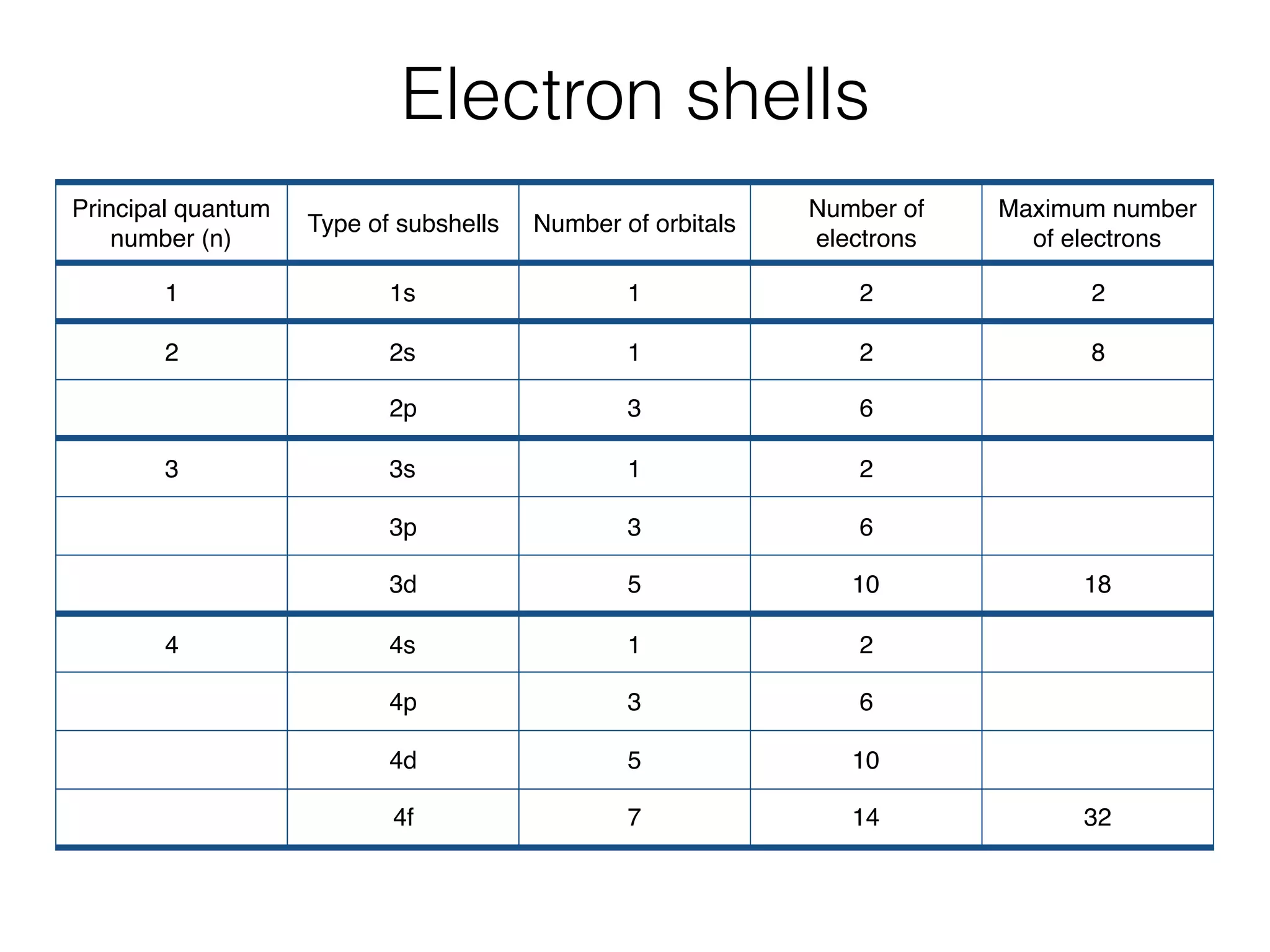
Electron shells
Principal quantum
number (n)
Type of subshells Number of orbitals
Number of
electrons
Maximum number
of electrons
1 1s 1 2 2
2 2s 1 2 8
2p 3 6
3 3s 1 2
3p 3 6
3d 5 10 18
4 4s 1 2
4p 3 6
4d 5 10
4f 7 14 32
Quantum numbers
ple: What is the name of the oribital(s) with quantum number n=3?
er: 3s, 3p, and 3d. Because n=3, the possible values of l = 0, 1, 2, which indicates the shapes of each subshell.
als
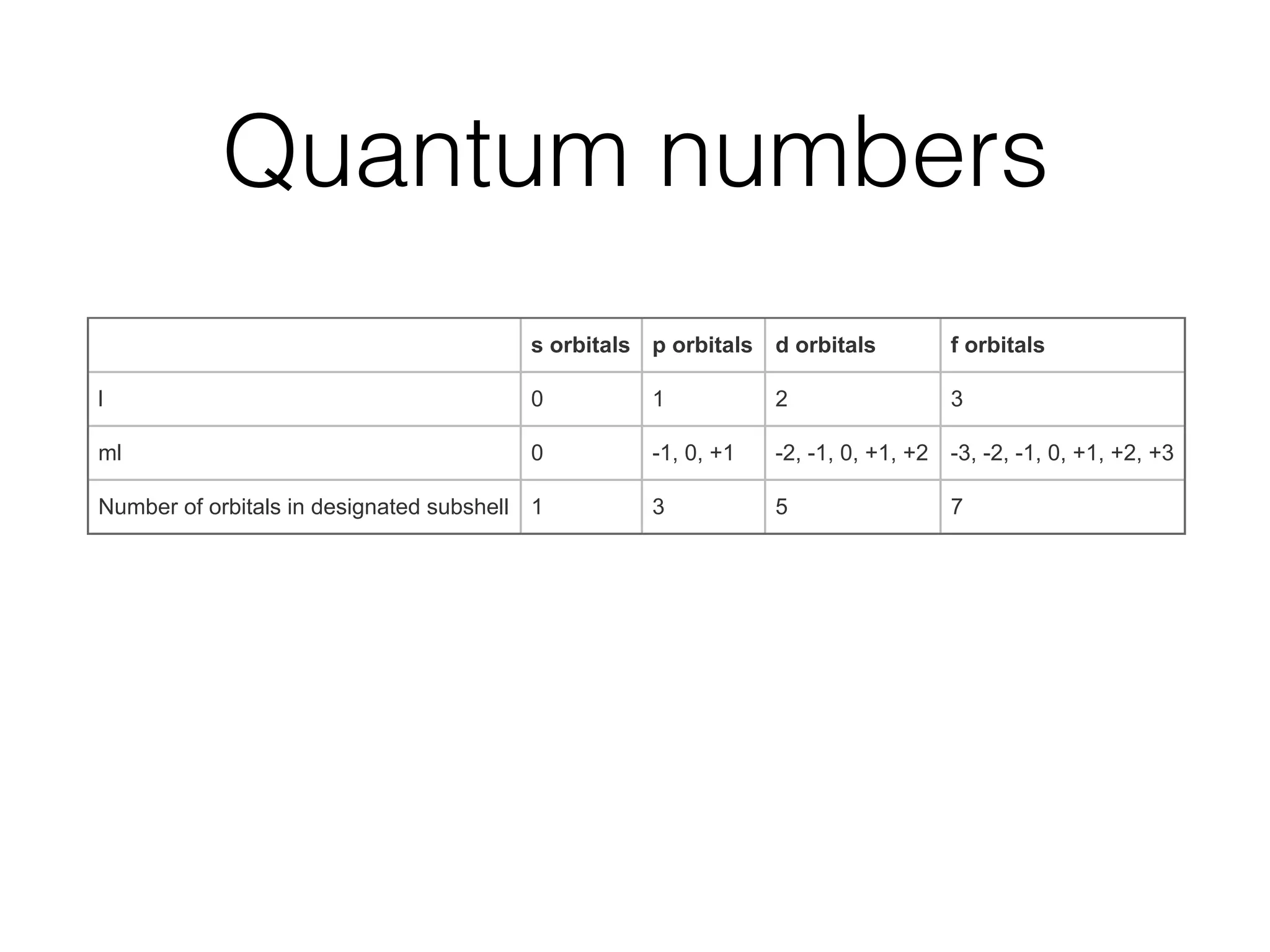
umber of orbitals in a subshell is equivalent to the number of values the magnetic quantum number ml takes on. A helpful equa
mine the number of orbitals in a subshell is 2l +1. This equation will not give you the value of ml, but the number of possible value
n take on in a particular orbital. For example, if l=1 and ml can have values -1, 0, or +1, the value of 2l+1 will be three and there
different orbitals. The names of the orbitals are named after the subshells they are found in:
s orbitals p orbitals d orbitals f orbitals
l 0 1 2 3
ml 0 -1, 0, +1 -2, -1, 0, +1, +2 -3, -2, -1, 0, +1, +2, +3
Number of orbitals in designated subshell 1 3 5 7
figure below, we see examples of two orbitals: the p orbital (blue) and the s orbital (red). The red s orbital is a 1s orbital. To pictur
l, imagine a layer similar to a cross section of a jawbreaker around the circle. The layers are depicting the atoms angular nod
e a 3s orbital, imagine another layer around the circle, and so on and so on. The p orbital is similar to the shape of a dumbbell, w
ation within a subshell depending on ml . The shape and orientation of an orbital depends on l and ml.
Shapes of orbitals
In an atom, the electrons do not travel in fixed orbits around the nucleus; i.e. they are At
not localised in fixed orbits. Instead they travel in a region of space around the
nucleus called an atomic orbital.
An atomic orbital is a region of space round the nucleus in which the probability of
finding a particular electron (in a free atom) is the greatest- 98 % chance of finding
an electron.
Or
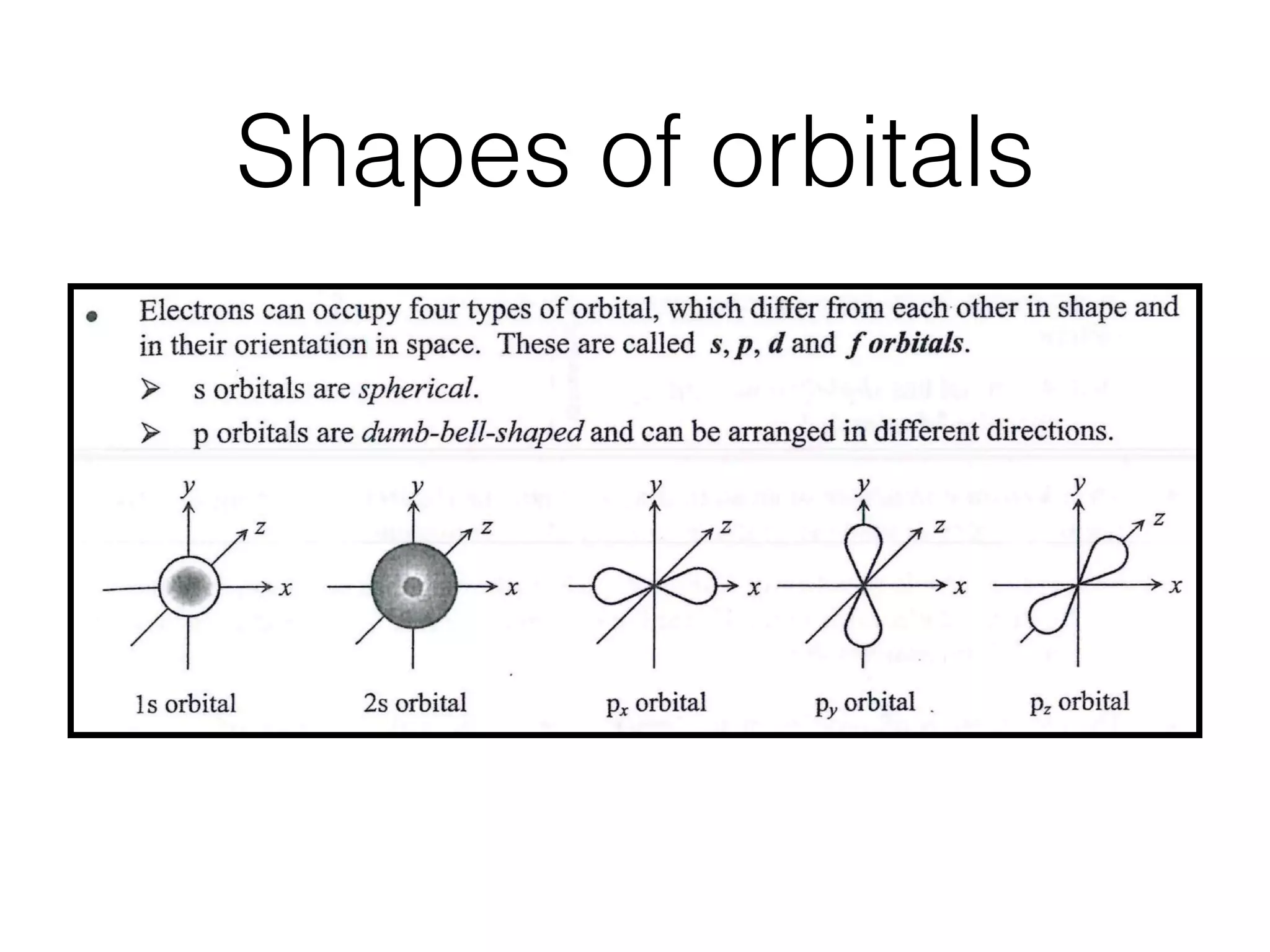
Electrons can occupy four types of orbital, which differ from each other in shape and
in their orientation in space. These are called s, p, d and forbitals.
s orbitals are spherical.
~, p orbitals are dumb-bell-shaped and can be arranged in different directions.
l s orbital 2s orbital Px orbital Pr orbital . Pz orbital
There are five types of d orbitals (dxy, dye, d=, dx2_r, and dz, ).
Z Z ...-""! Z Z Z
Y .
/l~/'~': Y
y
~ / i . >x"~ X
X X
Shapes of orbitalsl s orbital 2s orbital Px orbital Pr orbital . Pz orbital
There are five types of d orbitals (dxy, dye, d=, dx2_r, and dz, ).
Z Z ...-""! Z Z Z
Y .
/l~/'~': Y
y
.:::.ii
~ / i . >x
' ~
"~ X
X X
: .~
dxy orbital v- d. orbital d= orbital dx,_y~ orbital d~, orbital
Each of d~y, dy~ and d= orbitals consists of four lobes (of the same size and
same shape) on the xy, yz and zx plane respectively.
The d~2_?2 orbital consists of four lobes along the x- and y- axes.
The shape of the dz, orbital is different from the other four- it consists of two
lobes along the z-axis with a 'ring' in the middle.
All the d orbitals are degenerate; i.e. of the same energy level.
[NB. In drawing shapes of orbitals, the x-, y- and z- axes must be shown so as to
illustrate the 3-D property of the orbitals.]
Shells a
Electronic configuration
• Electronic configuration is arrangement of electrons
in an atom, that is how electrons are distributed
among the various orbitals.
• Two common notations,
a) spdf notation
b) orbital-as-box (or lines) diagram
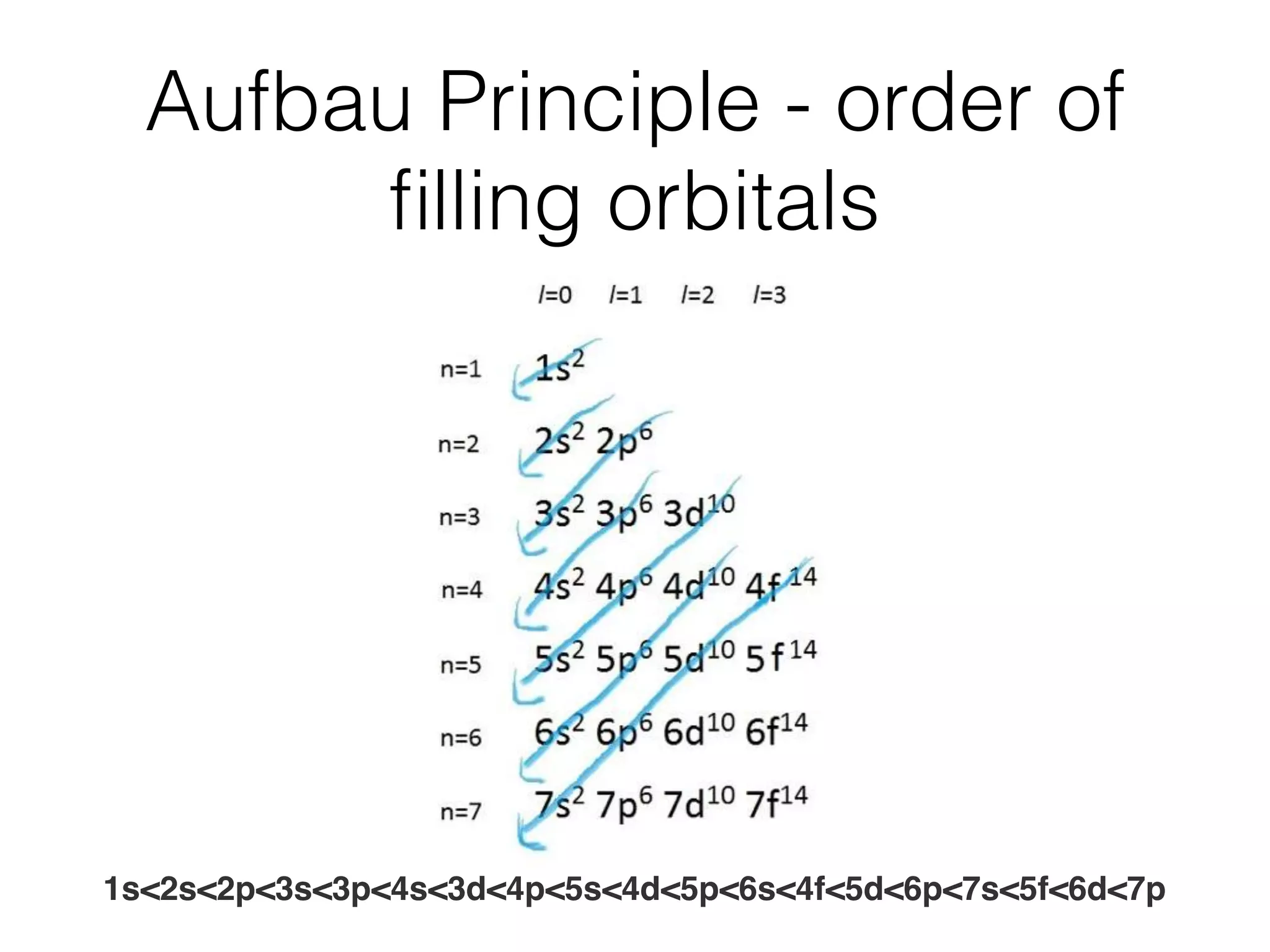
Aufbau Principle - order of
filling orbitals
• Aufbau Electrons fill low energy orbitals (closer to the
nucleus) before they fill higher energy ones.
• Consider Hund’s first and second rules (understand how
to apply them, so you can explain in your own words,
with examples)
• Hund’s 1st rule: Electronic configuration with as many
electrons with parallel spins is lower in energy
• Hund’s 2nd rule: Electronic configuration with spins that
are aligned/paired is lower in energy.
Hund’s First Rule
• Hund’s first rule: electrons will always occupy an empty
orbital before they pair up
• Electrons are negatively charged, they repel each another.
• Electrons minimise repulsion by occupying their own orbital
rather than sharing an orbital with another electron
• Also, electrons in singly occupied orbitals are less
effectively screened or shielded from the nucleus
• Electronic configuration with as many electrons with
parallel spins is lower in energy
Hund’s Second Rule
• Unpaired electrons in singly occupied orbitals have the
same spins.
• If all electrons orbit in the same direction, they meet less
often than if some of them orbit in opposite directions
• When they orbit in opposite directions (opposite spins),
the repulsive force increases, which separates electrons.
• Hence, configuration with spins that are aligned/paired is
lower in energy.
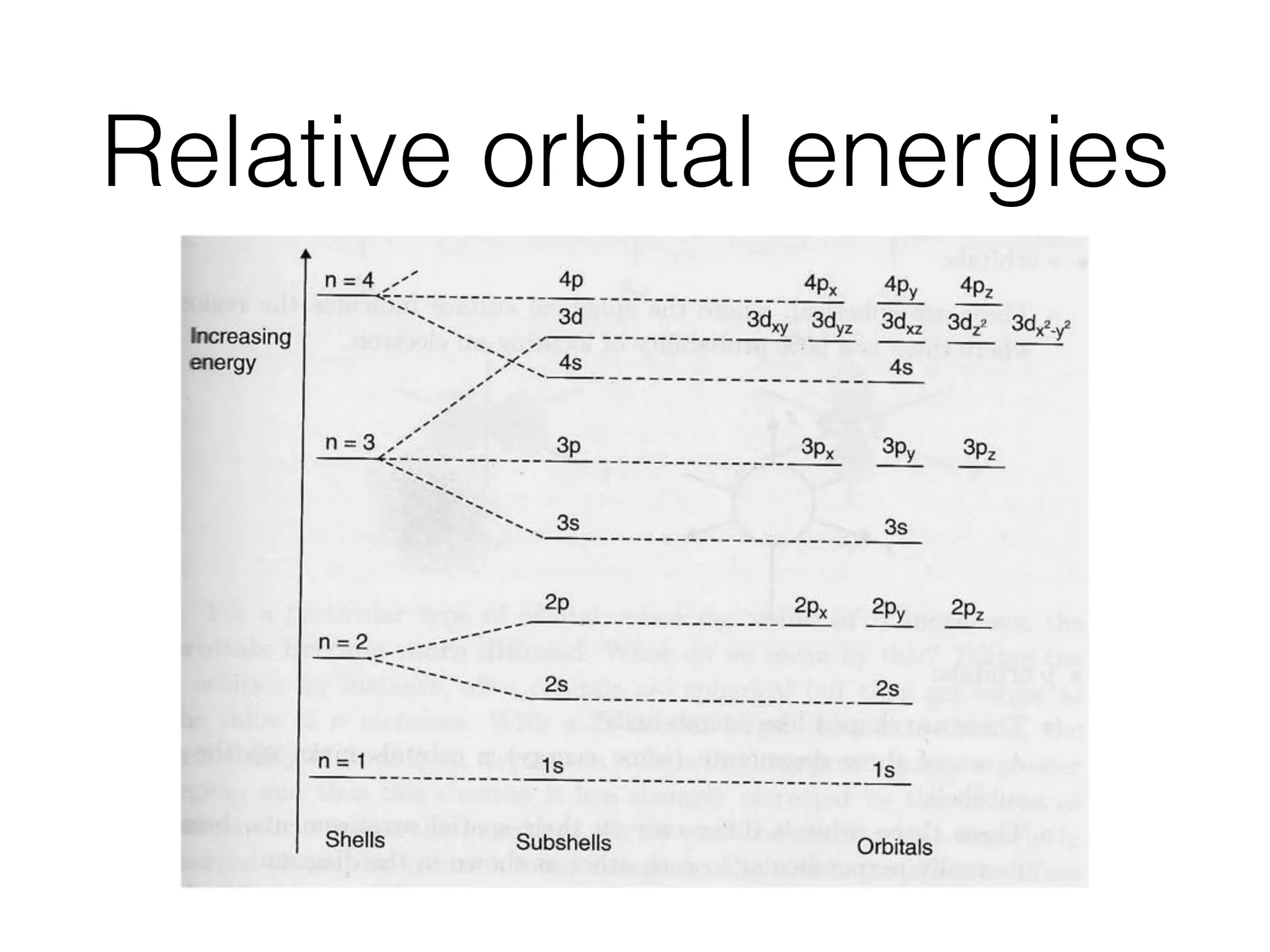
Relative orbital energies
Aufbau Principle - order of
filling orbitals
1s<2s<2p<3s<3p<4s<3d<4p<5s<4d<5p<6s<4f<5d<6p<7s<5f<6d<7p
Aufbau Principle - Exercise
• Complete electronic configurations of elements H to
Kr (c/w or h/w)
• One column - try the spdf notation - superscript the
number of electrons in each subshell
• Refer to textbook(s) or chemguide.
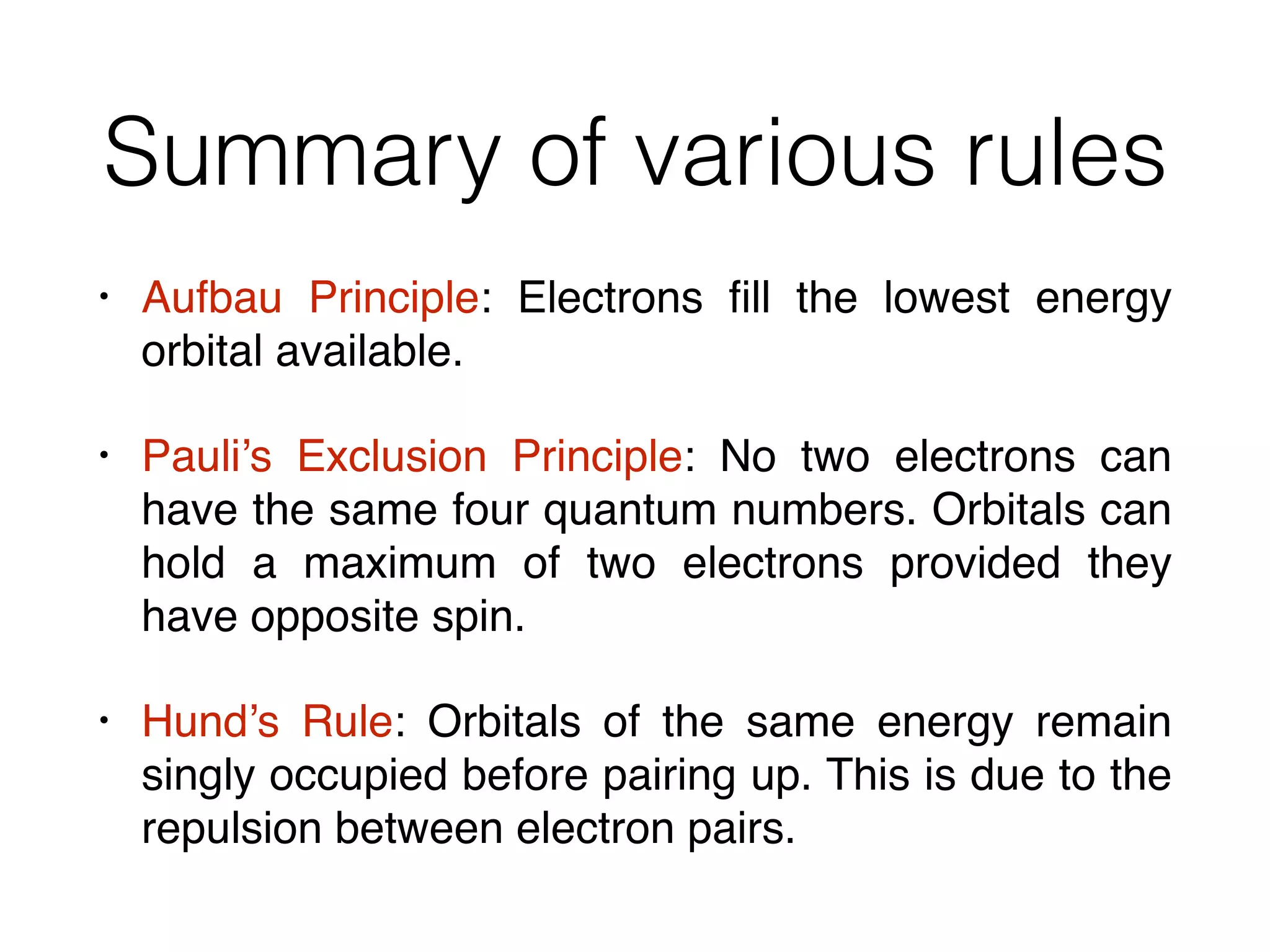
Summary of various rules
• Aufbau Principle: Electrons fill the lowest energy
orbital available.
• Pauli’s Exclusion Principle: No two electrons can
have the same four quantum numbers. Orbitals can
hold a maximum of two electrons provided they
have opposite spin.
• Hund’s Rule: Orbitals of the same energy remain
singly occupied before pairing up. This is due to the
repulsion between electron pairs.
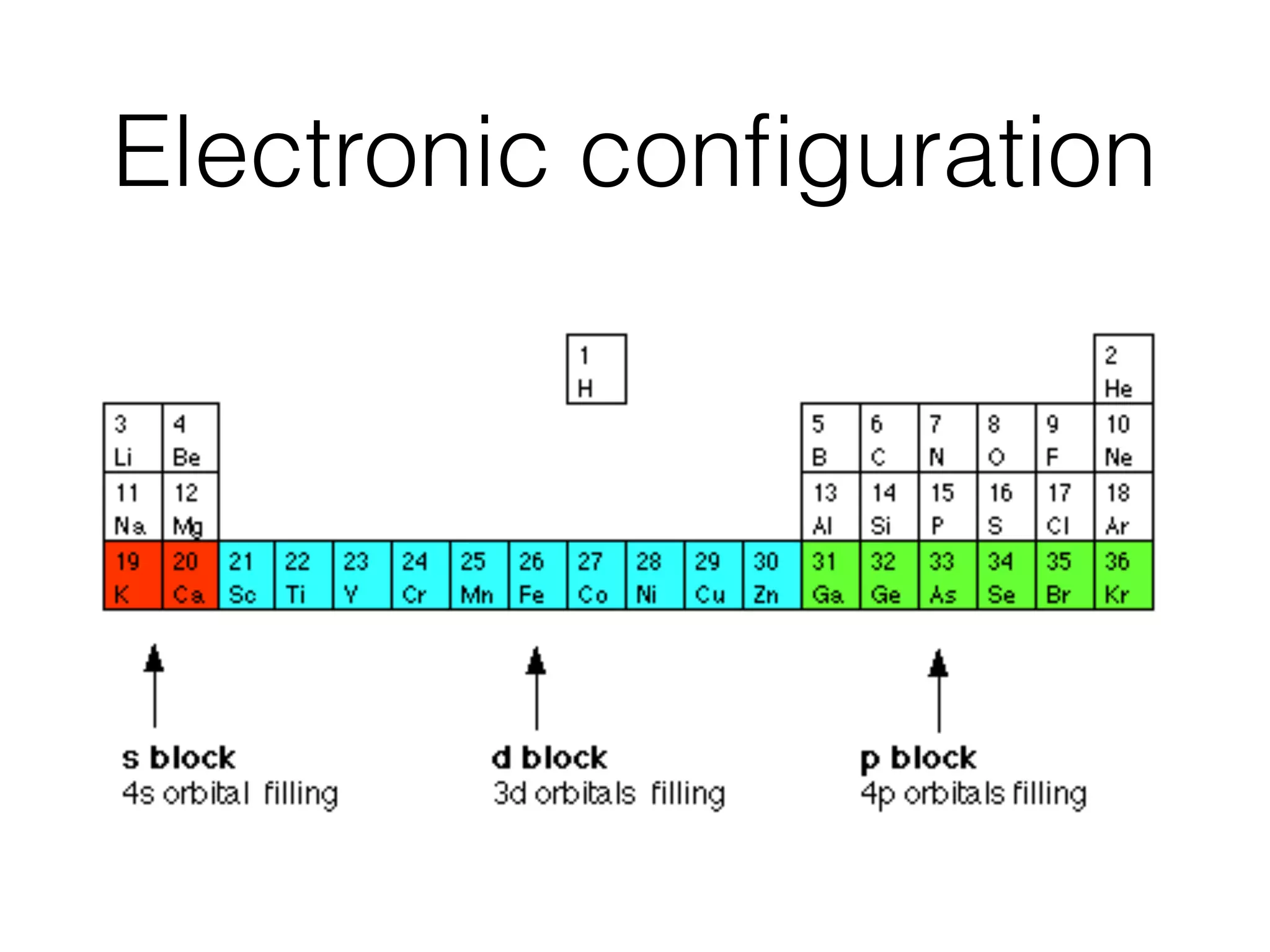
Electronic configuration
the next lowest energy orbital is the 4s - so that fills first.
K 1s22s22p63s23p64s1
Ca 1s22s22p63s23p64s2
d-block elements
d-block elements are thought of as elements in which the last
electron to be added to the atom is in a d orbital. (Actually, that
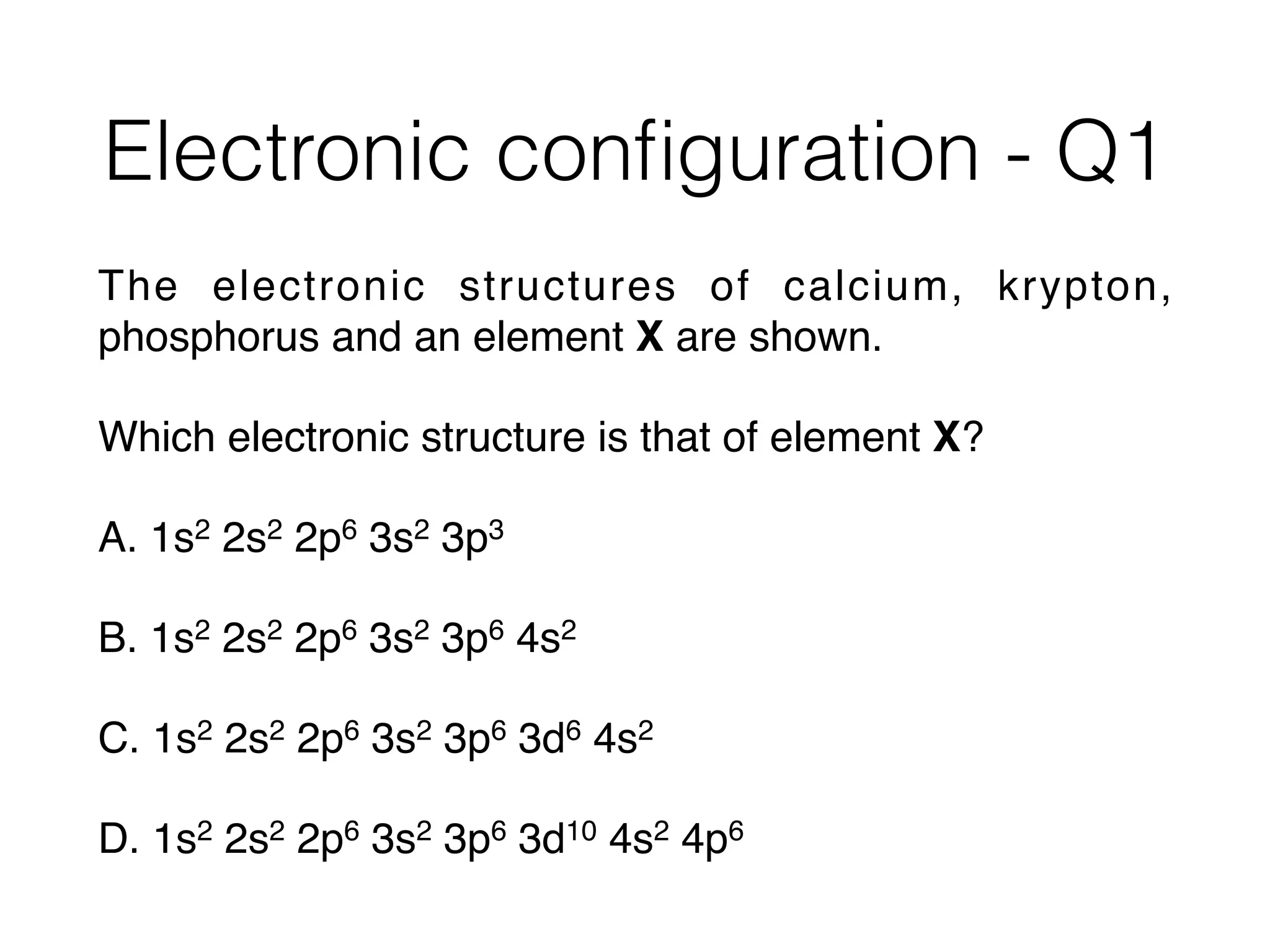
Electronic configuration - Q1
The electronic structures of calcium, krypton,
phosphorus and an element X are shown.
Which electronic structure is that of element X?
A. 1s2 2s2 2p6 3s2 3p3
B. 1s2 2s2 2p6 3s2 3p6 4s2
C. 1s2 2s2 2p6 3s2 3p6 3d6 4s2
D. 1s2 2s2 2p6 3s2 3p6 3d10 4s2 4p6
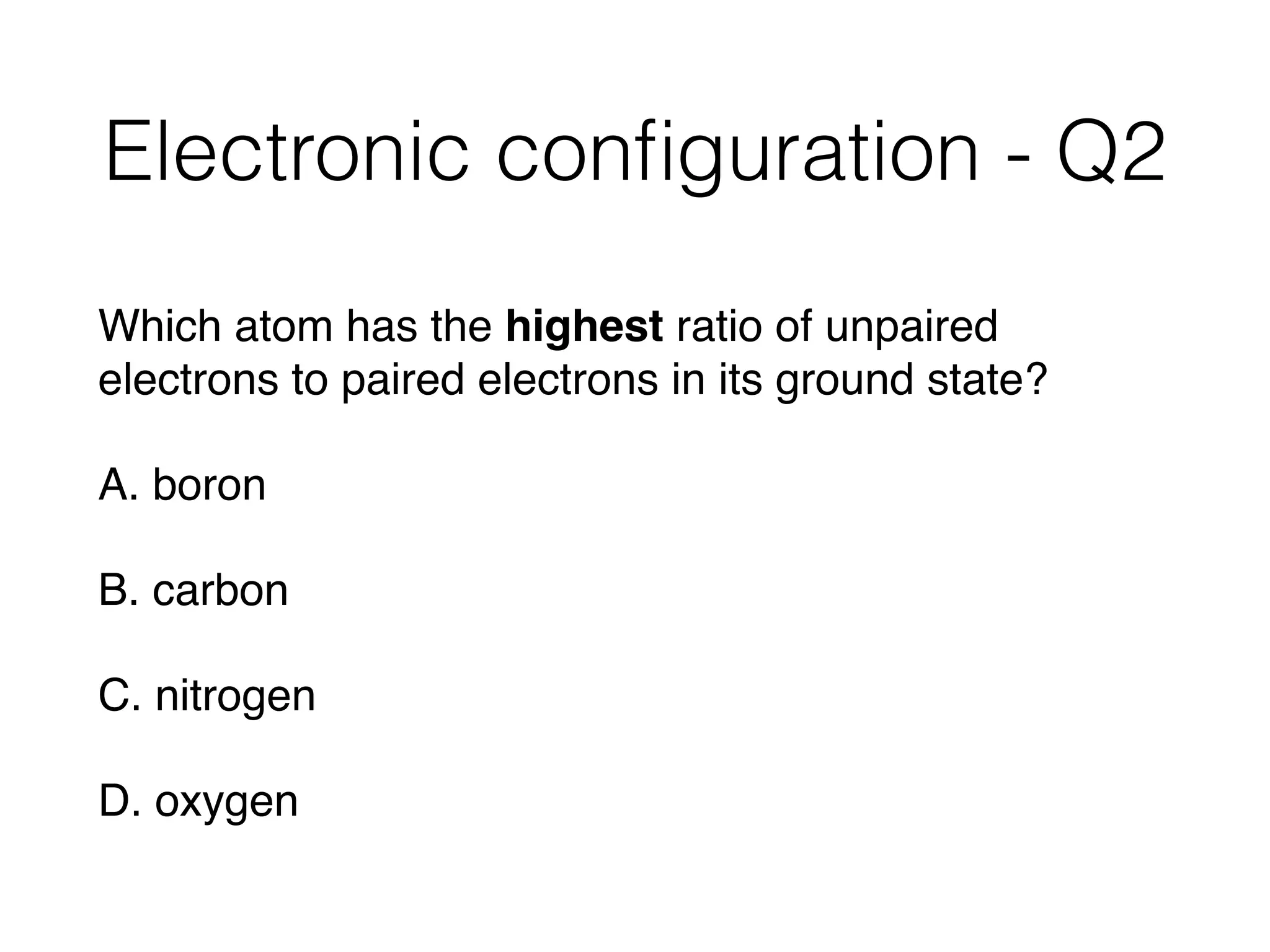
Electronic configuration - Q2
Which atom has the highest ratio of unpaired
electrons to paired electrons in its ground state?
A. boron
B. carbon
C. nitrogen
D. oxygen
Electronic configuration
• When filling in orbitals in atoms (neutral), fill 4s
before 3d (Aufbau’s).
• When d-block elements form ions, the 4s electrons
are lost first.
Electronic configuration - Cr
and Cu
• Explain this! (half d-shell and full-d shell
stability)
• Which one fills first, but lose from which one
first? (explain this)
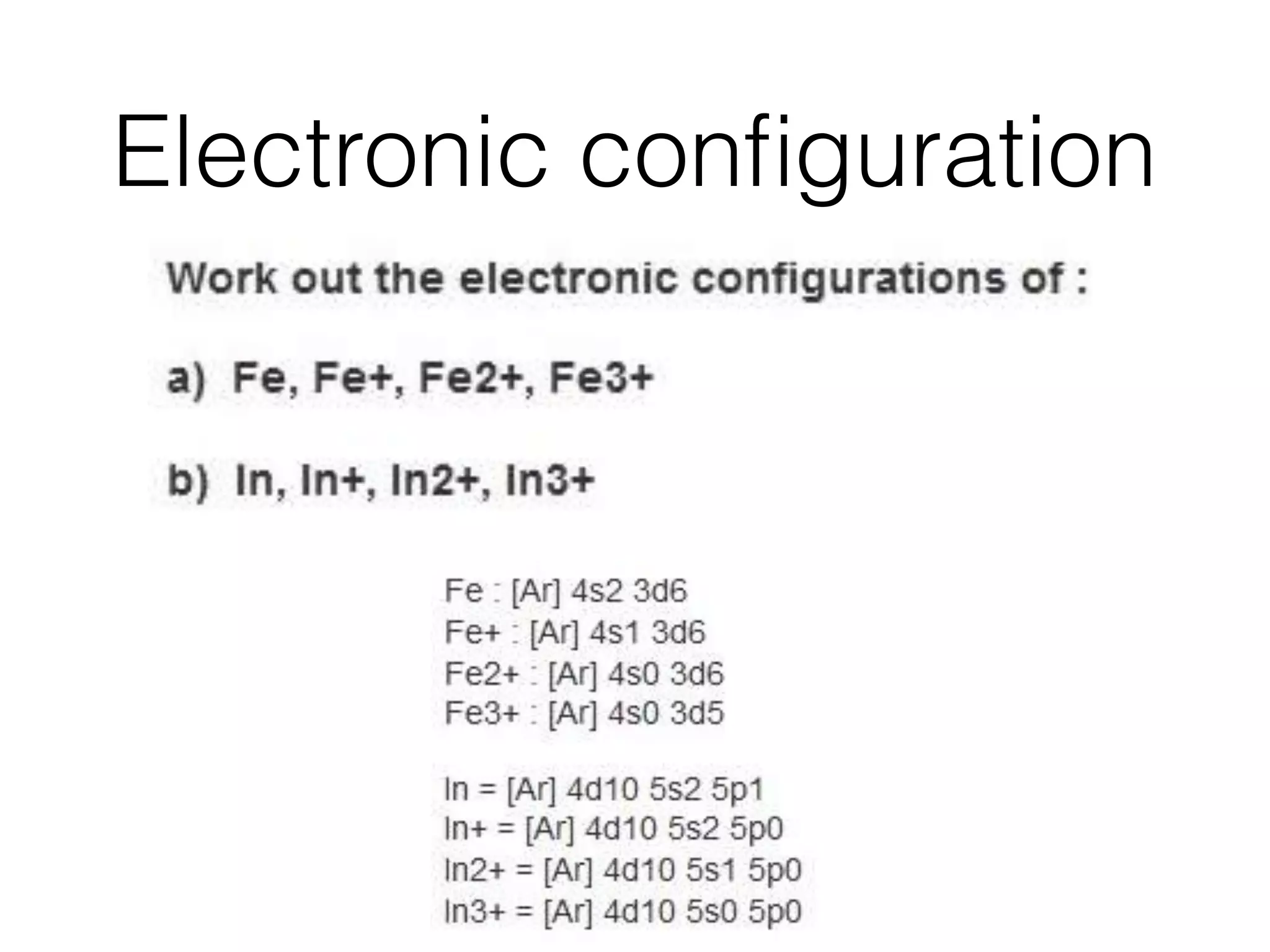
Electronic configuration
Electronic configuration - Q3
An ion of manganese has an electronic configuration
of [Ar] 3d4. Which compound contains this ion?
A. MnCl2 B. MnO C. Mn2O3 D. MnO2
Electronic configuration - Q4
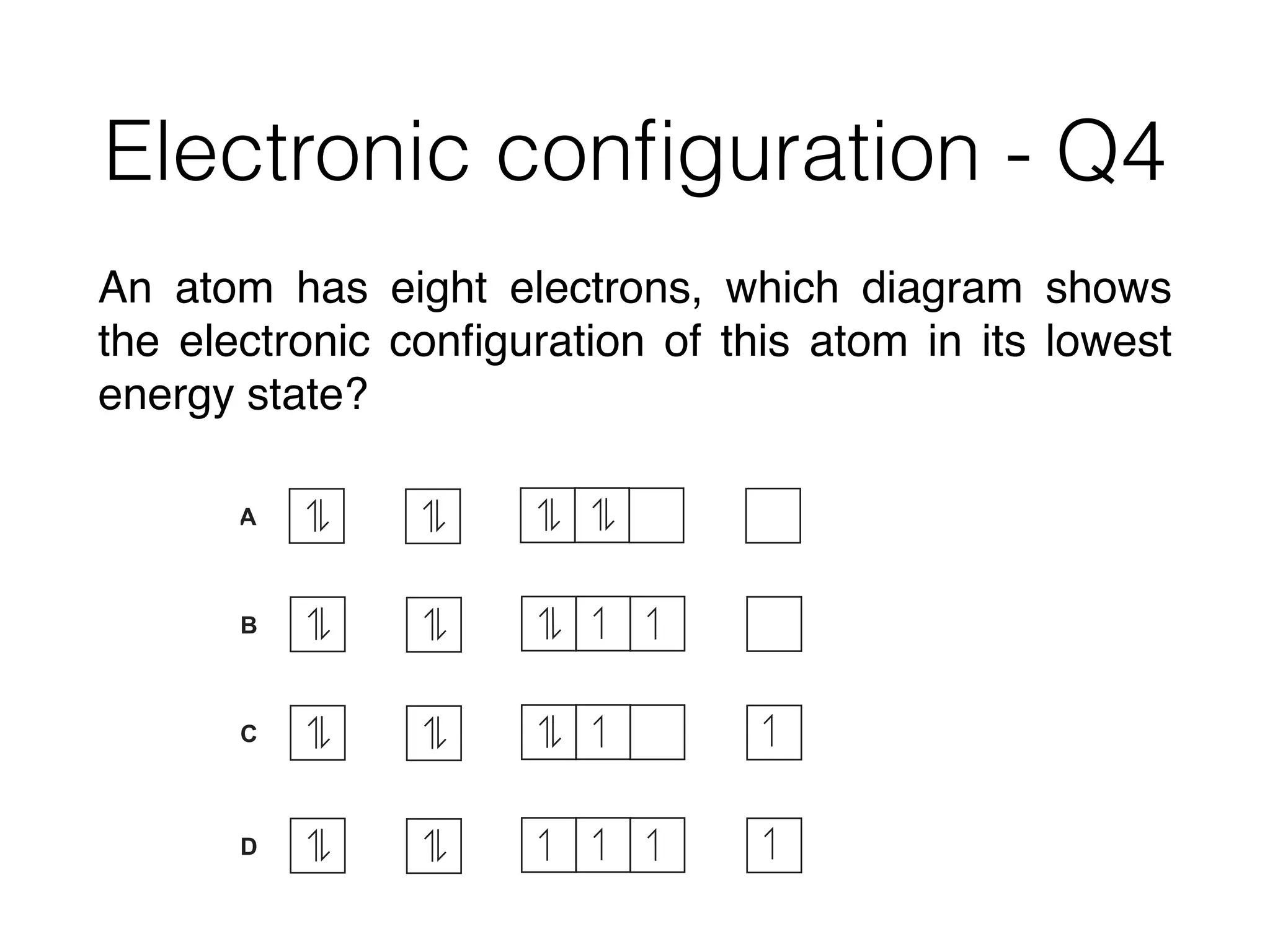
An atom has eight electrons, which diagram shows
the electronic configuration of this atom in its lowest
energy state?
3
4 Use of the Data Booklet is relevant to this question.
It is now thought that where an element exists as several isotopes, the stable ones usually
contain a ‘magic number’ of neutrons. One of these magic numbers is 126.
Which isotope is unstable?
A 209
Bi B 208
Pb C 210
Po D 208
Tl
5 An atom has eight electrons.
Which diagram shows the electronic configuration of this atom in its lowest energy state?
6 The gecko, a small lizard, can climb up a smooth glass window. The gecko has millions o
A
B
C
D
Electronic configuration - Q5
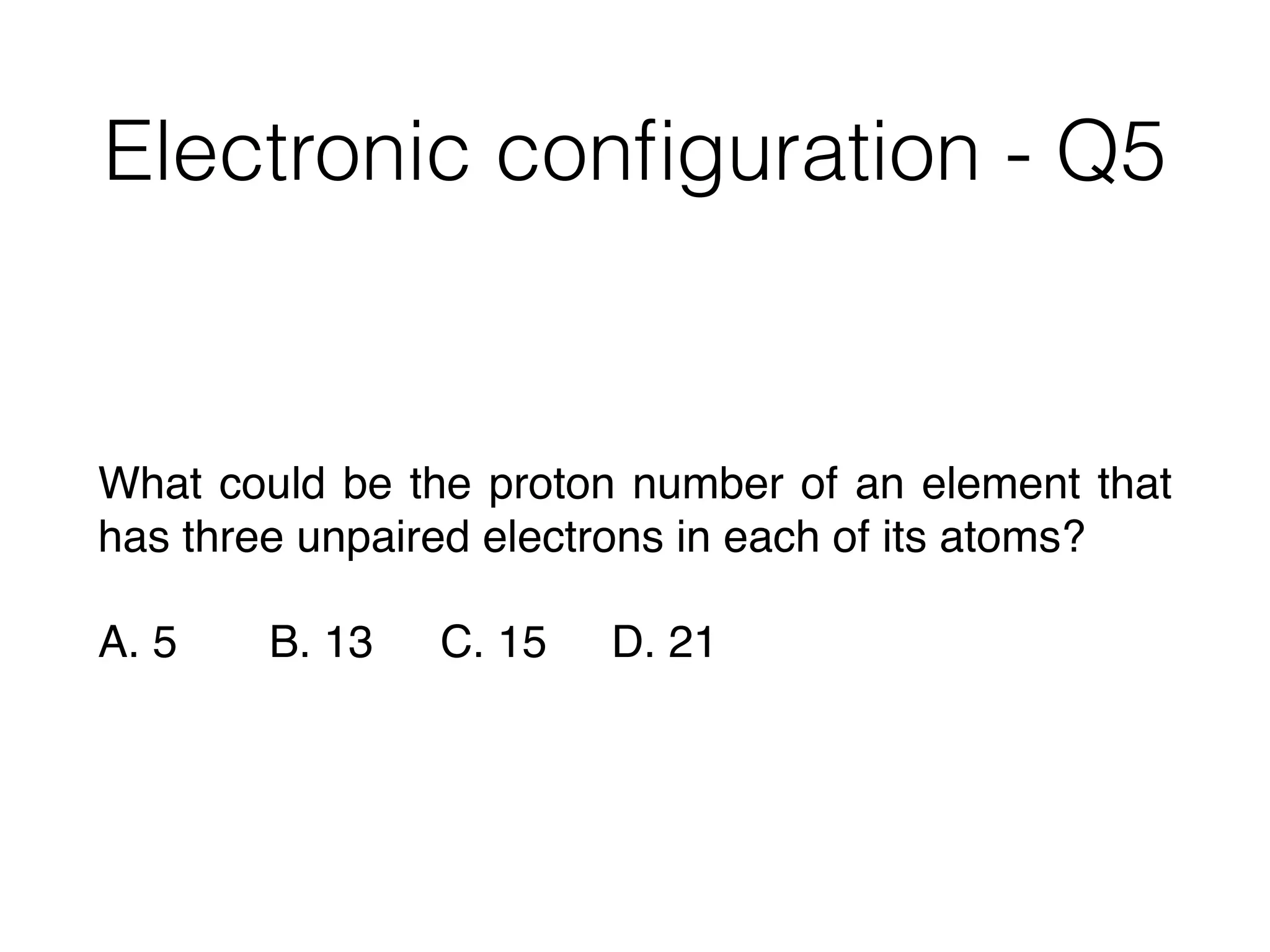
What could be the proton number of an element that
has three unpaired electrons in each of its atoms?
A. 5 B. 13 C. 15 D. 21
Assignment
• Electronic configuration - qst 9,10,11
• Set on ?
• Submit on ?
Ionisation energy
¢e Factors influencing the ionisation energies (I.E.)of elements, ,: : . :
~ , TrendsinI:E. across a period and down agroup of the Periodic;Table. .
4 , Electronic configurations of elements deduced from successive I.E. data, and hence
the position of that element within the Periodic Table.
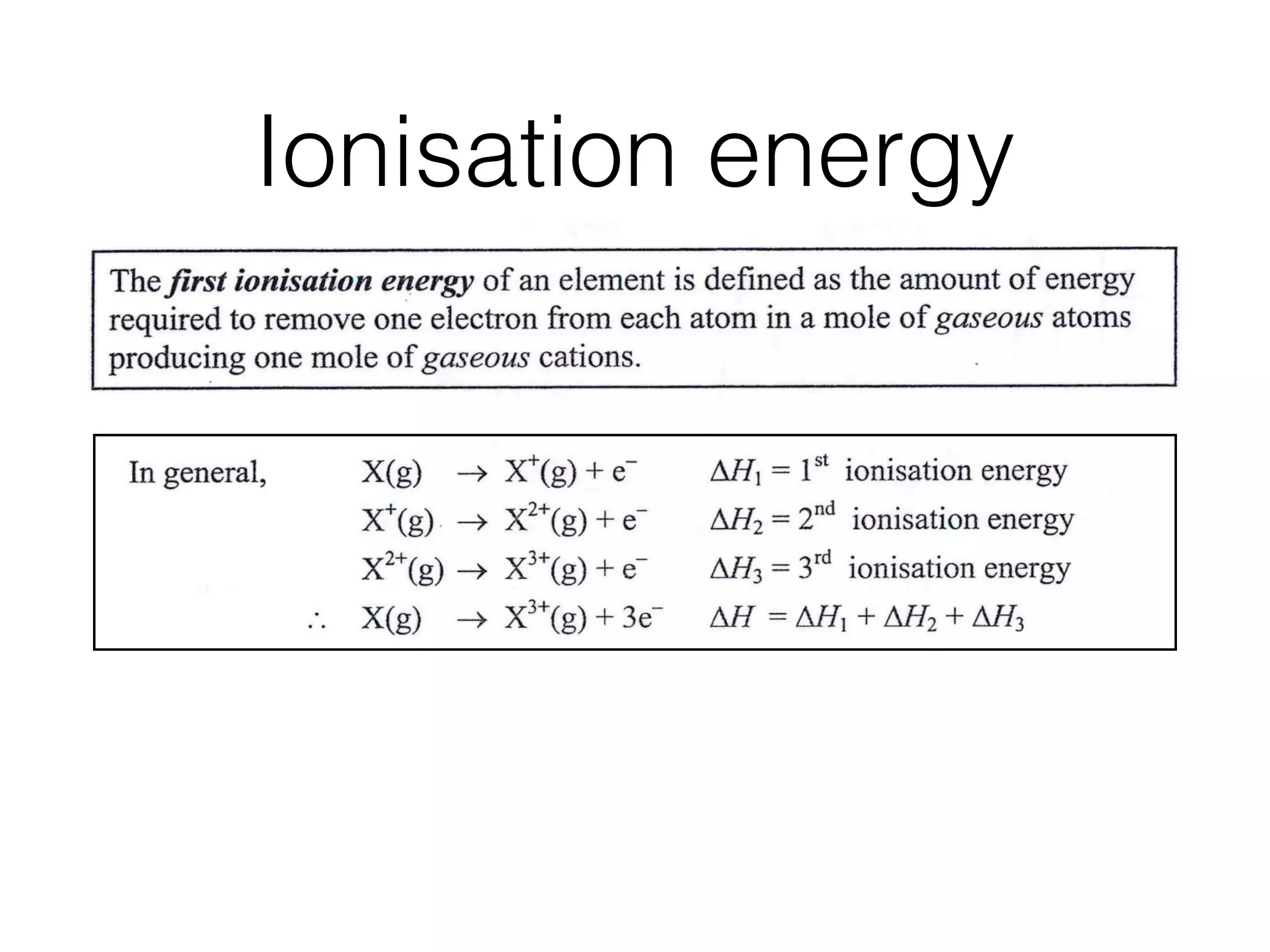
Thefirst ionisation energy of an element is defined as the amount of energy
required to remove one election from each atom in a mole of gaseous atoms
producing one mole of gaseous cations.
In general, AH1 = 1st ionisation energy
A J-/2 = 2nd ionisation energy
/~3 -- 3rd ionisation energy
-- ~-/1 +/~/2 + ~/'3
Ionisation energies normally have positive values since energy is absorbed in
removing an electron.
The successive ionisation energies of an element increase with the removal of
each electron because the remaining electrons are attracted more strongly by the
constant positive charge on the nucleus.
The number of ionisation energies that an element can have equals its atomic
number.
¢e Factors influencing the ionisation energies (I.E.)of elements, ,: : . :
~ , TrendsinI:E. across a period and down agroup of the Periodic;Table. .
4 , Electronic configurations of elements deduced from successive I.E. data, and hence
the position of that element within the Periodic Table.
Thefirst ionisation energy of an element is defined as the amount of energy
required to remove one election from each atom in a mole of gaseous atoms
producing one mole of gaseous cations.
In general, AH1 = 1st ionisation energy
A J-/2 = 2nd ionisation energy
/~3 -- 3rd ionisation energy
-- ~-/1 +/~/2 + ~/'3
Ionisation energies normally have positive values since energy is absorbed in
removing an electron.
The successive ionisation energies of an element increase with the removal of
each electron because the remaining electrons are attracted more strongly by the
constant positive charge on the nucleus.
The number of ionisation energies that an element can have equals its atomic
number.
Ionisation energy
Ionisation energies normally have positive values since energy is absorbed in
removing an electron.
The successive ionisation energies of an element increase with the removal of
each electron because the remaining electrons are attracted more strongly by the
constant positive charge on the nucleus.
The number of ionisation energies that an element can have equals its atomic
number.
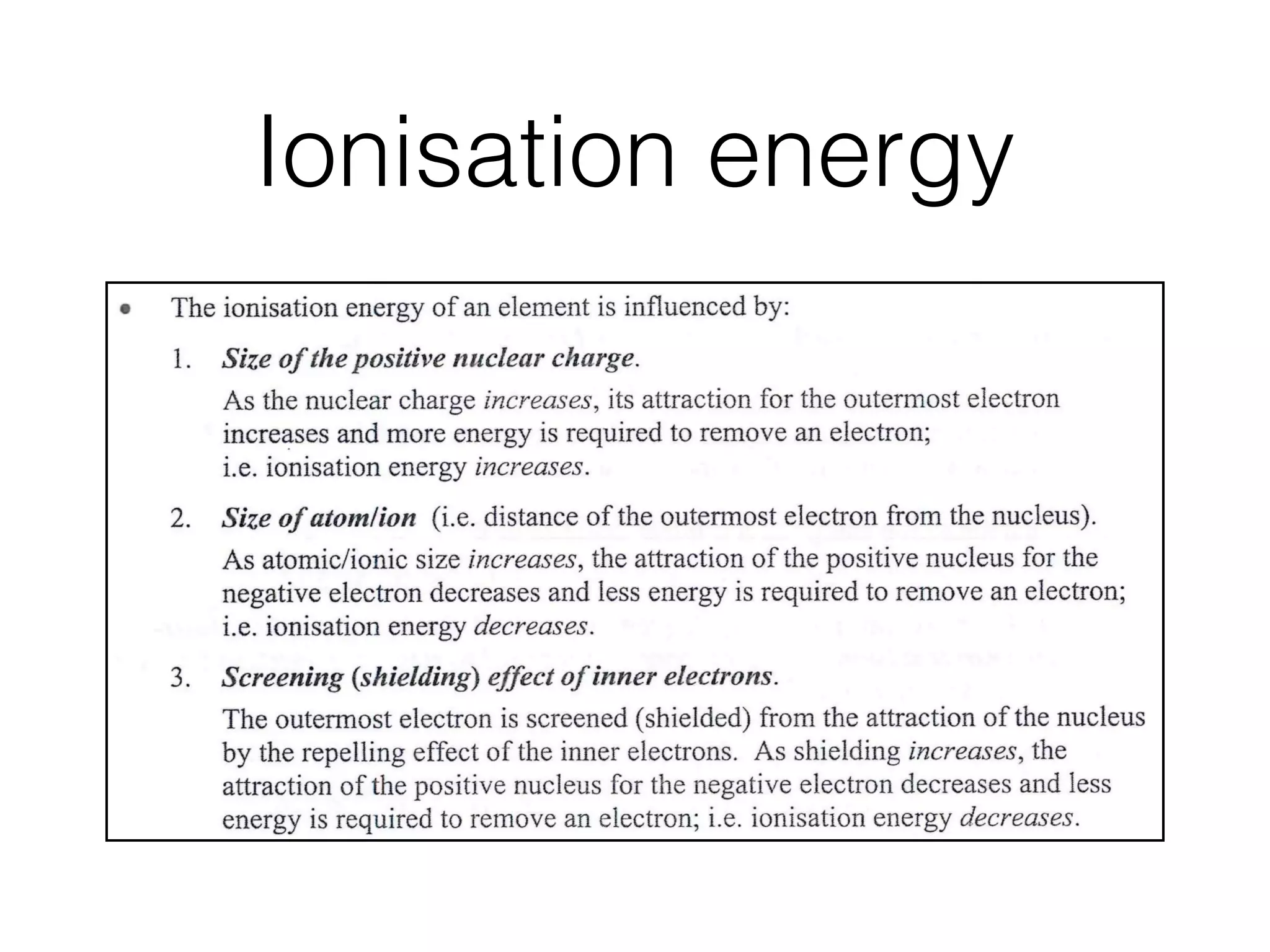
The ionisation energy of an element is influenced by"
Size of thepositive nuclear charge.
As the nuclear charge increases, its attraction for the outermost electron
increases and more energy is required to remove an electron;
i.e. ionisation energy increases.
Size of atom~ion (i.e. distance of the outermost electron from the nucleus).
As atomic/ionic size increases, the attraction of the positive nucleus for the
negative electron decreases and less energy is required to remove an electron;
i.e. ionisation energy decreases.
Screening (shielding) effect of inner electrons.
The outermost election is screened (shielded) from the attraction of the nucleus
by the repelling effect of the inner electrons. As shielding increases, the
attraction of the positive nucleus for the negative electron decreases and less
energy is required to remove an electron; i.e. ionisation energy decreases.
© Step-by-Step
Fact
Influen
Ionisa
Ener
Ionisation energy
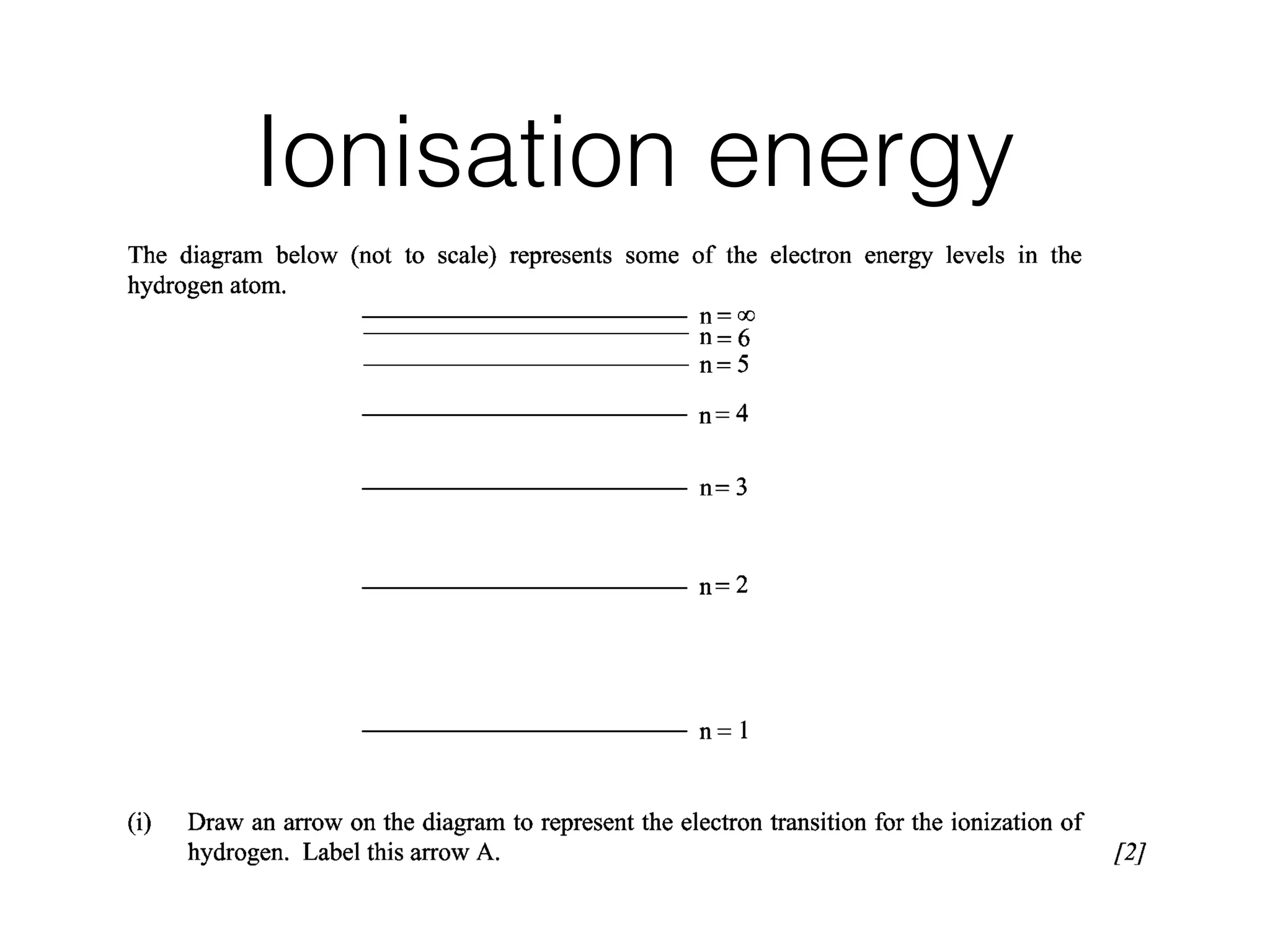
Ionisation energy - Q1
B. Electrons in the highest main energy level
C. The number of electrons required to complete the highest main energy level
D. The total number of electrons in the atom
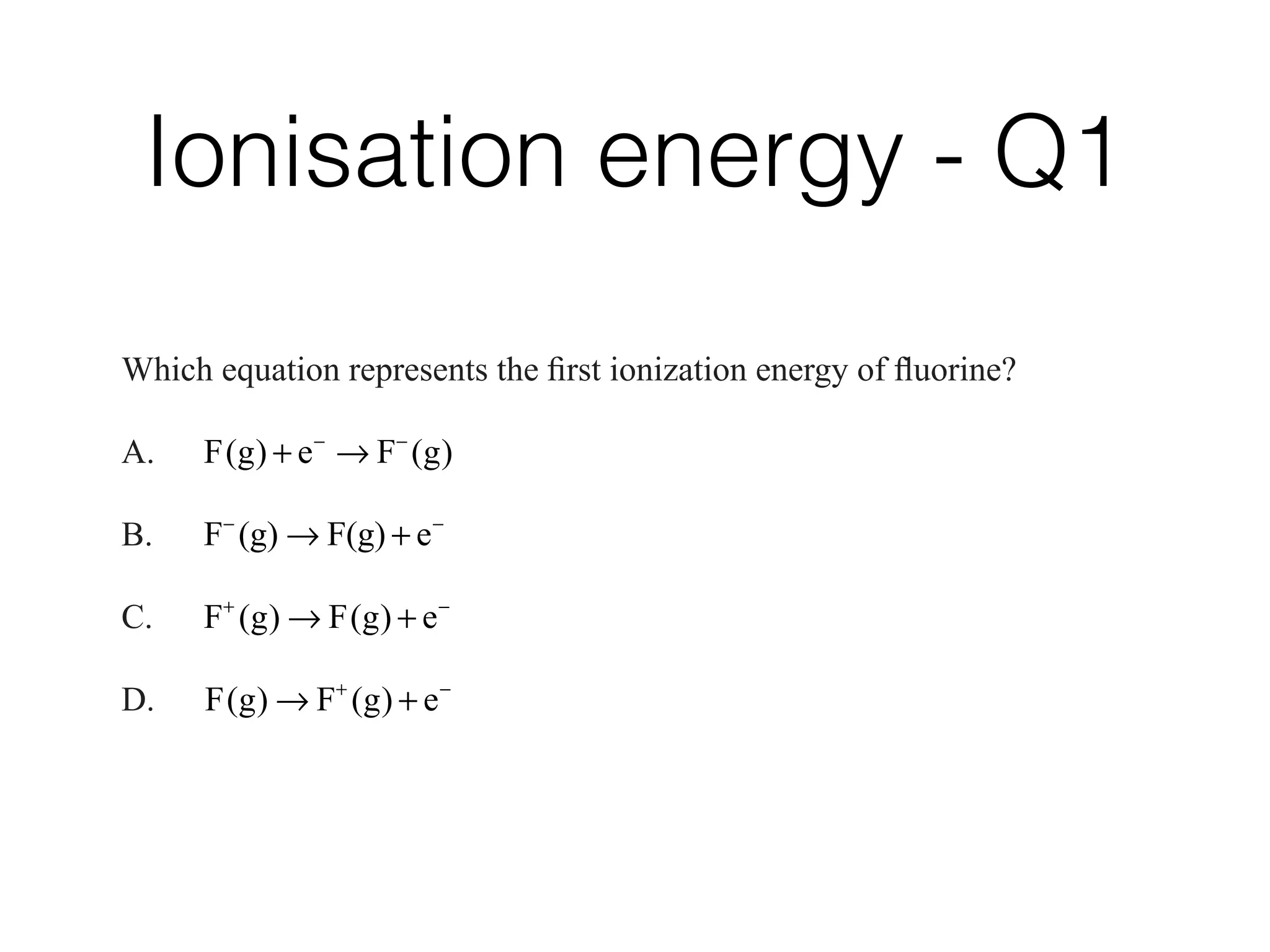
7.   Which  equation  represents  the  first  ionization  energy  of  fluorine?
A. F g e F g( ) ( )
B. F (g) F(g) e
C. F g F g e( ) ( )
D. F g F g e( ) ( )
Ionisation energy down a
group
1.2 Atomic Structure
d D o w n
oup
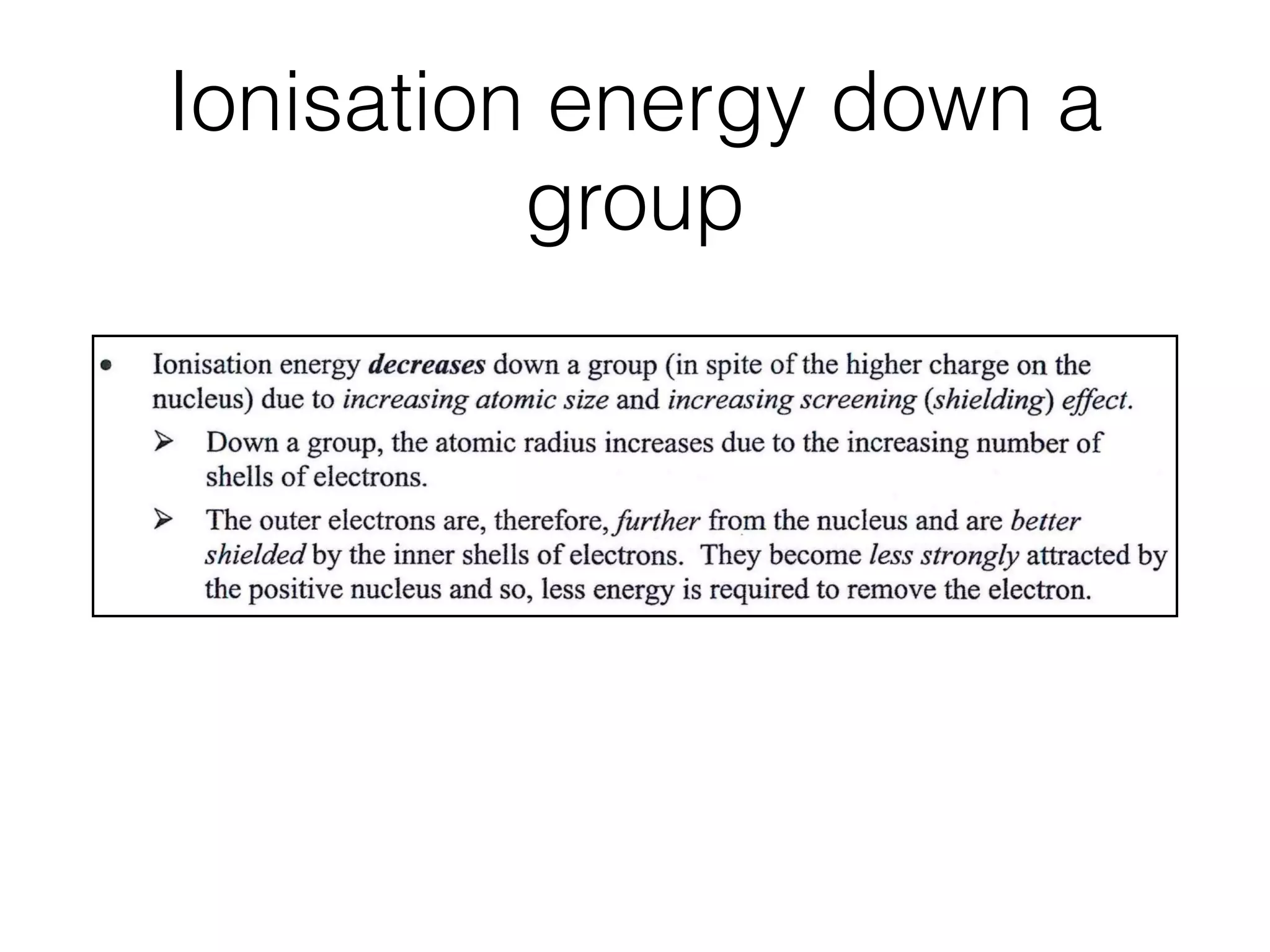
Ionisation energy decreases down a group (in spite of the higher charge on the
nucleus) due to increasing atomic size and increasing screening (shielding) effect.
Down a group, the atomic radius increases due to the increasing number of
shells of electrons.
The outer electrons are, therefore,further from the nucleus and are better
shielded by the inner shells of electrons. They become less strongly attracted by
the positive nucleus and so, less energy is required to remove the electron.
Across ,
riod
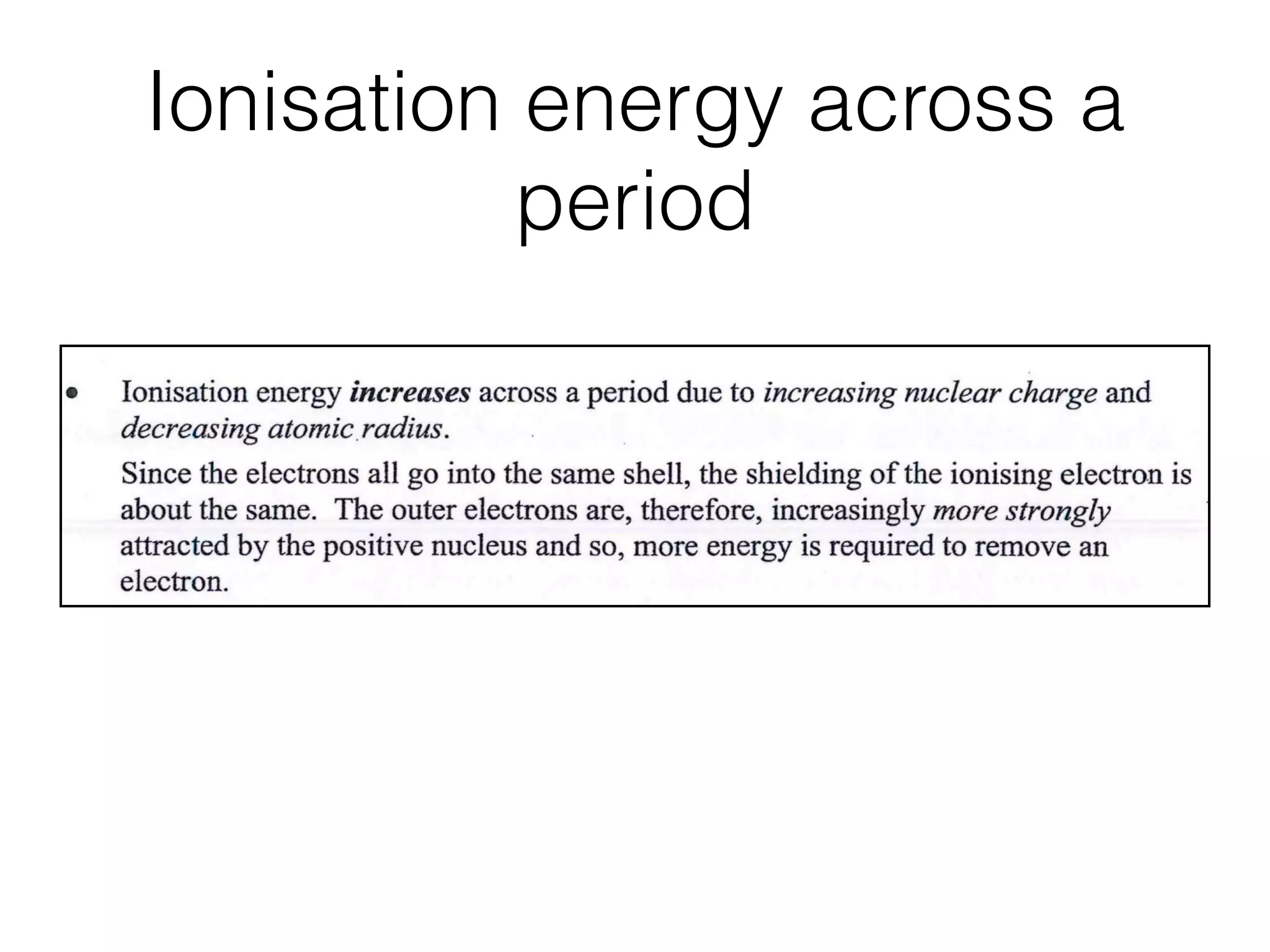
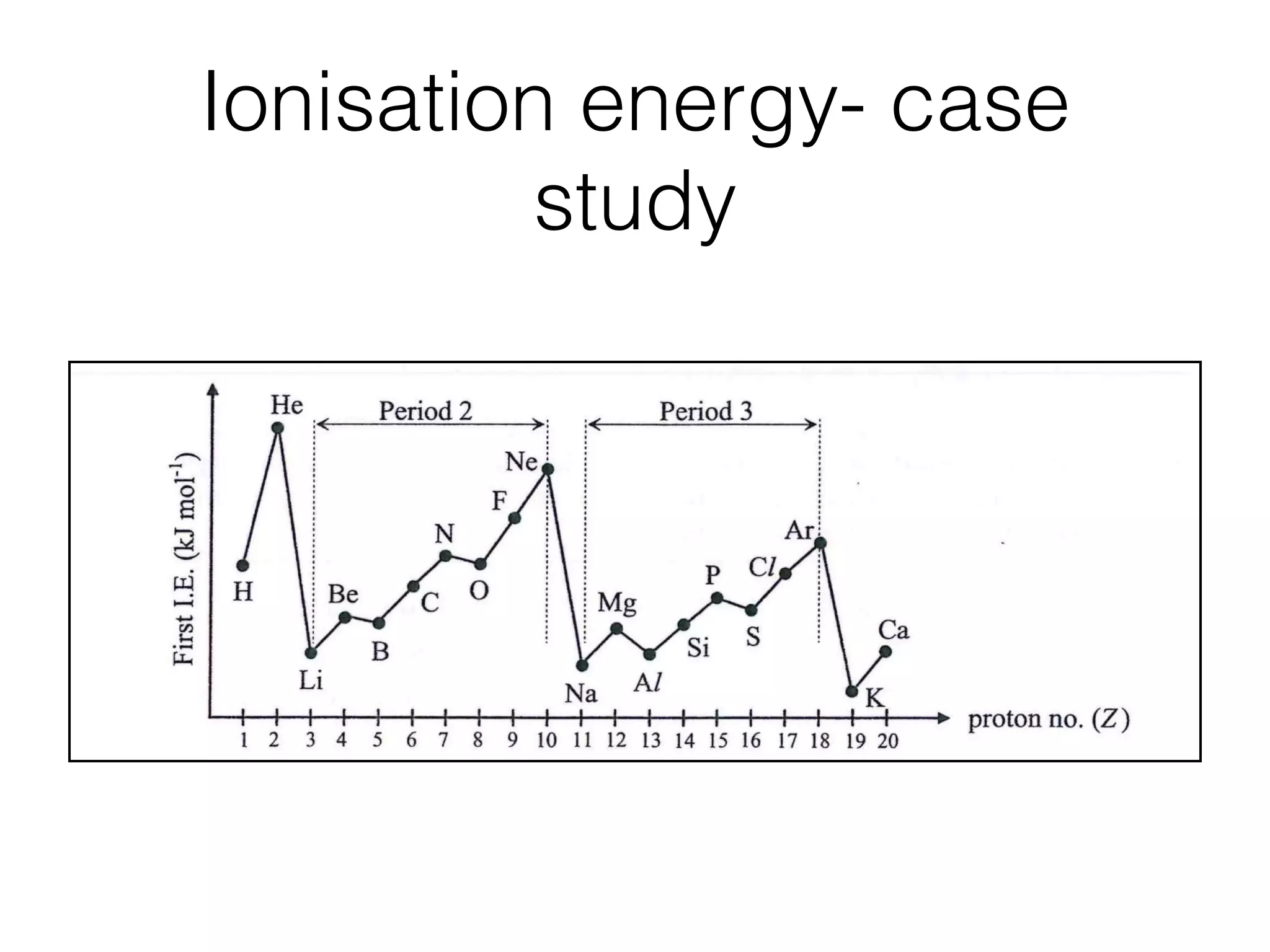
Ionisation energy increases across a period due to increasing nuclear charge and
decreasing atomicradius.
Since the electrons all go into the same shell, the shielding of the ionising electron is
about the same. The outer electrons are, therefore, increasingly more strongly
attracted by the positive nucleus and so, more energy is required to remove an
electron.
He Period 2 Period 3i< >! i< >i
Ionisation energy across a
period
1.2 Atomic Structure
D o w n
p
Ionisation energy decreases down a group (in spite of the higher charge on the
nucleus) due to increasing atomic size and increasing screening (shielding) effect.
Down a group, the atomic radius increases due to the increasing number of
shells of electrons.
The outer electrons are, therefore,further from the nucleus and are better
shielded by the inner shells of electrons. They become less strongly attracted by
the positive nucleus and so, less energy is required to remove the electron.
ross ,
d
Ionisation energy increases across a period due to increasing nuclear charge and
decreasing atomicradius.
Since the electrons all go into the same shell, the shielding of the ionising electron is
about the same. The outer electrons are, therefore, increasingly more strongly
attracted by the positive nucleus and so, more energy is required to remove an
electron.
of
.
20)
He Period 2 Period 3
A
i< >! i< >i
i N i A,i
~ i ~ B
i N a ~ ~ A / S i S i ~ K C a
Ionisation energy- case
study
The outer electrons are, therefore,further from the nucleus and are better
shielded by the inner shells of electrons. They become less strongly attracted by
the positive nucleus and so, less energy is required to remove the electron.
cross ,
d
Ionisation energy increases across a period due to increasing nuclear charge and
decreasing atomicradius.
Since the electrons all go into the same shell, the shielding of the ionising electron is
about the same. The outer electrons are, therefore, increasingly more strongly
attracted by the positive nucleus and so, more energy is required to remove an
electron.
n of
E.
20)
He Period 2 Period 3
A
i< >! i< >i
i N i A,i
~ i ~ B
i N a ~ ~ A / S i S i ~ K C a
I I I ! ! n I i a I I I l I l i I I ! ,I
i i i ! t i i I ! i i i ! i i i i ! !
1 2 3 4 5 6 7 8 9 1 0 11 1 2 13 1 4 1 5 1 6 1 7 1 8 1 9 2 0
:- proton no. (Z)
ities
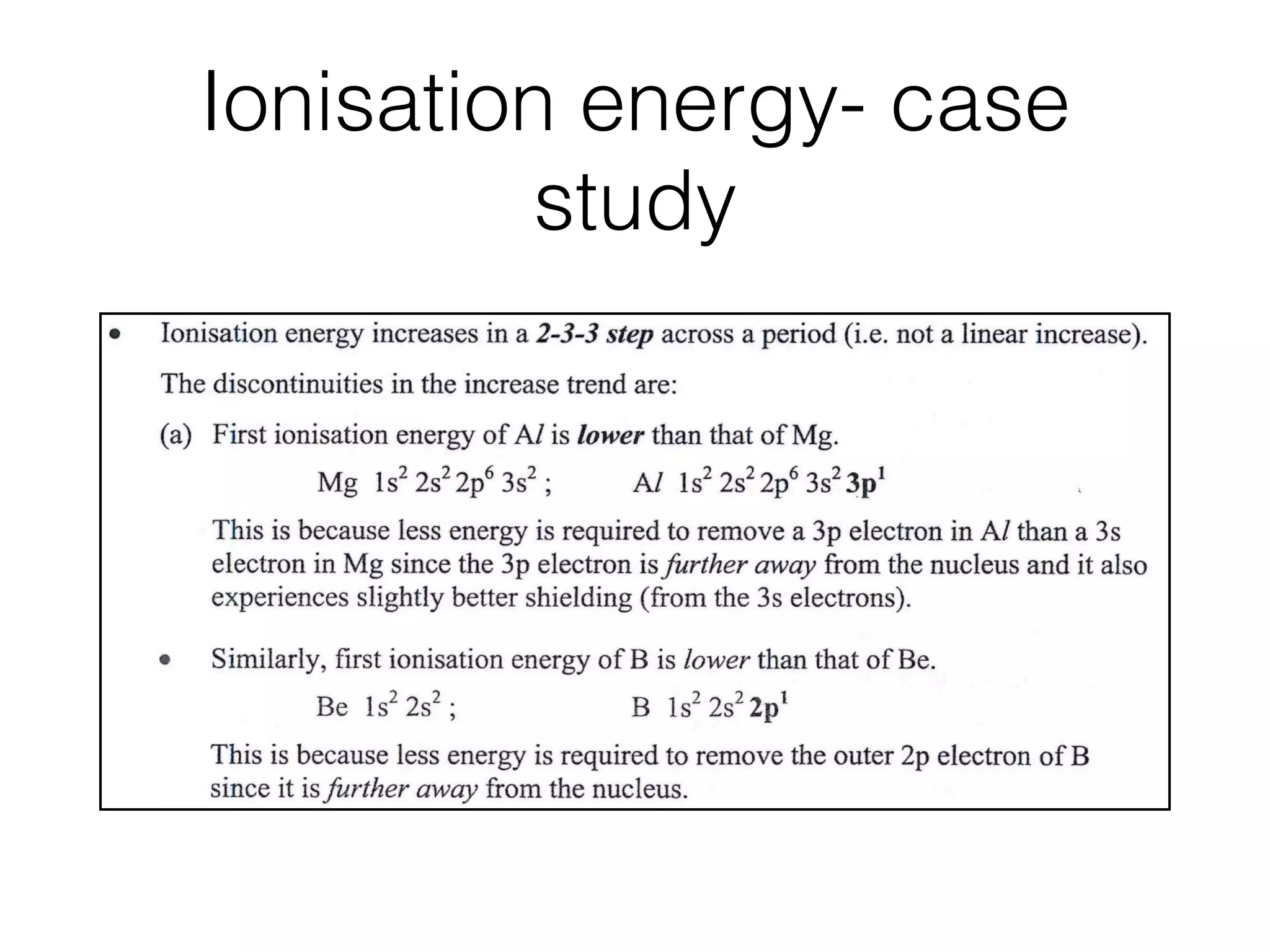
Ionisation energy increases in a 2-3-3 step across a period (i.e. not a linear increase).
The discontinuities in the increase trend are:
(a) First ionisation energy of AI is lower than that of Mg.
Ionisation energy
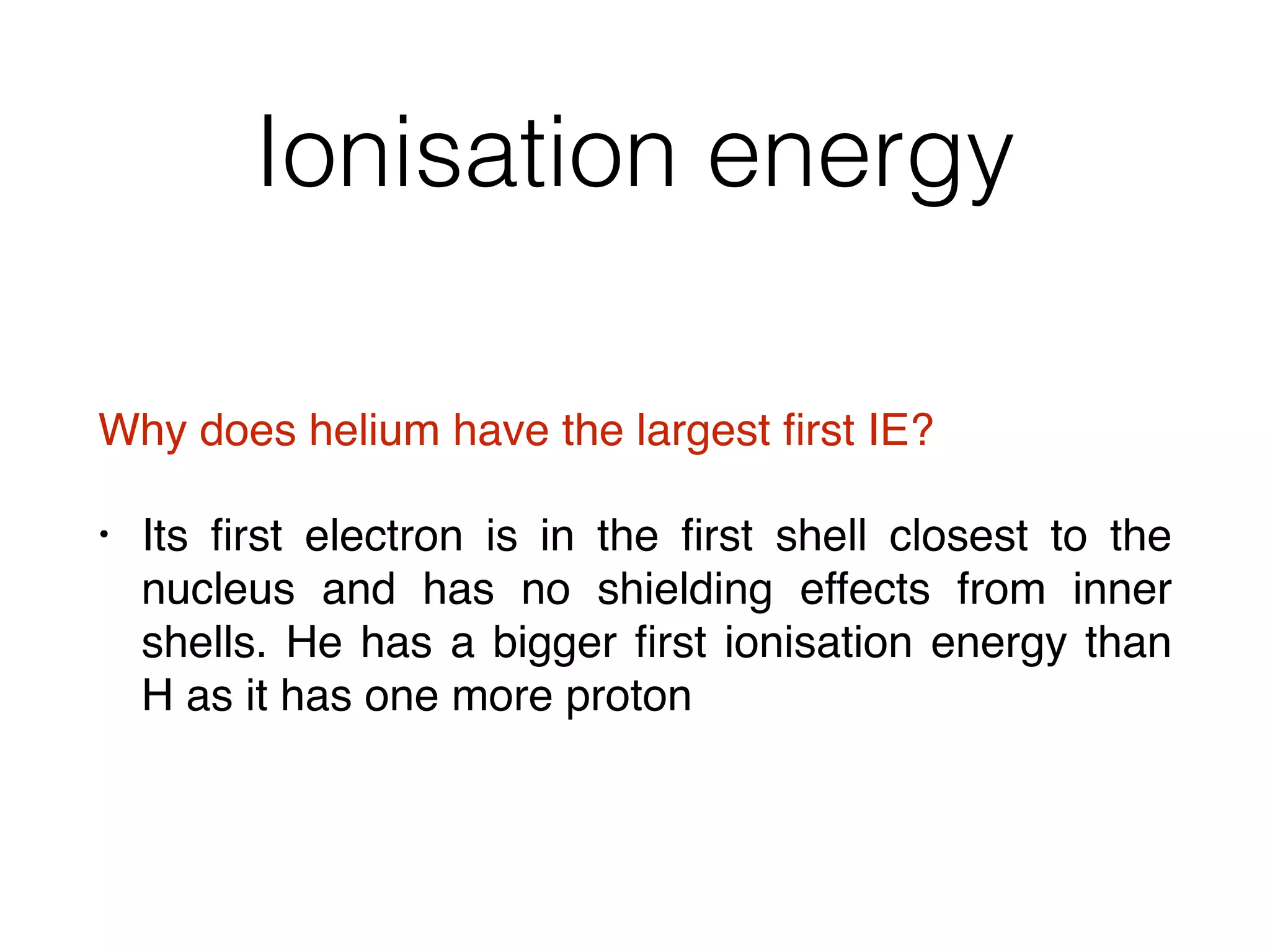
Why does helium have the largest first IE?
• Its first electron is in the first shell closest to the
nucleus and has no shielding effects from inner
shells. He has a bigger first ionisation energy than
H as it has one more proton
Ionisation energy
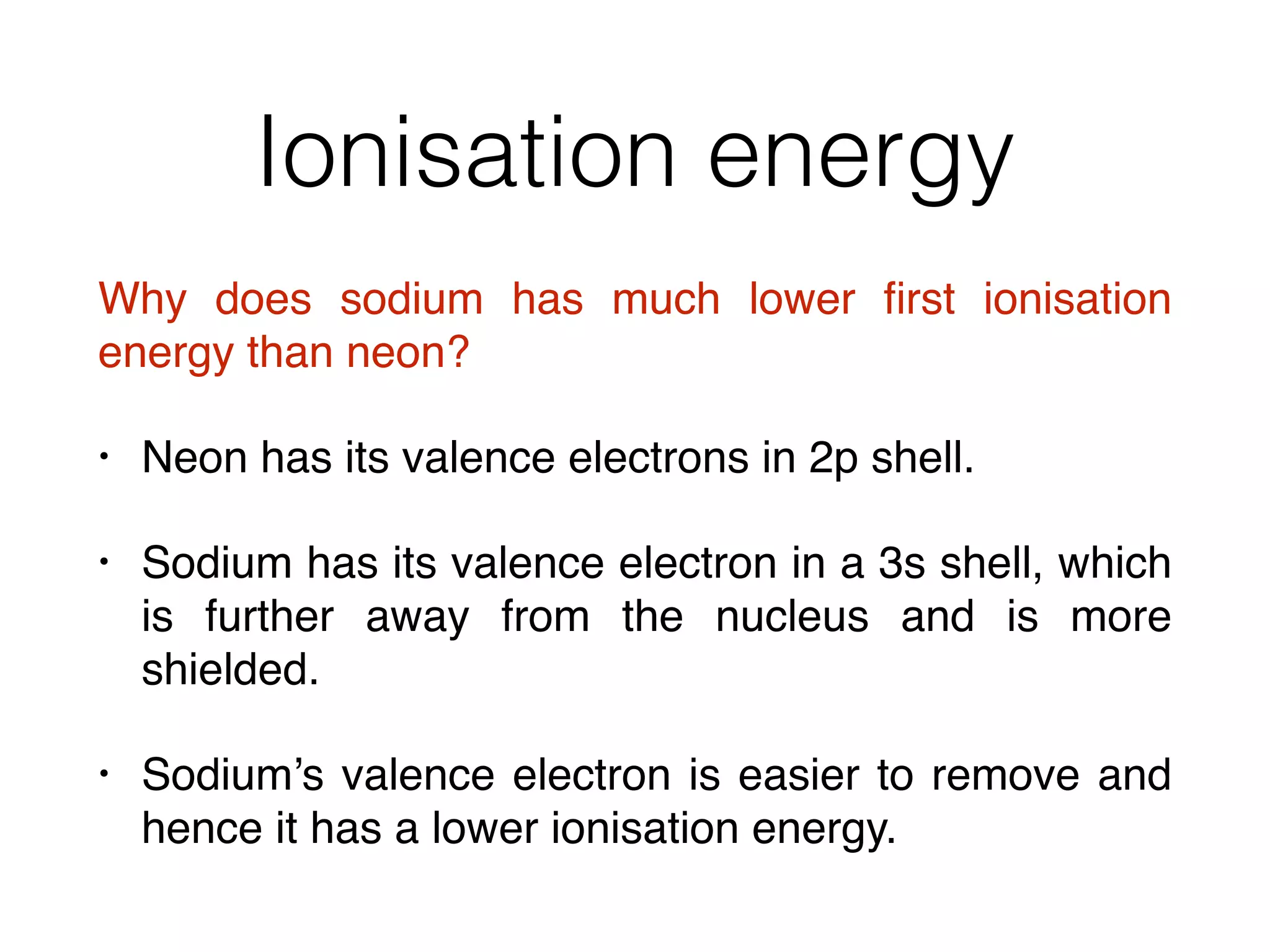
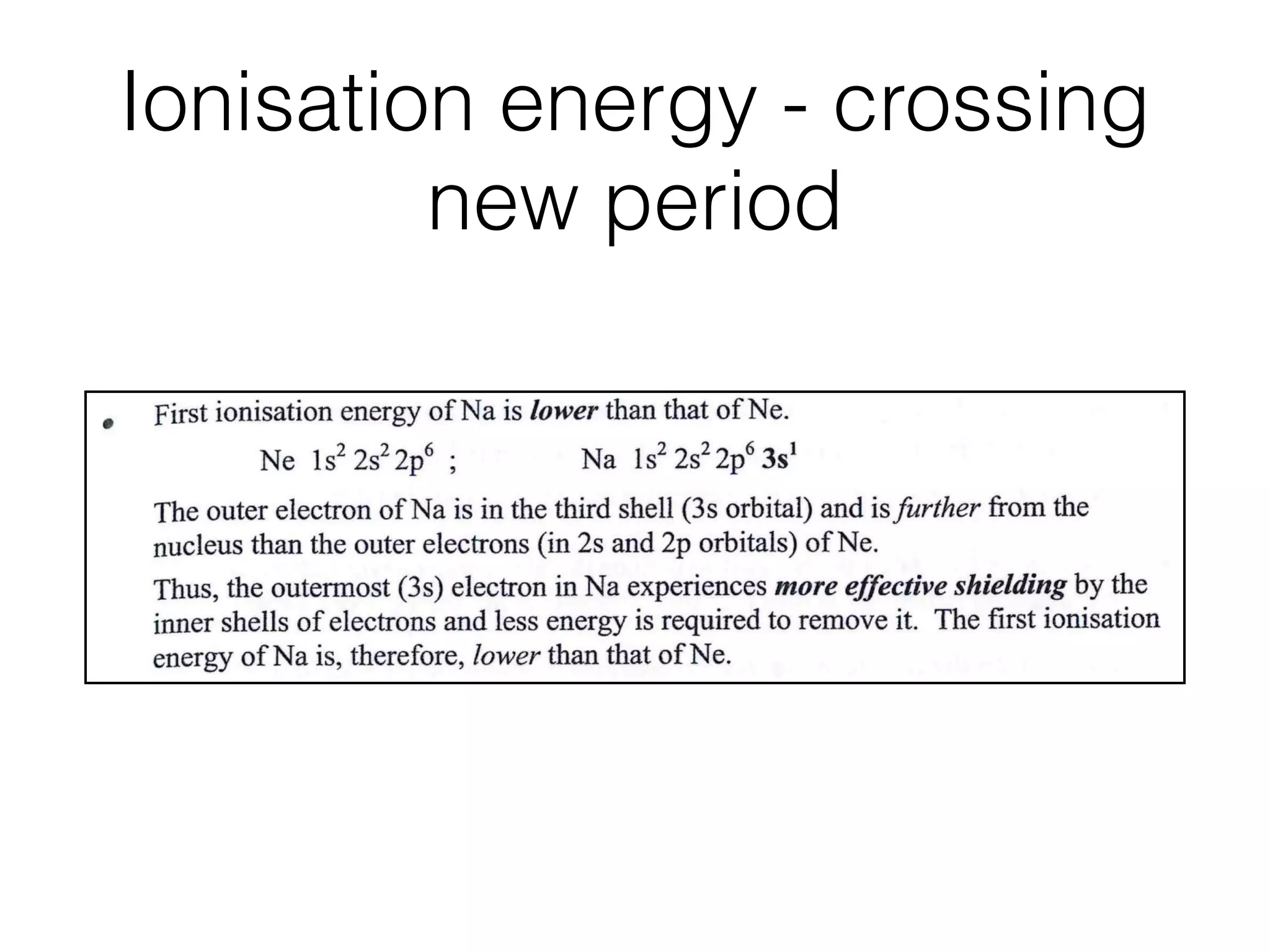
Why does sodium has much lower first ionisation
energy than neon?
• Neon has its valence electrons in 2p shell.
• Sodium has its valence electron in a 3s shell, which
is further away from the nucleus and is more
shielded.
• Sodium’s valence electron is easier to remove and
hence it has a lower ionisation energy.
Ionisation energy
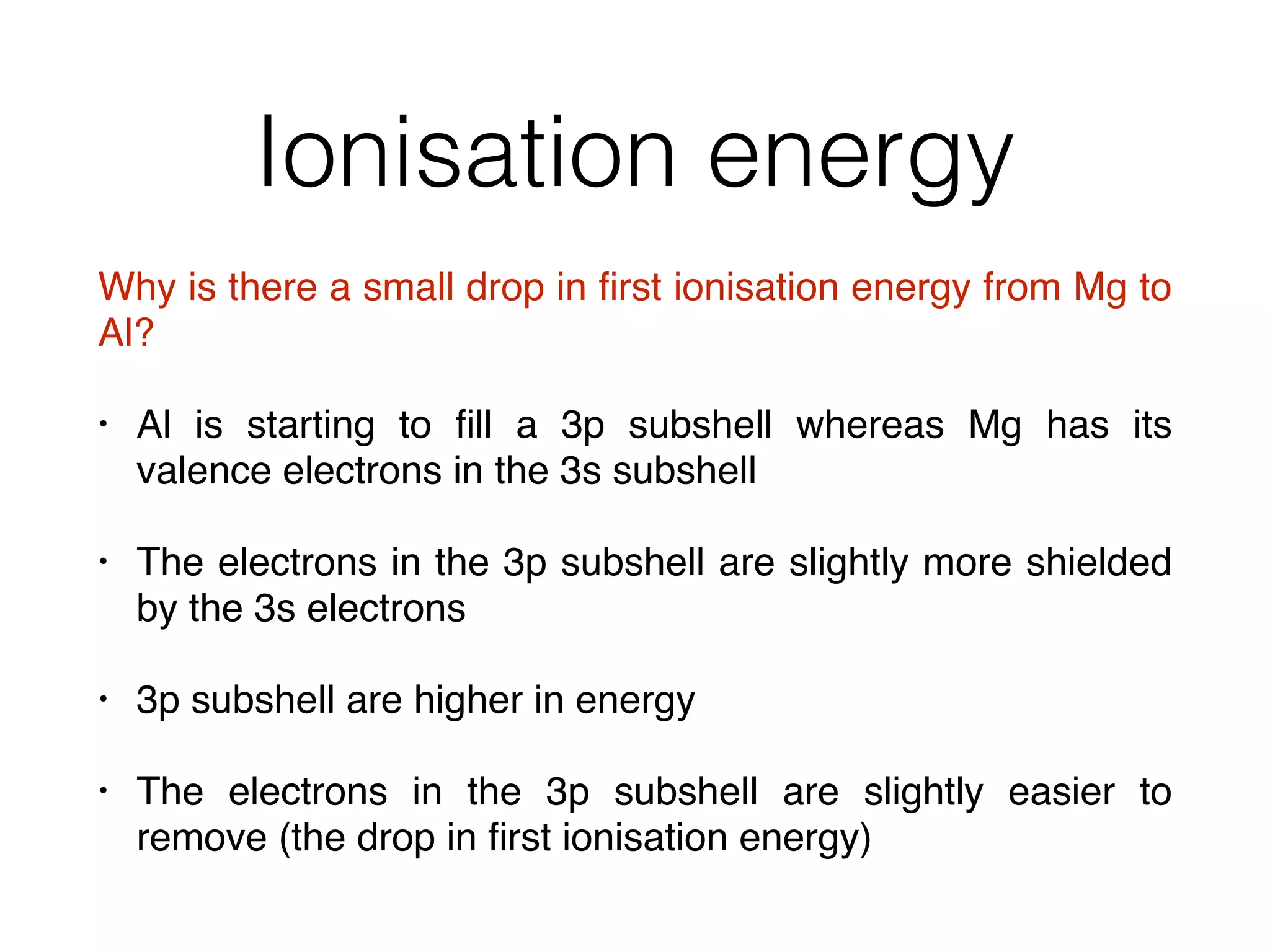
Why is there a small drop in first ionisation energy from Mg to
Al?
• Al is starting to fill a 3p subshell whereas Mg has its
valence electrons in the 3s subshell
• The electrons in the 3p subshell are slightly more shielded
by the 3s electrons
• 3p subshell are higher in energy
• The electrons in the 3p subshell are slightly easier to
remove (the drop in first ionisation energy)
Ionisation energy
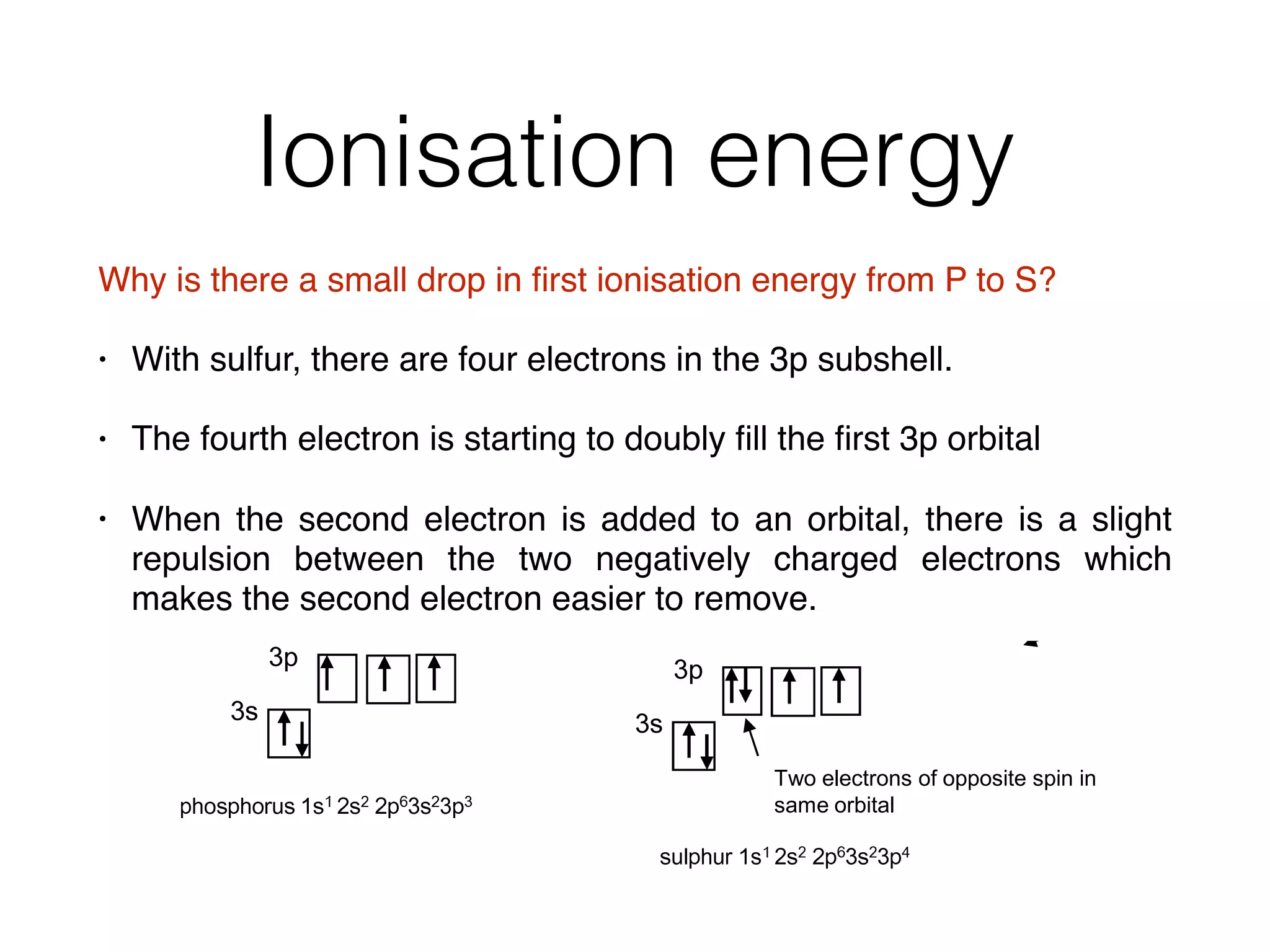
Why is there a small drop in first ionisation energy from P to S?
• With sulfur, there are four electrons in the 3p subshell.
• The fourth electron is starting to doubly fill the first 3p orbital
• When the second electron is added to an orbital, there is a slight
repulsion between the two negatively charged electrons which
makes the second electron easier to remove.
A. As one goes across a period the electrons are being added to the same
shell which has the same distance from the nucleus and shame shielding
effect. The number of protons increases, however, making the effective
attraction of the nucleus greater.
Q. Why has Na a much lower first ionisation energy than Neon?
This is because Na will have its outer electron in a 3s shell further from
the nucleus and is more shielded. So Na’s outer electron is easier to
remove and has a lower ionisation energy.
Q. Why is there a small drop from Mg to Al?
Al is starting to fill a 3p sub shell, whereas Mg has its outer electrons in the 3s
sub shell. The electrons in the 3p subshell are slightly easier to remove because
the 3p electrons are higher in energy and are also slightly shielded by the 3s
electrons
Learn carefully the
explanations for
these two small
drops as they are
different to the
usual factors
Q. Why is there a small drop from P to S?
V
S
With sulphur there are 4 electrons in the 3p sub shell and the 4th is starting to doubly
fill the first 3p orbital.
When the second electron is added to an orbital there is a slight repulsion between the
two negatively charged electrons which makes the second electron easier to remove.
V
S
Two electrons of opposite spin in
same orbital
Ionisation energy- case
study
tion of
st I.E.
Z = 20)
Ai N i A,i
~ i ~ B
i N a ~ ~ A / S i S i ~ K C a
I I I ! ! n I i a I I I l I l i I I ! ,I
i i i ! t i i I ! i i i ! i i i i ! !
1 2 3 4 5 6 7 8 9 1 0 11 1 2 13 1 4 1 5 1 6 1 7 1 8 1 9 2 0
:- proton no. (Z)
tinuities
Ionisation energy increases in a 2-3-3 step across a period (i.e. not a linear increase).
The discontinuities in the increase trend are:
(a) First ionisation energy of AI is lower than that of Mg.
Mg ls2 2s2 2p6 3s2 ; A/ ls2 2s2 2p6 3s2 3pl
This is because less energy is required to remove a 3p electron in Al than a 3s
electron in Mg since the 3p electron is further away from the nucleus and it also
experiences slightly better shielding (from the 3s electrons).
Similarly, first ionisation energy of B is lower than that of Be.
Be 1 s~ 2s2 ; B 1 s2 2s~- 2pl
This is because less energy is required to remove the outer 2p electron of B
since it is further away from the nucleus.
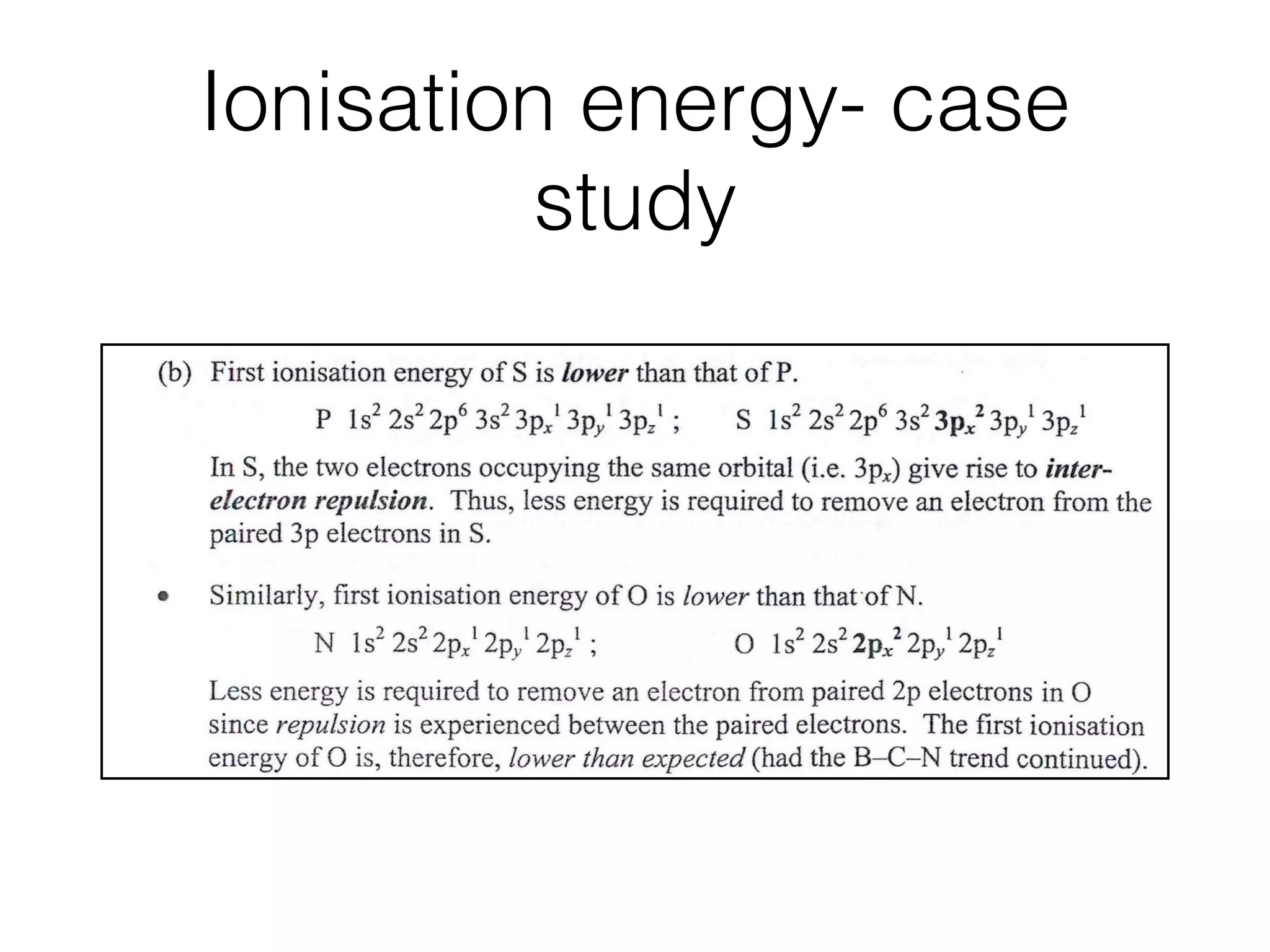
(b) First ionisation energy of S is lower than that of P.
P ls2 2s2 2p6 3s2 3pfl 3pfl 3pzI ; S ls2 2s2 2p6 3s2 3pff 3pfl 3pfl
Ionisation energy- case
study
Mg ls2 2s2 2p6 3s2 ; A/ ls2 2s2 2p6 3s2 3pl
This is because less energy is required to remove a 3p electron in Al than a 3s
electron in Mg since the 3p electron is further away from the nucleus and it also
experiences slightly better shielding (from the 3s electrons).
Similarly, first ionisation energy of B is lower than that of Be.
Be 1 s~ 2s2 ; B 1 s2 2s~- 2pl
This is because less energy is required to remove the outer 2p electron of B
since it is further away from the nucleus.
(b) First ionisation energy of S is lower than that of P.
P ls2 2s2 2p6 3s2 3pfl 3pfl 3pzI ; S ls2 2s2 2p6 3s2 3pff 3pfl 3pfl
In S, the two electrons occupying the same orbital (i.e. 3p,) give rise to inter-
electron repulsion. Thus, less energy is required to remove an electron from the
paired 3p electrons in S.
Similarly, first ionisation energy of O is lower than thatofN.
N ls2 2sZ2p~12py12p_,l ; O ls2 2s22pxZ2pfl 2pzl
Less energy is required to remove an electron from paired 2p electrons in O
since repulsion is experienced between the paired electrons. The first ionisation
energy of O is, therefore, lower than expected (had the B-C-N trend continued).
© Step-by-Step
Advanced Guide - Chemistry
Ionisation energy - crossing
new period
- l~2Aiomic Structure
First ionisation energy of Na is lower than that of Ne.
Ne ls2 2s22p6 ; Na ls2 2s22p63s1
The outer electron of Na is in the third shell (3s orbital) and is further from the
nucleus than the outer electrons (in 2s and 2p orbitals) of Ne.
Thus, the outermost (3s) electron in Na experiences more effective shielding by the
inner shells of electrons and less energy is required to remove it. The first ionisation
energy of Na is, therefore, lower than that of Ne.
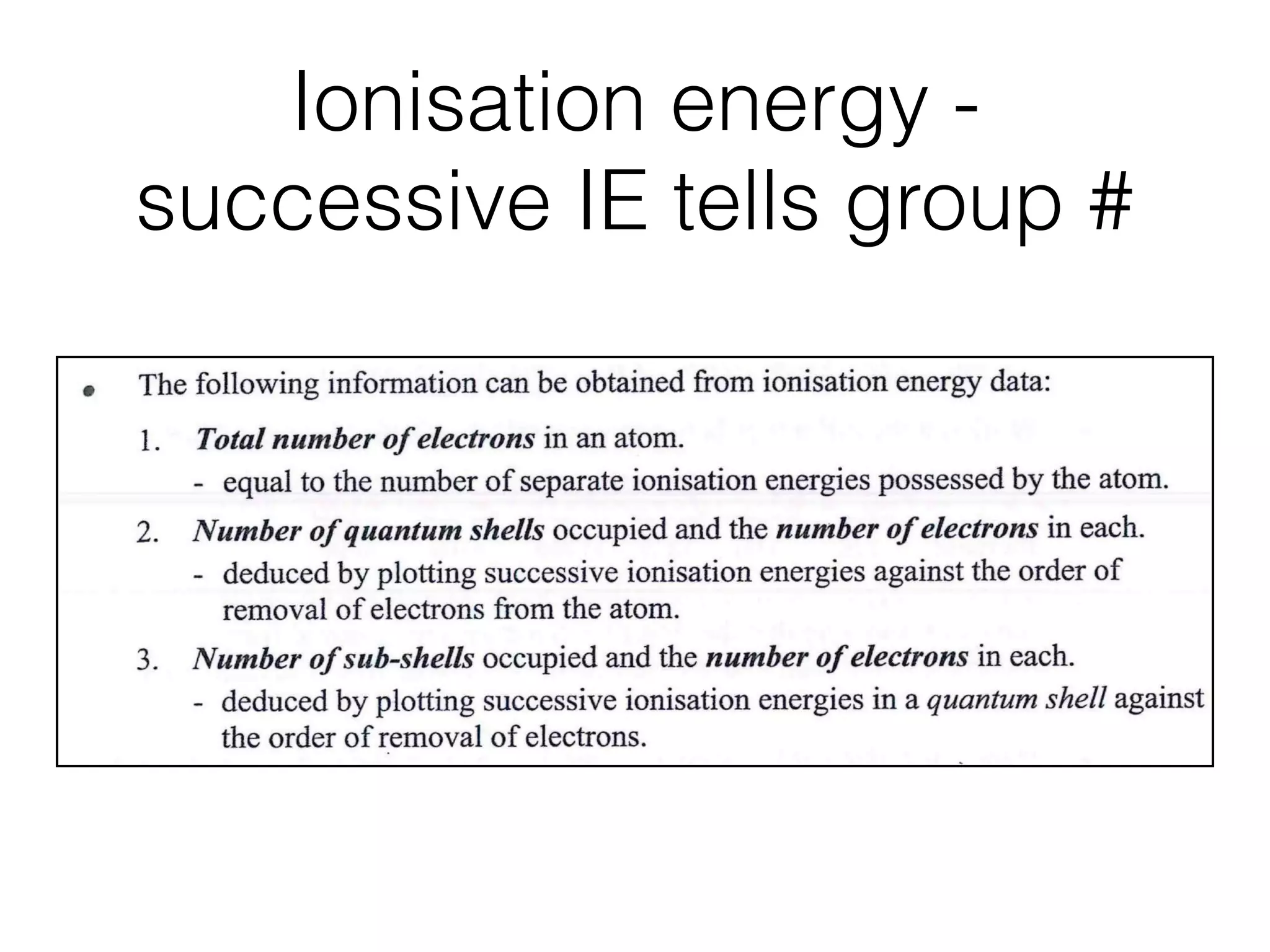
The following information can be obtained from ionisation energy data:
1. Total number of electrons in an atom.
- equal to the number of separate ionisation energies possessed by the atom.
Number of quantum shells occupied and the number of electrons in each.
- deduced by plotting successive ionisation energies against the order of
removal of electrons from the atom.
Succe
I.
Assignment
• Q12, 13, 14, 15, 16
• Set on ?
• Submit on ?
Ionisation energy -
successive IE tells group #
First ionisation energy of Na is lower than that of Ne.
Ne ls2 2s22p6 ; Na ls2 2s22p63s1
The outer electron of Na is in the third shell (3s orbital) and is further from the
nucleus than the outer electrons (in 2s and 2p orbitals) of Ne.
Thus, the outermost (3s) electron in Na experiences more effective shielding by the
inner shells of electrons and less energy is required to remove it. The first ionisation
energy of Na is, therefore, lower than that of Ne.
The following information can be obtained from ionisation energy data:
1. Total number of electrons in an atom.
- equal to the number of separate ionisation energies possessed by the atom.
Number of quantum shells occupied and the number of electrons in each.
- deduced by plotting successive ionisation energies against the order of
removal of electrons from the atom.
Number of sub-shells occupied and the number of electrons in each.
- deduced by plotting successive ionisation energies in a quantum shell against
the order of removal of electrons.
e.g. 1 Successive ionisation energies forpotassium atom
Ig I.E.
6
Ionisation energy -
successive IE tells group #
The following information can be obtained from ionisation energy data:
1. Total number of electrons in an atom.
- equal to the number of separate ionisation energies possessed by the atom.
Number of quantum shells occupied and the number of electrons in each.
- deduced by plotting successive ionisation energies against the order of
removal of electrons from the atom.
Number of sub-shells occupied and the number of electrons in each.
- deduced by plotting successive ionisation energies in a quantum shell against
the order of removal of electrons.
Success
I.E.
e.g. 1 Successive ionisation energies forpotassium atom
Ig I.E.
6
(4thquantumshell)
~ ,
,- 1 electron F i5
[ ~ i ~ 2 e l e c t r o n s
4 , , ~ , ,,
[ ~ ~ - ° ~ ~ , ' i i ~ (lSt quantum shell)
3 [ T, - i i 8electrons i ! !
~ rd ~'; ](2naquantumshell)I , 1
2 ', ! (3 quantum shell) ', ',
i ! ',
1 ~ ' t , , , ~ , , I ~ , , , , ~ , i ~ ~ J
0 1 2 3 4 5 6 7 8 9 10 11 12 13 14 15 16 17 18 19 20
order of electrons removed
Potassium atom has a total of 19 electrons, which fall into four groups.
- two electrons very close to the nucleus (in the 1st quantum shell, which are
most difficult to remove),
- eight electrons further out (in the 2na quantum shell),
Ionisation energy -
successive IE tells group #
6
(4thquantumshell)
~ ,
,- 1 electron F i5
[ ~ i ~ 2 e l e c t r o n s
4 , , ~ , ,,
[ ~ ~ - ° ~ ~ , ' i i ~ (lSt quantum shell)
3 [ T, - i i 8electrons i ! !
~ rd ~'; ](2naquantumshell)I , 1
2 ', ! (3 quantum shell) ', ',
i ! ',
1 ~ ' t , , , ~ , , I ~ , , , , ~ , i ~ ~ J
0 1 2 3 4 5 6 7 8 9 10 11 12 13 14 15 16 17 18 19 20
order of electrons removed
Potassium atom has a total of 19 electrons, which fall into four groups.
- two electrons very close to the nucleus (in the 1st quantum shell, which are
most difficult to remove),
- eight electrons further out (in the 2na quantum shell),
- another eight electrons even further out (in the 3rd quantum shell) and
- one further away still (in the 4th quantum shell).
Hence, the electron arrangement in potassium is written as 2,8,8,1.
Ionisation energies in the 3ra quantum shell of potassium
The steady rise in ionisation energy for
successive removal of the first six electrons
followed by a sharp increase, suggests that the
last two electrons are more strongly attracted
lg I.E.
Ionisation energy -
successive IE tells group #
nterpret
uccessive
E. Data
1.2 Atomic structure ....................................................
Hence the following graphs provide evidences of existence of shells and sub-shells
(i) plot of first ionisation energies against atomic numbers, and
(ii) plot of successive ionisation energies for a particular element.
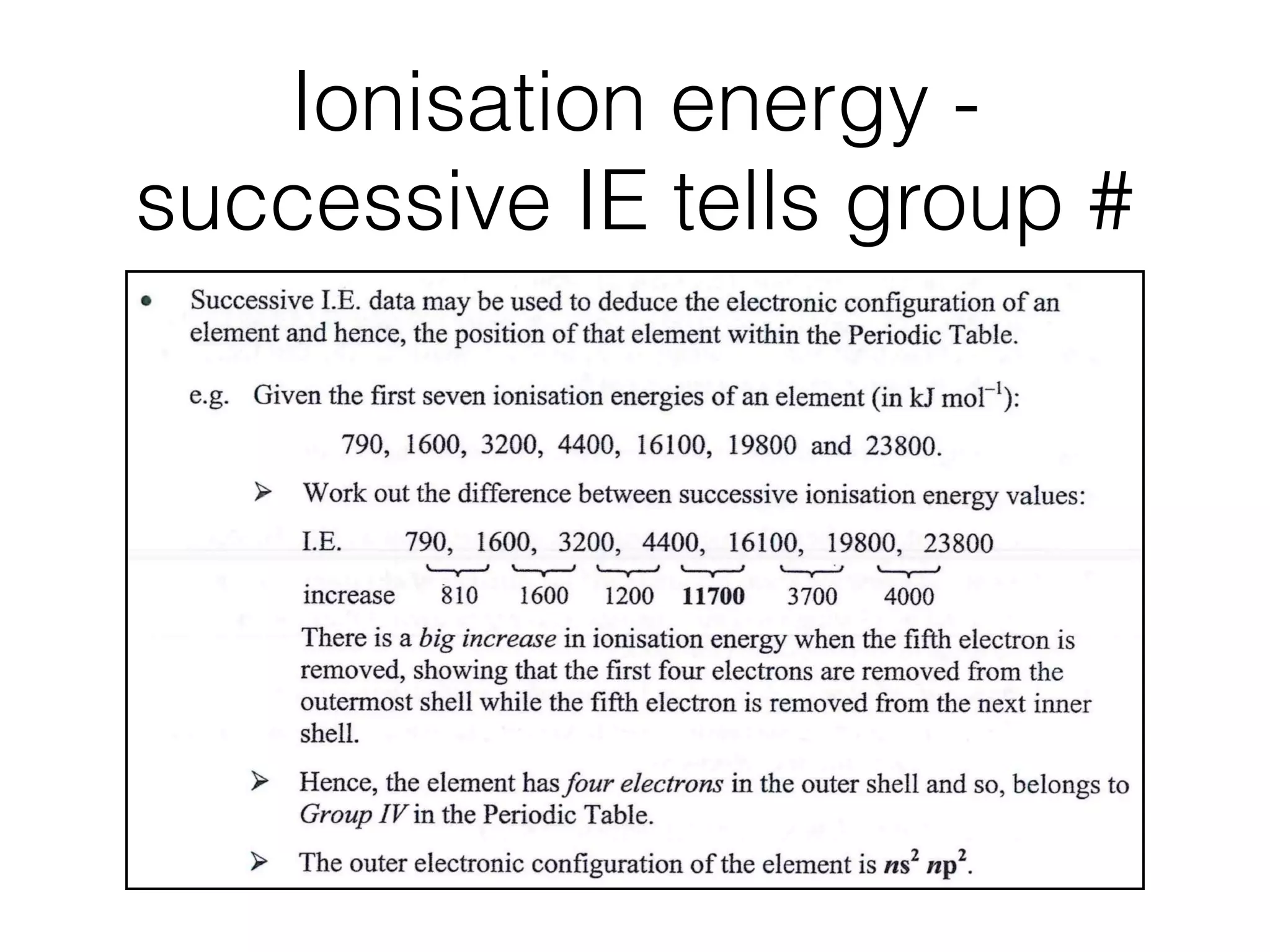
Successive I.E. data may be used to deduce the electronic configuration of an
element and hence, the position of that element within the Periodic Table.
e.g. Given the first seven ionisation energies of an element (in kJ mol-l)
790, 1600, 3200, 4400, 16100, 19800 and 23800.
Work out the difference between successive ionisation energy values:
increase
790, 1600, 3200, 4400, 16100, 19800, 23800
810 1600 1200 117110 3700 4000
There is a big increase in ionisation energy when the fifth electron is
removed, showing that the first four electrons are removed from the
outermost shell while the fifth electron is removed from the next inner
shell.
Hence, the element has four electrons in the outer shell and so, belongs to
Group IV in the Periodic Table.
~' The outer electronic configuration of the element is ns2 np2.
OStep-by-Step
Successive ionisation
energy - Q2
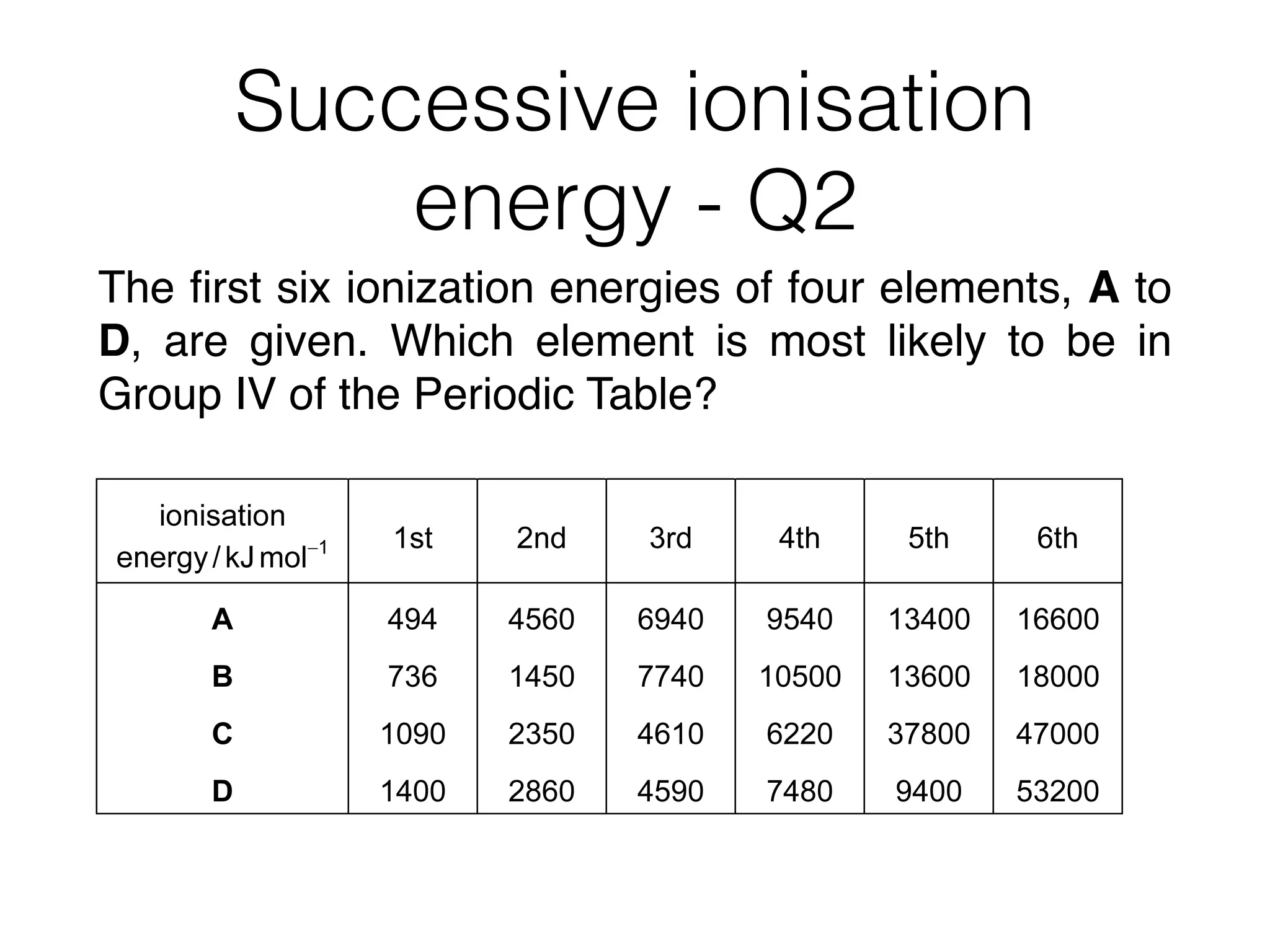
The first six ionization energies of four elements, A to
D, are given. Which element is most likely to be in
Group IV of the Periodic Table?
2NaN3 → 2Na + 3N2
10Na + 2KNO3 → K2O + 5Na2O + N2
How many moles of nitrogen gas are produced from 1 mol of sodium azide, NaN3?
A 1.5 B 1.6 C 3.2 D 4.0
3 The first six ionisation energies of four elements, A to D, are given.
Which element is most likely to be in Group IV of the Periodic Table?
ionisation
energy/kJmol−1 1st 2nd 3rd 4th 5th 6th
A 494 4560 6940 9540 13400 16600
B 736 1450 7740 10500 13600 18000
C 1090 2350 4610 6220 37800 47000
D 1400 2860 4590 7480 9400 53200
4 In which species are the numbers of electrons and neutrons equal?
Successive ionisation
energies - Q3
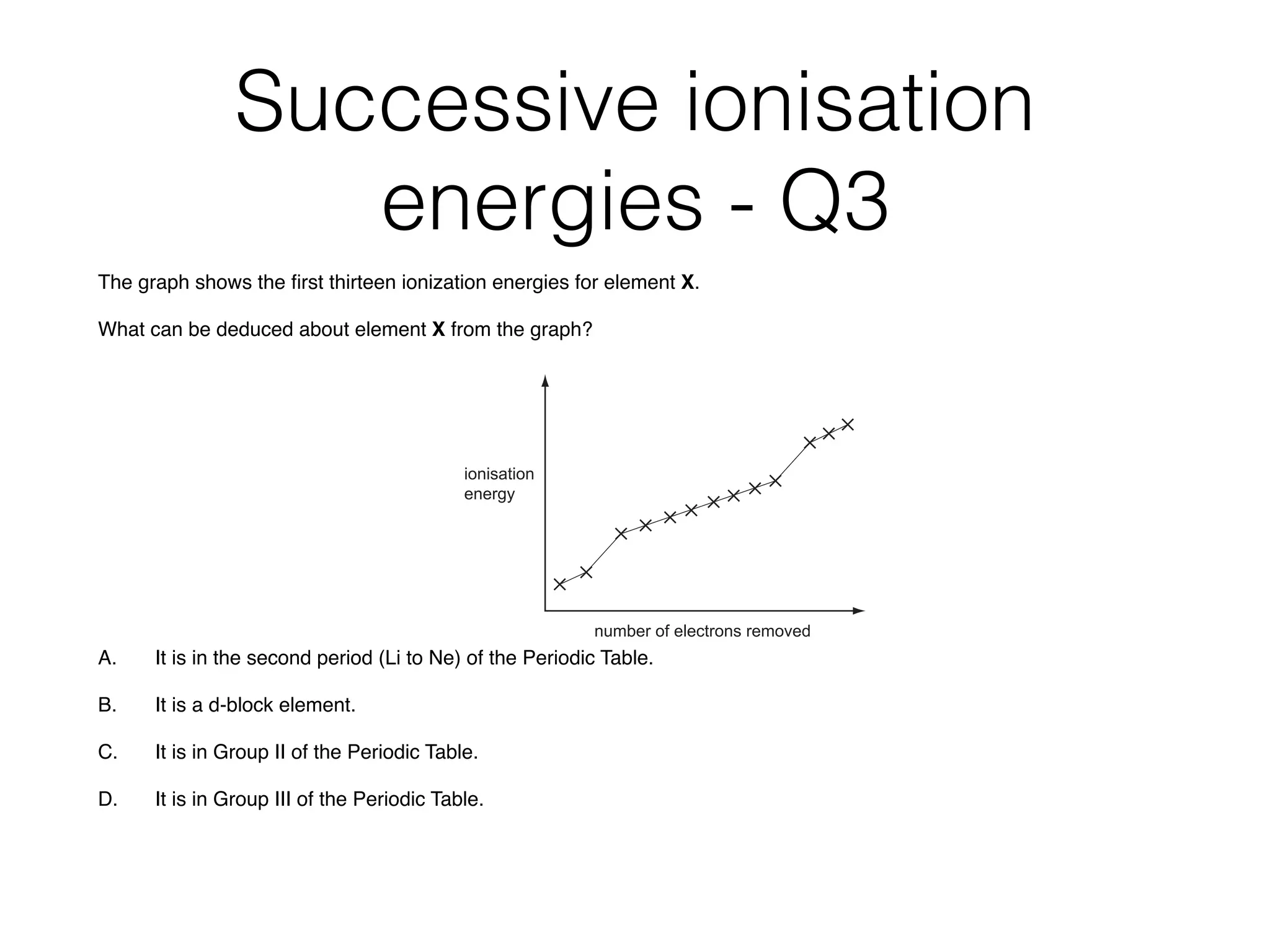
The graph shows the first thirteen ionization energies for element X.
What can be deduced about element X from the graph?
A. It is in the second period (Li to Ne) of the Periodic Table.
B. It is a d-block element.
C. It is in Group II of the Periodic Table.
D. It is in Group III of the Periodic Table.
3
4 The graph shows the first thirteen ionisation energies for element X.
number of electrons removed
ionisation
energy
What can be deduced about element X from the graph?
A It is in the second period (Li to Ne) of the Periodic Table.
B It is a d-block element.
C It is in Group II of the Periodic Table.
D It is in Group III of the Periodic Table.
5 Hydrogen bonding can occur between molecules of methanal, HCHO, and molecules of liquid Y.
What could liquid Y be?
A CH3OH
Successive ionisation
energies - Q4
2
1 The table shows the successive ionisation energies for an element Q.
1st 2nd 3rd 4th
ionisation energy/kJmol–1
418 3070 4600 5860
What is the likely formula of the oxide of Q?
A QO B Q3O2 C Q2O D Q2O3
2 How many neutrons are present in 0.13g of 13
C?
[L = the Avogadro constant]
A 0.06L B 0.07L C 0.13L D 0.91L
Assignment
• Q17, 18, 21, 22
• Omit qst 19, 20  23
• Set on ?
• Submit on ?
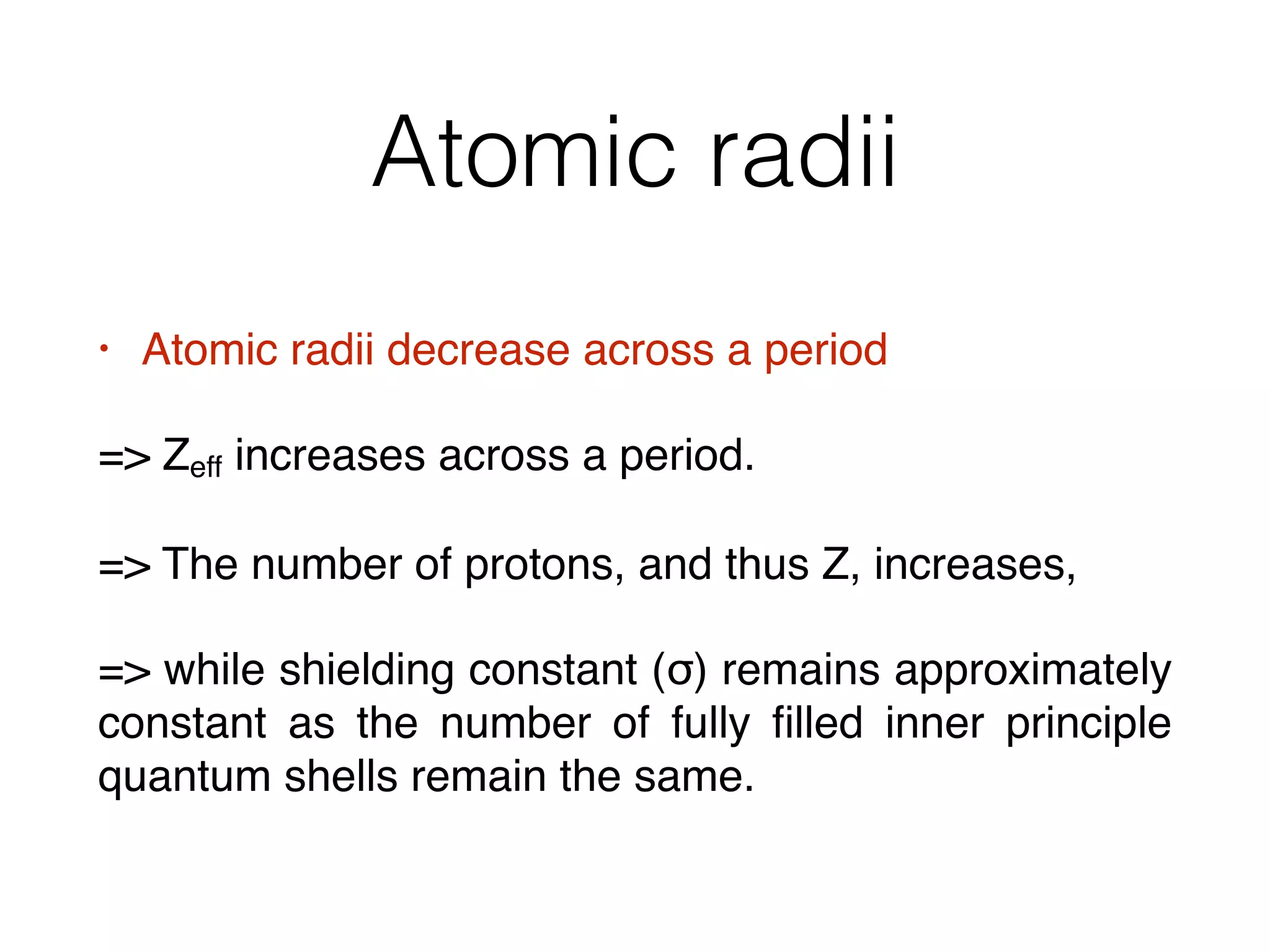
Atomic radii
• Atomic radii decrease across a period
= Zeff increases across a period.
= The number of protons, and thus Z, increases,
= while shielding constant (σ) remains approximately
constant as the number of fully filled inner principle
quantum shells remain the same.
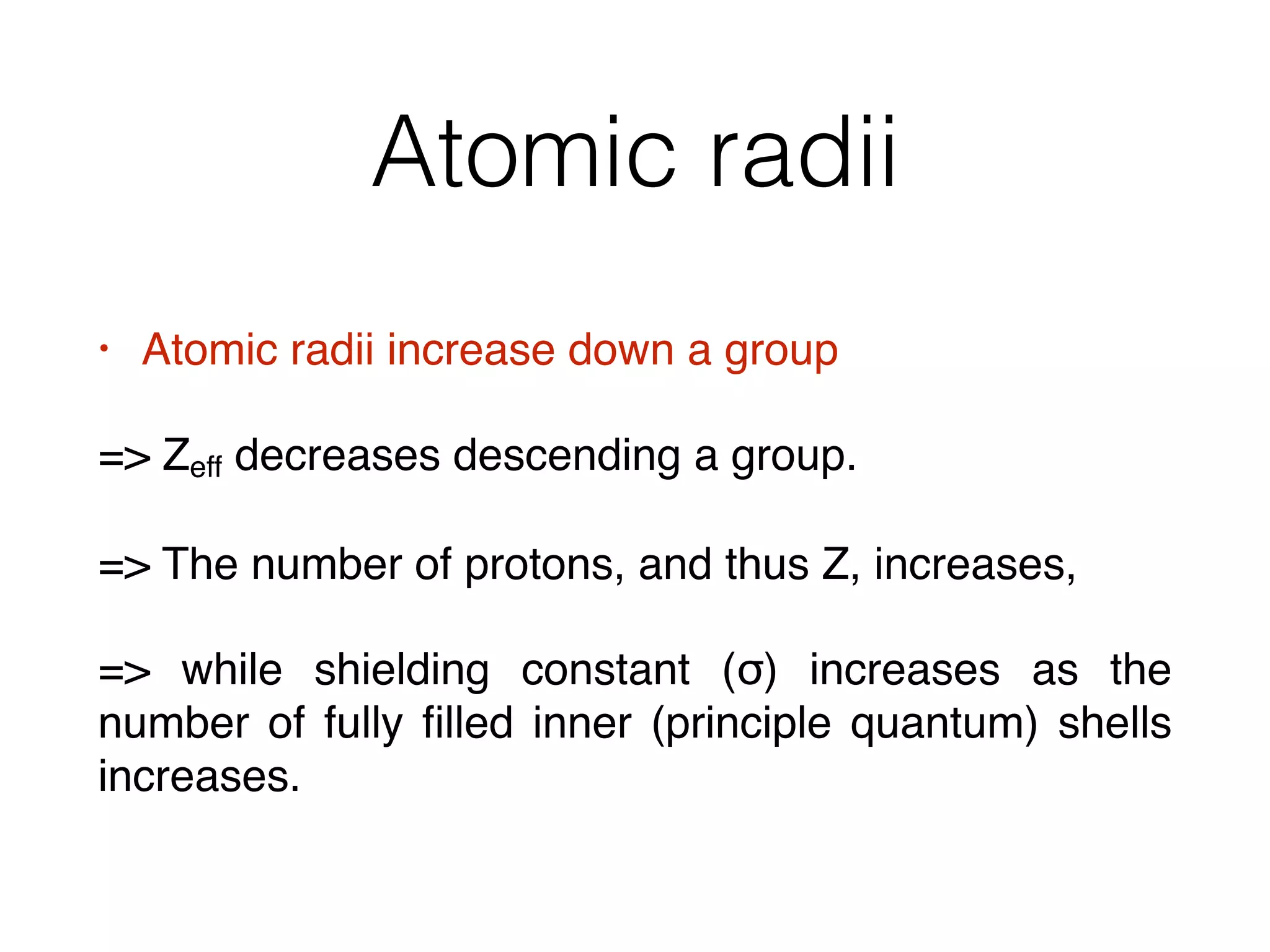
Atomic radii
• Atomic radii increase down a group
= Zeff decreases descending a group.
= The number of protons, and thus Z, increases,
= while shielding constant (σ) increases as the
number of fully filled inner (principle quantum) shells
increases.
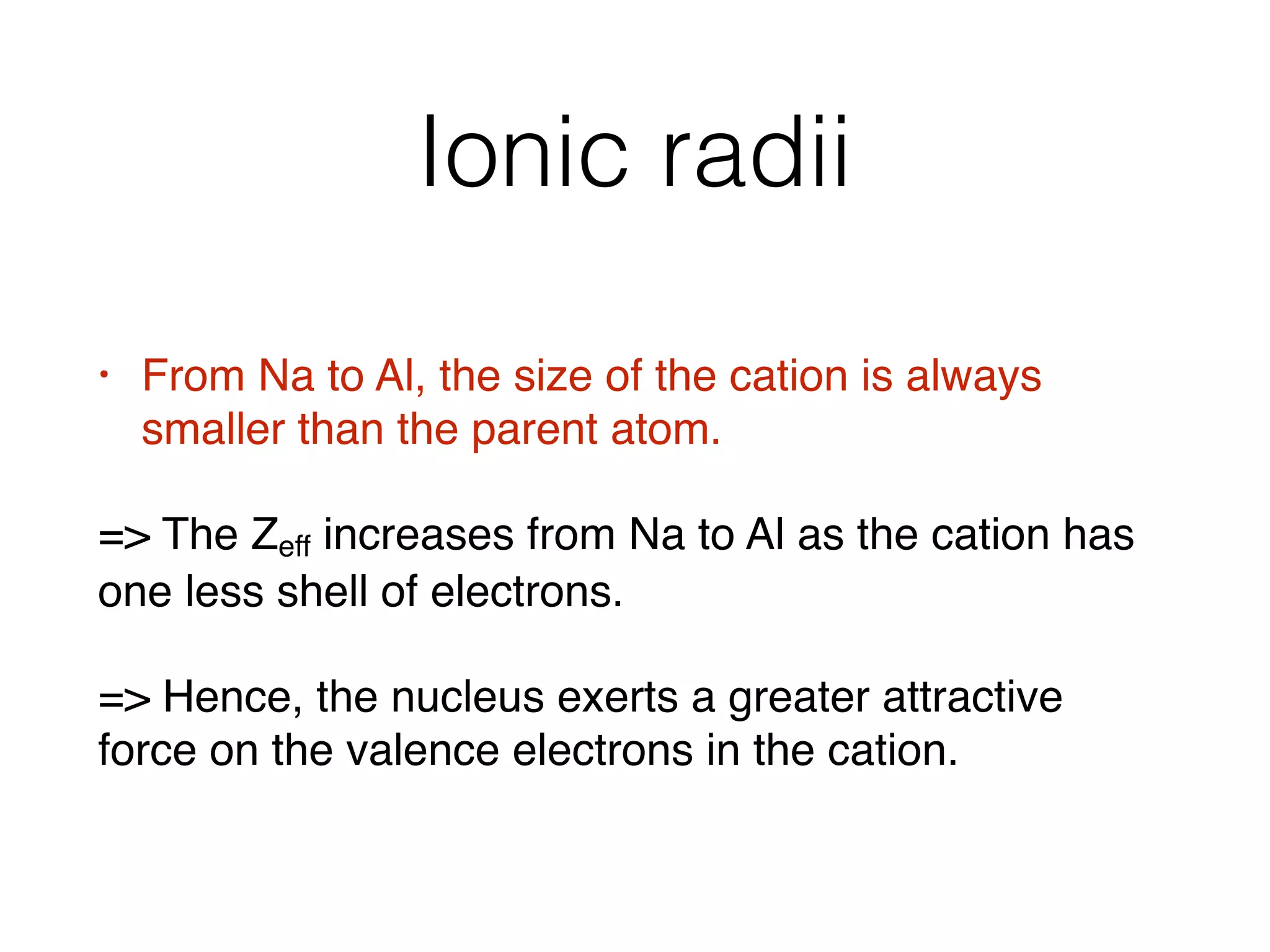
Ionic radii
• From Na to Al, the size of the cation is always
smaller than the parent atom.
= The Zeff increases from Na to Al as the cation has
one less shell of electrons.
= Hence, the nucleus exerts a greater attractive
force on the valence electrons in the cation.
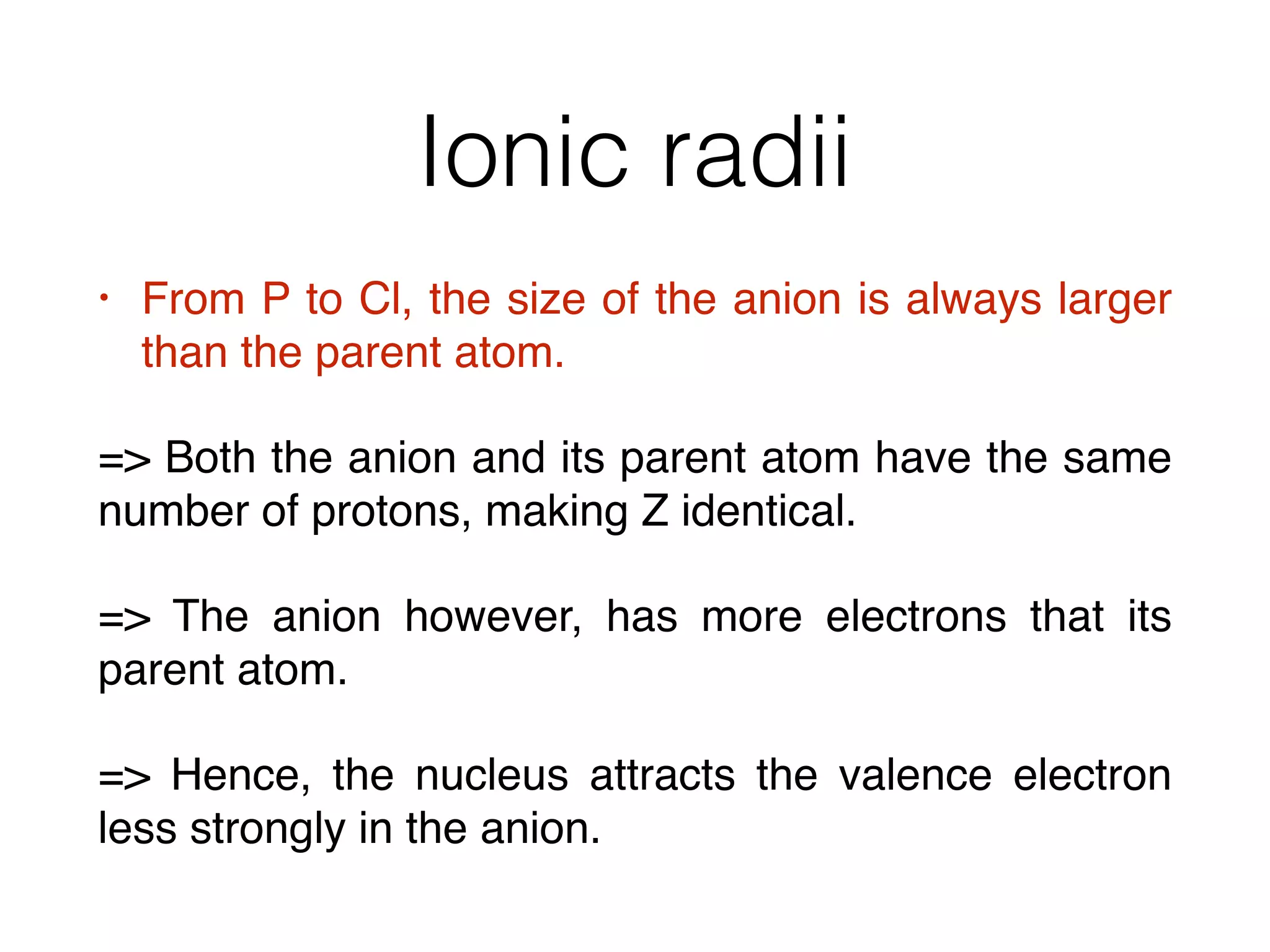
Ionic radii
• From P to Cl, the size of the anion is always larger
than the parent atom.
= Both the anion and its parent atom have the same
number of protons, making Z identical.
= The anion however, has more electrons that its
parent atom.
= Hence, the nucleus attracts the valence electron
less strongly in the anion.
Effective nuclear charge -
atomic and ionic radius - Q1
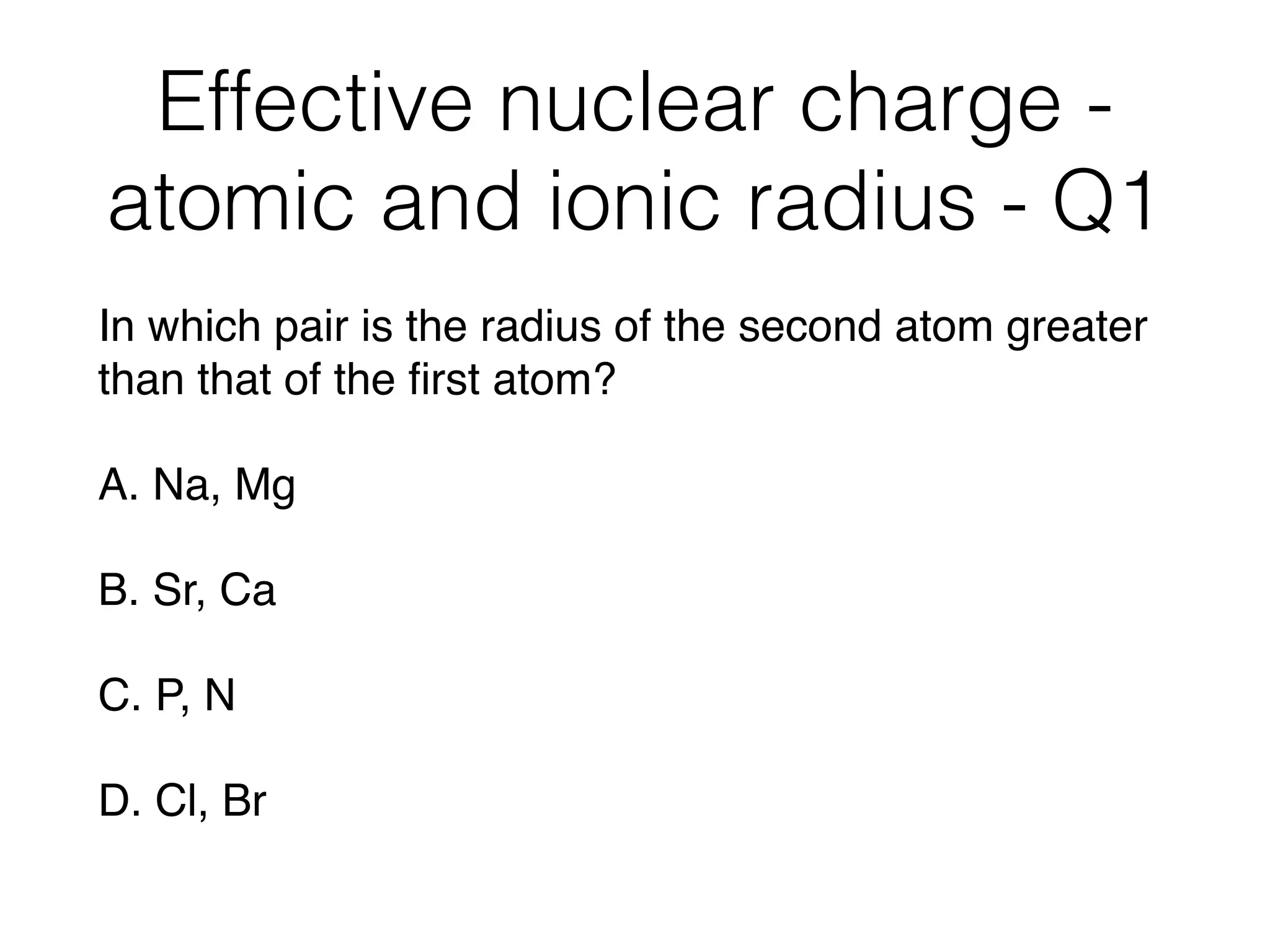
In which pair is the radius of the second atom greater
than that of the first atom?
A. Na, Mg
B. Sr, Ca
C. P, N
D. Cl, Br
Effective nuclear charge -
atomic and ionic radius - Q2
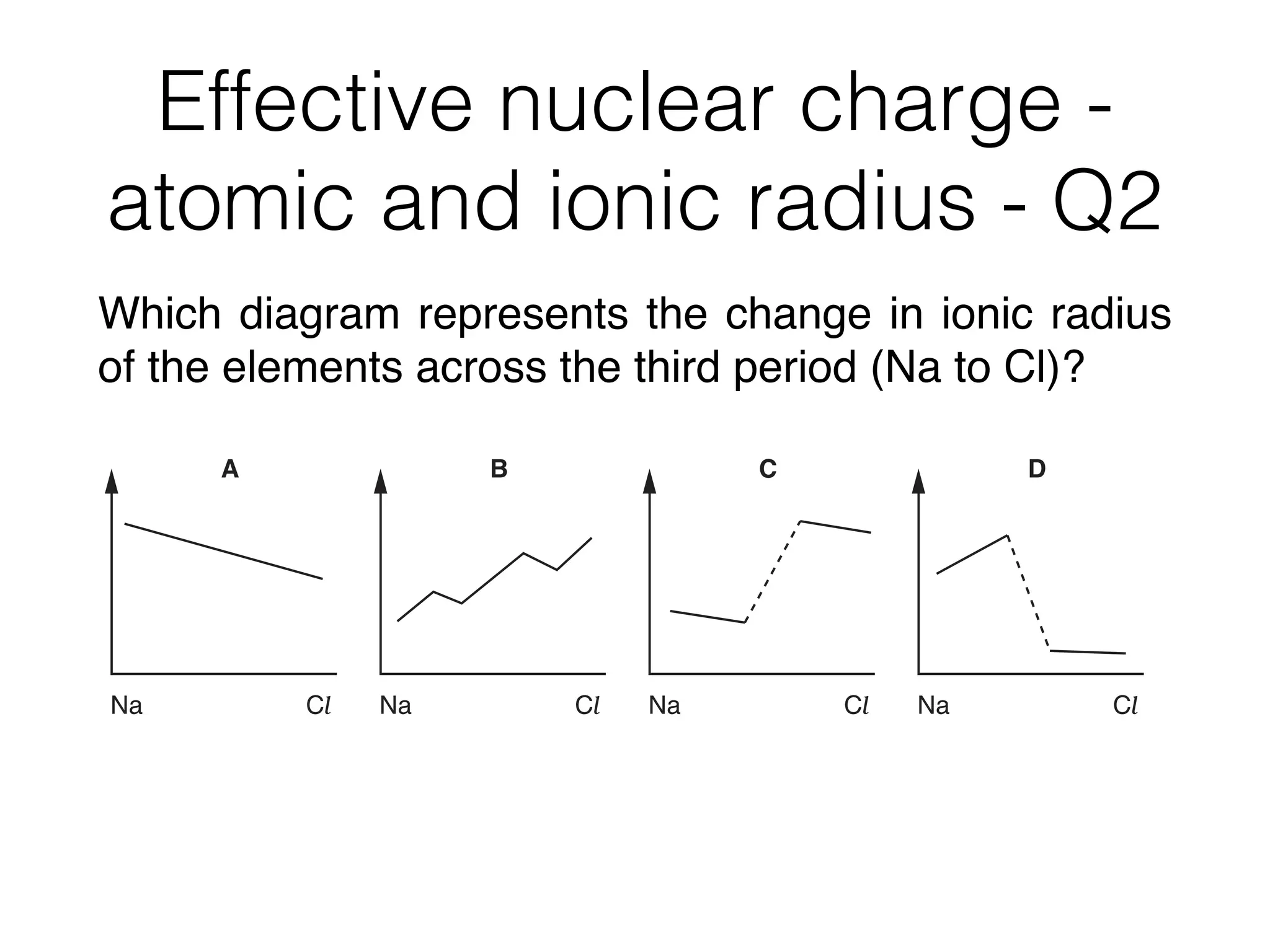
Which diagram represents the change in ionic radius
of the elements across the third period (Na to Cl)?
with acid to form a salt.
What could be the element Q?
A magnesium
B aluminium
C silicon
D phosphorus
14 Which diagram represents the change in ionic radius of the elements across the third period
(Na to Cl)?
15 The propellant used in the solid rocket booster of a space shuttle is a mixture of aluminium and
compound X. Compound X contains chlorine in an oxidation state of +7.
Which of the following could be compound X?
Na Cl
A
Na Cl
B
Na Cl
C
Na Cl
D
What is wrong with the
following explanation?
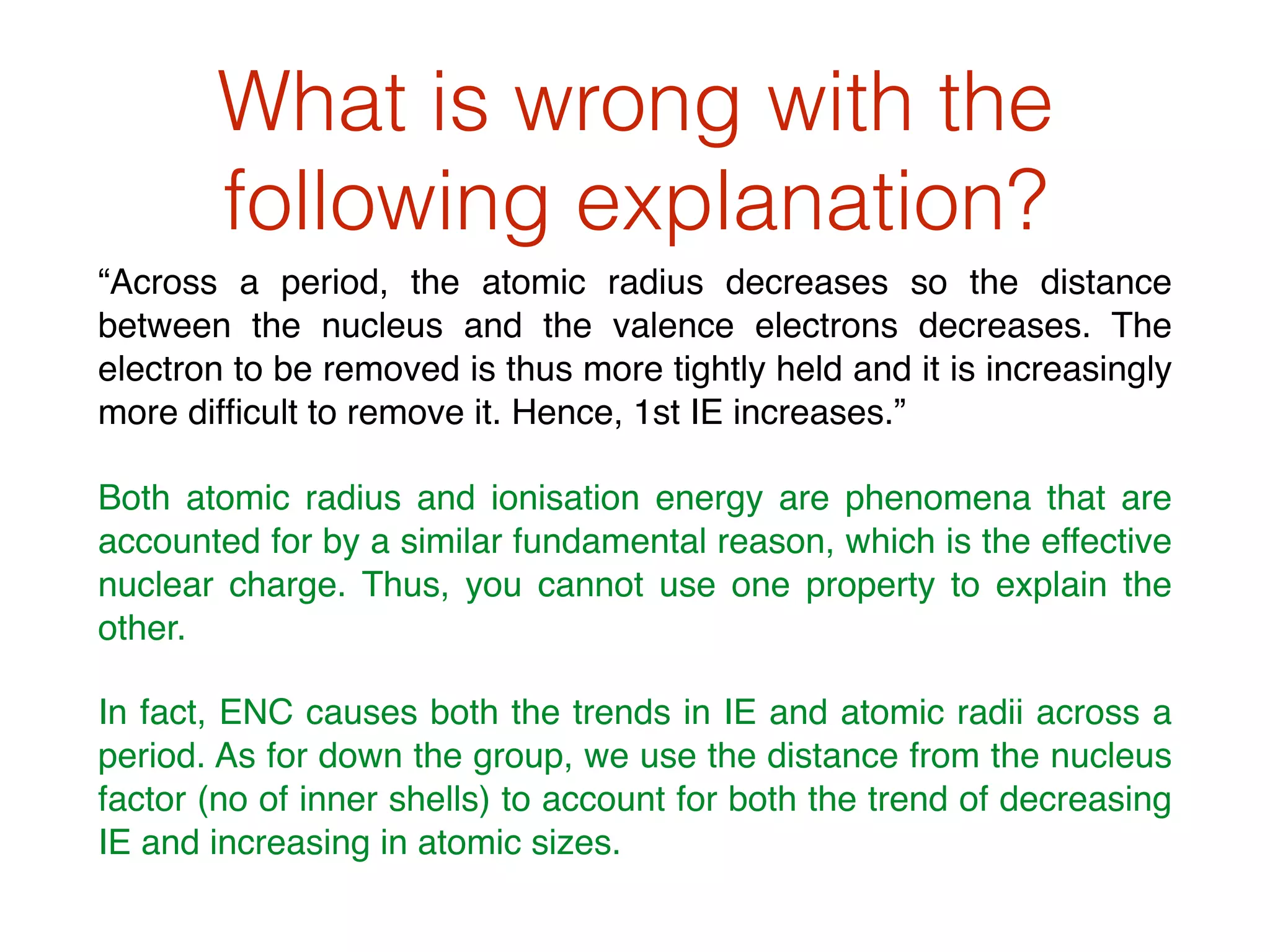
“Across a period, the atomic radius decreases so the distance
between the nucleus and the valence electrons decreases. The
electron to be removed is thus more tightly held and it is increasingly
more difficult to remove it. Hence, 1st IE increases.”
Both atomic radius and ionisation energy are phenomena that are
accounted for by a similar fundamental reason, which is the effective
nuclear charge. Thus, you cannot use one property to explain the
other.
In fact, ENC causes both the trends in IE and atomic radii across a
period. As for down the group, we use the distance from the nucleus
factor (no of inner shells) to account for both the trend of decreasing
IE and increasing in atomic sizes.

Csonn t2 atomic structure

  • 1.
    Atomic structure Omit qst5, 7, 8 - in notes Omit qst 2,20 - in examples
  • 2.
    Dalton’s Atomic Theory •All elements are composed of tiny indivisible particles called atoms. • Atoms of the same element are identical. The atoms of any one element are different from those of any other element. • Atoms of different elements can combine with another in simple whole number ratios to form compounds. • Chemical reactions occur when atoms are separated, joined, or rearranged. However, atoms of one element cannot be changed into atoms of another element by a chemical reaction.
  • 3.
    Dalton’s Atomic Theory •All elements are composed of tiny indivisible particles called atoms. • Atoms of the same element are identical. The atoms of any one element are different from those of any other element. • Atoms of different elements can combine with another in simple whole number ratios to form compounds. • Chemical reactions occur when atoms are separated, joined, or rearranged. However, atoms of one element cannot be changed into atoms of another element by a chemical reaction.
  • 4.
    Dalton’s Atomic Theory- Q1 John Dalton’s atomic theory, published in 1808, contained four predictions about atoms. Which of his predictions is still considered to be correct? A. Atoms are very small in size. B. No atom can be split into simpler parts. C. All the atoms of a particular element have the same mass. D. All the atoms of one element are different in mass from all atoms of other elements.
  • 5.
    Radioactivity • Radioactivity -a result of unstable nuclei • (Review history?) • The Periodic Table arranges elements in order of increasing proton (or atomic) number, NOT mass number.
  • 6.
    Order of discoveryof sub- atomic particles • Electrons (cathode ray) by J Thompson • Protons by E Rutherford • Neutrons by J Chadwick
  • 7.
    Discovery of electrons 2.Atoms of the same element are identical. Isotopes are atoms of the same element that have different mass numbers because of different numbers of neutrons, therefore, all atoms of the same element are NOT identical. 3. Thomson’s Model of the Atom – Joseph John Thomson (1856 – 1940) a. Describe and diagram the apparatus Thomson used in his experiments L. Farrell – Chemistry 11– Atomic Structure – Answers – Page 3 of 7Deflection towards positive plate (electric field) => negatively charged electrons => small mass, about 1/2000 times mass of a hydrogen atom
  • 8.
    Discovery of protons The “Plum-Pudding”  model  couldn’t  explain  the  surprising observations. However, Rutherford suggested that atoms consist of largely empty space and that the mass is largely concentrated into a very small, positively charged nucleus. Most alpha particles pass through the empty space in the atom with very little deflection. When the alpha particle approaches on a path close to the nucleus, however, the positive charges strongly repel each other, and the alpha particle is deflected through a large angle. www.studyguide.pk Alpha particle is He-4, +2 charge => deflection due to strong repulsion with the nucleus of gold foil => Core of nucleus has protons that are positively charged!
  • 9.
    Discovery of neutrons hadwick beryllium Nocharged ed on the k. However, fin wax was ium, charged ed and d knocked out neutrons from the beryllium, and in turn these knocked out x. subatomic particles ode ray) www.studyguide.pk => Mass of an atom concentrated in its nucleus is usually only half the mass of the number of protons => There is another particle of same mass but no charge present. => Alpha particles knock out neutrons from Be => These in turn knock out protons from paraffin (detected)
  • 10.
    Bohr’s Model -not examined • Lines are seen in the emission spectrum of hydrogen.
  • 11.
    Bohr’s model • Electronscan only have energy in quanta => they can only exist in quantised levels of energy • These energy levels are most commonly called as shells or orbitals.
  • 12.
    Assignment • Q1, 3,4, 6 • Skip qst 2, 5, 7 & 8 • Set on ? • Submit on ?
  • 13.
    Orbitals • An atomicorbital is a region in space where there is a high possibility that electrons on an atom can be found. It has a fixed energy level. • Quantum numbers “describe” the state of a confined electron. • There are four types of quantum numbers, • a) the principal quantum number (n) • b) the angular momentum quantum number (l) • c) the magnetic quantum number (ml) • d) the spin quantum number (ms)
  • 14.
    Sub-orbital/sub-shell • A subshellis a group of orbitals with the same energy level but different orientation in space. • These subshells are represented by the letters, • a) s (sharp) • b) p (principal) • c) d (diffuse) • d) f (fundamental)
  • 15.
    Electron shells Principal quantum number(n) Type of subshells Number of orbitals Number of electrons Maximum number of electrons 1 1s 1 2 2 2 2s 1 2 8 2p 3 6 3 3s 1 2 3p 3 6 3d 5 10 18 4 4s 1 2 4p 3 6 4d 5 10 4f 7 14 32
  • 16.
    Quantum numbers ple: Whatis the name of the oribital(s) with quantum number n=3? er: 3s, 3p, and 3d. Because n=3, the possible values of l = 0, 1, 2, which indicates the shapes of each subshell. als umber of orbitals in a subshell is equivalent to the number of values the magnetic quantum number ml takes on. A helpful equa mine the number of orbitals in a subshell is 2l +1. This equation will not give you the value of ml, but the number of possible value n take on in a particular orbital. For example, if l=1 and ml can have values -1, 0, or +1, the value of 2l+1 will be three and there different orbitals. The names of the orbitals are named after the subshells they are found in: s orbitals p orbitals d orbitals f orbitals l 0 1 2 3 ml 0 -1, 0, +1 -2, -1, 0, +1, +2 -3, -2, -1, 0, +1, +2, +3 Number of orbitals in designated subshell 1 3 5 7 figure below, we see examples of two orbitals: the p orbital (blue) and the s orbital (red). The red s orbital is a 1s orbital. To pictur l, imagine a layer similar to a cross section of a jawbreaker around the circle. The layers are depicting the atoms angular nod e a 3s orbital, imagine another layer around the circle, and so on and so on. The p orbital is similar to the shape of a dumbbell, w ation within a subshell depending on ml . The shape and orientation of an orbital depends on l and ml.
  • 17.
    Shapes of orbitals Inan atom, the electrons do not travel in fixed orbits around the nucleus; i.e. they are At not localised in fixed orbits. Instead they travel in a region of space around the nucleus called an atomic orbital. An atomic orbital is a region of space round the nucleus in which the probability of finding a particular electron (in a free atom) is the greatest- 98 % chance of finding an electron. Or Electrons can occupy four types of orbital, which differ from each other in shape and in their orientation in space. These are called s, p, d and forbitals. s orbitals are spherical. ~, p orbitals are dumb-bell-shaped and can be arranged in different directions. l s orbital 2s orbital Px orbital Pr orbital . Pz orbital There are five types of d orbitals (dxy, dye, d=, dx2_r, and dz, ). Z Z ...-""! Z Z Z Y . /l~/'~': Y y ~ / i . >x"~ X X X
  • 18.
    Shapes of orbitalsls orbital 2s orbital Px orbital Pr orbital . Pz orbital There are five types of d orbitals (dxy, dye, d=, dx2_r, and dz, ). Z Z ...-""! Z Z Z Y . /l~/'~': Y y .:::.ii ~ / i . >x ' ~ "~ X X X : .~ dxy orbital v- d. orbital d= orbital dx,_y~ orbital d~, orbital Each of d~y, dy~ and d= orbitals consists of four lobes (of the same size and same shape) on the xy, yz and zx plane respectively. The d~2_?2 orbital consists of four lobes along the x- and y- axes. The shape of the dz, orbital is different from the other four- it consists of two lobes along the z-axis with a 'ring' in the middle. All the d orbitals are degenerate; i.e. of the same energy level. [NB. In drawing shapes of orbitals, the x-, y- and z- axes must be shown so as to illustrate the 3-D property of the orbitals.] Shells a
  • 19.
    Electronic configuration • Electronicconfiguration is arrangement of electrons in an atom, that is how electrons are distributed among the various orbitals. • Two common notations, a) spdf notation b) orbital-as-box (or lines) diagram
  • 20.
    Aufbau Principle -order of filling orbitals • Aufbau Electrons fill low energy orbitals (closer to the nucleus) before they fill higher energy ones. • Consider Hund’s first and second rules (understand how to apply them, so you can explain in your own words, with examples) • Hund’s 1st rule: Electronic configuration with as many electrons with parallel spins is lower in energy • Hund’s 2nd rule: Electronic configuration with spins that are aligned/paired is lower in energy.
  • 21.
    Hund’s First Rule •Hund’s first rule: electrons will always occupy an empty orbital before they pair up • Electrons are negatively charged, they repel each another. • Electrons minimise repulsion by occupying their own orbital rather than sharing an orbital with another electron • Also, electrons in singly occupied orbitals are less effectively screened or shielded from the nucleus • Electronic configuration with as many electrons with parallel spins is lower in energy
  • 22.
    Hund’s Second Rule •Unpaired electrons in singly occupied orbitals have the same spins. • If all electrons orbit in the same direction, they meet less often than if some of them orbit in opposite directions • When they orbit in opposite directions (opposite spins), the repulsive force increases, which separates electrons. • Hence, configuration with spins that are aligned/paired is lower in energy.
  • 23.
  • 24.
    Aufbau Principle -order of filling orbitals 1s<2s<2p<3s<3p<4s<3d<4p<5s<4d<5p<6s<4f<5d<6p<7s<5f<6d<7p
  • 25.
    Aufbau Principle -Exercise • Complete electronic configurations of elements H to Kr (c/w or h/w) • One column - try the spdf notation - superscript the number of electrons in each subshell • Refer to textbook(s) or chemguide.
  • 26.
    Summary of variousrules • Aufbau Principle: Electrons fill the lowest energy orbital available. • Pauli’s Exclusion Principle: No two electrons can have the same four quantum numbers. Orbitals can hold a maximum of two electrons provided they have opposite spin. • Hund’s Rule: Orbitals of the same energy remain singly occupied before pairing up. This is due to the repulsion between electron pairs.
  • 27.
    Electronic configuration the nextlowest energy orbital is the 4s - so that fills first. K 1s22s22p63s23p64s1 Ca 1s22s22p63s23p64s2 d-block elements d-block elements are thought of as elements in which the last electron to be added to the atom is in a d orbital. (Actually, that
  • 28.
    Electronic configuration -Q1 The electronic structures of calcium, krypton, phosphorus and an element X are shown. Which electronic structure is that of element X? A. 1s2 2s2 2p6 3s2 3p3 B. 1s2 2s2 2p6 3s2 3p6 4s2 C. 1s2 2s2 2p6 3s2 3p6 3d6 4s2 D. 1s2 2s2 2p6 3s2 3p6 3d10 4s2 4p6
  • 29.
    Electronic configuration -Q2 Which atom has the highest ratio of unpaired electrons to paired electrons in its ground state? A. boron B. carbon C. nitrogen D. oxygen
  • 30.
    Electronic configuration • Whenfilling in orbitals in atoms (neutral), fill 4s before 3d (Aufbau’s). • When d-block elements form ions, the 4s electrons are lost first.
  • 31.
    Electronic configuration -Cr and Cu • Explain this! (half d-shell and full-d shell stability) • Which one fills first, but lose from which one first? (explain this)
  • 32.
  • 33.
    Electronic configuration -Q3 An ion of manganese has an electronic configuration of [Ar] 3d4. Which compound contains this ion? A. MnCl2 B. MnO C. Mn2O3 D. MnO2
  • 34.
    Electronic configuration -Q4 An atom has eight electrons, which diagram shows the electronic configuration of this atom in its lowest energy state? 3 4 Use of the Data Booklet is relevant to this question. It is now thought that where an element exists as several isotopes, the stable ones usually contain a ‘magic number’ of neutrons. One of these magic numbers is 126. Which isotope is unstable? A 209 Bi B 208 Pb C 210 Po D 208 Tl 5 An atom has eight electrons. Which diagram shows the electronic configuration of this atom in its lowest energy state? 6 The gecko, a small lizard, can climb up a smooth glass window. The gecko has millions o A B C D
  • 35.
    Electronic configuration -Q5 What could be the proton number of an element that has three unpaired electrons in each of its atoms? A. 5 B. 13 C. 15 D. 21
  • 36.
    Assignment • Electronic configuration- qst 9,10,11 • Set on ? • Submit on ?
  • 37.
    Ionisation energy ¢e Factorsinfluencing the ionisation energies (I.E.)of elements, ,: : . : ~ , TrendsinI:E. across a period and down agroup of the Periodic;Table. . 4 , Electronic configurations of elements deduced from successive I.E. data, and hence the position of that element within the Periodic Table. Thefirst ionisation energy of an element is defined as the amount of energy required to remove one election from each atom in a mole of gaseous atoms producing one mole of gaseous cations. In general, AH1 = 1st ionisation energy A J-/2 = 2nd ionisation energy /~3 -- 3rd ionisation energy -- ~-/1 +/~/2 + ~/'3 Ionisation energies normally have positive values since energy is absorbed in removing an electron. The successive ionisation energies of an element increase with the removal of each electron because the remaining electrons are attracted more strongly by the constant positive charge on the nucleus. The number of ionisation energies that an element can have equals its atomic number. ¢e Factors influencing the ionisation energies (I.E.)of elements, ,: : . : ~ , TrendsinI:E. across a period and down agroup of the Periodic;Table. . 4 , Electronic configurations of elements deduced from successive I.E. data, and hence the position of that element within the Periodic Table. Thefirst ionisation energy of an element is defined as the amount of energy required to remove one election from each atom in a mole of gaseous atoms producing one mole of gaseous cations. In general, AH1 = 1st ionisation energy A J-/2 = 2nd ionisation energy /~3 -- 3rd ionisation energy -- ~-/1 +/~/2 + ~/'3 Ionisation energies normally have positive values since energy is absorbed in removing an electron. The successive ionisation energies of an element increase with the removal of each electron because the remaining electrons are attracted more strongly by the constant positive charge on the nucleus. The number of ionisation energies that an element can have equals its atomic number.
  • 38.
    Ionisation energy Ionisation energiesnormally have positive values since energy is absorbed in removing an electron. The successive ionisation energies of an element increase with the removal of each electron because the remaining electrons are attracted more strongly by the constant positive charge on the nucleus. The number of ionisation energies that an element can have equals its atomic number. The ionisation energy of an element is influenced by" Size of thepositive nuclear charge. As the nuclear charge increases, its attraction for the outermost electron increases and more energy is required to remove an electron; i.e. ionisation energy increases. Size of atom~ion (i.e. distance of the outermost electron from the nucleus). As atomic/ionic size increases, the attraction of the positive nucleus for the negative electron decreases and less energy is required to remove an electron; i.e. ionisation energy decreases. Screening (shielding) effect of inner electrons. The outermost election is screened (shielded) from the attraction of the nucleus by the repelling effect of the inner electrons. As shielding increases, the attraction of the positive nucleus for the negative electron decreases and less energy is required to remove an electron; i.e. ionisation energy decreases. © Step-by-Step Fact Influen Ionisa Ener
  • 39.
  • 40.
    Ionisation energy -Q1 B. Electrons in the highest main energy level C. The number of electrons required to complete the highest main energy level D. The total number of electrons in the atom 7.   Which  equation  represents  the  first  ionization  energy  of  fluorine? A. F g e F g( ) ( ) B. F (g) F(g) e C. F g F g e( ) ( ) D. F g F g e( ) ( )
  • 41.
    Ionisation energy downa group 1.2 Atomic Structure d D o w n oup Ionisation energy decreases down a group (in spite of the higher charge on the nucleus) due to increasing atomic size and increasing screening (shielding) effect. Down a group, the atomic radius increases due to the increasing number of shells of electrons. The outer electrons are, therefore,further from the nucleus and are better shielded by the inner shells of electrons. They become less strongly attracted by the positive nucleus and so, less energy is required to remove the electron. Across , riod Ionisation energy increases across a period due to increasing nuclear charge and decreasing atomicradius. Since the electrons all go into the same shell, the shielding of the ionising electron is about the same. The outer electrons are, therefore, increasingly more strongly attracted by the positive nucleus and so, more energy is required to remove an electron. He Period 2 Period 3i< >! i< >i
  • 42.
    Ionisation energy acrossa period 1.2 Atomic Structure D o w n p Ionisation energy decreases down a group (in spite of the higher charge on the nucleus) due to increasing atomic size and increasing screening (shielding) effect. Down a group, the atomic radius increases due to the increasing number of shells of electrons. The outer electrons are, therefore,further from the nucleus and are better shielded by the inner shells of electrons. They become less strongly attracted by the positive nucleus and so, less energy is required to remove the electron. ross , d Ionisation energy increases across a period due to increasing nuclear charge and decreasing atomicradius. Since the electrons all go into the same shell, the shielding of the ionising electron is about the same. The outer electrons are, therefore, increasingly more strongly attracted by the positive nucleus and so, more energy is required to remove an electron. of . 20) He Period 2 Period 3 A i< >! i< >i i N i A,i ~ i ~ B i N a ~ ~ A / S i S i ~ K C a
  • 43.
    Ionisation energy- case study Theouter electrons are, therefore,further from the nucleus and are better shielded by the inner shells of electrons. They become less strongly attracted by the positive nucleus and so, less energy is required to remove the electron. cross , d Ionisation energy increases across a period due to increasing nuclear charge and decreasing atomicradius. Since the electrons all go into the same shell, the shielding of the ionising electron is about the same. The outer electrons are, therefore, increasingly more strongly attracted by the positive nucleus and so, more energy is required to remove an electron. n of E. 20) He Period 2 Period 3 A i< >! i< >i i N i A,i ~ i ~ B i N a ~ ~ A / S i S i ~ K C a I I I ! ! n I i a I I I l I l i I I ! ,I i i i ! t i i I ! i i i ! i i i i ! ! 1 2 3 4 5 6 7 8 9 1 0 11 1 2 13 1 4 1 5 1 6 1 7 1 8 1 9 2 0 :- proton no. (Z) ities Ionisation energy increases in a 2-3-3 step across a period (i.e. not a linear increase). The discontinuities in the increase trend are: (a) First ionisation energy of AI is lower than that of Mg.
  • 44.
    Ionisation energy Why doeshelium have the largest first IE? • Its first electron is in the first shell closest to the nucleus and has no shielding effects from inner shells. He has a bigger first ionisation energy than H as it has one more proton
  • 45.
    Ionisation energy Why doessodium has much lower first ionisation energy than neon? • Neon has its valence electrons in 2p shell. • Sodium has its valence electron in a 3s shell, which is further away from the nucleus and is more shielded. • Sodium’s valence electron is easier to remove and hence it has a lower ionisation energy.
  • 46.
    Ionisation energy Why isthere a small drop in first ionisation energy from Mg to Al? • Al is starting to fill a 3p subshell whereas Mg has its valence electrons in the 3s subshell • The electrons in the 3p subshell are slightly more shielded by the 3s electrons • 3p subshell are higher in energy • The electrons in the 3p subshell are slightly easier to remove (the drop in first ionisation energy)
  • 47.
    Ionisation energy Why isthere a small drop in first ionisation energy from P to S? • With sulfur, there are four electrons in the 3p subshell. • The fourth electron is starting to doubly fill the first 3p orbital • When the second electron is added to an orbital, there is a slight repulsion between the two negatively charged electrons which makes the second electron easier to remove. A. As one goes across a period the electrons are being added to the same shell which has the same distance from the nucleus and shame shielding effect. The number of protons increases, however, making the effective attraction of the nucleus greater. Q. Why has Na a much lower first ionisation energy than Neon? This is because Na will have its outer electron in a 3s shell further from the nucleus and is more shielded. So Na’s outer electron is easier to remove and has a lower ionisation energy. Q. Why is there a small drop from Mg to Al? Al is starting to fill a 3p sub shell, whereas Mg has its outer electrons in the 3s sub shell. The electrons in the 3p subshell are slightly easier to remove because the 3p electrons are higher in energy and are also slightly shielded by the 3s electrons Learn carefully the explanations for these two small drops as they are different to the usual factors Q. Why is there a small drop from P to S? V S With sulphur there are 4 electrons in the 3p sub shell and the 4th is starting to doubly fill the first 3p orbital. When the second electron is added to an orbital there is a slight repulsion between the two negatively charged electrons which makes the second electron easier to remove. V S Two electrons of opposite spin in same orbital
  • 48.
    Ionisation energy- case study tionof st I.E. Z = 20) Ai N i A,i ~ i ~ B i N a ~ ~ A / S i S i ~ K C a I I I ! ! n I i a I I I l I l i I I ! ,I i i i ! t i i I ! i i i ! i i i i ! ! 1 2 3 4 5 6 7 8 9 1 0 11 1 2 13 1 4 1 5 1 6 1 7 1 8 1 9 2 0 :- proton no. (Z) tinuities Ionisation energy increases in a 2-3-3 step across a period (i.e. not a linear increase). The discontinuities in the increase trend are: (a) First ionisation energy of AI is lower than that of Mg. Mg ls2 2s2 2p6 3s2 ; A/ ls2 2s2 2p6 3s2 3pl This is because less energy is required to remove a 3p electron in Al than a 3s electron in Mg since the 3p electron is further away from the nucleus and it also experiences slightly better shielding (from the 3s electrons). Similarly, first ionisation energy of B is lower than that of Be. Be 1 s~ 2s2 ; B 1 s2 2s~- 2pl This is because less energy is required to remove the outer 2p electron of B since it is further away from the nucleus. (b) First ionisation energy of S is lower than that of P. P ls2 2s2 2p6 3s2 3pfl 3pfl 3pzI ; S ls2 2s2 2p6 3s2 3pff 3pfl 3pfl
  • 49.
    Ionisation energy- case study Mgls2 2s2 2p6 3s2 ; A/ ls2 2s2 2p6 3s2 3pl This is because less energy is required to remove a 3p electron in Al than a 3s electron in Mg since the 3p electron is further away from the nucleus and it also experiences slightly better shielding (from the 3s electrons). Similarly, first ionisation energy of B is lower than that of Be. Be 1 s~ 2s2 ; B 1 s2 2s~- 2pl This is because less energy is required to remove the outer 2p electron of B since it is further away from the nucleus. (b) First ionisation energy of S is lower than that of P. P ls2 2s2 2p6 3s2 3pfl 3pfl 3pzI ; S ls2 2s2 2p6 3s2 3pff 3pfl 3pfl In S, the two electrons occupying the same orbital (i.e. 3p,) give rise to inter- electron repulsion. Thus, less energy is required to remove an electron from the paired 3p electrons in S. Similarly, first ionisation energy of O is lower than thatofN. N ls2 2sZ2p~12py12p_,l ; O ls2 2s22pxZ2pfl 2pzl Less energy is required to remove an electron from paired 2p electrons in O since repulsion is experienced between the paired electrons. The first ionisation energy of O is, therefore, lower than expected (had the B-C-N trend continued). © Step-by-Step Advanced Guide - Chemistry
  • 50.
    Ionisation energy -crossing new period - l~2Aiomic Structure First ionisation energy of Na is lower than that of Ne. Ne ls2 2s22p6 ; Na ls2 2s22p63s1 The outer electron of Na is in the third shell (3s orbital) and is further from the nucleus than the outer electrons (in 2s and 2p orbitals) of Ne. Thus, the outermost (3s) electron in Na experiences more effective shielding by the inner shells of electrons and less energy is required to remove it. The first ionisation energy of Na is, therefore, lower than that of Ne. The following information can be obtained from ionisation energy data: 1. Total number of electrons in an atom. - equal to the number of separate ionisation energies possessed by the atom. Number of quantum shells occupied and the number of electrons in each. - deduced by plotting successive ionisation energies against the order of removal of electrons from the atom. Succe I.
  • 51.
    Assignment • Q12, 13,14, 15, 16 • Set on ? • Submit on ?
  • 52.
    Ionisation energy - successiveIE tells group # First ionisation energy of Na is lower than that of Ne. Ne ls2 2s22p6 ; Na ls2 2s22p63s1 The outer electron of Na is in the third shell (3s orbital) and is further from the nucleus than the outer electrons (in 2s and 2p orbitals) of Ne. Thus, the outermost (3s) electron in Na experiences more effective shielding by the inner shells of electrons and less energy is required to remove it. The first ionisation energy of Na is, therefore, lower than that of Ne. The following information can be obtained from ionisation energy data: 1. Total number of electrons in an atom. - equal to the number of separate ionisation energies possessed by the atom. Number of quantum shells occupied and the number of electrons in each. - deduced by plotting successive ionisation energies against the order of removal of electrons from the atom. Number of sub-shells occupied and the number of electrons in each. - deduced by plotting successive ionisation energies in a quantum shell against the order of removal of electrons. e.g. 1 Successive ionisation energies forpotassium atom Ig I.E. 6
  • 53.
    Ionisation energy - successiveIE tells group # The following information can be obtained from ionisation energy data: 1. Total number of electrons in an atom. - equal to the number of separate ionisation energies possessed by the atom. Number of quantum shells occupied and the number of electrons in each. - deduced by plotting successive ionisation energies against the order of removal of electrons from the atom. Number of sub-shells occupied and the number of electrons in each. - deduced by plotting successive ionisation energies in a quantum shell against the order of removal of electrons. Success I.E. e.g. 1 Successive ionisation energies forpotassium atom Ig I.E. 6 (4thquantumshell) ~ , ,- 1 electron F i5 [ ~ i ~ 2 e l e c t r o n s 4 , , ~ , ,, [ ~ ~ - ° ~ ~ , ' i i ~ (lSt quantum shell) 3 [ T, - i i 8electrons i ! ! ~ rd ~'; ](2naquantumshell)I , 1 2 ', ! (3 quantum shell) ', ', i ! ', 1 ~ ' t , , , ~ , , I ~ , , , , ~ , i ~ ~ J 0 1 2 3 4 5 6 7 8 9 10 11 12 13 14 15 16 17 18 19 20 order of electrons removed Potassium atom has a total of 19 electrons, which fall into four groups. - two electrons very close to the nucleus (in the 1st quantum shell, which are most difficult to remove), - eight electrons further out (in the 2na quantum shell),
  • 54.
    Ionisation energy - successiveIE tells group # 6 (4thquantumshell) ~ , ,- 1 electron F i5 [ ~ i ~ 2 e l e c t r o n s 4 , , ~ , ,, [ ~ ~ - ° ~ ~ , ' i i ~ (lSt quantum shell) 3 [ T, - i i 8electrons i ! ! ~ rd ~'; ](2naquantumshell)I , 1 2 ', ! (3 quantum shell) ', ', i ! ', 1 ~ ' t , , , ~ , , I ~ , , , , ~ , i ~ ~ J 0 1 2 3 4 5 6 7 8 9 10 11 12 13 14 15 16 17 18 19 20 order of electrons removed Potassium atom has a total of 19 electrons, which fall into four groups. - two electrons very close to the nucleus (in the 1st quantum shell, which are most difficult to remove), - eight electrons further out (in the 2na quantum shell), - another eight electrons even further out (in the 3rd quantum shell) and - one further away still (in the 4th quantum shell). Hence, the electron arrangement in potassium is written as 2,8,8,1. Ionisation energies in the 3ra quantum shell of potassium The steady rise in ionisation energy for successive removal of the first six electrons followed by a sharp increase, suggests that the last two electrons are more strongly attracted lg I.E.
  • 55.
    Ionisation energy - successiveIE tells group # nterpret uccessive E. Data 1.2 Atomic structure .................................................... Hence the following graphs provide evidences of existence of shells and sub-shells (i) plot of first ionisation energies against atomic numbers, and (ii) plot of successive ionisation energies for a particular element. Successive I.E. data may be used to deduce the electronic configuration of an element and hence, the position of that element within the Periodic Table. e.g. Given the first seven ionisation energies of an element (in kJ mol-l) 790, 1600, 3200, 4400, 16100, 19800 and 23800. Work out the difference between successive ionisation energy values: increase 790, 1600, 3200, 4400, 16100, 19800, 23800 810 1600 1200 117110 3700 4000 There is a big increase in ionisation energy when the fifth electron is removed, showing that the first four electrons are removed from the outermost shell while the fifth electron is removed from the next inner shell. Hence, the element has four electrons in the outer shell and so, belongs to Group IV in the Periodic Table. ~' The outer electronic configuration of the element is ns2 np2. OStep-by-Step
  • 56.
    Successive ionisation energy -Q2 The first six ionization energies of four elements, A to D, are given. Which element is most likely to be in Group IV of the Periodic Table? 2NaN3 → 2Na + 3N2 10Na + 2KNO3 → K2O + 5Na2O + N2 How many moles of nitrogen gas are produced from 1 mol of sodium azide, NaN3? A 1.5 B 1.6 C 3.2 D 4.0 3 The first six ionisation energies of four elements, A to D, are given. Which element is most likely to be in Group IV of the Periodic Table? ionisation energy/kJmol−1 1st 2nd 3rd 4th 5th 6th A 494 4560 6940 9540 13400 16600 B 736 1450 7740 10500 13600 18000 C 1090 2350 4610 6220 37800 47000 D 1400 2860 4590 7480 9400 53200 4 In which species are the numbers of electrons and neutrons equal?
  • 57.
    Successive ionisation energies -Q3 The graph shows the first thirteen ionization energies for element X. What can be deduced about element X from the graph? A. It is in the second period (Li to Ne) of the Periodic Table. B. It is a d-block element. C. It is in Group II of the Periodic Table. D. It is in Group III of the Periodic Table. 3 4 The graph shows the first thirteen ionisation energies for element X. number of electrons removed ionisation energy What can be deduced about element X from the graph? A It is in the second period (Li to Ne) of the Periodic Table. B It is a d-block element. C It is in Group II of the Periodic Table. D It is in Group III of the Periodic Table. 5 Hydrogen bonding can occur between molecules of methanal, HCHO, and molecules of liquid Y. What could liquid Y be? A CH3OH
  • 58.
    Successive ionisation energies -Q4 2 1 The table shows the successive ionisation energies for an element Q. 1st 2nd 3rd 4th ionisation energy/kJmol–1 418 3070 4600 5860 What is the likely formula of the oxide of Q? A QO B Q3O2 C Q2O D Q2O3 2 How many neutrons are present in 0.13g of 13 C? [L = the Avogadro constant] A 0.06L B 0.07L C 0.13L D 0.91L
  • 59.
    Assignment • Q17, 18,21, 22 • Omit qst 19, 20 23 • Set on ? • Submit on ?
  • 60.
    Atomic radii • Atomicradii decrease across a period = Zeff increases across a period. = The number of protons, and thus Z, increases, = while shielding constant (σ) remains approximately constant as the number of fully filled inner principle quantum shells remain the same.
  • 61.
    Atomic radii • Atomicradii increase down a group = Zeff decreases descending a group. = The number of protons, and thus Z, increases, = while shielding constant (σ) increases as the number of fully filled inner (principle quantum) shells increases.
  • 62.
    Ionic radii • FromNa to Al, the size of the cation is always smaller than the parent atom. = The Zeff increases from Na to Al as the cation has one less shell of electrons. = Hence, the nucleus exerts a greater attractive force on the valence electrons in the cation.
  • 63.
    Ionic radii • FromP to Cl, the size of the anion is always larger than the parent atom. = Both the anion and its parent atom have the same number of protons, making Z identical. = The anion however, has more electrons that its parent atom. = Hence, the nucleus attracts the valence electron less strongly in the anion.
  • 64.
    Effective nuclear charge- atomic and ionic radius - Q1 In which pair is the radius of the second atom greater than that of the first atom? A. Na, Mg B. Sr, Ca C. P, N D. Cl, Br
  • 65.
    Effective nuclear charge- atomic and ionic radius - Q2 Which diagram represents the change in ionic radius of the elements across the third period (Na to Cl)? with acid to form a salt. What could be the element Q? A magnesium B aluminium C silicon D phosphorus 14 Which diagram represents the change in ionic radius of the elements across the third period (Na to Cl)? 15 The propellant used in the solid rocket booster of a space shuttle is a mixture of aluminium and compound X. Compound X contains chlorine in an oxidation state of +7. Which of the following could be compound X? Na Cl A Na Cl B Na Cl C Na Cl D
  • 66.
    What is wrongwith the following explanation? “Across a period, the atomic radius decreases so the distance between the nucleus and the valence electrons decreases. The electron to be removed is thus more tightly held and it is increasingly more difficult to remove it. Hence, 1st IE increases.” Both atomic radius and ionisation energy are phenomena that are accounted for by a similar fundamental reason, which is the effective nuclear charge. Thus, you cannot use one property to explain the other. In fact, ENC causes both the trends in IE and atomic radii across a period. As for down the group, we use the distance from the nucleus factor (no of inner shells) to account for both the trend of decreasing IE and increasing in atomic sizes.