Transition Elements
Transition Elements
The focus for Inorganic Chemistry (Gp II, VII, Transition
Elements) is the trends for the physical and chemical

properties of the elements.
Overview
Transition Elements
• definition
• electronic configuration

Physical Properties
• atomic/ ionic radii
• ionisation energy
• mp

Chemical Properties (4C)
• catalysts

- give examples of TE as
homo/heterogeneous catalysts

• complex ion

- definition
- ligand exchange

• coordination compound
• colour
- account for colour using CFT
Transition Elements

Definition

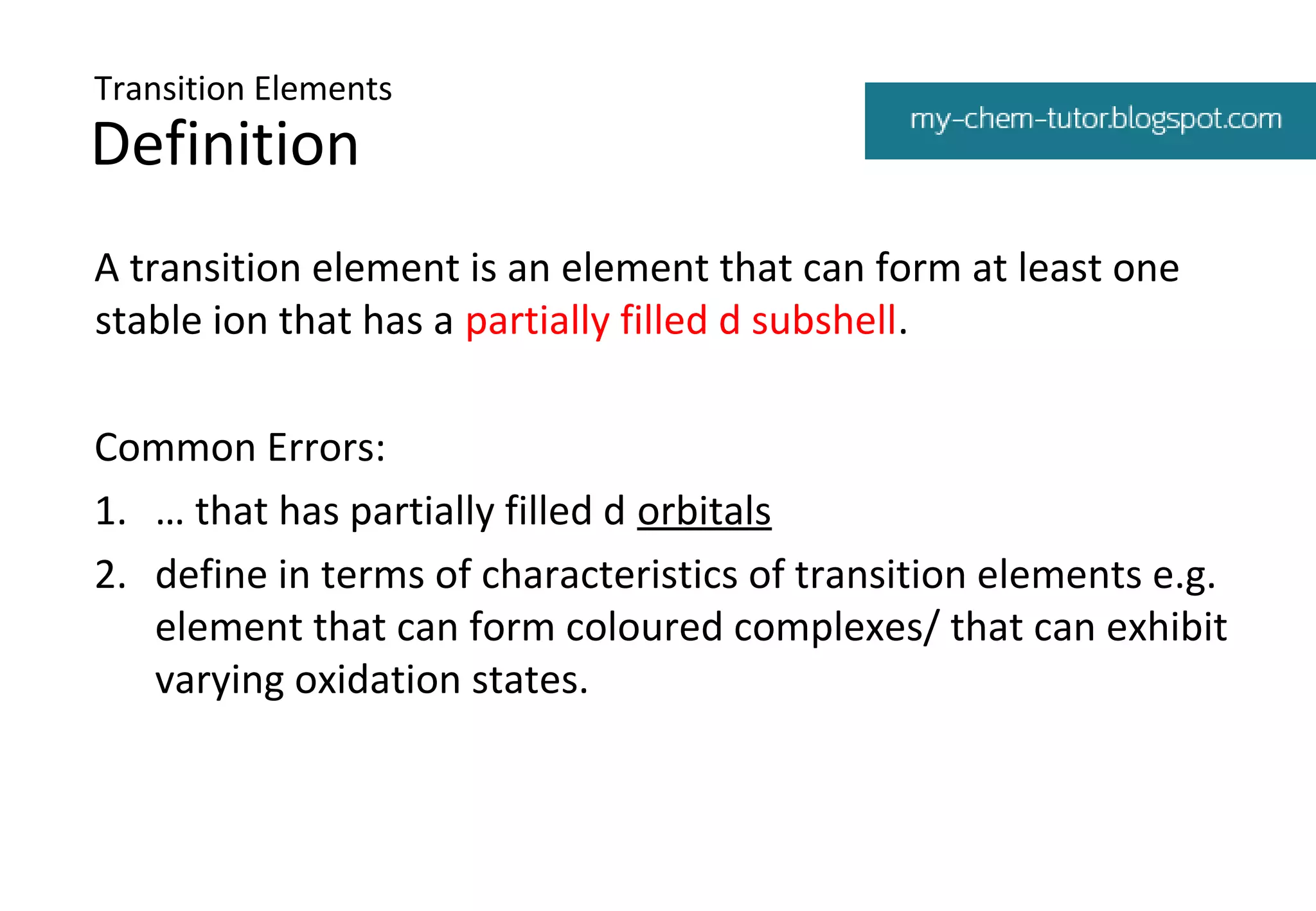
A transition element is an element that can form at least one
stable ion that has a partially filled d subshell.
Common Errors:
1. … that has partially filled d orbitals
2. define in terms of characteristics of transition elements e.g.
element that can form coloured complexes/ that can exhibit
varying oxidation states.
Transition Elements

Electronic Configuration
• Fill up 4s before 3d.
e.g. Ti: 1s2 2s2 2p6 3s2 3p6 3d2 4s2
• Remove from 4s before 3d.
e.g. Ti+: 1s2 2s2 2p6 3s2 3p6 3d2 4s1
• Remember the exceptions (Cr, Cu)
Transition Elements

Electronic Configuration
For transition metal ions, write config for the metal atom first
before removing from 4s.
e.g. Fe3+
Fe
:1s2 2s2 2p6 3s2 3p6 3d6 4s2
Fe3+ :1s2 2s2 2p6 3s2 3p6 3d5
Wrong: 1s2 2s2 2p6 3s2 3p6 3d3 4s2
Physical Properties
Atomic Radii
Note that in this chapter, there are 2 comparisons that we can
make where the explanations are different:
1. transition element with main group metal in same Period
2. transition element with another transition element in the
same Period.
Students often get confused and give the wrong explanation.
Physical Properties
A transition element has a smaller atomic radius than a main
group metal in the same period e.g. Ca and Fe
Explanation:
- Fe has more protons than Ca  nuclear charge of Fe is
higher
- Although Fe has more e–, the e– are added to the 3d
orbitals which provide poor shielding
- Increase in nuclear charge outweighs the increase in
shielding effect
 effective nuclear charge is higher for Fe
Physical Properties
Across the Period, the atomic radii of transition elements
remains relatively constant.
Explanation:
- Across the Period, no. of protons increases, nuclear charge
increases
- e– are added to an inner d subshell, shielding effect
increases significantly
- Increase in nuclear charge is about equal to the increase in
shielding effect  effective nuclear charge remains constant
Q: For TM complexes e.g. [Cu(NH3)4(H2O)2]2+, how can the 3d
and 4s accommodate all the lone pairs from the ligands?
A: TM can also use the energetically accessible 4p orbitals for
bonding.
i.e. 3d, 4s and 4p orbitals are available for bonding
 9 orbitals that can accommodate up to 18 e–
Q: Is TiO2+ a complex ion? How do I identify complex ions?
A: A complex ion contains ligands that are datively bonded to
the metal.
Oxo ions (ions containing the metal and oxygen only) are not
complex ions
Example: TiO2+, VO2+, Cr2O72–, MnO4–
Reason: oxygen is covalently bonded to the metal
Q: How do I identify ligands that are not datively bonded to the
metal?

1. Erase all the bonds between the metal and the ligands.
2. Determine if the ligands are stable chemically i.e.
stable
: H2O, NH3
unstable : OH, Cl, O (incomplete octet)
3. Ligands that are stable form dative bonds to the metal
4. Ligands that are unstable form ionic/ covalent bonds to
the metal
Q: How do I determine the charge on the metal in a complex?
1. Erase all the bonds between the metal and the ligands.
2. Determine if the ligands are stable chemically i.e.
stable : H2O, NH3
unstable : OH, Cl, O (incomplete octet)
3. Ligands that are stable have no charge
4. For unstable ligands, determine the charge on it
i.e. OH–, Cl–, O2–
5. Use algebraic method to determine charge on metal.
Example:

2+

dative bond
ionic bond
stable

unstable
Q: How do I identify the donor atom in polyatomic ligands?
A: Memorise. Some generalisations:
Ligands containing COO–, use oxygen with –ve charge.
For CO, CN–, SCN–, use the less electro–ve atom (in red).
In research, the donor atom is determined through (i)
quantum calculations and (ii) single crystal X-ray diffraction.
Q: For aq. metal ions, when do we write out the aqua ligands
and when do we not?
A: It is actually acceptable both ways i.e.
Fe2+ (aq) ≡ [Fe(H2O)6]2+
Cu2+ (aq) ≡ [Cu(H2O)6]2+
The aqua ligands are only shown when they are directly involved
in the reaction to emphasise their presence e.g.
Hydrolysis of water
[Fe(H2O)6]3+ + H2O  [Fe(H2O)5(OH)]2+ + H3O+
Ligand exchange
[Fe(H2O)6]3+ + 6NH3  [Fe(NH3)6]3+ + 6H2O
Q: Do strong ligands and strong field ligands mean the
same thing?
A: No.
Strong ligands:
- form strong bonds to the metal
- can displace weaker ligands from their complexes
(ligand
exchange reactions)
Q: Do strong ligands and strong field ligands mean the same
thing?
A: No.
Strong field ligands:
- cause big crystal field splitting.
However, ligands that can bind strongly to the metal usually
causes bigger splitting.

Transition Elements

  • 1.
  • 2.
    Transition Elements The focusfor Inorganic Chemistry (Gp II, VII, Transition Elements) is the trends for the physical and chemical properties of the elements.
  • 3.
    Overview Transition Elements • definition •electronic configuration Physical Properties • atomic/ ionic radii • ionisation energy • mp Chemical Properties (4C) • catalysts - give examples of TE as homo/heterogeneous catalysts • complex ion - definition - ligand exchange • coordination compound • colour - account for colour using CFT
  • 4.
    Transition Elements Definition A transitionelement is an element that can form at least one stable ion that has a partially filled d subshell. Common Errors: 1. … that has partially filled d orbitals 2. define in terms of characteristics of transition elements e.g. element that can form coloured complexes/ that can exhibit varying oxidation states.
  • 5.
    Transition Elements Electronic Configuration •Fill up 4s before 3d. e.g. Ti: 1s2 2s2 2p6 3s2 3p6 3d2 4s2 • Remove from 4s before 3d. e.g. Ti+: 1s2 2s2 2p6 3s2 3p6 3d2 4s1 • Remember the exceptions (Cr, Cu)
  • 6.
    Transition Elements Electronic Configuration Fortransition metal ions, write config for the metal atom first before removing from 4s. e.g. Fe3+ Fe :1s2 2s2 2p6 3s2 3p6 3d6 4s2 Fe3+ :1s2 2s2 2p6 3s2 3p6 3d5 Wrong: 1s2 2s2 2p6 3s2 3p6 3d3 4s2
  • 7.
    Physical Properties Atomic Radii Notethat in this chapter, there are 2 comparisons that we can make where the explanations are different: 1. transition element with main group metal in same Period 2. transition element with another transition element in the same Period. Students often get confused and give the wrong explanation.
  • 8.
    Physical Properties A transitionelement has a smaller atomic radius than a main group metal in the same period e.g. Ca and Fe Explanation: - Fe has more protons than Ca  nuclear charge of Fe is higher - Although Fe has more e–, the e– are added to the 3d orbitals which provide poor shielding - Increase in nuclear charge outweighs the increase in shielding effect  effective nuclear charge is higher for Fe
  • 9.
    Physical Properties Across thePeriod, the atomic radii of transition elements remains relatively constant. Explanation: - Across the Period, no. of protons increases, nuclear charge increases - e– are added to an inner d subshell, shielding effect increases significantly - Increase in nuclear charge is about equal to the increase in shielding effect  effective nuclear charge remains constant
  • 10.
    Q: For TMcomplexes e.g. [Cu(NH3)4(H2O)2]2+, how can the 3d and 4s accommodate all the lone pairs from the ligands? A: TM can also use the energetically accessible 4p orbitals for bonding. i.e. 3d, 4s and 4p orbitals are available for bonding  9 orbitals that can accommodate up to 18 e–
  • 11.
    Q: Is TiO2+a complex ion? How do I identify complex ions? A: A complex ion contains ligands that are datively bonded to the metal. Oxo ions (ions containing the metal and oxygen only) are not complex ions Example: TiO2+, VO2+, Cr2O72–, MnO4– Reason: oxygen is covalently bonded to the metal
  • 12.
    Q: How doI identify ligands that are not datively bonded to the metal? 1. Erase all the bonds between the metal and the ligands. 2. Determine if the ligands are stable chemically i.e. stable : H2O, NH3 unstable : OH, Cl, O (incomplete octet) 3. Ligands that are stable form dative bonds to the metal 4. Ligands that are unstable form ionic/ covalent bonds to the metal
  • 13.
    Q: How doI determine the charge on the metal in a complex? 1. Erase all the bonds between the metal and the ligands. 2. Determine if the ligands are stable chemically i.e. stable : H2O, NH3 unstable : OH, Cl, O (incomplete octet) 3. Ligands that are stable have no charge 4. For unstable ligands, determine the charge on it i.e. OH–, Cl–, O2– 5. Use algebraic method to determine charge on metal.
  • 14.
  • 15.
    Q: How doI identify the donor atom in polyatomic ligands? A: Memorise. Some generalisations: Ligands containing COO–, use oxygen with –ve charge. For CO, CN–, SCN–, use the less electro–ve atom (in red). In research, the donor atom is determined through (i) quantum calculations and (ii) single crystal X-ray diffraction.
  • 16.
    Q: For aq.metal ions, when do we write out the aqua ligands and when do we not? A: It is actually acceptable both ways i.e. Fe2+ (aq) ≡ [Fe(H2O)6]2+ Cu2+ (aq) ≡ [Cu(H2O)6]2+
  • 17.
    The aqua ligandsare only shown when they are directly involved in the reaction to emphasise their presence e.g. Hydrolysis of water [Fe(H2O)6]3+ + H2O  [Fe(H2O)5(OH)]2+ + H3O+ Ligand exchange [Fe(H2O)6]3+ + 6NH3  [Fe(NH3)6]3+ + 6H2O
  • 18.
    Q: Do strongligands and strong field ligands mean the same thing? A: No. Strong ligands: - form strong bonds to the metal - can displace weaker ligands from their complexes (ligand exchange reactions)
  • 19.
    Q: Do strongligands and strong field ligands mean the same thing? A: No. Strong field ligands: - cause big crystal field splitting. However, ligands that can bind strongly to the metal usually causes bigger splitting.