

.
1
Introduction
 Molecular term symbols mark different
electronic energy levels of a diatomic
molecule.
 These symbols are similar to atomic term
symbols, since both follow the Russell-
Saunders coupling scheme.
2
 Molecular term symbols employ symmetry
labels from group theory.
 The possibility of an electronic transition can
be deducted from molecular term symbols
following selection rules.
3
Symmetries of diatomic molecules
• In group theory, heteronuclear diatomic molecules have
C∞v symmetries, and homonuclear ones have D∞h
symmetries.
• There are infinitely many representations in both groups,
among which the irreducible representations are
symbolized using the notations "Σ, Π, Δ, etc.
• Both kinds of groups bear a perpendicular mirror plane,
or σv. So (+) and (-) are used to categorize the symmetry
with respect to σv.
• D∞h symmetries indicate an inversion center in the
molecule, yet C∞v symmetries do not. For D∞h,
irreducible representations are further classified by
parity, using the "g" and "u" symbols.
4
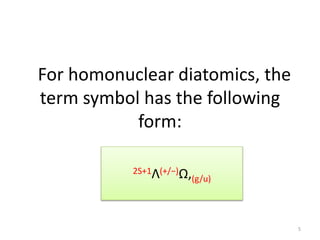
For homonuclear diatomics, the
term symbol has the following
form:
2S+1Λ(+/−)Ω,(g/u)
5
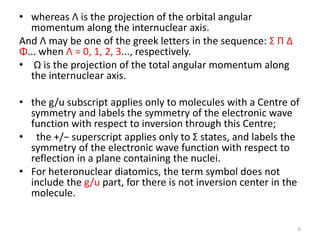
• whereas Λ is the projection of the orbital angular
momentum along the internuclear axis.
And Λ may be one of the greek letters in the sequence: Σ Π Δ
Φ... when Λ = 0, 1, 2, 3..., respectively.
• Ω is the projection of the total angular momentum along
the internuclear axis.
• the g/u subscript applies only to molecules with a Centre of
symmetry and labels the symmetry of the electronic wave
function with respect to inversion through this Centre;
• the +/− superscript applies only to Σ states, and labels the
symmetry of the electronic wave function with respect to
reflection in a plane containing the nuclei.
• For heteronuclear diatomics, the term symbol does not
include the g/u part, for there is not inversion center in the
molecule.
6
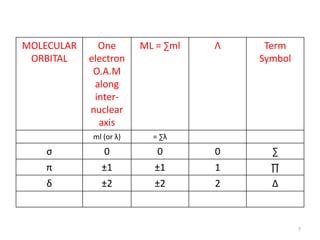
MOLECULAR
ORBITAL
One
electron
O.A.M
along
inter-
nuclear
axis
ML = ∑ml Λ Term
Symbol
ml (or λ) = ∑λ
σ 0 0 0 ∑
π ±1 ±1 1 ∏
δ ±2 ±2 2 ∆
7
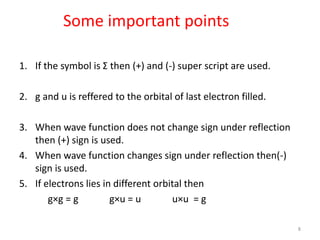
Some important points
1. If the symbol is Σ then (+) and (-) super script are used.
2. g and u is reffered to the orbital of last electron filled.
3. When wave function does not change sign under reflection
then (+) sign is used.
4. When wave function changes sign under reflection then(-)
sign is used.
5. If electrons lies in different orbital then
g×g = g g×u = u u×u = g
8
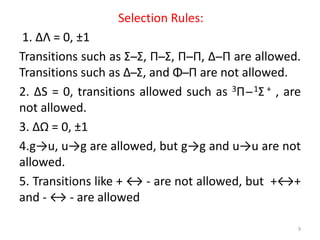
Selection Rules:
1. ΔΛ = 0, ±1
Transitions such as Σ ̶ Σ, Π ̶ Σ, Π ̶ Π, Δ ̶ Π are allowed.
Transitions such as Δ ̶ Σ, and Φ ̶ Π are not allowed.
2. ΔS = 0, transitions allowed such as 3Π ̶ 1Σ + , are
not allowed.
3. ΔΩ = 0, ±1
4.g→u, u→g are allowed, but g→g and u→u are not
allowed.
5. Transitions like + ↔ - are not allowed, but +↔+
and - ↔ - are allowed
9
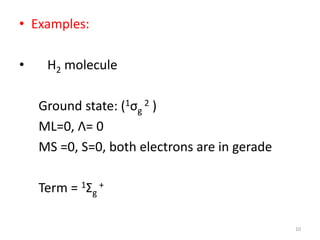
• Examples:
• H2 molecule
Ground state: (1σg
2 )
ML=0, Λ= 0
MS =0, S=0, both electrons are in gerade
Term = 1Σg
+
10
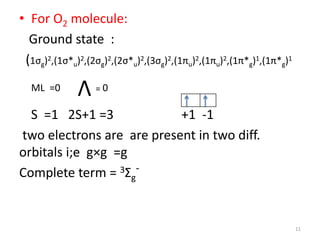
• For O2 molecule:
Ground state :
(1σg)2,(1σ*u)2,(2σg)2,(2σ*u)2,(3σg)2,(1πu)2,(1πu)2,(1π*g)1,(1π*g)1
ML =0 Λ = 0
S =1 2S+1 =3 +1 -1
two electrons are are present in two diff.
orbitals i;e g×g =g
Complete term = 3Σg
-
11
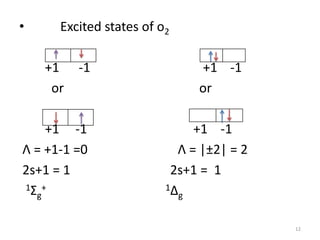
• Excited states of o2
+1 -1 +1 -1
or or
+1 -1 +1 -1
Λ = +1-1 =0 Λ = |±2| = 2
2s+1 = 1 2s+1 = 1
1Σg
+ 1Δg
12
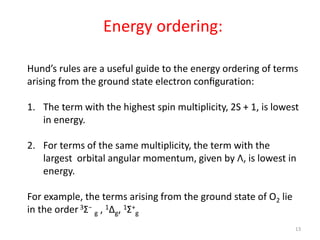
Energy ordering:
Hund’s rules are a useful guide to the energy ordering of terms
arising from the ground state electron configuration:
1. The term with the highest spin multiplicity, 2S + 1, is lowest
in energy.
2. For terms of the same multiplicity, the term with the
largest orbital angular momentum, given by Λ, is lowest in
energy.
For example, the terms arising from the ground state of O2 lie
in the order 3Σ−
g , 1∆g, 1Σ+
g
13
14

Molecular term sybol

  • 1.
  • 2.
    Introduction  Molecular termsymbols mark different electronic energy levels of a diatomic molecule.  These symbols are similar to atomic term symbols, since both follow the Russell- Saunders coupling scheme. 2
  • 3.
     Molecular termsymbols employ symmetry labels from group theory.  The possibility of an electronic transition can be deducted from molecular term symbols following selection rules. 3
  • 4.
    Symmetries of diatomicmolecules • In group theory, heteronuclear diatomic molecules have C∞v symmetries, and homonuclear ones have D∞h symmetries. • There are infinitely many representations in both groups, among which the irreducible representations are symbolized using the notations "Σ, Π, Δ, etc. • Both kinds of groups bear a perpendicular mirror plane, or σv. So (+) and (-) are used to categorize the symmetry with respect to σv. • D∞h symmetries indicate an inversion center in the molecule, yet C∞v symmetries do not. For D∞h, irreducible representations are further classified by parity, using the "g" and "u" symbols. 4
  • 5.
    For homonuclear diatomics,the term symbol has the following form: 2S+1Λ(+/−)Ω,(g/u) 5
  • 6.
    • whereas Λis the projection of the orbital angular momentum along the internuclear axis. And Λ may be one of the greek letters in the sequence: Σ Π Δ Φ... when Λ = 0, 1, 2, 3..., respectively. • Ω is the projection of the total angular momentum along the internuclear axis. • the g/u subscript applies only to molecules with a Centre of symmetry and labels the symmetry of the electronic wave function with respect to inversion through this Centre; • the +/− superscript applies only to Σ states, and labels the symmetry of the electronic wave function with respect to reflection in a plane containing the nuclei. • For heteronuclear diatomics, the term symbol does not include the g/u part, for there is not inversion center in the molecule. 6
  • 7.
    MOLECULAR ORBITAL One electron O.A.M along inter- nuclear axis ML = ∑mlΛ Term Symbol ml (or λ) = ∑λ σ 0 0 0 ∑ π ±1 ±1 1 ∏ δ ±2 ±2 2 ∆ 7
  • 8.
    Some important points 1.If the symbol is Σ then (+) and (-) super script are used. 2. g and u is reffered to the orbital of last electron filled. 3. When wave function does not change sign under reflection then (+) sign is used. 4. When wave function changes sign under reflection then(-) sign is used. 5. If electrons lies in different orbital then g×g = g g×u = u u×u = g 8
  • 9.
    Selection Rules: 1. ΔΛ= 0, ±1 Transitions such as Σ ̶ Σ, Π ̶ Σ, Π ̶ Π, Δ ̶ Π are allowed. Transitions such as Δ ̶ Σ, and Φ ̶ Π are not allowed. 2. ΔS = 0, transitions allowed such as 3Π ̶ 1Σ + , are not allowed. 3. ΔΩ = 0, ±1 4.g→u, u→g are allowed, but g→g and u→u are not allowed. 5. Transitions like + ↔ - are not allowed, but +↔+ and - ↔ - are allowed 9
  • 10.
    • Examples: • H2molecule Ground state: (1σg 2 ) ML=0, Λ= 0 MS =0, S=0, both electrons are in gerade Term = 1Σg + 10
  • 11.
    • For O2molecule: Ground state : (1σg)2,(1σ*u)2,(2σg)2,(2σ*u)2,(3σg)2,(1πu)2,(1πu)2,(1π*g)1,(1π*g)1 ML =0 Λ = 0 S =1 2S+1 =3 +1 -1 two electrons are are present in two diff. orbitals i;e g×g =g Complete term = 3Σg - 11
  • 12.
    • Excited statesof o2 +1 -1 +1 -1 or or +1 -1 +1 -1 Λ = +1-1 =0 Λ = |±2| = 2 2s+1 = 1 2s+1 = 1 1Σg + 1Δg 12
  • 13.
    Energy ordering: Hund’s rulesare a useful guide to the energy ordering of terms arising from the ground state electron configuration: 1. The term with the highest spin multiplicity, 2S + 1, is lowest in energy. 2. For terms of the same multiplicity, the term with the largest orbital angular momentum, given by Λ, is lowest in energy. For example, the terms arising from the ground state of O2 lie in the order 3Σ− g , 1∆g, 1Σ+ g 13
  • 14.