KEY


                        GENERAL CHEMISTRY-I (1411)
                                 S.I. # 27

1. What is the maximum number of electrons that can occupy each of the following
subshells:
             a. 3p      ____6____

             b. 5d             ____10____

             c. 2s             ____2____

             d. 4f             ____14____

2. What is the maximum number of electrons in an atom that can have the following
quantum numbers:

             a. n = 2, ms = - ½                 2p   ↓↓↓ = 3
                                                     -1 0 1

             b. n = 5, l = 3                    5f   ↑↓ ↑↓ ↑↓ ↑↓ ↑↓ ↑↓ ↑↓ = 14
                                                     -3       -2       -1    0       1       2   3

                     c. n = 4, l = 3, ml = -3        4f                ↑↓ __ __ __ __ __ __ =
2
                                                     -3       -2       -1   0    1       2   3

             d. n = 4, l = 1, ml = 1            4p   __ __ ↑↓                        = 2
                                                     -1   0        1


3. Write the condensed electron configuration for the following atoms, and indicate
how many unpaired electrons each has:

             a. Cs             [Xe]6s1               1 unpaired e-

             b. Ni             [Ar] 4s2 3d8          2 unpaired e-

             c. Se             [Ar] 4s2 3d10 4p4     2 unpaired e-

             d. Cd             [Kr] 5s2 4d10         0 unpaired e-

             e. Ac             [Rn] 7s2 6d1          9 unpaired e-

             f. Pt             [Xe] 6s1 4f14 5d9     2 unpaired e-

             g. Ga             [Ar] 4s2 3d10 4p1     1 unpaired e-

             h. Ca             [Ar] 4s2              0 unpaired e-

             i. V              [Ar] 4s2 3d3          3 unpaired e-

             j. I              [Kr] 5s2 4d10 5p5     1 unpaired e-
KEY


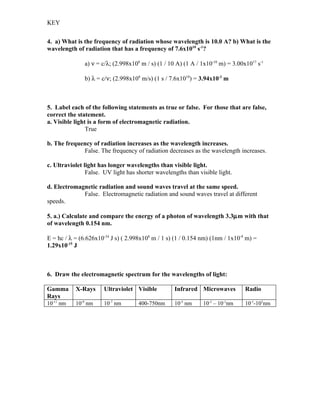
4. a) What is the frequency of radiation whose wavelength is 10.0 A? b) What is the
wavelength of radiation that has a frequency of 7.6x10¹⁰ s-1?

               a) ν = c/λ; (2.998x10⁸ m / s) (1 / 10 A) (1 A / 1x10⁻¹⁰ m) = 3.00x10¹⁷ s-1

               b) λ = c/ν; (2.998x10⁸ m/s) (1 s / 7.6x10¹⁰) = 3.94x10⁻³ m


5. Label each of the following statements as true or false. For those that are false,
correct the statement.
a. Visible light is a form of electromagnetic radiation.
                True

b. The frequency of radiation increases as the wavelength increases.
             False. The frequency of radiation decreases as the wavelength increases.

c. Ultraviolet light has longer wavelengths than visible light.
                False. UV light has shorter wavelengths than visible light.

d. Electromagnetic radiation and sound waves travel at the same speed.
             False. Electromagnetic radiation and sound waves travel at different
speeds.

5. a.) Calculate and compare the energy of a photon of wavelength 3.3µm with that
of wavelength 0.154 nm.

E = hc / λ = (6.626x10⁻³⁴ J s) ( 2.998x10⁸ m / 1 s) (1 / 0.154 nm) (1nm / 1x10⁻⁹ m) =
1.29x10⁻¹⁵ J


6. Draw the electromagnetic spectrum for the wavelengths of light:

Gamma      X-Rays      Ultraviolet Visible          Infrared Microwaves          Radio
Rays
10-11 nm   10-9 nm     10-7 nm       400-750nm      10-5 nm     10-3 – 10-1nm    10-1-103nm

#27 Key

  • 1.
    KEY GENERAL CHEMISTRY-I (1411) S.I. # 27 1. What is the maximum number of electrons that can occupy each of the following subshells: a. 3p ____6____ b. 5d ____10____ c. 2s ____2____ d. 4f ____14____ 2. What is the maximum number of electrons in an atom that can have the following quantum numbers: a. n = 2, ms = - ½ 2p ↓↓↓ = 3 -1 0 1 b. n = 5, l = 3 5f ↑↓ ↑↓ ↑↓ ↑↓ ↑↓ ↑↓ ↑↓ = 14 -3 -2 -1 0 1 2 3 c. n = 4, l = 3, ml = -3 4f ↑↓ __ __ __ __ __ __ = 2 -3 -2 -1 0 1 2 3 d. n = 4, l = 1, ml = 1 4p __ __ ↑↓ = 2 -1 0 1 3. Write the condensed electron configuration for the following atoms, and indicate how many unpaired electrons each has: a. Cs [Xe]6s1 1 unpaired e- b. Ni [Ar] 4s2 3d8 2 unpaired e- c. Se [Ar] 4s2 3d10 4p4 2 unpaired e- d. Cd [Kr] 5s2 4d10 0 unpaired e- e. Ac [Rn] 7s2 6d1 9 unpaired e- f. Pt [Xe] 6s1 4f14 5d9 2 unpaired e- g. Ga [Ar] 4s2 3d10 4p1 1 unpaired e- h. Ca [Ar] 4s2 0 unpaired e- i. V [Ar] 4s2 3d3 3 unpaired e- j. I [Kr] 5s2 4d10 5p5 1 unpaired e-
  • 2.
    KEY 4. a) Whatis the frequency of radiation whose wavelength is 10.0 A? b) What is the wavelength of radiation that has a frequency of 7.6x10¹⁰ s-1? a) ν = c/λ; (2.998x10⁸ m / s) (1 / 10 A) (1 A / 1x10⁻¹⁰ m) = 3.00x10¹⁷ s-1 b) λ = c/ν; (2.998x10⁸ m/s) (1 s / 7.6x10¹⁰) = 3.94x10⁻³ m 5. Label each of the following statements as true or false. For those that are false, correct the statement. a. Visible light is a form of electromagnetic radiation. True b. The frequency of radiation increases as the wavelength increases. False. The frequency of radiation decreases as the wavelength increases. c. Ultraviolet light has longer wavelengths than visible light. False. UV light has shorter wavelengths than visible light. d. Electromagnetic radiation and sound waves travel at the same speed. False. Electromagnetic radiation and sound waves travel at different speeds. 5. a.) Calculate and compare the energy of a photon of wavelength 3.3µm with that of wavelength 0.154 nm. E = hc / λ = (6.626x10⁻³⁴ J s) ( 2.998x10⁸ m / 1 s) (1 / 0.154 nm) (1nm / 1x10⁻⁹ m) = 1.29x10⁻¹⁵ J 6. Draw the electromagnetic spectrum for the wavelengths of light: Gamma X-Rays Ultraviolet Visible Infrared Microwaves Radio Rays 10-11 nm 10-9 nm 10-7 nm 400-750nm 10-5 nm 10-3 – 10-1nm 10-1-103nm