VerificationVerification
Gookyi Dennis A. N.Gookyi Dennis A. N.
October.07.2014
ContentsContents
 Static Timing Analysis
2
Static Timing AnalysisStatic Timing Analysis
 Problems with DTA:
Poses a bottleneck for large complex designs because
simulation requires a lot of time execute
Relies on the quality and coverage of testbenches
Difficult to figure out critical paths simulations
3
Fundamentals of STAFundamentals of STA
 STA determines if a circuit meets timing
constraints without having to simulate the design
in a cycle to cycle manner
 It computes the delay for each path of the design
and therefore the critical path can easily be found
 To perform STA, here are some assumptions made:
No combinational feedback loops are allowed
All register feedback paths must be broken
 STA is used to verify timing specification but not
the functionality of the design
4
Fundamentals of STAFundamentals of STA
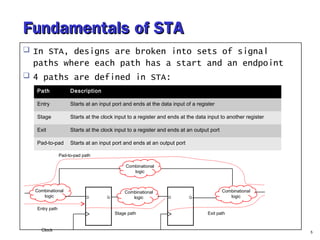
 In STA, designs are broken into sets of signal
paths where each path has a start and an endpoint
 4 paths are defined in STA:
5
Path Description
Entry Starts at an input port and ends at the data input of a register
Stage Starts at the clock input to a register and ends at the data input to another register
Exit Starts at the clock input to a register and ends at an output port
Pad-to-pad Starts at an input port and ends at an output port
D Q D Q
Combinational
logic
Combinational
logic
Combinational
logic
Combinational
logic
Clock
Entry path
Pad-to-pad path
Stage path Exit path
Timing SpecificationsTiming Specifications
 The most used timing constraints are divided into:
Port related constraints:
 Input delay (offset-in)
 Output delay (offset-out)
 Input-output (pad to pad)
Clock related constraints:
 Clock period
 Setup time
 Hold time
6
Port-Related ConstraintsPort-Related Constraints
 The various port related constraints include:
7
Delay Description
Input Specifies the arrival time of the input signal relative to active edge of
the clock
Output Specifies the latest time that a signal from the output of a register may
reach may reach the output port
Input-Output Applies to the path from an input port to an output port without passing
through any register
D Q D Q
Combinational
logic
Combinational
logic
Combinational
logic
Combinational
logic
Clock
Input delay Offset in
Offset out Output delay
Clock Related ConstraintsClock Related Constraints
 Before defining the various constraints, the
factors that cause uncertainty of a clock signal
should be explored:
8
Factor Description
Clock jitter Clock period may shrink or expand on a cycle-by-cycle basis
Clock-to-Q delay Max propagation delay from clock edge (sampling edge) to new
value of Q output
Input capacitance Gate capacitance of both NMOS and PMOS transistors
Interconnect capacitance Parasitic capacitances of interconnect between any two nodes
Self-loading capacitance Output capacitance of both NMOS and PMOS transistors
Clock skew Misalignment of clock edges in a synchronous system circuit
temperature Affects currents of both NMOS and PMOS transistors
D Q D Q
Input capacitance
Self-loading capacitance
interconnect capacitance
Tq
Clock Related ConstraintsClock Related Constraints
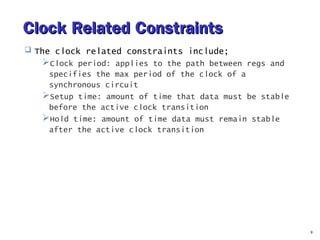
 The clock related constraints include;
Clock period: applies to the path between regs and
specifies the max period of the clock of a
synchronous circuit
Setup time: amount of time that data must be stable
before the active clock transition
Hold time: amount of time data must remain stable
after the active clock transition
9
Timing AnalysisTiming Analysis
 After timing specification is given, STA can
proceed to measure the critical path
 Critical path is the path with the longest
propagation delay in the design
 Formally, critical path has a negative or smallest
slack time
slack time = required time – arrival time
 Critical path limits system performance
10
Timing ExceptionsTiming Exceptions
 Timing analysis tools usually treat all paths in
the design as single cycle by default before
performing STA
 In most designs, there are paths that exhibit
timing exceptions
 Two common timing exceptions include
False paths
Multi-cycle paths
11
False PathFalse Path
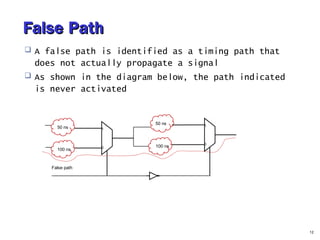
 A false path is identified as a timing path that
does not actually propagate a signal
 As shown in the diagram below, the path indicated
is never activated
12
1
0
1
0
50 ns
100 ns
100 ns
50 ns
False path
Multi-Cycle pathMulti-Cycle path
 In multi-cycle path, data may take more than one
clock cycle to reach their destination
 It is required to indicate which paths are multi-
cycle paths in other to avoid false results from
the STA
13
Multi-Cycle pathMulti-Cycle path
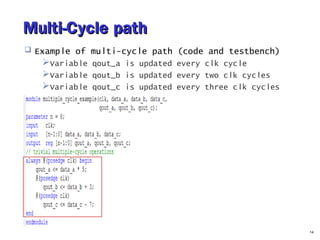
 Example of multi-cycle path (code and testbench)
Variable qout_a is updated every clk cycle
Variable qout_b is updated every two clk cycles
Variable qout_c is updated every three clk cycles
14
Multi-Cycle PathMulti-Cycle Path
 Testbench and waveform:
15
Multi-Cycle PathMulti-Cycle Path
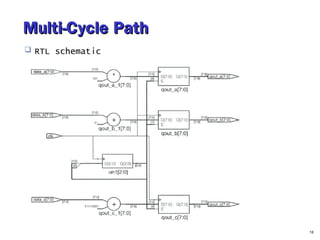
 RTL schematic
16
Value Change Dump (VCD) FilesValue Change Dump (VCD) Files
 A VCD file is a text file that contains information
about value changes on selected variables in a
design
 The main purpose is to provide information for
debug tools
 Two types of VCD files include:
Four-state VCD file: selected variable changes in
{0,1,x,z} without any strength information
Extended VCD file: selected variable changes in all
states and strength information
17
Four-State VCD FileFour-State VCD File
 “adder_nbit” is the module instantiated to generate
the VCD file
18
Four-State VCD fileFour-State VCD file
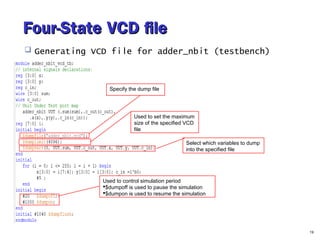
 Generating VCD file for adder_nbit (testbench)
19
Specify the dump file
Select which variables to dump
into the specified file
Used to control simulation period
$dumpoff is used to pause the simulation
$dumpon is used to resume the simulation
Used to set the maximum
size of the specified VCD
file
Four-State VCD fileFour-State VCD file
 VCD file format:
20
$date
Fri Sep 05 17:32:13 2014
$end
$version
ModelSim Version 10.1c
$end
$timescale
1ps
$end
$scope module adder_nbit_vcd_tb $end
$scope module UUT $end
$var wire 1 ! sum [3] $end
$var wire 1 " sum [2] $end
$var wire 1 # sum [1] $end
$var wire 1 $ sum [0] $end
$var wire 1 % c_out $end
$var wire 1 & x [3] $end
$var wire 1 ' x [2] $end
$var wire 1 ( x [1] $end
$var wire 1 ) x [0] $end
$var wire 1 * y [3] $end
$var wire 1 + y [2] $end
$var wire 1 , y [1] $end
$var wire 1 - y [0] $end
$var wire 1 . c_in $end
$upscope $end
$upscope $end
$enddefinitions $end
#0
$dumpvars
0$
0#
0"
0!
0%
0.
0)
0(
0'
0&
0-
0,
0+
0*
$end
#5000
1-
1$
#10000
0-
1,
0$
1#
#15000
1-
1$
#20000
$dumpoff
x$
x#
x"
x!
x%
x.
x)
x(
x'
x&
x-
x,
x+
x*
$end
ISE Design FlowISE Design Flow
 ISE design flow can be grouped into
Design entry
Synthesis
Implementation
Configure FPGA
21
Design EntryDesign Entry
 Design entry is based on HDL
 After a design is entered into the design flow, the
functional verification is followed through
simulation or formal proof
22
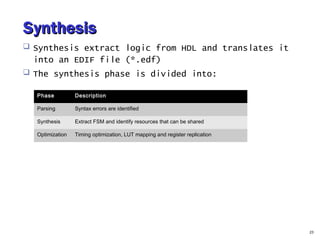
SynthesisSynthesis
 Synthesis extract logic from HDL and translates it
into an EDIF file (*.edf)
 The synthesis phase is divided into:
23
Phase Description
Parsing Syntax errors are identified
Synthesis Extract FSM and identify resources that can be shared
Optimization Timing optimization, LUT mapping and register replication
ImplementationImplementation
 The implementation step includes three main steps:
 The map step finishes the logic synthesis
operations
 A resource used report is obtained after the map
step is finalized
24
Step Description
Translation Merges multiple design files into a single gate-level netlist
Map Groups logical symbols from the gate-level netlist into physical
components including CLBs and IOBs
PAR Places synthesized logic components into FPGA fabrics
ImplementationImplementation
 Translation report of “adder_nbit”:
25
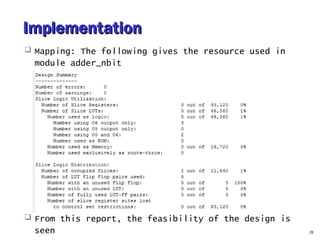
ImplementationImplementation
 Mapping: The following gives the resource used in
module adder_nbit
 From this report, the feasibility of the design is
seen 26
ImplementationImplementation
 In the PAR step, logic elements are placed and
connected onto the device
 Implementation tools extract timing data after PAR
step
 Post-PAR STA of adder_nbit is given below:
27
Critical path
Configure FPGAConfigure FPGA
 This generates a programming file (.bit)
 This is used to configure the specified FPGA so
that it would work as expected
 The bit file is can be uploaded directly to the
FPGA
28

Verilog HDL Verification

  • 1.
    VerificationVerification Gookyi Dennis A.N.Gookyi Dennis A. N. October.07.2014
  • 2.
  • 3.
    Static Timing AnalysisStaticTiming Analysis  Problems with DTA: Poses a bottleneck for large complex designs because simulation requires a lot of time execute Relies on the quality and coverage of testbenches Difficult to figure out critical paths simulations 3
  • 4.
    Fundamentals of STAFundamentalsof STA  STA determines if a circuit meets timing constraints without having to simulate the design in a cycle to cycle manner  It computes the delay for each path of the design and therefore the critical path can easily be found  To perform STA, here are some assumptions made: No combinational feedback loops are allowed All register feedback paths must be broken  STA is used to verify timing specification but not the functionality of the design 4
  • 5.
    Fundamentals of STAFundamentalsof STA  In STA, designs are broken into sets of signal paths where each path has a start and an endpoint  4 paths are defined in STA: 5 Path Description Entry Starts at an input port and ends at the data input of a register Stage Starts at the clock input to a register and ends at the data input to another register Exit Starts at the clock input to a register and ends at an output port Pad-to-pad Starts at an input port and ends at an output port D Q D Q Combinational logic Combinational logic Combinational logic Combinational logic Clock Entry path Pad-to-pad path Stage path Exit path
  • 6.
    Timing SpecificationsTiming Specifications The most used timing constraints are divided into: Port related constraints:  Input delay (offset-in)  Output delay (offset-out)  Input-output (pad to pad) Clock related constraints:  Clock period  Setup time  Hold time 6
  • 7.
    Port-Related ConstraintsPort-Related Constraints The various port related constraints include: 7 Delay Description Input Specifies the arrival time of the input signal relative to active edge of the clock Output Specifies the latest time that a signal from the output of a register may reach may reach the output port Input-Output Applies to the path from an input port to an output port without passing through any register D Q D Q Combinational logic Combinational logic Combinational logic Combinational logic Clock Input delay Offset in Offset out Output delay
  • 8.
    Clock Related ConstraintsClockRelated Constraints  Before defining the various constraints, the factors that cause uncertainty of a clock signal should be explored: 8 Factor Description Clock jitter Clock period may shrink or expand on a cycle-by-cycle basis Clock-to-Q delay Max propagation delay from clock edge (sampling edge) to new value of Q output Input capacitance Gate capacitance of both NMOS and PMOS transistors Interconnect capacitance Parasitic capacitances of interconnect between any two nodes Self-loading capacitance Output capacitance of both NMOS and PMOS transistors Clock skew Misalignment of clock edges in a synchronous system circuit temperature Affects currents of both NMOS and PMOS transistors D Q D Q Input capacitance Self-loading capacitance interconnect capacitance Tq
  • 9.
    Clock Related ConstraintsClockRelated Constraints  The clock related constraints include; Clock period: applies to the path between regs and specifies the max period of the clock of a synchronous circuit Setup time: amount of time that data must be stable before the active clock transition Hold time: amount of time data must remain stable after the active clock transition 9
  • 10.
    Timing AnalysisTiming Analysis After timing specification is given, STA can proceed to measure the critical path  Critical path is the path with the longest propagation delay in the design  Formally, critical path has a negative or smallest slack time slack time = required time – arrival time  Critical path limits system performance 10
  • 11.
    Timing ExceptionsTiming Exceptions Timing analysis tools usually treat all paths in the design as single cycle by default before performing STA  In most designs, there are paths that exhibit timing exceptions  Two common timing exceptions include False paths Multi-cycle paths 11
  • 12.
    False PathFalse Path A false path is identified as a timing path that does not actually propagate a signal  As shown in the diagram below, the path indicated is never activated 12 1 0 1 0 50 ns 100 ns 100 ns 50 ns False path
  • 13.
    Multi-Cycle pathMulti-Cycle path In multi-cycle path, data may take more than one clock cycle to reach their destination  It is required to indicate which paths are multi- cycle paths in other to avoid false results from the STA 13
  • 14.
    Multi-Cycle pathMulti-Cycle path Example of multi-cycle path (code and testbench) Variable qout_a is updated every clk cycle Variable qout_b is updated every two clk cycles Variable qout_c is updated every three clk cycles 14
  • 15.
    Multi-Cycle PathMulti-Cycle Path Testbench and waveform: 15
  • 16.
  • 17.
    Value Change Dump(VCD) FilesValue Change Dump (VCD) Files  A VCD file is a text file that contains information about value changes on selected variables in a design  The main purpose is to provide information for debug tools  Two types of VCD files include: Four-state VCD file: selected variable changes in {0,1,x,z} without any strength information Extended VCD file: selected variable changes in all states and strength information 17
  • 18.
    Four-State VCD FileFour-StateVCD File  “adder_nbit” is the module instantiated to generate the VCD file 18
  • 19.
    Four-State VCD fileFour-StateVCD file  Generating VCD file for adder_nbit (testbench) 19 Specify the dump file Select which variables to dump into the specified file Used to control simulation period $dumpoff is used to pause the simulation $dumpon is used to resume the simulation Used to set the maximum size of the specified VCD file
  • 20.
    Four-State VCD fileFour-StateVCD file  VCD file format: 20 $date Fri Sep 05 17:32:13 2014 $end $version ModelSim Version 10.1c $end $timescale 1ps $end $scope module adder_nbit_vcd_tb $end $scope module UUT $end $var wire 1 ! sum [3] $end $var wire 1 " sum [2] $end $var wire 1 # sum [1] $end $var wire 1 $ sum [0] $end $var wire 1 % c_out $end $var wire 1 & x [3] $end $var wire 1 ' x [2] $end $var wire 1 ( x [1] $end $var wire 1 ) x [0] $end $var wire 1 * y [3] $end $var wire 1 + y [2] $end $var wire 1 , y [1] $end $var wire 1 - y [0] $end $var wire 1 . c_in $end $upscope $end $upscope $end $enddefinitions $end #0 $dumpvars 0$ 0# 0" 0! 0% 0. 0) 0( 0' 0& 0- 0, 0+ 0* $end #5000 1- 1$ #10000 0- 1, 0$ 1# #15000 1- 1$ #20000 $dumpoff x$ x# x" x! x% x. x) x( x' x& x- x, x+ x* $end
  • 21.
    ISE Design FlowISEDesign Flow  ISE design flow can be grouped into Design entry Synthesis Implementation Configure FPGA 21
  • 22.
    Design EntryDesign Entry Design entry is based on HDL  After a design is entered into the design flow, the functional verification is followed through simulation or formal proof 22
  • 23.
    SynthesisSynthesis  Synthesis extractlogic from HDL and translates it into an EDIF file (*.edf)  The synthesis phase is divided into: 23 Phase Description Parsing Syntax errors are identified Synthesis Extract FSM and identify resources that can be shared Optimization Timing optimization, LUT mapping and register replication
  • 24.
    ImplementationImplementation  The implementationstep includes three main steps:  The map step finishes the logic synthesis operations  A resource used report is obtained after the map step is finalized 24 Step Description Translation Merges multiple design files into a single gate-level netlist Map Groups logical symbols from the gate-level netlist into physical components including CLBs and IOBs PAR Places synthesized logic components into FPGA fabrics
  • 25.
  • 26.
    ImplementationImplementation  Mapping: Thefollowing gives the resource used in module adder_nbit  From this report, the feasibility of the design is seen 26
  • 27.
    ImplementationImplementation  In thePAR step, logic elements are placed and connected onto the device  Implementation tools extract timing data after PAR step  Post-PAR STA of adder_nbit is given below: 27 Critical path
  • 28.
    Configure FPGAConfigure FPGA This generates a programming file (.bit)  This is used to configure the specified FPGA so that it would work as expected  The bit file is can be uploaded directly to the FPGA 28