Physical Design
ASIC Design
IL2200 , ASIC Design Slide 2
Lecture Outline
 Physical Implementation Styles
 ASIC Design Flow
 Floor and Power planning
 Placement
 Clock Tree Synthesis
 Routing
 Timing Analysis
 Verification and Energy Calculation
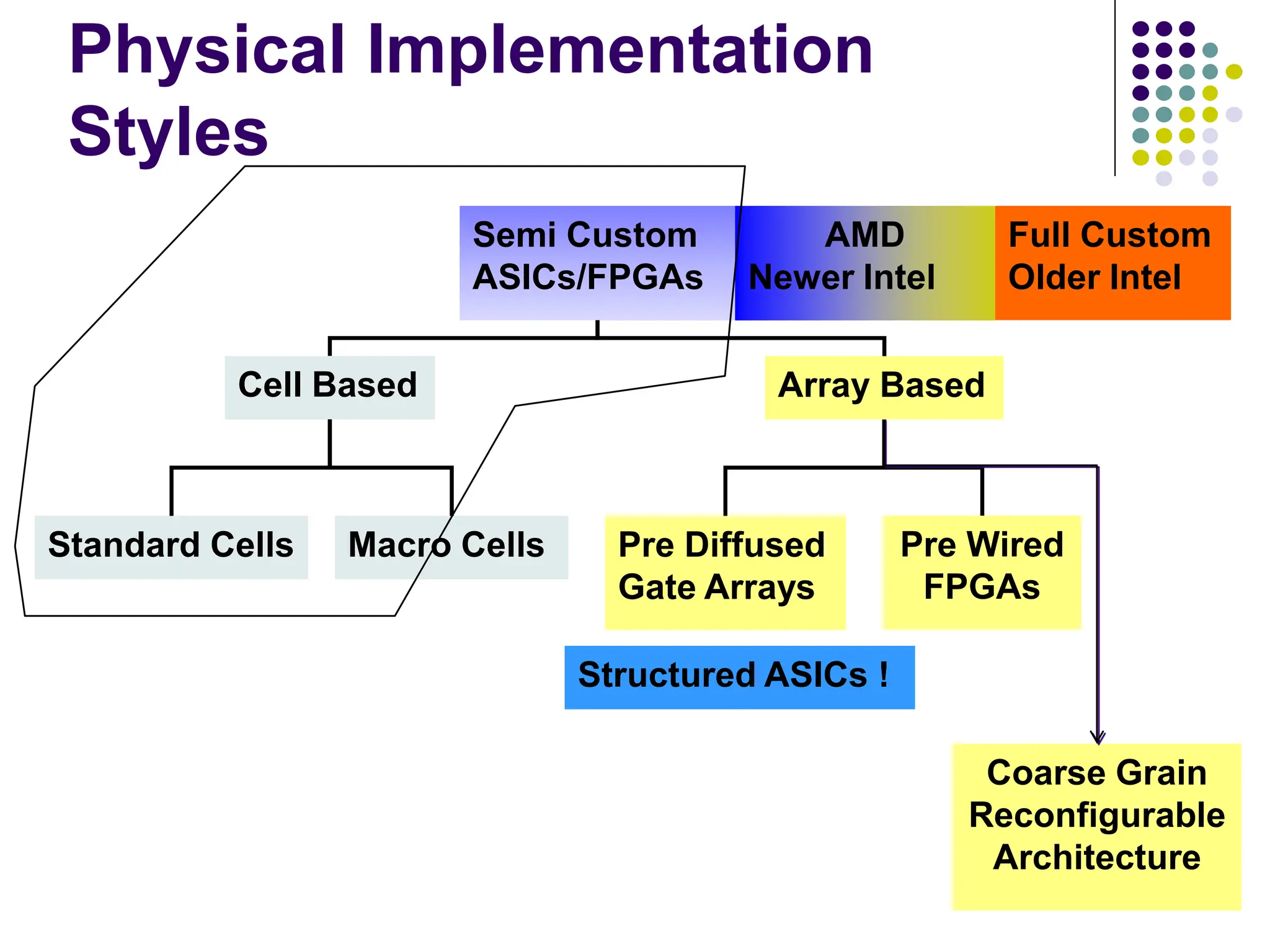
Physical Implementation
Styles
Semi Custom
ASICs/FPGAs
Full Custom
Older Intel
Standard Cells Macro Cells
Cell Based Array Based
Pre Diffused
Gate Arrays
Pre Wired
FPGAs
AMD
Newer Intel
Structured ASICs !
Coarse Grain
Reconfigurable
Architecture
cells
ro u tin g a rea
r
o
u
ti
n
g
a
r
e
a
feed th ro u g h
cell
w a s ted
sp a ce
Standard Cell Layout
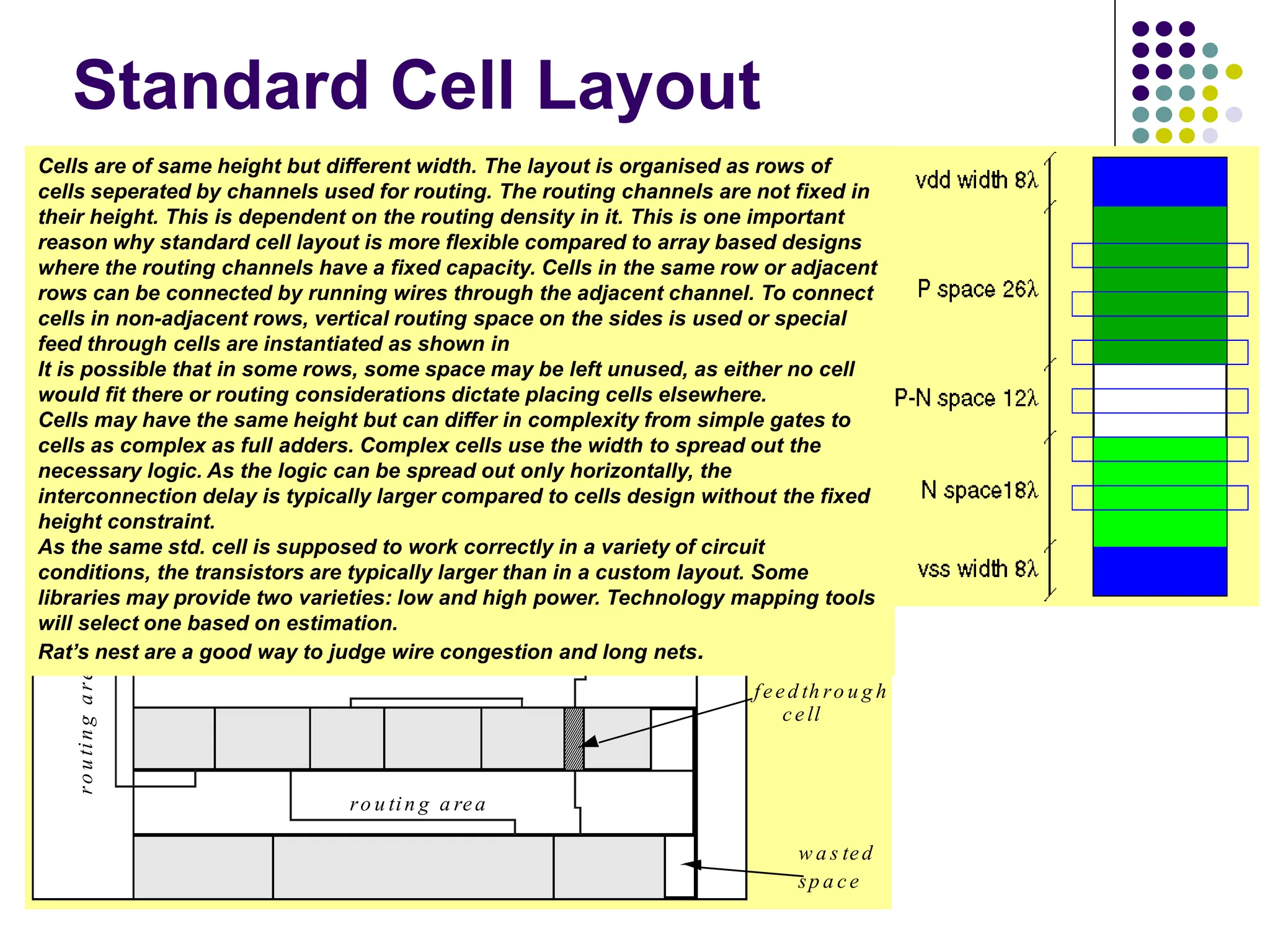
Cells are of same height but different width. The layout is organised as rows of
cells seperated by channels used for routing. The routing channels are not fixed in
their height. This is dependent on the routing density in it. This is one important
reason why standard cell layout is more flexible compared to array based designs
where the routing channels have a fixed capacity. Cells in the same row or adjacent
rows can be connected by running wires through the adjacent channel. To connect
cells in non-adjacent rows, vertical routing space on the sides is used or special
feed through cells are instantiated as shown in
It is possible that in some rows, some space may be left unused, as either no cell
would fit there or routing considerations dictate placing cells elsewhere.
Cells may have the same height but can differ in complexity from simple gates to
cells as complex as full adders. Complex cells use the width to spread out the
necessary logic. As the logic can be spread out only horizontally, the
interconnection delay is typically larger compared to cells design without the fixed
height constraint.
As the same std. cell is supposed to work correctly in a variety of circuit
conditions, the transistors are typically larger than in a custom layout. Some
libraries may provide two varieties: low and high power. Technology mapping tools
will select one based on estimation.
Rat’s nest are a good way to judge wire congestion and long nets.
IL2200 , ASIC Design Slide 5
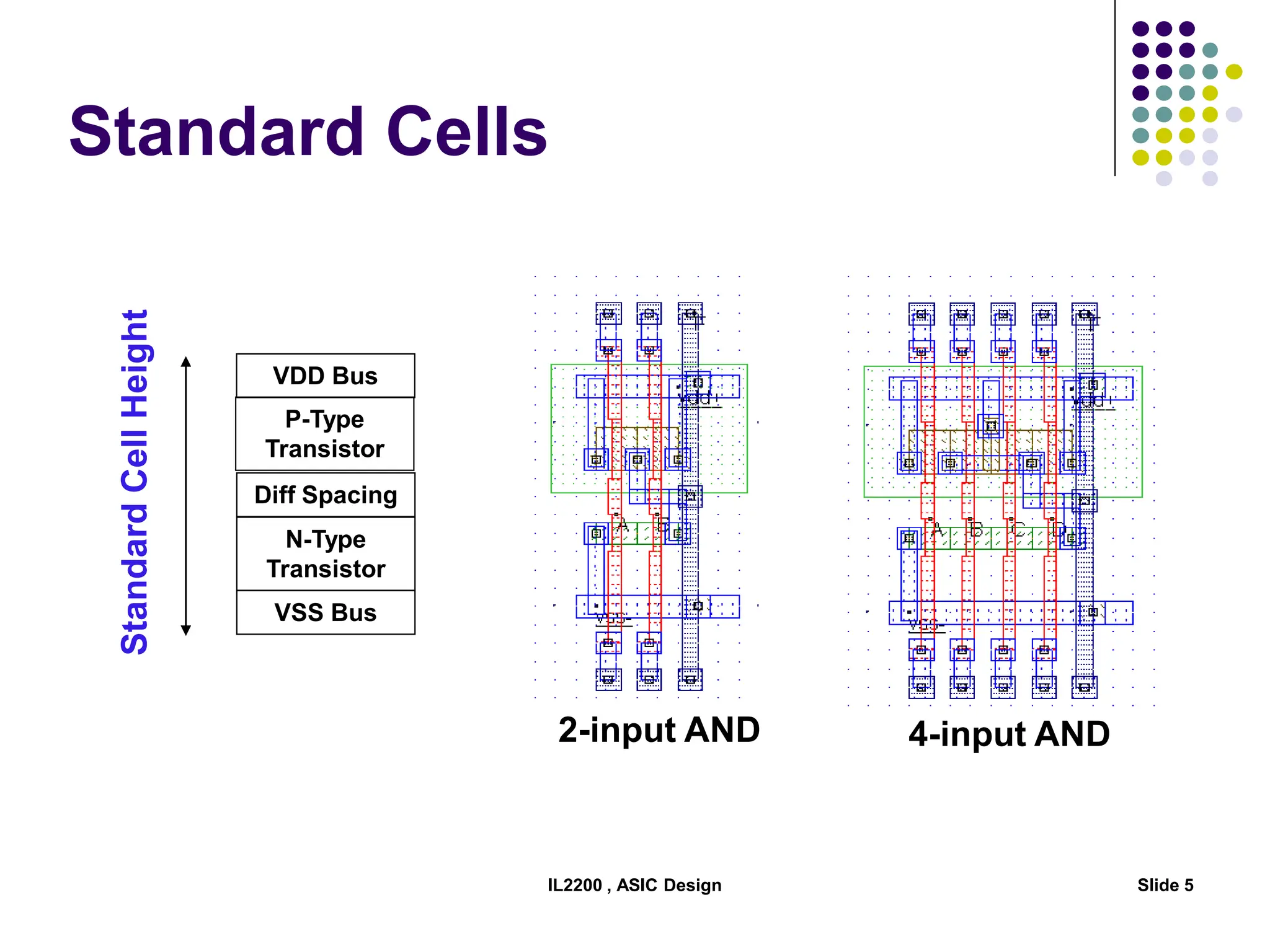
Standard Cells
P-Type
Transistor
Diff Spacing
N-Type
Transistor
VSS Bus
VDD Bus
Standard
Cell
Height
4-input AND
2-input AND
IL2200 , ASIC Design Slide 6
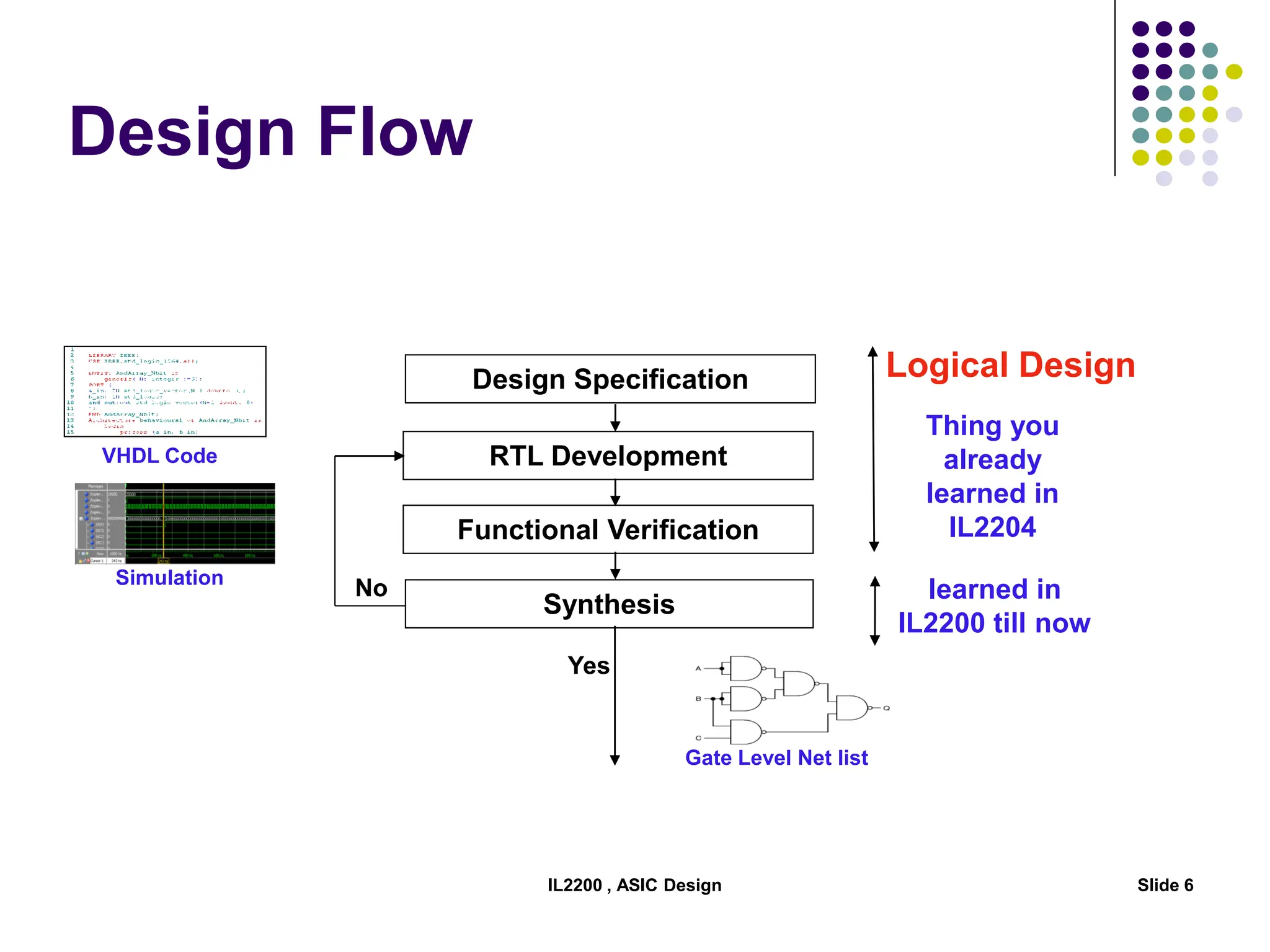
Design Flow
Design Specification
Synthesis
Functional Verification
RTL Development
Thing you
already
learned in
IL2204
Gate Level Net list
VHDL Code
Logical Design
No
Yes
Simulation
learned in
IL2200 till now
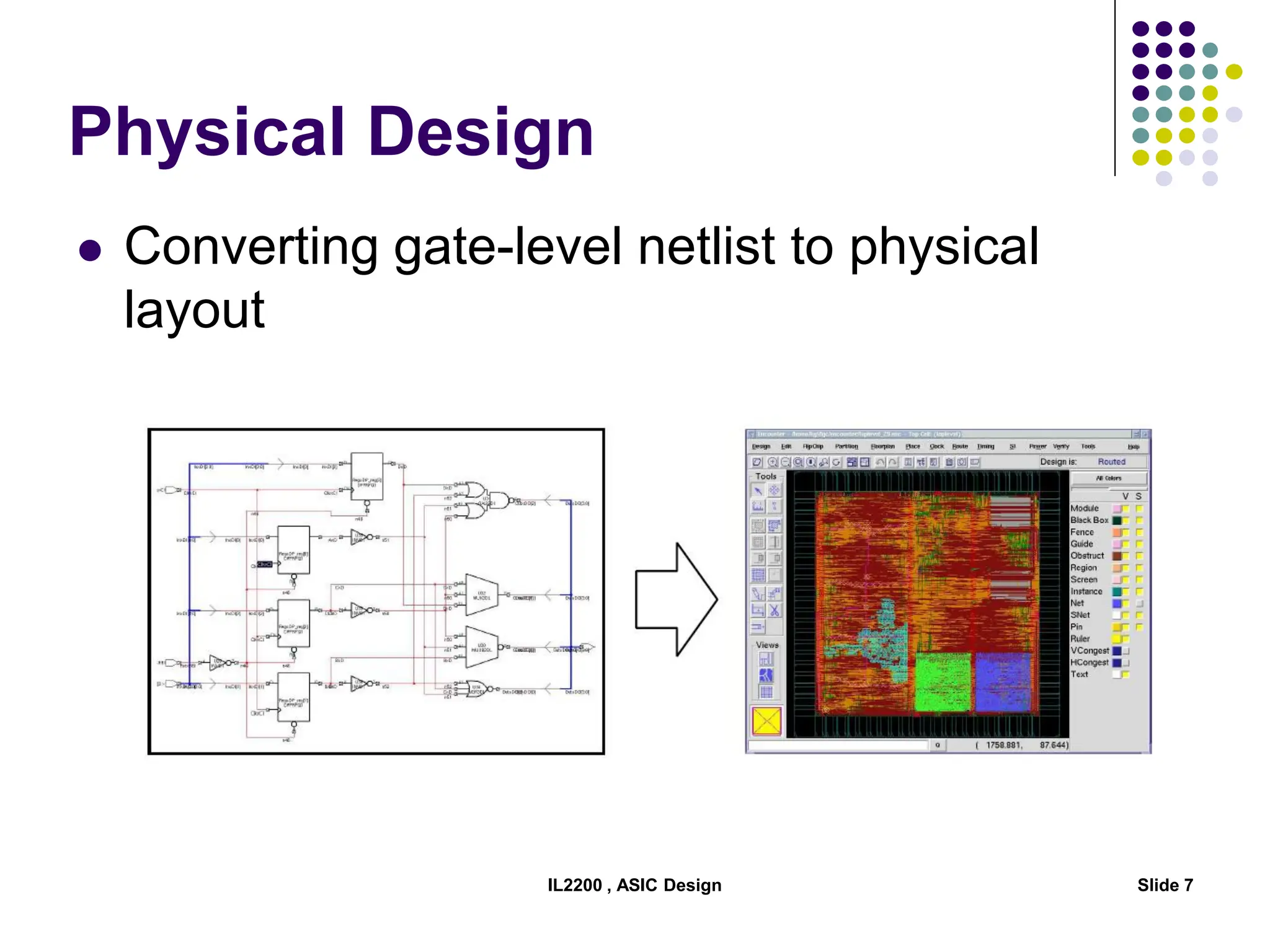
Physical Design
 Converting gate-level netlist to physical
layout
IL2200 , ASIC Design Slide 7
IL2200 , ASIC Design Slide 8
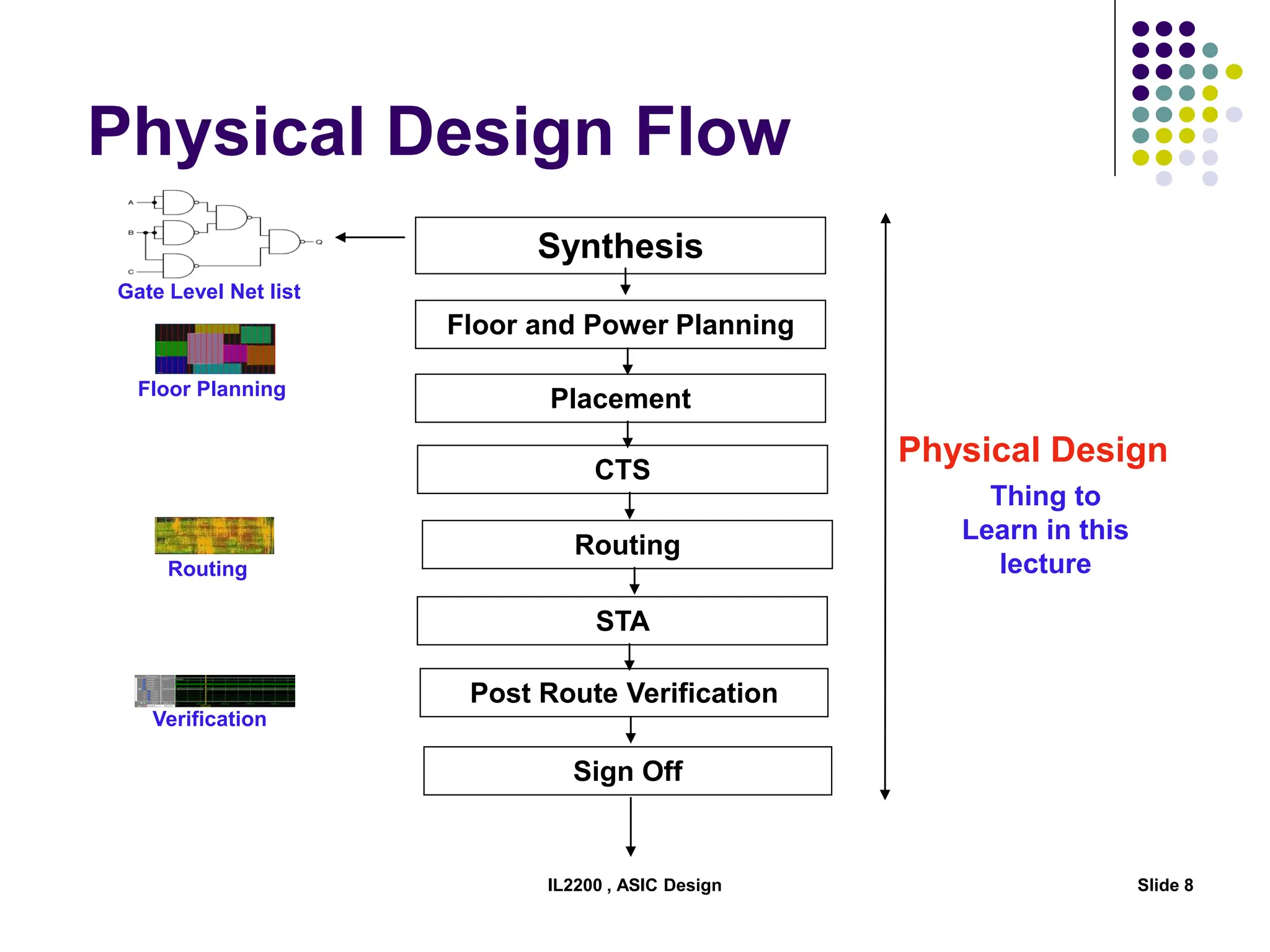
Physical Design Flow
Synthesis
Post Route Verification
Placement
Floor and Power Planning
Thing to
Learn in this
lecture
Gate Level Net list
Physical Design
Sign Off
Floor Planning
Verification
Routing
STA
CTS
Routing
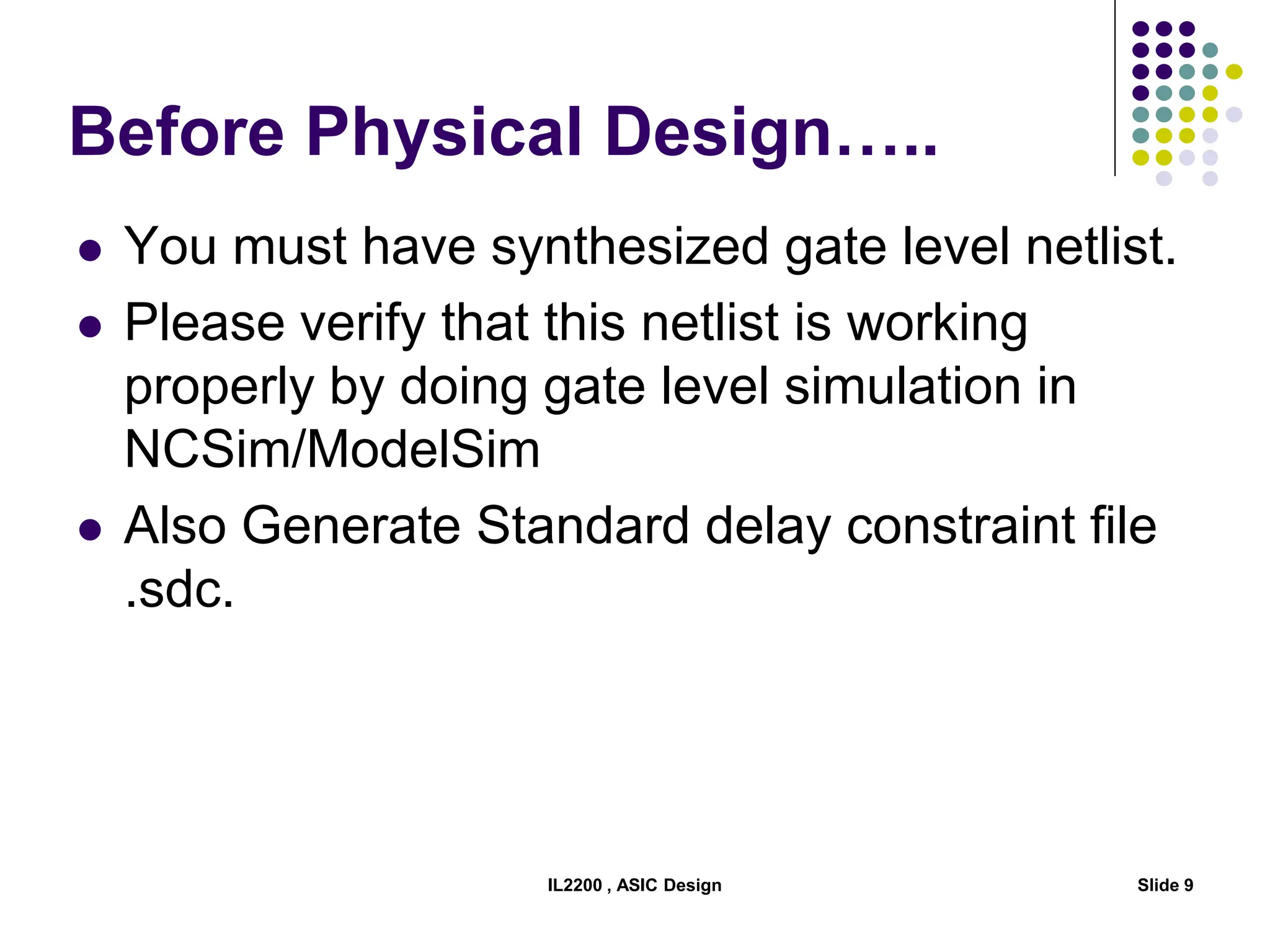
Before Physical Design…..
 You must have synthesized gate level netlist.
 Please verify that this netlist is working
properly by doing gate level simulation in
NCSim/ModelSim
 Also Generate Standard delay constraint file
.sdc.
IL2200 , ASIC Design Slide 9
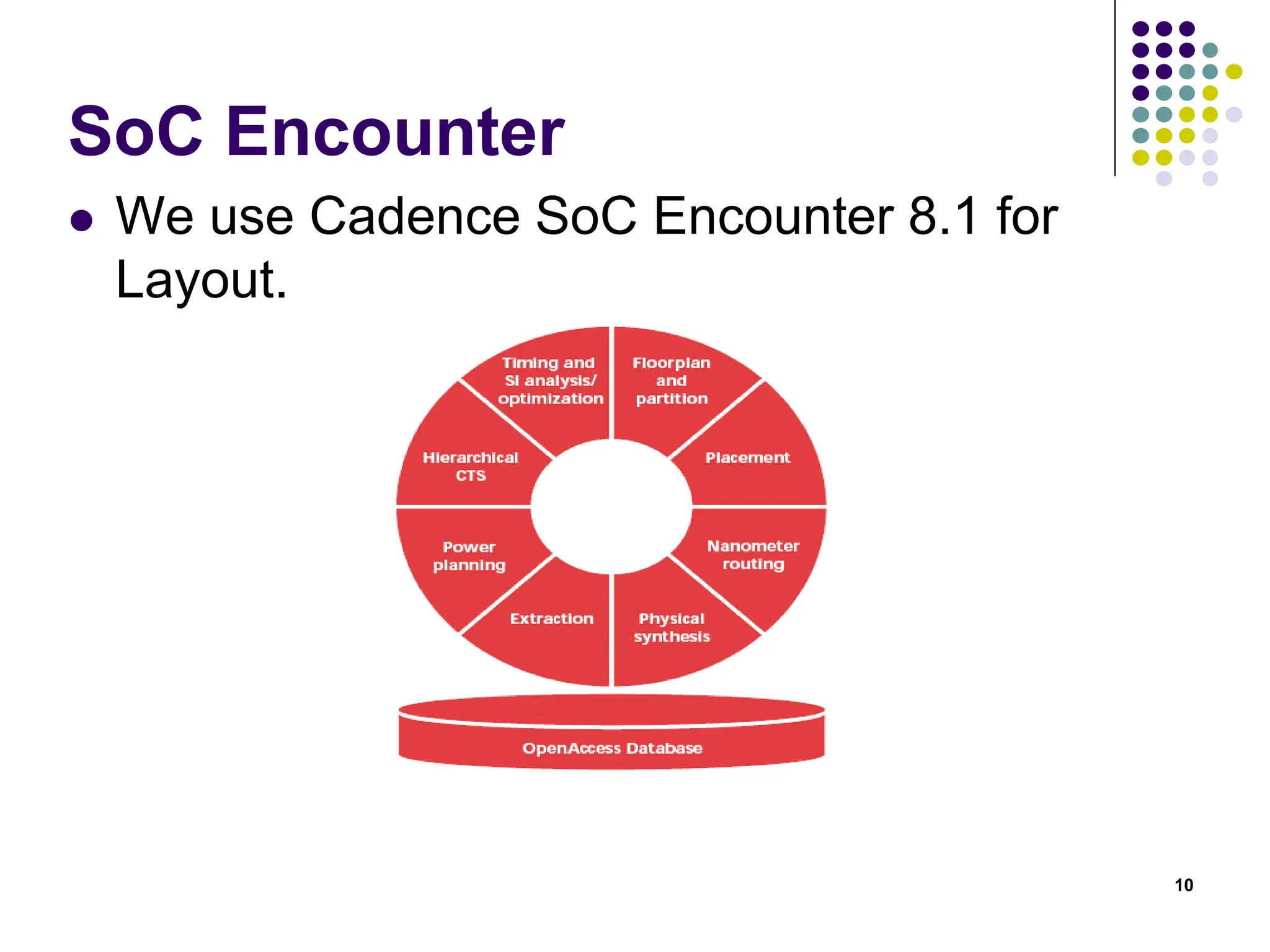
SoC Encounter
10
 We use Cadence SoC Encounter 8.1 for
Layout.
IL2200 , ASIC Design Slide 11
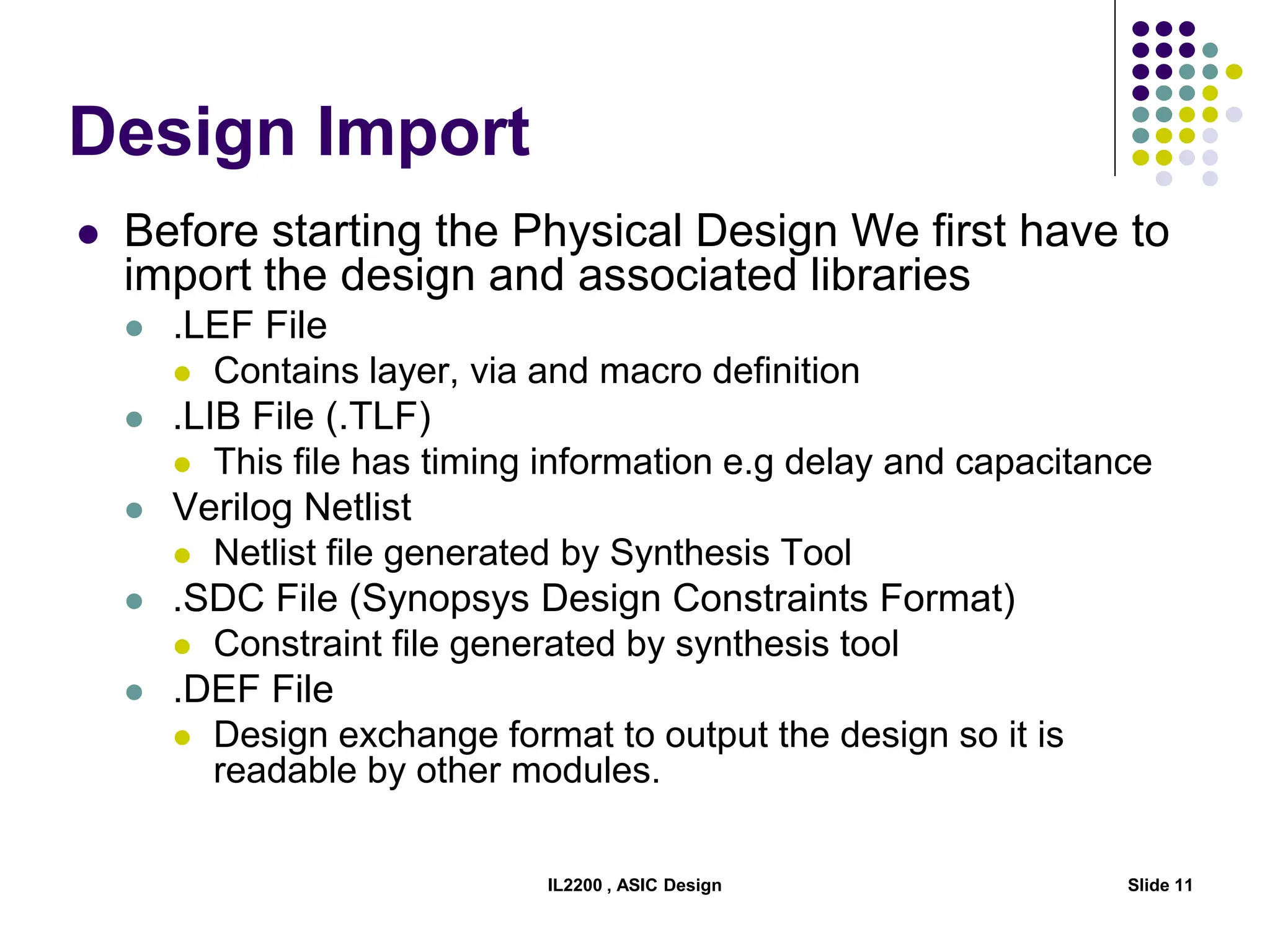
Design Import
 Before starting the Physical Design We first have to
import the design and associated libraries
 .LEF File
 Contains layer, via and macro definition
 .LIB File (.TLF)
 This file has timing information e.g delay and capacitance
 Verilog Netlist
 Netlist file generated by Synthesis Tool
 .SDC File (Synopsys Design Constraints Format)
 Constraint file generated by synthesis tool
 .DEF File
 Design exchange format to output the design so it is
readable by other modules.
IL2200 , ASIC Design Slide 12
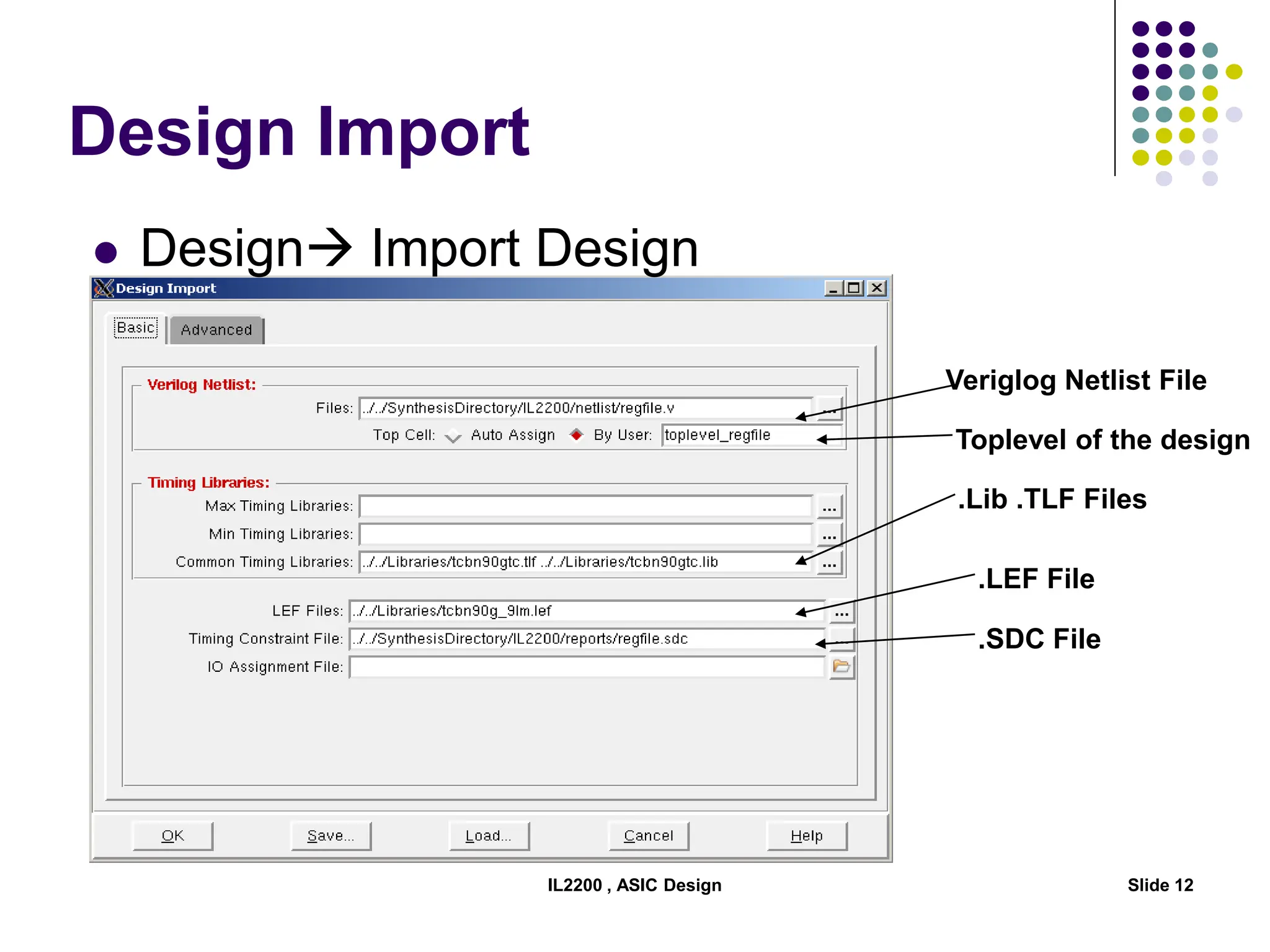
Design Import
Toplevel of the design
Veriglog Netlist File
.Lib .TLF Files
.LEF File
.SDC File
 Design Import Design
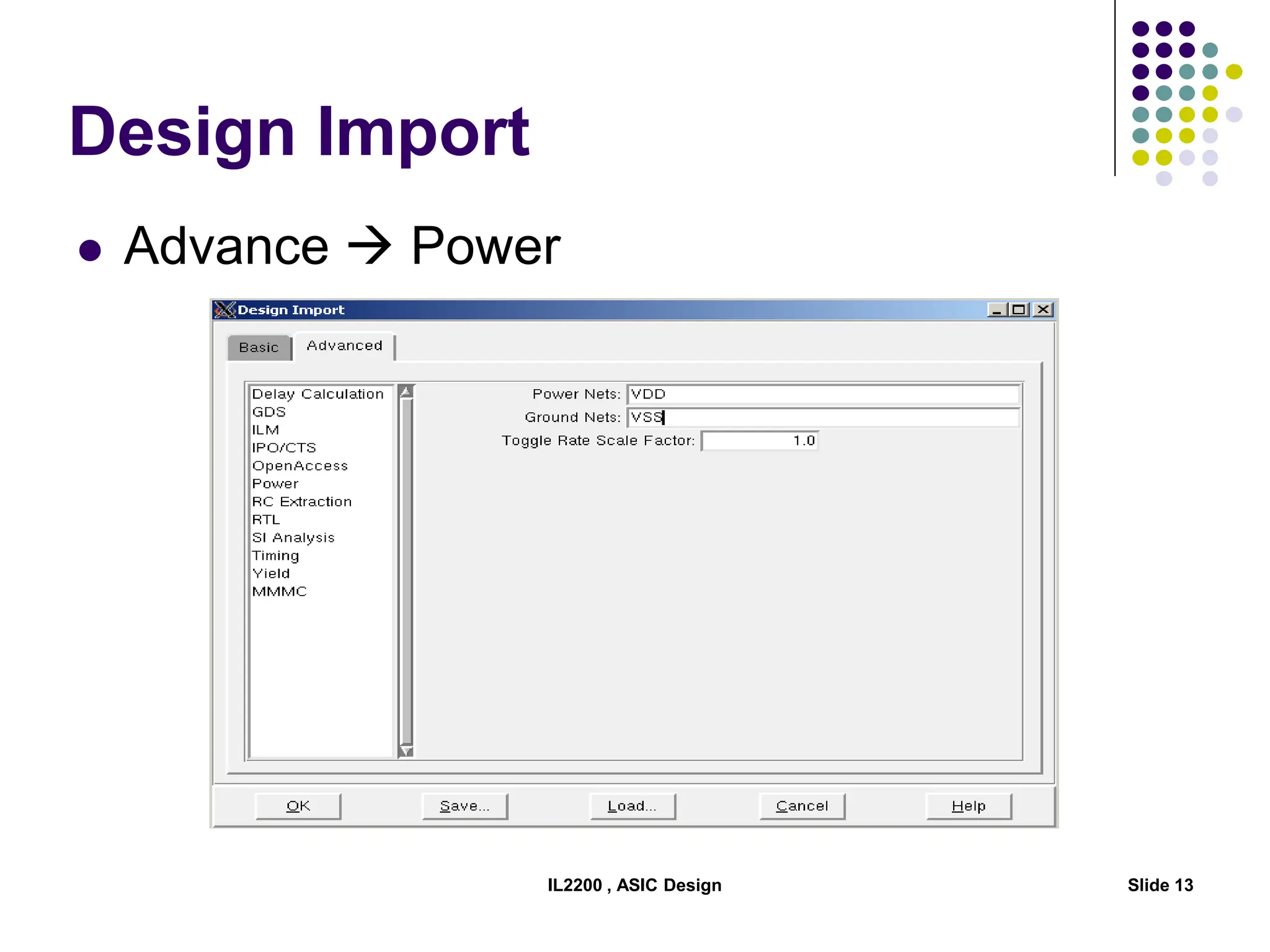
Design Import
 Advance  Power
IL2200 , ASIC Design Slide 13
IL2200 , ASIC Design Slide 14
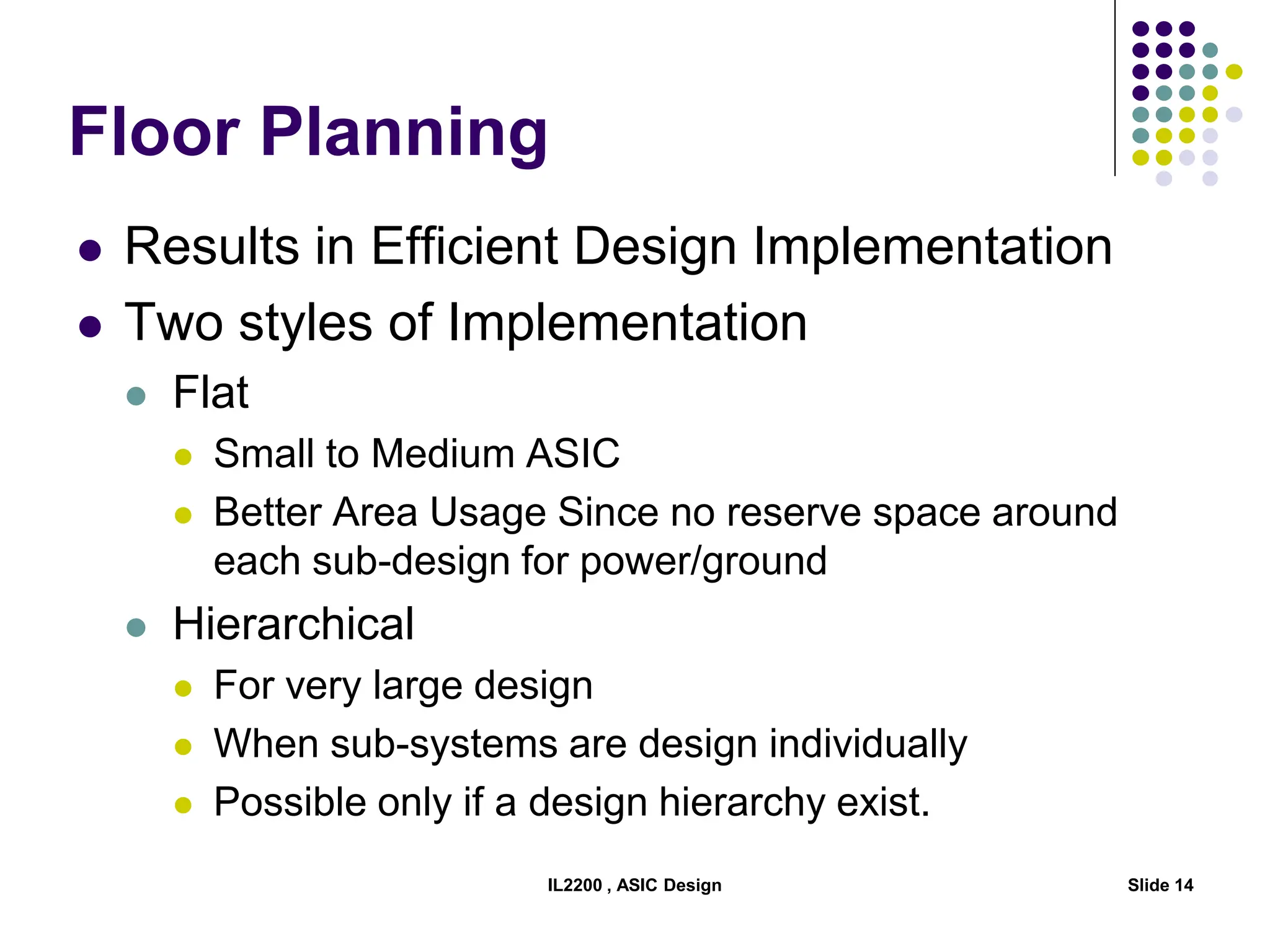
Floor Planning
 Results in Efficient Design Implementation
 Two styles of Implementation
 Flat
 Small to Medium ASIC
 Better Area Usage Since no reserve space around
each sub-design for power/ground
 Hierarchical
 For very large design
 When sub-systems are design individually
 Possible only if a design hierarchy exist.
IL2200 , ASIC Design Slide 15
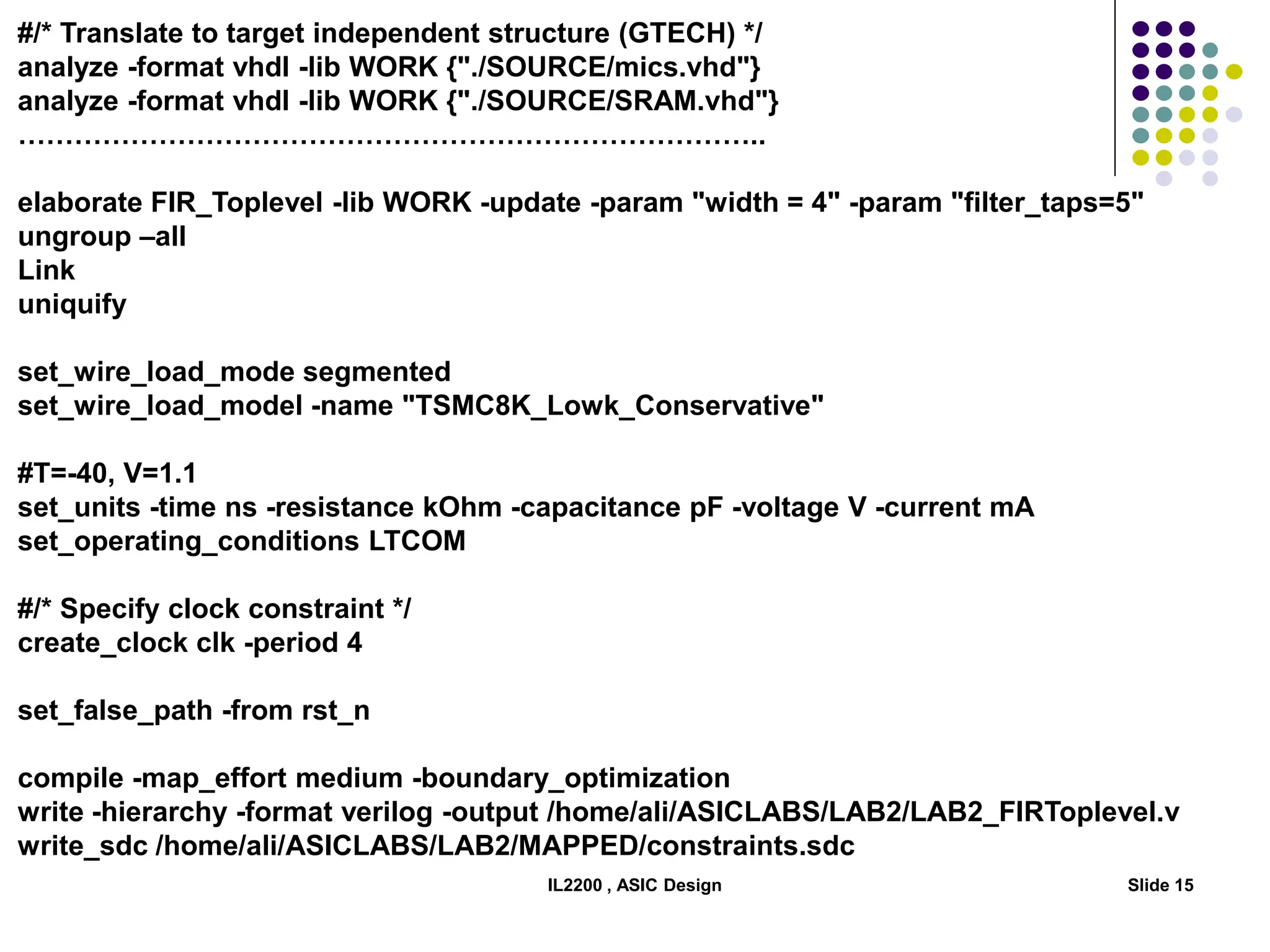
#/* Translate to target independent structure (GTECH) */
analyze -format vhdl -lib WORK {"./SOURCE/mics.vhd"}
analyze -format vhdl -lib WORK {"./SOURCE/SRAM.vhd"}
……………………………………………………………………..
elaborate FIR_Toplevel -lib WORK -update -param "width = 4" -param "filter_taps=5"
ungroup –all
Link
uniquify
set_wire_load_mode segmented
set_wire_load_model -name "TSMC8K_Lowk_Conservative"
#T=-40, V=1.1
set_units -time ns -resistance kOhm -capacitance pF -voltage V -current mA
set_operating_conditions LTCOM
#/* Specify clock constraint */
create_clock clk -period 4
set_false_path -from rst_n
compile -map_effort medium -boundary_optimization
write -hierarchy -format verilog -output /home/ali/ASICLABS/LAB2/LAB2_FIRToplevel.v
write_sdc /home/ali/ASICLABS/LAB2/MAPPED/constraints.sdc
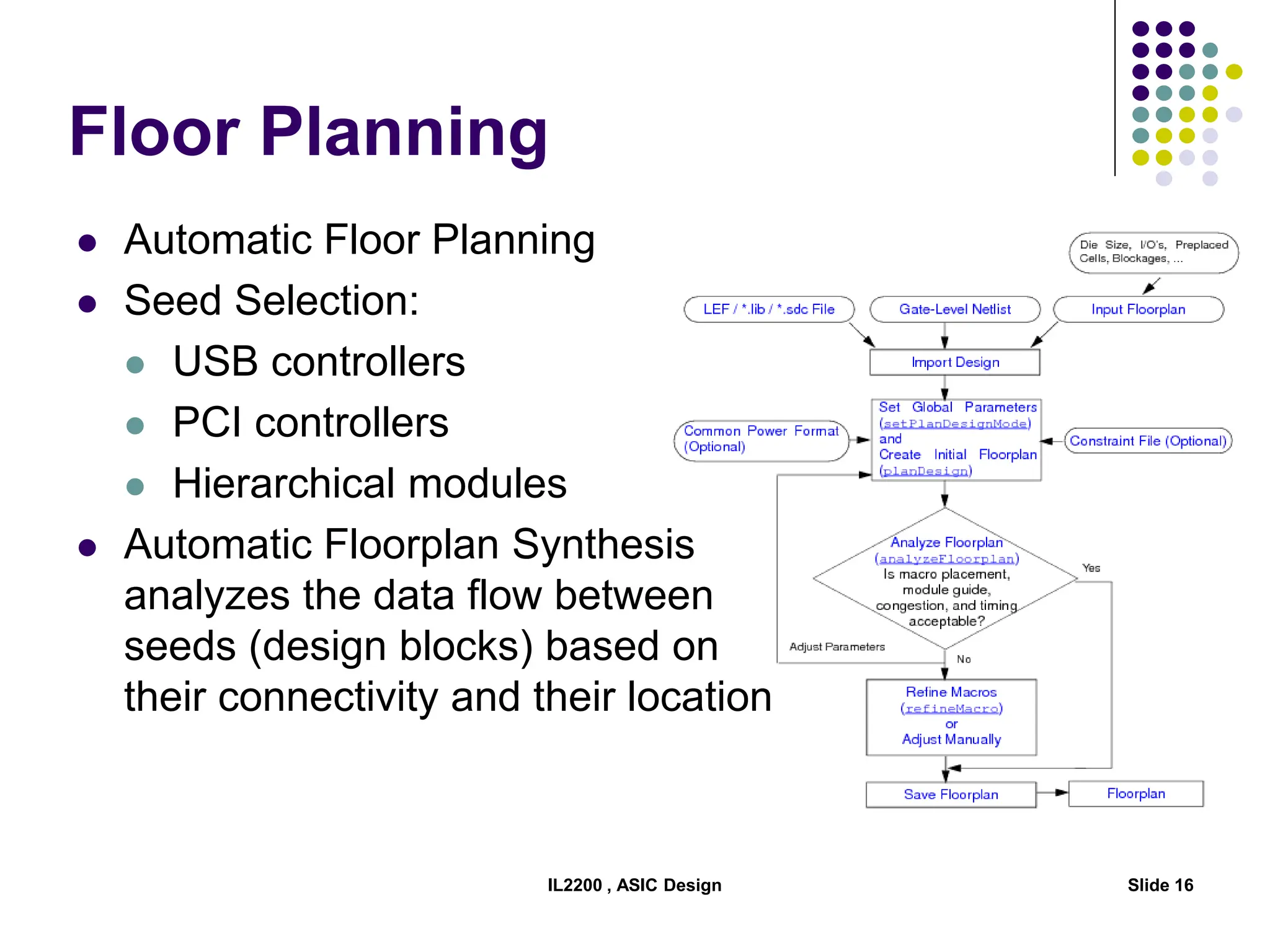
Floor Planning
IL2200 , ASIC Design Slide 16
 Automatic Floor Planning
 Seed Selection:
 USB controllers
 PCI controllers
 Hierarchical modules
 Automatic Floorplan Synthesis
analyzes the data flow between
seeds (design blocks) based on
their connectivity and their location
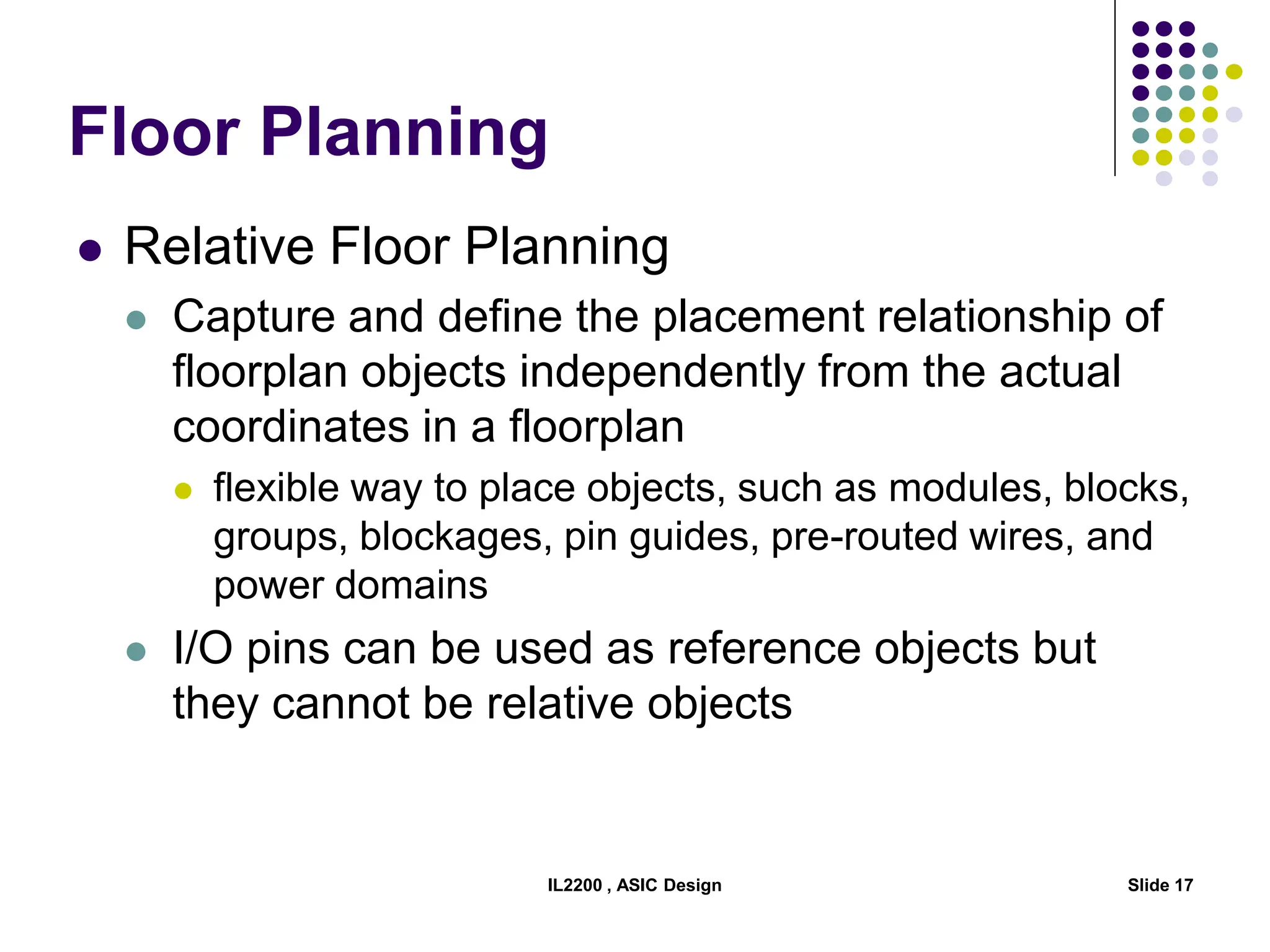
Floor Planning
 Relative Floor Planning
 Capture and define the placement relationship of
floorplan objects independently from the actual
coordinates in a floorplan
 flexible way to place objects, such as modules, blocks,
groups, blockages, pin guides, pre-routed wires, and
power domains
 I/O pins can be used as reference objects but
they cannot be relative objects
IL2200 , ASIC Design Slide 17
Floor Planning
IL2200 , ASIC Design Slide 18
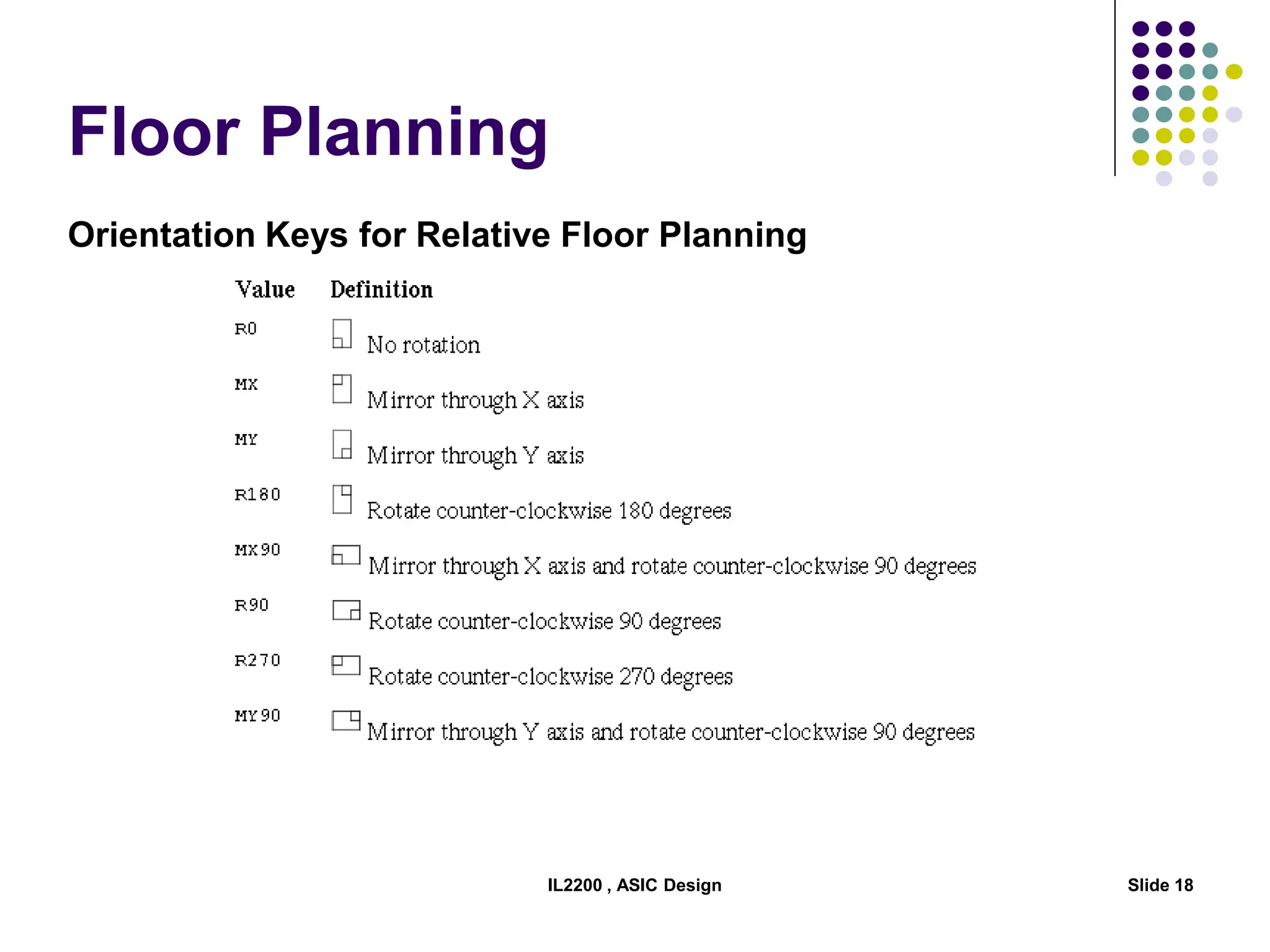
Orientation Keys for Relative Floor Planning
IL2200 , ASIC Design Slide 19
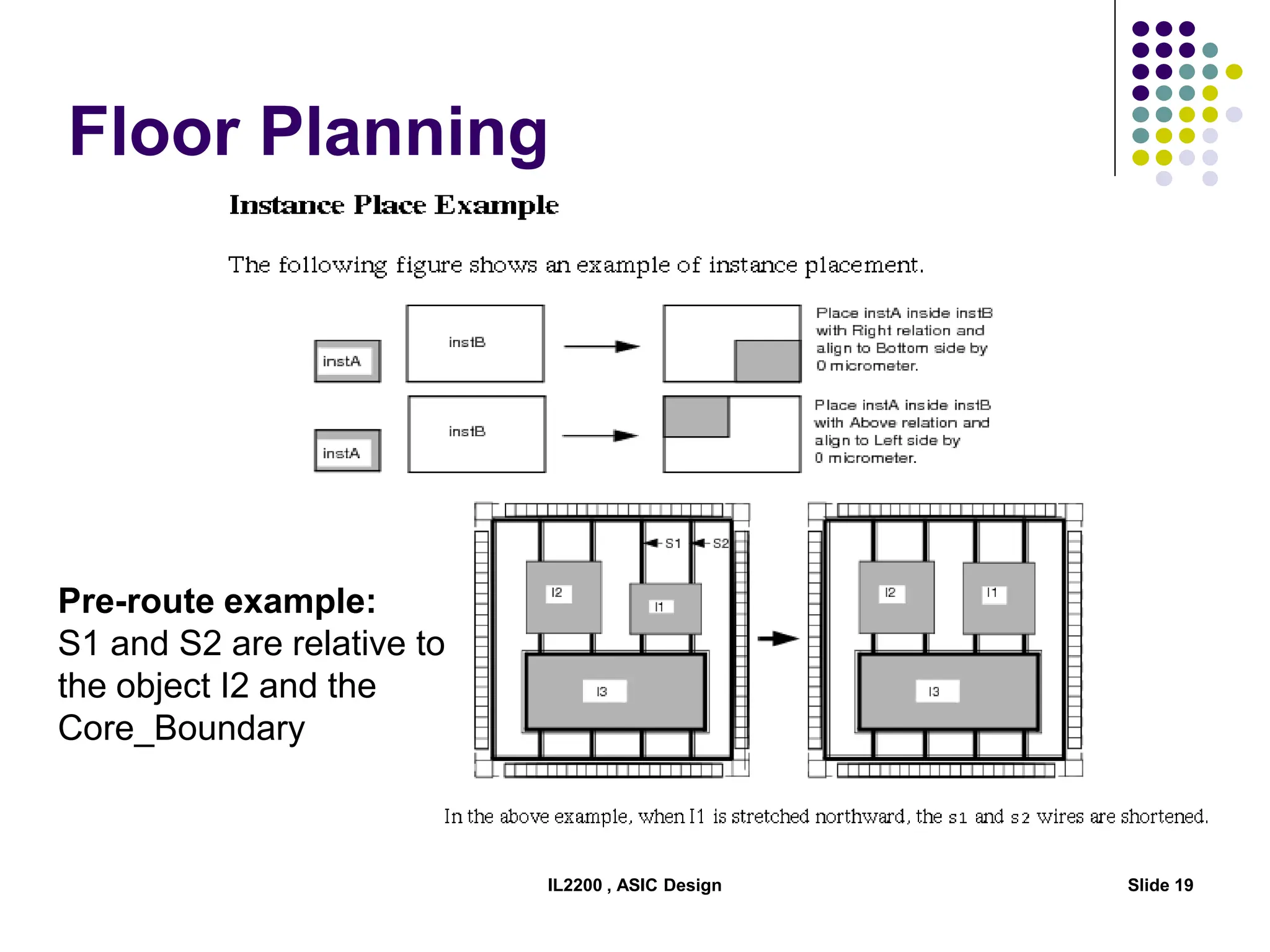
Pre-route example:
S1 and S2 are relative to
the object I2 and the
Core_Boundary
Floor Planning
Floor Planning
IL2200 , ASIC Design Slide 20
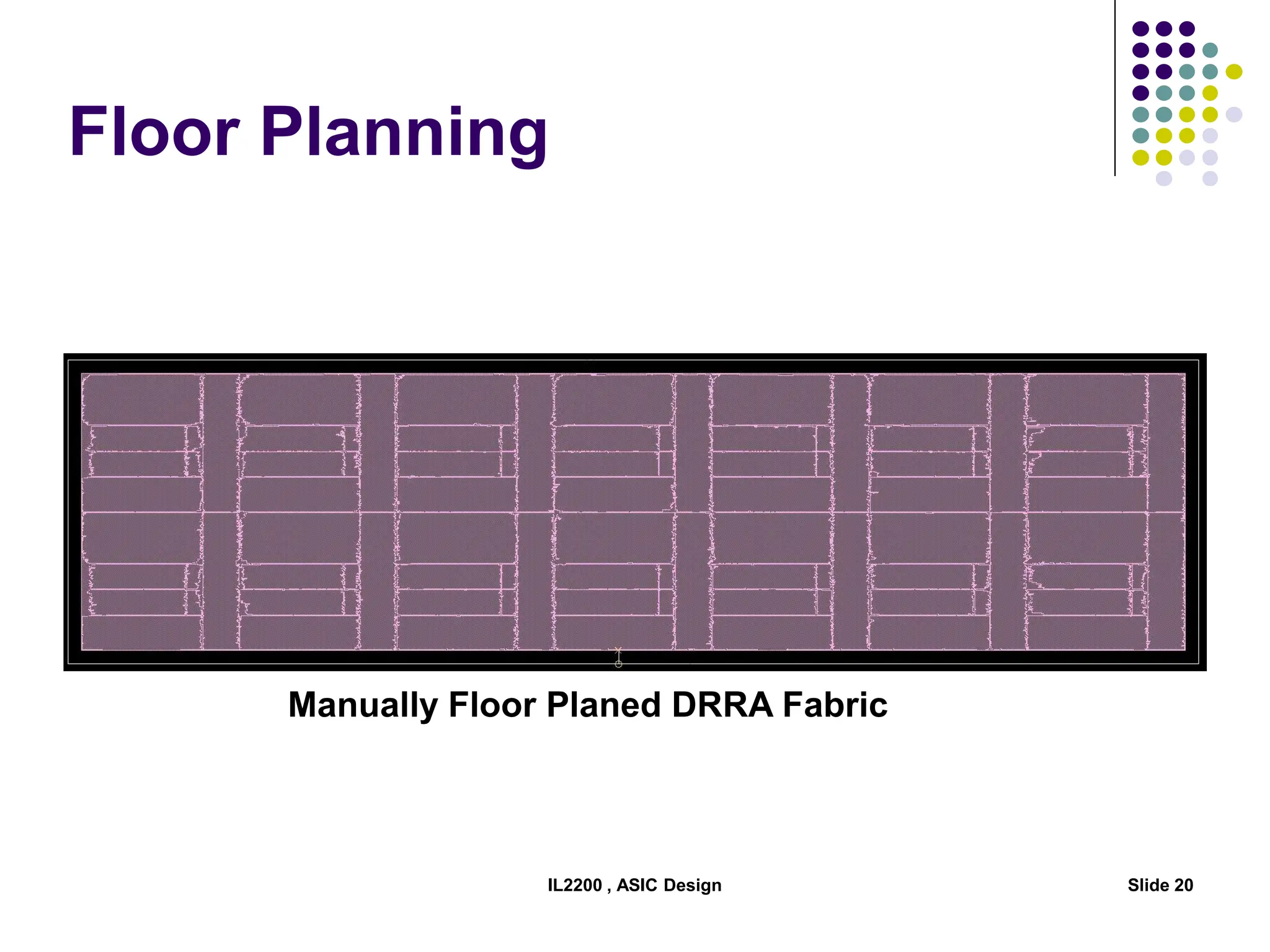
Manually Floor Planed DRRA Fabric
IL2200 , ASIC Design Slide 21
Floor Planning
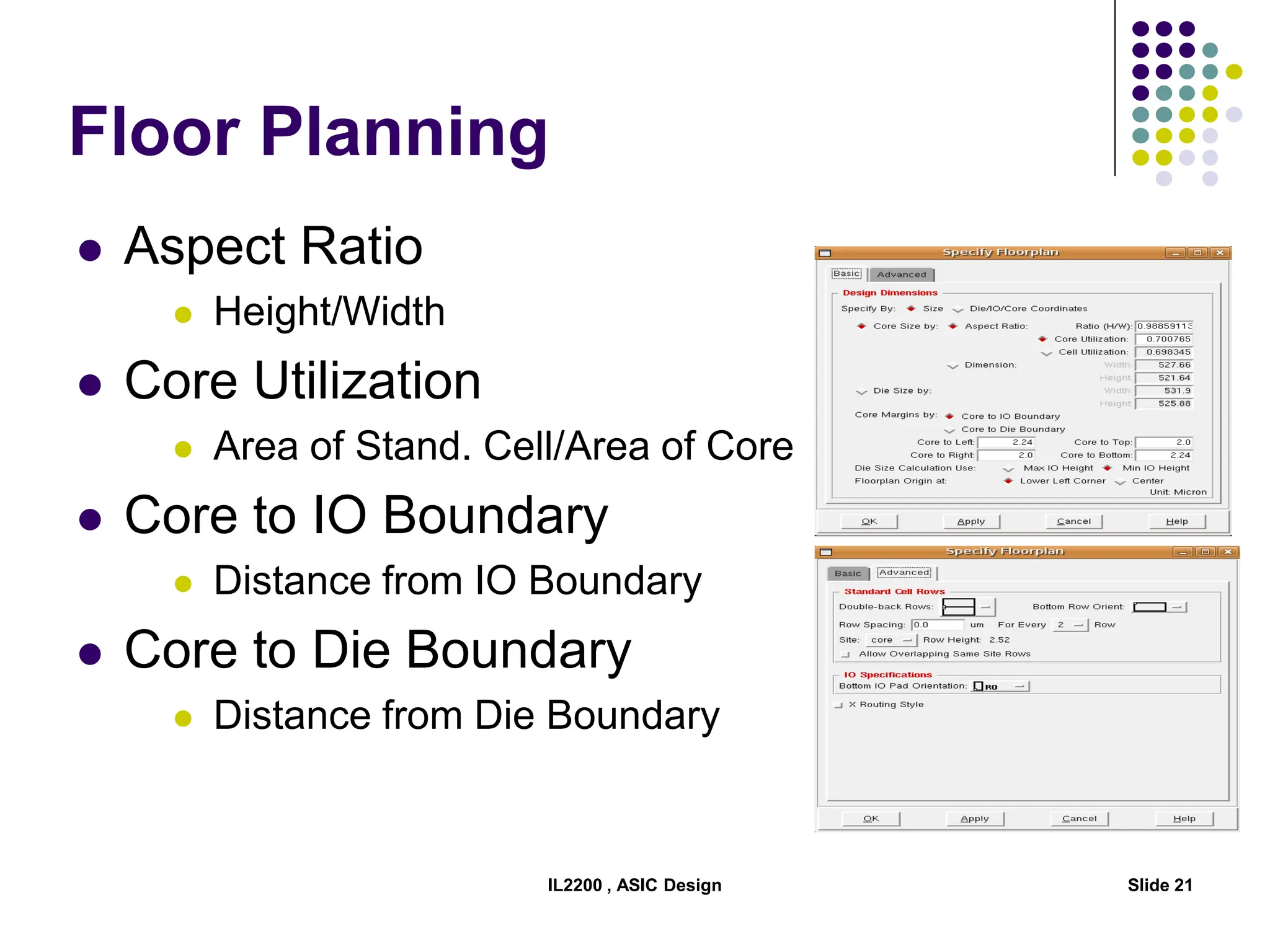
 Aspect Ratio
 Height/Width
 Core Utilization
 Area of Stand. Cell/Area of Core
 Core to IO Boundary
 Distance from IO Boundary
 Core to Die Boundary
 Distance from Die Boundary
IL2200 , ASIC Design Slide 22
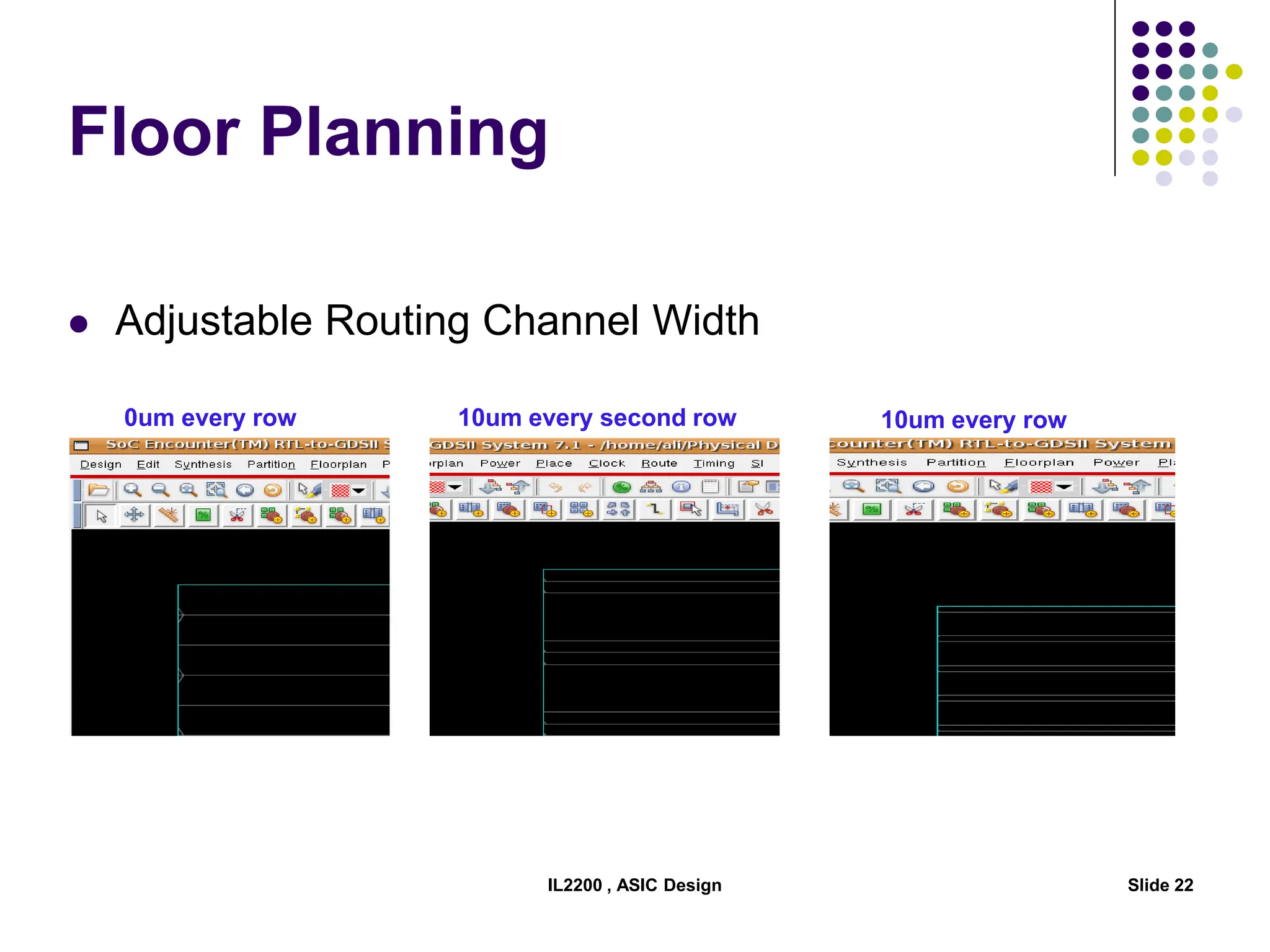
Floor Planning
0um every row 10um every row
10um every second row
 Adjustable Routing Channel Width
IL2200 , ASIC Design Slide 23
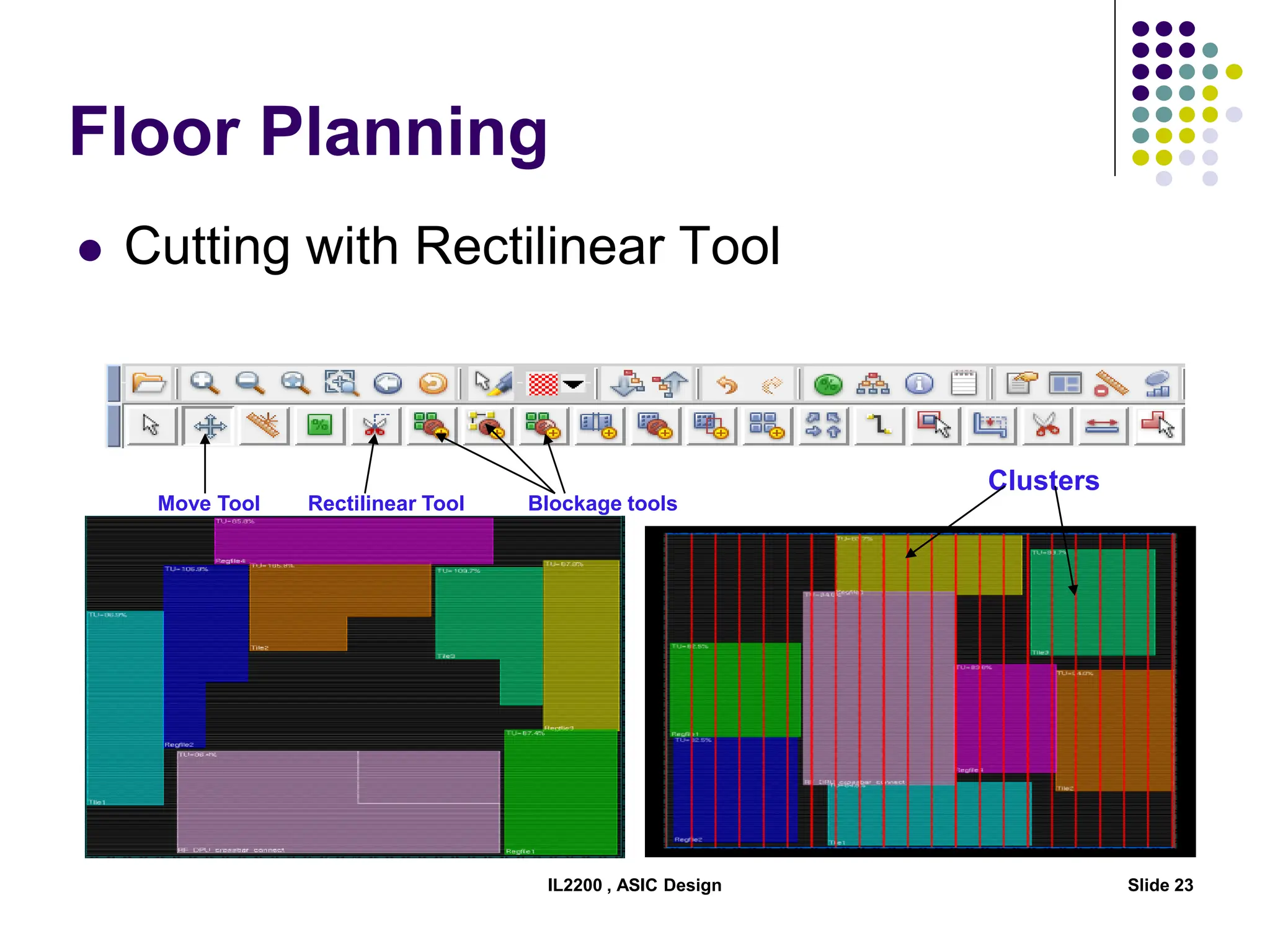
Floor Planning
 Cutting with Rectilinear Tool
Clusters
Rectilinear Tool
Move Tool Blockage tools
IL2200 , ASIC Design Slide 24
Partitioning
 Part of Floor Planning
 Standard Cells are in Floating States before
placement.
 Have not been assigned a fixed location in Core
 Time to define clusters and regions
 To keep time critical component close
 Soft Regions
 Boundary can change during standard cell
placement
 Hard Regions
 Prevent Standard cell crossing boundaries
IL2200 , ASIC Design Slide 25
Partitioning
 Exclusive Regions
 Allow standard cells assigned to the region to be
placed within the region
 Non Exclusive Regions
 Allow standard cells that do not belong to the
region to be placed within the region
IL2200 , ASIC Design Slide 26
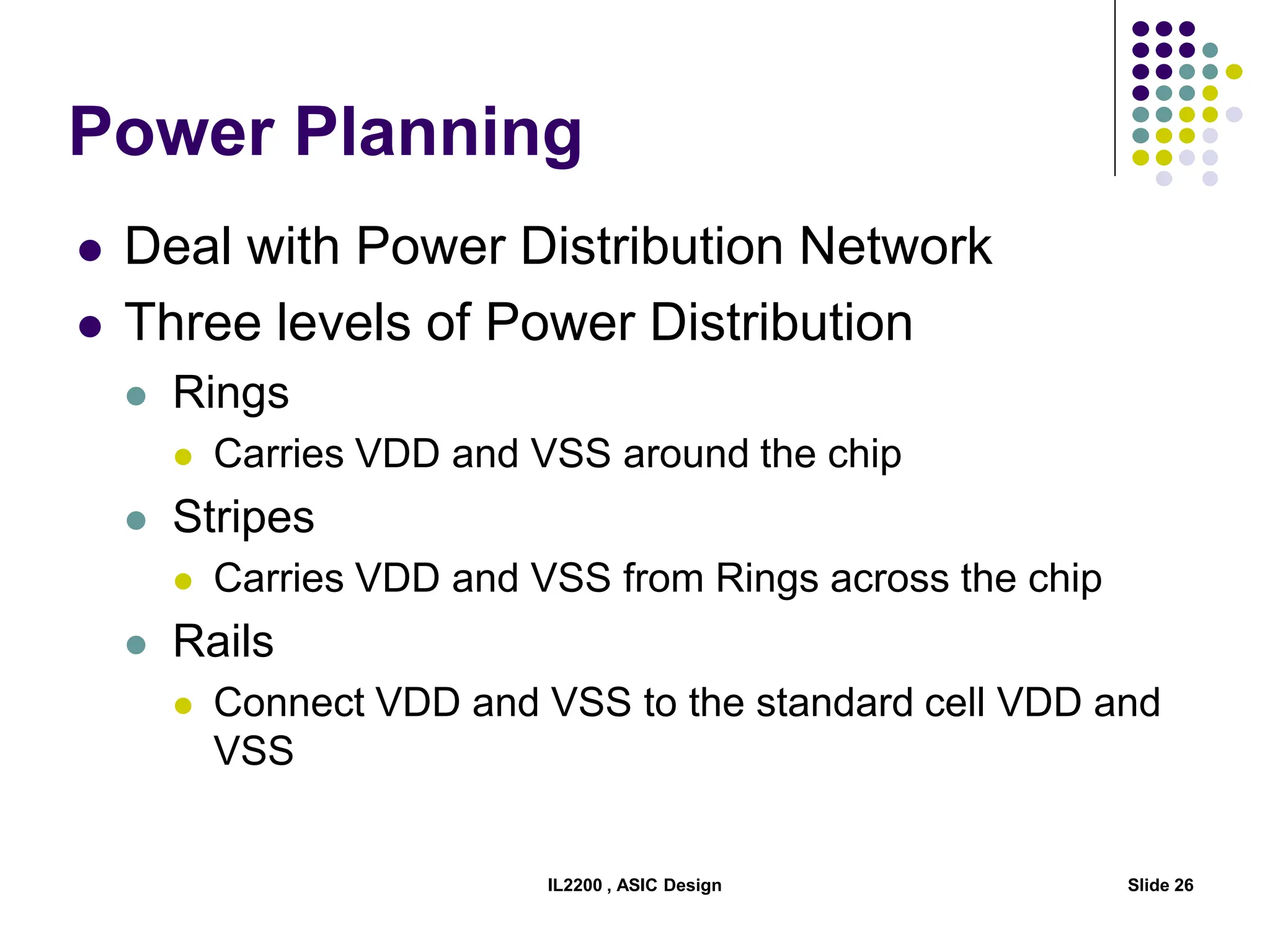
Power Planning
 Deal with Power Distribution Network
 Three levels of Power Distribution
 Rings
 Carries VDD and VSS around the chip
 Stripes
 Carries VDD and VSS from Rings across the chip
 Rails
 Connect VDD and VSS to the standard cell VDD and
VSS
IL2200 , ASIC Design Slide 27
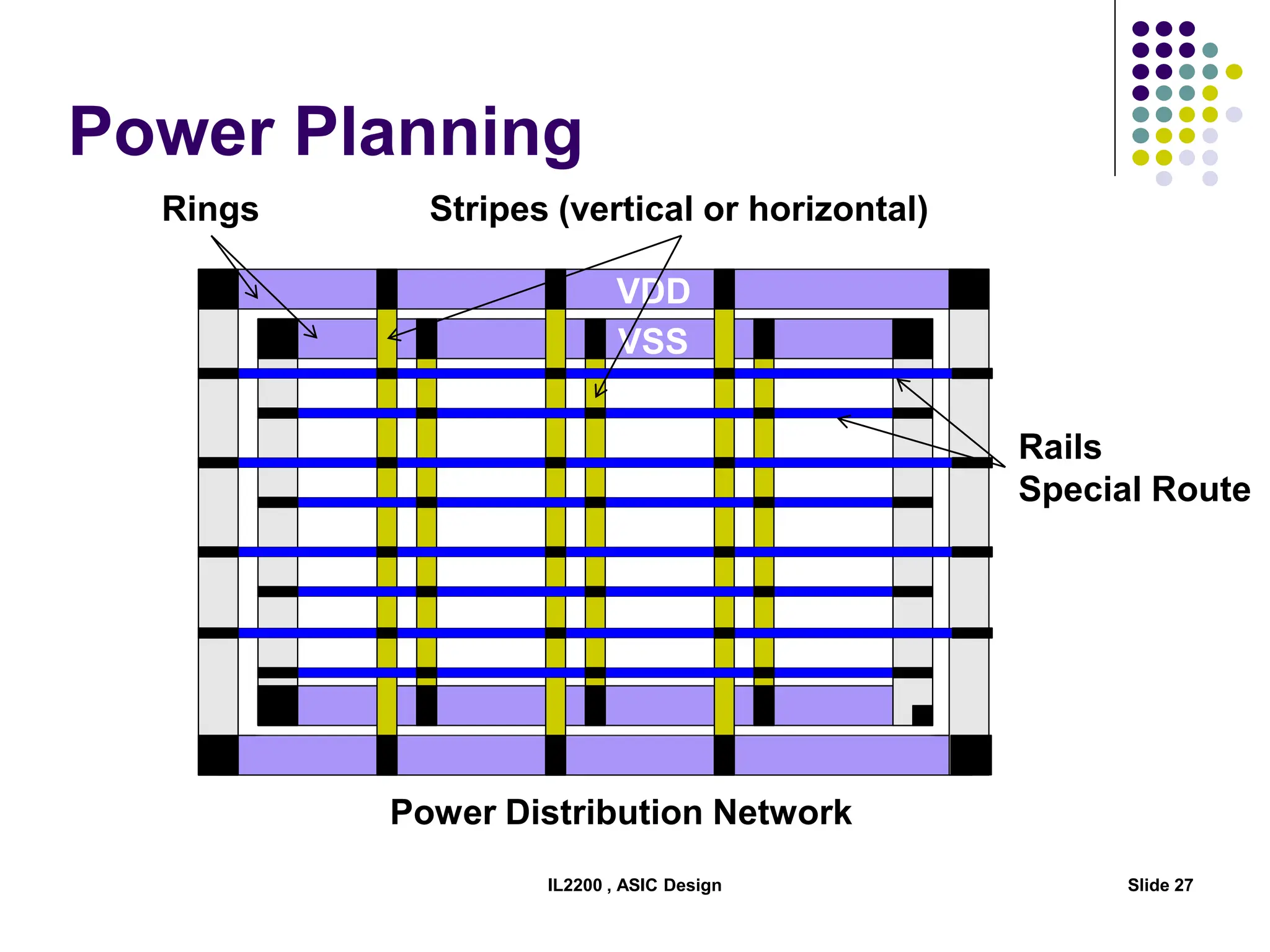
Power Planning
VDD
VSS
Rings Stripes (vertical or horizontal)
Rails
Special Route
Power Distribution Network
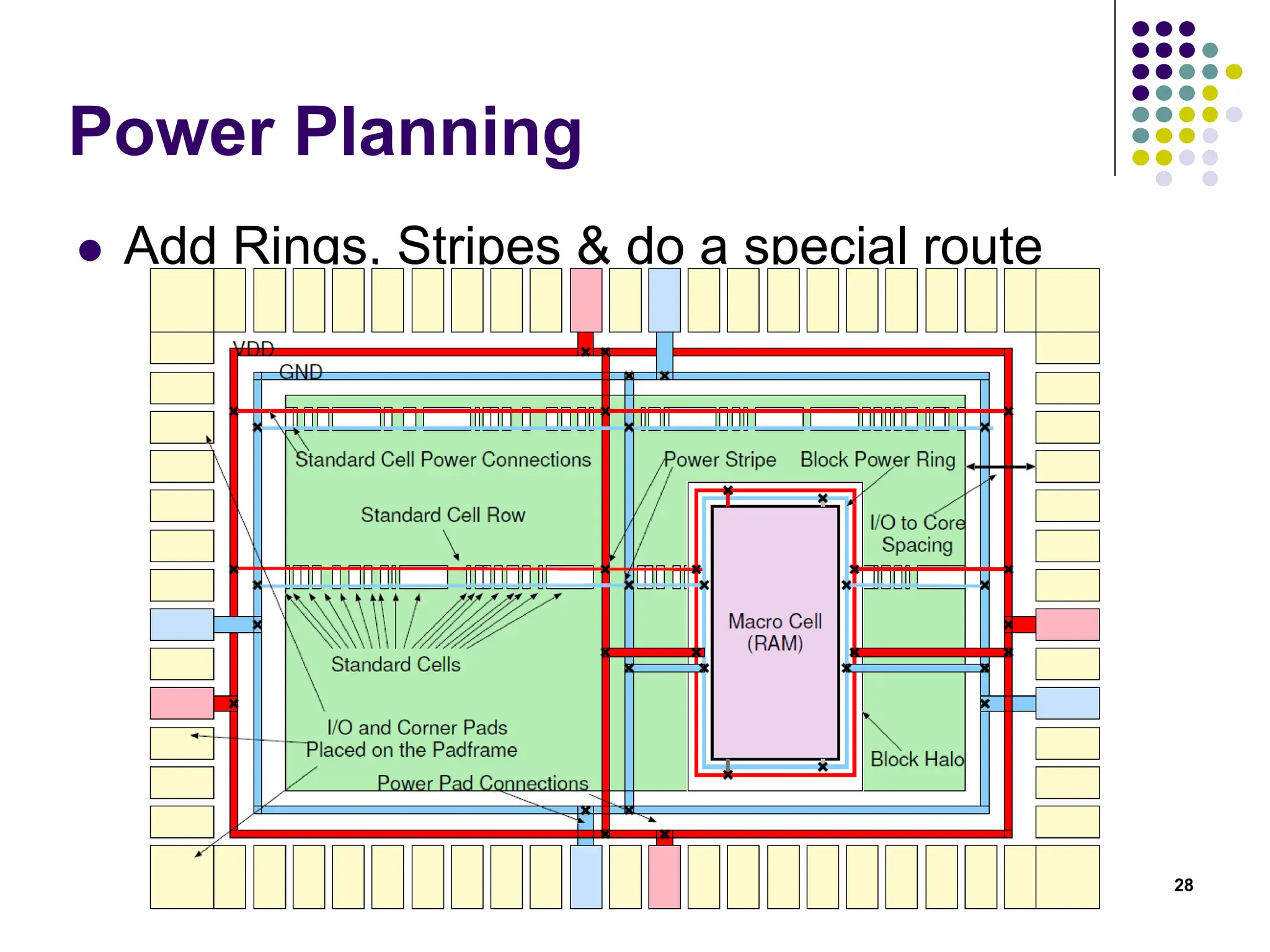
Power Planning
28
 Add Rings, Stripes & do a special route
IL2200 , ASIC Design Slide 29
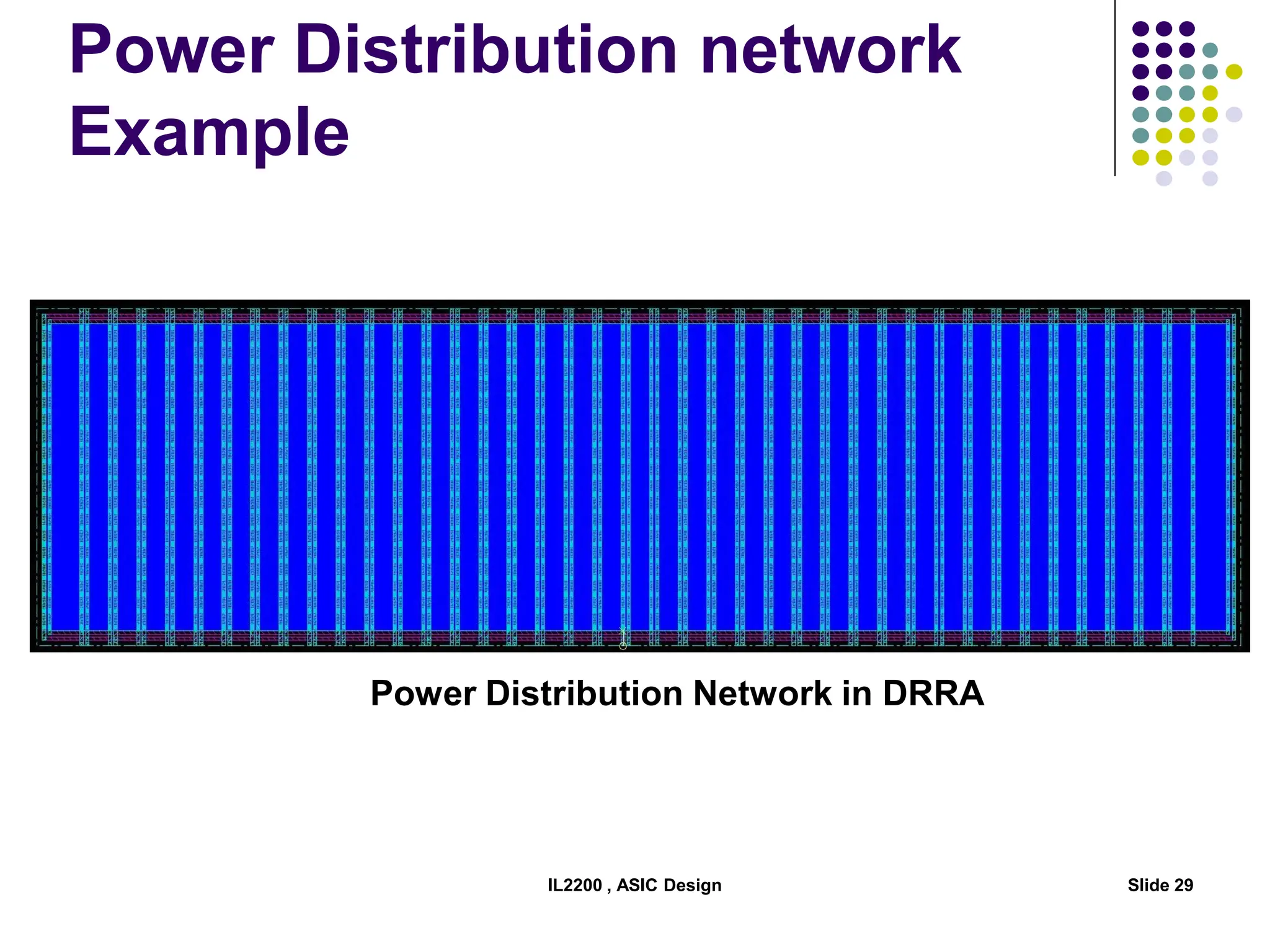
Power Distribution network
Example
Power Distribution Network in DRRA
IL2200 , ASIC Design Slide 30
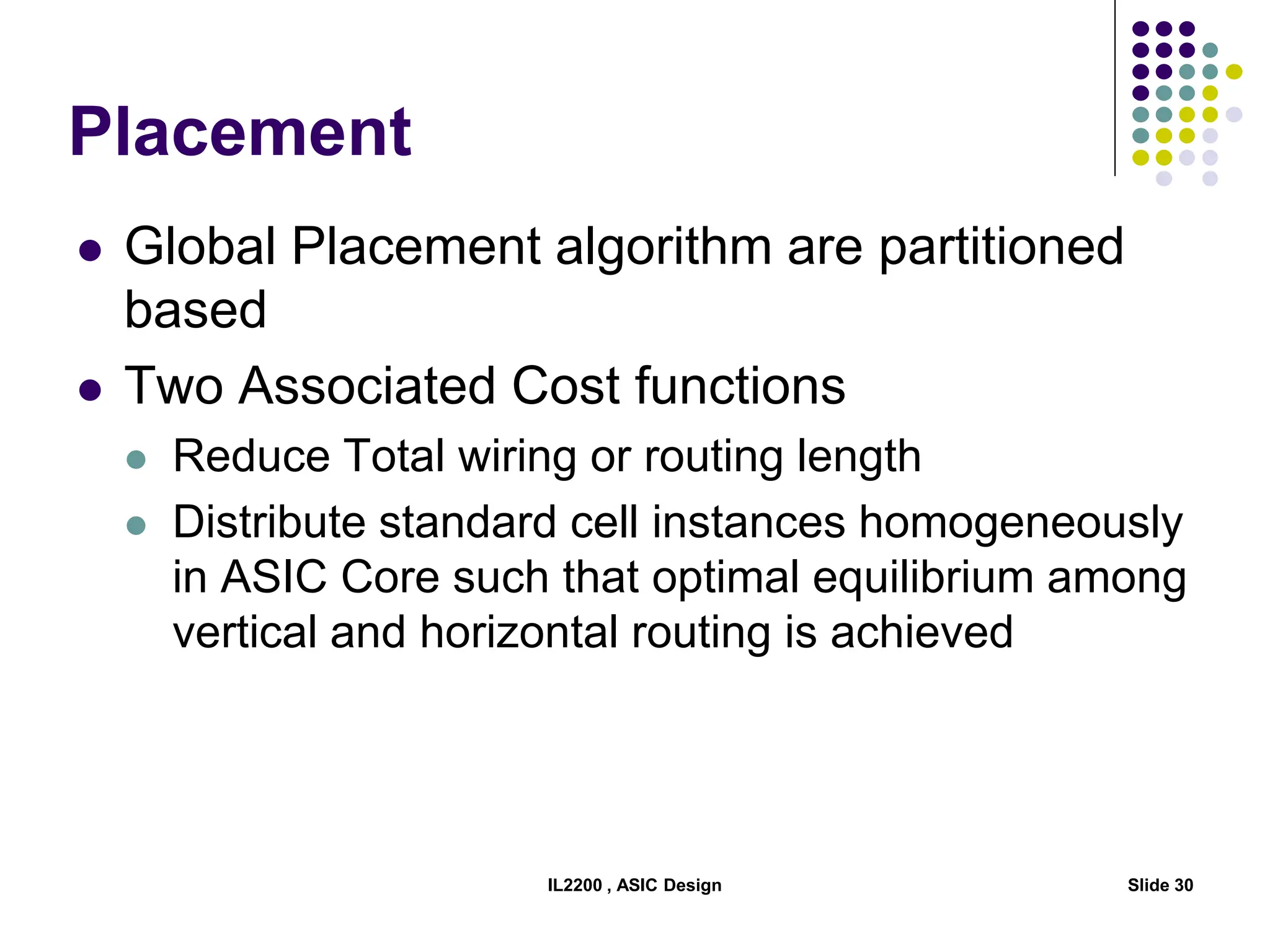
Placement
 Global Placement algorithm are partitioned
based
 Two Associated Cost functions
 Reduce Total wiring or routing length
 Distribute standard cell instances homogeneously
in ASIC Core such that optimal equilibrium among
vertical and horizontal routing is achieved
IL2200 , ASIC Design Slide 31
Detailed Placement
 After global placement
 To Refine placement based on congestion, timing and
power
 Congestion Driven Placement
 To distance standard cell instances from each other such
that more routing tracks are created between them
 Timing Driven Placement
 To optimize large sets of path delays
 Net Based
 Try to control the delay on signal path by imposing an
upper bound delay or weight to net
IL2200 , ASIC Design Slide 34
Clock Tree Synthesis
 Automatic insertion of buffers/inverters along
the clock path to balance the clock delay to
all the clock inputs.
Why balancing clock delay?
Clock Skew?
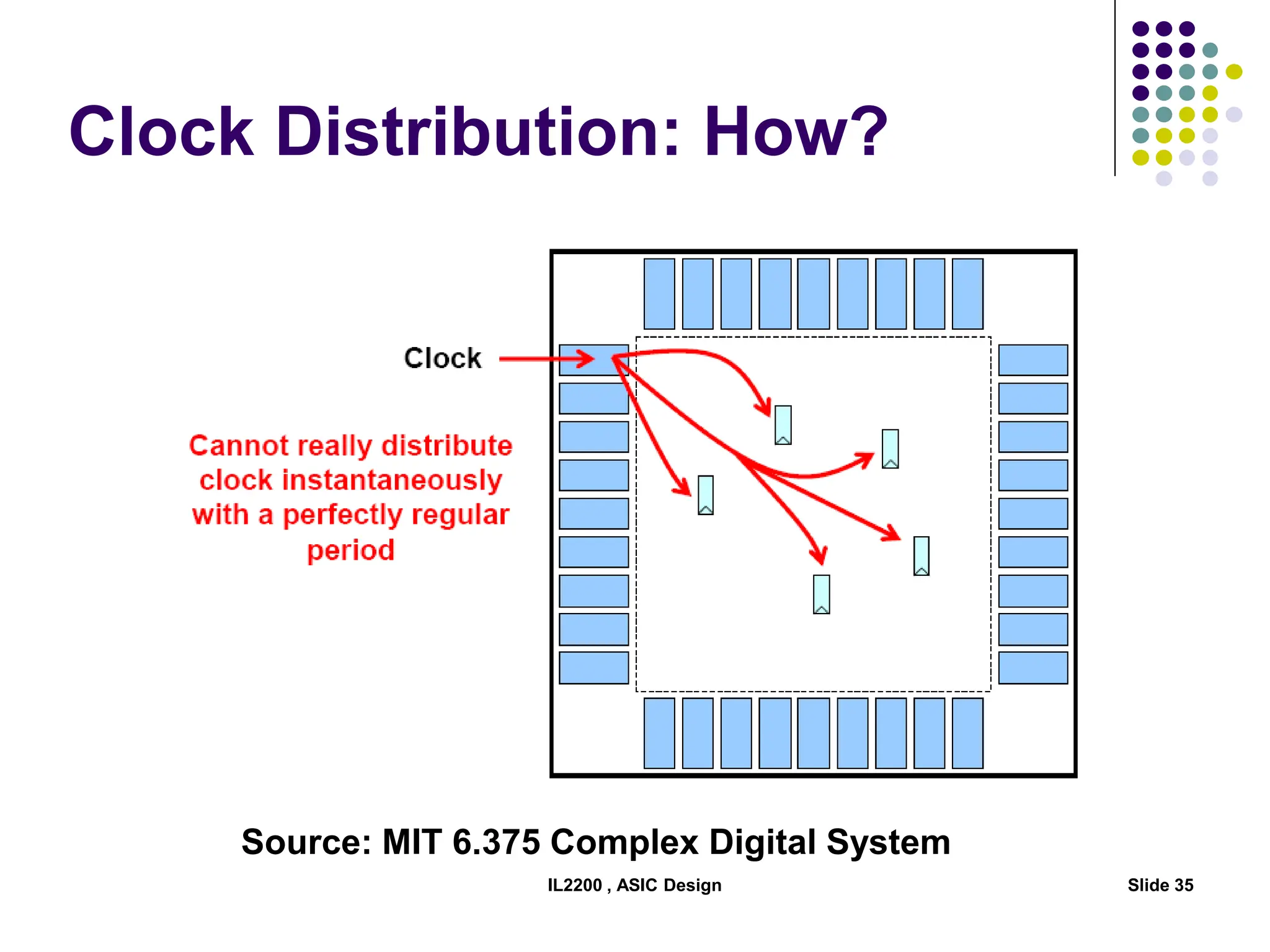
Clock Distribution: How?
IL2200 , ASIC Design Slide 35
Source: MIT 6.375 Complex Digital System
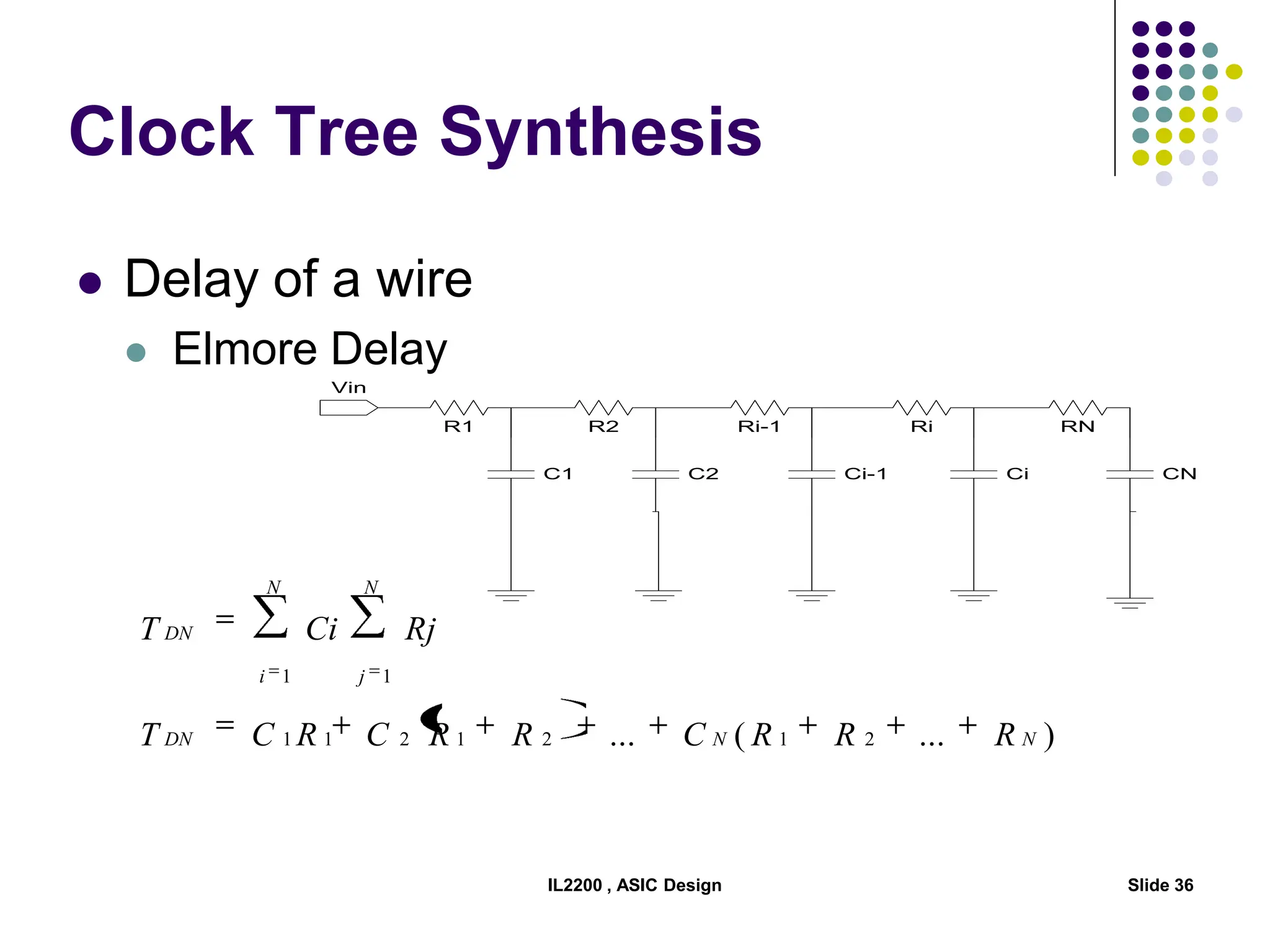
IL2200 , ASIC Design Slide 36
Clock Tree Synthesis
R1
Vin
C1
R2
C2
Ri-1
Ci-1
Ri
Ci
RN
CN
)
...
(
... 2
1
2
1
2
1
1
1
1
N
N
DN
N
j
N
i
DN
R
R
R
C
R
R
C
R
C
T
Rj
Ci
T
 Delay of a wire
 Elmore Delay
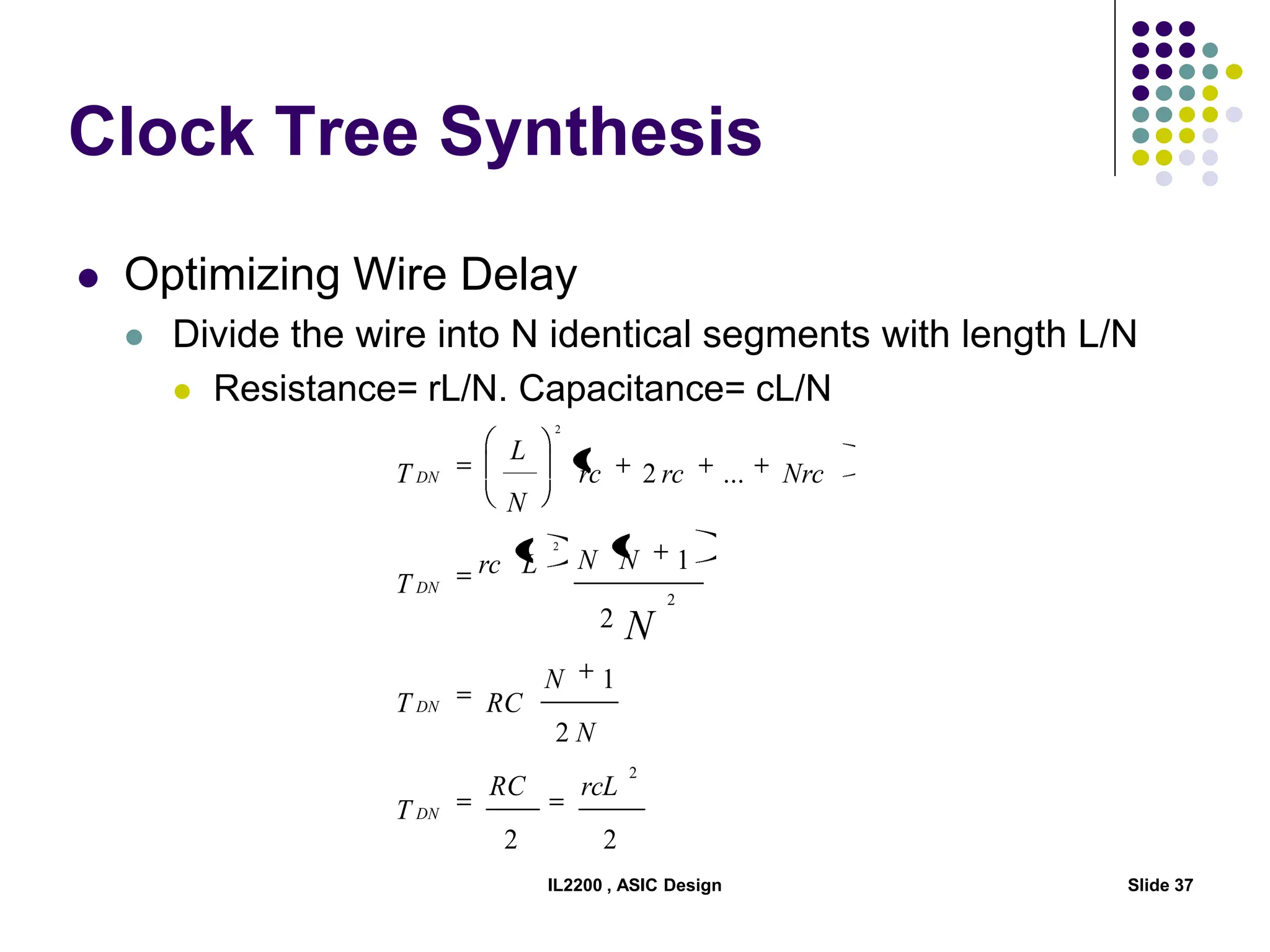
IL2200 , ASIC Design Slide 37
Clock Tree Synthesis
 Optimizing Wire Delay
 Divide the wire into N identical segments with length L/N
 Resistance= rL/N. Capacitance= cL/N
2
2
2
1
2
1
...
2
2
2
2
2
rcL
RC
T
N
N
RC
T
N
N
L
rc
T
Nrc
rc
rc
N
L
T
DN
DN
DN
DN
N
IL2200 , ASIC Design Slide 38
Clock Tree Synthesis
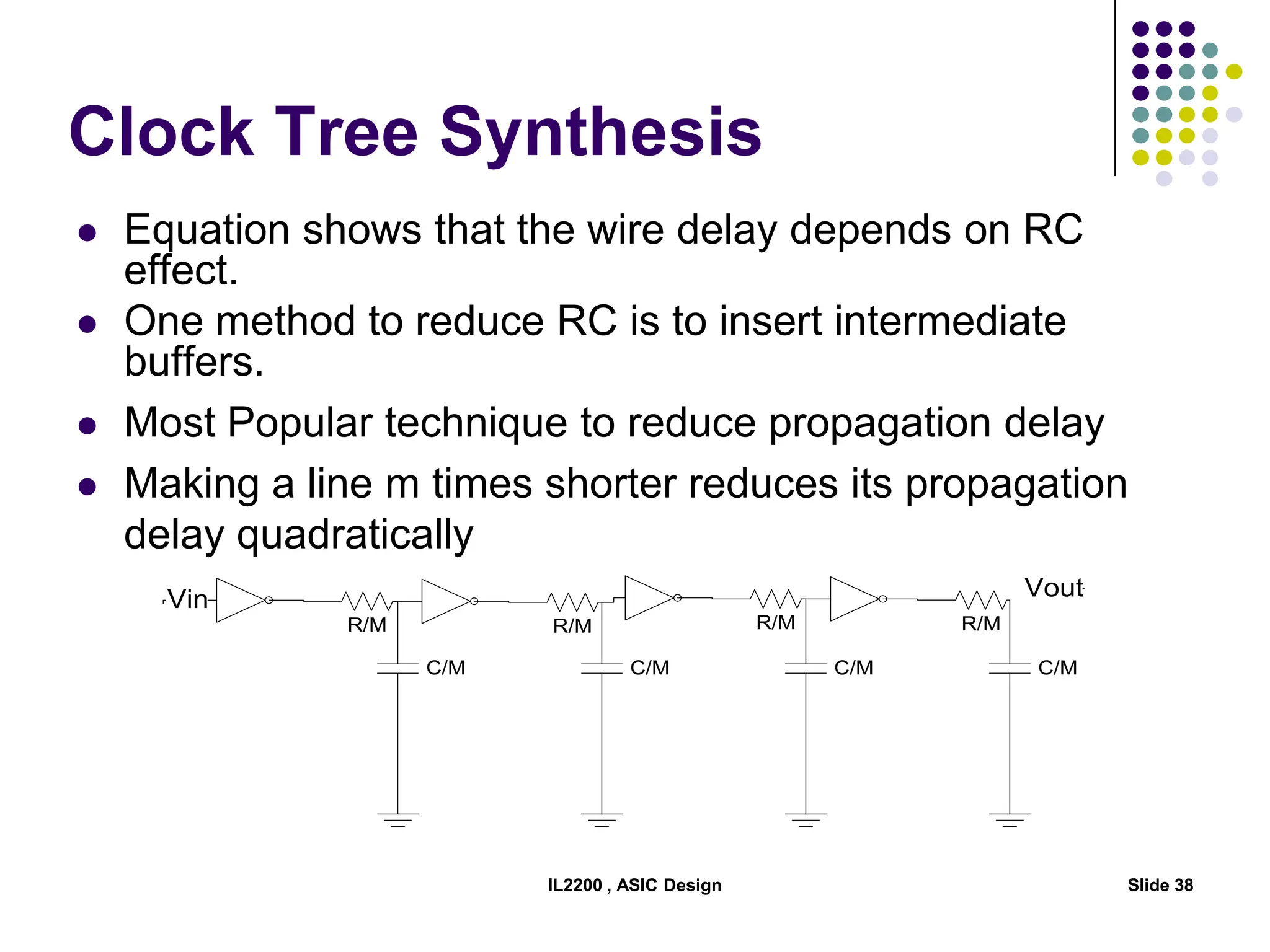
 Equation shows that the wire delay depends on RC
effect.
 One method to reduce RC is to insert intermediate
buffers.
 Most Popular technique to reduce propagation delay
 Making a line m times shorter reduces its propagation
delay quadratically
R/M R/M R/M R/M
Vin Vout
C/M C/M C/M C/M
IL2200 , ASIC Design Slide 39
Clock Tree Synthesis
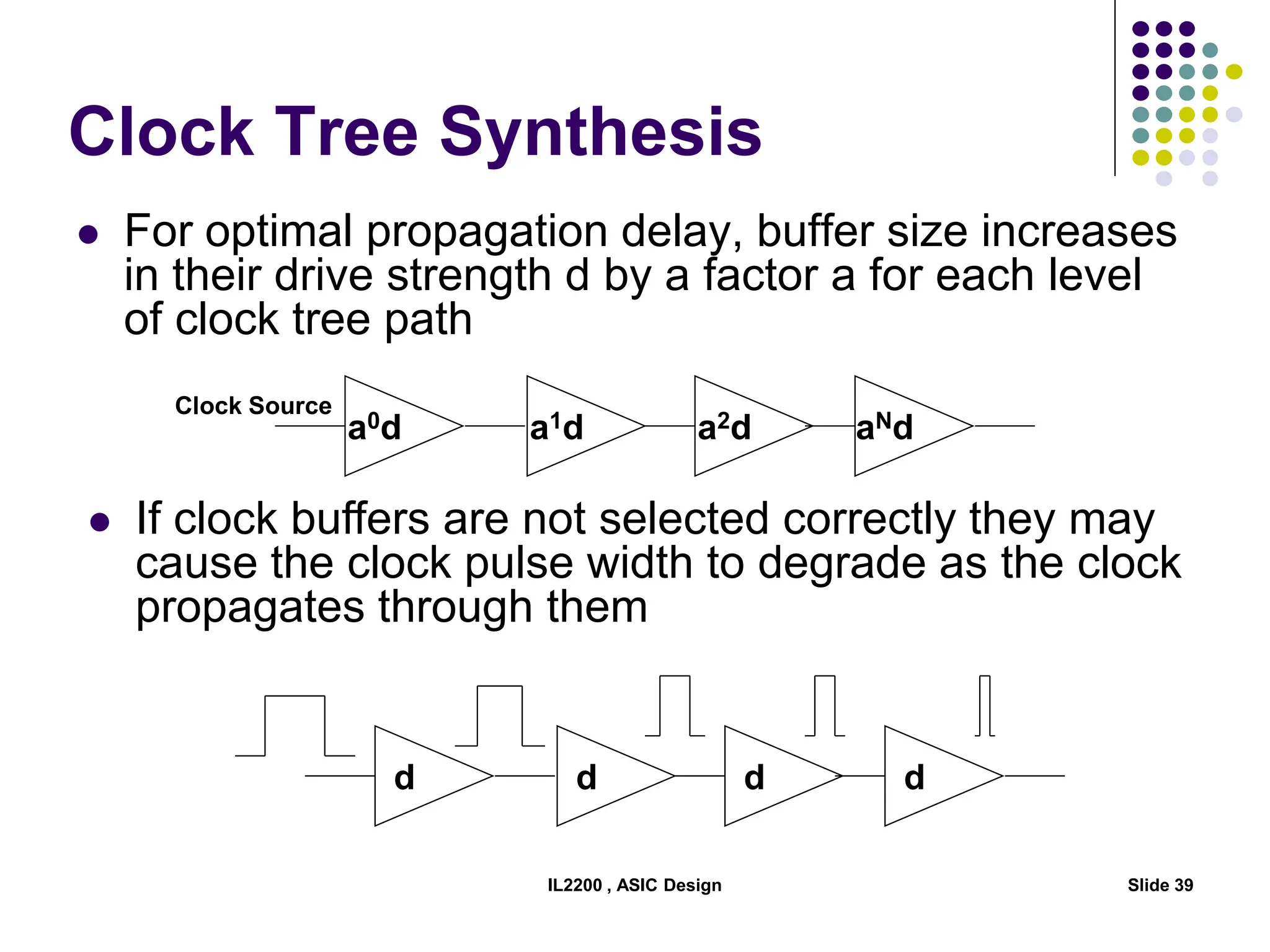
 For optimal propagation delay, buffer size increases
in their drive strength d by a factor a for each level
of clock tree path
a0d a1d a2d aNd
Clock Source
 If clock buffers are not selected correctly they may
cause the clock pulse width to degrade as the clock
propagates through them
d d d d
IL2200 , ASIC Design Slide 40
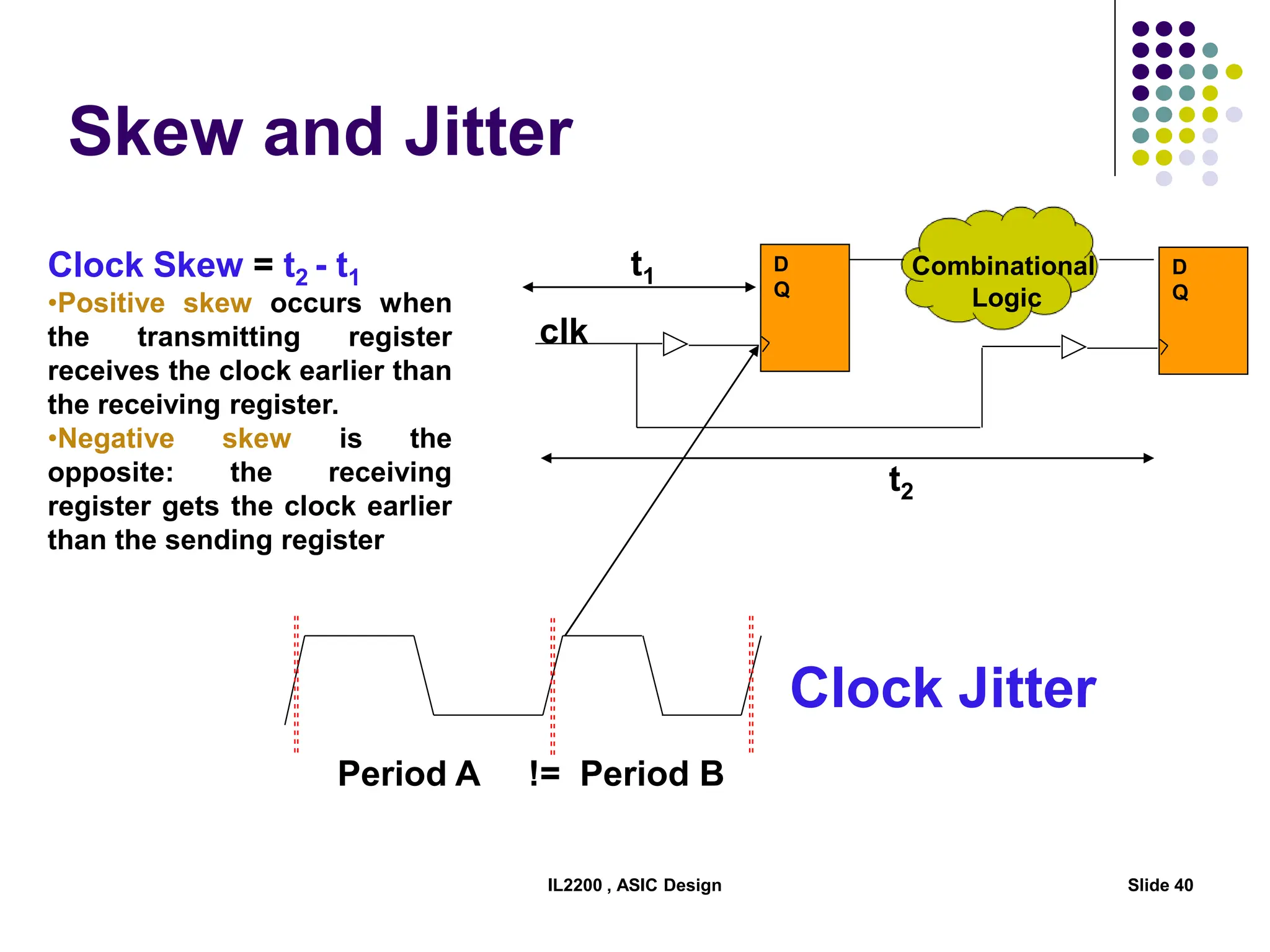
Skew and Jitter
D
Q
D
Q
Combinational
Logic
clk
t2
t1
Period A != Period B
Clock Jitter
Clock Skew = t2 - t1
•Positive skew occurs when
the transmitting register
receives the clock earlier than
the receiving register.
•Negative skew is the
opposite: the receiving
register gets the clock earlier
than the sending register
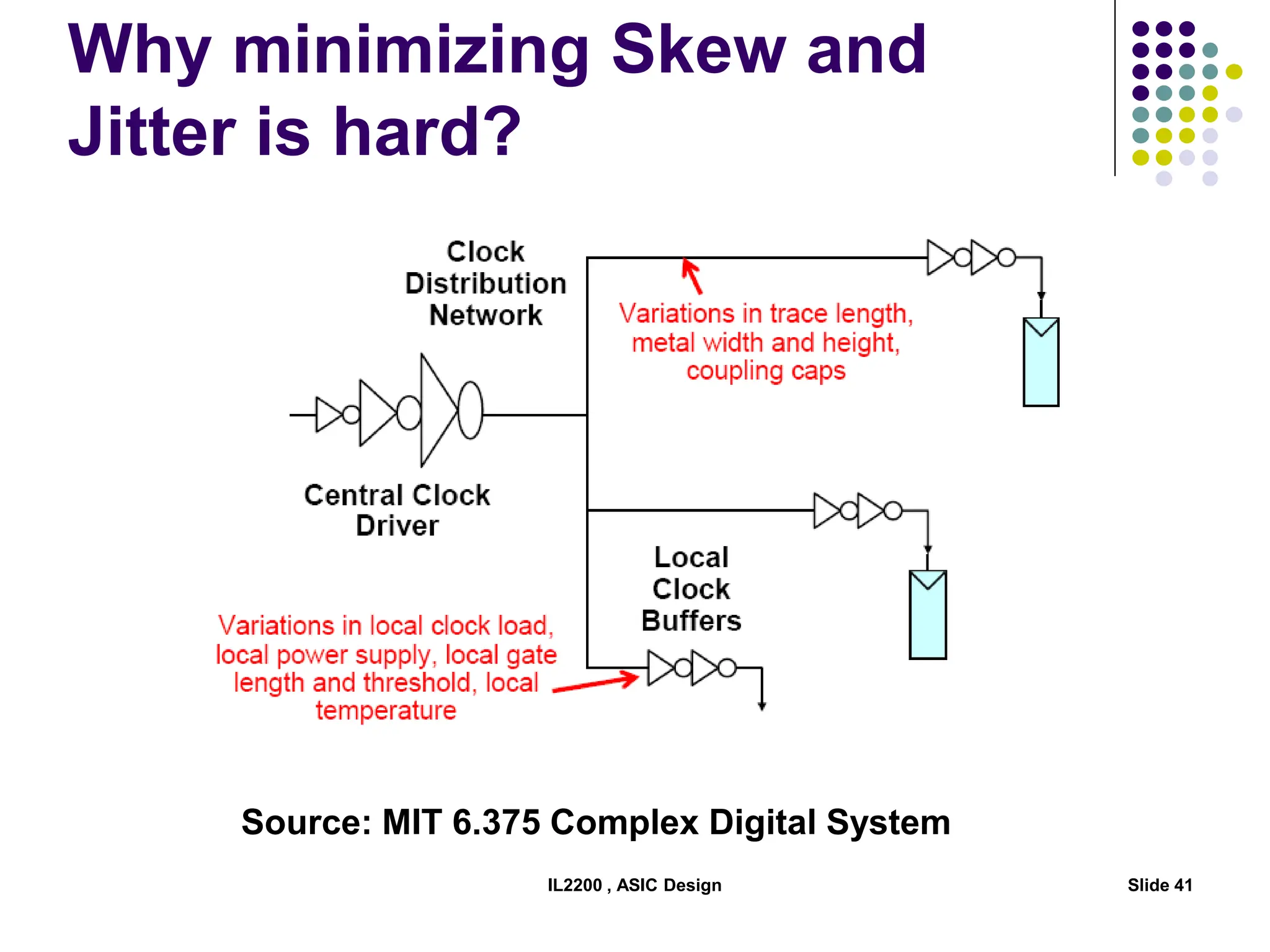
Why minimizing Skew and
Jitter is hard?
IL2200 , ASIC Design Slide 41
Source: MIT 6.375 Complex Digital System
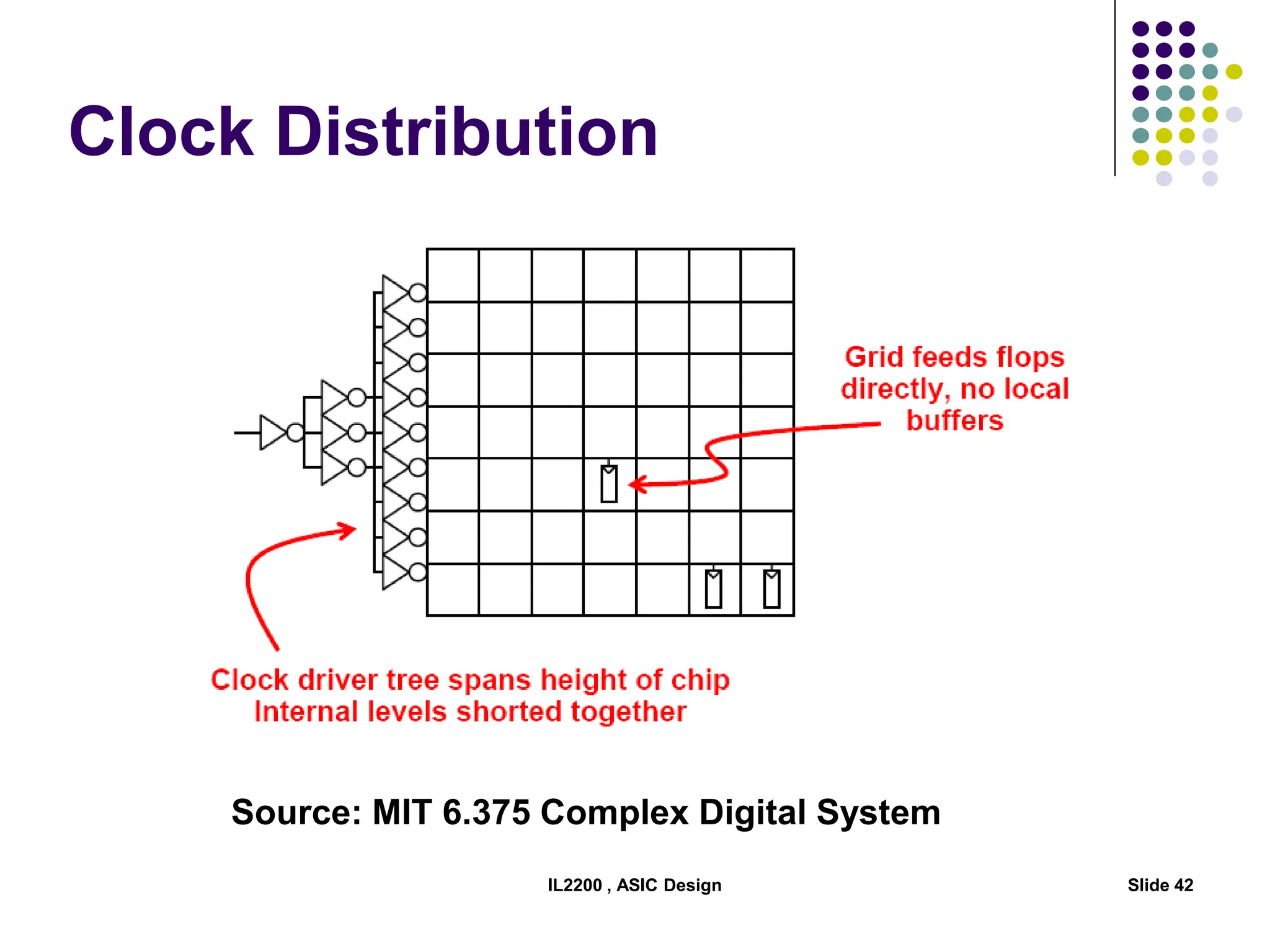
Clock Distribution
IL2200 , ASIC Design Slide 42
Source: MIT 6.375 Complex Digital System
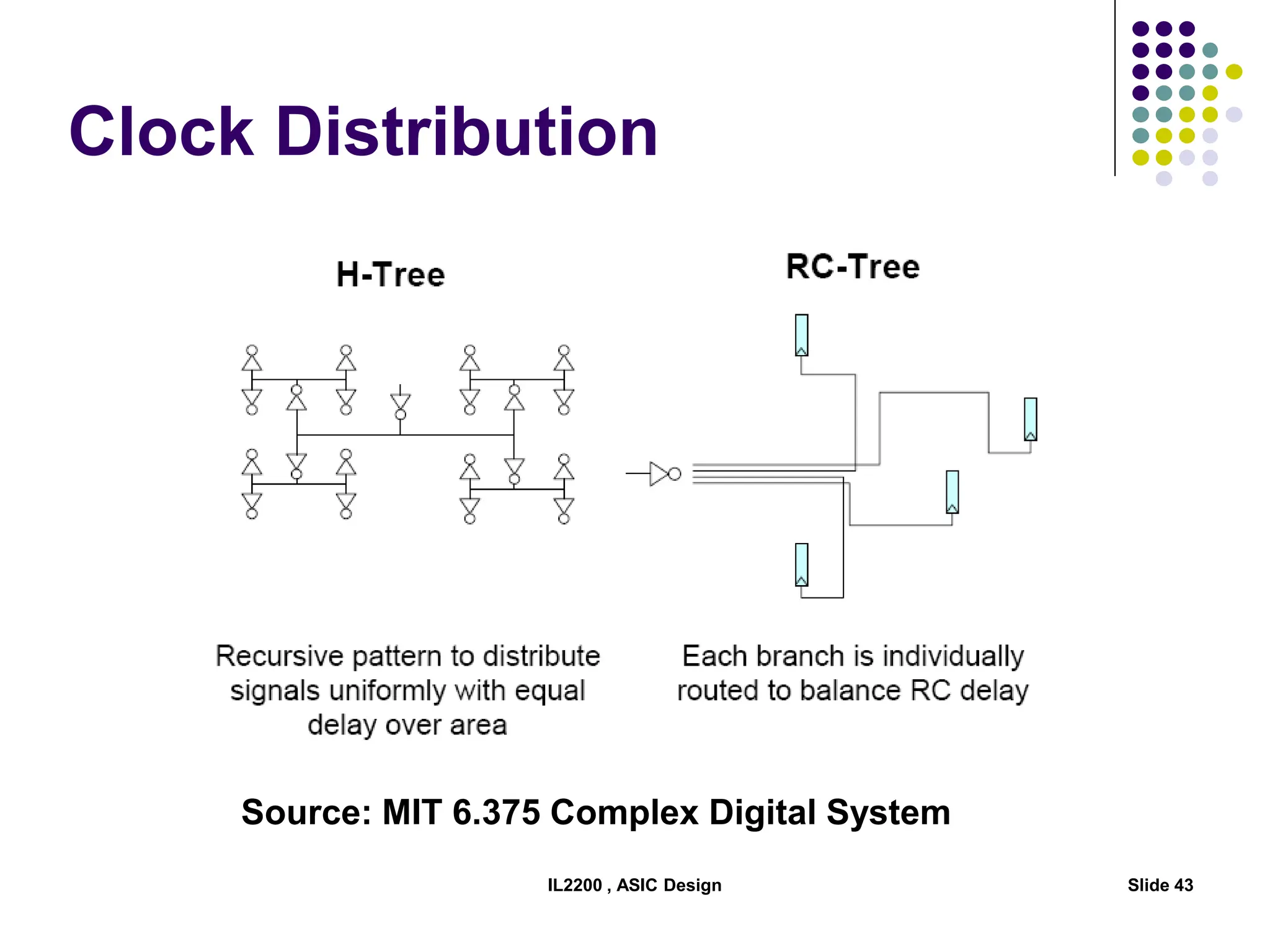
Clock Distribution
IL2200 , ASIC Design Slide 43
Source: MIT 6.375 Complex Digital System
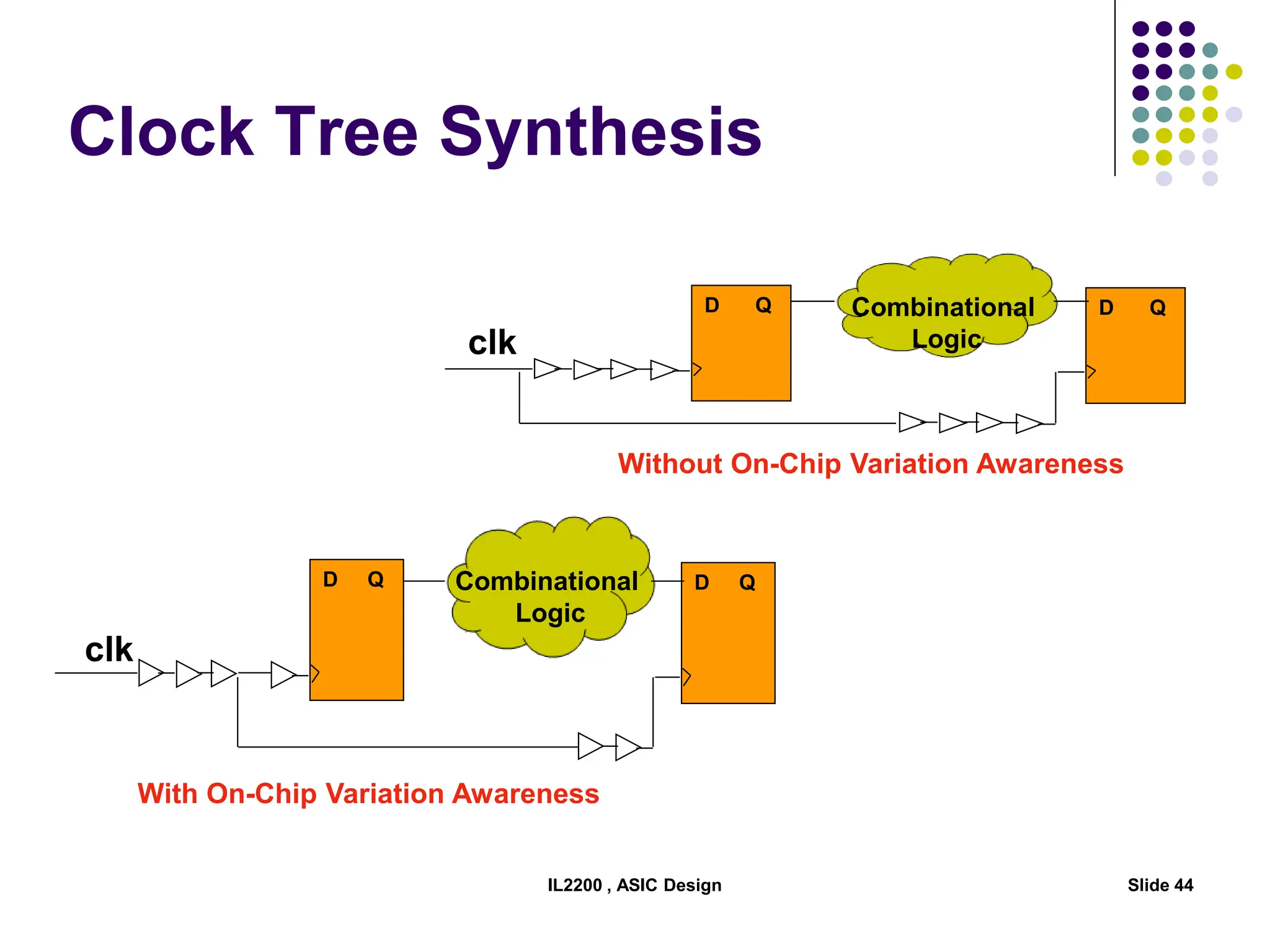
IL2200 , ASIC Design Slide 44
Clock Tree Synthesis
D Q D Q
Combinational
Logic
clk
D Q D Q
Combinational
Logic
clk
Without On-Chip Variation Awareness
With On-Chip Variation Awareness
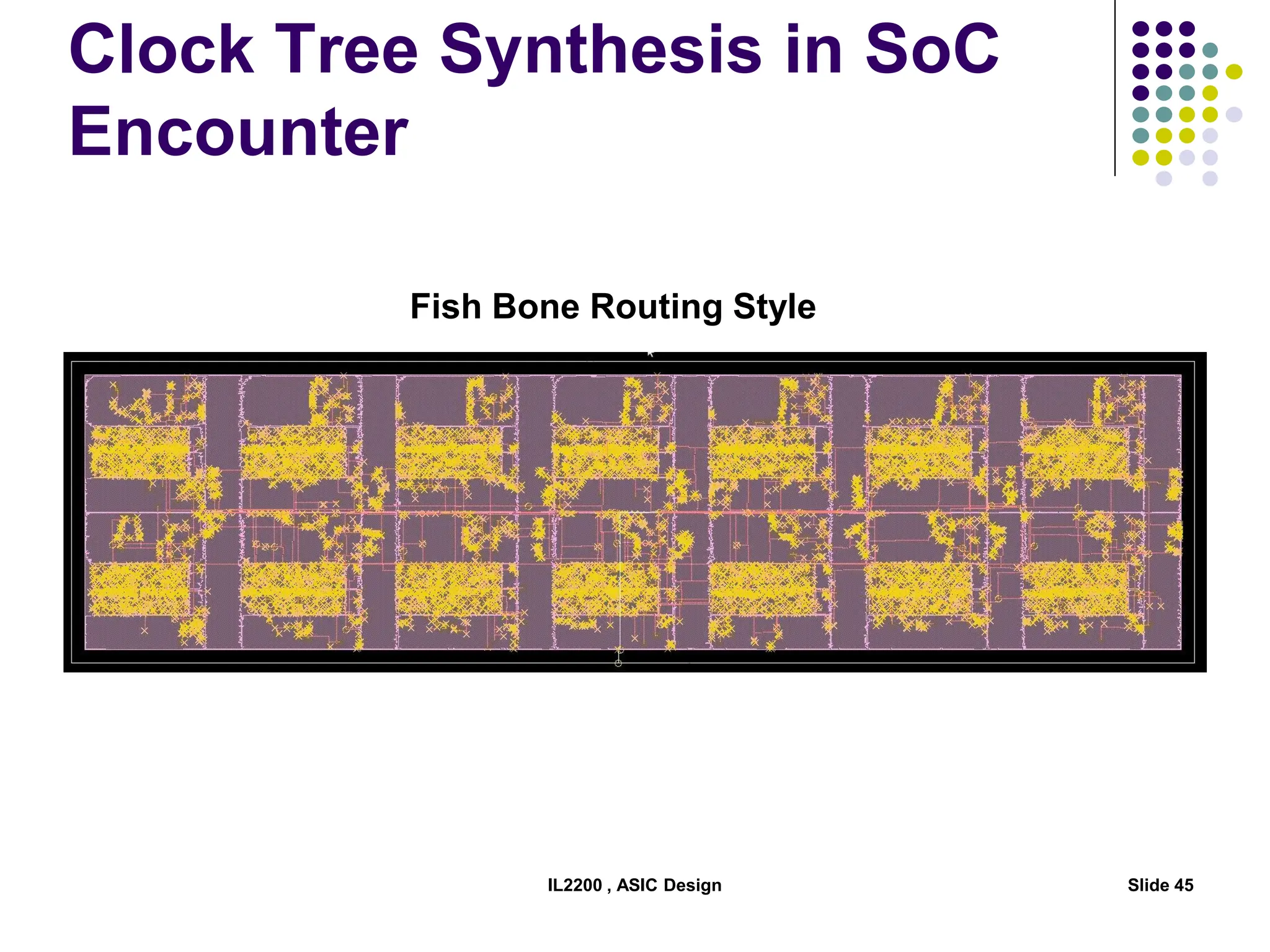
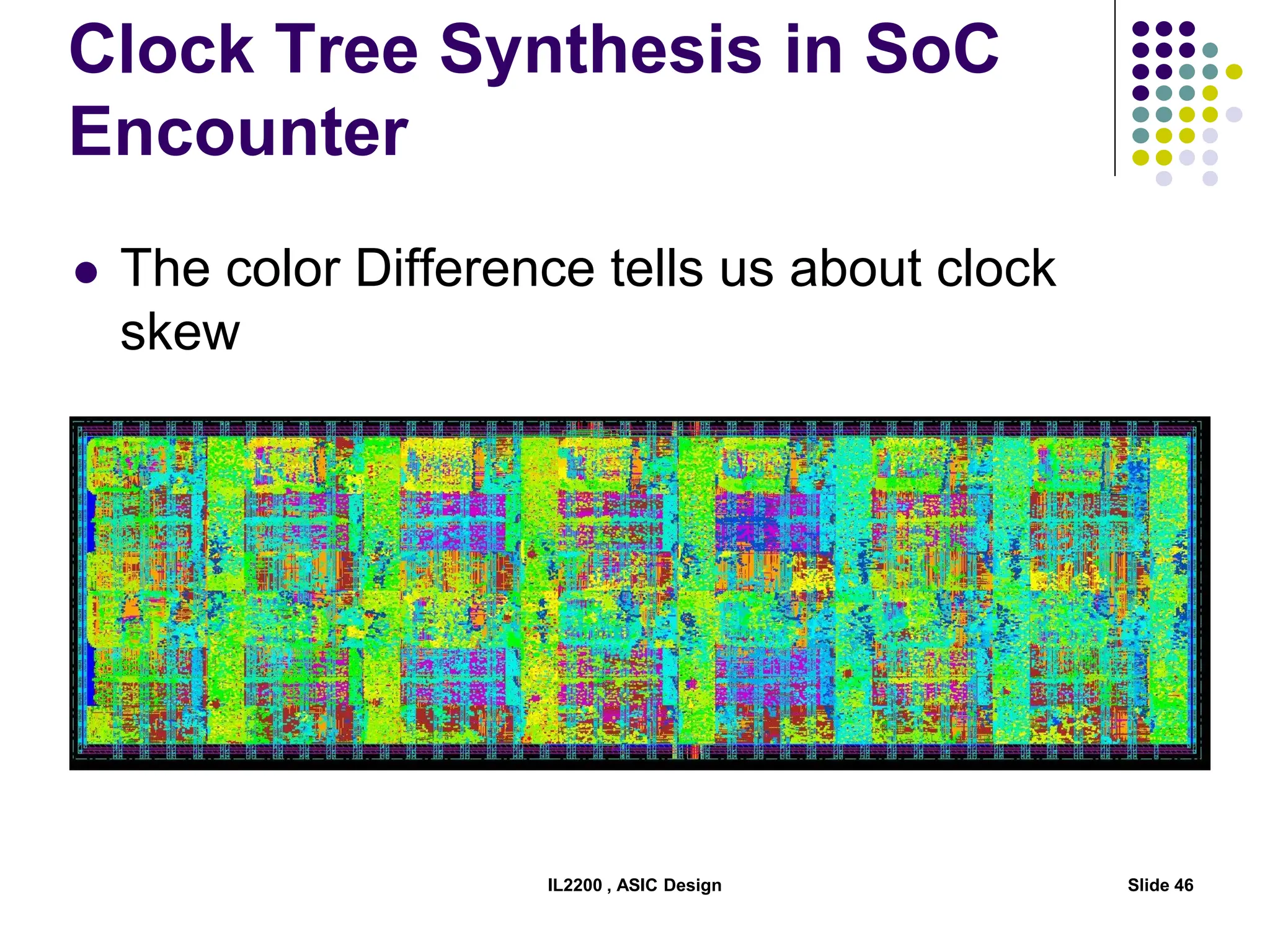
Clock Tree Synthesis in SoC
Encounter
IL2200 , ASIC Design Slide 45
Fish Bone Routing Style
Clock Tree Synthesis in SoC
Encounter
IL2200 , ASIC Design Slide 46
 The color Difference tells us about clock
skew
IL2200 , ASIC Design Slide 47
Electromigration
 Electromigration (EM) is the movement or
molecular transfer of metal from one area to
another area that is caused by an excessive
electrical current in the direction of electron
flow.
 EM currents exceeding recommended
guidelines can result in premature ASIC
device failure
IL2200 , ASIC Design Slide 48
Routing
 Global Routing
 Decomposes ASIC design interconnection into net
segments
 Assign these segments to regions
 Detail Routing
 Follows global routing
 Performs actually physical interconnection of ASIC design
 Places actual wire segments in the region defined by the
global router to complete the connections between the
ports
IL2200 , ASIC Design Slide 49
Power Analysis
 Power analysis
 Reduces risk of IR voltage drops in power nets
 Ground bounce on the ground nets
 Reduces Electromigration effects due to high current
 Resistance of power and ground net extracted
 Average current of each transistor connected to
power net is calculated
 Average currents are distributed throughout the
power net
 Calculate node voltages and branch currents
 Design goal violations shown
IL2200 , ASIC Design Slide 50
RC Extraction
 RC extraction is the calculation of all the
routed net capacitances and resistances
 Used for
 Delay calculation
 Static Timing Analysis
 Circuit Simulation
 Signal Integrity Analysis
IL2200 , ASIC Design Slide 51
Verification
 The complete placed and routed design is verified
before fabrication
 Functional Verification
 Verification is performed against behavioral RTL pre-layout
and post-layout structural description (netlist) for the design
validation.
 Rule Based
 Assertion based verification
 Assertions macros are expressions that, if false, indicate
and error
 Instantiated in RTL Code
Energy Calculation
 Save your design as a Verilog Netlist
 Simulate the Design in NCSim/ModelSim
 Create a VCD File
 Restore the Design in encounter
 Read the VCD Activity file
 Report Power to get the average power
 Energy= Pave * Tperiod * No of Cycles
IL2200 , ASIC Design Slide 52
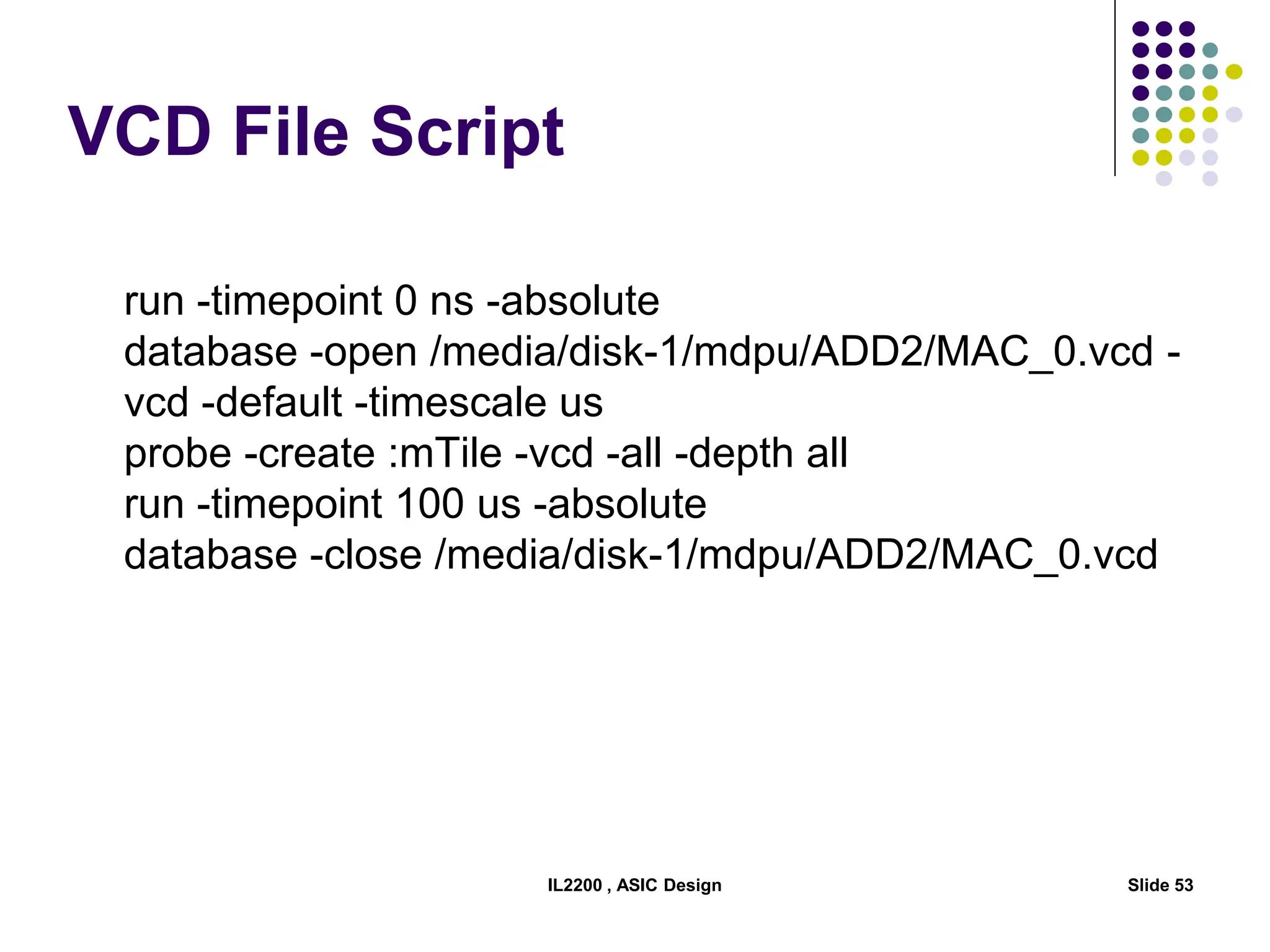
VCD File Script
run -timepoint 0 ns -absolute
database -open /media/disk-1/mdpu/ADD2/MAC_0.vcd -
vcd -default -timescale us
probe -create :mTile -vcd -all -depth all
run -timepoint 100 us -absolute
database -close /media/disk-1/mdpu/ADD2/MAC_0.vcd
IL2200 , ASIC Design Slide 53
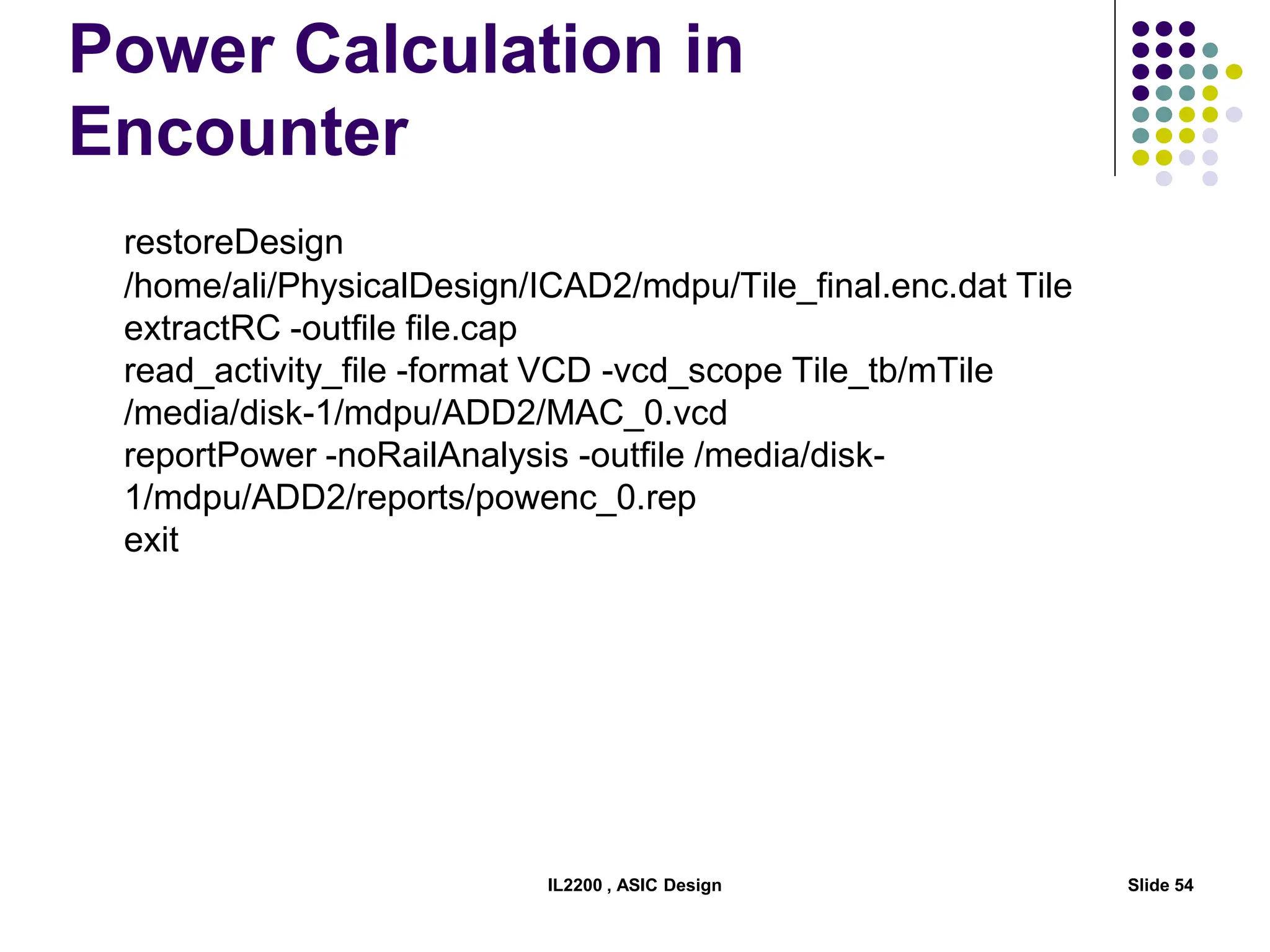
Power Calculation in
Encounter
restoreDesign
/home/ali/PhysicalDesign/ICAD2/mdpu/Tile_final.enc.dat Tile
extractRC -outfile file.cap
read_activity_file -format VCD -vcd_scope Tile_tb/mTile
/media/disk-1/mdpu/ADD2/MAC_0.vcd
reportPower -noRailAnalysis -outfile /media/disk-
1/mdpu/ADD2/reports/powenc_0.rep
exit
IL2200 , ASIC Design Slide 54

Physical Design, ASIC Design, Standard Cells

  • 1.
  • 2.
    IL2200 , ASICDesign Slide 2 Lecture Outline  Physical Implementation Styles  ASIC Design Flow  Floor and Power planning  Placement  Clock Tree Synthesis  Routing  Timing Analysis  Verification and Energy Calculation
  • 3.
    Physical Implementation Styles Semi Custom ASICs/FPGAs FullCustom Older Intel Standard Cells Macro Cells Cell Based Array Based Pre Diffused Gate Arrays Pre Wired FPGAs AMD Newer Intel Structured ASICs ! Coarse Grain Reconfigurable Architecture
  • 4.
    cells ro u ting a rea r o u ti n g a r e a feed th ro u g h cell w a s ted sp a ce Standard Cell Layout Cells are of same height but different width. The layout is organised as rows of cells seperated by channels used for routing. The routing channels are not fixed in their height. This is dependent on the routing density in it. This is one important reason why standard cell layout is more flexible compared to array based designs where the routing channels have a fixed capacity. Cells in the same row or adjacent rows can be connected by running wires through the adjacent channel. To connect cells in non-adjacent rows, vertical routing space on the sides is used or special feed through cells are instantiated as shown in It is possible that in some rows, some space may be left unused, as either no cell would fit there or routing considerations dictate placing cells elsewhere. Cells may have the same height but can differ in complexity from simple gates to cells as complex as full adders. Complex cells use the width to spread out the necessary logic. As the logic can be spread out only horizontally, the interconnection delay is typically larger compared to cells design without the fixed height constraint. As the same std. cell is supposed to work correctly in a variety of circuit conditions, the transistors are typically larger than in a custom layout. Some libraries may provide two varieties: low and high power. Technology mapping tools will select one based on estimation. Rat’s nest are a good way to judge wire congestion and long nets.
  • 5.
    IL2200 , ASICDesign Slide 5 Standard Cells P-Type Transistor Diff Spacing N-Type Transistor VSS Bus VDD Bus Standard Cell Height 4-input AND 2-input AND
  • 6.
    IL2200 , ASICDesign Slide 6 Design Flow Design Specification Synthesis Functional Verification RTL Development Thing you already learned in IL2204 Gate Level Net list VHDL Code Logical Design No Yes Simulation learned in IL2200 till now
  • 7.
    Physical Design  Convertinggate-level netlist to physical layout IL2200 , ASIC Design Slide 7
  • 8.
    IL2200 , ASICDesign Slide 8 Physical Design Flow Synthesis Post Route Verification Placement Floor and Power Planning Thing to Learn in this lecture Gate Level Net list Physical Design Sign Off Floor Planning Verification Routing STA CTS Routing
  • 9.
    Before Physical Design….. You must have synthesized gate level netlist.  Please verify that this netlist is working properly by doing gate level simulation in NCSim/ModelSim  Also Generate Standard delay constraint file .sdc. IL2200 , ASIC Design Slide 9
  • 10.
    SoC Encounter 10  Weuse Cadence SoC Encounter 8.1 for Layout.
  • 11.
    IL2200 , ASICDesign Slide 11 Design Import  Before starting the Physical Design We first have to import the design and associated libraries  .LEF File  Contains layer, via and macro definition  .LIB File (.TLF)  This file has timing information e.g delay and capacitance  Verilog Netlist  Netlist file generated by Synthesis Tool  .SDC File (Synopsys Design Constraints Format)  Constraint file generated by synthesis tool  .DEF File  Design exchange format to output the design so it is readable by other modules.
  • 12.
    IL2200 , ASICDesign Slide 12 Design Import Toplevel of the design Veriglog Netlist File .Lib .TLF Files .LEF File .SDC File  Design Import Design
  • 13.
    Design Import  Advance Power IL2200 , ASIC Design Slide 13
  • 14.
    IL2200 , ASICDesign Slide 14 Floor Planning  Results in Efficient Design Implementation  Two styles of Implementation  Flat  Small to Medium ASIC  Better Area Usage Since no reserve space around each sub-design for power/ground  Hierarchical  For very large design  When sub-systems are design individually  Possible only if a design hierarchy exist.
  • 15.
    IL2200 , ASICDesign Slide 15 #/* Translate to target independent structure (GTECH) */ analyze -format vhdl -lib WORK {"./SOURCE/mics.vhd"} analyze -format vhdl -lib WORK {"./SOURCE/SRAM.vhd"} …………………………………………………………………….. elaborate FIR_Toplevel -lib WORK -update -param "width = 4" -param "filter_taps=5" ungroup –all Link uniquify set_wire_load_mode segmented set_wire_load_model -name "TSMC8K_Lowk_Conservative" #T=-40, V=1.1 set_units -time ns -resistance kOhm -capacitance pF -voltage V -current mA set_operating_conditions LTCOM #/* Specify clock constraint */ create_clock clk -period 4 set_false_path -from rst_n compile -map_effort medium -boundary_optimization write -hierarchy -format verilog -output /home/ali/ASICLABS/LAB2/LAB2_FIRToplevel.v write_sdc /home/ali/ASICLABS/LAB2/MAPPED/constraints.sdc
  • 16.
    Floor Planning IL2200 ,ASIC Design Slide 16  Automatic Floor Planning  Seed Selection:  USB controllers  PCI controllers  Hierarchical modules  Automatic Floorplan Synthesis analyzes the data flow between seeds (design blocks) based on their connectivity and their location
  • 17.
    Floor Planning  RelativeFloor Planning  Capture and define the placement relationship of floorplan objects independently from the actual coordinates in a floorplan  flexible way to place objects, such as modules, blocks, groups, blockages, pin guides, pre-routed wires, and power domains  I/O pins can be used as reference objects but they cannot be relative objects IL2200 , ASIC Design Slide 17
  • 18.
    Floor Planning IL2200 ,ASIC Design Slide 18 Orientation Keys for Relative Floor Planning
  • 19.
    IL2200 , ASICDesign Slide 19 Pre-route example: S1 and S2 are relative to the object I2 and the Core_Boundary Floor Planning
  • 20.
    Floor Planning IL2200 ,ASIC Design Slide 20 Manually Floor Planed DRRA Fabric
  • 21.
    IL2200 , ASICDesign Slide 21 Floor Planning  Aspect Ratio  Height/Width  Core Utilization  Area of Stand. Cell/Area of Core  Core to IO Boundary  Distance from IO Boundary  Core to Die Boundary  Distance from Die Boundary
  • 22.
    IL2200 , ASICDesign Slide 22 Floor Planning 0um every row 10um every row 10um every second row  Adjustable Routing Channel Width
  • 23.
    IL2200 , ASICDesign Slide 23 Floor Planning  Cutting with Rectilinear Tool Clusters Rectilinear Tool Move Tool Blockage tools
  • 24.
    IL2200 , ASICDesign Slide 24 Partitioning  Part of Floor Planning  Standard Cells are in Floating States before placement.  Have not been assigned a fixed location in Core  Time to define clusters and regions  To keep time critical component close  Soft Regions  Boundary can change during standard cell placement  Hard Regions  Prevent Standard cell crossing boundaries
  • 25.
    IL2200 , ASICDesign Slide 25 Partitioning  Exclusive Regions  Allow standard cells assigned to the region to be placed within the region  Non Exclusive Regions  Allow standard cells that do not belong to the region to be placed within the region
  • 26.
    IL2200 , ASICDesign Slide 26 Power Planning  Deal with Power Distribution Network  Three levels of Power Distribution  Rings  Carries VDD and VSS around the chip  Stripes  Carries VDD and VSS from Rings across the chip  Rails  Connect VDD and VSS to the standard cell VDD and VSS
  • 27.
    IL2200 , ASICDesign Slide 27 Power Planning VDD VSS Rings Stripes (vertical or horizontal) Rails Special Route Power Distribution Network
  • 28.
    Power Planning 28  AddRings, Stripes & do a special route
  • 29.
    IL2200 , ASICDesign Slide 29 Power Distribution network Example Power Distribution Network in DRRA
  • 30.
    IL2200 , ASICDesign Slide 30 Placement  Global Placement algorithm are partitioned based  Two Associated Cost functions  Reduce Total wiring or routing length  Distribute standard cell instances homogeneously in ASIC Core such that optimal equilibrium among vertical and horizontal routing is achieved
  • 31.
    IL2200 , ASICDesign Slide 31 Detailed Placement  After global placement  To Refine placement based on congestion, timing and power  Congestion Driven Placement  To distance standard cell instances from each other such that more routing tracks are created between them  Timing Driven Placement  To optimize large sets of path delays  Net Based  Try to control the delay on signal path by imposing an upper bound delay or weight to net
  • 32.
    IL2200 , ASICDesign Slide 34 Clock Tree Synthesis  Automatic insertion of buffers/inverters along the clock path to balance the clock delay to all the clock inputs. Why balancing clock delay? Clock Skew?
  • 33.
    Clock Distribution: How? IL2200, ASIC Design Slide 35 Source: MIT 6.375 Complex Digital System
  • 34.
    IL2200 , ASICDesign Slide 36 Clock Tree Synthesis R1 Vin C1 R2 C2 Ri-1 Ci-1 Ri Ci RN CN ) ... ( ... 2 1 2 1 2 1 1 1 1 N N DN N j N i DN R R R C R R C R C T Rj Ci T  Delay of a wire  Elmore Delay
  • 35.
    IL2200 , ASICDesign Slide 37 Clock Tree Synthesis  Optimizing Wire Delay  Divide the wire into N identical segments with length L/N  Resistance= rL/N. Capacitance= cL/N 2 2 2 1 2 1 ... 2 2 2 2 2 rcL RC T N N RC T N N L rc T Nrc rc rc N L T DN DN DN DN N
  • 36.
    IL2200 , ASICDesign Slide 38 Clock Tree Synthesis  Equation shows that the wire delay depends on RC effect.  One method to reduce RC is to insert intermediate buffers.  Most Popular technique to reduce propagation delay  Making a line m times shorter reduces its propagation delay quadratically R/M R/M R/M R/M Vin Vout C/M C/M C/M C/M
  • 37.
    IL2200 , ASICDesign Slide 39 Clock Tree Synthesis  For optimal propagation delay, buffer size increases in their drive strength d by a factor a for each level of clock tree path a0d a1d a2d aNd Clock Source  If clock buffers are not selected correctly they may cause the clock pulse width to degrade as the clock propagates through them d d d d
  • 38.
    IL2200 , ASICDesign Slide 40 Skew and Jitter D Q D Q Combinational Logic clk t2 t1 Period A != Period B Clock Jitter Clock Skew = t2 - t1 •Positive skew occurs when the transmitting register receives the clock earlier than the receiving register. •Negative skew is the opposite: the receiving register gets the clock earlier than the sending register
  • 39.
    Why minimizing Skewand Jitter is hard? IL2200 , ASIC Design Slide 41 Source: MIT 6.375 Complex Digital System
  • 40.
    Clock Distribution IL2200 ,ASIC Design Slide 42 Source: MIT 6.375 Complex Digital System
  • 41.
    Clock Distribution IL2200 ,ASIC Design Slide 43 Source: MIT 6.375 Complex Digital System
  • 42.
    IL2200 , ASICDesign Slide 44 Clock Tree Synthesis D Q D Q Combinational Logic clk D Q D Q Combinational Logic clk Without On-Chip Variation Awareness With On-Chip Variation Awareness
  • 43.
    Clock Tree Synthesisin SoC Encounter IL2200 , ASIC Design Slide 45 Fish Bone Routing Style
  • 44.
    Clock Tree Synthesisin SoC Encounter IL2200 , ASIC Design Slide 46  The color Difference tells us about clock skew
  • 45.
    IL2200 , ASICDesign Slide 47 Electromigration  Electromigration (EM) is the movement or molecular transfer of metal from one area to another area that is caused by an excessive electrical current in the direction of electron flow.  EM currents exceeding recommended guidelines can result in premature ASIC device failure
  • 46.
    IL2200 , ASICDesign Slide 48 Routing  Global Routing  Decomposes ASIC design interconnection into net segments  Assign these segments to regions  Detail Routing  Follows global routing  Performs actually physical interconnection of ASIC design  Places actual wire segments in the region defined by the global router to complete the connections between the ports
  • 47.
    IL2200 , ASICDesign Slide 49 Power Analysis  Power analysis  Reduces risk of IR voltage drops in power nets  Ground bounce on the ground nets  Reduces Electromigration effects due to high current  Resistance of power and ground net extracted  Average current of each transistor connected to power net is calculated  Average currents are distributed throughout the power net  Calculate node voltages and branch currents  Design goal violations shown
  • 48.
    IL2200 , ASICDesign Slide 50 RC Extraction  RC extraction is the calculation of all the routed net capacitances and resistances  Used for  Delay calculation  Static Timing Analysis  Circuit Simulation  Signal Integrity Analysis
  • 49.
    IL2200 , ASICDesign Slide 51 Verification  The complete placed and routed design is verified before fabrication  Functional Verification  Verification is performed against behavioral RTL pre-layout and post-layout structural description (netlist) for the design validation.  Rule Based  Assertion based verification  Assertions macros are expressions that, if false, indicate and error  Instantiated in RTL Code
  • 50.
    Energy Calculation  Saveyour design as a Verilog Netlist  Simulate the Design in NCSim/ModelSim  Create a VCD File  Restore the Design in encounter  Read the VCD Activity file  Report Power to get the average power  Energy= Pave * Tperiod * No of Cycles IL2200 , ASIC Design Slide 52
  • 51.
    VCD File Script run-timepoint 0 ns -absolute database -open /media/disk-1/mdpu/ADD2/MAC_0.vcd - vcd -default -timescale us probe -create :mTile -vcd -all -depth all run -timepoint 100 us -absolute database -close /media/disk-1/mdpu/ADD2/MAC_0.vcd IL2200 , ASIC Design Slide 53
  • 52.
    Power Calculation in Encounter restoreDesign /home/ali/PhysicalDesign/ICAD2/mdpu/Tile_final.enc.datTile extractRC -outfile file.cap read_activity_file -format VCD -vcd_scope Tile_tb/mTile /media/disk-1/mdpu/ADD2/MAC_0.vcd reportPower -noRailAnalysis -outfile /media/disk- 1/mdpu/ADD2/reports/powenc_0.rep exit IL2200 , ASIC Design Slide 54