10/03/2025
19EC37E – FUNDAMENTALS OF SEMICONDUCTOR CHIP
TESTING
PRESENTED BY,
Dr.I.VIVEK ANAND,
Assistant Professor(Senior Grade) / ECE,
-National Engineering College, K.R.Nagar, Kovilpatti.
1
“
”
10/03/2025
2
Life cycle of Integrated Circuits (IC)
10/03/2025
3
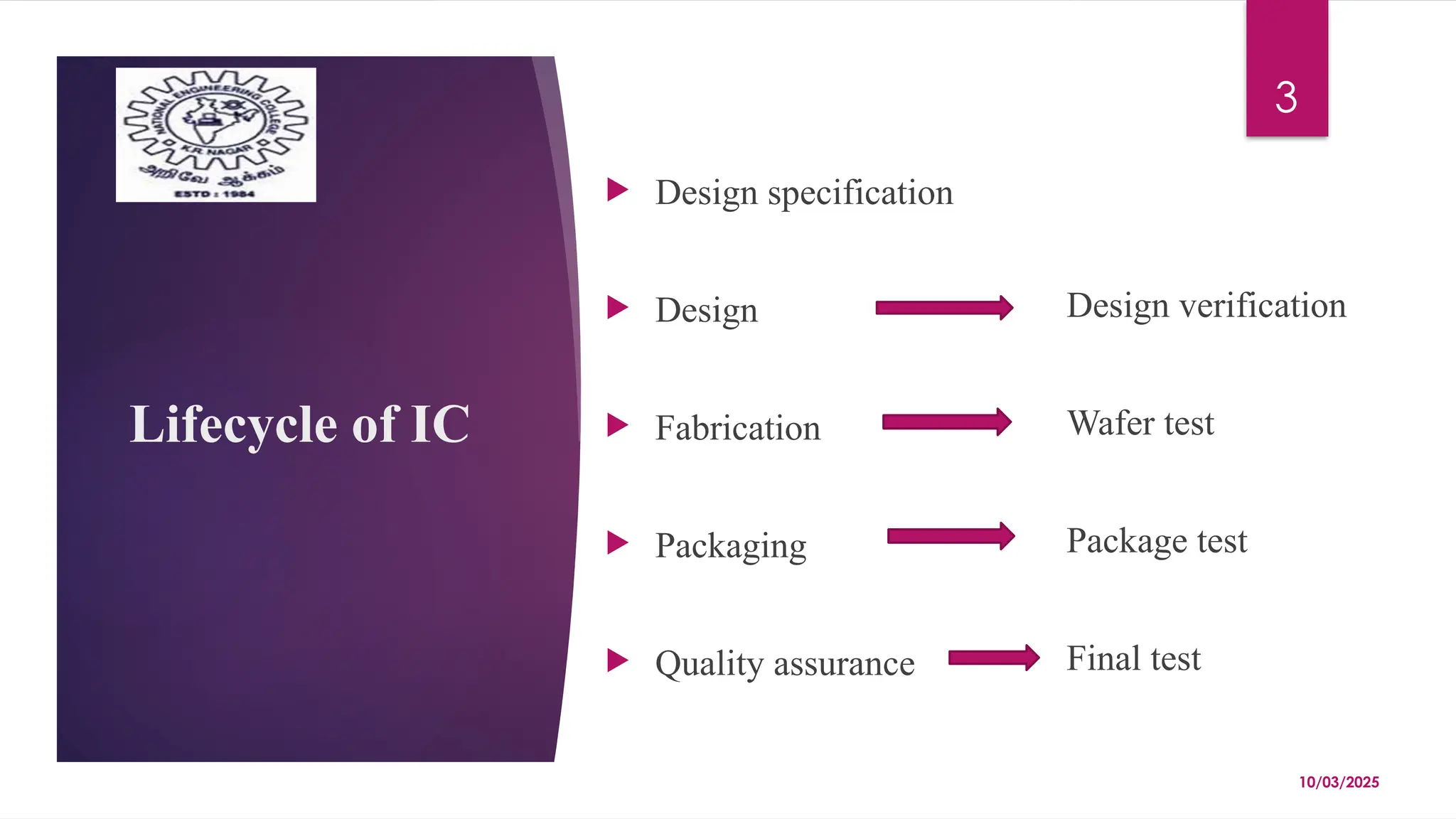
Lifecycle of IC
 Design specification
 Design
 Fabrication
 Packaging
 Quality assurance
Design verification
Wafer test
Package test
Final test
10/03/2025
4
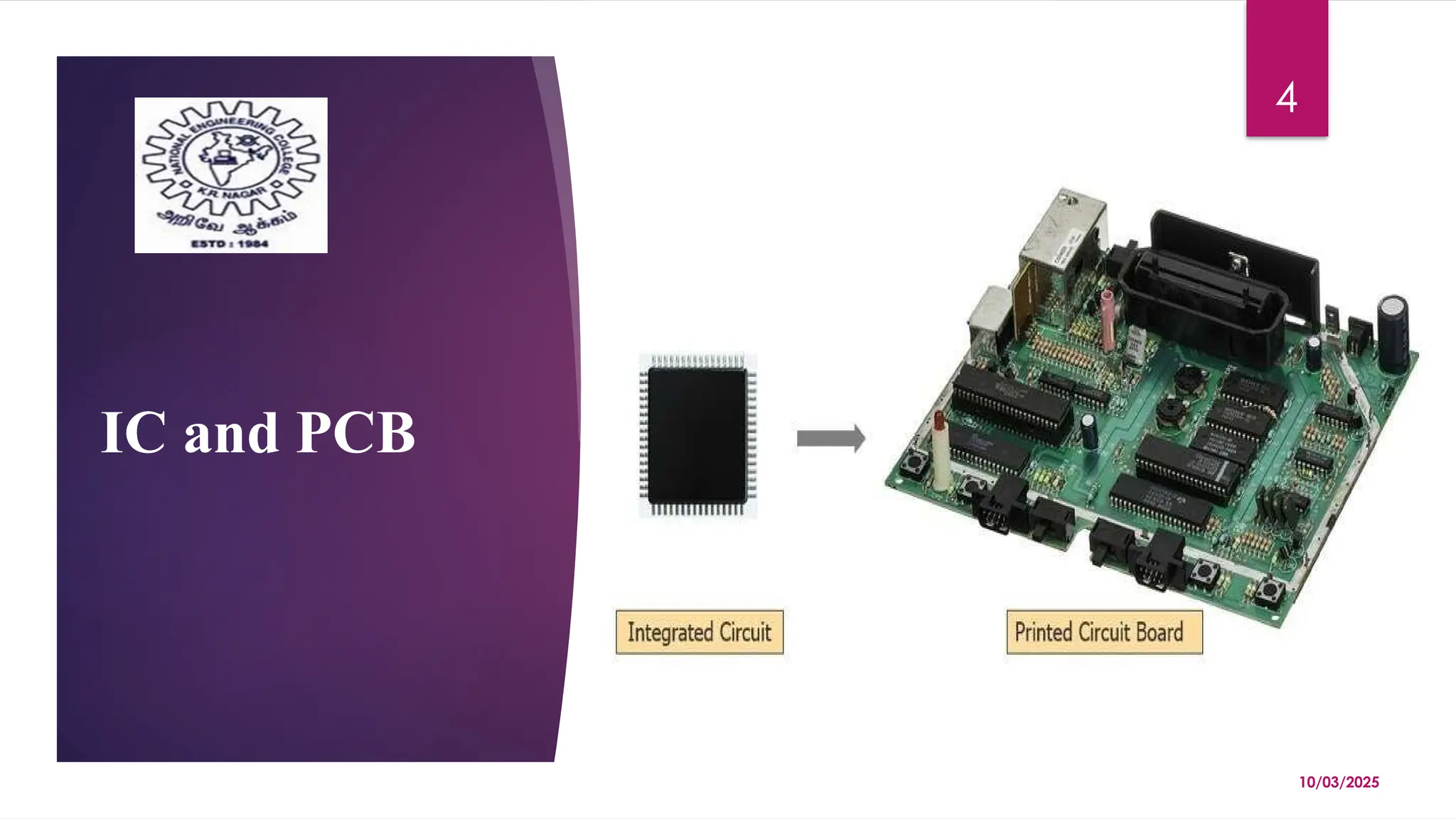
IC and PCB
10/03/2025
5
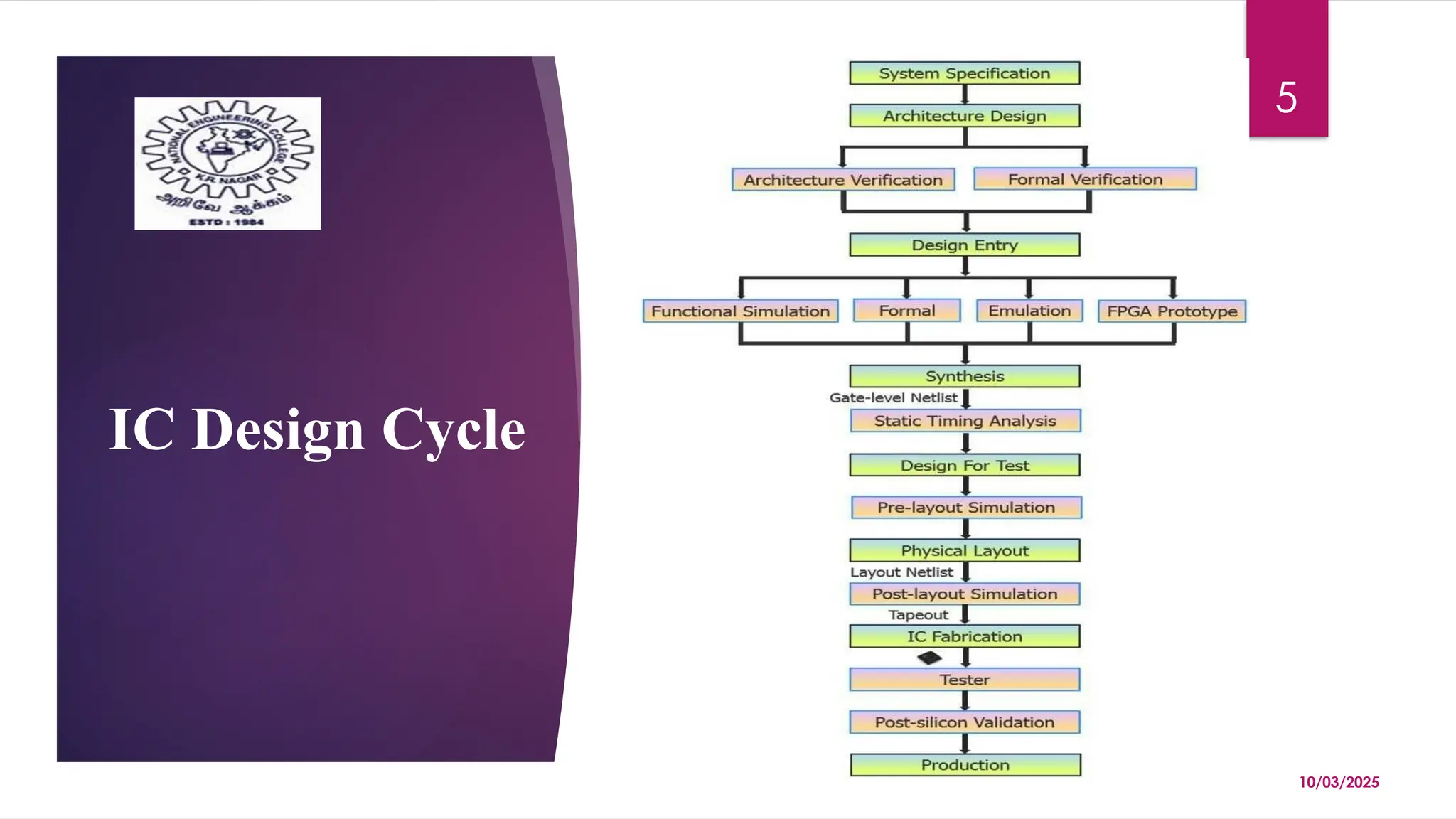
IC Design Cycle
10/03/2025
6
System
Specification
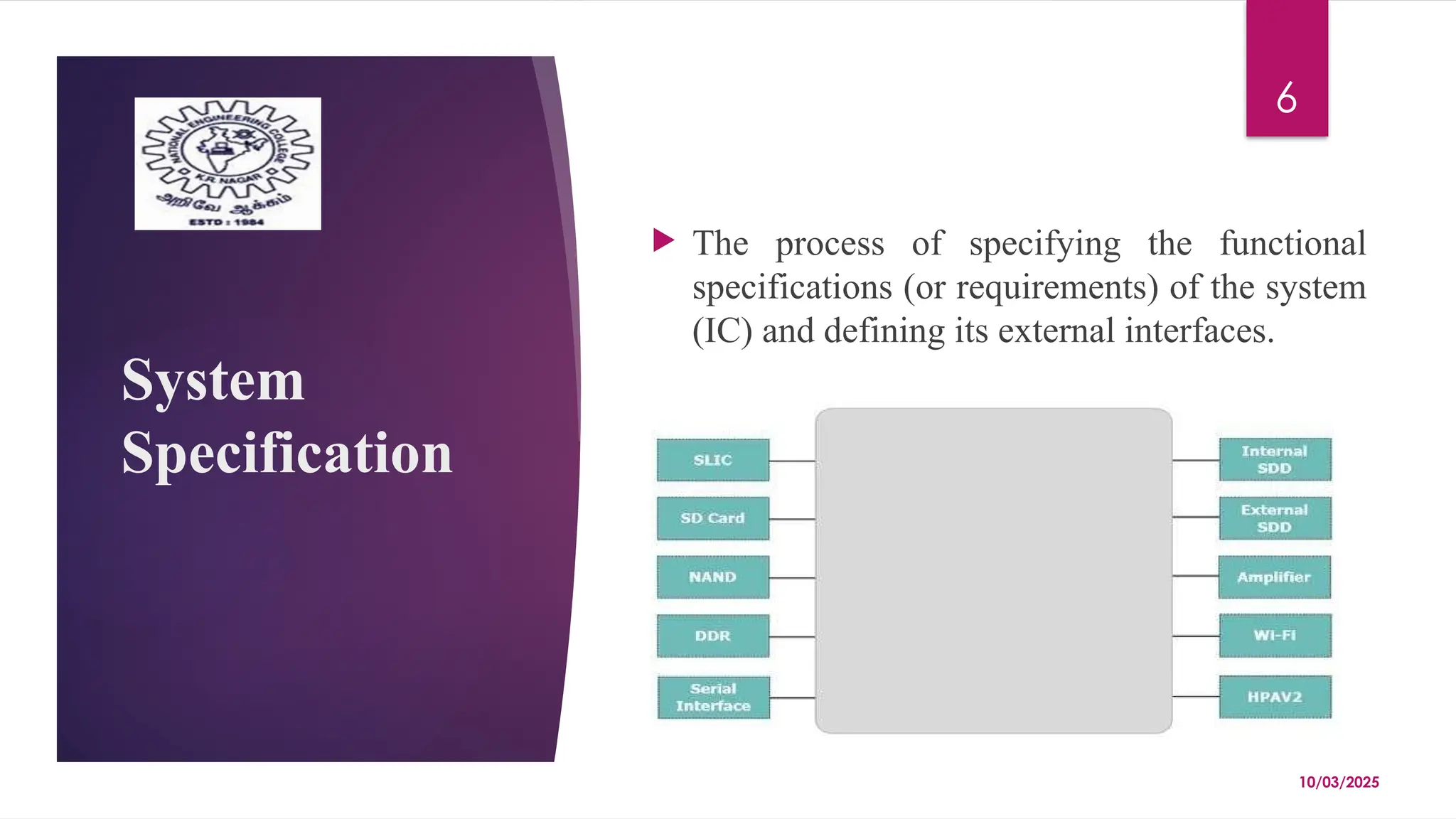
 The process of specifying the functional
specifications (or requirements) of the system
(IC) and defining its external interfaces.
10/03/2025
7
Architecture
Design
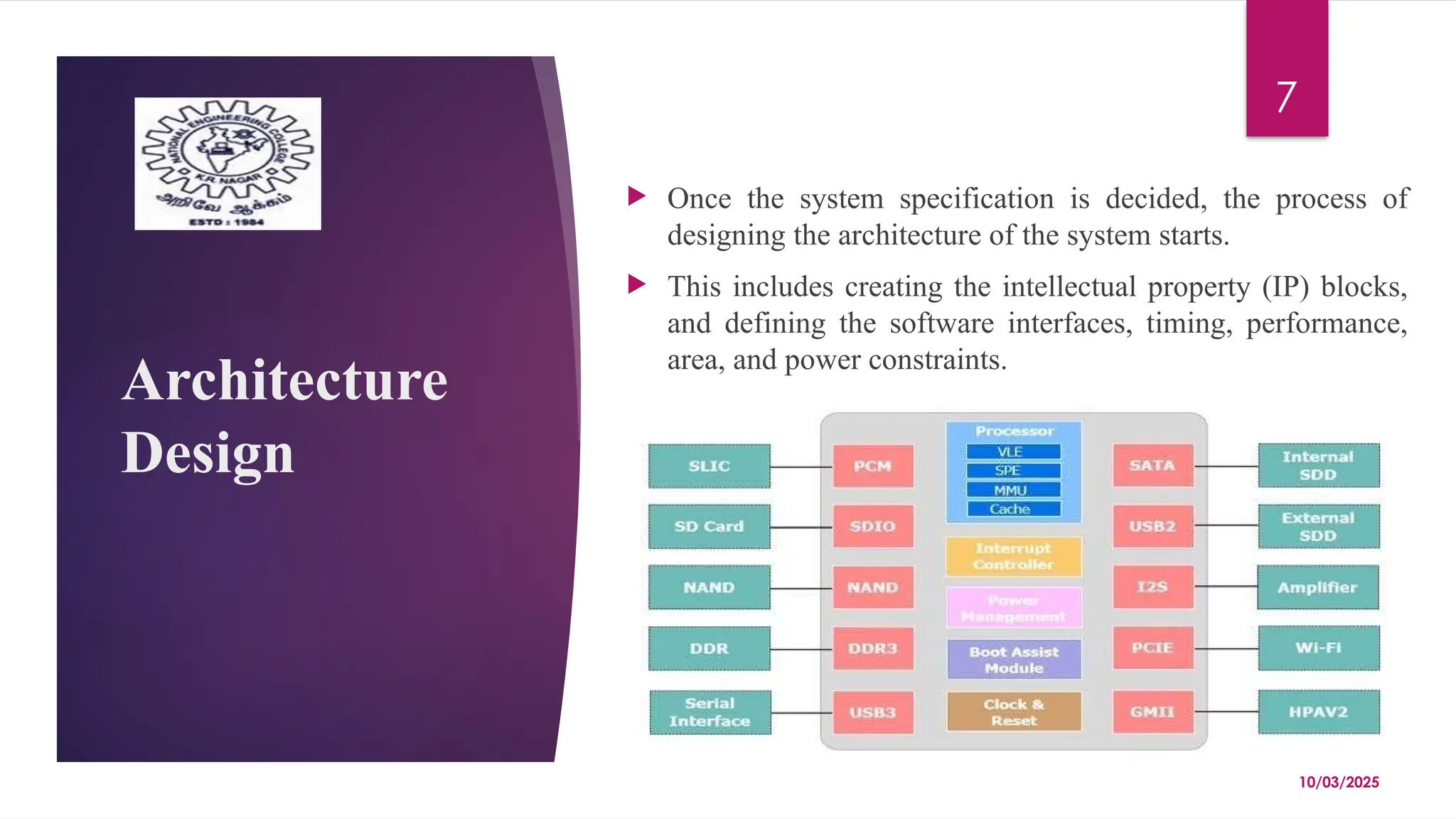
 Once the system specification is decided, the process of
designing the architecture of the system starts.
 This includes creating the intellectual property (IP) blocks,
and defining the software interfaces, timing, performance,
area, and power constraints.
10/03/2025
8
Architecture
Verification
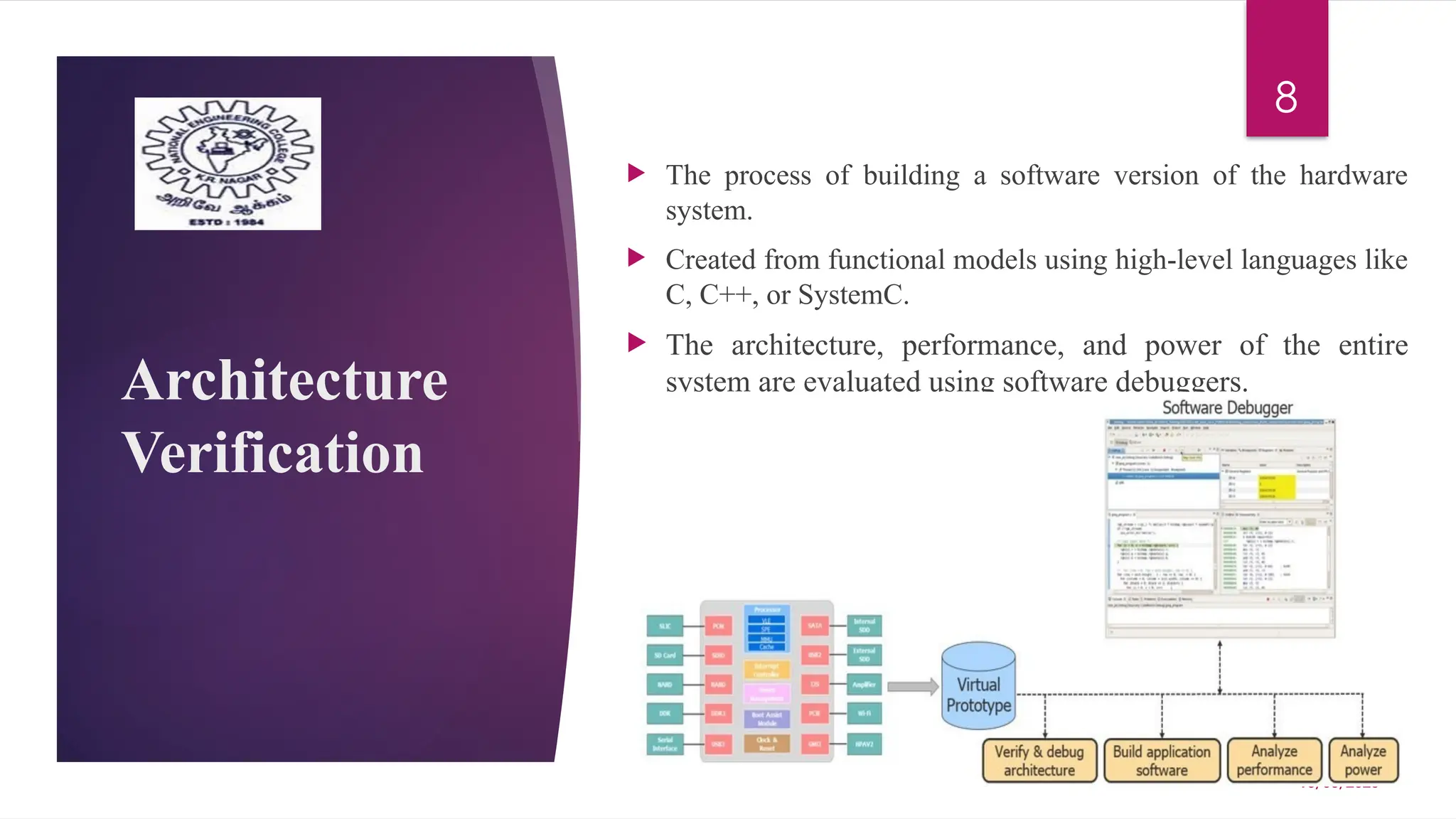
 The process of building a software version of the hardware
system.
 Created from functional models using high-level languages like
C, C++, or SystemC.
 The architecture, performance, and power of the entire
system are evaluated using software debuggers.
10/03/2025
9
Formal
Verification –
Property
Checking
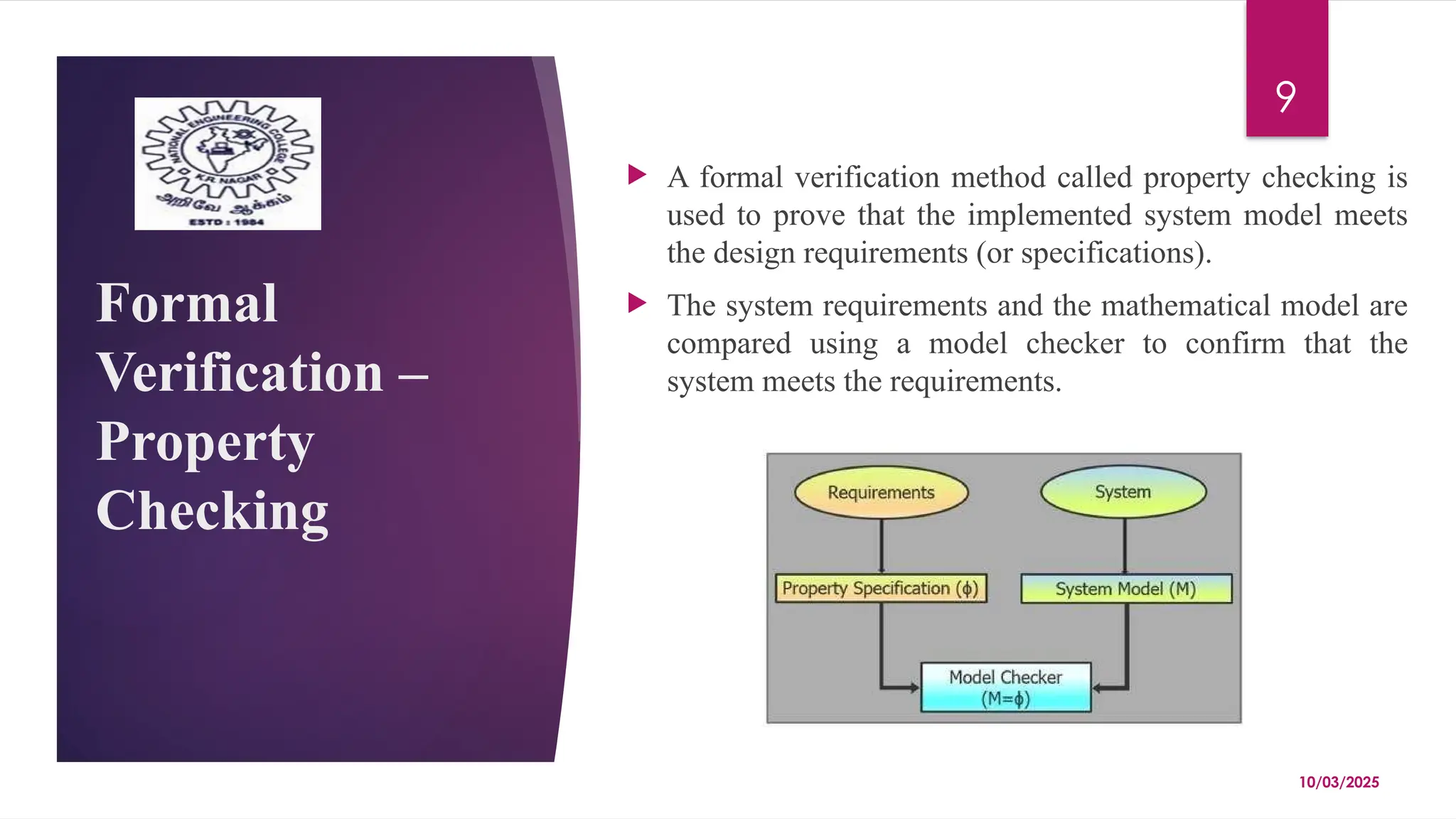
 A formal verification method called property checking is
used to prove that the implemented system model meets
the design requirements (or specifications).
 The system requirements and the mathematical model are
compared using a model checker to confirm that the
system meets the requirements.
10/03/2025
10
Design Entry
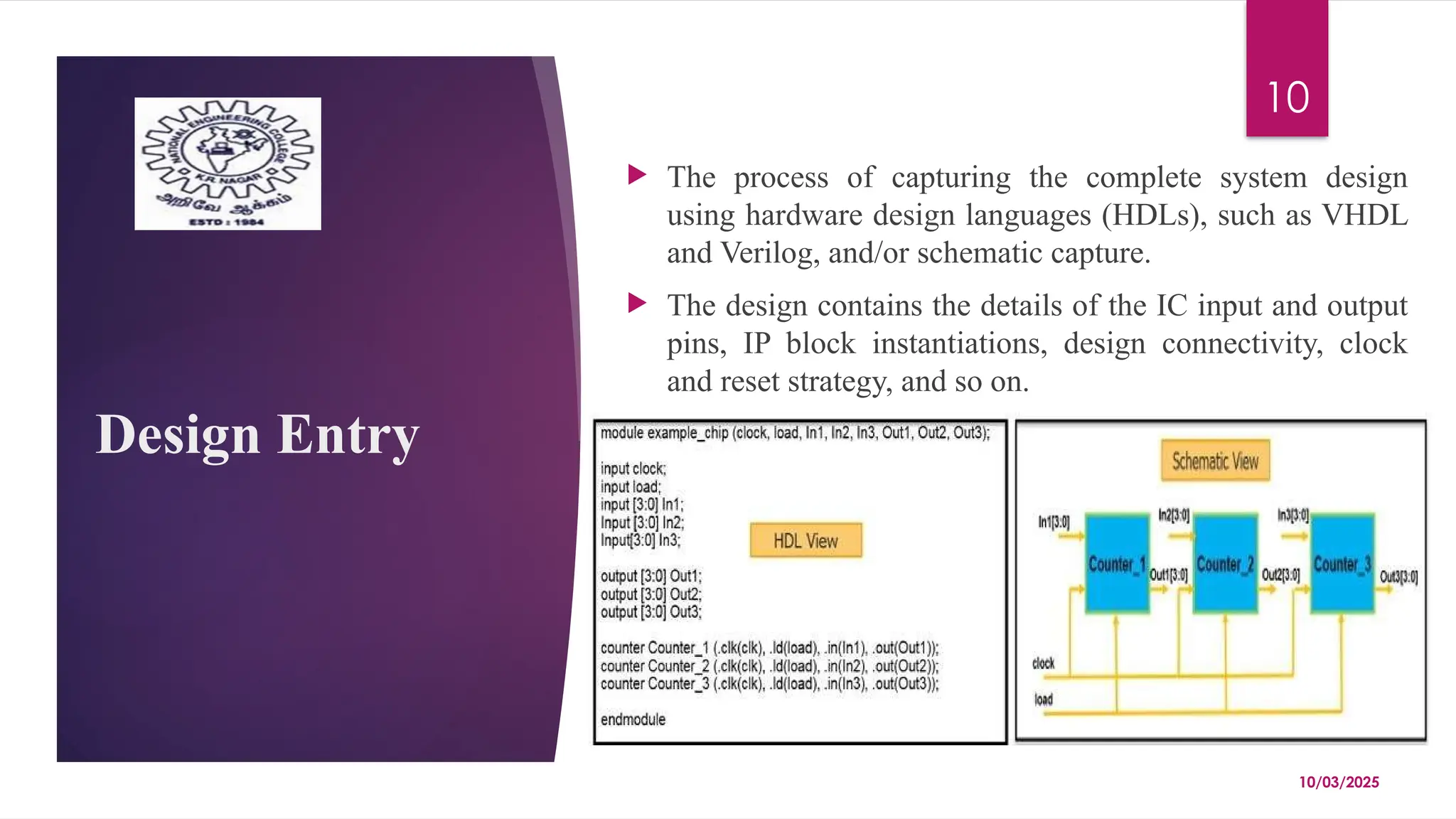
 The process of capturing the complete system design
using hardware design languages (HDLs), such as VHDL
and Verilog, and/or schematic capture.
 The design contains the details of the IC input and output
pins, IP block instantiations, design connectivity, clock
and reset strategy, and so on.
10/03/2025
11
Functional
Simulation
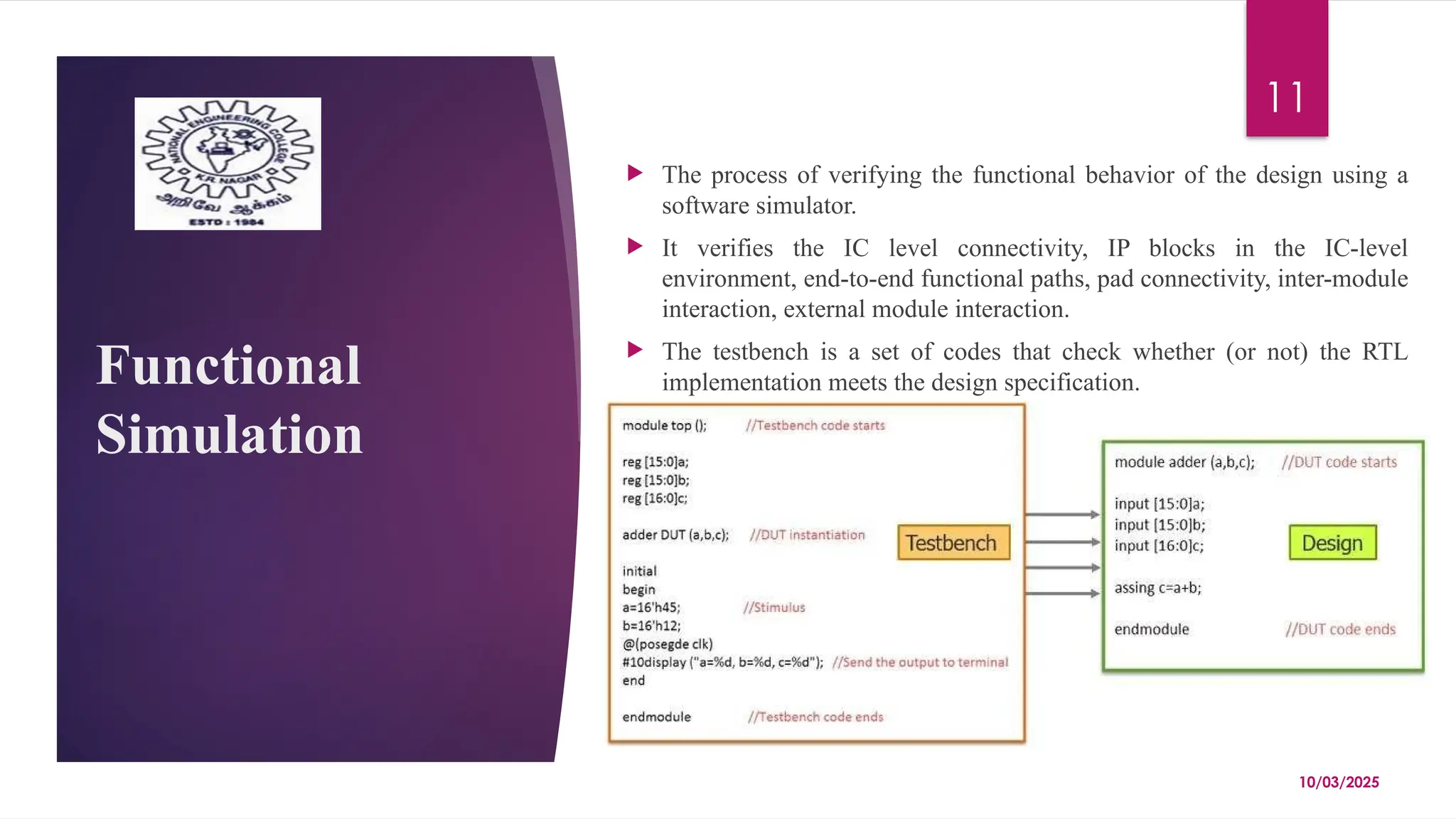
 The process of verifying the functional behavior of the design using a
software simulator.
 It verifies the IC level connectivity, IP blocks in the IC-level
environment, end-to-end functional paths, pad connectivity, inter-module
interaction, external module interaction.
 The testbench is a set of codes that check whether (or not) the RTL
implementation meets the design specification.
10/03/2025
12
Formal
Verification –
Equivalence
Checking
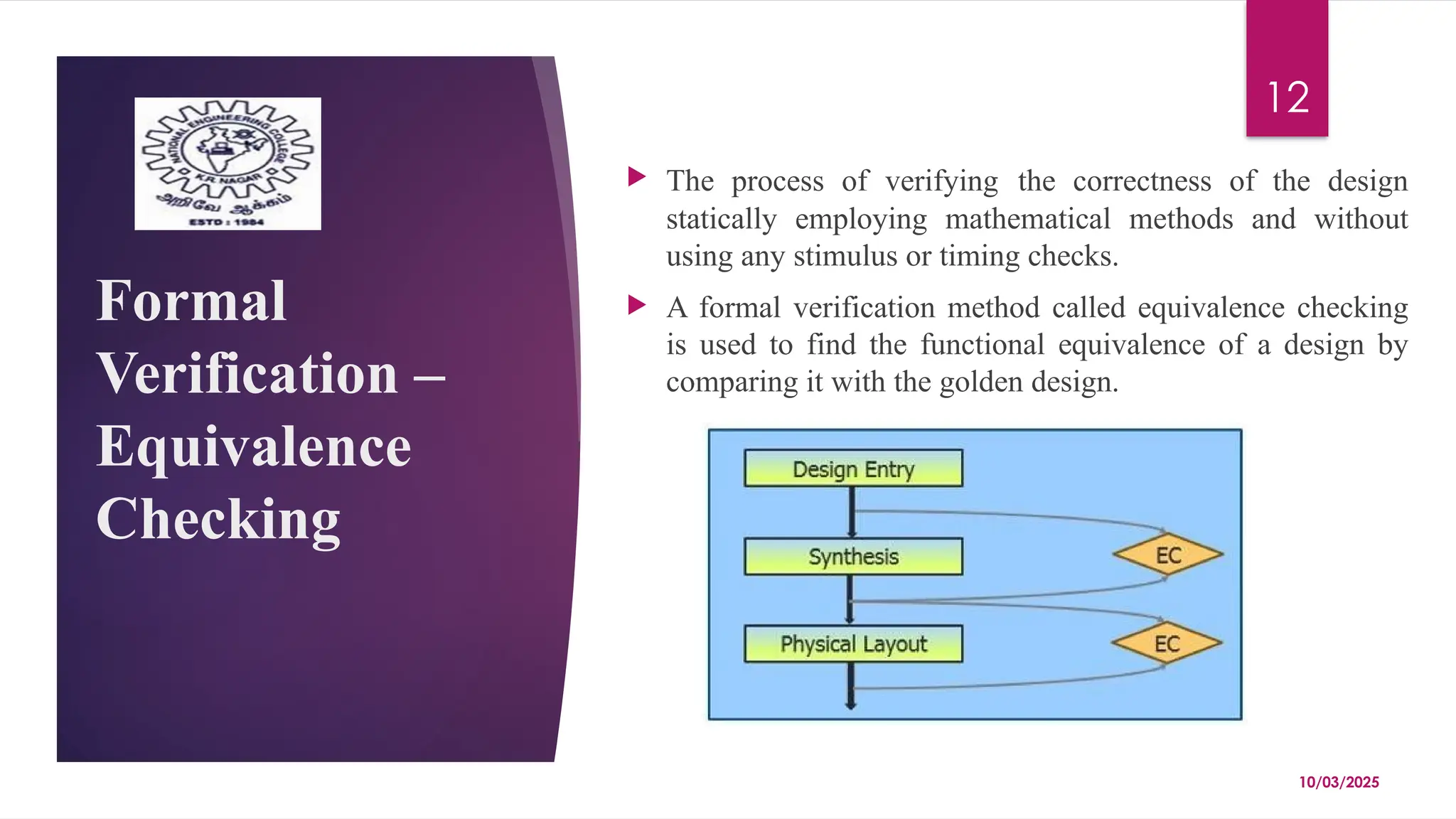
 The process of verifying the correctness of the design
statically employing mathematical methods and without
using any stimulus or timing checks.
 A formal verification method called equivalence checking
is used to find the functional equivalence of a design by
comparing it with the golden design.
10/03/2025
13
Synthesis
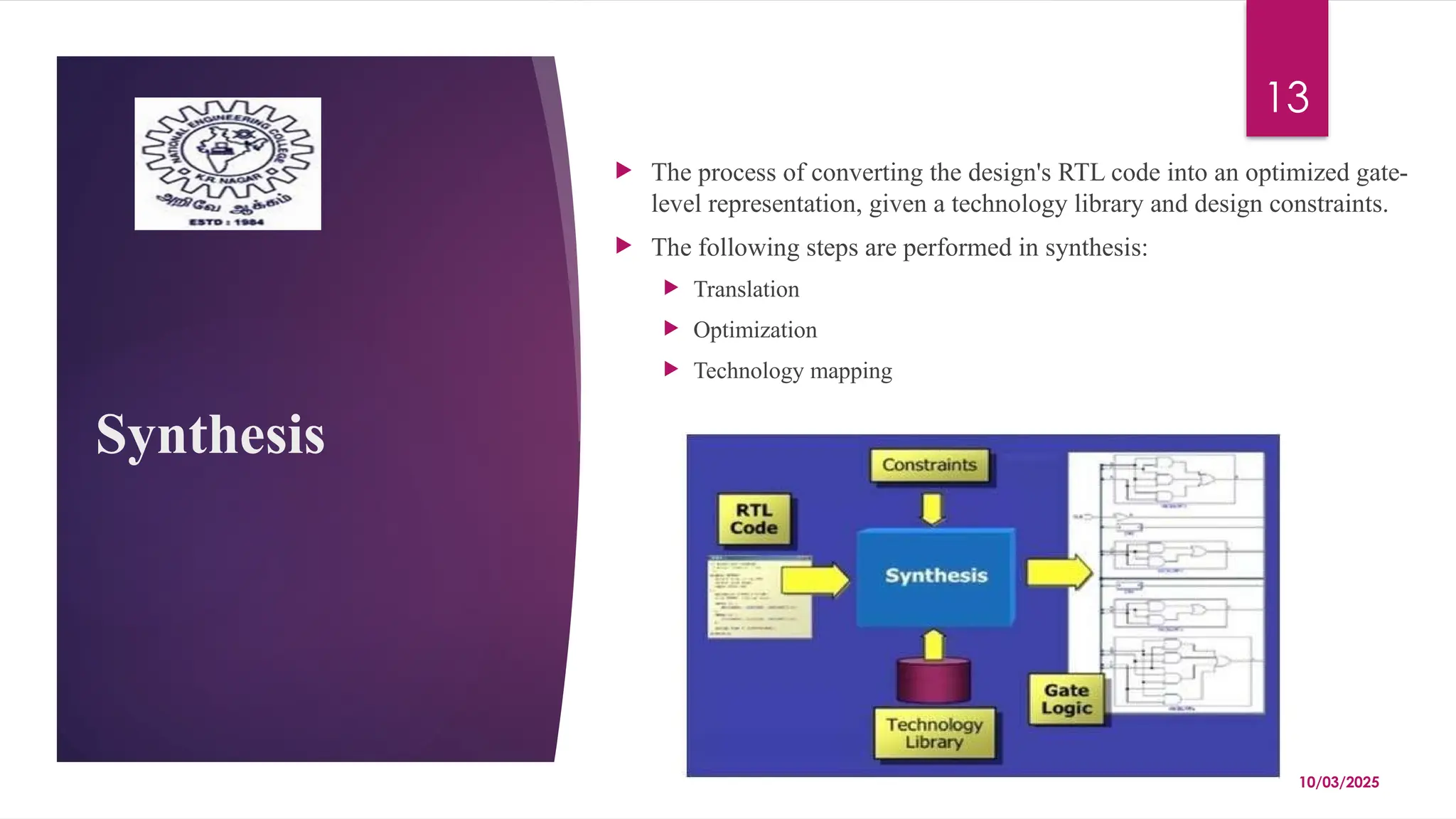
 The process of converting the design's RTL code into an optimized gate-
level representation, given a technology library and design constraints.
 The following steps are performed in synthesis:
 Translation
 Optimization
 Technology mapping
10/03/2025
14
Static Timing
Analysis (STA)
 The process of verifying the timing characteristics of a
design without providing any stimulus.
 STA is fast and exhaustive, but it doesn't check the
functionality of the design.
 It is performed in various stages of the IC design cycle
10/03/2025
15
Design for Test
(DFT)
 The process of manufacturing an IC is not 100% error-
free.
 Extra logic, known as Design for Test (DFT) logic, has
to be inserted in the design to aid in post-production
testing of the IC to identify manufacturing defects.
 When an IC is manufactured, it is first checked for any
manufacturing defects with the help of the DFT logic.
 If there are no manufacturing defects, then the IC is
checked for functional correctness.
10/03/2025
16
Pre-Layout
Simulation
 Before the gate-level netlist is sent for physical layout,
it is verified for functional and timing behavior by
software applications.
10/03/2025
17
Physical Layout
 Physical layout is the transition from the logical view of
the IC to the physical view.
 The output of the physical layout process is a Graphical
Database System (GDSII) file, which is a binary file
format representing planar geometrical shapes, text
labels, and other information related to the physical
layout.
 The steps performed in physical layout are as follows:
 Floor planning
 Partitioning
 Place and Route
 Clock Tree Synthesis
10/03/2025
18
Post – Layout
Simulation
 Post-layout simulation is the process of verifying the
design after the physical layout of the design has been
established.
 The checks performed in post-layout simulation are as
follows:
 Design Rule Check (DRC)
 Electrical Rule Check (ERC)
 Layout Vs. Schematic (LVS)
10/03/2025
19
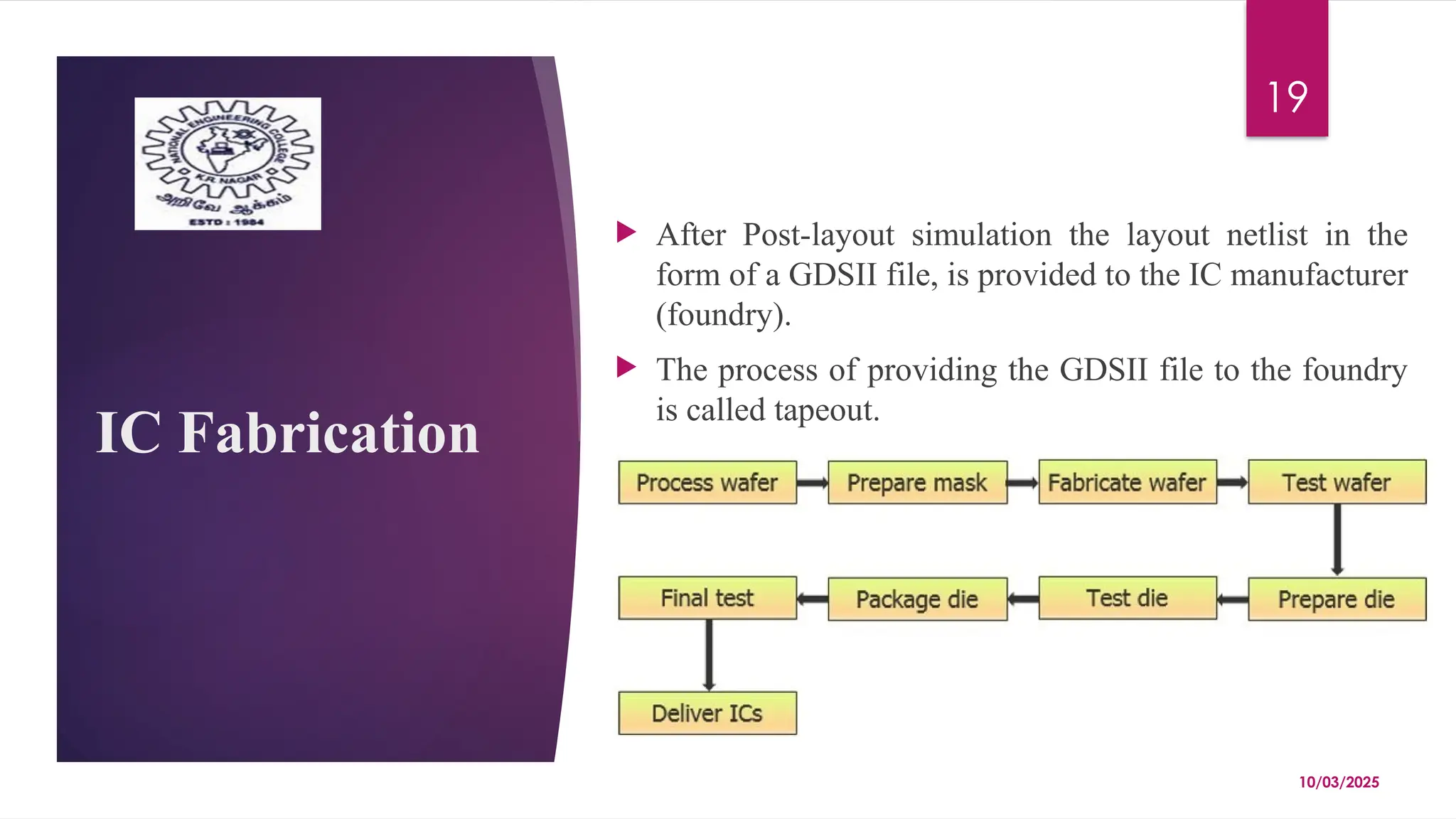
IC Fabrication
 After Post-layout simulation the layout netlist in the
form of a GDSII file, is provided to the IC manufacturer
(foundry).
 The process of providing the GDSII file to the foundry
is called tapeout.
10/03/2025
20
IC Tester
 IC manufacturing isn't 100% reliable, resulting in many
samples that have manufacturing defects.
 Once the IC is received from the foundry, a tester is
used to filter the defective ICs.
 The tester provides input stimulus to the IC and verifies
the output.
 It also verifies the electrical and thermal characteristics
of the IC and finds the ideal operating conditions.
10/03/2025
21
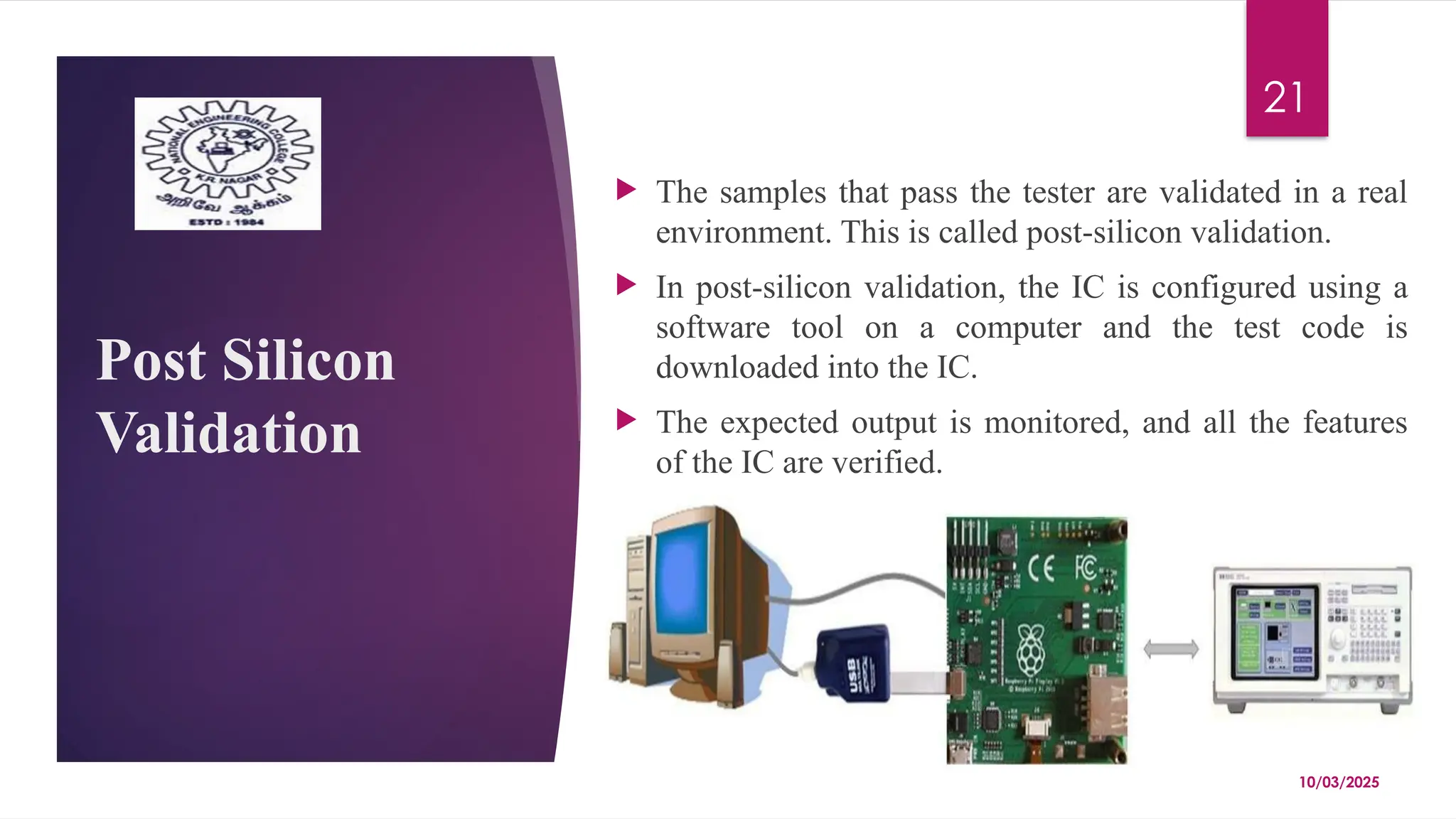
Post Silicon
Validation
 The samples that pass the tester are validated in a real
environment. This is called post-silicon validation.
 In post-silicon validation, the IC is configured using a
software tool on a computer and the test code is
downloaded into the IC.
 The expected output is monitored, and all the features
of the IC are verified.
10/03/2025
22
Design Phase
• Architectural level testing
• Gate level testing
• Transistor level testing
• Layout
10/03/2025
23
Types of Testing
• WAFER SORTING
• PACKAGE LEVEL TESTING
• CHARACTERISATION
TEST
10/03/2025
24
IC Packages
• DUAL INLINE PACKAGE
• SMALL OUTLINE PACKAGES
• QUAD FLAT PACKAGE
• BALL GRID ARRAY
10/03/2025
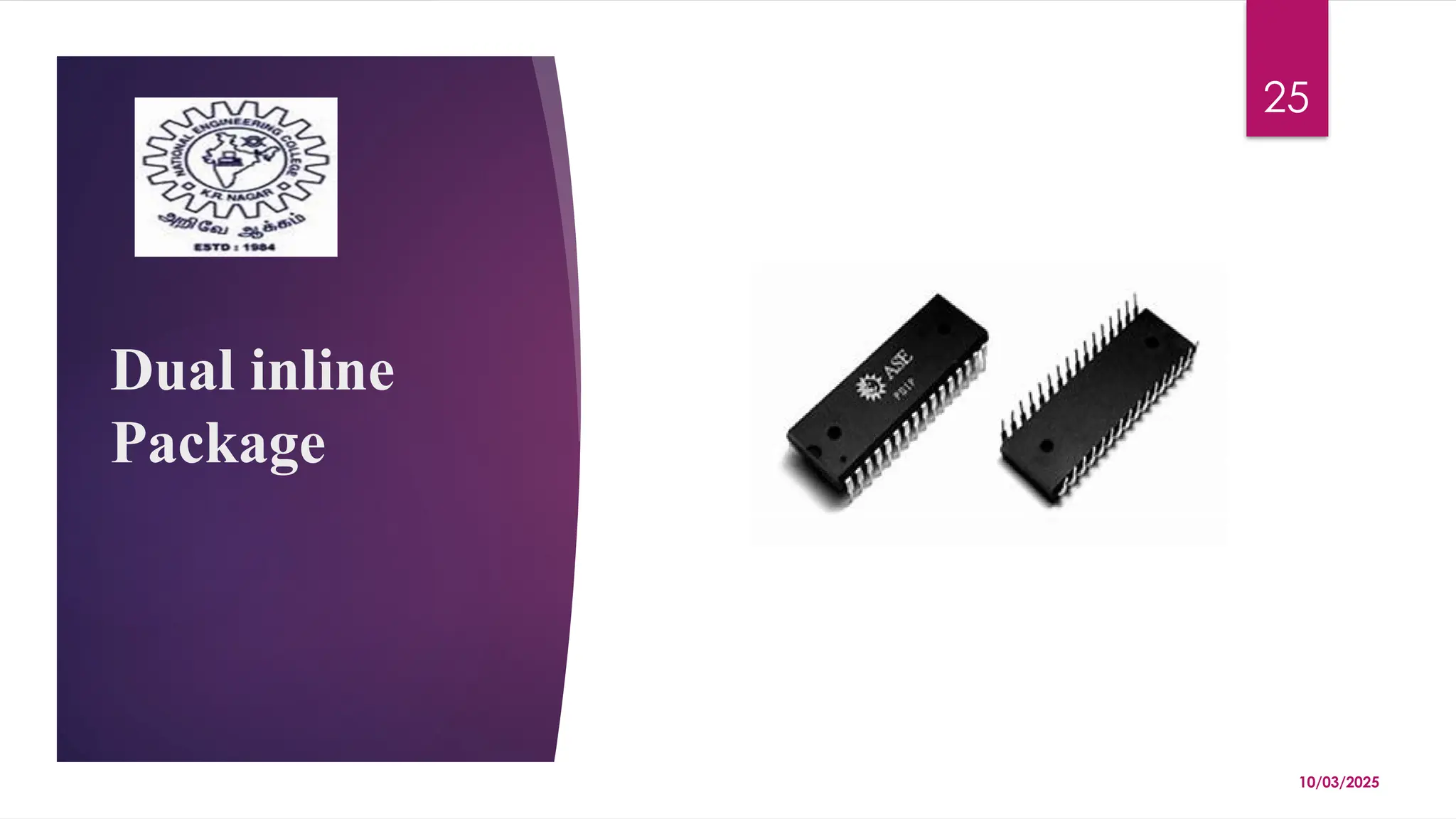
25
Dual inline
Package
10/03/2025
26
Small Outline
Package
 A thin small outline package (TSOP) is an IC
component that consists of a rectangular
shape with small pins along the horizontal
edges.
 TSOPs are common on ICs that power RAM
and flash memory.
10/03/2025
27
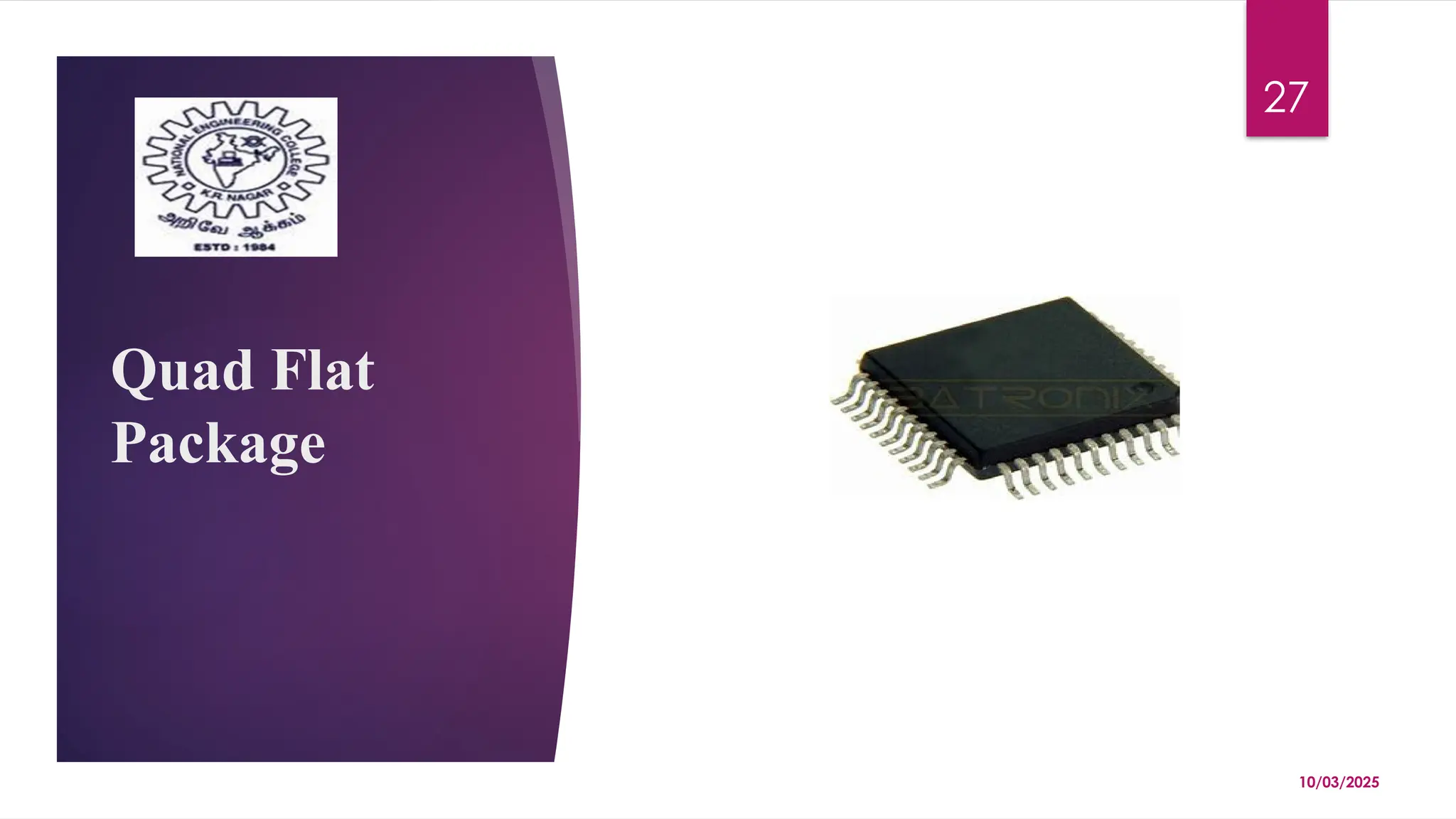
Quad Flat
Package
10/03/2025
28
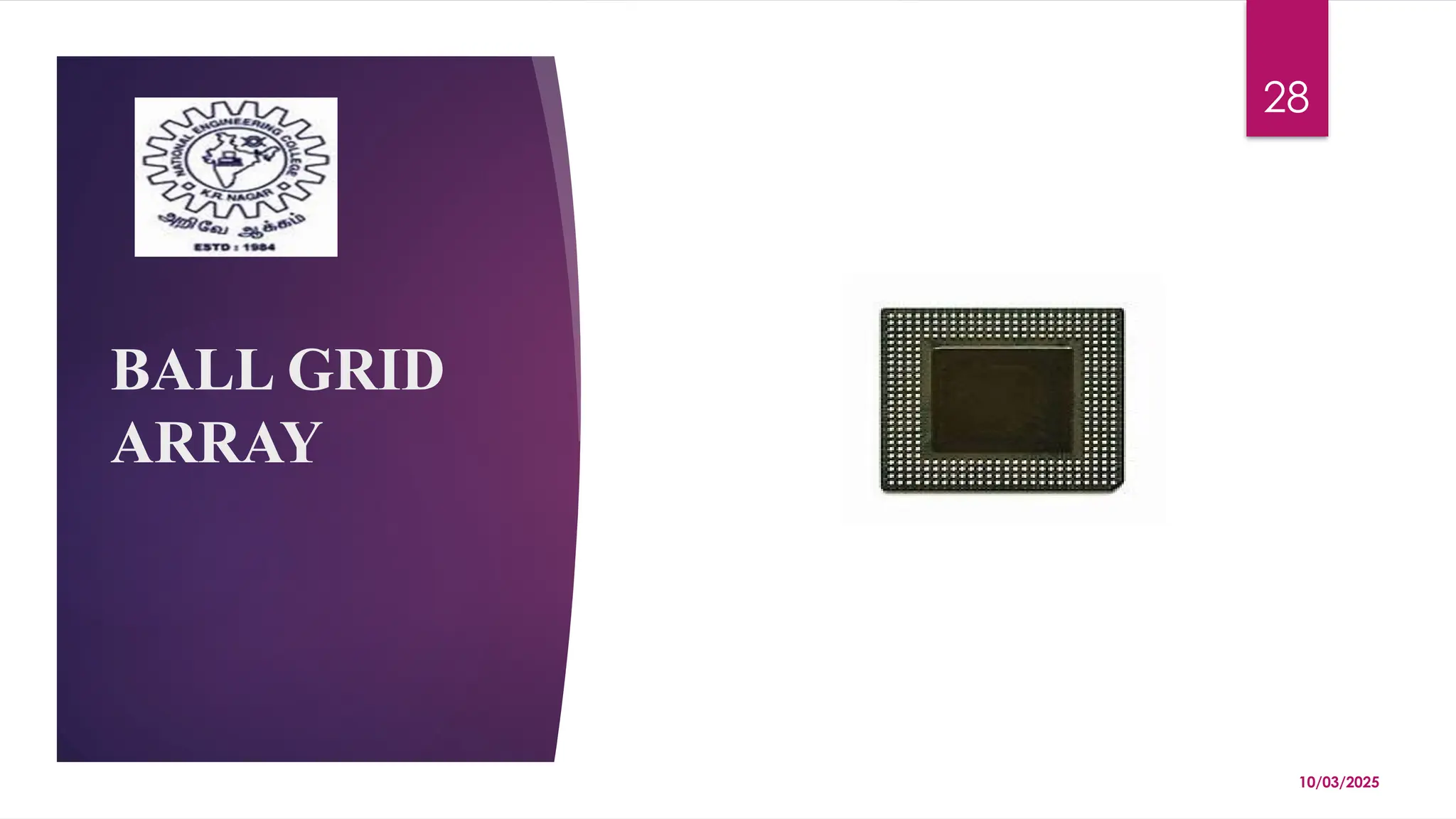
BALL GRID
ARRAY
10/03/2025
29
Thank You

2-IC Lifecycle from fundamental of ic chip testing

  • 1.
    10/03/2025 19EC37E – FUNDAMENTALSOF SEMICONDUCTOR CHIP TESTING PRESENTED BY, Dr.I.VIVEK ANAND, Assistant Professor(Senior Grade) / ECE, -National Engineering College, K.R.Nagar, Kovilpatti. 1
  • 2.
    “ ” 10/03/2025 2 Life cycle ofIntegrated Circuits (IC)
  • 3.
    10/03/2025 3 Lifecycle of IC Design specification  Design  Fabrication  Packaging  Quality assurance Design verification Wafer test Package test Final test
  • 4.
  • 5.
  • 6.
    10/03/2025 6 System Specification  The processof specifying the functional specifications (or requirements) of the system (IC) and defining its external interfaces.
  • 7.
    10/03/2025 7 Architecture Design  Once thesystem specification is decided, the process of designing the architecture of the system starts.  This includes creating the intellectual property (IP) blocks, and defining the software interfaces, timing, performance, area, and power constraints.
  • 8.
    10/03/2025 8 Architecture Verification  The processof building a software version of the hardware system.  Created from functional models using high-level languages like C, C++, or SystemC.  The architecture, performance, and power of the entire system are evaluated using software debuggers.
  • 9.
    10/03/2025 9 Formal Verification – Property Checking  Aformal verification method called property checking is used to prove that the implemented system model meets the design requirements (or specifications).  The system requirements and the mathematical model are compared using a model checker to confirm that the system meets the requirements.
  • 10.
    10/03/2025 10 Design Entry  Theprocess of capturing the complete system design using hardware design languages (HDLs), such as VHDL and Verilog, and/or schematic capture.  The design contains the details of the IC input and output pins, IP block instantiations, design connectivity, clock and reset strategy, and so on.
  • 11.
    10/03/2025 11 Functional Simulation  The processof verifying the functional behavior of the design using a software simulator.  It verifies the IC level connectivity, IP blocks in the IC-level environment, end-to-end functional paths, pad connectivity, inter-module interaction, external module interaction.  The testbench is a set of codes that check whether (or not) the RTL implementation meets the design specification.
  • 12.
    10/03/2025 12 Formal Verification – Equivalence Checking  Theprocess of verifying the correctness of the design statically employing mathematical methods and without using any stimulus or timing checks.  A formal verification method called equivalence checking is used to find the functional equivalence of a design by comparing it with the golden design.
  • 13.
    10/03/2025 13 Synthesis  The processof converting the design's RTL code into an optimized gate- level representation, given a technology library and design constraints.  The following steps are performed in synthesis:  Translation  Optimization  Technology mapping
  • 14.
    10/03/2025 14 Static Timing Analysis (STA) The process of verifying the timing characteristics of a design without providing any stimulus.  STA is fast and exhaustive, but it doesn't check the functionality of the design.  It is performed in various stages of the IC design cycle
  • 15.
    10/03/2025 15 Design for Test (DFT) The process of manufacturing an IC is not 100% error- free.  Extra logic, known as Design for Test (DFT) logic, has to be inserted in the design to aid in post-production testing of the IC to identify manufacturing defects.  When an IC is manufactured, it is first checked for any manufacturing defects with the help of the DFT logic.  If there are no manufacturing defects, then the IC is checked for functional correctness.
  • 16.
    10/03/2025 16 Pre-Layout Simulation  Before thegate-level netlist is sent for physical layout, it is verified for functional and timing behavior by software applications.
  • 17.
    10/03/2025 17 Physical Layout  Physicallayout is the transition from the logical view of the IC to the physical view.  The output of the physical layout process is a Graphical Database System (GDSII) file, which is a binary file format representing planar geometrical shapes, text labels, and other information related to the physical layout.  The steps performed in physical layout are as follows:  Floor planning  Partitioning  Place and Route  Clock Tree Synthesis
  • 18.
    10/03/2025 18 Post – Layout Simulation Post-layout simulation is the process of verifying the design after the physical layout of the design has been established.  The checks performed in post-layout simulation are as follows:  Design Rule Check (DRC)  Electrical Rule Check (ERC)  Layout Vs. Schematic (LVS)
  • 19.
    10/03/2025 19 IC Fabrication  AfterPost-layout simulation the layout netlist in the form of a GDSII file, is provided to the IC manufacturer (foundry).  The process of providing the GDSII file to the foundry is called tapeout.
  • 20.
    10/03/2025 20 IC Tester  ICmanufacturing isn't 100% reliable, resulting in many samples that have manufacturing defects.  Once the IC is received from the foundry, a tester is used to filter the defective ICs.  The tester provides input stimulus to the IC and verifies the output.  It also verifies the electrical and thermal characteristics of the IC and finds the ideal operating conditions.
  • 21.
    10/03/2025 21 Post Silicon Validation  Thesamples that pass the tester are validated in a real environment. This is called post-silicon validation.  In post-silicon validation, the IC is configured using a software tool on a computer and the test code is downloaded into the IC.  The expected output is monitored, and all the features of the IC are verified.
  • 22.
    10/03/2025 22 Design Phase • Architecturallevel testing • Gate level testing • Transistor level testing • Layout
  • 23.
    10/03/2025 23 Types of Testing •WAFER SORTING • PACKAGE LEVEL TESTING • CHARACTERISATION TEST
  • 24.
    10/03/2025 24 IC Packages • DUALINLINE PACKAGE • SMALL OUTLINE PACKAGES • QUAD FLAT PACKAGE • BALL GRID ARRAY
  • 25.
  • 26.
    10/03/2025 26 Small Outline Package  Athin small outline package (TSOP) is an IC component that consists of a rectangular shape with small pins along the horizontal edges.  TSOPs are common on ICs that power RAM and flash memory.
  • 27.
  • 28.
  • 29.