Frustrated by unsecured
Wi-Fi, a fix is on the way….
Presented by:
VISHAL S PAI
(1NH11EC124)
NEW HORIZON COLLEGE OF
ENGINEERING
Contents
Introduction
WiGig alliance Logo
Need For faster Wireless Connectivity
Wi-Gig specification
Structure of Wi-Gig
 Physical Layer
 Medium Access Layer
 Protocol Adaptation Layer
Usage Models
Conclusion
Introduction
WiGig (Wireless Gigabit Alliance) is the new brand
established by the Wi-Fi alliance for the IEEE 802.11ad
standard.
It is an extremely high-speed, but short range, local
networking technology.
Enables data rates up to 7Gbps, more than 10 times
the speed of the fastest Wi-Fi network based on IEEE
802.11n.
WiGig alliance Logo
The Wi-Fi Alliance created a
separate, unique logo for WiGig
to avoid confusion between the
standards.
Need For faster Wireless Connectivity
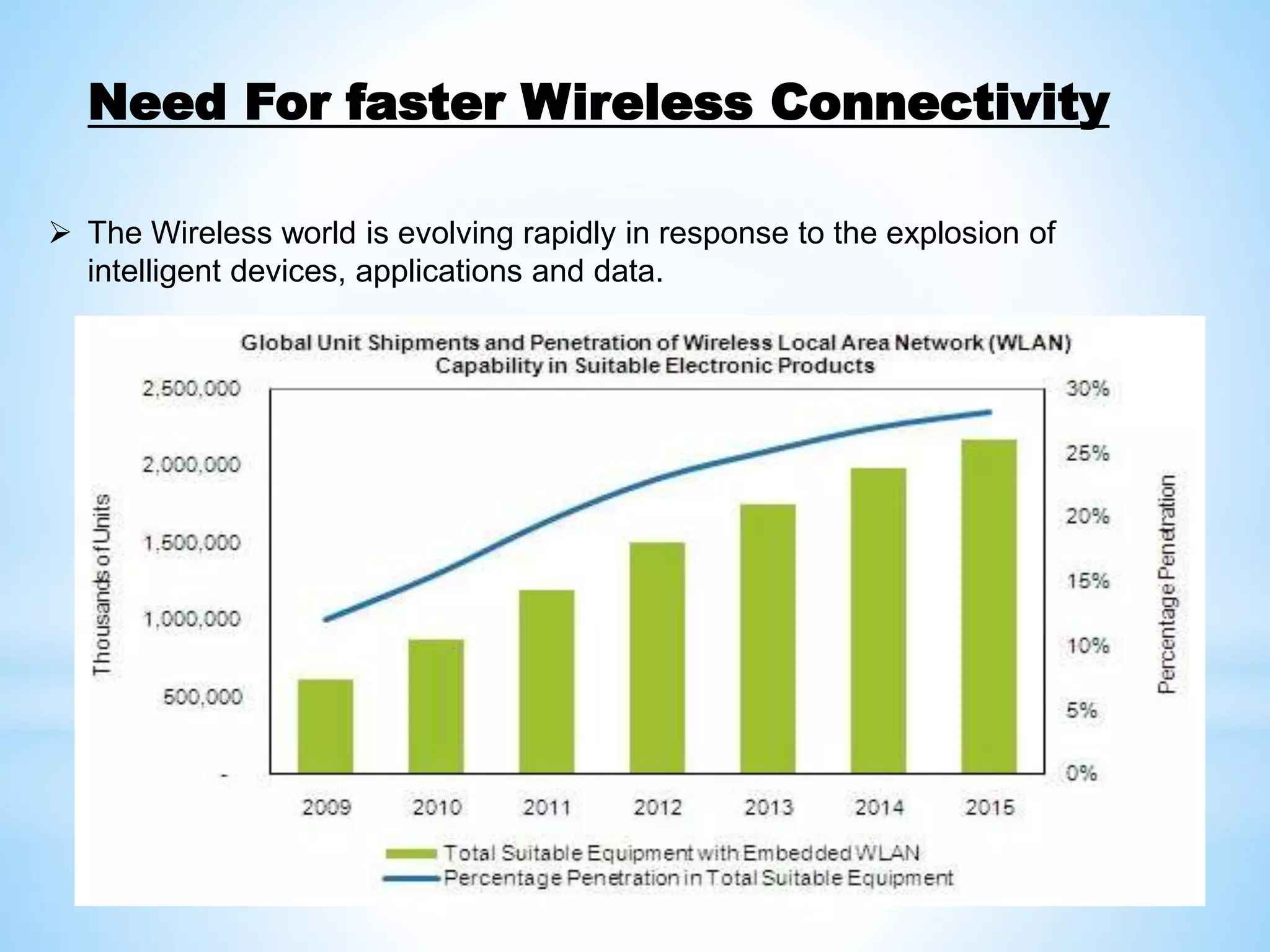
 The Wireless world is evolving rapidly in response to the explosion of
intelligent devices, applications and data.
 Support for data transmission rates up to 7 Gbps
• more than 10 times the speed of the fastest Wi-Fi
networks based on IEEE 802.11n
 It operates in the unlicensed 60 GHz frequency band
• More spectrum available than the 2.4 GHz and 5 GHz
bands used by existing Wi-Fi products.
• This allows wider channels that support faster
transmission speeds
Specification
 Based on IEEE 802.11
• Provides native Wi-Fi support
• Enables devices to transparently switch between 802.11
networks operating in any frequency band including 2.4
GHz, 5 GHz and 60 GHz
 Support for beamforming, maximizing signal strength and
enabling robust communication at distances beyond 10
meters
 Advanced security using the Galois/Counter Mode of the
AES encryption algorithm
 Support for high-performance wireless implementations of
HDMI, Display Port, USB and PCIe
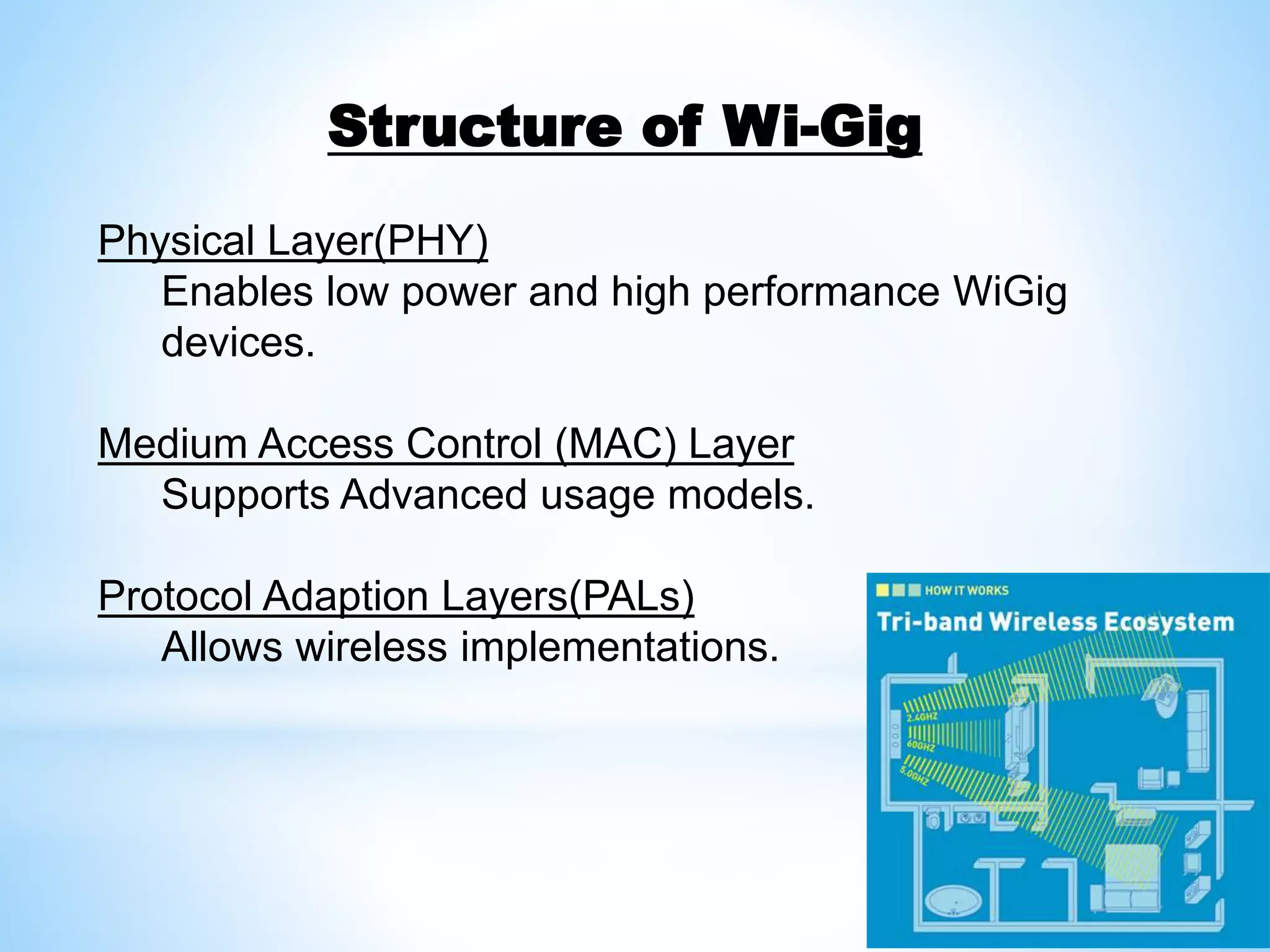
Structure of Wi-Gig
Physical Layer(PHY)
Enables low power and high performance WiGig
devices.
Medium Access Control (MAC) Layer
Supports Advanced usage models.
Protocol Adaption Layers(PALs)
Allows wireless implementations.
WiGig specification defines four channels, each 2.16 GHz wide.
 These wide channels support applications such as uncompressed
video transmission.
 Supports 2types of modulation & coding schemes(MCS).
1. Orthogonal frequency-division multiplexing (OFDM)
2. Single carrier (SC)
The schemes share common elements such as preamble and
channel coding.
This reduces implementation complexity for manufacturers of
WiGig devices.
Physical Layer (PHY)
Orthogonal frequency-division
multiplexing (OFDM)
 It supports communication over longer distances with greater
delay spreads.
 providing more flexibility in handling obstacles and reflected
signals.
 Furthermore, OFDM allows the greatest transmission speeds of up
to 7 Gbps.
Single carrier (SC)
 Single carrier (SC) typically results in lower power consumption
 So it is often a better fit for small, low-power handheld devices
 SC supports transmission speeds up to 4.6 Gbps.
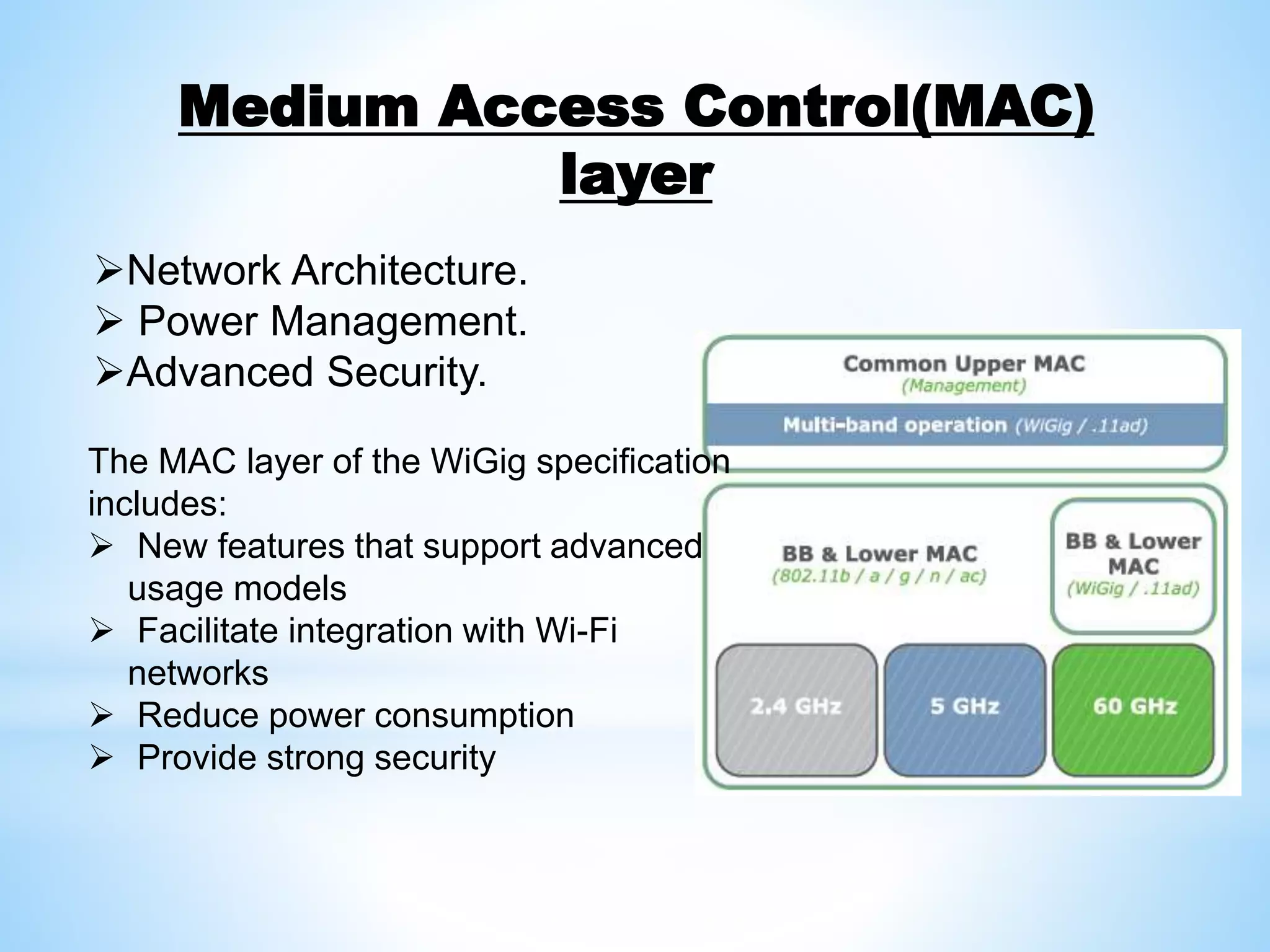
Medium Access Control(MAC)
layer
Network Architecture.
 Power Management.
Advanced Security.
The MAC layer of the WiGig specification
includes:
 New features that support advanced
usage models
 Facilitate integration with Wi-Fi
networks
 Reduce power consumption
 Provide strong security
 The specification defines a new network architecture that
enables two devices to communicate directly with each other
allowing
• New uses such as rapidly synchronizing two devices .
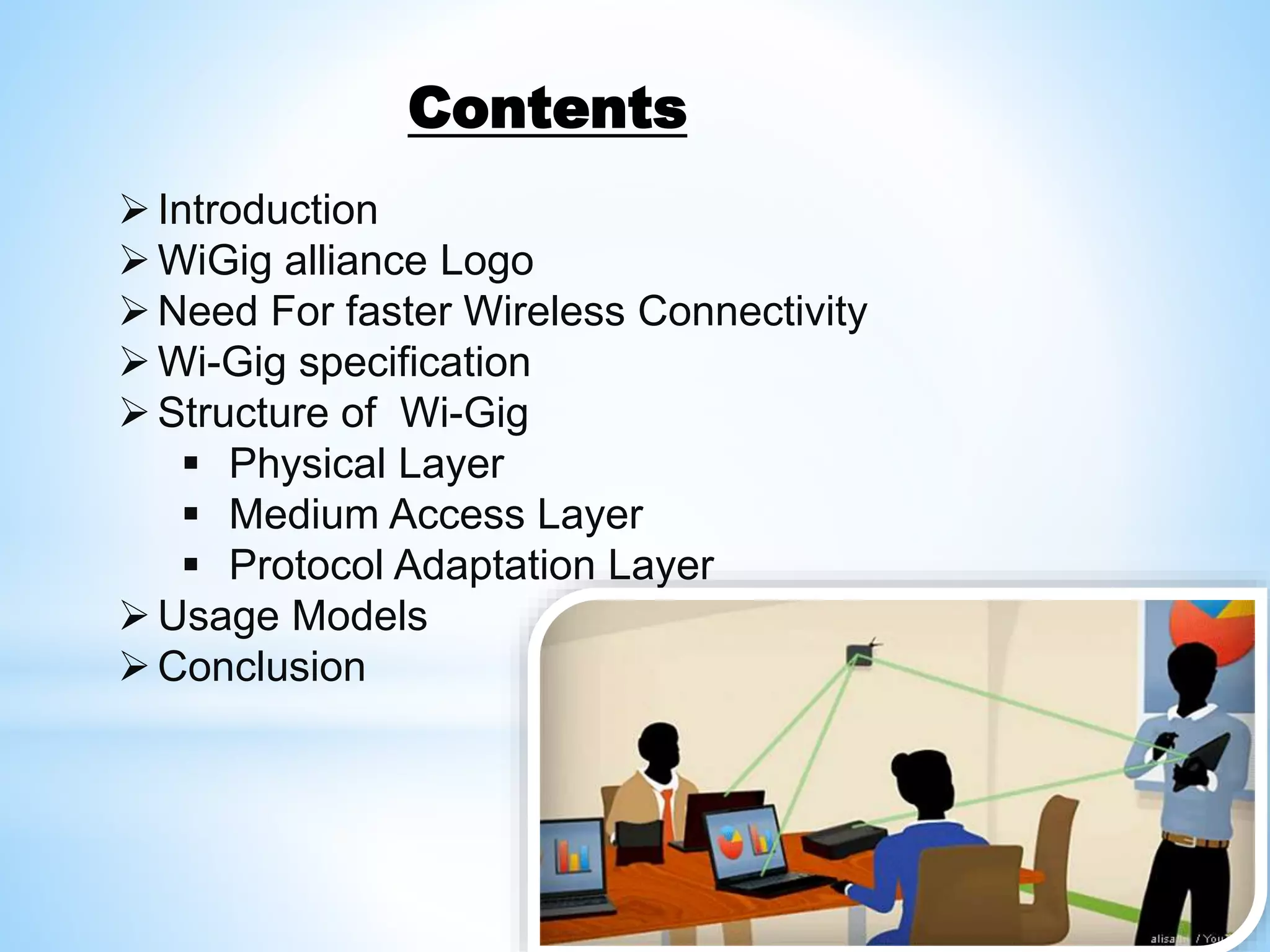
• Transmitting audio-visual data to a projector or TV.
Network Architecture
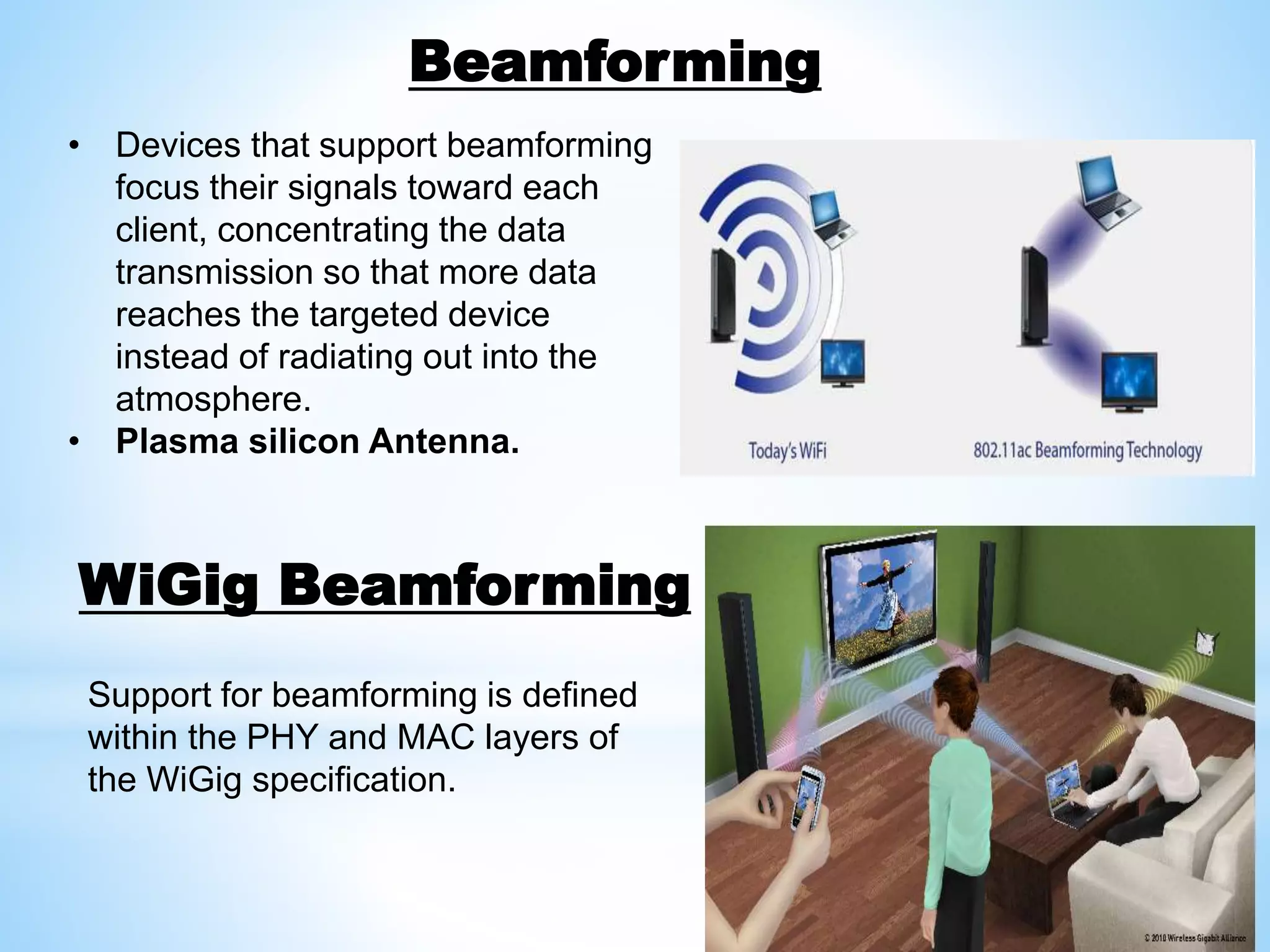
Support for beamforming is defined
within the PHY and MAC layers of
the WiGig specification.
WiGig Beamforming
Beamforming
• Devices that support beamforming
focus their signals toward each
client, concentrating the data
transmission so that more data
reaches the targeted device
instead of radiating out into the
atmosphere.
• Plasma silicon Antenna.
Protocol Adaptation Layer
 Defined by the WiGig Alliance to support specific data
and display standards over 60 GHz
 PALs allow wireless implementations of these standard
interfaces that run directly on the WiGig MAC and PHY
 It can be implemented in hardware
 The initial PALs are
 audio-visual (A/V), which defines support for HDMI
and DisplayPort,
 input-output (I/O), which defines support for USB and
PCIe
Usage Models
WiGig offers unrivaled raw speed, interference
resistance, good range, high capacity networking, multi-
gigabit real throughput in a handheld power envelope,
and near-wire equivalent latency.
 Given these benefits, WiGig is well-suited for a broad
range of applications, from tri-band networking (2.4/5/60
GHz) to wireless storage and edge caching to wireless
docking.
Conclusion
WiGig power point presenttion

WiGig power point presenttion

  • 1.
    Frustrated by unsecured Wi-Fi,a fix is on the way…. Presented by: VISHAL S PAI (1NH11EC124) NEW HORIZON COLLEGE OF ENGINEERING
  • 2.
    Contents Introduction WiGig alliance Logo NeedFor faster Wireless Connectivity Wi-Gig specification Structure of Wi-Gig  Physical Layer  Medium Access Layer  Protocol Adaptation Layer Usage Models Conclusion
  • 3.
    Introduction WiGig (Wireless GigabitAlliance) is the new brand established by the Wi-Fi alliance for the IEEE 802.11ad standard. It is an extremely high-speed, but short range, local networking technology. Enables data rates up to 7Gbps, more than 10 times the speed of the fastest Wi-Fi network based on IEEE 802.11n.
  • 4.
    WiGig alliance Logo TheWi-Fi Alliance created a separate, unique logo for WiGig to avoid confusion between the standards.
  • 5.
    Need For fasterWireless Connectivity  The Wireless world is evolving rapidly in response to the explosion of intelligent devices, applications and data.
  • 6.
     Support fordata transmission rates up to 7 Gbps • more than 10 times the speed of the fastest Wi-Fi networks based on IEEE 802.11n  It operates in the unlicensed 60 GHz frequency band • More spectrum available than the 2.4 GHz and 5 GHz bands used by existing Wi-Fi products. • This allows wider channels that support faster transmission speeds Specification
  • 7.
     Based onIEEE 802.11 • Provides native Wi-Fi support • Enables devices to transparently switch between 802.11 networks operating in any frequency band including 2.4 GHz, 5 GHz and 60 GHz  Support for beamforming, maximizing signal strength and enabling robust communication at distances beyond 10 meters  Advanced security using the Galois/Counter Mode of the AES encryption algorithm  Support for high-performance wireless implementations of HDMI, Display Port, USB and PCIe
  • 8.
    Structure of Wi-Gig PhysicalLayer(PHY) Enables low power and high performance WiGig devices. Medium Access Control (MAC) Layer Supports Advanced usage models. Protocol Adaption Layers(PALs) Allows wireless implementations.
  • 9.
    WiGig specification definesfour channels, each 2.16 GHz wide.  These wide channels support applications such as uncompressed video transmission.  Supports 2types of modulation & coding schemes(MCS). 1. Orthogonal frequency-division multiplexing (OFDM) 2. Single carrier (SC) The schemes share common elements such as preamble and channel coding. This reduces implementation complexity for manufacturers of WiGig devices. Physical Layer (PHY)
  • 10.
    Orthogonal frequency-division multiplexing (OFDM) It supports communication over longer distances with greater delay spreads.  providing more flexibility in handling obstacles and reflected signals.  Furthermore, OFDM allows the greatest transmission speeds of up to 7 Gbps. Single carrier (SC)  Single carrier (SC) typically results in lower power consumption  So it is often a better fit for small, low-power handheld devices  SC supports transmission speeds up to 4.6 Gbps.
  • 11.
    Medium Access Control(MAC) layer NetworkArchitecture.  Power Management. Advanced Security. The MAC layer of the WiGig specification includes:  New features that support advanced usage models  Facilitate integration with Wi-Fi networks  Reduce power consumption  Provide strong security
  • 12.
     The specificationdefines a new network architecture that enables two devices to communicate directly with each other allowing • New uses such as rapidly synchronizing two devices . • Transmitting audio-visual data to a projector or TV. Network Architecture
  • 13.
    Support for beamformingis defined within the PHY and MAC layers of the WiGig specification. WiGig Beamforming Beamforming • Devices that support beamforming focus their signals toward each client, concentrating the data transmission so that more data reaches the targeted device instead of radiating out into the atmosphere. • Plasma silicon Antenna.
  • 14.
  • 15.
     Defined bythe WiGig Alliance to support specific data and display standards over 60 GHz  PALs allow wireless implementations of these standard interfaces that run directly on the WiGig MAC and PHY  It can be implemented in hardware  The initial PALs are  audio-visual (A/V), which defines support for HDMI and DisplayPort,  input-output (I/O), which defines support for USB and PCIe
  • 16.
  • 17.
    WiGig offers unrivaledraw speed, interference resistance, good range, high capacity networking, multi- gigabit real throughput in a handheld power envelope, and near-wire equivalent latency.  Given these benefits, WiGig is well-suited for a broad range of applications, from tri-band networking (2.4/5/60 GHz) to wireless storage and edge caching to wireless docking. Conclusion