Isaac Amornortey Yowetu
Approximating a
Dominant Eigenvalue by
the Power Method
March 15, 2022
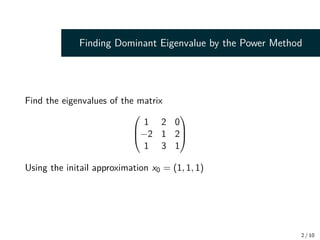
Finding Dominant Eigenvalue by the Power Method
Find the eigenvalues of the matrix



1 2 0
−2 1 2
1 3 1



Using the initail approximation x0 = (1, 1, 1)
2 / 10
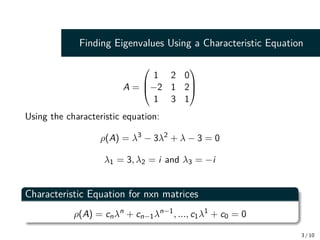
Finding Eigenvalues Using a Characteristic Equation
A =



1 2 0
−2 1 2
1 3 1



Using the characteristic equation:
ρ(A) = λ3
− 3λ2
+ λ − 3 = 0
λ1 = 3, λ2 = i and λ3 = −i
Characteristic Equation for nxn matrices
ρ(A) = cnλn
+ cn−1λn−1
, ..., c1λ1
+ c0 = 0
3 / 10
Solution
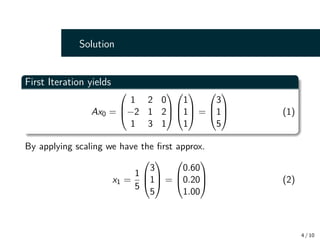
First Iteration yields
Ax0 =



1 2 0
−2 1 2
1 3 1






1
1
1


 =



3
1
5


 (1)
By applying scaling we have the first approx.
x1 =
1
5



3
1
5


 =



0.60
0.20
1.00


 (2)
4 / 10
Solution Cont’d
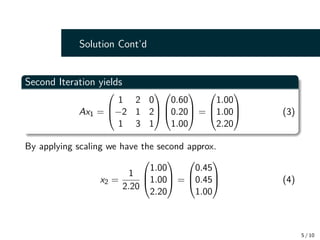
Second Iteration yields
Ax1 =



1 2 0
−2 1 2
1 3 1






0.60
0.20
1.00


 =



1.00
1.00
2.20


 (3)
By applying scaling we have the second approx.
x2 =
1
2.20



1.00
1.00
2.20


 =



0.45
0.45
1.00


 (4)
5 / 10
Solution Cont’d
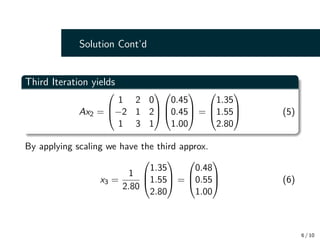
Third Iteration yields
Ax2 =



1 2 0
−2 1 2
1 3 1






0.45
0.45
1.00


 =



1.35
1.55
2.80


 (5)
By applying scaling we have the third approx.
x3 =
1
2.80



1.35
1.55
2.80


 =



0.48
0.55
1.00


 (6)
6 / 10
Solution Cont’d
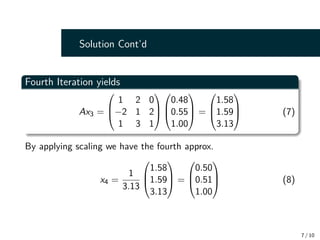
Fourth Iteration yields
Ax3 =



1 2 0
−2 1 2
1 3 1






0.48
0.55
1.00


 =



1.58
1.59
3.13


 (7)
By applying scaling we have the fourth approx.
x4 =
1
3.13



1.58
1.59
3.13


 =



0.50
0.51
1.00


 (8)
7 / 10
Solution Cont’d
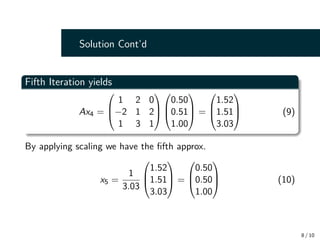
Fifth Iteration yields
Ax4 =



1 2 0
−2 1 2
1 3 1






0.50
0.51
1.00


 =



1.52
1.51
3.03


 (9)
By applying scaling we have the fifth approx.
x5 =
1
3.03



1.52
1.51
3.03


 =



0.50
0.50
1.00


 (10)
8 / 10
Solution Cont’d
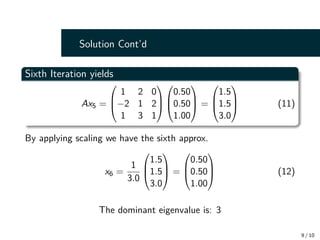
Sixth Iteration yields
Ax5 =



1 2 0
−2 1 2
1 3 1






0.50
0.50
1.00


 =



1.5
1.5
3.0


 (11)
By applying scaling we have the sixth approx.
x6 =
1
3.0



1.5
1.5
3.0


 =



0.50
0.50
1.00


 (12)
The dominant eigenvalue is: 3
9 / 10
Rayleigh Quotient
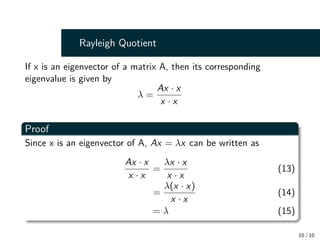
If x is an eigenvector of a matrix A, then its corresponding
eigenvalue is given by
λ =
Ax · x
x · x
Proof
Since x is an eigenvector of A, Ax = λx can be written as
Ax · x
x · x
=
λx · x
x · x
(13)
=
λ(x · x)
x · x
(14)
= λ (15)
10 / 10

Approximating Dominant Eivenvalue By The Power Method

  • 1.
    Isaac Amornortey Yowetu Approximatinga Dominant Eigenvalue by the Power Method March 15, 2022
  • 2.
    Finding Dominant Eigenvalueby the Power Method Find the eigenvalues of the matrix    1 2 0 −2 1 2 1 3 1    Using the initail approximation x0 = (1, 1, 1) 2 / 10
  • 3.
    Finding Eigenvalues Usinga Characteristic Equation A =    1 2 0 −2 1 2 1 3 1    Using the characteristic equation: ρ(A) = λ3 − 3λ2 + λ − 3 = 0 λ1 = 3, λ2 = i and λ3 = −i Characteristic Equation for nxn matrices ρ(A) = cnλn + cn−1λn−1 , ..., c1λ1 + c0 = 0 3 / 10
  • 4.
    Solution First Iteration yields Ax0=    1 2 0 −2 1 2 1 3 1       1 1 1    =    3 1 5    (1) By applying scaling we have the first approx. x1 = 1 5    3 1 5    =    0.60 0.20 1.00    (2) 4 / 10
  • 5.
    Solution Cont’d Second Iterationyields Ax1 =    1 2 0 −2 1 2 1 3 1       0.60 0.20 1.00    =    1.00 1.00 2.20    (3) By applying scaling we have the second approx. x2 = 1 2.20    1.00 1.00 2.20    =    0.45 0.45 1.00    (4) 5 / 10
  • 6.
    Solution Cont’d Third Iterationyields Ax2 =    1 2 0 −2 1 2 1 3 1       0.45 0.45 1.00    =    1.35 1.55 2.80    (5) By applying scaling we have the third approx. x3 = 1 2.80    1.35 1.55 2.80    =    0.48 0.55 1.00    (6) 6 / 10
  • 7.
    Solution Cont’d Fourth Iterationyields Ax3 =    1 2 0 −2 1 2 1 3 1       0.48 0.55 1.00    =    1.58 1.59 3.13    (7) By applying scaling we have the fourth approx. x4 = 1 3.13    1.58 1.59 3.13    =    0.50 0.51 1.00    (8) 7 / 10
  • 8.
    Solution Cont’d Fifth Iterationyields Ax4 =    1 2 0 −2 1 2 1 3 1       0.50 0.51 1.00    =    1.52 1.51 3.03    (9) By applying scaling we have the fifth approx. x5 = 1 3.03    1.52 1.51 3.03    =    0.50 0.50 1.00    (10) 8 / 10
  • 9.
    Solution Cont’d Sixth Iterationyields Ax5 =    1 2 0 −2 1 2 1 3 1       0.50 0.50 1.00    =    1.5 1.5 3.0    (11) By applying scaling we have the sixth approx. x6 = 1 3.0    1.5 1.5 3.0    =    0.50 0.50 1.00    (12) The dominant eigenvalue is: 3 9 / 10
  • 10.
    Rayleigh Quotient If xis an eigenvector of a matrix A, then its corresponding eigenvalue is given by λ = Ax · x x · x Proof Since x is an eigenvector of A, Ax = λx can be written as Ax · x x · x = λx · x x · x (13) = λ(x · x) x · x (14) = λ (15) 10 / 10