Binary Operations
2021
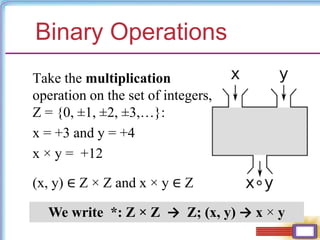
Binary Operations
Take the multiplication
operation on the set of integers,
Z = {0, ±1, ±2, ±3,…}:
x = +3 and y = +4
x × y = +12
(x, y) ∈ Z × Z and x × y ∈ Z
We write *: Z × Z → Z; (x, y) → x × y
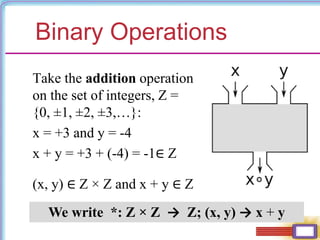
Binary Operations
Take the addition operation
on the set of integers, Z =
{0, ±1, ±2, ±3,…}:
x = +3 and y = -4
x + y = +3 + (-4) = -1∈ Z
(x, y) ∈ Z × Z and x + y ∈ Z
We write *: Z × Z → Z; (x, y) → x + y
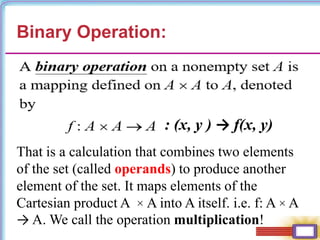
Binary Operation:
: (x, y ) → f(x, y)
That is a calculation that combines two elements
of the set (called operands) to produce another
element of the set. It maps elements of the
Cartesian product A × A into A itself. i.e. f: A × A
→ A. We call the operation multiplication!
Binary Operation notation
• We usually write binary operations
infix that is, between their arguments,
rather than prefix, before their
arguments.
• Also, the symbols chosen for binary
operations are usually reminiscent of
+ or × rather than letters.
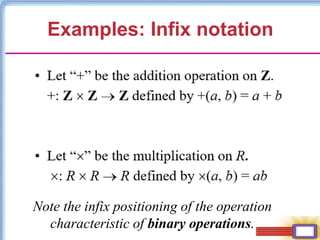
Examples: Infix notation
Note the infix positioning of the operation
characteristic of binary operations.
Binary operations on Z
Given the set of integers X, we normally call the
operation “multiplication” and denote it by * even
though we can define the operations in many ways:
• x * y = x + 2y + 3
• x * y = 1 + xy
• x * y = 3x + y
or even
• x * y = x + y
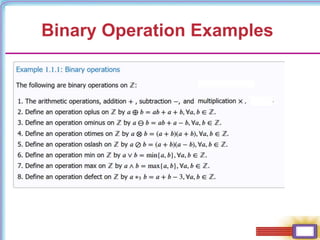
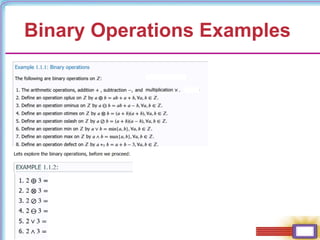
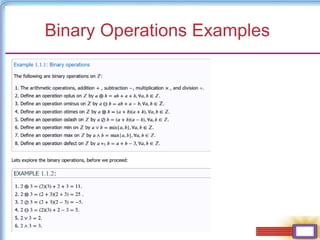
Binary Operation Examples
Binary Operations Examples
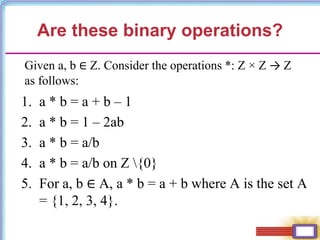
Are these binary operations?
1. a * b = a + b – 1
2. a * b = 1 – 2ab
3. a * b = a/b
4. a * b = a/b on Z {0}
5. For a, b ∈ A, a * b = a + b where A is the set A
= {1, 2, 3, 4}.
Given a, b ∈ Z. Consider the operations *: Z × Z → Z
as follows:
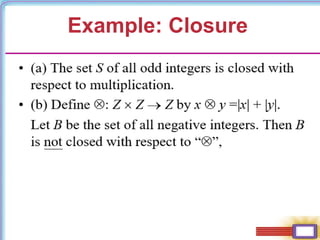
Example: Closure
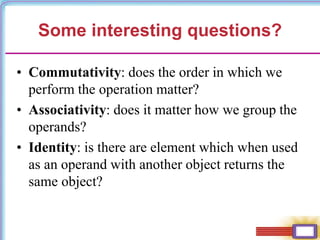
Some interesting questions?
• Commutativity: does the order in which we
perform the operation matter?
• Associativity: does it matter how we group the
operands?
• Identity: is there are element which when used
as an operand with another object returns the
same object?
Binary
Operati
on
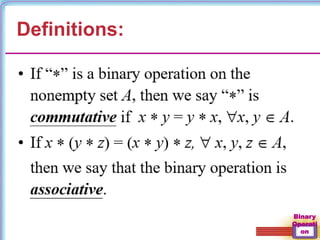
Definitions:
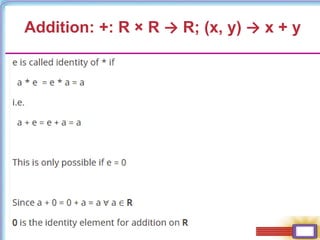
Addition: +: R × R → R; (x, y) → x + y
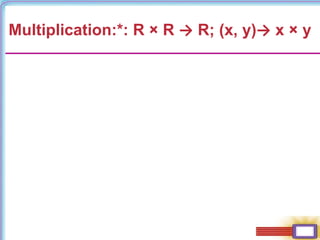
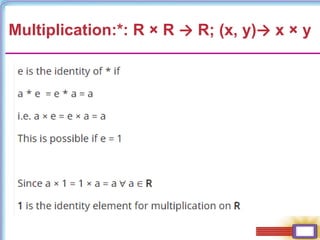
Multiplication:*: R × R → R; (x, y)→ x × y
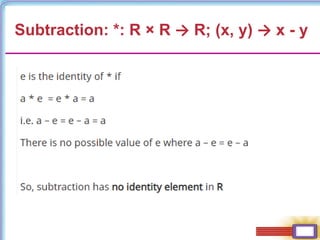
Subtraction: *: R × R → R; (x, y) → x - y
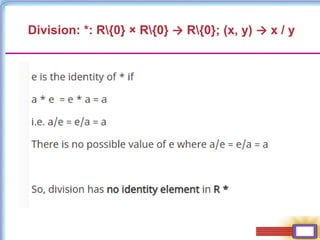
Division: *: R{0} × R{0} → R{0}; (x, y) → x / y
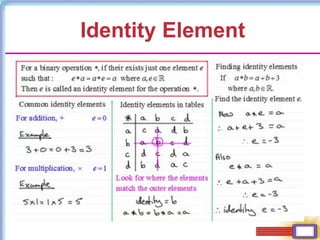
Define an identity element for a binary operation.
Binary
Operati
on
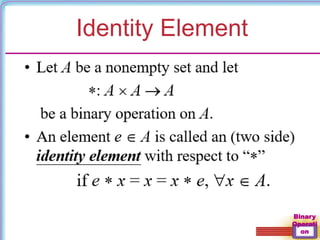
Identity Element
RTP: The Identity Element is Unique
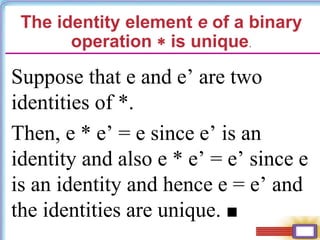
The identity element e of a binary
operation  is unique.
Suppose that e and e’ are two
identities of *.
Then, e * e’ = e since e’ is an
identity and also e * e’ = e’ since e
is an identity and hence e = e’ and
the identities are unique. ■
Identity Element
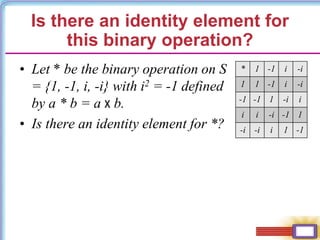
Is there an identity element for
this binary operation?
• Let * be the binary operation on S
= {1, -1, i, -i} with i2 = -1 defined
by a * b = a x b.
• Is there an identity element for *?
* 1 -1 i -i
1 1 -1 i -i
-1 -1 1 -i i
i i -i -1 1
-i -i i 1 -1
Binary
Operati
on
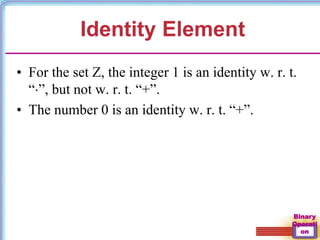
Identity Element
• For the set Z, the integer 1 is an identity w. r. t.
“”, but not w. r. t. “+”.
• The number 0 is an identity w. r. t. “+”.
Binary
Operati
on
Identity Element
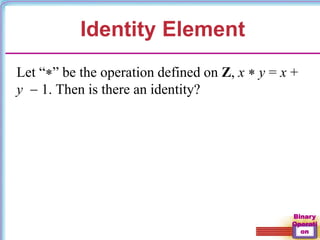
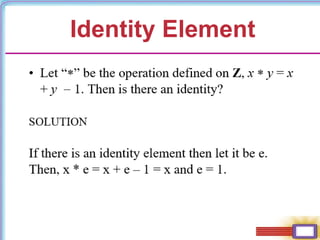
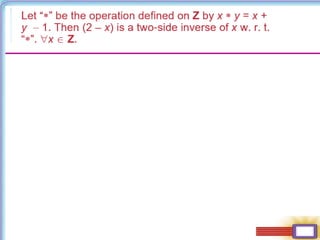
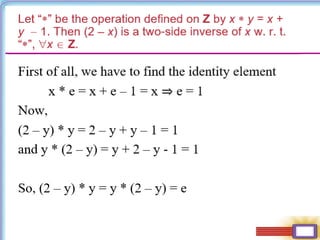
Let “” be the operation defined on Z, x  y = x +
y  1. Then is there an identity?
Identity Element
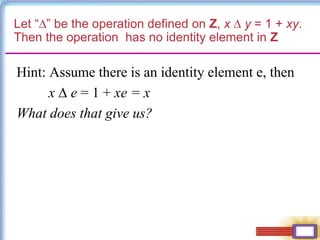
Let “∆” be the operation defined on Z, x ∆ y = 1 + xy.
Then the operation has no identity element in Z
Hint: Assume there is an identity element e, then
x ∆ e = 1 + xe = x
What does that give us?
SOLUTION
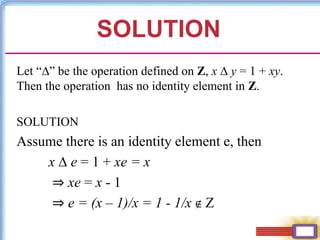
Let “∆” be the operation defined on Z, x ∆ y = 1 + xy.
Then the operation has no identity element in Z.
SOLUTION
Assume there is an identity element e, then
x ∆ e = 1 + xe = x
⇒ xe = x - 1
⇒ e = (x – 1)/x = 1 - 1/x ∉ Z
A binary operation which is NOT commutative?
A binary operation which is NOT associative?
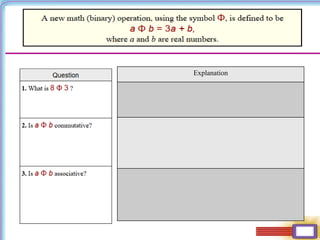
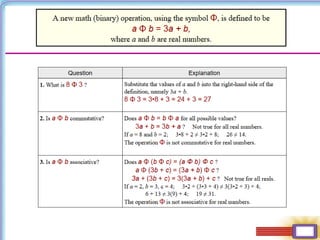
Explanation
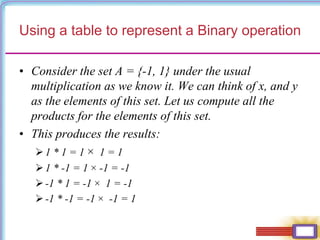
Using a table to represent a Binary operation
• Consider the set A = {-1, 1} under the usual
multiplication as we know it. We can think of x, and y
as the elements of this set. Let us compute all the
products for the elements of this set.
• This produces the results:
1 * 1 = 1 × 1 = 1
1 * -1 = 1 × -1 = -1
-1 * 1 = -1 × 1 = -1
-1 * -1 = -1 × -1 = 1
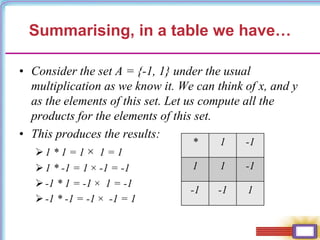
Summarising, in a table we have…
• Consider the set A = {-1, 1} under the usual
multiplication as we know it. We can think of x, and y
as the elements of this set. Let us compute all the
products for the elements of this set.
• This produces the results:
1 * 1 = 1 × 1 = 1
1 * -1 = 1 × -1 = -1
-1 * 1 = -1 × 1 = -1
-1 * -1 = -1 × -1 = 1
* 1 -1
1 1 -1
-1 -1 1
Cayley Table
When we are given a binary
operation on a finite set, it is common
to specify it in tabular form,
sometimes called a Cayley table.
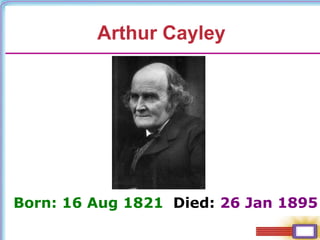
Arthur Cayley
Born: 16 Aug 1821 Died: 26 Jan 1895
• In 1863 Cayley was appointed Sadleirian
professor of Pure Mathematics at Cambridge.
• He published over 900 papers and notes
covering nearly every aspect of modern
mathematics.
Arthur Cayley
The most important of his work was
developing the algebra of matrices, work in
non-Euclidean geometry and n-dimensional
geometry.
As early as 1849 Cayley wrote a paper
linking his ideas on permutations with
Cauchy's.
 In 1854 Cayley wrote two papers which are
remarkable for the insight they have of
abstract groups.
Arthur Cayley
At that time the only known groups were
permutation groups and even this was a
radically new area, yet Cayley defines an
abstract group and gives a table to display the
group multiplication.
These tables become known as Cayley Tables.
Arthur Cayley
He gives the 'Cayley tables' of some special
permutation groups but, much more
significantly for the introduction of the
abstract group concept, he realised that
matrices were groups .
Arthur Cayley
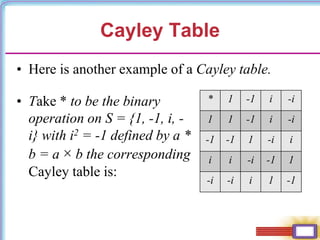
Cayley Table
• Take * to be the binary
operation on S = {1, -1, i, -
i} with i2 = -1 defined by a *
b = a × b the corresponding
Cayley table is:
• Here is another example of a Cayley table.
* 1 -1 i -i
1 1 -1 i -i
-1 -1 1 -i i
i i -i -1 1
-i -i i 1 -1
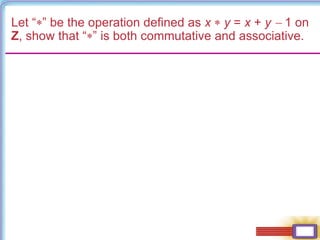
Let “” be the operation defined as x  y = x + y  1 on
Z, show that “” is both commutative and associative.
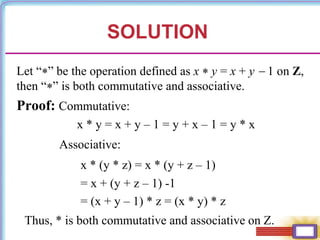
SOLUTION
Let “” be the operation defined as x  y = x + y  1 on Z,
then “” is both commutative and associative.
Proof: Commutative:
x * y = x + y – 1 = y + x – 1 = y * x
Associative:
x * (y * z) = x * (y + z – 1)
= x + (y + z – 1) -1
= (x + y – 1) * z = (x * y) * z
Thus, * is both commutative and associative on Z.
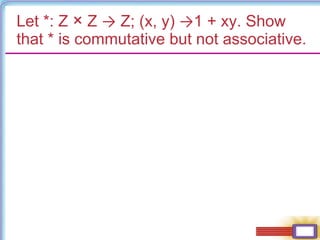
Let *: Z × Z → Z; (x, y) →1 + xy. Show
that * is commutative but not associative.
Show: x  y = x + 2y. This operation is neither
commutative, nor associative.
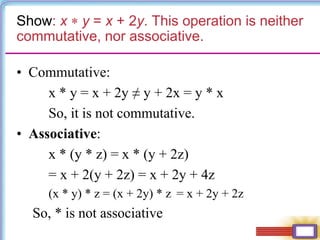
Show: x  y = x + 2y. This operation is neither
commutative, nor associative.
• Commutative:
x * y = x + 2y ≠ y + 2x = y * x
So, it is not commutative.
• Associative:
x * (y * z) = x * (y + 2z)
= x + 2(y + 2z) = x + 2y + 4z
(x * y) * z = (x + 2y) * z = x + 2y + 2z
So, * is not associative
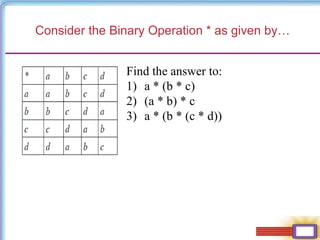
Consider the Binary Operation * as given by…
Find the answer to:
1) a * (b * c)
2) (a * b) * c
3) a * (b * (c * d))
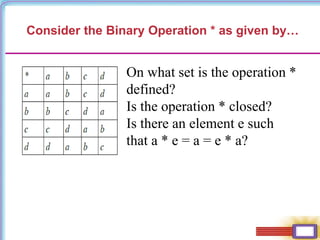
Consider the Binary Operation * as given by…
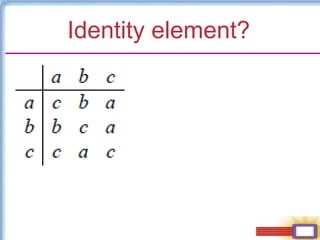
On what set is the operation *
defined?
Is the operation * closed?
Is there an element e such
that a * e = a = e * a?
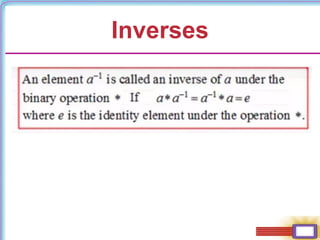
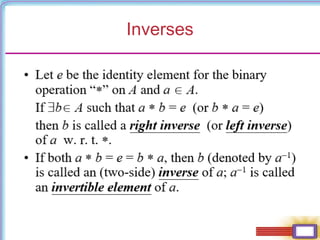
Inverses
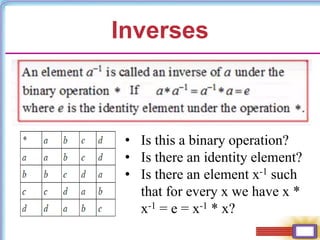
Inverses
• Is this a binary operation?
• Is there an identity element?
• Is there an element x-1 such
that for every x we have x *
x-1 = e = x-1 * x?
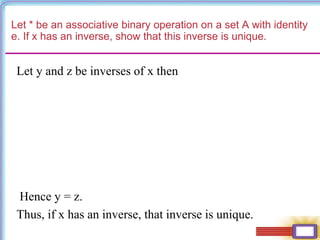
Let * be an associative binary operation on a set A with identity
e. If x has an inverse, show that this inverse is unique.
Let y and z be inverses of x then
Hence y = z.
Thus, if x has an inverse, that inverse is unique.
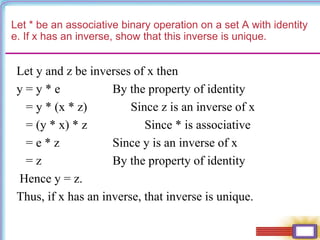
Let * be an associative binary operation on a set A with identity
e. If x has an inverse, show that this inverse is unique.
Let y and z be inverses of x then
y = y * e By the property of identity
= y * (x * z) Since z is an inverse of x
= (y * x) * z Since * is associative
= e * z Since y is an inverse of x
= z By the property of identity
Hence y = z.
Thus, if x has an inverse, that inverse is unique.
Inverses
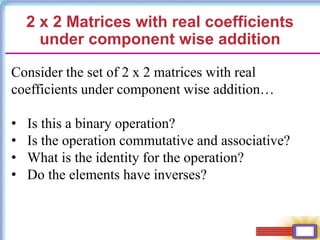
2 x 2 Matrices with real coefficients
under component wise addition
Consider the set of 2 x 2 matrices with real
coefficients under component wise addition…
• Is this a binary operation?
• Is the operation commutative and associative?
• What is the identity for the operation?
• Do the elements have inverses?
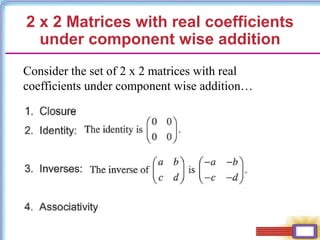
2 x 2 Matrices with real coefficients
under component wise addition
Consider the set of 2 x 2 matrices with real
coefficients under component wise addition…
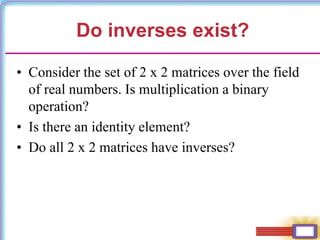
Do inverses exist?
• Consider the set of 2 x 2 matrices over the field
of real numbers. Is multiplication a binary
operation?
• Is there an identity element?
• Do all 2 x 2 matrices have inverses?
Do inverses exist?
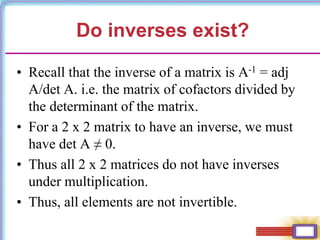
• Recall that the inverse of a matrix is A-1 = adj
A/det A. i.e. the matrix of cofactors divided by
the determinant of the matrix.
• For a 2 x 2 matrix to have an inverse, we must
have det A ≠ 0.
• Thus all 2 x 2 matrices do not have inverses
under multiplication.
• Thus, all elements are not invertible.
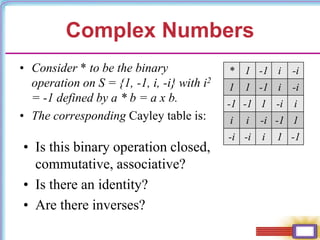
Complex Numbers
• Consider * to be the binary
operation on S = {1, -1, i, -i} with i2
= -1 defined by a * b = a x b.
• The corresponding Cayley table is:
• Is this binary operation closed,
commutative, associative?
• Is there an identity?
• Are there inverses?
* 1 -1 i -i
1 1 -1 i -i
-1 -1 1 -i i
i i -i -1 1
-i -i i 1 -1
Is there a way we can check for commutativity
quickly from the Cayley table?…
How would you check for associativity?…
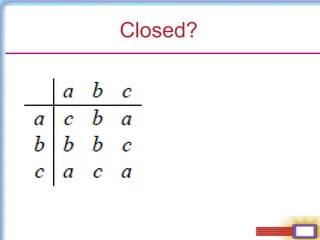
Closed?
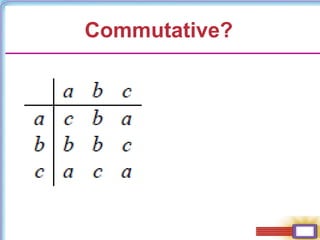
Commutative?
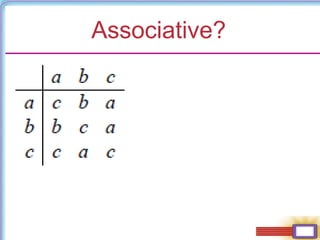
Associative?
Identity element?
Example – Power Set
• The intersection and union of two subsets of a set A are
both binary operations on the power set of A, P(A).
• If A = {1, 2} what would be the identity element for
each of these operations?
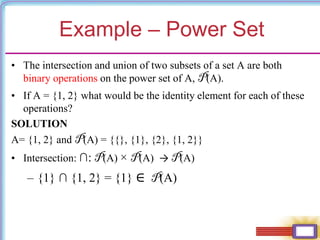
Example – Power Set
• The intersection and union of two subsets of a set A are both
binary operations on the power set of A, P(A).
• If A = {1, 2} what would be the identity element for each of these
operations?
SOLUTION
A= {1, 2} and P(A) = {{}, {1}, {2}, {1, 2}}
• Intersection: ∩: P(A) × P(A) → P(A)
– {1} ∩ {1, 2} = {1} ∈ P(A)
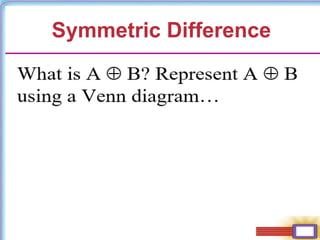
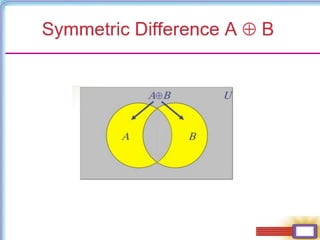
Symmetric Difference
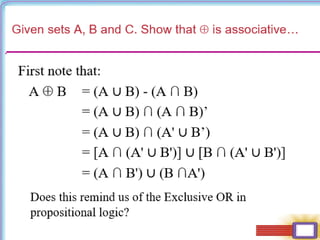
Does this remind us of the Exclusive OR in
propositional logic?
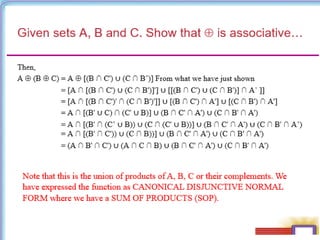
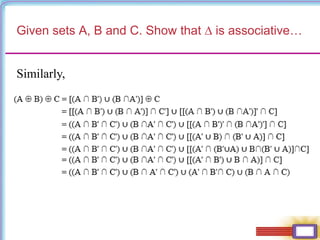
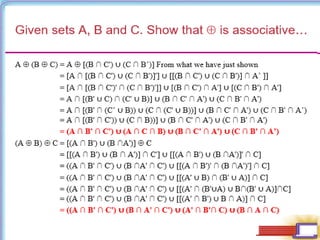
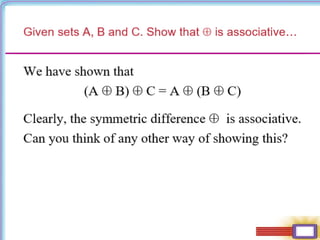
Given sets A, B and C. Show that ∆ is associative…
Similarly,
Some Past Paper Questions
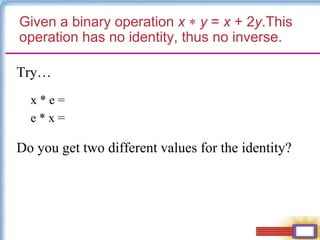
Given a binary operation x  y = x + 2y.This
operation has no identity, thus no inverse.
Try…
x * e =
e * x =
Do you get two different values for the identity?
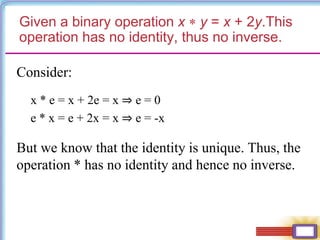
Given a binary operation x  y = x + 2y.This
operation has no identity, thus no inverse.
Consider:
x * e = x + 2e = x ⇒ e = 0
e * x = e + 2x = x ⇒ e = -x
But we know that the identity is unique. Thus, the
operation * has no identity and hence no inverse.
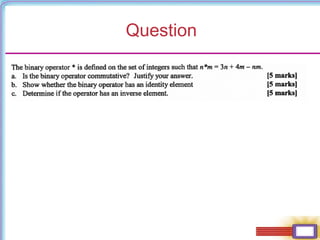
Question
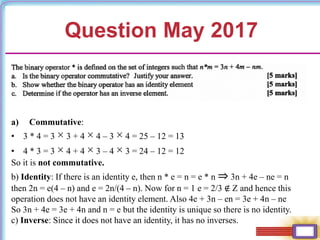
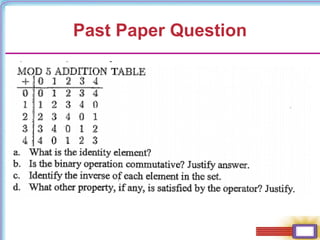
Question May 2017
a) Commutative:
• 3 * 4 = 3 × 3 + 4 × 4 – 3 × 4 = 25 – 12 = 13
• 4 * 3 = 3 × 4 + 4 × 3 – 4 × 3 = 24 – 12 = 12
So it is not commutative.
b) Identity: If there is an identity e, then n * e = n = e * n ⇒ 3n + 4e – ne = n
then 2n = e(4 – n) and e = 2n/(4 – n). Now for n = 1 e = 2/3 ∉ Z and hence this
operation does not have an identity element. Also 4e + 3n – en = 3e + 4n – ne
So 3n + 4e = 3e + 4n and n = e but the identity is unique so there is no identity.
c) Inverse: Since it does not have an identity, it has no inverses.
Past Paper Question
Questions

Dm2021 binary operations

  • 1.
  • 2.
    Binary Operations Take themultiplication operation on the set of integers, Z = {0, ±1, ±2, ±3,…}: x = +3 and y = +4 x × y = +12 (x, y) ∈ Z × Z and x × y ∈ Z We write *: Z × Z → Z; (x, y) → x × y
  • 3.
    Binary Operations Take theaddition operation on the set of integers, Z = {0, ±1, ±2, ±3,…}: x = +3 and y = -4 x + y = +3 + (-4) = -1∈ Z (x, y) ∈ Z × Z and x + y ∈ Z We write *: Z × Z → Z; (x, y) → x + y
  • 4.
    Binary Operation: : (x,y ) → f(x, y) That is a calculation that combines two elements of the set (called operands) to produce another element of the set. It maps elements of the Cartesian product A × A into A itself. i.e. f: A × A → A. We call the operation multiplication!
  • 5.
    Binary Operation notation •We usually write binary operations infix that is, between their arguments, rather than prefix, before their arguments. • Also, the symbols chosen for binary operations are usually reminiscent of + or × rather than letters.
  • 6.
    Examples: Infix notation Notethe infix positioning of the operation characteristic of binary operations.
  • 7.
    Binary operations onZ Given the set of integers X, we normally call the operation “multiplication” and denote it by * even though we can define the operations in many ways: • x * y = x + 2y + 3 • x * y = 1 + xy • x * y = 3x + y or even • x * y = x + y
  • 8.
  • 9.
  • 10.
  • 11.
    Are these binaryoperations? 1. a * b = a + b – 1 2. a * b = 1 – 2ab 3. a * b = a/b 4. a * b = a/b on Z {0} 5. For a, b ∈ A, a * b = a + b where A is the set A = {1, 2, 3, 4}. Given a, b ∈ Z. Consider the operations *: Z × Z → Z as follows:
  • 12.
  • 13.
    Some interesting questions? •Commutativity: does the order in which we perform the operation matter? • Associativity: does it matter how we group the operands? • Identity: is there are element which when used as an operand with another object returns the same object?
  • 14.
  • 15.
    Addition: +: R× R → R; (x, y) → x + y
  • 16.
    Multiplication:*: R ×R → R; (x, y)→ x × y
  • 17.
    Multiplication:*: R ×R → R; (x, y)→ x × y
  • 18.
    Subtraction: *: R× R → R; (x, y) → x - y
  • 19.
    Subtraction: *: R× R → R; (x, y) → x - y
  • 20.
    Division: *: R{0}× R{0} → R{0}; (x, y) → x / y
  • 21.
    Division: *: R{0}× R{0} → R{0}; (x, y) → x / y
  • 22.
    Define an identityelement for a binary operation.
  • 23.
  • 24.
    RTP: The IdentityElement is Unique
  • 25.
    The identity elemente of a binary operation  is unique. Suppose that e and e’ are two identities of *. Then, e * e’ = e since e’ is an identity and also e * e’ = e’ since e is an identity and hence e = e’ and the identities are unique. ■
  • 26.
  • 27.
    Is there anidentity element for this binary operation? • Let * be the binary operation on S = {1, -1, i, -i} with i2 = -1 defined by a * b = a x b. • Is there an identity element for *? * 1 -1 i -i 1 1 -1 i -i -1 -1 1 -i i i i -i -1 1 -i -i i 1 -1
  • 28.
    Binary Operati on Identity Element • Forthe set Z, the integer 1 is an identity w. r. t. “”, but not w. r. t. “+”. • The number 0 is an identity w. r. t. “+”.
  • 29.
    Binary Operati on Identity Element Let “”be the operation defined on Z, x  y = x + y  1. Then is there an identity?
  • 30.
  • 31.
    Let “∆” bethe operation defined on Z, x ∆ y = 1 + xy. Then the operation has no identity element in Z Hint: Assume there is an identity element e, then x ∆ e = 1 + xe = x What does that give us?
  • 32.
    SOLUTION Let “∆” bethe operation defined on Z, x ∆ y = 1 + xy. Then the operation has no identity element in Z. SOLUTION Assume there is an identity element e, then x ∆ e = 1 + xe = x ⇒ xe = x - 1 ⇒ e = (x – 1)/x = 1 - 1/x ∉ Z
  • 33.
    A binary operationwhich is NOT commutative?
  • 34.
    A binary operationwhich is NOT associative?
  • 35.
  • 37.
    Using a tableto represent a Binary operation • Consider the set A = {-1, 1} under the usual multiplication as we know it. We can think of x, and y as the elements of this set. Let us compute all the products for the elements of this set. • This produces the results: 1 * 1 = 1 × 1 = 1 1 * -1 = 1 × -1 = -1 -1 * 1 = -1 × 1 = -1 -1 * -1 = -1 × -1 = 1
  • 38.
    Summarising, in atable we have… • Consider the set A = {-1, 1} under the usual multiplication as we know it. We can think of x, and y as the elements of this set. Let us compute all the products for the elements of this set. • This produces the results: 1 * 1 = 1 × 1 = 1 1 * -1 = 1 × -1 = -1 -1 * 1 = -1 × 1 = -1 -1 * -1 = -1 × -1 = 1 * 1 -1 1 1 -1 -1 -1 1
  • 39.
    Cayley Table When weare given a binary operation on a finite set, it is common to specify it in tabular form, sometimes called a Cayley table.
  • 40.
    Arthur Cayley Born: 16Aug 1821 Died: 26 Jan 1895
  • 41.
    • In 1863Cayley was appointed Sadleirian professor of Pure Mathematics at Cambridge. • He published over 900 papers and notes covering nearly every aspect of modern mathematics. Arthur Cayley
  • 42.
    The most importantof his work was developing the algebra of matrices, work in non-Euclidean geometry and n-dimensional geometry. As early as 1849 Cayley wrote a paper linking his ideas on permutations with Cauchy's.  In 1854 Cayley wrote two papers which are remarkable for the insight they have of abstract groups. Arthur Cayley
  • 43.
    At that timethe only known groups were permutation groups and even this was a radically new area, yet Cayley defines an abstract group and gives a table to display the group multiplication. These tables become known as Cayley Tables. Arthur Cayley
  • 44.
    He gives the'Cayley tables' of some special permutation groups but, much more significantly for the introduction of the abstract group concept, he realised that matrices were groups . Arthur Cayley
  • 45.
    Cayley Table • Take* to be the binary operation on S = {1, -1, i, - i} with i2 = -1 defined by a * b = a × b the corresponding Cayley table is: • Here is another example of a Cayley table. * 1 -1 i -i 1 1 -1 i -i -1 -1 1 -i i i i -i -1 1 -i -i i 1 -1
  • 46.
    Let “” bethe operation defined as x  y = x + y  1 on Z, show that “” is both commutative and associative.
  • 47.
    SOLUTION Let “” bethe operation defined as x  y = x + y  1 on Z, then “” is both commutative and associative. Proof: Commutative: x * y = x + y – 1 = y + x – 1 = y * x Associative: x * (y * z) = x * (y + z – 1) = x + (y + z – 1) -1 = (x + y – 1) * z = (x * y) * z Thus, * is both commutative and associative on Z.
  • 48.
    Let *: Z× Z → Z; (x, y) →1 + xy. Show that * is commutative but not associative.
  • 49.
    Show: x y = x + 2y. This operation is neither commutative, nor associative.
  • 50.
    Show: x y = x + 2y. This operation is neither commutative, nor associative. • Commutative: x * y = x + 2y ≠ y + 2x = y * x So, it is not commutative. • Associative: x * (y * z) = x * (y + 2z) = x + 2(y + 2z) = x + 2y + 4z (x * y) * z = (x + 2y) * z = x + 2y + 2z So, * is not associative
  • 51.
    Consider the BinaryOperation * as given by… Find the answer to: 1) a * (b * c) 2) (a * b) * c 3) a * (b * (c * d))
  • 52.
    Consider the BinaryOperation * as given by… On what set is the operation * defined? Is the operation * closed? Is there an element e such that a * e = a = e * a?
  • 53.
  • 54.
    Inverses • Is thisa binary operation? • Is there an identity element? • Is there an element x-1 such that for every x we have x * x-1 = e = x-1 * x?
  • 55.
    Let * bean associative binary operation on a set A with identity e. If x has an inverse, show that this inverse is unique. Let y and z be inverses of x then Hence y = z. Thus, if x has an inverse, that inverse is unique.
  • 56.
    Let * bean associative binary operation on a set A with identity e. If x has an inverse, show that this inverse is unique. Let y and z be inverses of x then y = y * e By the property of identity = y * (x * z) Since z is an inverse of x = (y * x) * z Since * is associative = e * z Since y is an inverse of x = z By the property of identity Hence y = z. Thus, if x has an inverse, that inverse is unique.
  • 57.
  • 58.
    2 x 2Matrices with real coefficients under component wise addition Consider the set of 2 x 2 matrices with real coefficients under component wise addition… • Is this a binary operation? • Is the operation commutative and associative? • What is the identity for the operation? • Do the elements have inverses?
  • 59.
    2 x 2Matrices with real coefficients under component wise addition Consider the set of 2 x 2 matrices with real coefficients under component wise addition…
  • 60.
    Do inverses exist? •Consider the set of 2 x 2 matrices over the field of real numbers. Is multiplication a binary operation? • Is there an identity element? • Do all 2 x 2 matrices have inverses?
  • 61.
    Do inverses exist? •Recall that the inverse of a matrix is A-1 = adj A/det A. i.e. the matrix of cofactors divided by the determinant of the matrix. • For a 2 x 2 matrix to have an inverse, we must have det A ≠ 0. • Thus all 2 x 2 matrices do not have inverses under multiplication. • Thus, all elements are not invertible.
  • 64.
    Complex Numbers • Consider* to be the binary operation on S = {1, -1, i, -i} with i2 = -1 defined by a * b = a x b. • The corresponding Cayley table is: • Is this binary operation closed, commutative, associative? • Is there an identity? • Are there inverses? * 1 -1 i -i 1 1 -1 i -i -1 -1 1 -i i i i -i -1 1 -i -i i 1 -1
  • 65.
    Is there away we can check for commutativity quickly from the Cayley table?…
  • 66.
    How would youcheck for associativity?…
  • 67.
  • 68.
  • 69.
  • 70.
  • 71.
    Example – PowerSet • The intersection and union of two subsets of a set A are both binary operations on the power set of A, P(A). • If A = {1, 2} what would be the identity element for each of these operations?
  • 72.
    Example – PowerSet • The intersection and union of two subsets of a set A are both binary operations on the power set of A, P(A). • If A = {1, 2} what would be the identity element for each of these operations? SOLUTION A= {1, 2} and P(A) = {{}, {1}, {2}, {1, 2}} • Intersection: ∩: P(A) × P(A) → P(A) – {1} ∩ {1, 2} = {1} ∈ P(A)
  • 73.
  • 75.
  • 76.
    Does this remindus of the Exclusive OR in propositional logic?
  • 78.
    Given sets A,B and C. Show that ∆ is associative… Similarly,
  • 81.
    Some Past PaperQuestions
  • 82.
    Given a binaryoperation x  y = x + 2y.This operation has no identity, thus no inverse. Try… x * e = e * x = Do you get two different values for the identity?
  • 83.
    Given a binaryoperation x  y = x + 2y.This operation has no identity, thus no inverse. Consider: x * e = x + 2e = x ⇒ e = 0 e * x = e + 2x = x ⇒ e = -x But we know that the identity is unique. Thus, the operation * has no identity and hence no inverse.
  • 84.
  • 85.
    Question May 2017 a)Commutative: • 3 * 4 = 3 × 3 + 4 × 4 – 3 × 4 = 25 – 12 = 13 • 4 * 3 = 3 × 4 + 4 × 3 – 4 × 3 = 24 – 12 = 12 So it is not commutative. b) Identity: If there is an identity e, then n * e = n = e * n ⇒ 3n + 4e – ne = n then 2n = e(4 – n) and e = 2n/(4 – n). Now for n = 1 e = 2/3 ∉ Z and hence this operation does not have an identity element. Also 4e + 3n – en = 3e + 4n – ne So 3n + 4e = 3e + 4n and n = e but the identity is unique so there is no identity. c) Inverse: Since it does not have an identity, it has no inverses.
  • 86.
  • 87.