Newton-Raphson IterationNewton-Raphson Iteration
Subject-NTSM (MATHS 4)
GEC Gandhinagar Sector-28
Bhojani Nemish V.-150130103017
Module C3
MEI/OCR
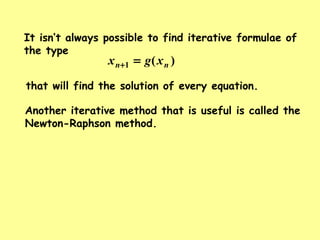
)(1 nn xgx =+
It isn’t always possible to find iterative formulae of
the type
that will find the solution of every equation.
Another iterative method that is useful is called the
Newton-Raphson method.
)(xfy =
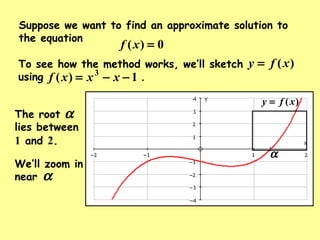
Suppose we want to find an approximate solution to
the equation
0)( =xf
The root
lies between
1 and 2.
α
α
To see how the method works, we’ll sketch
using .
)(xfy =
1)( 3
−−= xxxf
We’ll zoom in
near α
)(xfy =
α
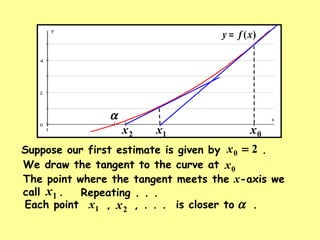
Suppose our first estimate is given by .20 =x
We draw the tangent to the curve at 0x
0x
Each point , , . . . is closer to .1x 2x α
1x
Repeating . . .
2x
The point where the tangent meets the x-axis we
call .1x
)(xfy =
0x1x
),( 00 yx x
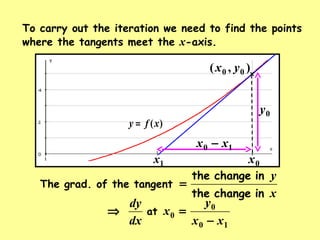
To carry out the iteration we need to find the points
where the tangents meet the x-axis.
The grad. of the tangent
x
y
inchangethe
inchangethe
=
10
0
0
xx
y
x
dx
dy
−
=⇒ at
0y
10 xx −
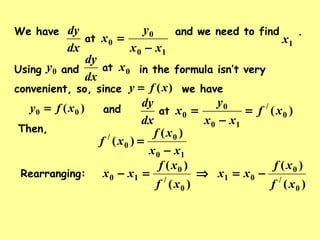
)( 00 xfy = and
10
0
0
xx
y
x
dx
dy
−
=at
We have and we need to find .
1x
Then,
10
0
0
/ )(
)(
xx
xf
xf
−
=
Rearranging:
)(
)(
0
/
0
10
xf
xf
xx =−
)(
)(
0
/
0
01
xf
xf
xx −=⇒
Using and in the formula isn’t very
convenient, so, since we have)(xfy =
0x
dx
dy
at0y
)( 0
/
10
0
0 xf
xx
y
x
dx
dy
=
−
=at
)(
)(
0
/
0
01
xf
xf
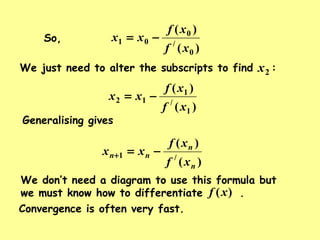
xx −=So,
We just need to alter the subscripts to find :2x
)(
)(
1
/
1
12
xf
xf
xx −=
Generalising gives
)(
)(
/1
n
n
nn
xf
xf
xx −=+
We don’t need a diagram to use this formula but
we must know how to differentiate .)(xf
Convergence is often very fast.
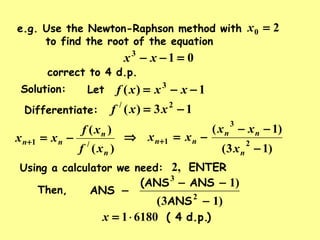
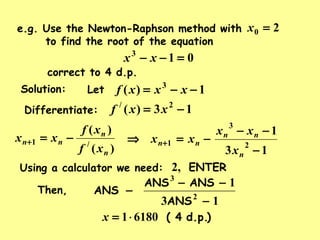
e.g. Use the Newton-Raphson method with
to find the root of the equation
20 =x
013
=−− xx
correct to 4 d.p.
Solution: Let 1)( 3
−−= xxxf
Differentiate: 13)( 2/
−= xxf
)(
)(
/1
n
n
nn
xf
xf
xx −=+
)13(
)1(
2
3
1
−
−−
−=⇒ +
n
nn
nn
x
xx
xx
Using a calculator we need: ENTER,2
)d.p.( 461801⋅=x
ANS
ANS(ANS
ANS
)13(
)1
2
3
−
−−
−Then,
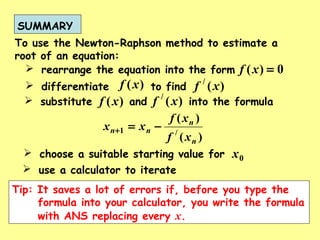
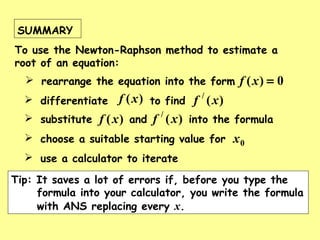
SUMMARY
To use the Newton-Raphson method to estimate a
root of an equation:
 rearrange the equation into the form 0)( =xf
 choose a suitable starting value for 0x
 substitute and into the formula)(xf )(/
xf
 differentiate to find)(xf )(/
xf
Tip: It saves a lot of errors if, before you type the
formula into your calculator, you write the formula
with ANS replacing every x.
 use a calculator to iterate
)(
)(
/1
n
n
nn
xf
xf
xx −=+
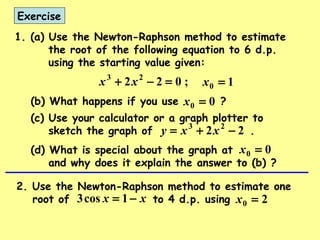
Exercise
1. (a) Use the Newton-Raphson method to estimate
the root of the following equation to 6 d.p.
using the starting value given:
;022 23
=−+ xx 10 =x
(b) What happens if you use ?
22 23
−+= xxy
00 =x
(c) Use your calculator or a graph plotter to
sketch the graph of .
(d) What is special about the graph at
and why does it explain the answer to (b) ?
00 =x
2. Use the Newton-Raphson method to estimate one
root of to 4 d.p. usingxx −= 1cos3 20 =x
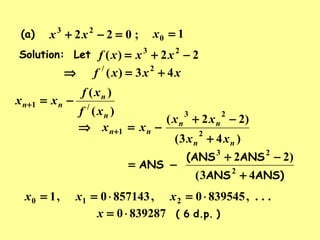
Solution: Let 22)( 23
−+= xxxf
;022 23
=−+ xx 10 =x(a)
xxxf 43)( 2/
+=⇒
)(
)(
/1
n
n
nn
xf
xf
xx −=+
)43(
)22(
2
23
1
nn
nn
nn
xx
xx
xx
+
−+
−=⇒ +
ANS)ANS
ANS(ANS
ANS
43(
)22
2
23
+
−+
−=
...,8395450,8571430,1 210 ⋅=⋅== xxx
)d.p.6(8392870⋅=x
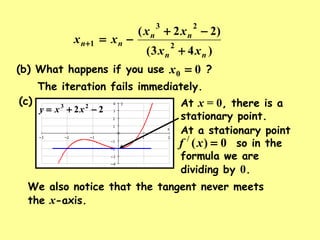
The iteration fails immediately.
(b) What happens if you use ?00 =x
)43(
)22(
2
23
1
nn
nn
nn
xx
xx
xx
+
−+
−=+
(c)
22 23
−+= xxy
At x = 0, there is a
stationary point.
We also notice that the tangent never meets
the x-axis.
At a stationary point
so in the
formula we are
dividing by 0.
0)(/
=xf
Solution:
,20 =x
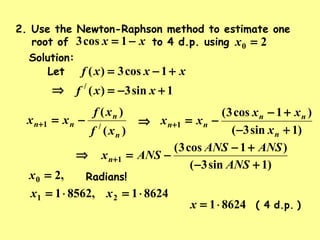
2. Use the Newton-Raphson method to estimate one
root of to 4 d.p. usingxx −= 1cos3 20 =x
Let xxxf +−= 1cos3)(
1sin3)(/
+−= xxf⇒
)(
)(
/1
n
n
nn
xf
xf
xx −=+ ⇒
)1sin3(
)1cos3(
1
+−
+−
−=+
n
nn
nn
x
xx
xx
Radians!
86241,85621 21 ⋅=⋅= xx
)d.p.( 486241⋅=x
⇒
)1sin3(
)1cos3(
1
+−
+−
−=+
ANS
ANSANS
ANSxn
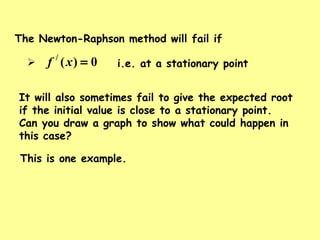
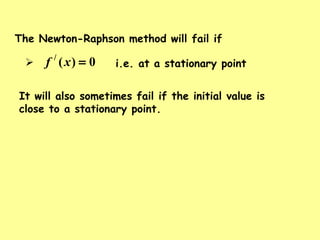
The Newton-Raphson method will fail if
 i.e. at a stationary point0)(/
=xf
It will also sometimes fail to give the expected root
if the initial value is close to a stationary point.
Can you draw a graph to show what could happen in
this case?
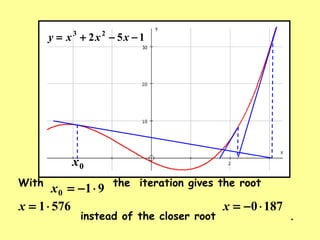
This is one example.
152 23
−−+= xxxy
With the iteration gives the root
instead of the closer root .
910 ⋅−=x
5761⋅=x 1870⋅−=x
0x
The following slides contain repeats of
information on earlier slides, shown without
colour, so that they can be printed and
photocopied.
For most purposes the slides can be printed
as “Handouts” with up to 6 slides per sheet.
)(1 nn xgx =+
It isn’t always possible to find iterative formulae of
the type
that will find the solution of every equation.
Another iterative method that is useful is called the
Newton-Raphson method.
SUMMARY
To use the Newton-Raphson method to estimate a
root of an equation:
 rearrange the equation into the form 0)( =xf
 choose a suitable starting value for 0x
 substitute and into the formula)(xf )(/
xf
 differentiate to find)(xf )(/
xf
Tip: It saves a lot of errors if, before you type the
formula into your calculator, you write the formula
with ANS replacing every x.
 use a calculator to iterate
e.g. Use the Newton-Raphson method with
to find the root of the equation
20 =x
013
=−− xx
correct to 4 d.p.
Solution: Let 1)( 3
−−= xxxf
Differentiate: 13)( 2/
−= xxf
)(
)(
/1
n
n
nn
xf
xf
xx −=+
13
1
2
3
1
−
−−
−=⇒ +
n
nn
nn
x
xx
xx
Using a calculator we need: ENTER,2
)d.p.( 461801⋅=x
ANS
ANSANS
ANS
13
1
2
3
−
−−
−Then,
The Newton-Raphson method will fail if
 i.e. at a stationary point0)(/
=xf
It will also sometimes fail if the initial value is
close to a stationary point.

Newton-Raphson Iteration marths 4 ntsm

  • 1.
    Newton-Raphson IterationNewton-Raphson Iteration Subject-NTSM(MATHS 4) GEC Gandhinagar Sector-28 Bhojani Nemish V.-150130103017
  • 2.
  • 3.
    )(1 nn xgx=+ It isn’t always possible to find iterative formulae of the type that will find the solution of every equation. Another iterative method that is useful is called the Newton-Raphson method.
  • 4.
    )(xfy = Suppose wewant to find an approximate solution to the equation 0)( =xf The root lies between 1 and 2. α α To see how the method works, we’ll sketch using . )(xfy = 1)( 3 −−= xxxf We’ll zoom in near α
  • 5.
    )(xfy = α Suppose ourfirst estimate is given by .20 =x We draw the tangent to the curve at 0x 0x Each point , , . . . is closer to .1x 2x α 1x Repeating . . . 2x The point where the tangent meets the x-axis we call .1x
  • 6.
    )(xfy = 0x1x ),( 00yx x To carry out the iteration we need to find the points where the tangents meet the x-axis. The grad. of the tangent x y inchangethe inchangethe = 10 0 0 xx y x dx dy − =⇒ at 0y 10 xx −
  • 7.
    )( 00 xfy= and 10 0 0 xx y x dx dy − =at We have and we need to find . 1x Then, 10 0 0 / )( )( xx xf xf − = Rearranging: )( )( 0 / 0 10 xf xf xx =− )( )( 0 / 0 01 xf xf xx −=⇒ Using and in the formula isn’t very convenient, so, since we have)(xfy = 0x dx dy at0y )( 0 / 10 0 0 xf xx y x dx dy = − =at
  • 8.
    )( )( 0 / 0 01 xf xf xx −=So, We justneed to alter the subscripts to find :2x )( )( 1 / 1 12 xf xf xx −= Generalising gives )( )( /1 n n nn xf xf xx −=+ We don’t need a diagram to use this formula but we must know how to differentiate .)(xf Convergence is often very fast.
  • 9.
    e.g. Use theNewton-Raphson method with to find the root of the equation 20 =x 013 =−− xx correct to 4 d.p. Solution: Let 1)( 3 −−= xxxf Differentiate: 13)( 2/ −= xxf )( )( /1 n n nn xf xf xx −=+ )13( )1( 2 3 1 − −− −=⇒ + n nn nn x xx xx Using a calculator we need: ENTER,2 )d.p.( 461801⋅=x ANS ANS(ANS ANS )13( )1 2 3 − −− −Then,
  • 10.
    SUMMARY To use theNewton-Raphson method to estimate a root of an equation:  rearrange the equation into the form 0)( =xf  choose a suitable starting value for 0x  substitute and into the formula)(xf )(/ xf  differentiate to find)(xf )(/ xf Tip: It saves a lot of errors if, before you type the formula into your calculator, you write the formula with ANS replacing every x.  use a calculator to iterate )( )( /1 n n nn xf xf xx −=+
  • 11.
    Exercise 1. (a) Usethe Newton-Raphson method to estimate the root of the following equation to 6 d.p. using the starting value given: ;022 23 =−+ xx 10 =x (b) What happens if you use ? 22 23 −+= xxy 00 =x (c) Use your calculator or a graph plotter to sketch the graph of . (d) What is special about the graph at and why does it explain the answer to (b) ? 00 =x 2. Use the Newton-Raphson method to estimate one root of to 4 d.p. usingxx −= 1cos3 20 =x
  • 12.
    Solution: Let 22)(23 −+= xxxf ;022 23 =−+ xx 10 =x(a) xxxf 43)( 2/ +=⇒ )( )( /1 n n nn xf xf xx −=+ )43( )22( 2 23 1 nn nn nn xx xx xx + −+ −=⇒ + ANS)ANS ANS(ANS ANS 43( )22 2 23 + −+ −= ...,8395450,8571430,1 210 ⋅=⋅== xxx )d.p.6(8392870⋅=x
  • 13.
    The iteration failsimmediately. (b) What happens if you use ?00 =x )43( )22( 2 23 1 nn nn nn xx xx xx + −+ −=+ (c) 22 23 −+= xxy At x = 0, there is a stationary point. We also notice that the tangent never meets the x-axis. At a stationary point so in the formula we are dividing by 0. 0)(/ =xf
  • 14.
    Solution: ,20 =x 2. Usethe Newton-Raphson method to estimate one root of to 4 d.p. usingxx −= 1cos3 20 =x Let xxxf +−= 1cos3)( 1sin3)(/ +−= xxf⇒ )( )( /1 n n nn xf xf xx −=+ ⇒ )1sin3( )1cos3( 1 +− +− −=+ n nn nn x xx xx Radians! 86241,85621 21 ⋅=⋅= xx )d.p.( 486241⋅=x ⇒ )1sin3( )1cos3( 1 +− +− −=+ ANS ANSANS ANSxn
  • 15.
    The Newton-Raphson methodwill fail if  i.e. at a stationary point0)(/ =xf It will also sometimes fail to give the expected root if the initial value is close to a stationary point. Can you draw a graph to show what could happen in this case? This is one example.
  • 16.
    152 23 −−+= xxxy Withthe iteration gives the root instead of the closer root . 910 ⋅−=x 5761⋅=x 1870⋅−=x 0x
  • 17.
    The following slidescontain repeats of information on earlier slides, shown without colour, so that they can be printed and photocopied. For most purposes the slides can be printed as “Handouts” with up to 6 slides per sheet.
  • 18.
    )(1 nn xgx=+ It isn’t always possible to find iterative formulae of the type that will find the solution of every equation. Another iterative method that is useful is called the Newton-Raphson method.
  • 19.
    SUMMARY To use theNewton-Raphson method to estimate a root of an equation:  rearrange the equation into the form 0)( =xf  choose a suitable starting value for 0x  substitute and into the formula)(xf )(/ xf  differentiate to find)(xf )(/ xf Tip: It saves a lot of errors if, before you type the formula into your calculator, you write the formula with ANS replacing every x.  use a calculator to iterate
  • 20.
    e.g. Use theNewton-Raphson method with to find the root of the equation 20 =x 013 =−− xx correct to 4 d.p. Solution: Let 1)( 3 −−= xxxf Differentiate: 13)( 2/ −= xxf )( )( /1 n n nn xf xf xx −=+ 13 1 2 3 1 − −− −=⇒ + n nn nn x xx xx Using a calculator we need: ENTER,2 )d.p.( 461801⋅=x ANS ANSANS ANS 13 1 2 3 − −− −Then,
  • 21.
    The Newton-Raphson methodwill fail if  i.e. at a stationary point0)(/ =xf It will also sometimes fail if the initial value is close to a stationary point.