Presentation on
Newton-Raphsan Method
Group Member
Shahadat Hossain 131-15-2313
Sakhawat Hossain 131-15-2406
Mahmud Ahmed 131-15-2404
Din Islam 131-15-2243
Ibrahim Faisal 131-15-2262
Alamin Khan 131-15-2412
Motivation
Newton method is originally developed for finding a root of a function. It is
also known as Newton-Raphson method.The problem can be formulated as,
given a function 𝑓: 𝑅 → 𝑅 , finding the point 𝑥0 such that 𝑓(𝑥0) = 0.
Background
The long way of Newton’s method to become Newton’s method, The name "Newton's method" is
derived from Isaac Newton's description of a special case of the method in De analysi per
aequationes numero terminorum infinitas. and in De metodis fluxionum et serierum
infinitarum. Newton applies the method only to polynomials. He does not compute the successive
approximations , but computes a sequence of polynomials, and only at the end arrives at an
approximation for the root x. Finally, Newton views the Vieta’s method. while his successor Jamshīd
al-Kāshī used a form of Newton's method to solve to find roots of N (Ypma 1995). A special case of
Newton's method for calculating square roots was known much earlier and is often called the Babylonian
method. Newton's method was used by 17th-century Japanese mathematician Seki Kōwa to
solve single-variable equations. Newton's method was first published in 1685 in A Treatise of Algebra
both Historical and Practical by John Wallis. In 1690, Joseph Raphson published a simplified
description inAnalysis aequationum universalis. Raphson again viewed Newton's method purely as an
algebraic method and restricted its use to polynomials, but he describes the method in terms of the
successive approximations xn instead of the more complicated sequence of polynomials used by
Newton. Finally, in 1740, Thomas Simpson described Newton's method as an iterative method for
solving general nonlinear equations using calculus, essentially giving the description above. In
the same publication, Simpson also gives the generalization to systems of two equations and
notes that Newton's method can be used for solving optimization problems by setting the gradient
to zero.
When this method is Applicable
If we’ve ever tried to find a root of a complicated function
algebraically, we may have had some difficulty. Using some basic
concepts of calculus, we have ways of numerically evaluating roots
of complicated functions. Commonly, we use the Newton-Raphson
method.This iterative process follows a set guideline to
approximate one root, considering the function, its derivative, and
an initial x-value
Newton-Raphsan Method
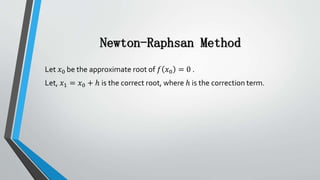
Let 𝑥0 be the approximate root of 𝑓 𝑥0 = 0 .
Let, 𝑥1 = 𝑥0 + ℎ is the correct root, where ℎ is the correction term.
Example
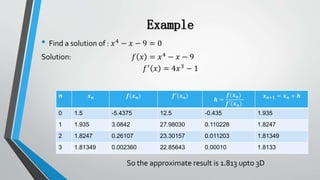
• Find a solution of : 𝑥4 − 𝑥 − 9 = 0
Solution: 𝑓 𝑥 = 𝑥4 − 𝑥 − 9
𝑓′ 𝑥 = 4𝑥3 − 1
So the approximate result is 1.813 upto 3D
n 𝒙 𝒏 𝒇(𝒙 𝒏) 𝒇′(𝒙 𝒏)
𝒉 =
𝒇(𝒙 𝒏)
𝒇′(𝒙 𝒏)
𝒙 𝒏+𝟏 = 𝒙 𝒏 + 𝒉
0 1.5 -5.4375 12.5 -0.435 1.935
1 1.935 3.0842 27.98030 0.110228 1.8247
2 1.8247 0.26107 23.30157 0.011203 1.81349
3 1.81349 0.002360 22.85643 0.00010 1.8133
Programming
Advantages of Newton-Raphson
• One of the fastest convergences to the root
• Converges on the root quadraticly
• Near a root, the number of significant digits approximately doubles with each step.
• This leads to the ability of the Newton-Raphson Method to “polish” a root from another
convergence technique
• Easy to convert to multiple dimensions
• Can be used to “polish” a root found by other methods
Application
• Multiplicative inverses of numbers and power series.
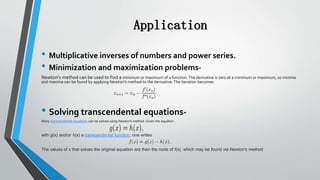
• Minimization and maximization problems-
Newton's method can be used to find a minimum or maximum of a function.The derivative is zero at a minimum or maximum, so minima
and maxima can be found by applying Newton's method to the derivative.The iteration becomes
• Solving transcendental equations-
Many transcendental equations can be solved using Newton's method. Given the equation
with g(x) and/or h(x) a transcendental function, one writes
The values of x that solves the original equation are then the roots of f(x), which may be found via Newton's method
Failure Analysis
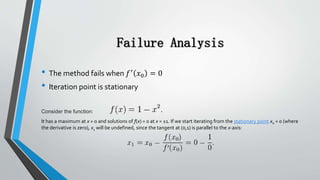
• The method fails when 𝑓′ 𝑥0 = 0
• Iteration point is stationary
Consider the function:
It has a maximum at x = 0 and solutions of f(x) = 0 at x = ±1. If we start iterating from the stationary point x0 = 0 (where
the derivative is zero), x1 will be undefined, since the tangent at (0,1) is parallel to the x-axis:
Mah

Mah

  • 1.
  • 2.
    Group Member Shahadat Hossain131-15-2313 Sakhawat Hossain 131-15-2406 Mahmud Ahmed 131-15-2404 Din Islam 131-15-2243 Ibrahim Faisal 131-15-2262 Alamin Khan 131-15-2412
  • 3.
    Motivation Newton method isoriginally developed for finding a root of a function. It is also known as Newton-Raphson method.The problem can be formulated as, given a function 𝑓: 𝑅 → 𝑅 , finding the point 𝑥0 such that 𝑓(𝑥0) = 0.
  • 4.
    Background The long wayof Newton’s method to become Newton’s method, The name "Newton's method" is derived from Isaac Newton's description of a special case of the method in De analysi per aequationes numero terminorum infinitas. and in De metodis fluxionum et serierum infinitarum. Newton applies the method only to polynomials. He does not compute the successive approximations , but computes a sequence of polynomials, and only at the end arrives at an approximation for the root x. Finally, Newton views the Vieta’s method. while his successor Jamshīd al-Kāshī used a form of Newton's method to solve to find roots of N (Ypma 1995). A special case of Newton's method for calculating square roots was known much earlier and is often called the Babylonian method. Newton's method was used by 17th-century Japanese mathematician Seki Kōwa to solve single-variable equations. Newton's method was first published in 1685 in A Treatise of Algebra both Historical and Practical by John Wallis. In 1690, Joseph Raphson published a simplified description inAnalysis aequationum universalis. Raphson again viewed Newton's method purely as an algebraic method and restricted its use to polynomials, but he describes the method in terms of the successive approximations xn instead of the more complicated sequence of polynomials used by Newton. Finally, in 1740, Thomas Simpson described Newton's method as an iterative method for solving general nonlinear equations using calculus, essentially giving the description above. In the same publication, Simpson also gives the generalization to systems of two equations and notes that Newton's method can be used for solving optimization problems by setting the gradient to zero.
  • 5.
    When this methodis Applicable If we’ve ever tried to find a root of a complicated function algebraically, we may have had some difficulty. Using some basic concepts of calculus, we have ways of numerically evaluating roots of complicated functions. Commonly, we use the Newton-Raphson method.This iterative process follows a set guideline to approximate one root, considering the function, its derivative, and an initial x-value
  • 6.
    Newton-Raphsan Method Let 𝑥0be the approximate root of 𝑓 𝑥0 = 0 . Let, 𝑥1 = 𝑥0 + ℎ is the correct root, where ℎ is the correction term.
  • 7.
    Example • Find asolution of : 𝑥4 − 𝑥 − 9 = 0 Solution: 𝑓 𝑥 = 𝑥4 − 𝑥 − 9 𝑓′ 𝑥 = 4𝑥3 − 1 So the approximate result is 1.813 upto 3D n 𝒙 𝒏 𝒇(𝒙 𝒏) 𝒇′(𝒙 𝒏) 𝒉 = 𝒇(𝒙 𝒏) 𝒇′(𝒙 𝒏) 𝒙 𝒏+𝟏 = 𝒙 𝒏 + 𝒉 0 1.5 -5.4375 12.5 -0.435 1.935 1 1.935 3.0842 27.98030 0.110228 1.8247 2 1.8247 0.26107 23.30157 0.011203 1.81349 3 1.81349 0.002360 22.85643 0.00010 1.8133
  • 8.
  • 9.
    Advantages of Newton-Raphson •One of the fastest convergences to the root • Converges on the root quadraticly • Near a root, the number of significant digits approximately doubles with each step. • This leads to the ability of the Newton-Raphson Method to “polish” a root from another convergence technique • Easy to convert to multiple dimensions • Can be used to “polish” a root found by other methods
  • 10.
    Application • Multiplicative inversesof numbers and power series. • Minimization and maximization problems- Newton's method can be used to find a minimum or maximum of a function.The derivative is zero at a minimum or maximum, so minima and maxima can be found by applying Newton's method to the derivative.The iteration becomes • Solving transcendental equations- Many transcendental equations can be solved using Newton's method. Given the equation with g(x) and/or h(x) a transcendental function, one writes The values of x that solves the original equation are then the roots of f(x), which may be found via Newton's method
  • 11.
    Failure Analysis • Themethod fails when 𝑓′ 𝑥0 = 0 • Iteration point is stationary Consider the function: It has a maximum at x = 0 and solutions of f(x) = 0 at x = ±1. If we start iterating from the stationary point x0 = 0 (where the derivative is zero), x1 will be undefined, since the tangent at (0,1) is parallel to the x-axis: