I’m going nuts
over derivatives!!!
2.1
The Derivative and the
Tangent Line Problem
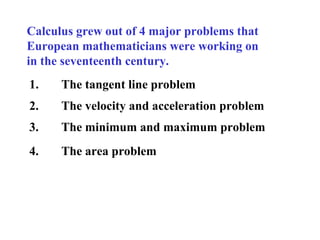
Calculus grew out of 4 major problems that
European mathematicians were working on
in the seventeenth century.
1. The tangent line problem
2. The velocity and acceleration problem
3. The minimum and maximum problem
4. The area problem
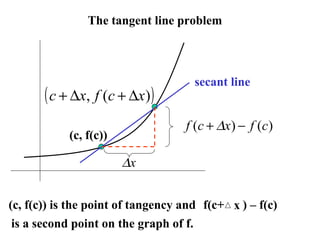
The tangent line problem
(c, f(c))
secant line
f(c+ ) – f(c)x(c, f(c)) is the point of tangency and
is a second point on the graph of f.
)()( cfxcf −+ ∆
x∆
( ))(, xcfxc ∆+∆+
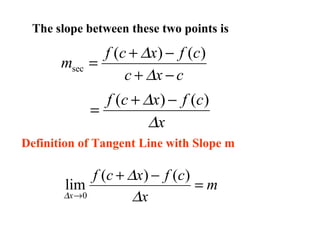
The slope between these two points is
cxc
cfxcf
m
−+
−+
=
∆
∆ )()(
sec
x
cfxcf
∆
∆ )()( −+
=
Definition of Tangent Line with Slope m
m
x
cfxcf
x
=
−+
→ ∆
∆
∆
)()(
lim
0
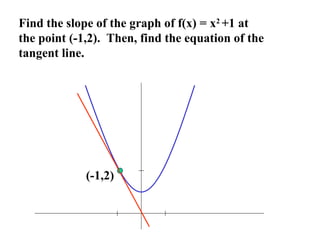
Find the slope of the graph of f(x) = x2
+1 at
the point (-1,2). Then, find the equation of the
tangent line.
(-1,2)
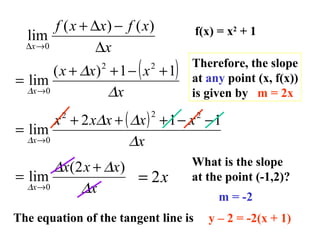
x
xfxxf
x ∆
−∆+
→∆
)()(
lim
0
( )
x
xxx
x ∆
∆
∆
11)(
lim
22
0
+−++
=
→
( )
x
xxxxx
x ∆
∆∆
∆
112
lim
222
0
−−+++
=
→
x
xxx
x ∆
∆∆
∆
)2(
lim
0
+
=
→
x2=
Therefore, the slope
at any point (x, f(x))
is given by m = 2x
What is the slope
at the point (-1,2)?
m = -2
The equation of the tangent line is y – 2 = -2(x + 1)
f(x) = x2
+ 1
The limit used to define the slope of a tangent
line is also used to define one of the two funda-
mental operations of calculus --- differentiation
Definition of the Derivative of a Function
x
xfxxf
xf
x ∆
∆
∆
)()(
lim)('
0
−+
=
→
f’(x) is read “f prime of x”
Other notations besides f’(x) include:
][)],([,', yDxf
dx
d
y
dx
dy
x
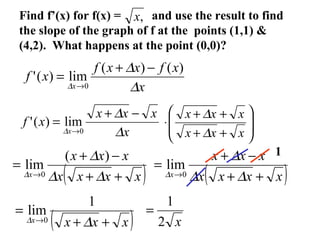
Find f’(x) for f(x) = and use the result to find
the slope of the graph of f at the points (1,1) &
(4,2). What happens at the point (0,0)?
,x
x
xfxxf
xf
x ∆
∆
∆
)()(
lim)('
0
−+
=
→
x
xxx
xf
x ∆
∆
∆
−+
=
→0
lim)(' 







++
++
⋅
xxx
xxx
∆
∆
( )xxxx
xxx
x ++
−+
=
→ ∆∆
∆
∆
)(
lim
0 ( )xxxx
xxx
x ++
−+
=
→ ∆∆
∆
∆ 0
lim
1
( )xxxx ++
=
→ ∆∆
1
lim
0 x2
1
=
x
mxf
2
1
)(' ==
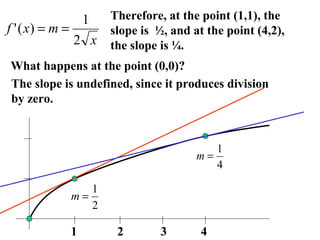
Therefore, at the point (1,1), the
slope is ½, and at the point (4,2),
the slope is ¼.
What happens at the point (0,0)?
The slope is undefined, since it produces division
by zero.
2
1
=m
4
1
=m
1 2 3 4
Find the derivative with respect to t for the
function .
2
t
y =
t
tfttf
dx
dy
t ∆
∆
∆
)()(
lim
0
−+
=
→
t
ttt
t ∆
∆
∆
22
lim
0
−
+=
→
1
)(
)(22
lim
0 t
ttt
ttt
t ∆
∆
∆
∆
+
+−
=
→
tttt
ttt
t ∆∆
∆
∆
1
)(
222
lim
0
⋅
+
−−
=
→
2
2
t
−=
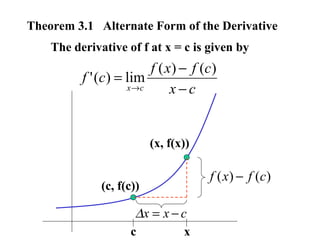
Theorem 3.1 Alternate Form of the Derivative
The derivative of f at x = c is given by
cx
cfxf
cf
cx −
−
=
→
)()(
lim)('
(c, f(c))
)()( cfxf −
cxx −=∆
c x
(x, f(x))
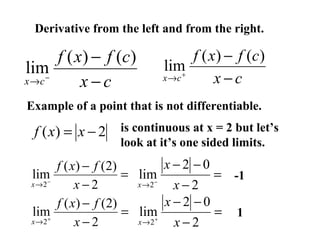
Derivative from the left and from the right.
cx
cfxf
cx −
−
−
→
)()(
lim
cx
cfxf
cx −
−
+
→
)()(
lim
Example of a point that is not differentiable.
2)( −= xxf is continuous at x = 2 but let’s
look at it’s one sided limits.
=
−
−
−
→ 2
)2()(
lim
2 x
fxf
x
=
−
−−
−
→ 2
02
lim
2 x
x
x
-1
=
−
−
+
→ 2
)2()(
lim
2 x
fxf
x
=
−
−−
+
→ 2
02
lim
2 x
x
x
1
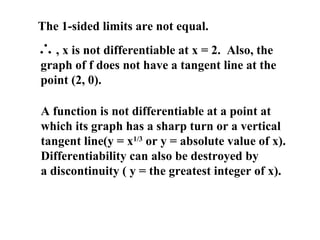
The 1-sided limits are not equal.
∴, x is not differentiable at x = 2. Also, the
graph of f does not have a tangent line at the
point (2, 0).
A function is not differentiable at a point at
which its graph has a sharp turn or a vertical
tangent line(y = x1/3
or y = absolute value of x).
Differentiability can also be destroyed by
a discontinuity ( y = the greatest integer of x).

Derivative power point

  • 1.
    I’m going nuts overderivatives!!! 2.1 The Derivative and the Tangent Line Problem
  • 2.
    Calculus grew outof 4 major problems that European mathematicians were working on in the seventeenth century. 1. The tangent line problem 2. The velocity and acceleration problem 3. The minimum and maximum problem 4. The area problem
  • 3.
    The tangent lineproblem (c, f(c)) secant line f(c+ ) – f(c)x(c, f(c)) is the point of tangency and is a second point on the graph of f. )()( cfxcf −+ ∆ x∆ ( ))(, xcfxc ∆+∆+
  • 4.
    The slope betweenthese two points is cxc cfxcf m −+ −+ = ∆ ∆ )()( sec x cfxcf ∆ ∆ )()( −+ = Definition of Tangent Line with Slope m m x cfxcf x = −+ → ∆ ∆ ∆ )()( lim 0
  • 5.
    Find the slopeof the graph of f(x) = x2 +1 at the point (-1,2). Then, find the equation of the tangent line. (-1,2)
  • 6.
    x xfxxf x ∆ −∆+ →∆ )()( lim 0 ( ) x xxx x∆ ∆ ∆ 11)( lim 22 0 +−++ = → ( ) x xxxxx x ∆ ∆∆ ∆ 112 lim 222 0 −−+++ = → x xxx x ∆ ∆∆ ∆ )2( lim 0 + = → x2= Therefore, the slope at any point (x, f(x)) is given by m = 2x What is the slope at the point (-1,2)? m = -2 The equation of the tangent line is y – 2 = -2(x + 1) f(x) = x2 + 1
  • 7.
    The limit usedto define the slope of a tangent line is also used to define one of the two funda- mental operations of calculus --- differentiation Definition of the Derivative of a Function x xfxxf xf x ∆ ∆ ∆ )()( lim)(' 0 −+ = → f’(x) is read “f prime of x” Other notations besides f’(x) include: ][)],([,', yDxf dx d y dx dy x
  • 8.
    Find f’(x) forf(x) = and use the result to find the slope of the graph of f at the points (1,1) & (4,2). What happens at the point (0,0)? ,x x xfxxf xf x ∆ ∆ ∆ )()( lim)(' 0 −+ = → x xxx xf x ∆ ∆ ∆ −+ = →0 lim)('         ++ ++ ⋅ xxx xxx ∆ ∆ ( )xxxx xxx x ++ −+ = → ∆∆ ∆ ∆ )( lim 0 ( )xxxx xxx x ++ −+ = → ∆∆ ∆ ∆ 0 lim 1 ( )xxxx ++ = → ∆∆ 1 lim 0 x2 1 =
  • 9.
    x mxf 2 1 )(' == Therefore, atthe point (1,1), the slope is ½, and at the point (4,2), the slope is ¼. What happens at the point (0,0)? The slope is undefined, since it produces division by zero. 2 1 =m 4 1 =m 1 2 3 4
  • 10.
    Find the derivativewith respect to t for the function . 2 t y = t tfttf dx dy t ∆ ∆ ∆ )()( lim 0 −+ = → t ttt t ∆ ∆ ∆ 22 lim 0 − += → 1 )( )(22 lim 0 t ttt ttt t ∆ ∆ ∆ ∆ + +− = → tttt ttt t ∆∆ ∆ ∆ 1 )( 222 lim 0 ⋅ + −− = → 2 2 t −=
  • 11.
    Theorem 3.1 AlternateForm of the Derivative The derivative of f at x = c is given by cx cfxf cf cx − − = → )()( lim)(' (c, f(c)) )()( cfxf − cxx −=∆ c x (x, f(x))
  • 12.
    Derivative from theleft and from the right. cx cfxf cx − − − → )()( lim cx cfxf cx − − + → )()( lim Example of a point that is not differentiable. 2)( −= xxf is continuous at x = 2 but let’s look at it’s one sided limits. = − − − → 2 )2()( lim 2 x fxf x = − −− − → 2 02 lim 2 x x x -1 = − − + → 2 )2()( lim 2 x fxf x = − −− + → 2 02 lim 2 x x x 1
  • 13.
    The 1-sided limitsare not equal. ∴, x is not differentiable at x = 2. Also, the graph of f does not have a tangent line at the point (2, 0). A function is not differentiable at a point at which its graph has a sharp turn or a vertical tangent line(y = x1/3 or y = absolute value of x). Differentiability can also be destroyed by a discontinuity ( y = the greatest integer of x).