
Dr. D. K. Brahma
Associate Professor
Department of Pharmacology
NEIGRIHMS, Shillong
Antiplatelet Drugs
(Antithrombotic Drugs)
Definition
• Drugs which interfere with platelet function
and are useful in prophylaxis of
thromboembolic disorders
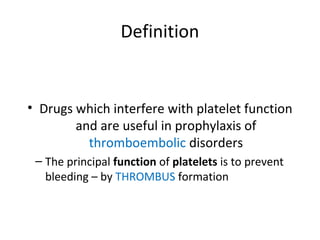
– The principal function of platelets is to prevent
bleeding – by THROMBUS formation
Background –
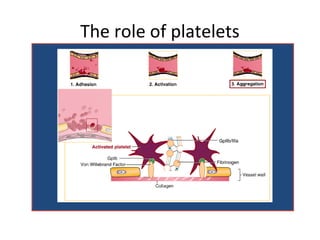
Platelet Aggregation
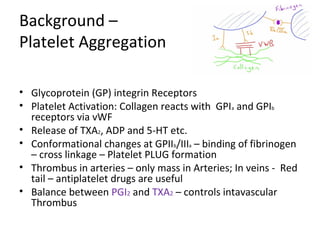
• Glycoprotein (GP) integrin Receptors
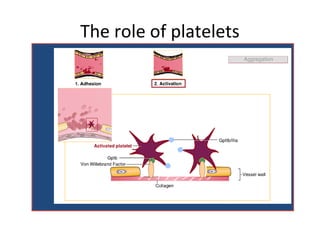
• Platelet Activation: Collagen reacts with GPIa and GPIb
receptors via vWF
• Release of TXA2, ADP and 5-HT etc.
• Conformational changes at GPIIb/IIIa – binding of fibrinogen
– cross linkage – Platelet PLUG formation
• Thrombus in arteries – only mass in Arteries; In veins - Red
tail – antiplatelet drugs are useful
• Balance between PGI2 and TXA2 – controls intavascular
Thrombus
The role of platelets
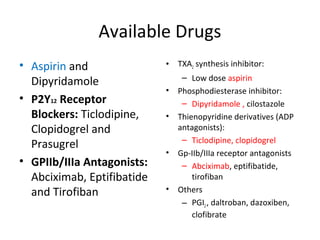
Available Drugs
• Aspirin and
Dipyridamole
• P2Y12 Receptor
Blockers: Ticlodipine,
Clopidogrel and
Prasugrel
• GPIIb/IIIa Antagonists:
Abciximab, Eptifibatide
and Tirofiban
• TXA2 synthesis inhibitor:
– Low dose aspirin
• Phosphodiesterase inhibitor:
– Dipyridamole , cilostazole
• Thienopyridine derivatives (ADP
antagonists):
– Ticlodipine, clopidogrel
• Gp-IIb/IIIa receptor antagonists
– Abciximab, eptifibatide,
tirofiban
• Others
– PGI2, daltroban, dazoxiben,
clofibrate
Aspirin
• MOA: Acetylates COX 1 and TX-synthase – irreversible inactivation -
in portal circulation (Deacetylation of Aspirin)occurs in liver
– TXA2 formation suppressed – fresh enzyme synthesis takes time – at
low doses
– Prolongation of bleeding time for 5 – 7 days
– Cumulative effect – 40 mg/day – max. at 160 mg
– Low doses – only TXA2 but higher doses both TXA2 and PGI2 (Clinically
irrelevant)
– In vessel wall – PGI2 suppression - can synthesize new enzymes
– At low doses (75 – 150 mg/day) – selective suppression of TXA2 –
higher doses – both TXA2 and PGI2
– Also inhibition of ADP – sticking interfered
Acetylsalicylic acid – major use
• Secondary prevention of transient ischaemic attack
(TIA), ischaemic stroke and myocardial infarction
• Prevention of ischaemic events in patients with
angina pectoris
• Prevention of coronary artery bypass graft (CABG)
occlusion
Dipyridamole -Vasodilator – used in angina
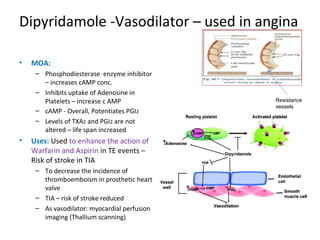
• MOA:
– Phosphodiesterase enzyme inhibitor
– increases cAMP conc.
– Inhibits uptake of Adenosine in
Platelets – increase c AMP
– cAMP - Overall, Potentiates PGI2
– Levels of TXA2 and PGI2 are not
altered – life span increased
• Uses: Used to enhance the action of
Warfarin and Aspirin in TE events –
Risk of stroke in TIA
– To decrease the incidence of
thromboemboism in prosthetic heart
valve
– TIA – risk of stroke reduced
– As vasodilator: myocardial perfusion
imaging (Thallium scanning)
Resistance
vessels
Dipyridamole - Kinetics
• Incompletely absorbed from the gastrointestinal tract with
peak plasma concentration occurring about 75 minutes after
oral administration
• More than 90% bound to plasma proteins
• A terminal half-life of 10 to 12 hours
• Metabolised in the liver
• Mainly excreted as glucuronides in the bile; a small amount is
excreted in the urine
• Available as 75 mg and 100 mg preparations
Ticlodipine
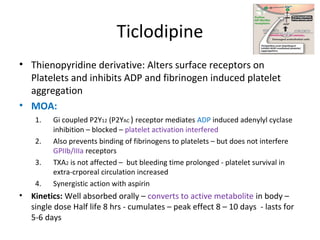
• Thienopyridine derivative: Alters surface receptors on
Platelets and inhibits ADP and fibrinogen induced platelet
aggregation
• MOA:
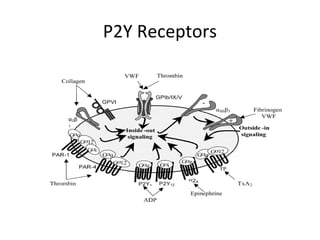
1. Gi coupled P2Y12 (P2YAC ) receptor mediates ADP induced adenylyl cyclase
inhibition – blocked – platelet activation interfered
2. Also prevents binding of fibrinogens to platelets – but does not interfere
GPIIb/IIIa receptors
3. TXA2 is not affected – but bleeding time prolonged - platelet survival in
extra-crporeal circulation increased
4. Synergistic action with aspirin
• Kinetics: Well absorbed orally – converts to active metabolite in body –
single dose Half life 8 hrs - cumulates – peak effect 8 – 10 days - lasts for
5-6 days
P2Y Receptors
Ticlodipine - Uses
• Secondary prevention of Stroke, TIA
• Intermittent claudication
• Unstable angina
• PCI
• Coronary artery bypass surgery
• Prophylaxis of MI
• With aspirin prevents restenosis after PCI and stent
• ADRs: Diarrhoea, vomiting, abdominal pain, headache,
tinnitus, skin rash
– Bleeding, neutropenia, thrombocytopemia and jaundice
– Limited Use
Clopidogrel
• Newer and more potent congener of Ticlodipine
• MOA – same with Ticlodipine but safer and better tolerated
• Studies: CAPRIE study - Slightly lower risk of ischaemic events
than aspirin recipients for primary ischemic events –
combination in checking restenosis in stent coronary
• Kinetics: Prodrug – 50% absorption
– Only a fraction is activated in liver by CYP2C19
– CYP2C19 – genetic polymorphism – interindividual variation of action
– Some are non responsive
– Omeprazole - DI
• ADRs: Bleeding – double with aspirin
– neutropenia, thrombocytopenia are rarer than Ticlodipine
Prasugrel
• Newer, most potent and faster P2Y12 purinergic receptor blocker
• Preferred in Acute Coronary Syndromes (ACS) and when strong
antiplatelet action required
• Prodrug – but faster and complete absorption – completely activated
• CYP2C19 substrate – but Genetic polymorphism related decrease and DI
with Omeprazole is rare
• Uses: STEMI, ACS to cover angioplasty
– Comparison with clopidogrel in STEMI and NSTEMI – Prasugrel – better in reduction in
death due to CVS causes
– Superior results in reduction of STENT thrombosis
• ADRs: Bleeding complications – severe, Intracranial haemorrhage – in TIA
and stroke patients
• CI: Ischaemic stroke and TIA
• Dose: 10 mg OD (available as 5 and 10 mg tablets)
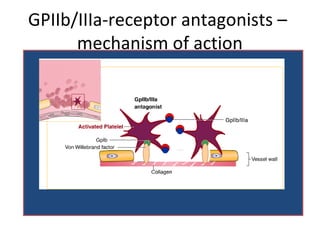
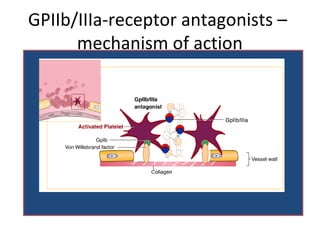
GPIIb/IIIa receptor antagonists
• Newer potent platelet aggregation inhibitor -
Abciximab, eptifibatide and tirofiban
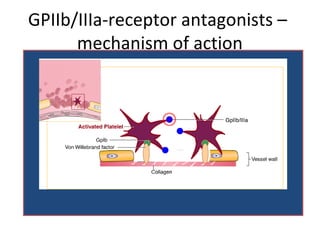
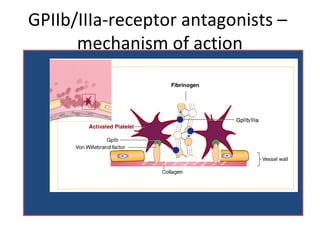
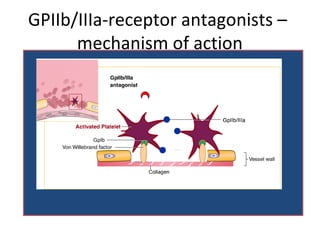
• GPIIb/IIIa is an adhesive receptor aggregation –
antagonists block aggregation -
GPIIb/IIIa-receptor antagonists –
mechanism of action
GPIIb/IIIa-receptor antagonists –
mechanism of action
GPIIb/IIIa-receptor antagonists –
mechanism of action
GPIIb/IIIa-receptor antagonists –
mechanism of action
GPIIb/IIIa-receptor antagonists –
mechanism of action
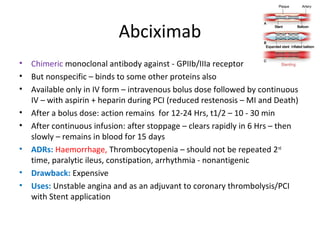
Abciximab
• Chimeric monoclonal antibody against - GPIIb/IIIa receptor
• But nonspecific – binds to some other proteins also
• Available only in IV form – intravenous bolus dose followed by continuous
IV – with aspirin + heparin during PCI (reduced restenosis – MI and Death)
• After a bolus dose: action remains for 12-24 Hrs, t1/2 – 10 - 30 min
• After continuous infusion: after stoppage – clears rapidly in 6 Hrs – then
slowly – remains in blood for 15 days
• ADRs: Haemorrhage, Thrombocytopenia – should not be repeated 2nd
time, paralytic ileus, constipation, arrhythmia - nonantigenic
• Drawback: Expensive
• Uses: Unstable angina and as an adjuvant to coronary thrombolysis/PCI
with Stent application
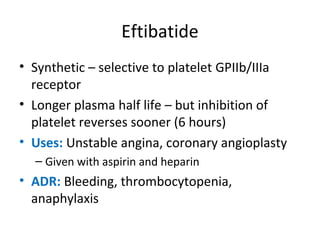
Eftibatide
• Synthetic – selective to platelet GPIIb/IIIa
receptor
• Longer plasma half life – but inhibition of
platelet reverses sooner (6 hours)
• Uses: Unstable angina, coronary angioplasty
– Given with aspirin and heparin
• ADR: Bleeding, thrombocytopenia,
anaphylaxis
Uses of Antiplatelets
1. Coronary Artery Disease:
• MI: Immediately after MI low dose aspirin
• Aspirin: routinely used after thrombolytic therapy to prevent
reocclusion; to cover PCI with heparin
• Unstable angina: Aspirin reduces risk of MI
• Primary and secondary prevention of MI: Evidence of coronary artery
disease - aspirin
2. Cerebrovascular Disease: Do not have much effect but prevents TIAs
3. Coronary angioplasty, stents etc.: patency of re-canalized artery or implant
bypass vessels improved – re-occlusion reduced
4. Prosthetic Heart Valve and Arteriovenous shunts: reduce formation of
microthrombi in heart valves
5. Venous Thromboembolism
6. Peripheral Vascular Disease
Must Know
• Aspirin as antiplatelet agent
• Clopidogrelel
An Aspirin a Day: The Wonder Drug That Could
Save YOUR Life
Thank you