M.Asiyabi
M.Pharm-1st year
Department of pharmacology
Historical background
• Platelets were discovered by G.Bizzozero in
1882.
• But, drug industry did not recognise them as
viable drug targets till 1960.
• Initially, researchers focused on clotting time
and also in thrombocytopenia.
• In 1960, focus shifted to interaction of
platelets with adhesion and aggregation.
Terminologies
• Thrombus : a blood clot formed in situ within the
vascular system of the body and impeding blood
flow.
• Embolus : a blood clot, air bubble, piece of fatty
deposit, or other object which has been carried in
the bloodstream cause an embolism.
• Venous thrombosis : a blood clot (thrombus) that
forms within a vein
• Deep vein thrombosis : a blood clot in the deep
veins of the leg
• Pulmonary embolism : a blood clot in the lungs.
• Arterial thrombosis : a blood clot that develops
in an artery
Etiology
• Arterial and venous thromboses are major
causes of morbidity and mortality rates.
• Deep-vein thrombosis (DVT) leads to
pulmonary embolism (PE).
• This triggers platelet aggregation and fibrin
formation leading to generation of a platelet-
rich thrombus that can temporarily or
permanently occlude blood flow.
• Arterial thrombi are rich in platelets because
of the high shear in the injured arteries.
• In contrast, venous thrombi (low shear
condition) contain relatively few platelets and
are predominantly composed of fibrin and
trapped red cells.
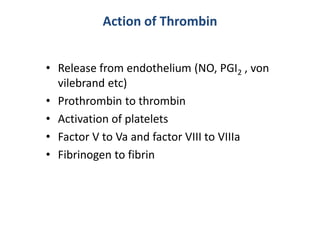
Action of Thrombin
• Release from endothelium (NO, PGI2 , von
vilebrand etc)
• Prothrombin to thrombin
• Activation of platelets
• Factor V to Va and factor VIII to VIIIa
• Fibrinogen to fibrin
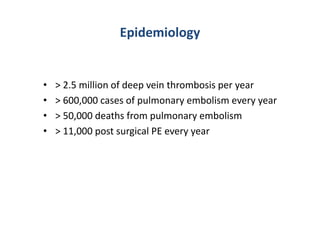
Epidemiology
• > 2.5 million of deep vein thrombosis per year
• > 600,000 cases of pulmonary embolism every year
• > 50,000 deaths from pulmonary embolism
• > 11,000 post surgical PE every year
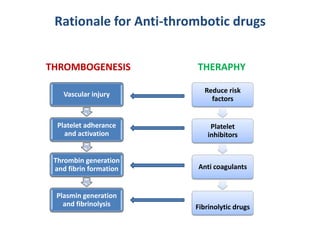
Rationale for Anti-thrombotic drugs
Vascular injury
Platelet adherance
and activation
Thrombin generation
and fibrin formation
Plasmin generation
and fibrinolysis
Reduce risk
factors
Platelet
inhibitors
Anti coagulants
Fibrinolytic drugs
THROMBOGENESIS THERAPHY
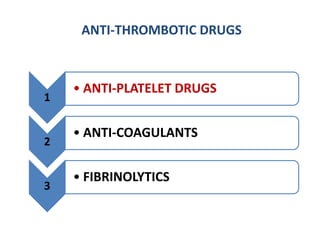
1
• ANTI-PLATELET DRUGS
2
• ANTI-COAGULANTS
3
• FIBRINOLYTICS
ANTI-THROMBOTIC DRUGS
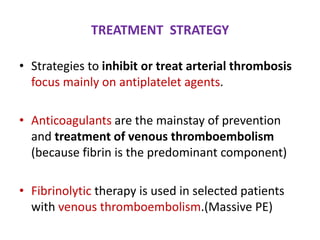
TREATMENT STRATEGY
• Strategies to inhibit or treat arterial thrombosis
focus mainly on antiplatelet agents.
• Anticoagulants are the mainstay of prevention
and treatment of venous thromboembolism
(because fibrin is the predominant component)
• Fibrinolytic therapy is used in selected patients
with venous thromboembolism.(Massive PE)
ANTI - PLATELET AGENTS
“Drugs which interfere with platelet function
and are useful in prophylaxis of
thromboembolic disorders”
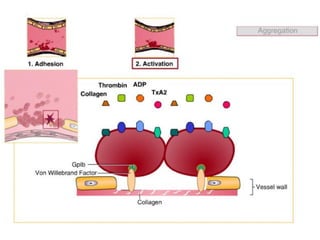
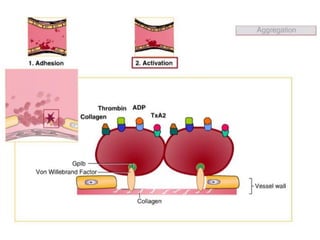
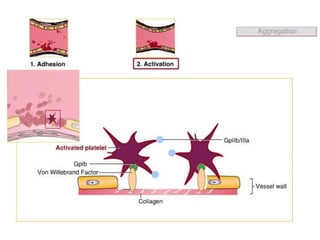
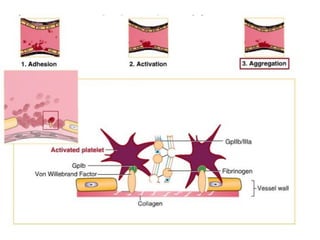
ROLE OF PLATELETS
Antiplatelet drugs target various
steps in this process.
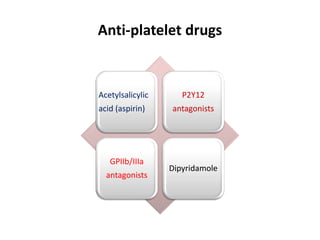
Anti-platelet drugs
Acetylsalicylic
acid (aspirin)
P2Y12
antagonists
GPIIb/IIIa
antagonists
Dipyridamole
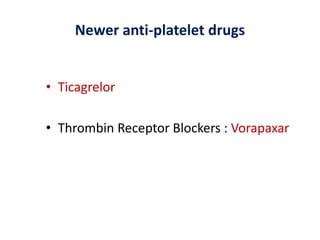
Newer anti-platelet drugs
• Ticagrelor
• Thrombin Receptor Blockers : Vorapaxar
ASPIRIN
(Acetyl salicylic acid)
• The most widely used antiplatelet agent
worldwide is aspirin.
• Maximal effective dose : 50-320 mg
• At high doses (1 g/d), it also inhibits COX-2
(responsible for synthesis of prostacyclin, a
potent inhibitor of platelet aggregation)
• So, Higher doses are potentially less efficacious
and also increase toxicity, especially bleeding.
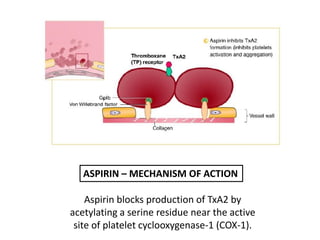
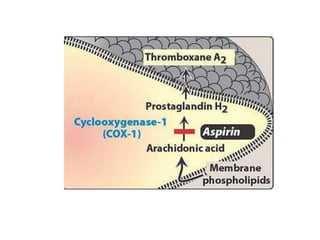
Aspirin blocks production of TxA2 by
acetylating a serine residue near the active
site of platelet cyclooxygenase-1 (COX-1).
ASPIRIN – MECHANISM OF ACTION
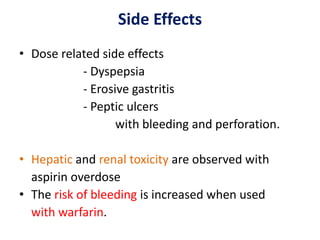
Side Effects
• Dose related side effects
- Dyspepsia
- Erosive gastritis
- Peptic ulcers
with bleeding and perforation.
• Hepatic and renal toxicity are observed with
aspirin overdose
• The risk of bleeding is increased when used
with warfarin.
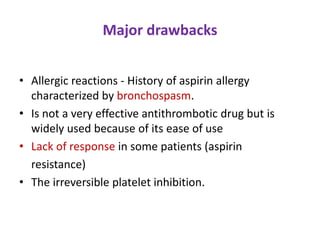
Major drawbacks
• Allergic reactions - History of aspirin allergy
characterized by bronchospasm.
• Is not a very effective antithrombotic drug but is
widely used because of its ease of use
• Lack of response in some patients (aspirin
resistance)
• The irreversible platelet inhibition.
Dipyridamole
Properties other than anti-platelet activity :
• Dipyridamole is a potent coronary vasodilator.
• It has minimal effect on BP and cardiac work.
MECHANISM OF ACTION ON NEXT SLIDE
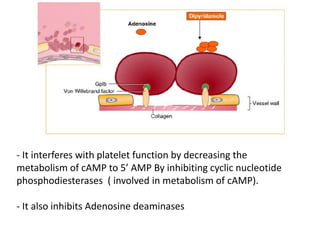
- It interferes with platelet function by decreasing the
metabolism of cAMP to 5’ AMP By inhibiting cyclic nucleotide
phosphodiesterases ( involved in metabolism of cAMP).
- It also inhibits Adenosine deaminases
Therapeutic uses
• The drug has little or no benefit as an
antithrombotic agent.
• So It is used in combination with warfarin.
• In the prophylaxis of coronary and cerebral
thrombosis of post-MI and post-stroke
patients.
• In patients with Prosthetic valves (artificial
heart valve) - it inhibits embolization.
• Dosage : 150 to 300 mg given BD
Adverse effects
• Exacerbation of Angina
• Headache
• Tachycardia
• GI distress.
DRAWBACKS :
1. Dipyridamole also has a vasodilatory effect and
should be used with caution in patients with severe
coronary artery disease;
2. chest pain may be aggravated in patients with
coronary artery disease who are receiving dipyridamole
Ticlopidine and Clopidogrel
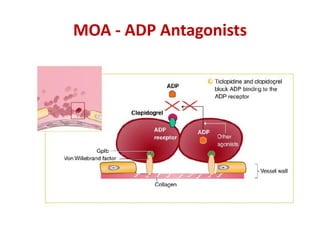
• ADP antagonists, inhibit binding of Adenosine di
phosphate (ADP) to its receptors irreversibly
• Also Inhibit fibrinogen induced platelet
aggregation with out modifying GPIIb/IIIa
• Synergistic action with aspirin
• Both are prodrugs have long duration of
antiplatelet effect
• Clopidogrel a congener of ticlodipine is safer and
better tolerated.
MOA - ADP Antagonists
Adverse effects
Ticlopidine (Dose : 250 mg BD)
– Diarrrhoea, vomiting, abdominal pain
– Headache, tinnitus, skin rash
– Bleeding, neutropenia, thrombocytopenia
Clopidogrel (Dose : 75 mg OD)
– Implantation bleeding
– Less bone marrow toxicity
– Diarrhoea, epigastric pain, rashes
Clopidogrel resistence
• This variability is because of genetic polymorphisms
in the Cytochrome P450 (CYP2C19*2) isoenzymes
involved in the metabolic activation of clopidogrel.
• This is important because 25% of whites, 30% of
African Americans, and 50% of Asians carry the loss-
of-function allele.
• This will render them resistant to clopidogrel.
• So to such patients , prasugrel or newer P2Y12
inhibitors may be better choices.
Prasugrel
• It is also prodrug.
• Its onset of action is more rapid than that of
ticlopidine or clopidogrel.
• It produces greater and more predictable
inhibition of ADP-induced platelet
aggregation.
• It has prolonged effect after discontinuation
• Therefore problem araises if patients require
urgent surgery.
Cont…
• Contraindication : those with a history of
cerebrovascular disease (high risk of
bleeding).
• Caution : in patients weighing <60 kg or in
those with renal impairment.
• Dose : loading dose is 60 mg, and is given
once daily at a dose of 10 mg.
Glycoprotein IIb/IIIa Inhibitors
• Glycoprotein IIb/IIIa is a platelet-surface integrin.
• Glycoprotein IIb/IIIa is inactive on resting
platelets.
• It undergoes a conformational transformation
when platelets are activated by thrombin,
collagen, or TxA2 which endows GP with the
capacity to serve as a receptor for fibrinogen and
von Willebrand factor.
• Thus, inhibitors of this receptor are potent
antiplatelet agents.
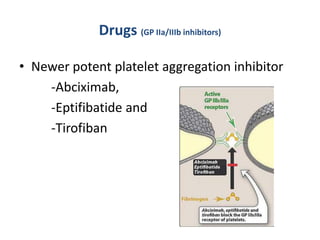
Drugs (GP IIa/IIIb inhibitors)
• Newer potent platelet aggregation inhibitor
-Abciximab,
-Eptifibatide and
-Tirofiban
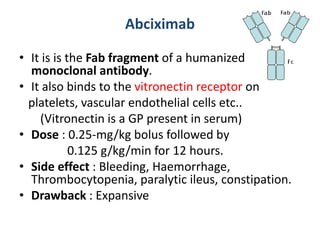
Abciximab
• It is is the Fab fragment of a humanized
monoclonal antibody.
• It also binds to the vitronectin receptor on
platelets, vascular endothelial cells etc..
(Vitronectin is a GP present in serum)
• Dose : 0.25-mg/kg bolus followed by
0.125 g/kg/min for 12 hours.
• Side effect : Bleeding, Haemorrhage,
Thrombocytopenia, paralytic ileus, constipation.
• Drawback : Expansive
Newer Anti-Platelets (Ticagrelor)
• It is an orally active, reversible inhibitor of
Purinergic receptor (P2Y12) – a G protein
coupled receptor.
• Dose : 90 mg tablets are available.
• When compared with clopidogrel, ticagrelor
produced a greater reduction in
cardiovascular death, MI, and stroke.
• It has a more rapid onset and offset of action.
Vorapaxar
• It is an orally active, high-affinity, potent and
competitive reversible antagonist of protease
activated receptor (PAR-1)
• So it blocks thrombin-mediated platelet
activation.
• Dose :Tablet 2.08 mg with Aspirin/ Clopidogrel
daily.
• Indications : To reduce thrombotic cardiovascular
events in patients.
• Adverse effect : Bleeding, depression, anemia.
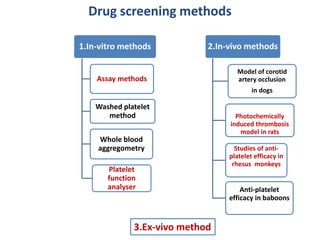
Drug screening methods
1.In-vitro methods
Assay methods
Washed platelet
method
Whole blood
aggregometry
Platelet
function
analyser
2.In-vivo methods
Model of corotid
artery occlusion
in dogs
Photochemically
induced thrombosis
model in rats
Studies of anti-
platelet efficacy in
rhesus monkeys
Anti-platelet
efficacy in baboons
3.Ex-vivo method
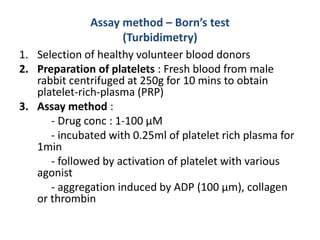
Assay method – Born’s test
(Turbidimetry)
1. Selection of healthy volunteer blood donors
2. Preparation of platelets : Fresh blood from male
rabbit centrifuged at 250g for 10 mins to obtain
platelet-rich-plasma (PRP)
3. Assay method :
- Drug conc : 1-100 µM
- incubated with 0.25ml of platelet rich plasma for
1min
- followed by activation of platelet with various
agonist
- aggregation induced by ADP (100 µm), collagen
or thrombin
Cont…
• The inhibition of aggregation is expressed as
the percentage of the maximal rate of
aggregation observed in the absence of
antagonists.
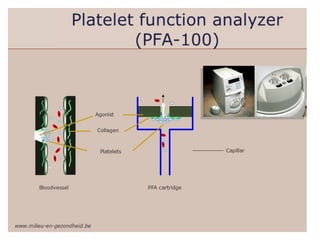
Platelet function analyser (PFA)
PFA -procedure
• Blood sample is drawn and stored at RT with
citrated buffer solution.
• 800 µL containing test drug is placed into a
catridge.
• The test catridges simulate an injured blood
vessel in which the membrane coated with
type I collagen or ADP catridge.
• Blood is pipetted and aspirated thro a capillary
with negative pressure and thereby shear
forces is produced.
cont….
• Platelet aggregation is produced.
• Finally, a platelet plug occludes the apperture.
• The time measurewd in secs from beginning
of test untill formation of aggregates is called
closure time (measure of over all function of
platelets)
Ex-vivo method
• Acid soluble collagen (100 µg/kg) is injected
into the aortic arch of rabbits via carotid
artery.
• Platelet count is performed on blood
withdrawn subsequent to collagen
administration.
• The test drug is administered to the animal
before the collagen injection.
Photochemically induced thrombosis
model in rats
• Requirements :
- Animal : male wistar rats (230-320 gms)
- Anesthetic : Penobarbitol sodium
- Test drug
• Jugular vein cannulation
• Microvessels in the mesentry are observed
under trans illumination with halogen lamp.
• Thrombus formation is induced in the
microvessels by filtered light of wavelength
420-490 nm.
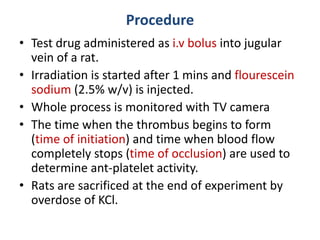
Procedure
• Test drug administered as i.v bolus into jugular
vein of a rat.
• Irradiation is started after 1 mins and flourescein
sodium (2.5% w/v) is injected.
• Whole process is monitored with TV camera
• The time when the thrombus begins to form
(time of initiation) and time when blood flow
completely stops (time of occlusion) are used to
determine ant-platelet activity.
• Rats are sacrificed at the end of experiment by
overdose of KCl.
Anti platelet  drugs