Dr. RAGHU PRASADA M S
MBBS,MD
ASSISTANT PROFESSOR
DEPT. OF PHARMACOLOGY
SSIMS & RC.
1
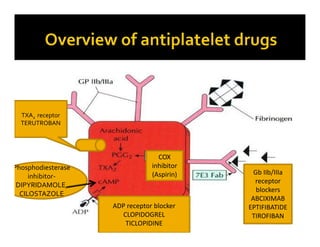
ADP receptor blocker
CLOPIDOGREL
TICLOPIDINE
COX
inhibitor
(Aspirin)
Phosphodiesterase
inhibitor-
DIPYRIDAMOLE,
CILOSTAZOLE
Gb IIb/IIIa
receptor
blockers
ABCIXIMAB
EPTIFIBATIDE
TIROFIBAN
TXA2 receptor
TERUTROBAN
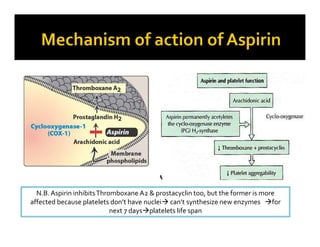
Aspirin
N.B.Aspirin inhibitsThromboxane A2 & prostacyclin too, but the former is more
affected because platelets don’t have nuclei can’t synthesize new enzymes for
next 7 daysplatelets life span
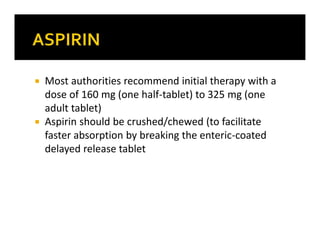
 Most authorities recommend initial therapy with a
dose of 160 mg (one half-tablet) to 325 mg (one
adult tablet)
 Aspirin should be crushed/chewed (to facilitate
faster absorption by breaking the enteric-coated
delayed release tablet
 Prophylaxis against unstable angina
 Post MI
 Post stroke
Adverse effects
GI –ulceration
Prolonged bleeding time  ↑ risk of hemorrhage
 It is an inhibitor of phosphodiesterase III (PDE
III) enzyme
 Vasodilator and inhibitor of platelet aggregation
 Initially approved for Intermittent claudication
 Indicated for the reduction of events
(myocardial infarction, stroke, and vascular
death) in patients with atherosclerosis
documented by recent stroke, recent MI or
established peripheral arterial disease.
ABCIXIMAB is composed of 7E3 Fab fragments.
derived from murine (mouse)
Humanized monoclonal antibody.
directed against glycoprotein receptor type GPIIb/IIIa.
Mechanism: The m7E3 Fab binds selectively to the
glycoprotein GPIIb/IIIa receptors inhibiting platelet
aggregation
Plasma T1/2- 30min Bolus –followed by slow IV
Angioplasty, recurrent MI
Major side effect- bleeding, thrombocytopenia,
bleeding
TIROFIBAN -non-peptic Synthetic arginine-glycine-
aspartic acid (R-G-D) sequence mimetics. Hence, it
blocks the binding of fibrinogen to glycoprotein
GPIIb/IIIa receptors
They are given intravenously for the reduction of
thrombotic complications during coronary angioplasty (if
they are given orally they are toxic)
Clinical trials showed reductions in the incidence of
death and non-fatal MI in response to the use of
tirofiban.
Synthetic cyclic Peptide inhibitor of fibrinogen
binding site on Gp IIb/ 3a receptors on platelets
It does not bind to receptors for vWF
Duration of action : 30 – 45 mins
Should be continued for 18-24 hours
Superior to Abciximab for upstream use
S/E-bleeding
TICLOPIDINE & CLOPIDOGREL
They inhibit irreversibly ADP binding to receptors 
inhibit platelet aggregation
No effect on PG synthesis
Used in aspirin intolerant patients
Acts by in inhibiting phoshodiesterase enzyme
Incompletely absorbed from the gastrointestinal
tract with peak plasma concentration occurring
about 75 minutes after oral administration
More than 90% bound to plasma proteins
A terminal half-life of 10 to 12 hours
Metabolised in the liver
Mainly excreted as glucuronides in the bile;
a small amount is excreted in the urine
It is an inhibitor of phosphodiesterase III (PDE III)
enzyme
Vasodilator and inhibitor of platelet aggregation
Intermittent claudication
Indicated for the reduction of events (myocardial
infarction, stroke, and vascular death) in patients with
atherosclerosis documented by recent stroke, recent
MI or established peripheral arterial disease
C/I- CHF patients
Prasugrel
Thienopyridine
More rapid onset of action than clopidogrel
Irreversible inhibitor of the P2Y12 receptor
Beneficial in the treatment and prevention of ACS
and the prevention of thromboembolic events
Adenosine Diphosphate-Receptor Antagonists
Ticagrelor
Cyclo-pentyl-triazo-pyrimidine (CPTP)
More rapid onset of action than clopidogrel
Reversible inhibitor of the P2Y12 receptor
 Myocardial infarction
 Unstable angina
 Coronary bypass implants
 Prosthetic heart valves and arteriovenous shunts
 Venous thromboembolism and PVD
 Cerebrovascular transient ischemic attacks
Class antiplatelet

Class antiplatelet

  • 1.
    Dr. RAGHU PRASADAM S MBBS,MD ASSISTANT PROFESSOR DEPT. OF PHARMACOLOGY SSIMS & RC. 1
  • 6.
    ADP receptor blocker CLOPIDOGREL TICLOPIDINE COX inhibitor (Aspirin) Phosphodiesterase inhibitor- DIPYRIDAMOLE, CILOSTAZOLE GbIIb/IIIa receptor blockers ABCIXIMAB EPTIFIBATIDE TIROFIBAN TXA2 receptor TERUTROBAN
  • 7.
    Aspirin N.B.Aspirin inhibitsThromboxane A2& prostacyclin too, but the former is more affected because platelets don’t have nuclei can’t synthesize new enzymes for next 7 daysplatelets life span
  • 8.
     Most authoritiesrecommend initial therapy with a dose of 160 mg (one half-tablet) to 325 mg (one adult tablet)  Aspirin should be crushed/chewed (to facilitate faster absorption by breaking the enteric-coated delayed release tablet
  • 9.
     Prophylaxis againstunstable angina  Post MI  Post stroke Adverse effects GI –ulceration Prolonged bleeding time  ↑ risk of hemorrhage
  • 10.
     It isan inhibitor of phosphodiesterase III (PDE III) enzyme  Vasodilator and inhibitor of platelet aggregation  Initially approved for Intermittent claudication  Indicated for the reduction of events (myocardial infarction, stroke, and vascular death) in patients with atherosclerosis documented by recent stroke, recent MI or established peripheral arterial disease.
  • 11.
    ABCIXIMAB is composedof 7E3 Fab fragments. derived from murine (mouse) Humanized monoclonal antibody. directed against glycoprotein receptor type GPIIb/IIIa. Mechanism: The m7E3 Fab binds selectively to the glycoprotein GPIIb/IIIa receptors inhibiting platelet aggregation Plasma T1/2- 30min Bolus –followed by slow IV Angioplasty, recurrent MI Major side effect- bleeding, thrombocytopenia, bleeding
  • 12.
    TIROFIBAN -non-peptic Syntheticarginine-glycine- aspartic acid (R-G-D) sequence mimetics. Hence, it blocks the binding of fibrinogen to glycoprotein GPIIb/IIIa receptors They are given intravenously for the reduction of thrombotic complications during coronary angioplasty (if they are given orally they are toxic) Clinical trials showed reductions in the incidence of death and non-fatal MI in response to the use of tirofiban.
  • 13.
    Synthetic cyclic Peptideinhibitor of fibrinogen binding site on Gp IIb/ 3a receptors on platelets It does not bind to receptors for vWF Duration of action : 30 – 45 mins Should be continued for 18-24 hours Superior to Abciximab for upstream use S/E-bleeding
  • 14.
    TICLOPIDINE & CLOPIDOGREL Theyinhibit irreversibly ADP binding to receptors  inhibit platelet aggregation No effect on PG synthesis Used in aspirin intolerant patients
  • 15.
    Acts by ininhibiting phoshodiesterase enzyme Incompletely absorbed from the gastrointestinal tract with peak plasma concentration occurring about 75 minutes after oral administration More than 90% bound to plasma proteins A terminal half-life of 10 to 12 hours Metabolised in the liver Mainly excreted as glucuronides in the bile; a small amount is excreted in the urine
  • 16.
    It is aninhibitor of phosphodiesterase III (PDE III) enzyme Vasodilator and inhibitor of platelet aggregation Intermittent claudication Indicated for the reduction of events (myocardial infarction, stroke, and vascular death) in patients with atherosclerosis documented by recent stroke, recent MI or established peripheral arterial disease C/I- CHF patients
  • 17.
    Prasugrel Thienopyridine More rapid onsetof action than clopidogrel Irreversible inhibitor of the P2Y12 receptor Beneficial in the treatment and prevention of ACS and the prevention of thromboembolic events Adenosine Diphosphate-Receptor Antagonists
  • 18.
    Ticagrelor Cyclo-pentyl-triazo-pyrimidine (CPTP) More rapidonset of action than clopidogrel Reversible inhibitor of the P2Y12 receptor
  • 19.
     Myocardial infarction Unstable angina  Coronary bypass implants  Prosthetic heart valves and arteriovenous shunts  Venous thromboembolism and PVD  Cerebrovascular transient ischemic attacks