
ANTICOAGULANTS
Dr. ZIKRULLAH
ANTICOAGULANT – GENERAL OVERVIEW
 Drugs that help prevent the clotting (coagulation) of blood.
 Coagulation will occur instantaneously once a blood vessel
has been severed.
BLOOD CLOTTING
Vascular Phase
Platelet Phase
Coagulation Phase
Fibrinolytic Phase
VASCULAR PHASE
 After initial injury a brief period of arteriolar vasoconstriction
occurs.
 As a result of reflex neurogenic mechanisms.
 Augmented by the local secretion of factors such as endothelin
(a potent endothelium-derived vasoconstrictor).
 The effect is transient.
PLATELET PHASE
 Blood vessel wall (endothelial cells) prevent platelet
adhesion and aggregation.
 Platelets contain receptors for fibrinogen and von-
Willebrand factor.
 After vessel injury Platelets adhere and aggregate.
 Release permeability increasing factors (e.g. vascular
permeability factor, VPF).
 Loose their membrane and form a viscous plug.
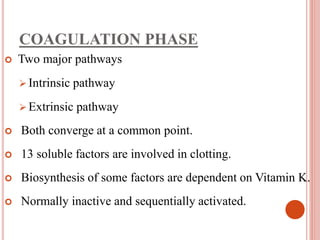
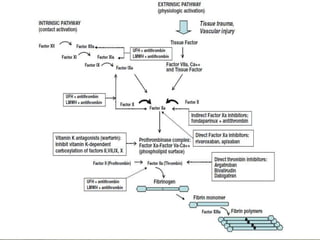
COAGULATION PHASE
 Two major pathways
 Intrinsic pathway
 Extrinsic pathway
 Both converge at a common point.
 13 soluble factors are involved in clotting.
 Biosynthesis of some factors are dependent on Vitamin K.
 Normally inactive and sequentially activated.
FIBRINOLYSIS
 Enhance degradation of clots.
 Activation of endogenous protease.
 Plasminogen (inactive form) is converted to plasmin (active
form).
 Plasmin breaks down fibrin clots.
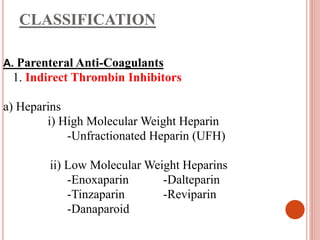
CLASSIFICATION
A. Parenteral Anti-Coagulants
1. Indirect Thrombin Inhibitors
a) Heparins
i) High Molecular Weight Heparin
-Unfractionated Heparin (UFH)
ii) Low Molecular Weight Heparins
-Enoxaparin -Dalteparin
-Tinzaparin -Reviparin
-Danaparoid
2. Direct Thrombin Inhibitors
-Hirudin -Lepirudin
-Bivalirudin - Argatroban
B. Oral Anti-Coagulants
1. Coumarins
-Warfarin
-Dicumarol
2. Indanediones
-Phenindione
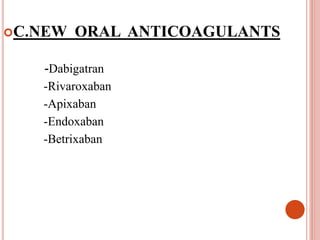
C.NEW ORAL ANTICOAGULANTS
-Dabigatran
-Rivaroxaban
-Apixaban
-Endoxaban
-Betrixaban
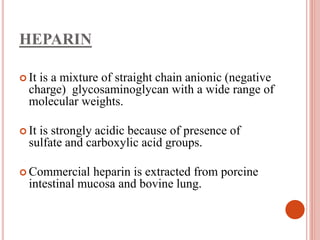
HEPARIN
 It is a mixture of straight chain anionic (negative
charge) glycosaminoglycan with a wide range of
molecular weights.
 It is strongly acidic because of presence of
sulfate and carboxylic acid groups.
 Commercial heparin is extracted from porcine
intestinal mucosa and bovine lung.
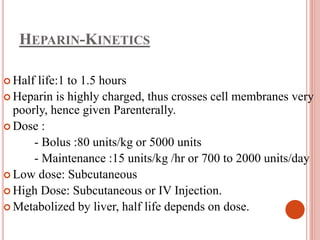
HEPARIN-KINETICS
 Half life:1 to 1.5 hours
 Heparin is highly charged, thus crosses cell membranes very
poorly, hence given Parenterally.
 Dose :
- Bolus :80 units/kg or 5000 units
- Maintenance :15 units/kg /hr or 700 to 2000 units/day
 Low dose: Subcutaneous
 High Dose: Subcutaneous or IV Injection.
 Metabolized by liver, half life depends on dose.
MECHANISM OF ACTION
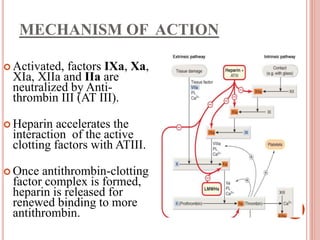
 Activated, factors IXa, Xa,
XIa, XIIa and IIa are
neutralized by Anti-
thrombin III (AT III).
 Heparin accelerates the
interaction of the active
clotting factors with ATIII.
 Once antithrombin-clotting
factor complex is formed,
heparin is released for
renewed binding to more
antithrombin.
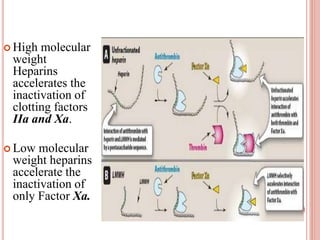
 High molecular
weight
Heparins
accelerates the
inactivation of
clotting factors
IIa and Xa.
 Low molecular
weight heparins
accelerate the
inactivation of
only Factor Xa.
MONITORING HEPARIN
 Activated Partial Thromboplastin Time (aPTT)
 Normal range: 25-40 seconds
 Therapeutic Range: 55-70 seconds
 Timing:
 4-6 hours after commencing infusion
 4-6 hours after changing dosing regimen
ASRA COMMENDATIONS
For mini dose prophylaxis:
 No contraindication: Hold morning dose.
 Check platelet count.
In a patients with combined neuraxial block and
intraoperative anticoagulation:
 Avoid RA in patients with medication of clotting
inhibitors in combination.
 Delay heparin dose up to one hour after needle
placement.
 Remove catheter 4 hours stopping the dose and start the dose
again after 1 hour.
 Check for motor and sensory blockade.
 Consider minimal dose of local anaesthetics for early
detection of spinal hematoma.
Combining neuraxial technique with full
anticoagulation of cardiac surgery:
 Insuffcient data and experience to determine the risk
of hematoma.
 Postoperative monitoring of neurological function.
 Selection of solution to minimize sensory and motor
blockade.
LMW HERARIN
 Mechnism of action:inhibit clotting factor Xa more than IIa.
 Examples :
- Deltaparin
- Enoxaparin
-Tinzaparin
 Half life:3 to 4 times than Heparin
 Doses :
- Deltaparin :2500-5000 unit/day
-Enoxaparin :30-40 mg/day
-Tinzaparin:175 unit/day
ASRA RECOMMENDATIONS
 Monitoring of anti-Xa level is not recommended.
 No RA in patients taking other clotting inhibition in
addition.
 In the presence of blood during needle and catheter
placement.
 Delay LMWH therapy for 24 hours
 Should be discussed with the surgeon.
 Preoperative LMWH:
 Thromboprophylaxis :needle placement should up to 10-12
hours.
 Treatment doses:a delay of at least 24 hours is
recommended.
 No RA if the dose is given in morning preoperatively.
 Postoperative LMWH:
 May undergo RA technique, but removal of the catheter
depends upon total daily dose and timing.
 (A ) Twice daily dose:
 Increased risk of spinal hematoma
 First dose of LMWH should not be administered 24 hours
postoperatively.
 Catheter should be removed prior to initiation of
thromboprophylaxis.
 LMWH dose should be started after 2 hours removing the
catheter.
(B)Single daily dose:
 First dose should be administered 6-8 hours
postoperatively.
 Second dose after 24 hours and catheters may be
safely maintained.
 Catheter should be removed after 12 hours of
last LMWH dose.
 LMWH dose can be started after 2 hours.
FOR GENERALANAESTHESIA
 Is it not contraindicated for patient with anticoagulant.
 Precaution should be consider:
 Avoid IM/S.C. drug administration.
 If IM administration is necessary,the arm should be
used(since local haemorrage is easier to detect and treat).
 All venopuncture/arterial puncture should be carried out
meticulosly.
 CVL by subclavian/int.jugular route is contraindicated.
 If CVL is necessary, used anticubital fossa.
 Ext.jugular can be used as hematoma formation can be treat
with ext.pressure.
 Atraumatic laryngoscopy and tracheal intubation.
 Avoid nasal intubation /NG tube.
 No precaution are necessary for patient receiving
prophylactic low dose heparin.
ADVANTAGES OF LMWH OVER UFH
 Better subcutaneous bioavailability(70-90%) compared to
UFH(20-30%).
 Longer and more consistent half life: once daily
subcutaneous administration.
 Since aPTT/clotting times are not prolonged, lab. monitoring
is not needed.
 Lower incidence of haemorrhagic complications.
USES OF HEPARIN
1.Treatment & Prevention of Deep Venous
Thrombosis in :
 Bedridden (Immobilized patients)
 Old people
 Post-operative
 Post-stroke patients
 Leg fractures
 Elective Surgery
2. Ischemic Heart Disease
Unstable angina
After MI
After angioplasty CABG, stent replacement
3. Rheumatic Heart Disease/ Atrial Fibrillation
4. Cerebrovascular Diseases
Cerebral Emboli (Prevention of recurrence)
5. Vascular Surgery, Prosthetic heart valves, Hemodialysis
To prevent thromboembolism
6. DIC
Abruptio placenta, malignancies, infections; increased consumption of
clotting factors
ADVERSE EFFECTS
1.Bleeding(most common)
2. Allergy and Anaphylaxis
3. Increased hair loss, alopecia
4. Long term-Osteoporosis, spontaneous fractures
5. Thrombocytopenia
CONTRAINDICATION
1. Hypersensitivity
2. Bleeding Disorders like Hemophilia
3. Thrombocytopenia
4-. Intracranial Hemorrhage
5. GIT Ulcerations
6. Threatened abortion
7. Advanced renal or hepatic disease
HEPARIN AND PREGNANCY
 Heparin does not cross the placenta, therefore it
must be used instead of warfarin in cases of
requiring anticoagulant therapy in pregnancy.
 Warfarin crosses the placenta and induces
changed in the fetus to produce the fetal warfarin
syndrome .
HEPARIN-INDUCED THROMBOCYTOPENIA
(HIT)
 2nd most common side effect after bleeding.
 Occurs in 3-5% of patients 5 to 10 days after initiation of
standard heparin therapy.
 Lower incidence in low molecular wt. heparin.
 Can be life-threatening.
 Due to production of IgG against complexes of heparin with
platelet.
 The complexes activate more platelets with the release of
more platelet factor 4 or other cytokines.
 This stimulates the formation of more IgG.
 This snow-ball effect uses up platelets and also leads to
thrombosis. Systemic bleeding and localized infarction (due
to thrombosis) occur.
 Once thrombocytopenia is determined, heparin must be
stopped. Direct thrombin inhibitor should be given
 Platelets must NOT be given because they will react with
antibody already being produced against them, causing
greater chance of thrombosis.
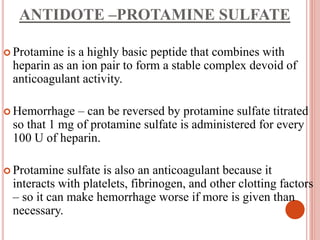
ANTIDOTE –PROTAMINE SULFATE
 Protamine is a highly basic peptide that combines with
heparin as an ion pair to form a stable complex devoid of
anticoagulant activity.
 Hemorrhage – can be reversed by protamine sulfate titrated
so that 1 mg of protamine sulfate is administered for every
100 U of heparin.
 Protamine sulfate is also an anticoagulant because it
interacts with platelets, fibrinogen, and other clotting factors
– so it can make hemorrhage worse if more is given than
necessary.
WARFARIN
Wisconsin Alumni Research Foundation Coumarin
Warfarin-Pharmacokinetics :
1. Rapidly and completely absorbed after oral administration
2. 100% Bioavailability
3. Highly plasma protein bound (99%)
4. Crosses the placenta (teratogenic)
5. Appears in milk;
6. Variable but slow clearance;depends on hepatic cytochrome
P450s
7. Biotransformation by the liver: Oxidation, Glucuronidation
8.Half life:40 hours
.
9.Doses :2-15mg/day.
10.Monitering :PT and INR
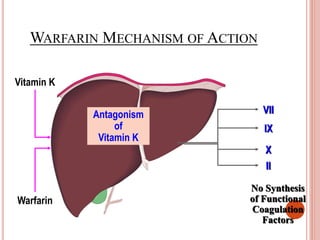
Warfarin
No Synthesis
of Functional
Coagulation
Factors
Antagonism
of
Vitamin K
WARFARIN MECHANISM OF ACTION
Vitamin K
VII
IX
X
II
USES
 Same as Heparin and other Anticoagulants.
 Monitoring necessary because of its low therapeutic index.
 PT (Prothrombin time is noted; time taken for blood to clot).
 Patients on Heparin are shifted to oral warfarin after 3-5
days
ADVERSE EFFECTS
1. Bleeding
Most common and most serious adverse effect;
Epistaxis, hematuria, GIT Bleeding, internal hemorrhages
2. Cutaneous Necrosis
This is due to decreased activity of Protein C
Protein C and Protein S found in bone & other tissues also
require Gamma carboxylations
3. Infarction of breast, fatty tissues, intestine and extremities
due to venous thrombosis caused by again decreased activity
of Protein C
ANTIDOTE OF WARFARIN
 Stop Warfarin
 Give Vitamin K (Antidote)
 Also Fresh frozen plasma, Prothrombin complex
concentrates and Recombinant factor VIIa can be
administered.
CONTRAINDICATIONS
1.Pregnancy
Fetal protein in bone and blood affected
-Causes birth defects including abnormal bone formation,
bone hypoplasia.
-CNS Defects, fetal hemorrhage, fetal
hypoprothrombinemia and fetal death may occur.
2. Other contraindications same as heparin.
PHYSIOLOGICAL/PATHOLOGICAL
FACTORS AFFECTING WARFARIN
ACTION
1. Increased warfarin action
 Malnutrition, debility (Decreased Vit. K)
 Liver disease, chronic alcoholism (Decreased clotting
factors)
 Hyperthyroidism (Increased degradation of Clotting factors)
 Newborns (Decreased vitamin K)
2. Decreased Warfarin Action
 Pregnancy (Increased clotting factors)
 Nephrotic syndrome
 Warfarin resistance (Genetic)
ASRA RECOMMENDATIONS
 Caution should made in performing neuraxial block in
patients recently discontinued warfarin therapy.
 The anticoagulant therapy must be stopped(ideally 4-5 days
before performing the block).
 Moniter PT / INR prior to initiation of block.
 No RA if in combination of other drugs affecting the
clotting.
 If the first dose given 24 hours eariler-check PT/INR.
 Patients receiving warfarin during epidural analgesia- do
PT/INR on daily basis.
 Check PT/INR before catheter removal if initial doses of
warfarin are given more than 36 hours preoperatively.
 Epidural catheter can be removed if INR is<1.5
 Neurological testing of the motor and sensory functions
should be done.
 Minimize the degree of motor and sensory block.
 If INR>3,hold warfarin in patients with enhanced drug
response.
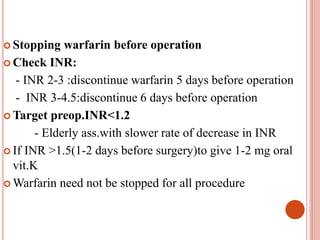
 Stopping warfarin before operation
 Check INR:
- INR 2-3 :discontinue warfarin 5 days before operation
- INR 3-4.5:discontinue 6 days before operation
 Target preop.INR<1.2
- Elderly ass.with slower rate of decrease in INR
 If INR >1.5(1-2 days before surgery)to give 1-2 mg oral
vit.K
 Warfarin need not be stopped for all procedure
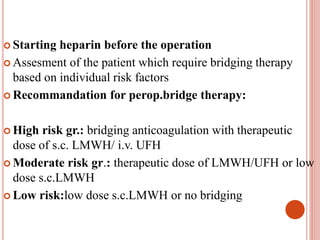
 Starting heparin before the operation
 Assesment of the patient which require bridging therapy
based on individual risk factors
 Recommandation for perop.bridge therapy:
 High risk gr.: bridging anticoagulation with therapeutic
dose of s.c. LMWH/ i.v. UFH
 Moderate risk gr.: therapeutic dose of LMWH/UFH or low
dose s.c.LMWH
 Low risk:low dose s.c.LMWH or no bridging
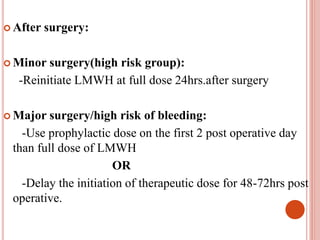
 After surgery:
 Minor surgery(high risk group):
-Reinitiate LMWH at full dose 24hrs.after surgery
 Major surgery/high risk of bleeding:
-Use prophylactic dose on the first 2 post operative day
than full dose of LMWH
OR
-Delay the initiation of therapeutic dose for 48-72hrs post
operative.
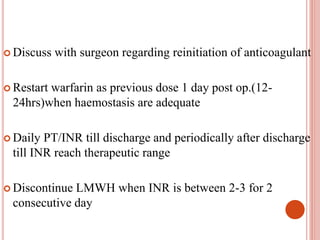
 Discuss with surgeon regarding reinitiation of anticoagulant
 Restart warfarin as previous dose 1 day post op.(12-
24hrs)when haemostasis are adequate
 Daily PT/INR till discharge and periodically after discharge
till INR reach therapeutic range
 Discontinue LMWH when INR is between 2-3 for 2
consecutive day
DIRECT THROMBIN INHIBITORS
(DTIS)
 The DTIs bind thrombin without additional binding proteins,
such as anti-thrombin, and they do not bind to other plasma
proteins such as platelet factor 4.
 Hirudin and Bivalirudin bind at both the catalytic or active
site of thrombin as well as at a substrate recognition site.
 Argatroban bind only at the thrombin active site
LEPIRUDIN
 Monitored by aPTT.
 Action independent of antithrombin.
 Use in thrombosis related to heparin induced
thrombocytopenia.
 No antidote.
 Adverse effect: Antibody formation against thrombin-
lepirudin complex.
Bivalirudin
Inhibits platelet activation
Use in percutaneous coronary angiography.
Argatroban
Used in heparin induced thrombocytopenia with or without
thrombosis
Monitored by aPTT
Dose reduction in liver disease
THANK YOU……