DRUGS
FOR
CONGESTIVE HEART FAILURE
(CHF/ CCF)
Congestive Heart Failure
 State where the heart cannot maintain an
adequate cardiac output to meet metabolic
demands of the body
 Almost all form of heart disease can lead to
heart failure
 Congestive heart failure (CHF) is a chronic
progressive condition that affects the pumping
power of your heart muscles.
 You have four heart chambers. The upper half of
your heart has two atria, and the lower half of your
heart has two ventricles. The ventricles pump
blood to your body’s organs and tissues, and the
atria receive blood from your body as it circulates
back from the rest of your body.
 CHF develops when your ventricles can’t pump
blood in sufficient volume to the body. Eventually,
blood and other fluids can back up inside your:
-lungs -abdomen -liver -lower body
New York Heart Association(NYHA) Classification
Drugs for CHF contd. ...……
Class I No symptoms with ordinary physical activity
Class
II
Symptoms with ordinary physical activity but
comfortable at rest
Class
III
Symptoms with less than ordinary physical
activity but comfortable at rest
Class
IV
Cannot carry on any physical activity without
symptoms. Symptoms may be present even at
rest. The symptoms increases with increase
physical activity
 Left, right & biventricular heart failure
Drugs for CHF contd. ...……
Left Heart Failure Right Heart Failure
Cardiomegaly
Pulmonary oedema
Raised JVP +/++
Pitting oedema +/++
Pleural effusions
Raised JVP +++
Hepatomegaly
Ascites
Pitting oedema +++
Therapy of CHF
Drugs for CHF contd. ...……
Correction of reversible cause
Diet and activity
o Salt restriction
o extremes of temperature & heavy physical
exertion should be avoided.
o Drugs that worsen CHF should be avoided
(including NSAIDs)
o Other
Drugs therapy
Drugs for CHF
Drugs for CHF contd. ...……
Inotropic drugs: Digoxin, Dobutamine,
Dopamine, Amrinone,
Milrinone
Diuretics: Furosemide, Bumetanide,
Thiazides, Spironolactone
(Aldosterone antagonist)
Vasodilators: ACE Inhibitors /ARB,
Hydralazine, Prazosin, Sod.
Nitroprusside, Nitrates
β Blocker: Metoprolol, Bisoprolol,
Carvedilol
CARDIAC GLYCOSIDES (Digitalis)
Drugs for CHF contd. ...……
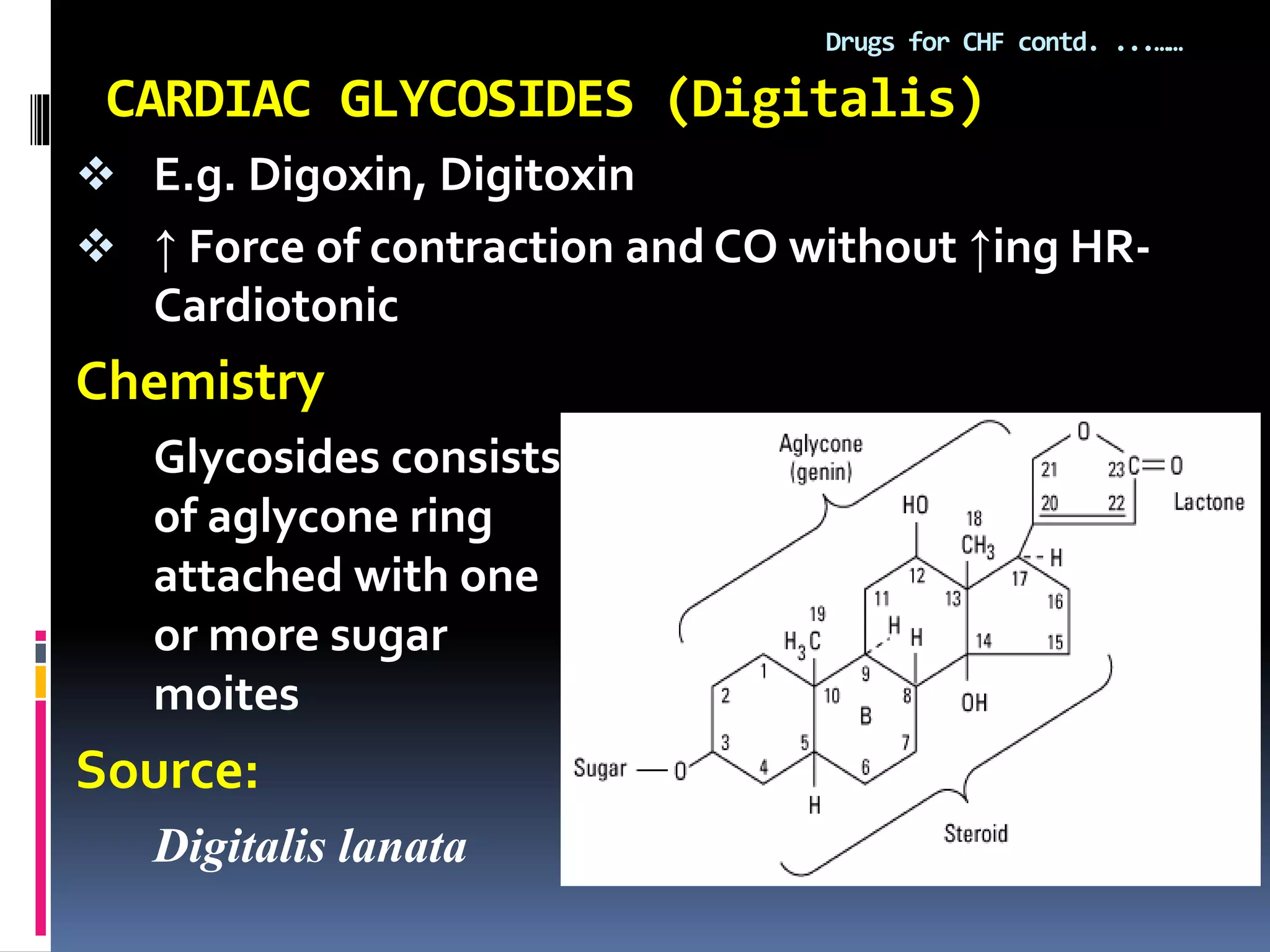
 E.g. Digoxin, Digitoxin
 ↑ Force of contraction and CO without ↑ing HR-
Cardiotonic
Chemistry
Glycosides consists
of aglycone ring
attached with one
or more sugar
moites
Source:
Digitalis lanata
Digitalis Contd……… Drugs for CHF contd. ...……
Effect in Heart:
 In failing heart; it ↑ force of contraction (Dose
dependent ) → ↑ CO
 Slow AV conduction → bradycardia
 More complete emptying of failing and dilated
ventricles
 SA node and A-V node automaticity is reduced at
therapeutic concentration
 They increase myocardial contractility and output in a
hypodynamic heart without a proportionate increase
in O2 consumption
Digitalis Contd……… Drugs for CHF contd. ...……
Mechanism of action:
Increase intracellular Ca2+ by blocking
Na+-K+ATPase
Digitalis Contd……… Drugs for CHF contd. ...……
Mechanism of action:
Ca2+
Ca2+
Ca2+
Ca2+
Ca2+
3Na+
2K+
Mechanism Contd……… Drugs for CHF contd. ...……
Ca2+
Ca2+
Ca2+
Ca2+
Ca2+
3Na+
2K+Digoxin 3Na+
Digitalis Contd……… Drugs for CHF contd. ...……
Effect in Blood vessels:
 No prominent effect in BP so can be given in
hypertensive patient
Effect CNS:
 Little effect in therapeutic dose
 Higher dose- activate CTZ, hyperapnoea,
central sympathetic stimulation, mental
confusion , disorientation, visual
disturbances
Digitalis Contd……… Drugs for CHF contd. ...……
PHARMACOKINETICS:
 Digitoxin: more lipid soluble ; slow & long acting
 Digoxin:
1. Fast and short acting than digitoxin
2. Relatively polar (……….)
3. Bioavailability differ from manufacture to
manufacturer
4. Food delay absorption
5. Concentrate in heart, Skeletal muscle, kidney
and liver : large volume of distribution (6-8 L/Kg)
6. t1/2 in elderly people………..?
Digitalis Contd……… Drugs for CHF contd. ...……
ADVERSE EFFECTS:
 Toxicity is high
 Margin of safety is low (therapeutic index 1.5-3)
 Extracardiac:
1. Initially: Anorexia, nausea, vomiting, diarrhoea
and abdominal pain
2. Fatigue, malaise, headache, mental confusion,
restlessness, hyperapnoea, disorientation,
psychosis, visual disturbances
3. Skin rashes and gynaecomastia rarely
 Cardiac:
Bradycardia, A-V block, any type of arrhythmias
Digitalis Contd……… Drugs for CHF contd. ...……
TREATMENT OF DIGITALISTOXICITY:
 Stop digitalis on earliest sign of toxicity
 Pot. Chloride administration (if toxicity is due to
chronic use/ use of diuretics ) which is guided by
serum pot. measurement
 Treatment of arrhythmias (if required)
a. Ventricular arrhythmias: Lignocaine i.v.
b. Supraventricular arrhythmias: Propranolol (oral/ i.v.)
c. A-V block & bradycardia: Atropine (i.m.)
 Digoxin antibody- very effective Orphan drug.
NOT used in our part
Digitalis Contd……… Drugs for CHF contd. ...……
CONTRAINDICATIONS:
 Hypokalemia
 Elderly, renal or severe hepatic disease (pt. more
sensitive)
 Hypothyroidism (low elimination, cumulation)
 Ventricular tachycardia
 Partial A-V Block
Digitalis Contd……… Drugs for CHF contd. ...……
Interactions:
Loop diuretics
Thiazide diuretics
Corticosteroids
Hypokalemia
Amiodarone
Verapamil
Erythromycin
Displace digitalis
from protein
binding site
Enhance digitalis
Cardiotoxicity
Catecholamines
Succinylcholine
Cause arrhythmias
Calcium
Digitalis Contd……… Drugs for CHF contd. ...……
Interactions:
Antacids
Sucralfate
Neomycin
Decrease
absorption of
digoxin
Enzyme inducers
Phenytoin
Phenobarbitone
Increase
metabolism of
digoxin
Decreased
digitalis Effect
Digitalis Contd……… Drugs for CHF contd. ...……
USES:
1. Congestive Heart Failure:
 Not commonly used because:
a. Have low margin of safety
b. Inable to reverse/ retard the disease progression
 Drug of choice in CHF patient:
a) With dilated heart and low ejection fraction
b) With atrial fibrillation
c) Not controlled by other drugs (resistant case)
 Prescribe in dose that provides plasma
concentration (0.8 -1.2ng/dl)- digitalization
 Stable clinical state for 2-3 months, withdrawal of
digitalis therapy can be attempted
Digitalis Contd………
Drugs for CHF contd. ...……
2. Cardiac arrhythmias:
 Atrial fibrillation (AF)
 Atrial flutter (AFl)
 Paroxysmal supraventricular tachycardia (PSVT)
 Atrial flutter and atrial fibrillation are
both abnormal heart rhythms.
 In atrial fibrillation, the atria beat irregularly. In
atrial flutter, the atria beat regularly, but faster
than usual and more often than the ventricles
 Dose: 0.125-0.25 mg PO/IV
DIURETICS Drugs for CHF contd. ...……
 High ceiling diuretics are preferred, but thiazide /
spironolactone can be added to overcome
resistance
 Mechanism:
a. ↑ Na+ & water excretion →↓ ECF volume →
↓ preload & improve ventricular efficacy
b. Remove oedema and congestion
 i.v furosemide increase venous capacitance
 Give quick symptomatic relief but DONOT influence
the disease process
 Intermittently used when required at low dose
Diuretics contd………… Drugs for CHF contd. ...……
 Spironolactone (aldesterone antagonist) –
decrease morbidity and mortality in patient
with severe heart failure
 Spironolactone is used in low dose (12.5-
25mg/day) as add on therapy with ACEIs
 Beneficial effect of spironolactone is slow
 Spironolactone is contraindicated in renal
insufficiency patient & pt. with hyperkalemia
Drugs for CHF contd. ...……
ACE Inhibitors/ ARBs:
 Orally active medium efficacy mixed dilator
 Vein dilation: ↓venous return → ↓ ventricular end
diastolic pressure & volume → reduce ventricle size
→ improve systole (Laplace law)
 Arteriolar dilation: ↓ afterload → weaker ventricular
contraction can pump more blood
 ↓ aldosterone release
 Recommended for all grades of CHF especially for
patient with left ventricular dysfunction but no
edema
 Advantages with ACEI:
a. Afford symptomatic relief
b. Retard/ reverse ventricular hypertrophy, myocardial
cell apoptosis and remodeling
Drugs for CHF contd. ...……
ROLE OF OTHERVASODILATORS:
Nitrates:Venodilator
Hydralazine, Minoxidil: Arteriolar dilators
Prazosin, Nitroprusside: Mixed dilators
 Hydralazine preferred in renal insufficiency patient
Drugs for CHF contd. ...……
Sympathomimetic inotropic drugs:
DOBUTAMINE:
 Selective β1 agonist given i.v.
 NOT commonly used b/c of potential to
produce angina or arrhythmias
 Preferred in acute HF accompaning MI,
cardiac surgery
Drugs for CHF contd. ...……
Phosphodiesterase III inhibitors:
AMRINONE (Inamrinone)
 Increase myocardial cAMP & influx of Ca2+
 Inodilator: (+ve inotropic and vasodilator)
 Given i.v.- action within 5 min & last for 2-3 hours
 Adverse effects: Thrombocytopenia (dose
related, transient & asymptomatic), nausea,
diarrhoea, abdominal pain, liver damage, fever
and arrhythmias
 Uses: Severe and refractory CHF (Short term i.v.
use along with other drugs)
Drugs for CHF contd. ...……
MILRINONE:
 More selective, more potent and short
acting than amrinone
 Thrombocytopenia – NOT significant
 Preferred over amrinone for short term use
Drugs for heart failure

Drugs for heart failure

  • 1.
  • 2.
    Congestive Heart Failure State where the heart cannot maintain an adequate cardiac output to meet metabolic demands of the body  Almost all form of heart disease can lead to heart failure
  • 3.
     Congestive heartfailure (CHF) is a chronic progressive condition that affects the pumping power of your heart muscles.  You have four heart chambers. The upper half of your heart has two atria, and the lower half of your heart has two ventricles. The ventricles pump blood to your body’s organs and tissues, and the atria receive blood from your body as it circulates back from the rest of your body.  CHF develops when your ventricles can’t pump blood in sufficient volume to the body. Eventually, blood and other fluids can back up inside your: -lungs -abdomen -liver -lower body
  • 4.
    New York HeartAssociation(NYHA) Classification Drugs for CHF contd. ...…… Class I No symptoms with ordinary physical activity Class II Symptoms with ordinary physical activity but comfortable at rest Class III Symptoms with less than ordinary physical activity but comfortable at rest Class IV Cannot carry on any physical activity without symptoms. Symptoms may be present even at rest. The symptoms increases with increase physical activity
  • 5.
     Left, right& biventricular heart failure Drugs for CHF contd. ...…… Left Heart Failure Right Heart Failure Cardiomegaly Pulmonary oedema Raised JVP +/++ Pitting oedema +/++ Pleural effusions Raised JVP +++ Hepatomegaly Ascites Pitting oedema +++
  • 6.
    Therapy of CHF Drugsfor CHF contd. ...…… Correction of reversible cause Diet and activity o Salt restriction o extremes of temperature & heavy physical exertion should be avoided. o Drugs that worsen CHF should be avoided (including NSAIDs) o Other Drugs therapy
  • 7.
    Drugs for CHF Drugsfor CHF contd. ...…… Inotropic drugs: Digoxin, Dobutamine, Dopamine, Amrinone, Milrinone Diuretics: Furosemide, Bumetanide, Thiazides, Spironolactone (Aldosterone antagonist) Vasodilators: ACE Inhibitors /ARB, Hydralazine, Prazosin, Sod. Nitroprusside, Nitrates β Blocker: Metoprolol, Bisoprolol, Carvedilol
  • 8.
    CARDIAC GLYCOSIDES (Digitalis) Drugsfor CHF contd. ...……  E.g. Digoxin, Digitoxin  ↑ Force of contraction and CO without ↑ing HR- Cardiotonic Chemistry Glycosides consists of aglycone ring attached with one or more sugar moites Source: Digitalis lanata
  • 9.
    Digitalis Contd……… Drugsfor CHF contd. ...…… Effect in Heart:  In failing heart; it ↑ force of contraction (Dose dependent ) → ↑ CO  Slow AV conduction → bradycardia  More complete emptying of failing and dilated ventricles  SA node and A-V node automaticity is reduced at therapeutic concentration  They increase myocardial contractility and output in a hypodynamic heart without a proportionate increase in O2 consumption
  • 10.
    Digitalis Contd……… Drugsfor CHF contd. ...…… Mechanism of action: Increase intracellular Ca2+ by blocking Na+-K+ATPase
  • 11.
    Digitalis Contd……… Drugsfor CHF contd. ...…… Mechanism of action: Ca2+ Ca2+ Ca2+ Ca2+ Ca2+ 3Na+ 2K+
  • 12.
    Mechanism Contd……… Drugsfor CHF contd. ...…… Ca2+ Ca2+ Ca2+ Ca2+ Ca2+ 3Na+ 2K+Digoxin 3Na+
  • 13.
    Digitalis Contd……… Drugsfor CHF contd. ...…… Effect in Blood vessels:  No prominent effect in BP so can be given in hypertensive patient Effect CNS:  Little effect in therapeutic dose  Higher dose- activate CTZ, hyperapnoea, central sympathetic stimulation, mental confusion , disorientation, visual disturbances
  • 14.
    Digitalis Contd……… Drugsfor CHF contd. ...…… PHARMACOKINETICS:  Digitoxin: more lipid soluble ; slow & long acting  Digoxin: 1. Fast and short acting than digitoxin 2. Relatively polar (……….) 3. Bioavailability differ from manufacture to manufacturer 4. Food delay absorption 5. Concentrate in heart, Skeletal muscle, kidney and liver : large volume of distribution (6-8 L/Kg) 6. t1/2 in elderly people………..?
  • 15.
    Digitalis Contd……… Drugsfor CHF contd. ...…… ADVERSE EFFECTS:  Toxicity is high  Margin of safety is low (therapeutic index 1.5-3)  Extracardiac: 1. Initially: Anorexia, nausea, vomiting, diarrhoea and abdominal pain 2. Fatigue, malaise, headache, mental confusion, restlessness, hyperapnoea, disorientation, psychosis, visual disturbances 3. Skin rashes and gynaecomastia rarely  Cardiac: Bradycardia, A-V block, any type of arrhythmias
  • 16.
    Digitalis Contd……… Drugsfor CHF contd. ...…… TREATMENT OF DIGITALISTOXICITY:  Stop digitalis on earliest sign of toxicity  Pot. Chloride administration (if toxicity is due to chronic use/ use of diuretics ) which is guided by serum pot. measurement  Treatment of arrhythmias (if required) a. Ventricular arrhythmias: Lignocaine i.v. b. Supraventricular arrhythmias: Propranolol (oral/ i.v.) c. A-V block & bradycardia: Atropine (i.m.)  Digoxin antibody- very effective Orphan drug. NOT used in our part
  • 17.
    Digitalis Contd……… Drugsfor CHF contd. ...…… CONTRAINDICATIONS:  Hypokalemia  Elderly, renal or severe hepatic disease (pt. more sensitive)  Hypothyroidism (low elimination, cumulation)  Ventricular tachycardia  Partial A-V Block
  • 18.
    Digitalis Contd……… Drugsfor CHF contd. ...…… Interactions: Loop diuretics Thiazide diuretics Corticosteroids Hypokalemia Amiodarone Verapamil Erythromycin Displace digitalis from protein binding site Enhance digitalis Cardiotoxicity Catecholamines Succinylcholine Cause arrhythmias Calcium
  • 19.
    Digitalis Contd……… Drugsfor CHF contd. ...…… Interactions: Antacids Sucralfate Neomycin Decrease absorption of digoxin Enzyme inducers Phenytoin Phenobarbitone Increase metabolism of digoxin Decreased digitalis Effect
  • 20.
    Digitalis Contd……… Drugsfor CHF contd. ...…… USES: 1. Congestive Heart Failure:  Not commonly used because: a. Have low margin of safety b. Inable to reverse/ retard the disease progression  Drug of choice in CHF patient: a) With dilated heart and low ejection fraction b) With atrial fibrillation c) Not controlled by other drugs (resistant case)  Prescribe in dose that provides plasma concentration (0.8 -1.2ng/dl)- digitalization  Stable clinical state for 2-3 months, withdrawal of digitalis therapy can be attempted
  • 21.
    Digitalis Contd……… Drugs forCHF contd. ...…… 2. Cardiac arrhythmias:  Atrial fibrillation (AF)  Atrial flutter (AFl)  Paroxysmal supraventricular tachycardia (PSVT)
  • 22.
     Atrial flutterand atrial fibrillation are both abnormal heart rhythms.  In atrial fibrillation, the atria beat irregularly. In atrial flutter, the atria beat regularly, but faster than usual and more often than the ventricles  Dose: 0.125-0.25 mg PO/IV
  • 23.
    DIURETICS Drugs forCHF contd. ...……  High ceiling diuretics are preferred, but thiazide / spironolactone can be added to overcome resistance  Mechanism: a. ↑ Na+ & water excretion →↓ ECF volume → ↓ preload & improve ventricular efficacy b. Remove oedema and congestion  i.v furosemide increase venous capacitance  Give quick symptomatic relief but DONOT influence the disease process  Intermittently used when required at low dose
  • 24.
    Diuretics contd………… Drugsfor CHF contd. ...……  Spironolactone (aldesterone antagonist) – decrease morbidity and mortality in patient with severe heart failure  Spironolactone is used in low dose (12.5- 25mg/day) as add on therapy with ACEIs  Beneficial effect of spironolactone is slow  Spironolactone is contraindicated in renal insufficiency patient & pt. with hyperkalemia
  • 25.
    Drugs for CHFcontd. ...…… ACE Inhibitors/ ARBs:  Orally active medium efficacy mixed dilator  Vein dilation: ↓venous return → ↓ ventricular end diastolic pressure & volume → reduce ventricle size → improve systole (Laplace law)  Arteriolar dilation: ↓ afterload → weaker ventricular contraction can pump more blood  ↓ aldosterone release  Recommended for all grades of CHF especially for patient with left ventricular dysfunction but no edema  Advantages with ACEI: a. Afford symptomatic relief b. Retard/ reverse ventricular hypertrophy, myocardial cell apoptosis and remodeling
  • 26.
    Drugs for CHFcontd. ...…… ROLE OF OTHERVASODILATORS: Nitrates:Venodilator Hydralazine, Minoxidil: Arteriolar dilators Prazosin, Nitroprusside: Mixed dilators  Hydralazine preferred in renal insufficiency patient
  • 27.
    Drugs for CHFcontd. ...…… Sympathomimetic inotropic drugs: DOBUTAMINE:  Selective β1 agonist given i.v.  NOT commonly used b/c of potential to produce angina or arrhythmias  Preferred in acute HF accompaning MI, cardiac surgery
  • 28.
    Drugs for CHFcontd. ...…… Phosphodiesterase III inhibitors: AMRINONE (Inamrinone)  Increase myocardial cAMP & influx of Ca2+  Inodilator: (+ve inotropic and vasodilator)  Given i.v.- action within 5 min & last for 2-3 hours  Adverse effects: Thrombocytopenia (dose related, transient & asymptomatic), nausea, diarrhoea, abdominal pain, liver damage, fever and arrhythmias  Uses: Severe and refractory CHF (Short term i.v. use along with other drugs)
  • 29.
    Drugs for CHFcontd. ...…… MILRINONE:  More selective, more potent and short acting than amrinone  Thrombocytopenia – NOT significant  Preferred over amrinone for short term use

Editor's Notes

  • #3 This condition, in the past, has been referred to as congestive heart failure due to edematous state produced by the fluid retention leading to pulmonary as well as peripheral congestion.
  • #9 Although digitalis is not the first drug and never the only drug used in heart failure, we begin our discussion with this group because other drugs are discussed in more detail in other chapters. Digitoxin- slow and long acting and given only by oral route.