
DRUGS
FOR
ANGINA PECTORIS (IHD)
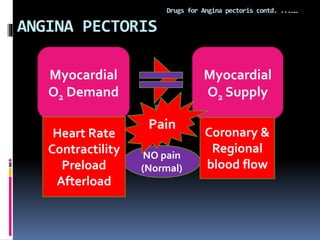
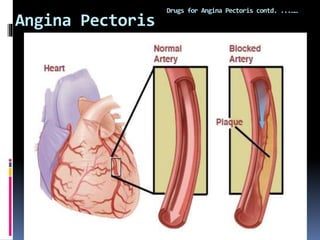
ANGINA PECTORIS
Angina: a strangling Pectoris: of the chest
 Pain syndrome due to induction of an
adverse oxygen supply & demand in portion
of myocardium
 Pain radiates (left side) – Jaw, neck,
shoulder, arm (occasionally back)
 Tight, squeezing, chocking
 Breathlessness
ANGINA PECTORIS
Myocardial
O2 Demand
Myocardial
O2 Supply
NO pain
(Normal)
Pain
Heart Rate
Contractility
Preload
Afterload
Coronary &
Regional
blood flow
Drugs for Angina pectoris contd. ...……
Types of Angina Pectoris
1. Stable (Classical/Typical) Angina
2. Unstable Angina
3. Variant (Prinzmetal) Angina
Drugs for Angina Pectoris contd. ...……
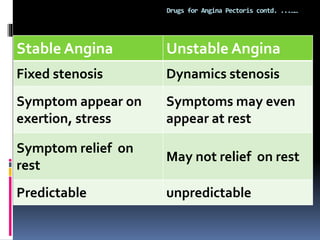
Stable Angina Unstable Angina
Fixed stenosis Dynamics stenosis
Symptom appear on
exertion, stress
Symptoms may even
appear at rest
Symptom relief on
rest
May not relief on rest
Predictable unpredictable
Drugs for Angina Pectoris contd. ...……
Prinzmetal,variantorrest-angina
 Prinzmetal angina is an uncommon pattern of
episodic angina that occurs at rest and is due to
coronary artery spasm.
 Symptoms are caused by decreased blood flow to
the heart muscle from the spasm of the coronary
artery.
 Prinzmetal angina generally responds promptly
to coronary vasodilators, such as nitroglycerin and
calcium-channel blockers.
Drugs for Angina Pectoris contd. ...……
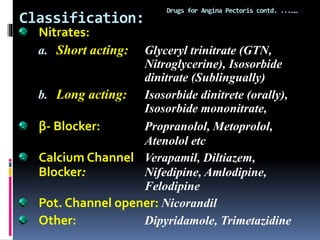
Angina Pectoris
Classification:
Drugs for Angina Pectoris contd. ...……
Nitrates:
a. Short acting: Glyceryl trinitrate (GTN,
Nitroglycerine), Isosorbide
dinitrate (Sublingually)
b. Long acting: Isosorbide dinitrete (orally),
Isosorbide mononitrate,
β- Blocker: Propranolol, Metoprolol,
Atenolol etc
Calcium Channel Verapamil, Diltiazem,
Blocker: Nifedipine, Amlodipine,
Felodipine
Pot. Channel opener: Nicorandil
Other: Dipyridamole, Trimetazidine
Clinical Classification:
Drugs for Angina Pectoris contd. ...……
Used to abort or terminate attack:
Glyceryl trinitrate (GTN),
Isosorbide dinitrate (Sublingually)
Used for chronic prophylaxis:
All other drugs
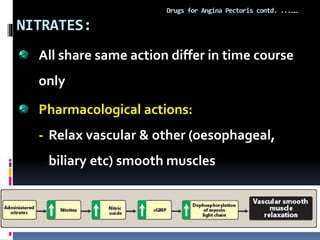
NITRATES:
Drugs for Angina Pectoris contd. ...……
All share same action differ in time course
only
Pharmacological actions:
- Relax vascular & other (oesophageal,
biliary etc) smooth muscles
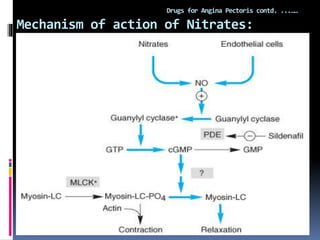
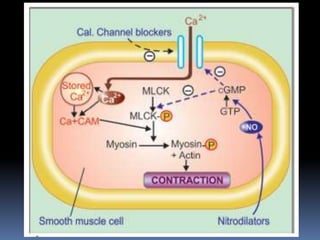
Mechanism of action of Nitrates:
Drugs for Angina Pectoris contd. ...……
 MOA: Nitrates inhibit coronary vasoconstriction or
spasm, increasing perfusion of the myocardium and,
thus, relieving vasospastic angina. In addition,
nitrates relax the veins (venodilation), decreasing
preload and myocardial oxygen consumption.
 Organic nitrates, such as nitroglycerin, relax vascular
smooth muscle by their intracellular conversion to
nitrite ions and then to nitric oxide, which, in turn,
activates guanylate cyclase and increases the cells’
cyclic guanosine monophosphate (cGMP). Elevated
cGMP ultimately leads to dephosphorylation of the
myosin light chain, resulting in vascular smooth
muscle relaxation
How Nitrates help (relieve pain) in
angina pectoris?
Drugs for Angina Pectoris contd. ...……
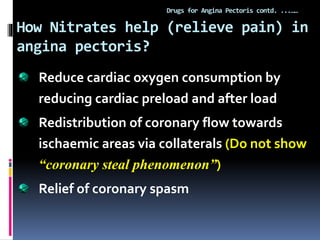
Reduce cardiac oxygen consumption by
reducing cardiac preload and after load
Redistribution of coronary flow towards
ischaemic areas via collaterals (Do not show
“coronary steal phenomenon”)
Relief of coronary spasm
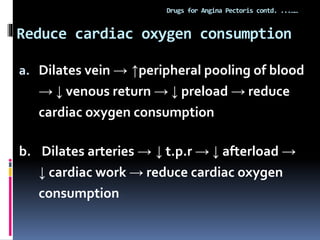
Reduce cardiac oxygen consumption
Drugs for Angina Pectoris contd. ...……
a. Dilates vein → ↑peripheral pooling of blood
→ ↓ venous return → ↓ preload → reduce
cardiac oxygen consumption
b. Dilates arteries → ↓ t.p.r → ↓ afterload →
↓ cardiac work → reduce cardiac oxygen
consumption
Redistribution of coronary flow
Drugs for Angina Pectoris contd. ...……
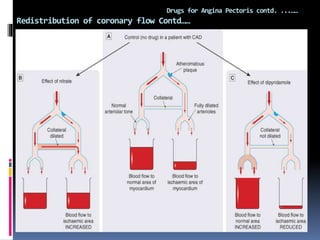
a. Nitrates preferentially relax bigger coronary
arteries than arterioles and also the
collateral circulation
b. Ischaemia induce dilation of arterioles in
the ischaemic zone
Both actions (a & b) preferentially increase
blood flow to ischaemic area
Redistribution of coronary flow Contd……
Drugs for Angina Pectoris contd. ...……
Pharmacokinetics of Nitrates
Drugs for Angina Pectoris contd. ...……
Lipid soluble, undergo high first pass
metabolism (except mononitrate)
Onset of action depend on route of
administration
Adverse effects of nitrates
Drugs for Angina Pectoris contd. ...……
a. Throbbing headache
b. Flushing, sweating, hypotension, palpitation,
dizziness & fainting
c. High dose- Methemoglobinemia
d. Tolerance:
- on continuous use (oral, transdermal, i.v.)
- Nitrate free interval is created every day to
overcome: eccentric administration
e. Dependence: so slow withdrawal with addition of
other drugs
Glyceryl trinitrate (GTN)
Drugs for Angina Pectoris contd. ...……
 Volatile liquid: adsorbed on inert matrix of
tablet
 Stored in air tight glass container
protecting from light
 Given SL: acts within 1-2 min, t1/2= 2 min
 Sublingual spray act more rapidly than tab
 Can also be given transdermally or i.v.
Isosorbide dinitrate
Drugs for Angina Pectoris contd. ...……
 SL for acute attack and oral for prophylaxis
 High and variable first pass metabolism
when given orally, t1/2= 40 min
 Last dose should not be given later than
6 pm
Isosorbide mononitrate
Drugs for Angina Pectoris contd. ...……
 Active metabolite of isosorbide dinitrate
 Low first pass metabolism- orally
 t1/2 =4-6 hours
 Last dose should be given in the afternoon;
SR tablet OD in the morning
Uses of nitrates
Drugs for Angina Pectoris contd. ...……
1. Stable angina:
 For acute attack:
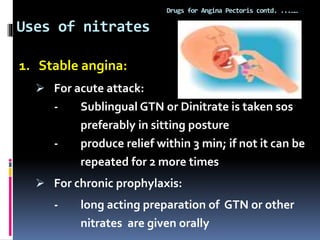
- Sublingual GTN or Dinitrate is taken sos
preferably in sitting posture
- produce relief within 3 min; if not it can be
repeated for 2 more times
 For chronic prophylaxis:
- long acting preparation of GTN or other
nitrates are given orally
Drugs for Angina Pectoris contd. ...……
2. Unstable angina and Myocardial Infarction
3. CHF and acute Left ventricular failure
4. Biliary colic
5. Esophageal spasm
Beta Blockers
Drugs for Angina Pectoris contd. ...……
 Heart rate
 Contractility
 BP
 Myocardial
O2 demand
 Increase exercise tolerance
 Lower risk of sudden cardiac death in IHD patient
 Decrease frequency and severity of attack :
Prophylactic use
 Worsen variant angina
 Selective beta blocker are preferred, taken
regularly & NOT withdrawn abruptly
 Do not dilate coronaries
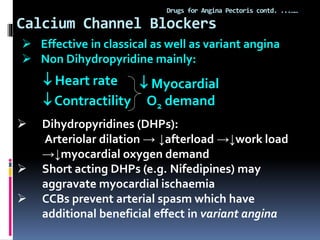
Calcium Channel Blockers
Drugs for Angina Pectoris contd. ...……
 Heart rate
 Contractility
 Myocardial
O2 demand
 Effective in classical as well as variant angina
 Non Dihydropyridine mainly:
 Dihydropyridines (DHPs):
Arteriolar dilation → ↓afterload →↓work load
→↓myocardial oxygen demand
 Short acting DHPs (e.g. Nifedipines) may
aggravate myocardial ischaemia
 CCBs prevent arterial spasm which have
additional beneficial effect in variant angina
Drugs for Angina Pectoris contd. ...……
Potassium Channel Opener
 MOA: Potassium-channel openers are drugs that activate
ATP-sensitive K+channels in vascular smooth muscle.
Opening these channels hyperpolarizes the smooth
muscle, which closes voltage-gated calcium channels and
decreases intracellular calcium. This leads to relaxation
and vasodilation. E.g. Nicorandil Dose: 5–20 mg BD
 Arteriolar andVenous dilator
 Uses: Stable &Variant angina
 Adverse effects
 Hypotension
 Flushing
 Dizziness
 Palpitation
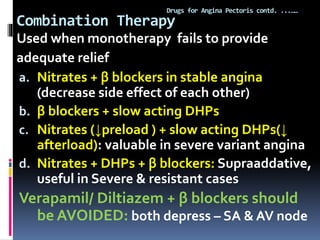
Combination Therapy
Drugs for Angina Pectoris contd. ...……
Used when monotherapy fails to provide
adequate relief
a. Nitrates + β blockers in stable angina
(decrease side effect of each other)
b. β blockers + slow acting DHPs
c. Nitrates (↓preload ) + slow acting DHPs(↓
afterload): valuable in severe variant angina
d. Nitrates + DHPs + β blockers: Supraaddative,
useful in Severe & resistant cases
Verapamil/ Diltiazem + β blockers should
be AVOIDED: both depress – SA & AV node
Drugs for angina pectoris