Aditi
Maitra
Dr. Aditi Maitra
Department of Pharmacology
CNMCH
KOLKATA
Antiplatelet Drugs
Aditi
Maitra
OVERVIEW OF HEMOSTASIS
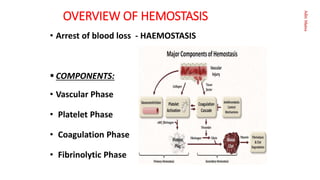
• Arrest of blood loss - HAEMOSTASIS
 COMPONENTS:
• Vascular Phase
• Platelet Phase
• Coagulation Phase
• Fibrinolytic Phase
Aditi
Maitra
OVERVIEW OF HEMOSTASIS
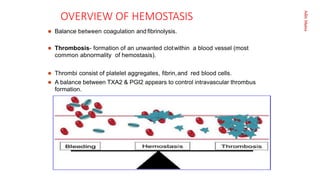
 Balance between coagulation and fibrinolysis.
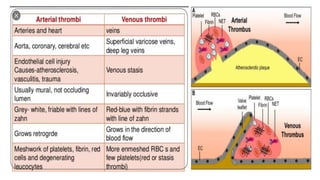
 Thrombosis- formation of an unwanted clotwithin a blood vessel (most
common abnormality of hemostasis).
 Thrombi consist of platelet aggregates, fibrin,and red blood cells.
 A balance between TXA2 & PGI2 appears to control intravascular thrombus
formation.
Aditi
Maitra
Aditi
Maitra
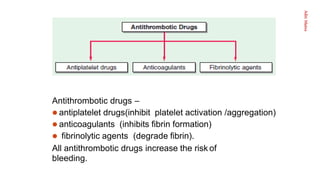
Antithrombotic drugs –
 antiplatelet drugs(inhibit platelet activation /aggregation)
 anticoagulants (inhibits fibrin formation)
 fibrinolytic agents (degrade fibrin).
All antithrombotic drugs increase the risk of
bleeding.
Aditi
Maitra
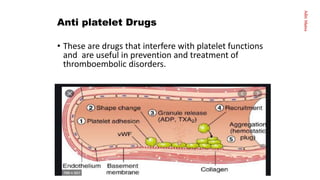
Anti platelet Drugs
• These are drugs that interfere with platelet functions
and are useful in prevention and treatment of
thromboembolic disorders.
Aditi
Maitra
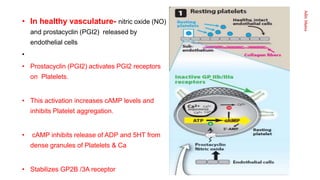
• In healthy vasculature- nitric oxide (NO)
and prostacyclin (PGI2) released by
endothelial cells
•
• Prostacyclin (PGI2) activates PGI2 receptors
on Platelets.
• This activation increases cAMP levels and
inhibits Platelet aggregation.
• cAMP inhibits release of ADP and 5HT from
dense granules of Platelets & Ca
• Stabilizes GP2B /3A receptor
Aditi
Maitra
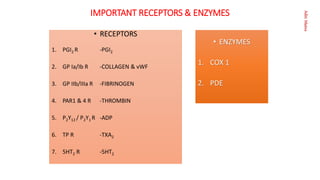
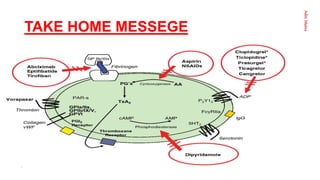
IMPORTANT RECEPTORS & ENZYMES
• RECEPTORS
1. PGI2 R -PGI2
2. GP Ia/Ib R -COLLAGEN & vWF
3. GP IIb/IIIa R -FIBRINOGEN
4. PAR1 & 4 R -THROMBIN
5. P2Y12 / P2Y1 R -ADP
6. TP R -TXA2
7. 5HT2 R -5HT2
• ENZYMES
1. COX 1
2. PDE
Aditi
Maitra
Aditi
Maitra
MECHANISM
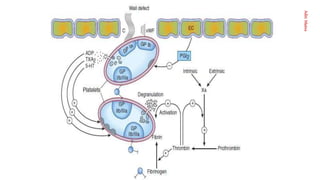
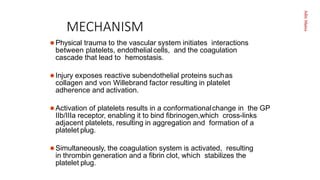
 Physical trauma to the vascular system initiates interactions
between platelets, endothelialcells, and the coagulation
cascade that lead to hemostasis.
 Injury exposes reactive subendothelial proteins suchas
collagen and von Willebrand factor resulting in platelet
adherence and activation.
 Activation of platelets results in a conformationalchange in the GP
IIb/IIIa receptor, enabling it to bind fibrinogen,which cross-links
adjacent platelets, resulting in aggregation and formation of a
platelet plug.
 Simultaneously, the coagulation system is activated, resulting
in thrombin generation and a fibrin clot, which stabilizes the
platelet plug.
Aditi
Maitra
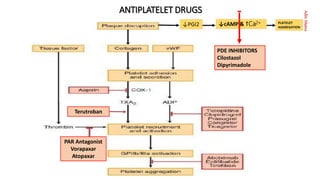
ANTIPLATELET DRUGS
↓PGI2 ↓cAMP & ↑Ca2+ PLATELET
AGGREGATION
-
PDE INHIBITORS
Cilostazol
Dipyrimadole
Terutroban
PAR Antagonist
Vorapaxar
Atopaxar
Aditi
Maitra
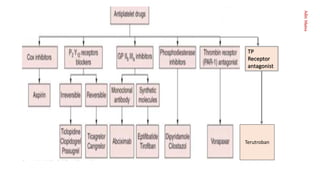
TP
Receptor
antagonist
Terutroban
Aditi
Maitra
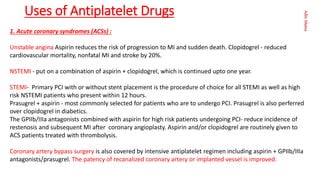
Uses of Antiplatelet Drugs
1. Acute coronary syndromes (ACSs) :
Unstable angina Aspirin reduces the risk of progression to MI and sudden death. Clopidogrel - reduced
cardiovascular mortality, nonfatal MI and stroke by 20%.
NSTEMI - put on a combination of aspirin + clopidogrel, which is continued upto one year.
STEMI- Primary PCI with or without stent placement is the procedure of choice for all STEMI as well as high
risk NSTEMI patients who present within 12 hours.
Prasugrel + aspirin - most commonly selected for patients who are to undergo PCI. Prasugrel is also perferred
over clopidogrel in diabetics.
The GPIIb/IIIa antagonists combined with aspirin for high risk patients undergoing PCI- reduce incidence of
restenosis and subsequent MI after coronary angioplasty. Aspirin and/or clopidogrel are routinely given to
ACS patients treated with thrombolysis.
Coronary artery bypass surgery is also covered by intensive antiplatelet regimen including aspirin + GPIIb/IIIa
antagonists/prasugrel. The patency of recanalized coronary artery or implanted vessel is improved.
Aditi
Maitra
2.Coronary artery disease : Primary prevention of ischaemia with aspirin is of no proven benefit- increases
the risk of cerebral haemorrhage. Continued aspirin/clopidogrel in prophylaxis in post-MI patients clearly
prevents reinfarction and reduces mortality.
3. Cerebrovascular disease :
Occurrence of stroke is also reduced in patients with persistent atrial fibrillation and
in those with history of stroke in the past - Aspirin or clopidogrel is recommended in all such individuals.
Combination of dipyridamole with low dose aspirin to be synergistic in secondary prevention of stroke.
4. Prosthetic heart valves and arteriovenous shunts :Antiplatelet drugs, used with warfarin reduce
formation of microthrombi on artificial heart valves and the incidence of embolism.
Antiplatelet drugs also prolong the patency of chronic arteriovenous shunts implanted for haemodialysis
and of vascular grafts.
5. Venous thromboembolism: Anticoagulants are routinely used in DVT and PE.
6. Peripheral vascular disease : Aspirin/ clopidogrel may produce some improvement in intermittent
claudication and reduce the incidence of thromboembolism.
Aditi
Maitra
ASPIRIN
4.
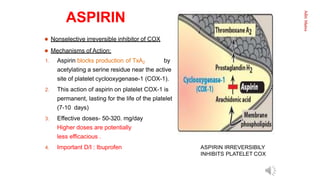
 Nonselective irreversible inhibitor of COX
 Mechanisms of Action:
1. Aspirin blocks production of TxA2 by
acetylating a serine residue near the active
site of platelet cyclooxygenase-1 (COX-1).
2. This action of aspirin on platelet COX-1 is
permanent, lasting for the life of the platelet
(7-10 days)
3. Effective doses- 50-320. mg/day
Higher doses are potentially
less efficacious .
4. Important D/I : Ibuprofen ASPIRIN IRREVERSIBILY
INHIBITS PLATELET COX
INHIBITS PLATELET
Aditi
Maitra
I.
III.
 Pharmacokinetics:
Rapidly absorbed from the stomach and upper
small intestine, peak plasma level within 1–2
hours
II. It is rapidly hydrolyzed (serum half-life 15 minutes)
to acetic acid and salicylate by esterases
Alkalinization of the urine increases the rate of
excretion
Aditi
Maitra
 Clinical Uses: decreases the incidence of
 Transient ischemic attacks
 Unstable angina, coronary artery thrombosis
with myocardial infarction and thrombosisafter
coronary artery bypass grafting
Aditi
Maitra
 Adverse effects:
 At antithrombotic doses - gastric upset (intolerance)
and gastric and duodenal ulcers. Use of enteric-
coated or buffered aspirin in place of plain aspirin
does not eliminate the risk of gastrointestinal side
effects
 Hepatotoxicity, asthma, rashes, GI bleeding, and renal
toxicity rarely at antiplatelet dose
 Contraindication – patients with hemophilia, patient with
aspirin allergy
Aditi
Maitra
DIPYRIDAMOLE
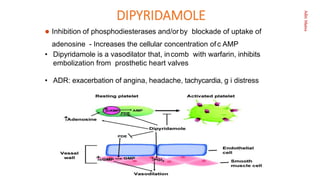
 Inhibition of phosphodiesterases and/orby blockade of uptake of
adenosine - Increases the cellular concentration of c AMP
• Dipyridamole is a vasodilator that, incomb with warfarin, inhibits
embolization from prosthetic heart valves
• ADR: exacerbation of angina, headache, tachycardia, g i distress
Aditi
Maitra
Aditi
Maitra
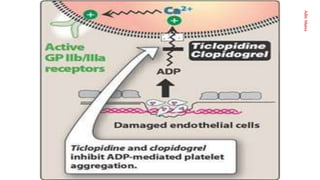
• Platelets contain two purinergic receptors, P2Y1 and P2Y12. both are GPCRs for ADP.
(require ADP for its activation)
• P2Y1- induces a shape change and aggregation P2Y12 - inhibits adenylyl cyclase. So
causes activation & ↑ Adhesiveness of platelet
• Ticlopidine (thienopyridine) is a prodrug . It is converted to the active thiol metabolite by
hepatic CYP . It is rapidly absorbed and highly bioavailable.
 It permanently inhibits the P2Y12 receptor by forming a disulfide bridge in the extracellular
region of the receptor.
 Maximal inhibition of platelet aggregation is not seen until 8-11 days after starting
therapy.
 Usual dose is 250 mg twice daily
 Most common side effects are nausea,vomiting, and diarrhea. Serious ADRs are severe
neutropenia(ANC <500/µL) Fatal agranulocytosis with thrombopenia, .TTP-HUS have also
been reported
TICLOPIDINE
Aditi
Maitra
CLOPIDOGREL
 Closely related to ticlopidine
 More potent and has more favourable toxicity profile.
 Irreversible inhibitor of platelet P2Y12 receptors
 It is a prodrug with a slow onset of action.
 The usual dose is 75 mg/day. The combination of clopidogrel plus aspirin is
superior to aspirin alone (two drugs are synergistic).
 The action of clopidogrel last for 5 days.
 Clopidogrel Resistance : genetic polymorphisms in the CYP enzymes(m.c-
CYP2C19) involved in the metabolic activation of clopidogrel
 IMPORTANT D/I - omeprazole
 FDA-approved indications - to reduce the rate of stroke, myocardial infarction,
and death in patients with recent myocardial infarction or stroke, established
peripheral arterial disease, or acute coronary syndrome
Aditi
Maitra
PRASUGREL
 Newest member of the thienopyridineclass- Produces greater and more
predictableresponse
 Prodrug- but more rapidly absorbed and completely activated, resulting
in faster and more consistent platelet inhibition.
 Though CYP2C19 is involved in activation of prasugrel as well, genetic
polymorphism related decrease in response, or interference by
omeprazole treatment has not been prominent
 Incidence of stent thrombosis, cardiovascular death, myocardial
infarction, and stroke - significantly lower
 Higher rates of fatal and life-threateningbleeding
Aditi
Maitra
TICAGRELOR
 Reversible inhibitor of P2Y12 -acts directly without any metabolic
activation
 Orally active and is given twice daily
 Faster onset & quicker offset of action
 FDA approved for the prevention of thrombotic events
 First new antiplatelet drug to demonstrate a
reduction in cardiovascular death compared with
clopidogrel in patients with acute coronary
syndromes
 Cangrelor (iv)- newer agent, reversible P2Y12 antagonist.
Aditi
Maitra
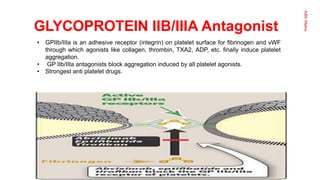
GLYCOPROTEIN IIB/IIIA Antagonist
• GPIIb/IIIa is an adhesive receptor (integrin) on platelet surface for fibrinogen and vWF
through which agonists like collagen, thrombin, TXA2, ADP, etc. finally induce platelet
aggregation.
• GP IIb/IIIa antagonists block aggregation induced by all platelet agonists.
• Strongest anti platelet drugs.
Aditi
Maitra
Aditi
Maitra
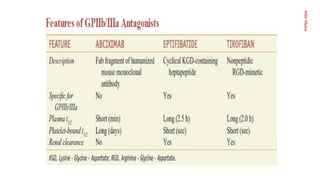
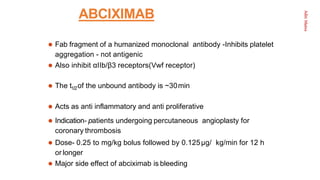
ABCIXIMAB
 Fab fragment of a humanized monoclonal antibody -Inhibits platelet
aggregation - not antigenic
 Also inhibit αIIb/β3 receptors(Vwf receptor)
 The t1/2of the unbound antibody is ~30min
 Acts as anti inflammatory and anti proliferative
 Indication- patients undergoing percutaneous angioplasty for
coronary thrombosis
 Dose- 0.25 to mg/kg bolus followed by 0.125μg/ kg/min for 12 h
or longer
 Major side effect of abciximab is bleeding
Aditi
Maitra
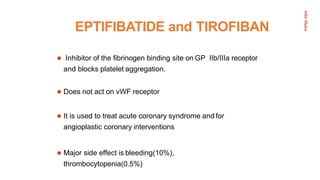
EPTIFIBATIDE and TIROFIBAN
 Inhibitor of the fibrinogen binding site on GP IIb/IIIa receptor
and blocks platelet aggregation.
 Does not act on vWF receptor
 It is used to treat acute coronary syndrome and for
angioplastic coronary interventions
 Major side effect is bleeding(10%),
thrombocytopenia(0.5%)
Aditi
Maitra
TAKE HOME MESSEGE
Aditi
Maitra

Antiplatelet drugs new

  • 1.
    Aditi Maitra Dr. Aditi Maitra Departmentof Pharmacology CNMCH KOLKATA Antiplatelet Drugs
  • 2.
    Aditi Maitra OVERVIEW OF HEMOSTASIS •Arrest of blood loss - HAEMOSTASIS  COMPONENTS: • Vascular Phase • Platelet Phase • Coagulation Phase • Fibrinolytic Phase
  • 3.
    Aditi Maitra OVERVIEW OF HEMOSTASIS Balance between coagulation and fibrinolysis.  Thrombosis- formation of an unwanted clotwithin a blood vessel (most common abnormality of hemostasis).  Thrombi consist of platelet aggregates, fibrin,and red blood cells.  A balance between TXA2 & PGI2 appears to control intravascular thrombus formation.
  • 4.
  • 5.
    Aditi Maitra Antithrombotic drugs – antiplatelet drugs(inhibit platelet activation /aggregation)  anticoagulants (inhibits fibrin formation)  fibrinolytic agents (degrade fibrin). All antithrombotic drugs increase the risk of bleeding.
  • 6.
    Aditi Maitra Anti platelet Drugs •These are drugs that interfere with platelet functions and are useful in prevention and treatment of thromboembolic disorders.
  • 7.
    Aditi Maitra • In healthyvasculature- nitric oxide (NO) and prostacyclin (PGI2) released by endothelial cells • • Prostacyclin (PGI2) activates PGI2 receptors on Platelets. • This activation increases cAMP levels and inhibits Platelet aggregation. • cAMP inhibits release of ADP and 5HT from dense granules of Platelets & Ca • Stabilizes GP2B /3A receptor
  • 8.
    Aditi Maitra IMPORTANT RECEPTORS &ENZYMES • RECEPTORS 1. PGI2 R -PGI2 2. GP Ia/Ib R -COLLAGEN & vWF 3. GP IIb/IIIa R -FIBRINOGEN 4. PAR1 & 4 R -THROMBIN 5. P2Y12 / P2Y1 R -ADP 6. TP R -TXA2 7. 5HT2 R -5HT2 • ENZYMES 1. COX 1 2. PDE
  • 9.
  • 10.
    Aditi Maitra MECHANISM  Physical traumato the vascular system initiates interactions between platelets, endothelialcells, and the coagulation cascade that lead to hemostasis.  Injury exposes reactive subendothelial proteins suchas collagen and von Willebrand factor resulting in platelet adherence and activation.  Activation of platelets results in a conformationalchange in the GP IIb/IIIa receptor, enabling it to bind fibrinogen,which cross-links adjacent platelets, resulting in aggregation and formation of a platelet plug.  Simultaneously, the coagulation system is activated, resulting in thrombin generation and a fibrin clot, which stabilizes the platelet plug.
  • 11.
    Aditi Maitra ANTIPLATELET DRUGS ↓PGI2 ↓cAMP& ↑Ca2+ PLATELET AGGREGATION - PDE INHIBITORS Cilostazol Dipyrimadole Terutroban PAR Antagonist Vorapaxar Atopaxar
  • 12.
  • 13.
    Aditi Maitra Uses of AntiplateletDrugs 1. Acute coronary syndromes (ACSs) : Unstable angina Aspirin reduces the risk of progression to MI and sudden death. Clopidogrel - reduced cardiovascular mortality, nonfatal MI and stroke by 20%. NSTEMI - put on a combination of aspirin + clopidogrel, which is continued upto one year. STEMI- Primary PCI with or without stent placement is the procedure of choice for all STEMI as well as high risk NSTEMI patients who present within 12 hours. Prasugrel + aspirin - most commonly selected for patients who are to undergo PCI. Prasugrel is also perferred over clopidogrel in diabetics. The GPIIb/IIIa antagonists combined with aspirin for high risk patients undergoing PCI- reduce incidence of restenosis and subsequent MI after coronary angioplasty. Aspirin and/or clopidogrel are routinely given to ACS patients treated with thrombolysis. Coronary artery bypass surgery is also covered by intensive antiplatelet regimen including aspirin + GPIIb/IIIa antagonists/prasugrel. The patency of recanalized coronary artery or implanted vessel is improved.
  • 14.
    Aditi Maitra 2.Coronary artery disease: Primary prevention of ischaemia with aspirin is of no proven benefit- increases the risk of cerebral haemorrhage. Continued aspirin/clopidogrel in prophylaxis in post-MI patients clearly prevents reinfarction and reduces mortality. 3. Cerebrovascular disease : Occurrence of stroke is also reduced in patients with persistent atrial fibrillation and in those with history of stroke in the past - Aspirin or clopidogrel is recommended in all such individuals. Combination of dipyridamole with low dose aspirin to be synergistic in secondary prevention of stroke. 4. Prosthetic heart valves and arteriovenous shunts :Antiplatelet drugs, used with warfarin reduce formation of microthrombi on artificial heart valves and the incidence of embolism. Antiplatelet drugs also prolong the patency of chronic arteriovenous shunts implanted for haemodialysis and of vascular grafts. 5. Venous thromboembolism: Anticoagulants are routinely used in DVT and PE. 6. Peripheral vascular disease : Aspirin/ clopidogrel may produce some improvement in intermittent claudication and reduce the incidence of thromboembolism.
  • 15.
    Aditi Maitra ASPIRIN 4.  Nonselective irreversibleinhibitor of COX  Mechanisms of Action: 1. Aspirin blocks production of TxA2 by acetylating a serine residue near the active site of platelet cyclooxygenase-1 (COX-1). 2. This action of aspirin on platelet COX-1 is permanent, lasting for the life of the platelet (7-10 days) 3. Effective doses- 50-320. mg/day Higher doses are potentially less efficacious . 4. Important D/I : Ibuprofen ASPIRIN IRREVERSIBILY INHIBITS PLATELET COX INHIBITS PLATELET
  • 16.
    Aditi Maitra I. III.  Pharmacokinetics: Rapidly absorbedfrom the stomach and upper small intestine, peak plasma level within 1–2 hours II. It is rapidly hydrolyzed (serum half-life 15 minutes) to acetic acid and salicylate by esterases Alkalinization of the urine increases the rate of excretion
  • 17.
    Aditi Maitra  Clinical Uses:decreases the incidence of  Transient ischemic attacks  Unstable angina, coronary artery thrombosis with myocardial infarction and thrombosisafter coronary artery bypass grafting
  • 18.
    Aditi Maitra  Adverse effects: At antithrombotic doses - gastric upset (intolerance) and gastric and duodenal ulcers. Use of enteric- coated or buffered aspirin in place of plain aspirin does not eliminate the risk of gastrointestinal side effects  Hepatotoxicity, asthma, rashes, GI bleeding, and renal toxicity rarely at antiplatelet dose  Contraindication – patients with hemophilia, patient with aspirin allergy
  • 19.
    Aditi Maitra DIPYRIDAMOLE  Inhibition ofphosphodiesterases and/orby blockade of uptake of adenosine - Increases the cellular concentration of c AMP • Dipyridamole is a vasodilator that, incomb with warfarin, inhibits embolization from prosthetic heart valves • ADR: exacerbation of angina, headache, tachycardia, g i distress
  • 20.
  • 21.
    Aditi Maitra • Platelets containtwo purinergic receptors, P2Y1 and P2Y12. both are GPCRs for ADP. (require ADP for its activation) • P2Y1- induces a shape change and aggregation P2Y12 - inhibits adenylyl cyclase. So causes activation & ↑ Adhesiveness of platelet • Ticlopidine (thienopyridine) is a prodrug . It is converted to the active thiol metabolite by hepatic CYP . It is rapidly absorbed and highly bioavailable.  It permanently inhibits the P2Y12 receptor by forming a disulfide bridge in the extracellular region of the receptor.  Maximal inhibition of platelet aggregation is not seen until 8-11 days after starting therapy.  Usual dose is 250 mg twice daily  Most common side effects are nausea,vomiting, and diarrhea. Serious ADRs are severe neutropenia(ANC <500/µL) Fatal agranulocytosis with thrombopenia, .TTP-HUS have also been reported TICLOPIDINE
  • 22.
    Aditi Maitra CLOPIDOGREL  Closely relatedto ticlopidine  More potent and has more favourable toxicity profile.  Irreversible inhibitor of platelet P2Y12 receptors  It is a prodrug with a slow onset of action.  The usual dose is 75 mg/day. The combination of clopidogrel plus aspirin is superior to aspirin alone (two drugs are synergistic).  The action of clopidogrel last for 5 days.  Clopidogrel Resistance : genetic polymorphisms in the CYP enzymes(m.c- CYP2C19) involved in the metabolic activation of clopidogrel  IMPORTANT D/I - omeprazole  FDA-approved indications - to reduce the rate of stroke, myocardial infarction, and death in patients with recent myocardial infarction or stroke, established peripheral arterial disease, or acute coronary syndrome
  • 23.
    Aditi Maitra PRASUGREL  Newest memberof the thienopyridineclass- Produces greater and more predictableresponse  Prodrug- but more rapidly absorbed and completely activated, resulting in faster and more consistent platelet inhibition.  Though CYP2C19 is involved in activation of prasugrel as well, genetic polymorphism related decrease in response, or interference by omeprazole treatment has not been prominent  Incidence of stent thrombosis, cardiovascular death, myocardial infarction, and stroke - significantly lower  Higher rates of fatal and life-threateningbleeding
  • 24.
    Aditi Maitra TICAGRELOR  Reversible inhibitorof P2Y12 -acts directly without any metabolic activation  Orally active and is given twice daily  Faster onset & quicker offset of action  FDA approved for the prevention of thrombotic events  First new antiplatelet drug to demonstrate a reduction in cardiovascular death compared with clopidogrel in patients with acute coronary syndromes  Cangrelor (iv)- newer agent, reversible P2Y12 antagonist.
  • 25.
    Aditi Maitra GLYCOPROTEIN IIB/IIIA Antagonist •GPIIb/IIIa is an adhesive receptor (integrin) on platelet surface for fibrinogen and vWF through which agonists like collagen, thrombin, TXA2, ADP, etc. finally induce platelet aggregation. • GP IIb/IIIa antagonists block aggregation induced by all platelet agonists. • Strongest anti platelet drugs.
  • 26.
  • 27.
    Aditi Maitra ABCIXIMAB  Fab fragmentof a humanized monoclonal antibody -Inhibits platelet aggregation - not antigenic  Also inhibit αIIb/β3 receptors(Vwf receptor)  The t1/2of the unbound antibody is ~30min  Acts as anti inflammatory and anti proliferative  Indication- patients undergoing percutaneous angioplasty for coronary thrombosis  Dose- 0.25 to mg/kg bolus followed by 0.125μg/ kg/min for 12 h or longer  Major side effect of abciximab is bleeding
  • 28.
    Aditi Maitra EPTIFIBATIDE and TIROFIBAN Inhibitor of the fibrinogen binding site on GP IIb/IIIa receptor and blocks platelet aggregation.  Does not act on vWF receptor  It is used to treat acute coronary syndrome and for angioplastic coronary interventions  Major side effect is bleeding(10%), thrombocytopenia(0.5%)
  • 29.
  • 30.