ANTICOAGULANTS
Dr. D. K. Brahma
Department of Pharmacology
NEIGRIHMS, Shillong
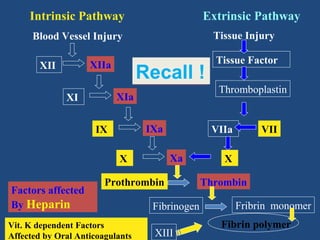
Intrinsic Pathway

Extrinsic Pathway
Tissue Injury

Blood Vessel Injury

Recall !

XIIa

XII

Thromboplastin

XIa

XI

IXa

IX

VIIa
Xa

X
Factors affected
By Heparin

Prothrombin

Vit. K dependent Factors
Affected by Oral Anticoagulants

Tissue Factor

Fibrinogen
XIII

VII

X
Thrombin
Fribrin monomer
Fibrin polymer
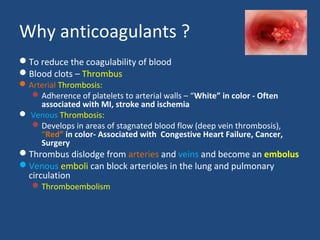
Why anticoagulants ?
To reduce the coagulability of blood
Blood clots – Thrombus

 Arterial Thrombosis:
 Adherence of platelets to arterial walls – “White” in color - Often
associated with MI, stroke and ischemia
 Venous Thrombosis:
 Develops in areas of stagnated blood flow (deep vein thrombosis),
“Red” in color- Associated with Congestive Heart Failure, Cancer,
Surgery

Thrombus dislodge from arteries and veins and become an embolus
Venous emboli can block arterioles in the lung and pulmonary
circulation
 Thromboembolism
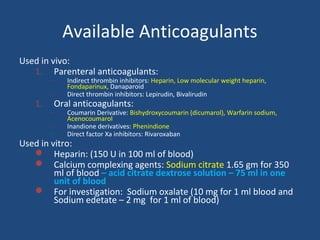
Available Anticoagulants
Used in vivo:
1. Parenteral anticoagulants:
–

1.

–

Indirect thrombin inhibitors: Heparin, Low molecular weight heparin,
Fondaparinux, Danaparoid
Direct thrombin inhibitors: Lepirudin, Bivalirudin

Oral anticoagulants:

–
–
–

Coumarin Derivative: Bishydroxycoumarin (dicumarol), Warfarin sodium,
Acenocoumarol
Inandione derivatives: Phenindione
Direct factor Xa inhibitors: Rivaroxaban

Used in vitro:
 Heparin: (150 U in 100 ml of blood)
 Calcium complexing agents: Sodium citrate 1.65 gm for 350
ml of blood – acid citrate dextrose solution – 75 ml in one
unit of blood
 For investigation: Sodium oxalate (10 mg for 1 ml blood and
Sodium edetate – 2 mg for 1 ml of blood)
Heparin as Prototype
Endogenous - strongest organic acid present in the
Body
Present in mast cells (MW – 75,000) – lungs, liver and
intestinal mucosa

Commercially - from Ox lung and Pig mucosa
(slaughter house)

Chemically, non-uniform mixture of straight chain
mucopolysaccharides with MW 10,000 to 20,000
Carries strong electro-negative charges

Types - (i) Regular or unfractionated (UFH) Heparin
(MW 5000 to 30,000) – IV or SC and (ii) LMWH (MW
2000 to 6000) – mostly SC
Heparin Actions
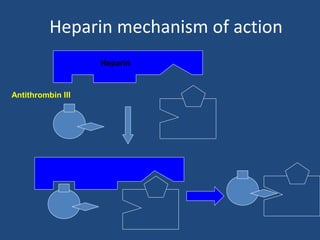
• Indirect acting - Activates plasma antithrombin III (AT III)
• Heparin-AT III complex inactivates clotting factors - Xa, IIa, IXa, XIIa
and XIIIa, but not VIIa (extrinsic pathway)
– At low conc. Xa mediated conversion of Prothrombin to thrombin affected
– Overall, Xa and IIa mediated conversion of fibrinogen to fibrin

• AT III (suicide inhibitor) – binds to clotting factors slowly to form
stable complex. Heparin enhances it by

1. Heaprin creates scaffolding to bind each (clotting
factors) other with AT III
2. A specific polysaccharide in heparin binds to AT III and
induce conformational changes – bind factors
Heparin Actions – contd.
• Inhibition of Xa needs only the 2nd mechanism (LMWH) fondaparinuxs
• IIa needs both the mechanism
• Antiplatelet action: High doses prevents platelet aggregation
prolongs Bleeding time
• Lipaemic clearing
• Pharmacokinetics:
– Highly ionized, not absorbed orally – given IV (instant action) and SC
(slow action)
– Does no cross BBB and placenta
– 100 U/kg dose half life is 1 Hr., but above this dose 1 – 4 Hrs
– Should not with – Penicillin, hydrocortisone or tetracycline
Heparin mechanism of action
Heparin

Antithrombin III

Thrombin
Heparin – Contd.
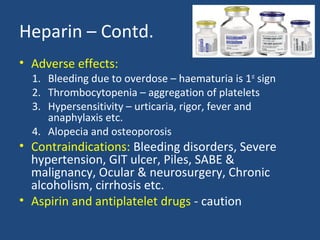
• Adverse effects:

1. Bleeding due to overdose – haematuria is 1st sign
2. Thrombocytopenia – aggregation of platelets
3. Hypersensitivity – urticaria, rigor, fever and
anaphylaxis etc.
4. Alopecia and osteoporosis

• Contraindications: Bleeding disorders, Severe
hypertension, GIT ulcer, Piles, SABE &
malignancy, Ocular & neurosurgery, Chronic
alcoholism, cirrhosis etc.
• Aspirin and antiplatelet drugs - caution
Low Molecular
Weight Heparin
(LMWH)
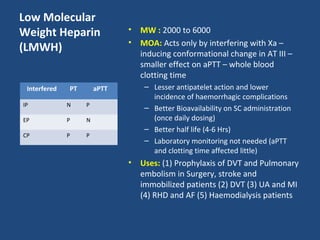
Interfered

PT

•
•

– Lesser antipatelet action and lower
incidence of haemorrhagic complications
– Better Bioavailability on SC administration
(once daily dosing)
– Better half life (4-6 Hrs)
– Laboratory monitoring not needed (aPTT
and clotting time affected little)

aPTT

IP

N

P

EP

P

N

CP

P

MW : 2000 to 6000
MOA: Acts only by interfering with Xa –
inducing conformational change in AT III –
smaller effect on aPTT – whole blood
clotting time

P

•

Uses: (1) Prophylaxis of DVT and Pulmonary
embolism in Surgery, stroke and
immobilized patients (2) DVT (3) UA and MI
(4) RHD and AF (5) Haemodialysis patients
Dosage of Heparin
• Unitage: Expressed in units as it is standardized by bioassay –
variable molecular size
• 1 mg = 120-140 U activity
• Administered as IV bolus 5000-10,000 u followed by 1000 u
/hr IV drip – adjusted with aPTT value
– Pretreatment aPTT value and followed by 1.5 to 2.5 times during
therapy

• Alternate: 10,000-20,000 deep SC every 8 Hrly (fine needle)
• Or, Low dose SC – 5000 SC 8-12 Hry before and after surgery
to prevent DVT
• Protamine Sulfate: Heparin antagonist – given IV (1mg =
100U) – cardiac and vascular surgery
Oral Anticoagulants
Warfarin
•
•

In vivo not in vitro
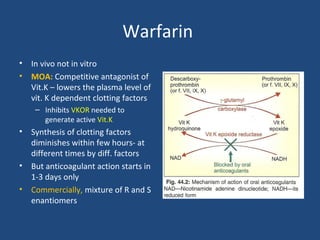
MOA: Competitive antagonist of
Vit.K – lowers the plasma level of
vit. K dependent clotting factors
– Inhibits VKOR needed to
generate active Vit.K

•

•
•

Synthesis of clotting factors
diminishes within few hours- at
different times by diff. factors
But anticoagulant action starts in
1-3 days only
Commercially, mixture of R and S
enantiomers
Warfarin – contd.
• Kinetics: Completely absorbed from intestine and
99% plasma protein bound – only 1% free (many
drugs can displace (sulfonamides, phenytoin –
toxicity) – half life 36 hrs.
• Dosing: Risky – calculate risk-benefit ratio

– Dose is individualized by repeated measurement of PT
– Optimum ratio of PT: 2-2.5 in prophylaxis of DVT, 2-3
in DVT treatment and 3-3.5 in MI etc.

• Uses: DVT, Pulmonary embolism and atrial
fibrillation (drug of choice – 3-4wks before and
after conversion)
Warfarin
• ADRs: Bleeding – epistaxis, haematuria, bleeding
GIT Intracranial haemorrhage
– Minor bleeding – Vit K (takes long)
– Fresh blood transfusion or blood factors
– Other ADRs: Alopecia, dermatitis and diarrhoea etc.

• Contraindications: Same as heparin
– Foetal warfarin syndrome: skeletal abnormality –
hypoplasia of nose, eye socket, hand bones and
growth retardation
Warfarin
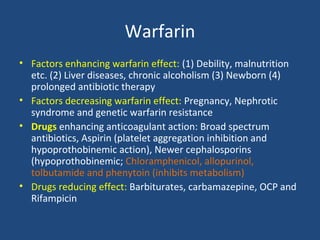
• Factors enhancing warfarin effect: (1) Debility, malnutrition
etc. (2) Liver diseases, chronic alcoholism (3) Newborn (4)
prolonged antibiotic therapy
• Factors decreasing warfarin effect: Pregnancy, Nephrotic
syndrome and genetic warfarin resistance
• Drugs enhancing anticoagulant action: Broad spectrum
antibiotics, Aspirin (platelet aggregation inhibition and
hypoprothobinemic action), Newer cephalosporins
(hypoprothobinemic; Chloramphenicol, allopurinol,
tolbutamide and phenytoin (inhibits metabolism)
• Drugs reducing effect: Barbiturates, carbamazepine, OCP and
Rifampicin
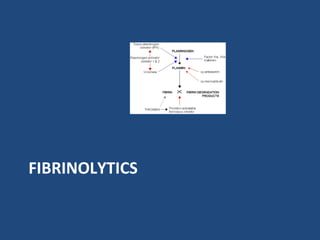
FIBRINOLYTICS
Fibrinolytics
•
•
•
•

Drugs used to lyse thrombi/clot to
recanalize occluded vessels –
coronary artery
MOA: Produce more plasmin dissolves fibrin thread
Drugs: Streptokinase, urokinase,
alteplase (rt-PA), reteplase and
tenecteplase
Streptokinase – once popular
– Binds to plasminogen and generate
plasmin
– Non-specific – activates circulating +
fibrin bound plasminogen– nonspecific fibrinogen depletory – but
less effect than newer ones in
fibrinolysis
Alteplase and Tenecteplase
•
•

•
•
•

Recombinant tissue plasminogen activator (rt-PA) – human tissue culture
– costlier than Streptokinase
MOA: tissue specific thrombolytic (acts on fibrin bound plasminogen
within thrombus) – also interferes with circulating plasminogen (50%) –
inactivated by PAI-1
Plasma half life 5 minutes – given slow IV (heparin needed)
MI: 1o mg IV bolus – followed by rest 90 mg infusion for 90 minutes
Pulmonary embolism: 100 mg slow IV for 2 Hrs

genetically engineered, higher
fibrin selectivity, not inactivated by PAI-1, can
be injected over 10 seconds single bolus

• Tenecteplase:
Uses of Thrombolytics
• AMI – alternative to PCI with stent placement
– aspirin + heparin co-administered to prevent
re-occlusion
• DVT: leg, pelvis and shoulder
• Pulmonary embolism
• Stroke: selected patients
Antifibrinolytics
• Epsilon amino-caproic acid (EACA) and
Tranexamic acid
• MOA: Inhibit Plasminogen activation and clot
dissolution
• EACA: Specific antidote for fibrinolytic agents –
also adjunctive value in other conditions
• Tranexamic acid: More potent than EACA
– Uses: fibrinolytic drugs, Bypass surgery, Menorrhagia,
Recurrent epistaxis, tonsillectomy & tooth extraction
(haemophiliacs)
Antiplatelet Drugs (antithrombotic
drugs)
Antiplatelet Drugs (antithrombotic
drugs)
• Drugs which interferes with platelet function and used in
prophylaxis of thromboembolic disorders.
• Drugs: Aspirin, Dipyridamole, Ticlodipine, Clopidogrel and
Prasugrel
• Aspirin as antiplatelet:
– Irreversible Inhibition of COX 1 and TX synthase
– Suppress TXA2 (generated by platelets) in low doses (75-150 mg) – till
fresh platelets are formed – prolonged bleeding time
– Suppress COX-1 and decrease PGI2 synthesis in vessel wall – but
endothelial cells immediately re-synthesize fresh enzyme
– Also inhibits release of ADP from platelets and their sticking to each
other – but not to adhesion to damaged vessel walls
Antithrombotic drugs - Dipyridamole
• Powerful coronary dilator – increases total
coronary flow
• MOA: Adeosine is local mediator involved in
autoregulation of coronary flow in response to
Ischaemia
– Dipyridamole prevents uptake and degradation of
adenosine and increases platelete cAMP – potentiates
PGI2 – interferes platelete aggregation

• Uses: Enhance antiplatelet action of Aspirin –
lowers the risks of TIAs – 150-300 mg / day
Antithrombotic drugs - Ticlodipine
• First thienopyridine derivative – Prodrug (active
metabolites in liver)
• MOA: Inhibits fibrinogen as well as ADP induced platelet
aggregation
– Gi coupled P2Y12 (P2YAC) purinergic receptors mediate adeylyl
cyclase inhibition due to ADP – blocked irreversibly
– No effect on TXA2
– Irreversible blockade of P2YAC – platelet inhibiton cumulates –
effects appear in 8-10 days

• Uses: Stroke prevention, TIA, intermittent claudication,
unstable angina, coronary bypass, prevention of MI
• Serious ADRs – Bleeding, neutropenia, hamolysis,
thrombocytopenia and jaundice - replaced by Clopidogrel
Antithrombotic drugs - Clopidogrel
• Similar MOA to Ticlodipine – irreversible blockade of platelet
function
– Safer and better tolerated than Ticlodipine

• Advantages over Aspirin in Ischaemia – lower incidence of
ischaemic events
• Synergistic action with aspirin – prevention of Ischaemic episodes
• Kinetics: Prodrug like Ticlodipine, 50% absorbed orally
– Only a fraction slowly activated in liver by CYP2C19 slow acting
– CYP2C19 – genetic polymorphism - interindivdual variability in
antiplatelet action
– Takes 5-7 days for action

• ADRs: Bleeding most common, neutropenia and thrombocytopenia
rarely
• Dose: 75 mg OD
Antithrombotics – Other Drugs
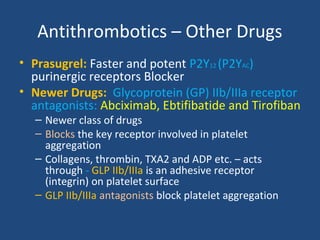
• Prasugrel: Faster and potent P2Y12 (P2YAC)
purinergic receptors Blocker
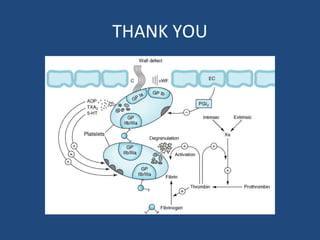
• Newer Drugs: Glycoprotein (GP) IIb/IIIa receptor
antagonists: Abciximab, Ebtifibatide and Tirofiban
– Newer class of drugs
– Blocks the key receptor involved in platelet
aggregation
– Collagens, thrombin, TXA2 and ADP etc. – acts
through - GLP IIb/IIIa is an adhesive receptor
(integrin) on platelet surface
– GLP IIb/IIIa antagonists block platelet aggregation
Uses of antithrombotics
• Coronary Artery Disease: Aspirin 75-150 mg/day in all
individuals with evidence of coronary artery disease –
clopidogrel is an alternative in ischaemia
• Acute Coronary Syndromes: Aspirin 325 mg orally and
LMW heparin – NSTEMI and STEMI
• Cerebrovascular accidents: Do not alter the course of
cerebral thrombosis – reduces incidence of TIA
• Prosthetic Heart Valves and arteriovenous shunts: In
conjunction with warfarin
• Venous thrombosis: DVT and PE
• Peripheral vascular disease
Must Know

•
•
•
•

Heparin, LMWH and Protamine sulfate
Warfarin
Fibrinolytics (Thrombolytics)
Antiplatelet Drugs – Aspirin, Dipyrydamole
and Clopidogrel
THANK YOU