FIBRINOLYTICS
&
ANTIFIBRINOLYTICS
By
Dr.Elza Emmannual
FIBRINOLYTICS
Drugs used to lyse
thrombi to
recanalize occluded
blood vessels
Works by activating
the natural
fibrinolytic system
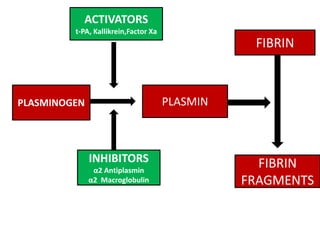
NATURAL FIBRINOLYTIC
SYSTEM
PLASMINOGEN
FIBRIN
FRAGMENTS
FIBRIN
PLASMIN
ACTIVATORS
t-PA, Kallikrein,Factor Xa
INHIBITORS
α2 Antiplasmin
α2 Macroglobulin
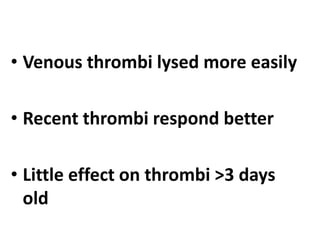
• Venous thrombi lysed more easily
• Recent thrombi respond better
• Little effect on thrombi >3 days
old
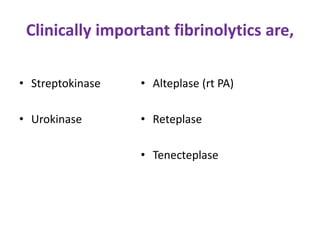
Clinically important fibrinolytics are,
• Streptokinase
• Urokinase
• Alteplase (rt PA)
• Reteplase
• Tenecteplase
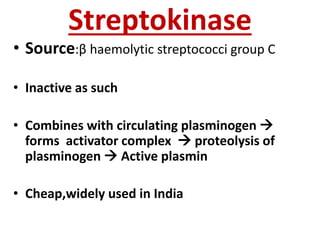
Streptokinase
• Source:β haemolytic streptococci group C
• Inactive as such
• Combines with circulating plasminogen 
forms activator complex  proteolysis of
plasminogen  Active plasmin
• Cheap,widely used in India
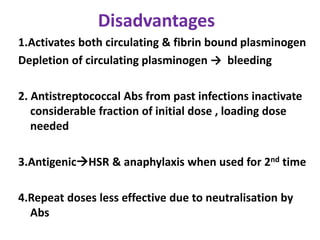
Disadvantages
1.Activates both circulating & fibrin bound plasminogen
Depletion of circulating plasminogen → bleeding
2. Antistreptococcal Abs from past infections inactivate
considerable fraction of initial dose , loading dose
needed
3.AntigenicHSR & anaphylaxis when used for 2nd time
4.Repeat doses less effective due to neutralisation by
Abs
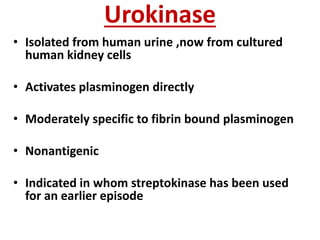
Urokinase
• Isolated from human urine ,now from cultured
human kidney cells
• Activates plasminogen directly
• Moderately specific to fibrin bound plasminogen
• Nonantigenic
• Indicated in whom streptokinase has been used
for an earlier episode
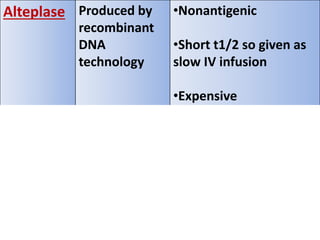
Alteplase Produced by
recombinant
DNA
technology
•Nonantigenic
•Short t1/2 so given as
slow IV infusion
•Expensive
Reteplase Produced by
recombinant
DNA
technology
•Modified form of rt-PA
•Long acting
•So given as bolus dose
repeated in 30 min
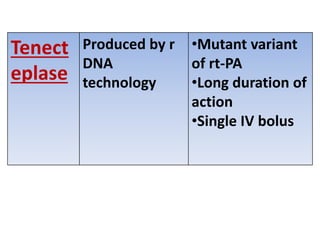
Tenect
eplase
Produced by r
DNA
technology
•Mutant variant
of rt-PA
•Long duration of
action
•Single IV bolus
USES
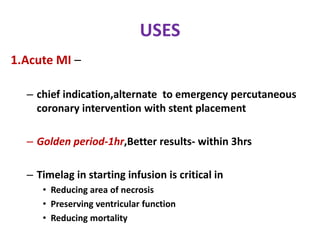
1.Acute MI –
– chief indication,alternate to emergency percutaneous
coronary intervention with stent placement
– Golden period-1hr,Better results- within 3hrs
– Timelag in starting infusion is critical in
• Reducing area of necrosis
• Preserving ventricular function
• Reducing mortality
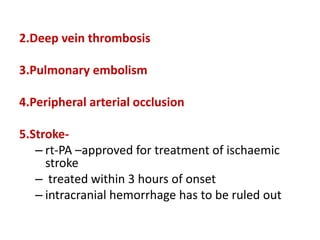
2.Deep vein thrombosis
3.Pulmonary embolism
4.Peripheral arterial occlusion
5.Stroke-
– rt-PA –approved for treatment of ischaemic
stroke
– treated within 3 hours of onset
– intracranial hemorrhage has to be ruled out
CONTRAINDICATIONS
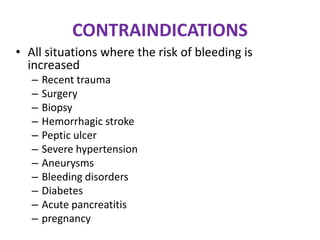
• All situations where the risk of bleeding is
increased
– Recent trauma
– Surgery
– Biopsy
– Hemorrhagic stroke
– Peptic ulcer
– Severe hypertension
– Aneurysms
– Bleeding disorders
– Diabetes
– Acute pancreatitis
– pregnancy
ANTIFIBRINOLYTICS
Drugs which inhibit
plasminogen activation &
dissolution of clot
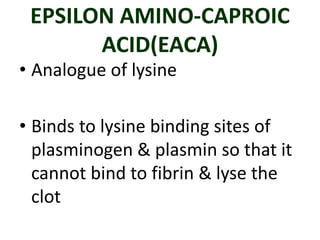
EPSILON AMINO-CAPROIC
ACID(EACA)
• Analogue of lysine
• Binds to lysine binding sites of
plasminogen & plasmin so that it
cannot bind to fibrin & lyse the
clot
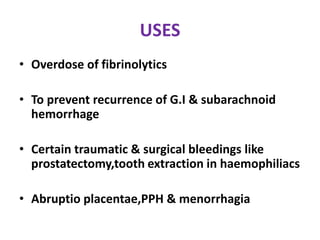
USES
• Overdose of fibrinolytics
• To prevent recurrence of G.I & subarachnoid
hemorrhage
• Certain traumatic & surgical bleedings like
prostatectomy,tooth extraction in haemophiliacs
• Abruptio placentae,PPH & menorrhagia
Adverse Effects
• In hematuria –ureteric obstruction by the
unlysed clots
• Intravascular thrombosis
• Hypotension,bradycardia,arrhythmias
• Caution in impaired renal function
• Myopathy
TRANEXAMIC ACID
• MOA-similar to EACA
• 7 times potent than EACA
• Preferred drug for bleeding due to
– Fibrinolytic drugs
– Cardiopulmonary bypass surgery
– Tonsillectomy,prostatic surgery,tooth extraction in
haemophiliacs
– Menorrhagia
– Recurrent epistaxis,hyphema due to ocular
trauma,peptic ulcer
Adverse Effects
• Nausea
• Diarrhoea
• Thromboembolic events
• Disturbed colour vision
• Allergic reactions
• Thrombophlebitis
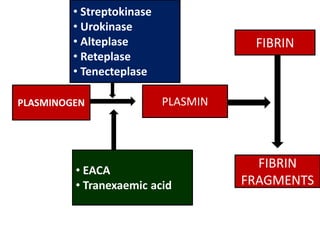
PLASMINOGEN
FIBRIN
FRAGMENTS
FIBRIN
PLASMIN
ACTIVATORS
INHIBITOR
• Streptokinase
• Urokinase
• Alteplase
• Reteplase
• Tenecteplase
• EACA
• Tranexaemic acid
THANK YOU

Fibrinolytics & antifibrinolytics