BY: PROFESSOR EMILIANO Z. SISON JR.





The adrenergic drugs affect receptors that are stimulated by
norepinephrine or epinephrine.
Some adrenergic drugs act directly on the adrenergic
receptor (adrenoceptor) by activating it and are said to be
sympathomimetic.
Others will block the action of the neurotransmitters at the
receptors (sympatholytics), whereas still other drugs affect
adrenergic function by interrupting the release of
norepinephrine from adrenergic neurons.
DRUGS UNDER ADRENERGIC AGONISTS
INDIRECT-ACTING

DIRECT-ACTING

DIRECT & INDIRECT ACTING
(mixed action)



Albuterol



Amphetamine



Ephedrine



Clonidine



Cocaine



Pseudophrine



Dobutamine



Tyramine



Dopamine



Epinephrine



Isoproterenol



Metaproterenol



Methoxamine



Norepinephrine



Phenylphrine



Piruterol



Salmeterol



Terbutaline
CARDIAC
ARRHYTHMIAS

HEADACHE

HYPERACTIVITY

INSOMIA

NAUSEA

TREMORS
Adrenergic neurons release norepinephrine as the primary
neurotransmitter.
These neurons are found in the central nervous system (CNS) and also in
the sympathetic nervous system, where they serve as links between
ganglia and the effector organs.
The adrenergic neurons and receptors, located either presynaptically on
the neuron or postsynaptically on the effector organ, are the sites of
action of the adrenergic drugs.
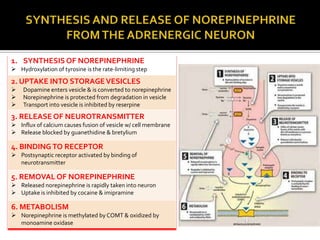
1. SYNTHESIS OF NOREPINEPHRINE
 Hydroxylation of tyrosine is the rate-limiting step

2. UPTAKE INTO STORAGE VESICLES




Dopamine enters vesicle & is converted to norepinephrine
Norepinephrine is protected from degradation in vesicle
Transport into vesicle is inhibited by reserpine

3. RELEASE OF NEUROTRANSMITTER
 Influx of calcium causes fusion of vesicle w/ cell membrane
 Release blocked by guanethidine & bretylium

4. BINDING TO RECEPTOR
 Postsynaptic receptor activated by binding of
neurotransmitter

5. REMOVAL OF NOREPINEPHRINE
 Released norepinephrine is rapidly taken into neuron
 Uptake is inhibited by cocaine & imipramine

6. METABOLISM
 Norepinephrine is methylated by COMT & oxidized by
monoamine oxidase
ADRENOCEPTORS

αRECEPTORS

α1-receptor

α2-receptor

βRECEPTORS

β1-receptor

β2-receptor

β3-receptor







The α-adrenoceptors show a weak response to the
synthetic agonist isoproterenol, but they are
responsive to the naturally occurring catecholamines
epinephrine and norepinephrine.
For α receptors, the rank order of potency is
epinephrine ≥ norepinephrine >> isoproterenol.
The α-adrenoceptors are subdivided into two
subgroups, α1 and α2, based on their affinities for α
agonists and blocking drugs.
For example, the α1 receptors have a higher affinity for
phenylephrine than do the α2 receptors.








β Receptors exhibit a set of responses different from those
of the α receptors.
These are characterized by a strong response to
isoproterenol, with less sensitivity to epinephrine and
norepinephrine.
For β receptors, the rank order of potency is
isoproterenol > epinephrine > norepinephrine.
The β-adrenoceptors can be subdivided into three major
subgroups, β1, β2, and β3, based on their affinities for
adrenergic agonists and antagonists, although several others
have been identified by gene cloning.
β1 Receptors have approximately equal affinities for
epinephrine and norepinephrine, whereas β2 receptors have a
higher affinity for epinephrine than for norepinephrine.
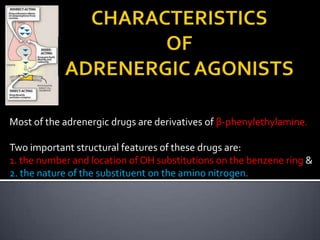
Most of the adrenergic drugs are derivatives of β-phenylethylamine.
Two important structural features of these drugs are:
1. the number and location of OH substitutions on the benzene ring &
2. the nature of the substituent on the amino nitrogen.


Sympathomimetic amines that contain the 3,4-dihydroxybenzene group:
(such as epinephrine, norepinephrine, isoproterenol, and dopamine)
are called catecholamines.



These compounds share the following properties:

2. Rapid inactivation
1. High potency

3. Poor penetration into
the CNS


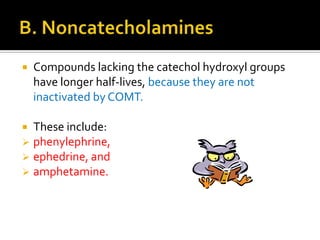
Compounds lacking the catechol hydroxyl groups
have longer half-lives, because they are not
inactivated by COMT.






These include:
phenylephrine,
ephedrine, and
amphetamine.





Epinephrine is synthesized from tyrosine in the adrenal
medulla and released, along with small quantities of
norepinephrine, into the bloodstream.
Epinephrine interacts with both α and β receptors.
At low doses, β effects (vasodilation) on the vascular system
predominate, whereas at high doses, α effects
(vasoconstriction) are strongest.
CARDIOVASCULAR

RESPIRATORY

HYPERGLYCEMIA

LIPOLYSIS

Epinephrine
strengthens the
contractility of the
myocardium (positive
inotropic: β1 action) and
increases its rate of
contraction (positive
chronotropic: β1 action).

Epinephrine causes
powerful
bronchodilation by
acting directly on
bronchial smooth
muscle (β2 action).

Epinephrine has a
significant
hyperglycemic effect
because of increased
glycogenolysis in the
liver (β2 effect),
increased release of
glucagon (β2 effect),
and a decreased release
of insulin (α2 effect).

Epinephrine initiates
lipolysis through its
agonist activity on the β
receptors of adipose
tissue, which upon
stimulation activate
adenylyl cyclase to
increase cAMP levels.
BRONCHOSPASM

GLAUCOMA

ANAPHYLACTIC
SHOCK

CARDIAC ARREST

ANESTHETICS

Epinephrine is the
primary drug used
in the emergency
treatment of any
condition of the
respiratory tract
when
bronchoconstriction
has resulted in
diminished
respiratory
exchange.

In
ophthalmology, a
two-percent
epinephrine
solution may be
used topically to
reduce
intraocular
pressure in openangle glaucoma.

Epinephrine is the
drug of choice for
the treatment of
Type I
hypersensitivity
reactions in
response to
allergens.

Epinephrine may
be used to restore
cardiac rhythm in
patients with
cardiac arrest
regardless of the
cause.

The effect of the
drug is to greatly
increase the
duration of the
local anesthesia.
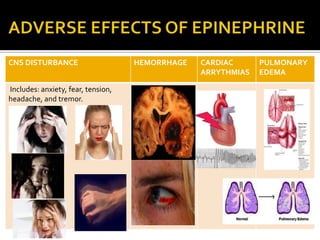
CNS DISTURBANCE
Includes: anxiety, fear, tension,
headache, and tremor.

HEMORRHAGE

CARDIAC
ARRYTHMIAS

PULMONARY
EDEMA
HYPERTHYROIDISM COCAINE

DIABETES

β-BLOCKERS

INHALATION
ANESTHETICS




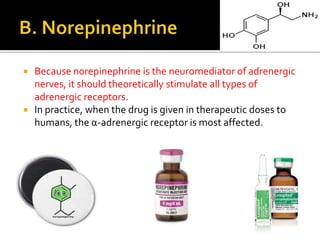
Because norepinephrine is the neuromediator of adrenergic
nerves, it should theoretically stimulate all types of
adrenergic receptors.
In practice, when the drug is given in therapeutic doses to
humans, the α-adrenergic receptor is most affected.
VASOCONSTRICTION

BARORECEPTOR REFLEX

EFFECTS OF ATROPINE
PRE-TREATMENT

Norepinephrine causes a rise in
peripheral resistance due to
intense vasoconstriction of most
vascular beds, including the
kidney (α1 effect).

In isolated cardiac tissue,
norepinephrine stimulates
cardiac contractility; however, in
vivo, little if any cardiac
stimulation is noted.

If atropine, which blocks the
transmission of vagal effects, is
given before norepinephrine,
then norepinephrine stimulation
of the heart is evident as
tachycardia.





Isoproterenol is a direct-acting synthetic catecholamine that
predominantly stimulates both β1- and β2-adrenergic
receptors.
Its nonselectivity is one of its drawbacks and the reason why
it is rarely used therapeutically.
Its action on α receptors is insignificant.
CARDIOVASCULAR

PULMONARY

OTHER EFFECTS

Isoproterenol produces
intense stimulation of the
heart to increase its rate and
force of contraction, causing
increased cardiac output.

Isoproterenol is as active as
epinephrine and rapidly
alleviates an acute attack of
asthma when taken by
inhalation (which is the
recommended route).

Other actions on β
receptors, such as increased
blood sugar and increased
lipolysis, can be
demonstrated but are not
clinically significant.




Dopamine, the immediate metabolic
precursor of norepinephrine, occurs naturally
in the CNS in the basal ganglia, where it
functions as a neurotransmitter, as well as in
the adrenal medulla.
Dopamine can activate α- and β-adrenergic
receptors.
CARDIOVASCULAR

RENAL & VISCERAL

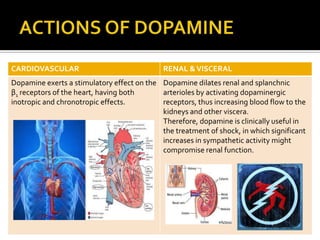
Dopamine exerts a stimulatory effect on the Dopamine dilates renal and splanchnic
β1 receptors of the heart, having both
arterioles by activating dopaminergic
inotropic and chronotropic effects.
receptors, thus increasing blood flow to the
kidneys and other viscera.
Therefore, dopamine is clinically useful in
the treatment of shock, in which significant
increases in sympathetic activity might
compromise renal function.





Dobutamine is a synthetic, direct-acting catecholamine that
is a β1-receptor agonist.
One of the stereoisomers has a stimulatory activity.
It increases cardiac rate and output with few vascular effects.
Dobutamine is used to increase cardiac output in congestive
heart failure as well as for inotropic support after cardiac
surgery.




Oxymetazoline is a direct-acting synthetic adrenergic
agonist that stimulates both α1- and α2-adrenergic receptors.
It is primarily used locally in the eye or the nose as a
vasoconstrictor.
Oxymetazoline is found in many over-the-counter shortterm nasal spray decongestant products as well as in
ophthalmic drops for the relief of redness of the eyes
associated with swimming, colds, or contact lens.





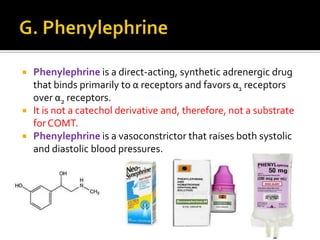
Phenylephrine is a direct-acting, synthetic adrenergic drug
that binds primarily to α receptors and favors α1 receptors
over α2 receptors.
It is not a catechol derivative and, therefore, not a substrate
for COMT.
Phenylephrine is a vasoconstrictor that raises both systolic
and diastolic blood pressures.





Methoxamine is a direct-acting, synthetic adrenergic drug
that binds primarily to α-receptors, with α1 receptors favored
over α2 receptors.
Methoxamine raises blood pressure by stimulating α1
receptors in the arterioles, causing vasoconstriction.
This causes an increase in total peripheral resistance.





Clonidine is an α2 agonist that is used in essential
hypertension to lower blood pressure because of its action in
the CNS.
It can be used to minimize the symptoms that accompany
withdrawal from opiates or benzodiazepines.
Clonidine acts centrally to produce inhibition of sympathetic
vasomotor centers, decreasing sympathetic outflow to the
periphery.





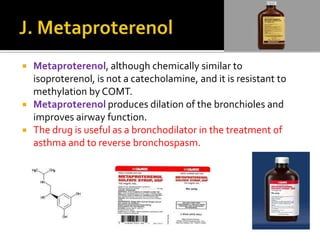
Metaproterenol, although chemically similar to
isoproterenol, is not a catecholamine, and it is resistant to
methylation by COMT.
Metaproterenol produces dilation of the bronchioles and
improves airway function.
The drug is useful as a bronchodilator in the treatment of
asthma and to reverse bronchospasm.


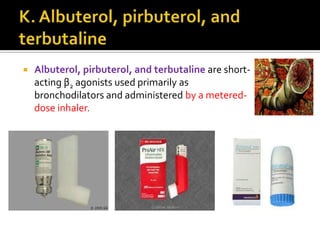
Albuterol, pirbuterol, and terbutaline are shortacting β2 agonists used primarily as
bronchodilators and administered by a metereddose inhaler.



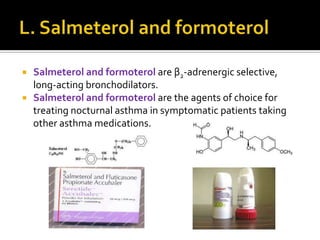
Salmeterol and formoterol are β2-adrenergic selective,
long-acting bronchodilators.
Salmeterol and formoterol are the agents of choice for
treating nocturnal asthma in symptomatic patients taking
other asthma medications.





The marked central stimulatory action of amphetamine is
often mistaken by drug abusers as its only action.
The CNS stimulant effects of amphetamine and its
derivatives have led to their use for treating hyperactivity in
children, narcolepsy, and appetite control.
Its use in pregnancy should be avoided because of adverse
effects on development of the fetus.





Tyramine is not a clinically useful drug, but it is important
because it is found in fermented foods, such as ripe cheese
and Chianti wine.
It is a normal by-product of tyrosine metabolism.
Normally, it is oxidized by MAO in the gastrointestinal tract,
but if the patient is taking MAO inhibitors, it can precipitate
serious vasopressor episodes.




Cocaine is unique among local anesthetics in having the
ability to block the Na+/K+-activated ATPase (required for
cellular uptake of norepinephrine) on the cell membrane of
the adrenergic neuron.
Like amphetamines, it can increase blood pressure by αagonist actions and β-stimulatory effects.





Ephedrine, and pseudoephedrine are plant alkaloids, that
are now made synthetically.
These drugs are mixed-action adrenergic agents.
They not only release stored norepinephrine from nerve
endings but also directly stimulate both α and β receptors.
Thus, a wide variety of adrenergic actions ensue that are
similar to those of epinephrine, although less potent.





Ephedrine enhances contractility and improves motor
function in myasthenia gravis.
Ephedrine has been used to treat asthma, as a nasal
decongestant (due to its local vasoconstrictor action), and to
raise blood pressure.
Pseudoephedrine is primarily used to treat nasal and sinus
congestion or congestion of the eustachian tubes.
SEE YOU ALL NEXT MEETING!!!

ADRENERGIC
ANTAGONISTS

Adrenergic agonists

  • 1.
  • 2.
       The adrenergic drugsaffect receptors that are stimulated by norepinephrine or epinephrine. Some adrenergic drugs act directly on the adrenergic receptor (adrenoceptor) by activating it and are said to be sympathomimetic. Others will block the action of the neurotransmitters at the receptors (sympatholytics), whereas still other drugs affect adrenergic function by interrupting the release of norepinephrine from adrenergic neurons.
  • 3.
    DRUGS UNDER ADRENERGICAGONISTS INDIRECT-ACTING DIRECT-ACTING DIRECT & INDIRECT ACTING (mixed action)  Albuterol  Amphetamine  Ephedrine  Clonidine  Cocaine  Pseudophrine  Dobutamine  Tyramine  Dopamine  Epinephrine  Isoproterenol  Metaproterenol  Methoxamine  Norepinephrine  Phenylphrine  Piruterol  Salmeterol  Terbutaline
  • 4.
  • 5.
    Adrenergic neurons releasenorepinephrine as the primary neurotransmitter. These neurons are found in the central nervous system (CNS) and also in the sympathetic nervous system, where they serve as links between ganglia and the effector organs. The adrenergic neurons and receptors, located either presynaptically on the neuron or postsynaptically on the effector organ, are the sites of action of the adrenergic drugs.
  • 6.
    1. SYNTHESIS OFNOREPINEPHRINE  Hydroxylation of tyrosine is the rate-limiting step 2. UPTAKE INTO STORAGE VESICLES    Dopamine enters vesicle & is converted to norepinephrine Norepinephrine is protected from degradation in vesicle Transport into vesicle is inhibited by reserpine 3. RELEASE OF NEUROTRANSMITTER  Influx of calcium causes fusion of vesicle w/ cell membrane  Release blocked by guanethidine & bretylium 4. BINDING TO RECEPTOR  Postsynaptic receptor activated by binding of neurotransmitter 5. REMOVAL OF NOREPINEPHRINE  Released norepinephrine is rapidly taken into neuron  Uptake is inhibited by cocaine & imipramine 6. METABOLISM  Norepinephrine is methylated by COMT & oxidized by monoamine oxidase
  • 7.
  • 8.
        The α-adrenoceptors showa weak response to the synthetic agonist isoproterenol, but they are responsive to the naturally occurring catecholamines epinephrine and norepinephrine. For α receptors, the rank order of potency is epinephrine ≥ norepinephrine >> isoproterenol. The α-adrenoceptors are subdivided into two subgroups, α1 and α2, based on their affinities for α agonists and blocking drugs. For example, the α1 receptors have a higher affinity for phenylephrine than do the α2 receptors.
  • 9.
         β Receptors exhibita set of responses different from those of the α receptors. These are characterized by a strong response to isoproterenol, with less sensitivity to epinephrine and norepinephrine. For β receptors, the rank order of potency is isoproterenol > epinephrine > norepinephrine. The β-adrenoceptors can be subdivided into three major subgroups, β1, β2, and β3, based on their affinities for adrenergic agonists and antagonists, although several others have been identified by gene cloning. β1 Receptors have approximately equal affinities for epinephrine and norepinephrine, whereas β2 receptors have a higher affinity for epinephrine than for norepinephrine.
  • 10.
    Most of theadrenergic drugs are derivatives of β-phenylethylamine. Two important structural features of these drugs are: 1. the number and location of OH substitutions on the benzene ring & 2. the nature of the substituent on the amino nitrogen.
  • 11.
     Sympathomimetic amines thatcontain the 3,4-dihydroxybenzene group: (such as epinephrine, norepinephrine, isoproterenol, and dopamine) are called catecholamines.  These compounds share the following properties: 2. Rapid inactivation 1. High potency 3. Poor penetration into the CNS
  • 12.
     Compounds lacking thecatechol hydroxyl groups have longer half-lives, because they are not inactivated by COMT.     These include: phenylephrine, ephedrine, and amphetamine.
  • 14.
       Epinephrine is synthesizedfrom tyrosine in the adrenal medulla and released, along with small quantities of norepinephrine, into the bloodstream. Epinephrine interacts with both α and β receptors. At low doses, β effects (vasodilation) on the vascular system predominate, whereas at high doses, α effects (vasoconstriction) are strongest.
  • 15.
    CARDIOVASCULAR RESPIRATORY HYPERGLYCEMIA LIPOLYSIS Epinephrine strengthens the contractility ofthe myocardium (positive inotropic: β1 action) and increases its rate of contraction (positive chronotropic: β1 action). Epinephrine causes powerful bronchodilation by acting directly on bronchial smooth muscle (β2 action). Epinephrine has a significant hyperglycemic effect because of increased glycogenolysis in the liver (β2 effect), increased release of glucagon (β2 effect), and a decreased release of insulin (α2 effect). Epinephrine initiates lipolysis through its agonist activity on the β receptors of adipose tissue, which upon stimulation activate adenylyl cyclase to increase cAMP levels.
  • 16.
    BRONCHOSPASM GLAUCOMA ANAPHYLACTIC SHOCK CARDIAC ARREST ANESTHETICS Epinephrine isthe primary drug used in the emergency treatment of any condition of the respiratory tract when bronchoconstriction has resulted in diminished respiratory exchange. In ophthalmology, a two-percent epinephrine solution may be used topically to reduce intraocular pressure in openangle glaucoma. Epinephrine is the drug of choice for the treatment of Type I hypersensitivity reactions in response to allergens. Epinephrine may be used to restore cardiac rhythm in patients with cardiac arrest regardless of the cause. The effect of the drug is to greatly increase the duration of the local anesthesia.
  • 17.
    CNS DISTURBANCE Includes: anxiety,fear, tension, headache, and tremor. HEMORRHAGE CARDIAC ARRYTHMIAS PULMONARY EDEMA
  • 18.
  • 19.
      Because norepinephrine isthe neuromediator of adrenergic nerves, it should theoretically stimulate all types of adrenergic receptors. In practice, when the drug is given in therapeutic doses to humans, the α-adrenergic receptor is most affected.
  • 20.
    VASOCONSTRICTION BARORECEPTOR REFLEX EFFECTS OFATROPINE PRE-TREATMENT Norepinephrine causes a rise in peripheral resistance due to intense vasoconstriction of most vascular beds, including the kidney (α1 effect). In isolated cardiac tissue, norepinephrine stimulates cardiac contractility; however, in vivo, little if any cardiac stimulation is noted. If atropine, which blocks the transmission of vagal effects, is given before norepinephrine, then norepinephrine stimulation of the heart is evident as tachycardia.
  • 21.
       Isoproterenol is adirect-acting synthetic catecholamine that predominantly stimulates both β1- and β2-adrenergic receptors. Its nonselectivity is one of its drawbacks and the reason why it is rarely used therapeutically. Its action on α receptors is insignificant.
  • 22.
    CARDIOVASCULAR PULMONARY OTHER EFFECTS Isoproterenol produces intensestimulation of the heart to increase its rate and force of contraction, causing increased cardiac output. Isoproterenol is as active as epinephrine and rapidly alleviates an acute attack of asthma when taken by inhalation (which is the recommended route). Other actions on β receptors, such as increased blood sugar and increased lipolysis, can be demonstrated but are not clinically significant.
  • 23.
      Dopamine, the immediatemetabolic precursor of norepinephrine, occurs naturally in the CNS in the basal ganglia, where it functions as a neurotransmitter, as well as in the adrenal medulla. Dopamine can activate α- and β-adrenergic receptors.
  • 24.
    CARDIOVASCULAR RENAL & VISCERAL Dopamineexerts a stimulatory effect on the Dopamine dilates renal and splanchnic β1 receptors of the heart, having both arterioles by activating dopaminergic inotropic and chronotropic effects. receptors, thus increasing blood flow to the kidneys and other viscera. Therefore, dopamine is clinically useful in the treatment of shock, in which significant increases in sympathetic activity might compromise renal function.
  • 25.
        Dobutamine is asynthetic, direct-acting catecholamine that is a β1-receptor agonist. One of the stereoisomers has a stimulatory activity. It increases cardiac rate and output with few vascular effects. Dobutamine is used to increase cardiac output in congestive heart failure as well as for inotropic support after cardiac surgery.
  • 26.
       Oxymetazoline is adirect-acting synthetic adrenergic agonist that stimulates both α1- and α2-adrenergic receptors. It is primarily used locally in the eye or the nose as a vasoconstrictor. Oxymetazoline is found in many over-the-counter shortterm nasal spray decongestant products as well as in ophthalmic drops for the relief of redness of the eyes associated with swimming, colds, or contact lens.
  • 27.
       Phenylephrine is adirect-acting, synthetic adrenergic drug that binds primarily to α receptors and favors α1 receptors over α2 receptors. It is not a catechol derivative and, therefore, not a substrate for COMT. Phenylephrine is a vasoconstrictor that raises both systolic and diastolic blood pressures.
  • 28.
       Methoxamine is adirect-acting, synthetic adrenergic drug that binds primarily to α-receptors, with α1 receptors favored over α2 receptors. Methoxamine raises blood pressure by stimulating α1 receptors in the arterioles, causing vasoconstriction. This causes an increase in total peripheral resistance.
  • 29.
       Clonidine is anα2 agonist that is used in essential hypertension to lower blood pressure because of its action in the CNS. It can be used to minimize the symptoms that accompany withdrawal from opiates or benzodiazepines. Clonidine acts centrally to produce inhibition of sympathetic vasomotor centers, decreasing sympathetic outflow to the periphery.
  • 30.
       Metaproterenol, although chemicallysimilar to isoproterenol, is not a catecholamine, and it is resistant to methylation by COMT. Metaproterenol produces dilation of the bronchioles and improves airway function. The drug is useful as a bronchodilator in the treatment of asthma and to reverse bronchospasm.
  • 31.
     Albuterol, pirbuterol, andterbutaline are shortacting β2 agonists used primarily as bronchodilators and administered by a metereddose inhaler.
  • 32.
      Salmeterol and formoterolare β2-adrenergic selective, long-acting bronchodilators. Salmeterol and formoterol are the agents of choice for treating nocturnal asthma in symptomatic patients taking other asthma medications.
  • 34.
       The marked centralstimulatory action of amphetamine is often mistaken by drug abusers as its only action. The CNS stimulant effects of amphetamine and its derivatives have led to their use for treating hyperactivity in children, narcolepsy, and appetite control. Its use in pregnancy should be avoided because of adverse effects on development of the fetus.
  • 35.
       Tyramine is nota clinically useful drug, but it is important because it is found in fermented foods, such as ripe cheese and Chianti wine. It is a normal by-product of tyrosine metabolism. Normally, it is oxidized by MAO in the gastrointestinal tract, but if the patient is taking MAO inhibitors, it can precipitate serious vasopressor episodes.
  • 36.
      Cocaine is uniqueamong local anesthetics in having the ability to block the Na+/K+-activated ATPase (required for cellular uptake of norepinephrine) on the cell membrane of the adrenergic neuron. Like amphetamines, it can increase blood pressure by αagonist actions and β-stimulatory effects.
  • 38.
        Ephedrine, and pseudoephedrineare plant alkaloids, that are now made synthetically. These drugs are mixed-action adrenergic agents. They not only release stored norepinephrine from nerve endings but also directly stimulate both α and β receptors. Thus, a wide variety of adrenergic actions ensue that are similar to those of epinephrine, although less potent.
  • 39.
       Ephedrine enhances contractilityand improves motor function in myasthenia gravis. Ephedrine has been used to treat asthma, as a nasal decongestant (due to its local vasoconstrictor action), and to raise blood pressure. Pseudoephedrine is primarily used to treat nasal and sinus congestion or congestion of the eustachian tubes.
  • 40.
    SEE YOU ALLNEXT MEETING!!! ADRENERGIC ANTAGONISTS