Anti Hyperlipidemic
Drugs
Dr. Ashwani Dhingra
Associate Professor
GGSCOP, YNR
Lipid disorders
Disorders of lipid
metabolism are
manifest by elevation
of the plasma
concentrations of the
various lipid and
lipoprotein fractions
(total and LDL
cholesterol, VLDL,
triglycerides,
chylomicrons) and they
result in cardiovascular
disease and
atherosclerosis
(deposition of fats at
walls of arteries,
forming plaque).
Type of hyperlipidemia
 Primary hyperlipidemia
It is usually due to genetic causes (such as a mutation
in a receptor protein), while
secondary hyperlipidemia arises due to other
underlying causes such as diabetes.
 Secondary hyperlipidemia
It is an abnormal rise in blood lipids (fats), including
cholesterol and triglycerides. It does not cause
discernible symptoms but can increase the risk of
heart attack and stroke.
CLASSIFICATION
Based on the pattern of lipoprotein on electrophoresis or
ltracentrifugation.
• Familial Chylomicronemia (I):increased Chylomicrons due to
deficiency of lipoprotein lipase or its cofactor
• Familial Hypercholesterolemia (IIA): levels of LDL tend to
increase with normal VLDL.
• Familial Combined (mixed)Hyperlipidemiaa (IIB): elevated levels
of VLDL, LDL.
• Familial Dysbetalipoproteinemia (III): Increased IDL resulting
increased TG and cholesterol levels.
• Familial Hypertriglyceridemia (VI): Increase VLDL production
with normal or decreased LDL.
• Familial mixed hypertriglyceridemia (V): Serum VLDL and
chylomicrons are increased
Secondary hyperlipidaemias
Secondary hyperlipidaemias results from:
• Liver disease
• Biliary disease
• Obesity
• Hypothyroidism
• Diabetes,
• Diet
• Alcohol excess
• Renal disease (nephrotic syndrome)
• Drugs, HIV protease inhibitors, thiazide diuretics, oral
contraceptive steroids
The most severe hyperlipidaemias usually occur In
patients with concurrent conditions, e.g. Diabetes
Mellitus with one of the primary hyperlipidaemias
Drug therapy: the primary goal of therapy is to:
 Decrease levels of LDL
 Increase in HDL
Classification of Anti-hyperlipidemic drugs
• Anti-hyperlipidemic drugs are mainly classified into 5 types:
• HMG CoA REDUCTASE INHIBITORS:
E.g.: Atorvastatin, Fluvastatin, Lovastatin, Pravastatin, Simvastatin.
• FIBRATES:
E.g.: Fenofibrate, Gemfibrozil, Clofibrate
• Anion –exchange resins( BILE ACID SEQUESTRANTS):
E.g.: Colesevelam, Colestipol, Cholestyramine
• Nicotinic acid:
E.g: NIACIN.
• CHOLESTEROL ABSORPTION INHIBITORS:
E.g.: Ezetimibe.
• OTHER DRUGS
E.g: Alpha-tocopherol acetate (vitamin E), Omega-3 marine
triglycerides (Maxepa), Orlistat
Most potent
LDL
reducers
HMG-CoA Reductase Inhibitors
(HMGs or statins)
Pravastatin
Simvastatin Atorvastatin
Fluvastatin Lovastatin
HMG-CoA Reductase Inhibitors
(HMGs or statins)
 Block the rate-limiting enzyme for
endogenous cholesterol synthesis, hydroxy-
methylglutaryl Coenzyme A (HMG CoA) reductase.
 Increased synthesis of LDL-receptors (upregulation) in
the liver
 Increased clearance of LDL from the circulation
Note: Plasma total cholesterol and LDL-cholesterol fall to
attain a maximum effect 1 month after therapy.
Mechanism of action of statins
Therapeutic uses:
 These drugs are effective in lowering plasma cholesterol
levels in all types of hyperlipidemias However, patients
who are homozygous for familial hypercholesterolemia
lack LDL receptors and, therefore, benefit much less
from treatment with these drugs.
 These drugs are often given in combination with other
antihyperlipidemic drugs
Pharmacokinetics:
 Pravastatin and fluvastatin are almost completely
absorbed after oral administration.
 oral doses of lovastatin and simvastatin are from 30 to
50 percent absorbed.
 pravastatin and fluvastatin are active, whereas lovastatin
and simvastatin must be hydrolyzed to their acid forms.
 Excretion takes place through the bile and feces
 some urinary elimination also occurs.
 Their half-lives range from 1.5 to 2 hours.
Adverse
effect of
statins
• Transient, and minor abnormality of
liver function tests
• Myopathy and rhabdomyolysis
(disintegration or dissolution of
muscle and elevation of muscle
enzymes (creatine hosphokinase,
CPK):
• In patients with renal insufficiency
• In patients taking drugs such as
cyclosporine, itraconazole,
erythromycin, gemfibrozil, or niacin.
Plasma creatine kinase levels should
be determined regularly.
Adverse
effect of
statins
Drug interactions: The HMG
CoA reductase inhibitors may
also increase warfarin levels.
Thus, it is important to
evaluate INR
Contraindications: These drugs
are contraindicated during
pregnancy and in nursing
mothers. They should not be
used in children or teenagers.
FIBRIC ACID DERIVATIVES
(FIBRATES)
Gemfibrozil
Bezafibrate
Ciprofibrate
Fenofibrate
Mechanism of action
Agonists at
PPAR(peroxisome
proliferator-activated
receptor) → expression of
genes responsible for
increased activity of plasma
lipoprotein lipase enzyme →
hydrolysis of VLDL and
chylomicrons→ ↓ serum TGs
Increase clearance of LDL
by liver & ↑ HDL.
Therapeutic uses
Hypertriglyceridemia (the most effective in reduction
TGs) - combined hyperlipidemia (type III) if statins are
contraindicated.
Pharmacokinetic of Fibric acid derivatives:
 well absorbed from the gastrointestinal tract
 extensively bound to plasma proteins
 excreted mainly by the kidney as unchanged drug or
metabolites.
Contraindication
 Where hepatic or renal function is severely
impaired (but gemfibrozil has been used in uraemic
and nephrotic patients without aggravating
deterioration in kidney function)
 pregnant or lactating women
Adverse
effect of
fibric acid
derivatives
Gastrointestinal effects
Lithiasis: Because these drugs increase biliary cholesterol
excretion, there is a predisposition to the formation of
gallstones.
Fibric acid derivatives may induce a Myopathy and
rhabdomyolysis the risk is greater in:
Patients with poor renal Function
In patients taking a statin.
Fibrates enhance the effect of co-administered oral
Anticoagulants.
Anion – exchange resins
(BILE ACID SEQUESTRANTS)
Colestipol
Cholestyramine
Colesevelam
Mechanism of action
• Anion exchange resins bind bile
acids in the intestine forming
complex →loss of bile acids in
the stools →↑ conversion of
cholesterol into bile acids in the
liver.
• Decreased concentration of
intrahepatic cholesterol →
compensatory increase in LDL
receptors →↑ hepatic uptake of
circulating LDL → ↓
serum LDL cholesterol levels.
Therapeutic uses:
1. In treatment of type IIA and IIB hyperlipidemias (along
with statins when response to statins is inadequate or
they are contraindicated).
2. Useful for Pruritus in biliary obstruction (↑ bile acids).
Pharmacokinetics:
• Orally given but neither absorbed nor metabolically
altered by intestine, totally excreted in feces.
Drug interactions:
• Tetracycline, warfarin, digoxin, thiazide diuretics,
phenobarbitone and thyroid hormones should be taken 1
h-2h before or 4 h-6h after colestyramine to
avoid impairment of their absorption (Because the drug
binds anions)
Adverse effect of Anion –
exchange resins (BILE ACID
SEQUESTRANTS)
• Gastrointestinal effects: constipation(most
common ), nausea, and flatulence,
anorexia, diarrhea, these effects are dose-
related.
• Impaired absorptions: At high doses,
cholestyramine and colestipol impair the
absorption of the fat-soluble vitamins (A,
D, E, and K).
Note: Colesevelam has fewer
gastrointestinal side effects and
not Impaired absorptions
Niacin (nicotinic acid)
Mechanism of action:
 It is a potent inhibitor of
lipolysis in adipose tissues → ↓
mobilization of FFAs (major
precursor of TGs) to the liver
→ ↓ VLDL (after few hours).
 Since LDL is derived from VLDL
so ↓ VLDL → ↓ LDL (after
few hours).
 ↑ HDL levels ( the most
potent antihyperlipidemic).
 ↓ endothelial dysfunction →↓
thrombosis.
N
O
HO
Niacin
(nicotinic
acid)
Therapeutic uses:
Niacin lowers plasma levels of both
cholesterol and triacylglycerol. Therefore, it is
particularly useful in the treatment of familial
hyperlipidemias. Niacin is also used to treat
other severe hypercholesterolemias, often in
combination with other antihyperlipidemic
agents. In addition, it is the most potent
antihyperlipidemic agent for raising plasma
HDL levels, which is the most common
indication for its clinical use.
Pharmacokinetics:
Niacin is administered orally. It is converted in
the body to nicotinamide, which
is incorporated into the cofactor nicotinamide-
adenine dinucleotide (NAD+). Niacin, its
nicotinamide derivative, and other metabolites
are excreted in the urine. [Note: Nicotinamide
alone does not decrease plasma lipid levels.]
Adverse effects:
1. Cutaneous flush )most common
side effects(accompanied by an
uncomfortable feeling of
warmth) and pruritus.
Administration of aspirin prior to
taking niacin decreases the
flush, which is prostaglandin
mediated. The sustained-
release formulation of niacin,
which is taken once daily at
bedtime, reduces bothersome
initial adverse effects.
2. Nausea and abdominal pain.
3. Hyperuricemia and gout) Niacin
inhibits tubular secretion of uric
acid (
4. Impaired glucose tolerance
5. Hepatotoxicity
Cholesterol absorption inhibitors
Ezetimibe
 Selectively inhibits intestinal absorption of dietary and
biliary cholesterol in the small intestine → ↓ in the delivery
of intestinal cholesterol to the liver → ↓ of hepatic
cholesterol stores → ↑ clearance of cholesterol from the
blood.
 Ezetimibe lowers LDL cholesterol and triacylglycerols
 Increases HDL cholesterol.
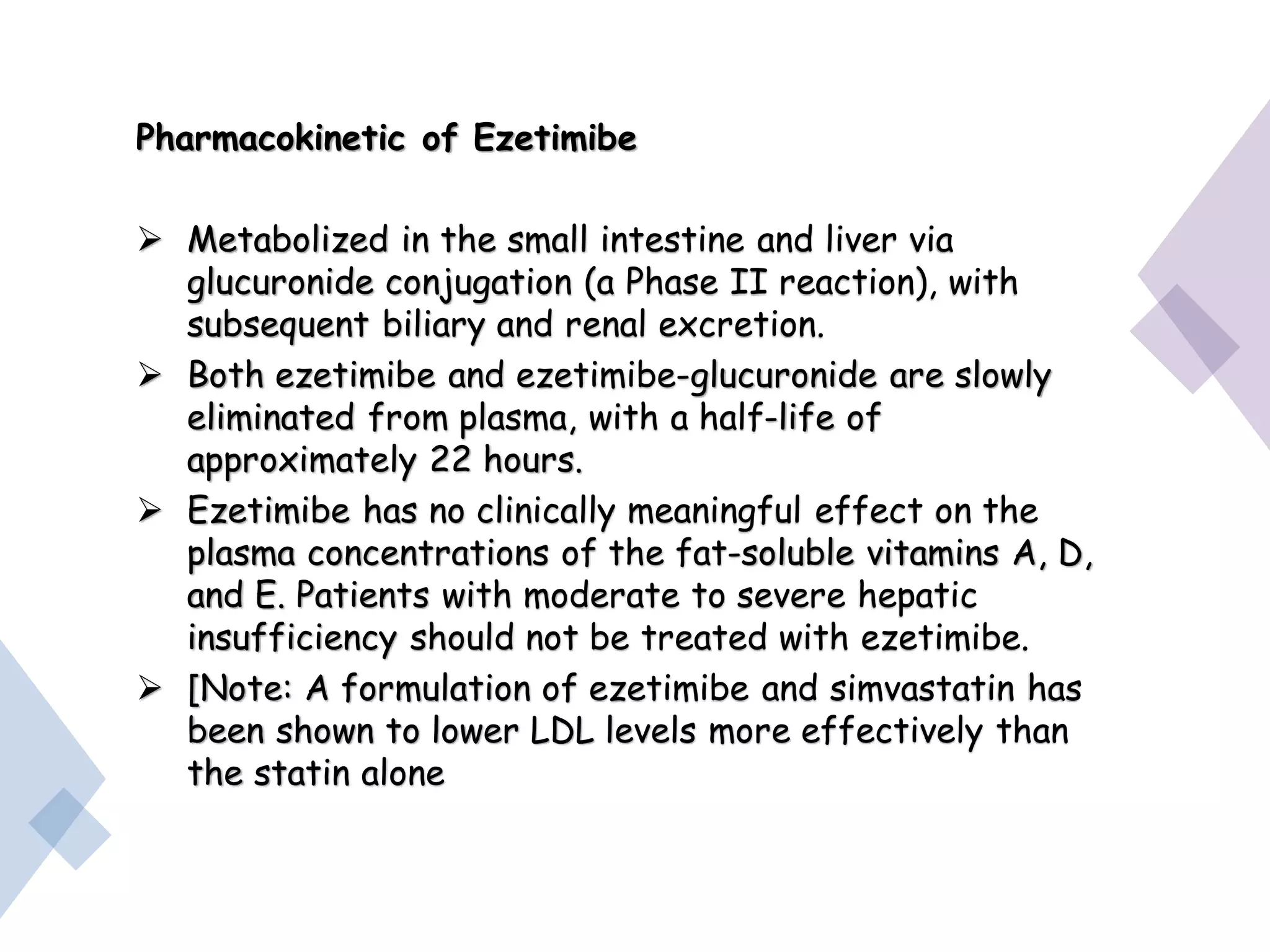
Pharmacokinetic of Ezetimibe
 Metabolized in the small intestine and liver via
glucuronide conjugation (a Phase II reaction), with
subsequent biliary and renal excretion.
 Both ezetimibe and ezetimibe-glucuronide are slowly
eliminated from plasma, with a half-life of
approximately 22 hours.
 Ezetimibe has no clinically meaningful effect on the
plasma concentrations of the fat-soluble vitamins A, D,
and E. Patients with moderate to severe hepatic
insufficiency should not be treated with ezetimibe.
 [Note: A formulation of ezetimibe and simvastatin has
been shown to lower LDL levels more effectively than
the statin alone
Combination drug
therapy
• Bile acid resins can be
safely combined with
statins or nicotinic acid
(↓ LDL, VLDL cholesterol
levels respectively).
• Ezetimibe + statins →
synergistic effects.
• Fibrates and statins are
CI → myopathy.
• Nicotinic acid and statins
(must be cautiously
used) → myopathy.
Alpha-tocopherol
acetate (vitamin E)
• Has no effect on lipid levels but is a
powerful antioxidant.
• Considerable evidence points to
oxidation of LDL as an essential step in
the development of atheroma, and
therefore interest has centred on the
role of either endogenous or
therapeutic vitamin E in prevention of
atheroma.
Omega-3 marine
triglycerides
(Maxepa)
• Contains the triglyceride
precursors of two
polyunsaturated fatty acids
derived from oily fish. They
have no place in treating
hypercholesterolaemia.
• Some patients with
moderate to severe
hypertriglyceridaemia may
respond to oral use, although
LDLcholesterol may rise.
Orlistat, a weight-reducing
agent, is a pancreatic lipase
inhibitor
 lowers the Glycaemia
of diabetes mellitus to a
degree that Accords with
the weight loss, and
improves Hyperlipidaemia.
 There is a risk
of steatorrhoea and alabsor
ption of Fat-soluble vitamins
A, D and E.
Thank you

Antihyperlipidemic drug

  • 1.
    Anti Hyperlipidemic Drugs Dr. AshwaniDhingra Associate Professor GGSCOP, YNR
  • 2.
    Lipid disorders Disorders oflipid metabolism are manifest by elevation of the plasma concentrations of the various lipid and lipoprotein fractions (total and LDL cholesterol, VLDL, triglycerides, chylomicrons) and they result in cardiovascular disease and atherosclerosis (deposition of fats at walls of arteries, forming plaque).
  • 5.
    Type of hyperlipidemia Primary hyperlipidemia It is usually due to genetic causes (such as a mutation in a receptor protein), while secondary hyperlipidemia arises due to other underlying causes such as diabetes.  Secondary hyperlipidemia It is an abnormal rise in blood lipids (fats), including cholesterol and triglycerides. It does not cause discernible symptoms but can increase the risk of heart attack and stroke.
  • 6.
    CLASSIFICATION Based on thepattern of lipoprotein on electrophoresis or ltracentrifugation. • Familial Chylomicronemia (I):increased Chylomicrons due to deficiency of lipoprotein lipase or its cofactor • Familial Hypercholesterolemia (IIA): levels of LDL tend to increase with normal VLDL. • Familial Combined (mixed)Hyperlipidemiaa (IIB): elevated levels of VLDL, LDL. • Familial Dysbetalipoproteinemia (III): Increased IDL resulting increased TG and cholesterol levels. • Familial Hypertriglyceridemia (VI): Increase VLDL production with normal or decreased LDL. • Familial mixed hypertriglyceridemia (V): Serum VLDL and chylomicrons are increased
  • 7.
    Secondary hyperlipidaemias Secondary hyperlipidaemiasresults from: • Liver disease • Biliary disease • Obesity • Hypothyroidism • Diabetes, • Diet • Alcohol excess • Renal disease (nephrotic syndrome) • Drugs, HIV protease inhibitors, thiazide diuretics, oral contraceptive steroids
  • 8.
    The most severehyperlipidaemias usually occur In patients with concurrent conditions, e.g. Diabetes Mellitus with one of the primary hyperlipidaemias Drug therapy: the primary goal of therapy is to:  Decrease levels of LDL  Increase in HDL
  • 9.
    Classification of Anti-hyperlipidemicdrugs • Anti-hyperlipidemic drugs are mainly classified into 5 types: • HMG CoA REDUCTASE INHIBITORS: E.g.: Atorvastatin, Fluvastatin, Lovastatin, Pravastatin, Simvastatin. • FIBRATES: E.g.: Fenofibrate, Gemfibrozil, Clofibrate • Anion –exchange resins( BILE ACID SEQUESTRANTS): E.g.: Colesevelam, Colestipol, Cholestyramine • Nicotinic acid: E.g: NIACIN. • CHOLESTEROL ABSORPTION INHIBITORS: E.g.: Ezetimibe. • OTHER DRUGS E.g: Alpha-tocopherol acetate (vitamin E), Omega-3 marine triglycerides (Maxepa), Orlistat
  • 10.
    Most potent LDL reducers HMG-CoA ReductaseInhibitors (HMGs or statins) Pravastatin Simvastatin Atorvastatin Fluvastatin Lovastatin
  • 11.
    HMG-CoA Reductase Inhibitors (HMGsor statins)  Block the rate-limiting enzyme for endogenous cholesterol synthesis, hydroxy- methylglutaryl Coenzyme A (HMG CoA) reductase.  Increased synthesis of LDL-receptors (upregulation) in the liver  Increased clearance of LDL from the circulation Note: Plasma total cholesterol and LDL-cholesterol fall to attain a maximum effect 1 month after therapy.
  • 12.
  • 14.
    Therapeutic uses:  Thesedrugs are effective in lowering plasma cholesterol levels in all types of hyperlipidemias However, patients who are homozygous for familial hypercholesterolemia lack LDL receptors and, therefore, benefit much less from treatment with these drugs.  These drugs are often given in combination with other antihyperlipidemic drugs Pharmacokinetics:  Pravastatin and fluvastatin are almost completely absorbed after oral administration.  oral doses of lovastatin and simvastatin are from 30 to 50 percent absorbed.  pravastatin and fluvastatin are active, whereas lovastatin and simvastatin must be hydrolyzed to their acid forms.  Excretion takes place through the bile and feces  some urinary elimination also occurs.  Their half-lives range from 1.5 to 2 hours.
  • 15.
    Adverse effect of statins • Transient,and minor abnormality of liver function tests • Myopathy and rhabdomyolysis (disintegration or dissolution of muscle and elevation of muscle enzymes (creatine hosphokinase, CPK): • In patients with renal insufficiency • In patients taking drugs such as cyclosporine, itraconazole, erythromycin, gemfibrozil, or niacin. Plasma creatine kinase levels should be determined regularly.
  • 16.
  • 17.
    Drug interactions: TheHMG CoA reductase inhibitors may also increase warfarin levels. Thus, it is important to evaluate INR Contraindications: These drugs are contraindicated during pregnancy and in nursing mothers. They should not be used in children or teenagers.
  • 18.
  • 19.
    Mechanism of action Agonistsat PPAR(peroxisome proliferator-activated receptor) → expression of genes responsible for increased activity of plasma lipoprotein lipase enzyme → hydrolysis of VLDL and chylomicrons→ ↓ serum TGs Increase clearance of LDL by liver & ↑ HDL.
  • 20.
    Therapeutic uses Hypertriglyceridemia (themost effective in reduction TGs) - combined hyperlipidemia (type III) if statins are contraindicated. Pharmacokinetic of Fibric acid derivatives:  well absorbed from the gastrointestinal tract  extensively bound to plasma proteins  excreted mainly by the kidney as unchanged drug or metabolites. Contraindication  Where hepatic or renal function is severely impaired (but gemfibrozil has been used in uraemic and nephrotic patients without aggravating deterioration in kidney function)  pregnant or lactating women
  • 21.
    Adverse effect of fibric acid derivatives Gastrointestinaleffects Lithiasis: Because these drugs increase biliary cholesterol excretion, there is a predisposition to the formation of gallstones. Fibric acid derivatives may induce a Myopathy and rhabdomyolysis the risk is greater in: Patients with poor renal Function In patients taking a statin. Fibrates enhance the effect of co-administered oral Anticoagulants.
  • 22.
    Anion – exchangeresins (BILE ACID SEQUESTRANTS) Colestipol Cholestyramine Colesevelam
  • 23.
    Mechanism of action •Anion exchange resins bind bile acids in the intestine forming complex →loss of bile acids in the stools →↑ conversion of cholesterol into bile acids in the liver. • Decreased concentration of intrahepatic cholesterol → compensatory increase in LDL receptors →↑ hepatic uptake of circulating LDL → ↓ serum LDL cholesterol levels.
  • 24.
    Therapeutic uses: 1. Intreatment of type IIA and IIB hyperlipidemias (along with statins when response to statins is inadequate or they are contraindicated). 2. Useful for Pruritus in biliary obstruction (↑ bile acids). Pharmacokinetics: • Orally given but neither absorbed nor metabolically altered by intestine, totally excreted in feces. Drug interactions: • Tetracycline, warfarin, digoxin, thiazide diuretics, phenobarbitone and thyroid hormones should be taken 1 h-2h before or 4 h-6h after colestyramine to avoid impairment of their absorption (Because the drug binds anions)
  • 25.
    Adverse effect ofAnion – exchange resins (BILE ACID SEQUESTRANTS) • Gastrointestinal effects: constipation(most common ), nausea, and flatulence, anorexia, diarrhea, these effects are dose- related. • Impaired absorptions: At high doses, cholestyramine and colestipol impair the absorption of the fat-soluble vitamins (A, D, E, and K). Note: Colesevelam has fewer gastrointestinal side effects and not Impaired absorptions
  • 26.
    Niacin (nicotinic acid) Mechanismof action:  It is a potent inhibitor of lipolysis in adipose tissues → ↓ mobilization of FFAs (major precursor of TGs) to the liver → ↓ VLDL (after few hours).  Since LDL is derived from VLDL so ↓ VLDL → ↓ LDL (after few hours).  ↑ HDL levels ( the most potent antihyperlipidemic).  ↓ endothelial dysfunction →↓ thrombosis. N O HO
  • 28.
    Niacin (nicotinic acid) Therapeutic uses: Niacin lowersplasma levels of both cholesterol and triacylglycerol. Therefore, it is particularly useful in the treatment of familial hyperlipidemias. Niacin is also used to treat other severe hypercholesterolemias, often in combination with other antihyperlipidemic agents. In addition, it is the most potent antihyperlipidemic agent for raising plasma HDL levels, which is the most common indication for its clinical use. Pharmacokinetics: Niacin is administered orally. It is converted in the body to nicotinamide, which is incorporated into the cofactor nicotinamide- adenine dinucleotide (NAD+). Niacin, its nicotinamide derivative, and other metabolites are excreted in the urine. [Note: Nicotinamide alone does not decrease plasma lipid levels.]
  • 29.
    Adverse effects: 1. Cutaneousflush )most common side effects(accompanied by an uncomfortable feeling of warmth) and pruritus. Administration of aspirin prior to taking niacin decreases the flush, which is prostaglandin mediated. The sustained- release formulation of niacin, which is taken once daily at bedtime, reduces bothersome initial adverse effects. 2. Nausea and abdominal pain. 3. Hyperuricemia and gout) Niacin inhibits tubular secretion of uric acid ( 4. Impaired glucose tolerance 5. Hepatotoxicity
  • 30.
    Cholesterol absorption inhibitors Ezetimibe Selectively inhibits intestinal absorption of dietary and biliary cholesterol in the small intestine → ↓ in the delivery of intestinal cholesterol to the liver → ↓ of hepatic cholesterol stores → ↑ clearance of cholesterol from the blood.  Ezetimibe lowers LDL cholesterol and triacylglycerols  Increases HDL cholesterol.
  • 32.
    Pharmacokinetic of Ezetimibe Metabolized in the small intestine and liver via glucuronide conjugation (a Phase II reaction), with subsequent biliary and renal excretion.  Both ezetimibe and ezetimibe-glucuronide are slowly eliminated from plasma, with a half-life of approximately 22 hours.  Ezetimibe has no clinically meaningful effect on the plasma concentrations of the fat-soluble vitamins A, D, and E. Patients with moderate to severe hepatic insufficiency should not be treated with ezetimibe.  [Note: A formulation of ezetimibe and simvastatin has been shown to lower LDL levels more effectively than the statin alone
  • 33.
    Combination drug therapy • Bileacid resins can be safely combined with statins or nicotinic acid (↓ LDL, VLDL cholesterol levels respectively). • Ezetimibe + statins → synergistic effects. • Fibrates and statins are CI → myopathy. • Nicotinic acid and statins (must be cautiously used) → myopathy.
  • 34.
    Alpha-tocopherol acetate (vitamin E) •Has no effect on lipid levels but is a powerful antioxidant. • Considerable evidence points to oxidation of LDL as an essential step in the development of atheroma, and therefore interest has centred on the role of either endogenous or therapeutic vitamin E in prevention of atheroma.
  • 35.
    Omega-3 marine triglycerides (Maxepa) • Containsthe triglyceride precursors of two polyunsaturated fatty acids derived from oily fish. They have no place in treating hypercholesterolaemia. • Some patients with moderate to severe hypertriglyceridaemia may respond to oral use, although LDLcholesterol may rise.
  • 36.
    Orlistat, a weight-reducing agent,is a pancreatic lipase inhibitor  lowers the Glycaemia of diabetes mellitus to a degree that Accords with the weight loss, and improves Hyperlipidaemia.  There is a risk of steatorrhoea and alabsor ption of Fat-soluble vitamins A, D and E.
  • 38.