ANTIPLATELETS &
FIBRINOLYTICS
ANTIPLATELETS
•The drugs which inhibit the platelets aggregation
are known as antiplatelet drugs.
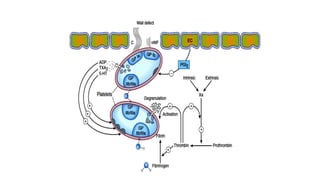
•Platelets aggregation, is an essential step in the
formation of hemostatic plug at the site of vascular
injury.
•These drugs have their role in some pathologic
conditions where formation of this haemostatic
plug is to be prevented.
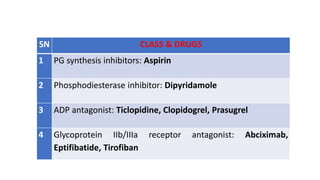
SN CLASS & DRUGS
1 PG synthesis inhibitors: Aspirin
2 Phosphodiesterase inhibitor: Dipyridamole
3 ADP antagonist: Ticlopidine, Clopidogrel, Prasugrel
4 Glycoprotein IIb/IIIa receptor antagonist: Abciximab,
Eptifibatide, Tirofiban
PG SYNTHESIS INHIBITORS
Aspirin
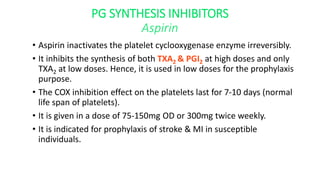
• Aspirin inactivates the platelet cyclooxygenase enzyme irreversibly.
• It inhibits the synthesis of both TXA2 & PGI2 at high doses and only
TXA2 at low doses. Hence, it is used in low doses for the prophylaxis
purpose.
• The COX inhibition effect on the platelets last for 7-10 days (normal
life span of platelets).
• It is given in a dose of 75-150mg OD or 300mg twice weekly.
• It is indicated for prophylaxis of stroke & MI in susceptible
individuals.
PHOSPHODIESTERASE INHIBITOR
Dipyridamole
• It is a phosphodiesterase enzyme inhibitor and act by
interfering in the platelets function by increasing platelet
AMP levels.
• It is used in combination with aspirin or warfarin in the
patients of prosthetic heart valves as a prophylactic
measure to decrease the incidence of thromboembolism.
• It is given orally in a dose of 25-100mg, TDS.
• Headache is the only and mild side effect.
ADP ANTAGONISTS
Ticlopidine, Clopidogrel, Prasugrel
• These are prodrugs and the active metabolites bind to
the ADP receptors (P2Y12) on platelets and block them.
• Platelet aggregation requires stimulation of ADP
receptors. Blockade of these receptors leads to anti-
aggregatory effect.
• The effect of these drugs last for 5-7 days.
• Ticlopidine is given orally in a dose of 250mg BD.
Cont..
• Clopidogrel is given orally in a dose of 75mg OD (300 mg
as loading dose in suspected MI).
• Prasugrel is given orally in a dose of 10 mg OD (60 mg as
loading dose).
• They are indicated for the prophylaxis of MI, stroke, TIA,
unstable angina, coronary artery bypass graft, etc.
Prasugrel is specifically used in STEMI.
• The major side effects are increase in bleeding
tendencies, GI disturbance, rashes, headache, etc.
GLYCOPROTEIN IIb/IIIa RECEPTOR ANTAGONISTS
(Abciximab, Eptifibatide, Tirofiban)
• The glycoprotein IIB/IIIa (GP-IIb/IIIa)receptors are present on
the platelet surface and have a role in platelet aggregation.
• Drugs such as Abciximab, Eptifibatide, Tirofiban block these
receptors and inhibit the platelet agonists induced platelet
aggregation.
Abciximab
• It is a monoclonal antibody & bind to the GP-IIb/IIIa
receptor complex and inhibits platelets aggregation with
high affinity and slow dissociation rate.
• It is given in a dose of 0.25mg/kg IV bolus followed by
0.125µgm/kg/minute IV infusion for 12 hours.
• It is indicated in acute coronary syndrome and patients
undergoing coronary angioplasty & other percutaneous
coronary interventions.
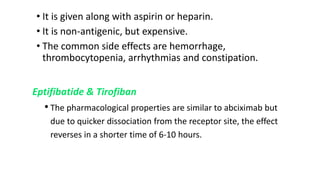
• It is given along with aspirin or heparin.
• It is non-antigenic, but expensive.
• The common side effects are hemorrhage,
thrombocytopenia, arrhythmias and constipation.
Eptifibatide & Tirofiban
• The pharmacological properties are similar to abciximab but
due to quicker dissociation from the receptor site, the effect
reverses in a shorter time of 6-10 hours.
Eptifibatide
• It is given in a dose of 180 μg/kg
IV bolus, then 2 μg/kg/minute IV
infusion upto 72 hours for the
management unstable angina.
• It is given in a dose of 180 μg/kg
IV bolus, just before the
procedure then 2 μg/kg/minute
IV infusion for 12–24 hours for
Coronary angioplasty.
Tirofiban
• It is given in a dose of 0.4
μg/kg/minute for 30 minutes,
then 0.1 μg/kg/minute for upto
48 hours for management of
acute coronary syndromes.
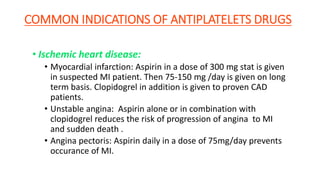
COMMON INDICATIONS OF ANTIPLATELETS DRUGS
• Ischemic heart disease:
• Myocardial infarction: Aspirin in a dose of 300 mg stat is given
in suspected MI patient. Then 75-150 mg /day is given on long
term basis. Clopidogrel in addition is given to proven CAD
patients.
• Unstable angina: Aspirin alone or in combination with
clopidogrel reduces the risk of progression of angina to MI
and sudden death .
• Angina pectoris: Aspirin daily in a dose of 75mg/day prevents
occurance of MI.
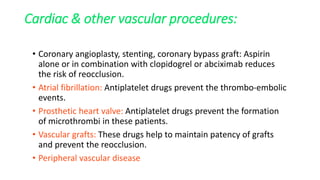
Cardiac & other vascular procedures:
• Coronary angioplasty, stenting, coronary bypass graft: Aspirin
alone or in combination with clopidogrel or abciximab reduces
the risk of reocclusion.
• Atrial fibrillation: Antiplatelet drugs prevent the thrombo-embolic
events.
• Prosthetic heart valve: Antiplatelet drugs prevent the formation
of microthrombi in these patients.
• Vascular grafts: These drugs help to maintain patency of grafts
and prevent the reocclusion.
• Peripheral vascular disease
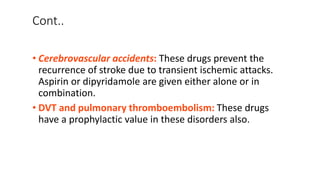
Cont..
• Cerebrovascular accidents: These drugs prevent the
recurrence of stroke due to transient ischemic attacks.
Aspirin or dipyridamole are given either alone or in
combination.
• DVT and pulmonary thromboembolism: These drugs
have a prophylactic value in these disorders also.
FIBRINOLYTICS (THROMBOLYTICS)
• Fibrinolytics or thrombolytics are the drugs, which cause lysis of
thrombus by activating natural fibrinolytic system. These drugs
act as therapeutic agents to recanalise the vessels occluded by
thrombus.
• In human body, tissue plasminogen activator, activates
plasminogen, which generates plasmin. This plasmin breaks the
insoluble fibrin to soluble fibrin fragments and thereby dissolves
the clot.
• The various thrombolytics in use are Streptokinase, Urokinase,
Alteplase, Reteplase, Tenecteplase etc.
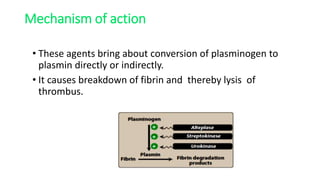
Mechanism of action
• These agents bring about conversion of plasminogen to
plasmin directly or indirectly.
• It causes breakdown of fibrin and thereby lysis of
thrombus.
Streptokinase
• is obtained from β-hemolytic streptococci and is one of
the first approved fibrinolytic agents. Streptokinase also
catalyzes the degradation of clotting factors V and VII.
• Streptokinase is antigenic in nature and the antibodies
formed after a single exposure of this agent persist in the
body for at least five years.
Cont..
• Repeated exposure within this period can cause
anaphylactic reactions. An alternative thrombolytic agent
like urokinase or tPA is used for subsequent
thrombolysis, if required.
• For MI patients, it is given as i.v. infusion over 1 hr in a
dose of 7.5–15 lac IU.
• For DVT and pulmonary embolism: loading dose of 2.5
lac IU over ½–1 hr is followed by 1 lac IU/hr infusion for
24 hrs.
Urokinase
• is an enzyme naturally obtained from human urine.
• For commercial preparation, human kidney cells are cultured for
its extraction. It directly converts plasminogen into active plasmin
and is approved for lysis of pulmonary emboli.
• Other uses of urokinase include treatment of acute MI, arterial
thromboembolism, coronary artery thrombosis, and severe DVT.
Cont..
• Its use has decreased these days due to availability of
better agents.
• For MI patients 2.5 lac IU are given intravenously over 10 min
and it is followed by 5 lac IU over next one hour. The infusion
can be stopped in between if evidence of recanalization is
there. Alternatively, continuous infusion for upto two hours in
a dose of 6000 IU/min can also be given.
• For DVT and pulmonary embolism: 4400 IU/kg are given
intravenously over 10 min and followed by 4400 IU/kg/hr for
12 hrs.
Alteplase (recombinant tissue plasminogen
activator or rt-PA)
• In earlier times, it was known as tissue plasminogen
activator (tPA).
• These days it is prepared by recombinant DNA technology
using human tissue culture cells. Alteplase is “fibrin
selective” at low doses i.e. it rapidly activates the fibrin
bound plasminigen present in the thrombus. It is non
antigenic.
Cont..
• For the patient of MI: i. v. bolus dose of 15mg ,followed by
infusion of 50 mg over 30 min and then 35 mg over the next 1 hr
is given. A total 90 min treatment period is there.
• For pulmonary embolism: 100 mg i.v. infusion is given in a period
of over 2 hr.
• For ischemic stroke: A total dose of 0.9 mg/kg is given. Out of
this, 10% of the dose is injected in the first minute and the
remaining 90% is infused intravenously by i.v. infusion over 60
min period.
Reteplase
• Reteplase is a genetically modified, small molecular
derivative of recombinant tPA with a longer half life.
• It is given in a dose of 10 mg slowly in 10 minutes period and
repeated after 30 minutes if required.
Tenecteplase
• is another recombinant tPA with a long half-life and has greater
binding affinity for fibrin than alteplase.
• It can be administered as a single iv bolus dose , whereas other
thrombolytic agents (except reteplase) are given by intravenous
infusion.
• It is given as a single i.v. bolus injection in a dose of 0.5 mg/kg
Indications
• Acute MI: Streptokinase is given as soon as possible.
Alteplase is preferred (in patients who can afford it) due
to better efficacy.
• Acute pulmonary embolism.
• Acute ischemic stroke: Alteplase given within three to six
hours of the TIA is beneficial in early recovery.
• Treatment of severe DVT: All agents have equal efficacy
in this condition.
Adverse effects
• The major side effect is hemorrhage.
• The other common side effects are fever, hypotension.
• The allergic reaction is common with streptokinase.
• These agents are contraindicated in pregnancy, and in
patients with wounds, a history of cerebrovascular
accident, brain tumor, head trauma and metastatic
cancer.
ABSOLUTE AND RELATIVE CONTRAINDICATIONS TO FIBRINOLYTIC THERAPY
Absolute Contraindications
 Prior intracranial hemorrhage
 Known structural cerebral vascular lesion
 Known malignant intracranial neoplasm
 Ischemic stroke within 3 months
 Suspected aortic dissection
 Active bleeding or bleeding diathesis
(excluding menses)
 Significant closed-head trauma or facial
trauma within 3 months
Relative Contraindications
 Uncontrolled hypertension (systolic blood
pressure >180 mm Hg or diastolic blood
pressure >110 mm Hg)
 Traumatic or prolonged CPR or major
surgery within 3 weeks
 Recent (within 2-4 weeks) internal
bleeding
 Noncompressible vascular punctures
 For streptokinase: prior exposure (more
than 5 days ago) or prior allergic reaction
to streptokinase
 Pregnancy
 Active peptic ulcer
 Current use of warfarin and INR >1.7
CPR, cardiopulmonary resuscitation; INR, international normalized ratio.
Antiplatelets

Antiplatelets

  • 1.
  • 2.
    ANTIPLATELETS •The drugs whichinhibit the platelets aggregation are known as antiplatelet drugs. •Platelets aggregation, is an essential step in the formation of hemostatic plug at the site of vascular injury. •These drugs have their role in some pathologic conditions where formation of this haemostatic plug is to be prevented.
  • 4.
    SN CLASS &DRUGS 1 PG synthesis inhibitors: Aspirin 2 Phosphodiesterase inhibitor: Dipyridamole 3 ADP antagonist: Ticlopidine, Clopidogrel, Prasugrel 4 Glycoprotein IIb/IIIa receptor antagonist: Abciximab, Eptifibatide, Tirofiban
  • 5.
    PG SYNTHESIS INHIBITORS Aspirin •Aspirin inactivates the platelet cyclooxygenase enzyme irreversibly. • It inhibits the synthesis of both TXA2 & PGI2 at high doses and only TXA2 at low doses. Hence, it is used in low doses for the prophylaxis purpose. • The COX inhibition effect on the platelets last for 7-10 days (normal life span of platelets). • It is given in a dose of 75-150mg OD or 300mg twice weekly. • It is indicated for prophylaxis of stroke & MI in susceptible individuals.
  • 6.
    PHOSPHODIESTERASE INHIBITOR Dipyridamole • Itis a phosphodiesterase enzyme inhibitor and act by interfering in the platelets function by increasing platelet AMP levels. • It is used in combination with aspirin or warfarin in the patients of prosthetic heart valves as a prophylactic measure to decrease the incidence of thromboembolism. • It is given orally in a dose of 25-100mg, TDS. • Headache is the only and mild side effect.
  • 7.
    ADP ANTAGONISTS Ticlopidine, Clopidogrel,Prasugrel • These are prodrugs and the active metabolites bind to the ADP receptors (P2Y12) on platelets and block them. • Platelet aggregation requires stimulation of ADP receptors. Blockade of these receptors leads to anti- aggregatory effect. • The effect of these drugs last for 5-7 days. • Ticlopidine is given orally in a dose of 250mg BD.
  • 8.
    Cont.. • Clopidogrel isgiven orally in a dose of 75mg OD (300 mg as loading dose in suspected MI). • Prasugrel is given orally in a dose of 10 mg OD (60 mg as loading dose). • They are indicated for the prophylaxis of MI, stroke, TIA, unstable angina, coronary artery bypass graft, etc. Prasugrel is specifically used in STEMI. • The major side effects are increase in bleeding tendencies, GI disturbance, rashes, headache, etc.
  • 9.
    GLYCOPROTEIN IIb/IIIa RECEPTORANTAGONISTS (Abciximab, Eptifibatide, Tirofiban) • The glycoprotein IIB/IIIa (GP-IIb/IIIa)receptors are present on the platelet surface and have a role in platelet aggregation. • Drugs such as Abciximab, Eptifibatide, Tirofiban block these receptors and inhibit the platelet agonists induced platelet aggregation.
  • 10.
    Abciximab • It isa monoclonal antibody & bind to the GP-IIb/IIIa receptor complex and inhibits platelets aggregation with high affinity and slow dissociation rate. • It is given in a dose of 0.25mg/kg IV bolus followed by 0.125µgm/kg/minute IV infusion for 12 hours. • It is indicated in acute coronary syndrome and patients undergoing coronary angioplasty & other percutaneous coronary interventions.
  • 11.
    • It isgiven along with aspirin or heparin. • It is non-antigenic, but expensive. • The common side effects are hemorrhage, thrombocytopenia, arrhythmias and constipation. Eptifibatide & Tirofiban • The pharmacological properties are similar to abciximab but due to quicker dissociation from the receptor site, the effect reverses in a shorter time of 6-10 hours.
  • 12.
    Eptifibatide • It isgiven in a dose of 180 μg/kg IV bolus, then 2 μg/kg/minute IV infusion upto 72 hours for the management unstable angina. • It is given in a dose of 180 μg/kg IV bolus, just before the procedure then 2 μg/kg/minute IV infusion for 12–24 hours for Coronary angioplasty. Tirofiban • It is given in a dose of 0.4 μg/kg/minute for 30 minutes, then 0.1 μg/kg/minute for upto 48 hours for management of acute coronary syndromes.
  • 13.
    COMMON INDICATIONS OFANTIPLATELETS DRUGS • Ischemic heart disease: • Myocardial infarction: Aspirin in a dose of 300 mg stat is given in suspected MI patient. Then 75-150 mg /day is given on long term basis. Clopidogrel in addition is given to proven CAD patients. • Unstable angina: Aspirin alone or in combination with clopidogrel reduces the risk of progression of angina to MI and sudden death . • Angina pectoris: Aspirin daily in a dose of 75mg/day prevents occurance of MI.
  • 14.
    Cardiac & othervascular procedures: • Coronary angioplasty, stenting, coronary bypass graft: Aspirin alone or in combination with clopidogrel or abciximab reduces the risk of reocclusion. • Atrial fibrillation: Antiplatelet drugs prevent the thrombo-embolic events. • Prosthetic heart valve: Antiplatelet drugs prevent the formation of microthrombi in these patients. • Vascular grafts: These drugs help to maintain patency of grafts and prevent the reocclusion. • Peripheral vascular disease
  • 15.
    Cont.. • Cerebrovascular accidents:These drugs prevent the recurrence of stroke due to transient ischemic attacks. Aspirin or dipyridamole are given either alone or in combination. • DVT and pulmonary thromboembolism: These drugs have a prophylactic value in these disorders also.
  • 16.
  • 17.
    • Fibrinolytics orthrombolytics are the drugs, which cause lysis of thrombus by activating natural fibrinolytic system. These drugs act as therapeutic agents to recanalise the vessels occluded by thrombus. • In human body, tissue plasminogen activator, activates plasminogen, which generates plasmin. This plasmin breaks the insoluble fibrin to soluble fibrin fragments and thereby dissolves the clot. • The various thrombolytics in use are Streptokinase, Urokinase, Alteplase, Reteplase, Tenecteplase etc.
  • 18.
    Mechanism of action •These agents bring about conversion of plasminogen to plasmin directly or indirectly. • It causes breakdown of fibrin and thereby lysis of thrombus.
  • 19.
    Streptokinase • is obtainedfrom β-hemolytic streptococci and is one of the first approved fibrinolytic agents. Streptokinase also catalyzes the degradation of clotting factors V and VII. • Streptokinase is antigenic in nature and the antibodies formed after a single exposure of this agent persist in the body for at least five years.
  • 20.
    Cont.. • Repeated exposurewithin this period can cause anaphylactic reactions. An alternative thrombolytic agent like urokinase or tPA is used for subsequent thrombolysis, if required. • For MI patients, it is given as i.v. infusion over 1 hr in a dose of 7.5–15 lac IU. • For DVT and pulmonary embolism: loading dose of 2.5 lac IU over ½–1 hr is followed by 1 lac IU/hr infusion for 24 hrs.
  • 21.
    Urokinase • is anenzyme naturally obtained from human urine. • For commercial preparation, human kidney cells are cultured for its extraction. It directly converts plasminogen into active plasmin and is approved for lysis of pulmonary emboli. • Other uses of urokinase include treatment of acute MI, arterial thromboembolism, coronary artery thrombosis, and severe DVT.
  • 22.
    Cont.. • Its usehas decreased these days due to availability of better agents. • For MI patients 2.5 lac IU are given intravenously over 10 min and it is followed by 5 lac IU over next one hour. The infusion can be stopped in between if evidence of recanalization is there. Alternatively, continuous infusion for upto two hours in a dose of 6000 IU/min can also be given. • For DVT and pulmonary embolism: 4400 IU/kg are given intravenously over 10 min and followed by 4400 IU/kg/hr for 12 hrs.
  • 23.
    Alteplase (recombinant tissueplasminogen activator or rt-PA) • In earlier times, it was known as tissue plasminogen activator (tPA). • These days it is prepared by recombinant DNA technology using human tissue culture cells. Alteplase is “fibrin selective” at low doses i.e. it rapidly activates the fibrin bound plasminigen present in the thrombus. It is non antigenic.
  • 24.
    Cont.. • For thepatient of MI: i. v. bolus dose of 15mg ,followed by infusion of 50 mg over 30 min and then 35 mg over the next 1 hr is given. A total 90 min treatment period is there. • For pulmonary embolism: 100 mg i.v. infusion is given in a period of over 2 hr. • For ischemic stroke: A total dose of 0.9 mg/kg is given. Out of this, 10% of the dose is injected in the first minute and the remaining 90% is infused intravenously by i.v. infusion over 60 min period.
  • 25.
    Reteplase • Reteplase isa genetically modified, small molecular derivative of recombinant tPA with a longer half life. • It is given in a dose of 10 mg slowly in 10 minutes period and repeated after 30 minutes if required.
  • 26.
    Tenecteplase • is anotherrecombinant tPA with a long half-life and has greater binding affinity for fibrin than alteplase. • It can be administered as a single iv bolus dose , whereas other thrombolytic agents (except reteplase) are given by intravenous infusion. • It is given as a single i.v. bolus injection in a dose of 0.5 mg/kg
  • 27.
    Indications • Acute MI:Streptokinase is given as soon as possible. Alteplase is preferred (in patients who can afford it) due to better efficacy. • Acute pulmonary embolism. • Acute ischemic stroke: Alteplase given within three to six hours of the TIA is beneficial in early recovery. • Treatment of severe DVT: All agents have equal efficacy in this condition.
  • 28.
    Adverse effects • Themajor side effect is hemorrhage. • The other common side effects are fever, hypotension. • The allergic reaction is common with streptokinase. • These agents are contraindicated in pregnancy, and in patients with wounds, a history of cerebrovascular accident, brain tumor, head trauma and metastatic cancer.
  • 29.
    ABSOLUTE AND RELATIVECONTRAINDICATIONS TO FIBRINOLYTIC THERAPY Absolute Contraindications  Prior intracranial hemorrhage  Known structural cerebral vascular lesion  Known malignant intracranial neoplasm  Ischemic stroke within 3 months  Suspected aortic dissection  Active bleeding or bleeding diathesis (excluding menses)  Significant closed-head trauma or facial trauma within 3 months Relative Contraindications  Uncontrolled hypertension (systolic blood pressure >180 mm Hg or diastolic blood pressure >110 mm Hg)  Traumatic or prolonged CPR or major surgery within 3 weeks  Recent (within 2-4 weeks) internal bleeding  Noncompressible vascular punctures  For streptokinase: prior exposure (more than 5 days ago) or prior allergic reaction to streptokinase  Pregnancy  Active peptic ulcer  Current use of warfarin and INR >1.7 CPR, cardiopulmonary resuscitation; INR, international normalized ratio.