Cytokines:
The Molecular
Messenger
Presented By:
Vivek kumar
M.Sc Microbiology
Bangalore University
Introduction
• The term “ Cytokines” is derived from a combination of two greek
words – “cyto” meaning cell & “kinos” meaning movement .
• Cytokines are cell signaling molecules that aid cell to cell communication
in immune responses & stimulate the movement of cells towards sites of
infection.
• Cytokines are a large group of proteins, peptides or glycoproteins that
are secreted by specific cells of immune system.
• Cytokines are a category of signaling molecules that mediates and
regulates immunity , inflammation & hematopoiesis.
• Cytokines are produced throughout the body by cells of diverse
embryological origin.
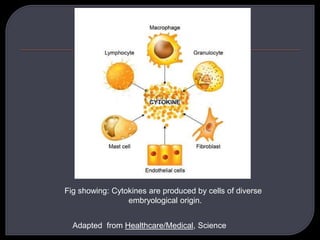
Fig showing: Cytokines are produced by cells of diverse
embryological origin.
Adapted from Healthcare/Medical, Science
Properties of Cytokines
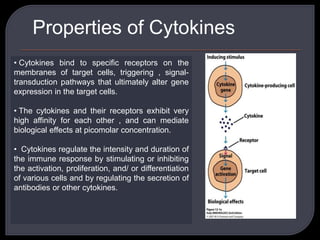
• Cytokines bind to specific receptors on the
membranes of target cells, triggering , signal-
transduction pathways that ultimately alter gene
expression in the target cells.
• The cytokines and their receptors exhibit very
high affinity for each other , and can mediate
biological effects at picomolar concentration.
• Cytokines regulate the intensity and duration of
the immune response by stimulating or inhibiting
the activation, proliferation, and/ or differentiation
of various cells and by regulating the secretion of
antibodies or other cytokines.
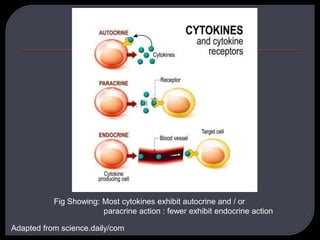
Fig Showing: Most cytokines exhibit autocrine and / or
paracrine action : fewer exhibit endocrine action
Adapted from science.daily/com
Cytokines exhibit the attributes of:
 Pleiotrophy
 Redundancy
 Synergy
 Antagonism
 Cascade Induction
which permit them to regulate cellular activity in
a coordinated , interactive way.
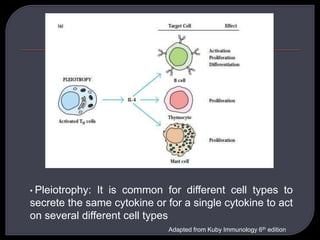
• Pleiotrophy: It is common for different cell types to
secrete the same cytokine or for a single cytokine to act
on several different cell types
Adapted from Kuby Immunology 6th edition
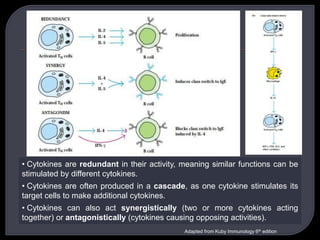
• Cytokines are redundant in their activity, meaning similar functions can be
stimulated by different cytokines.
• Cytokines are often produced in a cascade, as one cytokine stimulates its
target cells to make additional cytokines.
• Cytokines can also act synergistically (two or more cytokines acting
together) or antagonistically (cytokines causing opposing activities).
Adapted from Kuby Immunology 6th edition
Nomenclature
• Interleukins: That act as mediators between leukocytes, the vast majority
of these are produced by T- Helper cells.
•Lymphokines : produced by Lymphocytes.
• Monokines: Produced exclusively by monocytes.
• Interferons: involved in antiviral response.
• Colony Stimulating Factor: Supports the growth of red blood cell.
• Chemokines : mediate chemoattraction (chemotaxis) between cells.
Biological functions of Cytokines
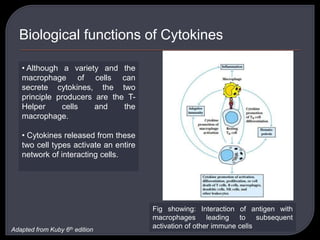
• Although a variety and the
macrophage of cells can
secrete cytokines, the two
principle producers are the T-
Helper cells and the
macrophage.
• Cytokines released from these
two cell types activate an entire
network of interacting cells.
Fig showing: Interaction of antigen with
macrophages leading to subsequent
activation of other immune cellsAdapted from Kuby 6th edition
• Among the numerous physiologic responses that require cytokine
involvement are development of cellular and humoral immune responses,
induction of the inflammatory response, regulation of hematopoiesis, control
of cellular proliferation and differentiation, and the healing of wounds.
• One way in which specificity is maintained is by careful regulation of the
expression of cytokine receptors on cells. Often cytokine receptors are
expressed on a cell only after that cell has interacted with antigen. In this way
cytokine activation is limited to antigen-activated lymphocytes.
•Cytokines secreted at the junction of interacting cells reach high enough
local concentrations to affect the target APC but not more distant cells.
• In addition, the half-life of cytokines in the bloodstream or other extracellular
fluids into which they are secreted is usually very short, ensuring that they act
for only a limited period of time
Cytokine Receptors
• To exert their biological effects, cytokines must first bind to specific
receptors expressed on the membrane of responsive target cells.
•Because these receptors are expressed by many types of cells, the
cytokines can affect a diverse array of cells.
• Biochemical characterization of cytokine receptors initially progressed at a
very slow pace because their levels on the membrane of responsive cells is
quite low.
•
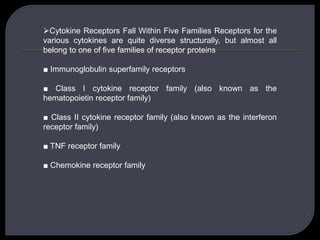
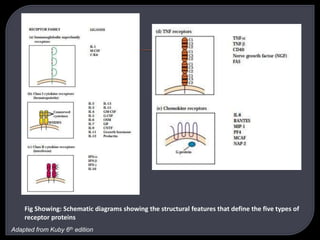
Cytokine Receptors Fall Within Five Families Receptors for the
various cytokines are quite diverse structurally, but almost all
belong to one of five families of receptor proteins
■ Immunoglobulin superfamily receptors
■ Class I cytokine receptor family (also known as the
hematopoietin receptor family)
■ Class II cytokine receptor family (also known as the interferon
receptor family)
■ TNF receptor family
■ Chemokine receptor family
Fig Showing: Schematic diagrams showing the structural features that define the five types of
receptor proteins
Adapted from Kuby 6th edition
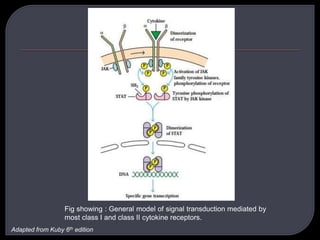
Fig showing : General model of signal transduction mediated by
most class I and class II cytokine receptors.
Adapted from Kuby 6th edition
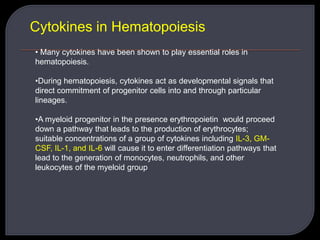
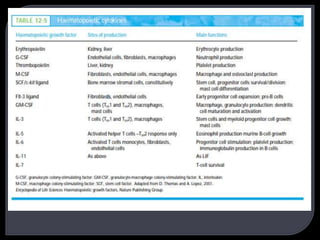
Cytokines in Hematopoiesis
• Many cytokines have been shown to play essential roles in
hematopoiesis.
•During hematopoiesis, cytokines act as developmental signals that
direct commitment of progenitor cells into and through particular
lineages.
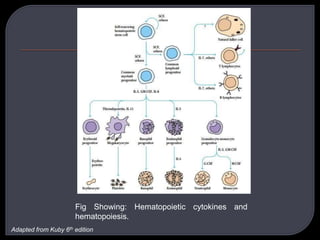
•A myeloid progenitor in the presence erythropoietin would proceed
down a pathway that leads to the production of erythrocytes;
suitable concentrations of a group of cytokines including IL-3, GM-
CSF, IL-1, and IL-6 will cause it to enter differentiation pathways that
lead to the generation of monocytes, neutrophils, and other
leukocytes of the myeloid group
Fig Showing: Hematopoietic cytokines and
hematopoiesis.
Adapted from Kuby 6th edition
Cytokine-Related Diseases
• Defects in the complex regulatory networks governing the expression of
cytokines and cytokine receptors have been implicated in a number of
diseases.
• Several diseases resulting from over expression or under expression of
cytokines or cytokine receptors.
 Bacterial Septic Shock
 The role of cytokine overproduction in pathogenesis can be
illustrated by bacterial septic shock.
This condition may develop a few hours after infection by certain
gram-negative bacteria, including E. coli, Klebsiella pneumoniae.
The symptoms of bacterial septic shock, which is often fatal,
include a drop in blood pressure, fever, diarrhea, and widespread
blood clotting in various organs.
Bacterial septic shock apparently develops because bacterial cell-
wall endotoxins stimulate macrophages to overproduce IL-1 and
TNF- to levels that cause septic shock.
 Bacterial Toxic Shock
 A variety of microorganisms produce toxins that act as
superantigens.
 Included among these bacterial superantigens are several
enterotoxins, exfoliating toxins, and toxic-shock syndrome
toxin (TSST1) from Staphylococcus aureus; pyrogenic
exotoxins from Streptococcus pyrogenes; and Mycoplasma
arthritidis supernatant (MAS).
The large number of T cells activated by these
superantigens results in excessive production of cytokines.
The toxic-shock syndrome toxin, for example, has been
shown to induce extremely high levels of TNF and IL-1.
Cytokine Activity Is Implicated in Lymphoid and
Myeloid Cancers
 Abnormalities in the production of cytokines or their receptors
have been associated with some types of cancer.
 For Example, abnormally high levels of IL-6 are secreted by
cardiac myxoma cells (a benign heart tumor), myeloma and
plasmacytoma cells, and cervical and bladder cancer cells.
 Chagas’ Disease
 The protozoan Trypanosoma cruzi is the causative agent of
Chagas’ disease, which is characterized by severe immune
suppression.
Antigen, mitogen, or anti-CD3 monoclonal antibody normally
can activate peripheral T cells, but in the presence of T. cruzi, T
cells are not activated by any of these agents. The defect in
these lymphocytes has been traced to a dramatic reduction in
the expression of the 55-kDa subunit of the IL-2 receptor.
Summary
 Introduction
 Properties of Cytokines
 Attributes of Cytokines
 Nomenclature
 Biological functions of Cytokines
 Cytokines in Hematopoiesis
 Cytokine-Related Diseases
• Kuby-immunology-6th-edition.
•https://www.sciencedirect.com/topics/neuroscience/cytokines
• http://www.bloodjournal.org/content/118/1/9?s
• https://www.verywellhealth.com
•https://www.ncbi.nlm.nih.gov/pmc/articles/PMC1766676/pdf/v060piii4
3.pdf
THANK YOU

Cytokines

  • 1.
    Cytokines: The Molecular Messenger Presented By: Vivekkumar M.Sc Microbiology Bangalore University
  • 2.
    Introduction • The term“ Cytokines” is derived from a combination of two greek words – “cyto” meaning cell & “kinos” meaning movement . • Cytokines are cell signaling molecules that aid cell to cell communication in immune responses & stimulate the movement of cells towards sites of infection. • Cytokines are a large group of proteins, peptides or glycoproteins that are secreted by specific cells of immune system. • Cytokines are a category of signaling molecules that mediates and regulates immunity , inflammation & hematopoiesis. • Cytokines are produced throughout the body by cells of diverse embryological origin.
  • 3.
    Fig showing: Cytokinesare produced by cells of diverse embryological origin. Adapted from Healthcare/Medical, Science
  • 4.
    Properties of Cytokines •Cytokines bind to specific receptors on the membranes of target cells, triggering , signal- transduction pathways that ultimately alter gene expression in the target cells. • The cytokines and their receptors exhibit very high affinity for each other , and can mediate biological effects at picomolar concentration. • Cytokines regulate the intensity and duration of the immune response by stimulating or inhibiting the activation, proliferation, and/ or differentiation of various cells and by regulating the secretion of antibodies or other cytokines.
  • 5.
    Fig Showing: Mostcytokines exhibit autocrine and / or paracrine action : fewer exhibit endocrine action Adapted from science.daily/com
  • 6.
    Cytokines exhibit theattributes of:  Pleiotrophy  Redundancy  Synergy  Antagonism  Cascade Induction which permit them to regulate cellular activity in a coordinated , interactive way.
  • 7.
    • Pleiotrophy: Itis common for different cell types to secrete the same cytokine or for a single cytokine to act on several different cell types Adapted from Kuby Immunology 6th edition
  • 8.
    • Cytokines areredundant in their activity, meaning similar functions can be stimulated by different cytokines. • Cytokines are often produced in a cascade, as one cytokine stimulates its target cells to make additional cytokines. • Cytokines can also act synergistically (two or more cytokines acting together) or antagonistically (cytokines causing opposing activities). Adapted from Kuby Immunology 6th edition
  • 9.
    Nomenclature • Interleukins: Thatact as mediators between leukocytes, the vast majority of these are produced by T- Helper cells. •Lymphokines : produced by Lymphocytes. • Monokines: Produced exclusively by monocytes. • Interferons: involved in antiviral response. • Colony Stimulating Factor: Supports the growth of red blood cell. • Chemokines : mediate chemoattraction (chemotaxis) between cells.
  • 10.
    Biological functions ofCytokines • Although a variety and the macrophage of cells can secrete cytokines, the two principle producers are the T- Helper cells and the macrophage. • Cytokines released from these two cell types activate an entire network of interacting cells. Fig showing: Interaction of antigen with macrophages leading to subsequent activation of other immune cellsAdapted from Kuby 6th edition
  • 11.
    • Among thenumerous physiologic responses that require cytokine involvement are development of cellular and humoral immune responses, induction of the inflammatory response, regulation of hematopoiesis, control of cellular proliferation and differentiation, and the healing of wounds. • One way in which specificity is maintained is by careful regulation of the expression of cytokine receptors on cells. Often cytokine receptors are expressed on a cell only after that cell has interacted with antigen. In this way cytokine activation is limited to antigen-activated lymphocytes. •Cytokines secreted at the junction of interacting cells reach high enough local concentrations to affect the target APC but not more distant cells. • In addition, the half-life of cytokines in the bloodstream or other extracellular fluids into which they are secreted is usually very short, ensuring that they act for only a limited period of time
  • 13.
    Cytokine Receptors • Toexert their biological effects, cytokines must first bind to specific receptors expressed on the membrane of responsive target cells. •Because these receptors are expressed by many types of cells, the cytokines can affect a diverse array of cells. • Biochemical characterization of cytokine receptors initially progressed at a very slow pace because their levels on the membrane of responsive cells is quite low. •
  • 14.
    Cytokine Receptors FallWithin Five Families Receptors for the various cytokines are quite diverse structurally, but almost all belong to one of five families of receptor proteins ■ Immunoglobulin superfamily receptors ■ Class I cytokine receptor family (also known as the hematopoietin receptor family) ■ Class II cytokine receptor family (also known as the interferon receptor family) ■ TNF receptor family ■ Chemokine receptor family
  • 15.
    Fig Showing: Schematicdiagrams showing the structural features that define the five types of receptor proteins Adapted from Kuby 6th edition
  • 16.
    Fig showing :General model of signal transduction mediated by most class I and class II cytokine receptors. Adapted from Kuby 6th edition
  • 17.
    Cytokines in Hematopoiesis •Many cytokines have been shown to play essential roles in hematopoiesis. •During hematopoiesis, cytokines act as developmental signals that direct commitment of progenitor cells into and through particular lineages. •A myeloid progenitor in the presence erythropoietin would proceed down a pathway that leads to the production of erythrocytes; suitable concentrations of a group of cytokines including IL-3, GM- CSF, IL-1, and IL-6 will cause it to enter differentiation pathways that lead to the generation of monocytes, neutrophils, and other leukocytes of the myeloid group
  • 18.
    Fig Showing: Hematopoieticcytokines and hematopoiesis. Adapted from Kuby 6th edition
  • 20.
    Cytokine-Related Diseases • Defectsin the complex regulatory networks governing the expression of cytokines and cytokine receptors have been implicated in a number of diseases. • Several diseases resulting from over expression or under expression of cytokines or cytokine receptors.  Bacterial Septic Shock  The role of cytokine overproduction in pathogenesis can be illustrated by bacterial septic shock. This condition may develop a few hours after infection by certain gram-negative bacteria, including E. coli, Klebsiella pneumoniae. The symptoms of bacterial septic shock, which is often fatal, include a drop in blood pressure, fever, diarrhea, and widespread blood clotting in various organs.
  • 21.
    Bacterial septic shockapparently develops because bacterial cell- wall endotoxins stimulate macrophages to overproduce IL-1 and TNF- to levels that cause septic shock.  Bacterial Toxic Shock  A variety of microorganisms produce toxins that act as superantigens.  Included among these bacterial superantigens are several enterotoxins, exfoliating toxins, and toxic-shock syndrome toxin (TSST1) from Staphylococcus aureus; pyrogenic exotoxins from Streptococcus pyrogenes; and Mycoplasma arthritidis supernatant (MAS). The large number of T cells activated by these superantigens results in excessive production of cytokines. The toxic-shock syndrome toxin, for example, has been shown to induce extremely high levels of TNF and IL-1.
  • 22.
    Cytokine Activity IsImplicated in Lymphoid and Myeloid Cancers  Abnormalities in the production of cytokines or their receptors have been associated with some types of cancer.  For Example, abnormally high levels of IL-6 are secreted by cardiac myxoma cells (a benign heart tumor), myeloma and plasmacytoma cells, and cervical and bladder cancer cells.  Chagas’ Disease  The protozoan Trypanosoma cruzi is the causative agent of Chagas’ disease, which is characterized by severe immune suppression. Antigen, mitogen, or anti-CD3 monoclonal antibody normally can activate peripheral T cells, but in the presence of T. cruzi, T cells are not activated by any of these agents. The defect in these lymphocytes has been traced to a dramatic reduction in the expression of the 55-kDa subunit of the IL-2 receptor.
  • 23.
    Summary  Introduction  Propertiesof Cytokines  Attributes of Cytokines  Nomenclature  Biological functions of Cytokines  Cytokines in Hematopoiesis  Cytokine-Related Diseases
  • 24.
    • Kuby-immunology-6th-edition. •https://www.sciencedirect.com/topics/neuroscience/cytokines • http://www.bloodjournal.org/content/118/1/9?s •https://www.verywellhealth.com •https://www.ncbi.nlm.nih.gov/pmc/articles/PMC1766676/pdf/v060piii4 3.pdf
  • 25.