



ANTIBODY STRUCTURE AND
GENE ARRANGEMENTS
PAUL SINGH
INTRODUCTION
Antibodies are immunoglobulin's, consisting of two identical heavy chains and
two identical light chains, that recognizes a particular epitope on an antigen
and facilitates clearance of that antigen.
 Secretedby plasma cells of the immune systemagainst an antigen.
Antibodies are highlyspecific for an antigen.
There are five majorclasses of antibodies .(IgA, IgM, IgD, IgE, IgG)
FUNCTIONS OF ANTIBODY
An antibody has several diverse roles in the immune system, primary functions include:
 Neutalization: Direct inactivation of pathogen or toxin thereby preventing its interaction with
human cells.
 Opsonization: Antibodies promote coating of pathogens and make them more efficient for
phagocytosis.
 Activation of Complement: Antibodies activate complement pathway, thereby helping in more
efficient phagocytosis .
Basic structure is a ‘Y’ -Shaped tetrapeptide;
A basic antibody exists as a monomer(IgD,IgG,IgE;) secreted antibodies can be
dimeric (IgA) or pentameric (IgM).
Antibodies are made up of two identical light chains and two identical heavy chains.
In mammals there are two types of immunoglobulin light chain, which are lambda (λ)
and kappa(к)
Other type of light chains include iota( і)chain, found in sharks and body fish.
STRUCTURE OF ANTIBODY
HEAVY CHAIN
There are five types of mammalian Ig heavy chain, denoted by α,δ,ε,γ,μ.
The type of heavy chain present defines the class of antibody; these chains are found
as IgA, IgD, IgE, IgG,IgM respectively.
Each heavy chain has two regions, the constant region and the variable region.
The constant region is identical in all antibodies of the same isotype, but differs in
antibodies of different isotypes.
The variable region of each heavy chain is approximately 110 amino acids long.
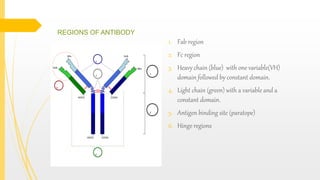
REGIONS OF ANTIBODY
1. Fab region
2. Fc region
3. Heavy chain (blue) with one variable(VH)
domain followed by constant domain.
4. Light chain (green) with a variable and a
constant domain.
5. Antigen binding site (paratope)
6. Hinge regions
GENE REARRANGEMNT
The к and λ light chains and the heavy chains are encoded by multigene families
situated on different chromosomes.
These multigene families contains several coding sequences, called gene
segments(Intons) separated by noncoding regions. During B-cell maturation, these
gene segments are rearranged and brought together to form functional
immunoglobulin genes.
The к and λ light-chain families contain V, J, and C gene segments; the rearranged VJ
segments encode the variable region of the light chains.
GENE REARRANGEMENT
The heavy-chain family contains V, D, J, and C gene
segments; the rearranged VDJ gene segments encode
the variable region of the heavy chain.
Each V gene segment is preceded at its 5ˈ end by a
short signal or leader (L) peptide that guides the heavy
or light chain through the endoplasmic reticulum.
The signal peptide is cleaved from the nascent light
and heavy chains before assembly of the finished
immunoglobulin molecule.
COMPOSITION OF LIGHT AND HEAVY
CHAIN
In humans, the lambda locus is complex, there are 31 functional Vλ gene
segments, 4 Jλsegments and 7 Cλsegments.
The kappa locus is composed of 85 Vк gene segments, 5 Jк segments and a
single Cк segment.
The heavy chain gene family has 51 VH gene segments, 27 DH gene segments
6 JH segments and a series of CH gene segments of which 5CH gene segments
are arranged sequentially.
LIGHT CHAIN REARRANGEMENT
Expression of both к and λ light chains requires rearrangement of the variable-
region V and J gene segments.
In humans, any of the functional V λ genes can combine with a functional J λ -C λ
combination, Similarly in к light-chain DNA, any Vк gene segments can be
combine with a functional Jк gene segments.
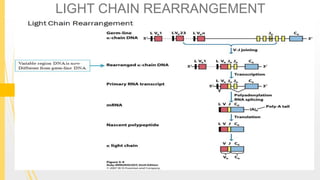
Rearranged к and λ genes contain the following regions in order from the 5ˈto 3ˈ
end: a short leader (L) exon, a noncoding sequence (intron), a joined VJ gene
segment, a second intron, and the constant region.
Upstream from each leader gene segment is a promoter sequence.
The rearranged light chain sequence is transcribed by RNA polymerase to
form a light-chain primary RNA transcript.
The introns in the primary transcript are removed by RNA processing
enzymes, and the resulting light-chain messenger RNA then exits from the
nucleus.
The light-chain mRNA binds to ribosomes and is translated into the light-
chain protein.
LIGHT CHAIN REARRANGEMENT
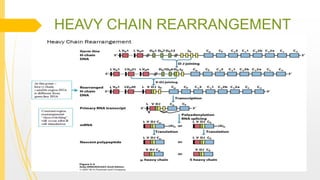
HEAVY CHAIN REARRANGEMENT
 Generation of a functional immunoglobulin heavy-chain gene requires two separate
rearrangement events within the variable region.
 A DH gene segment first joins to a JH segment; the resulting DH-JH segment then moves and joins
a VH segment to generate a VH-DH-JH unit that encodes the entire variable region.
 In heavy-chain DNA, variable-region rearrangement produces a rearranged gene consisting of
the following sequences, starting from the 5 end: a short L exon, an intron, a joined VDJ segment,
another intron, and a series of C gene segments.
 As with the light-chain genes, a promoter sequence is located a short distance upstream from
each heavy-chain leader sequence.
Once heavy-chain gene is rearranged, RNA polymerase can
bind to the promoter sequence and transcribe the entire
heavy-chain gene, including the introns.
Initially, both Cμ and Cδ gene segments are transcribed.
These two mRNAs are then translated, and the leader
peptide of the resulting nascent polypeptide is cleaved,
generating finished μ and δ chains.
HEAVY CHAIN REARRANGEMENT
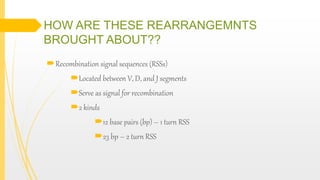
HOW ARE THESE REARRANGEMNTS
BROUGHT ABOUT??
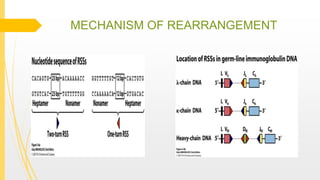
Recombination signal sequences (RSSs)
Located between V, D, and J segments
Serve as signal for recombination
2 kinds
12 base pairs (bp) – 1 turn RSS
23 bp – 2 turn RSS
MECHANISM OF REARRANGEMENT
Catalyzed by enzymes
V(D)J recombinase
Proteins mediate V-(D)-J joining
RAG-1 and RAG-2
THANK YOU

ANTIBODY STRUCTURE AD GENE REARRANGEMENTS

  • 1.
    ANTIBODY STRUCTURE AND GENEARRANGEMENTS PAUL SINGH
  • 2.
    INTRODUCTION Antibodies are immunoglobulin's,consisting of two identical heavy chains and two identical light chains, that recognizes a particular epitope on an antigen and facilitates clearance of that antigen.  Secretedby plasma cells of the immune systemagainst an antigen. Antibodies are highlyspecific for an antigen. There are five majorclasses of antibodies .(IgA, IgM, IgD, IgE, IgG)
  • 3.
    FUNCTIONS OF ANTIBODY Anantibody has several diverse roles in the immune system, primary functions include:  Neutalization: Direct inactivation of pathogen or toxin thereby preventing its interaction with human cells.  Opsonization: Antibodies promote coating of pathogens and make them more efficient for phagocytosis.  Activation of Complement: Antibodies activate complement pathway, thereby helping in more efficient phagocytosis .
  • 4.
    Basic structure isa ‘Y’ -Shaped tetrapeptide; A basic antibody exists as a monomer(IgD,IgG,IgE;) secreted antibodies can be dimeric (IgA) or pentameric (IgM). Antibodies are made up of two identical light chains and two identical heavy chains. In mammals there are two types of immunoglobulin light chain, which are lambda (λ) and kappa(к) Other type of light chains include iota( і)chain, found in sharks and body fish. STRUCTURE OF ANTIBODY
  • 5.
    HEAVY CHAIN There arefive types of mammalian Ig heavy chain, denoted by α,δ,ε,γ,μ. The type of heavy chain present defines the class of antibody; these chains are found as IgA, IgD, IgE, IgG,IgM respectively. Each heavy chain has two regions, the constant region and the variable region. The constant region is identical in all antibodies of the same isotype, but differs in antibodies of different isotypes. The variable region of each heavy chain is approximately 110 amino acids long.
  • 6.
    REGIONS OF ANTIBODY 1.Fab region 2. Fc region 3. Heavy chain (blue) with one variable(VH) domain followed by constant domain. 4. Light chain (green) with a variable and a constant domain. 5. Antigen binding site (paratope) 6. Hinge regions
  • 7.
  • 8.
    The к andλ light chains and the heavy chains are encoded by multigene families situated on different chromosomes. These multigene families contains several coding sequences, called gene segments(Intons) separated by noncoding regions. During B-cell maturation, these gene segments are rearranged and brought together to form functional immunoglobulin genes. The к and λ light-chain families contain V, J, and C gene segments; the rearranged VJ segments encode the variable region of the light chains. GENE REARRANGEMENT
  • 9.
    The heavy-chain familycontains V, D, J, and C gene segments; the rearranged VDJ gene segments encode the variable region of the heavy chain. Each V gene segment is preceded at its 5ˈ end by a short signal or leader (L) peptide that guides the heavy or light chain through the endoplasmic reticulum. The signal peptide is cleaved from the nascent light and heavy chains before assembly of the finished immunoglobulin molecule.
  • 10.
    COMPOSITION OF LIGHTAND HEAVY CHAIN In humans, the lambda locus is complex, there are 31 functional Vλ gene segments, 4 Jλsegments and 7 Cλsegments. The kappa locus is composed of 85 Vк gene segments, 5 Jк segments and a single Cк segment. The heavy chain gene family has 51 VH gene segments, 27 DH gene segments 6 JH segments and a series of CH gene segments of which 5CH gene segments are arranged sequentially.
  • 11.
    LIGHT CHAIN REARRANGEMENT Expressionof both к and λ light chains requires rearrangement of the variable- region V and J gene segments. In humans, any of the functional V λ genes can combine with a functional J λ -C λ combination, Similarly in к light-chain DNA, any Vк gene segments can be combine with a functional Jк gene segments. Rearranged к and λ genes contain the following regions in order from the 5ˈto 3ˈ end: a short leader (L) exon, a noncoding sequence (intron), a joined VJ gene segment, a second intron, and the constant region. Upstream from each leader gene segment is a promoter sequence.
  • 12.
    The rearranged lightchain sequence is transcribed by RNA polymerase to form a light-chain primary RNA transcript. The introns in the primary transcript are removed by RNA processing enzymes, and the resulting light-chain messenger RNA then exits from the nucleus. The light-chain mRNA binds to ribosomes and is translated into the light- chain protein.
  • 13.
  • 14.
    HEAVY CHAIN REARRANGEMENT Generation of a functional immunoglobulin heavy-chain gene requires two separate rearrangement events within the variable region.  A DH gene segment first joins to a JH segment; the resulting DH-JH segment then moves and joins a VH segment to generate a VH-DH-JH unit that encodes the entire variable region.  In heavy-chain DNA, variable-region rearrangement produces a rearranged gene consisting of the following sequences, starting from the 5 end: a short L exon, an intron, a joined VDJ segment, another intron, and a series of C gene segments.  As with the light-chain genes, a promoter sequence is located a short distance upstream from each heavy-chain leader sequence.
  • 15.
    Once heavy-chain geneis rearranged, RNA polymerase can bind to the promoter sequence and transcribe the entire heavy-chain gene, including the introns. Initially, both Cμ and Cδ gene segments are transcribed. These two mRNAs are then translated, and the leader peptide of the resulting nascent polypeptide is cleaved, generating finished μ and δ chains.
  • 16.
  • 17.
    HOW ARE THESEREARRANGEMNTS BROUGHT ABOUT?? Recombination signal sequences (RSSs) Located between V, D, and J segments Serve as signal for recombination 2 kinds 12 base pairs (bp) – 1 turn RSS 23 bp – 2 turn RSS
  • 18.
  • 19.
    Catalyzed by enzymes V(D)Jrecombinase Proteins mediate V-(D)-J joining RAG-1 and RAG-2
  • 20.