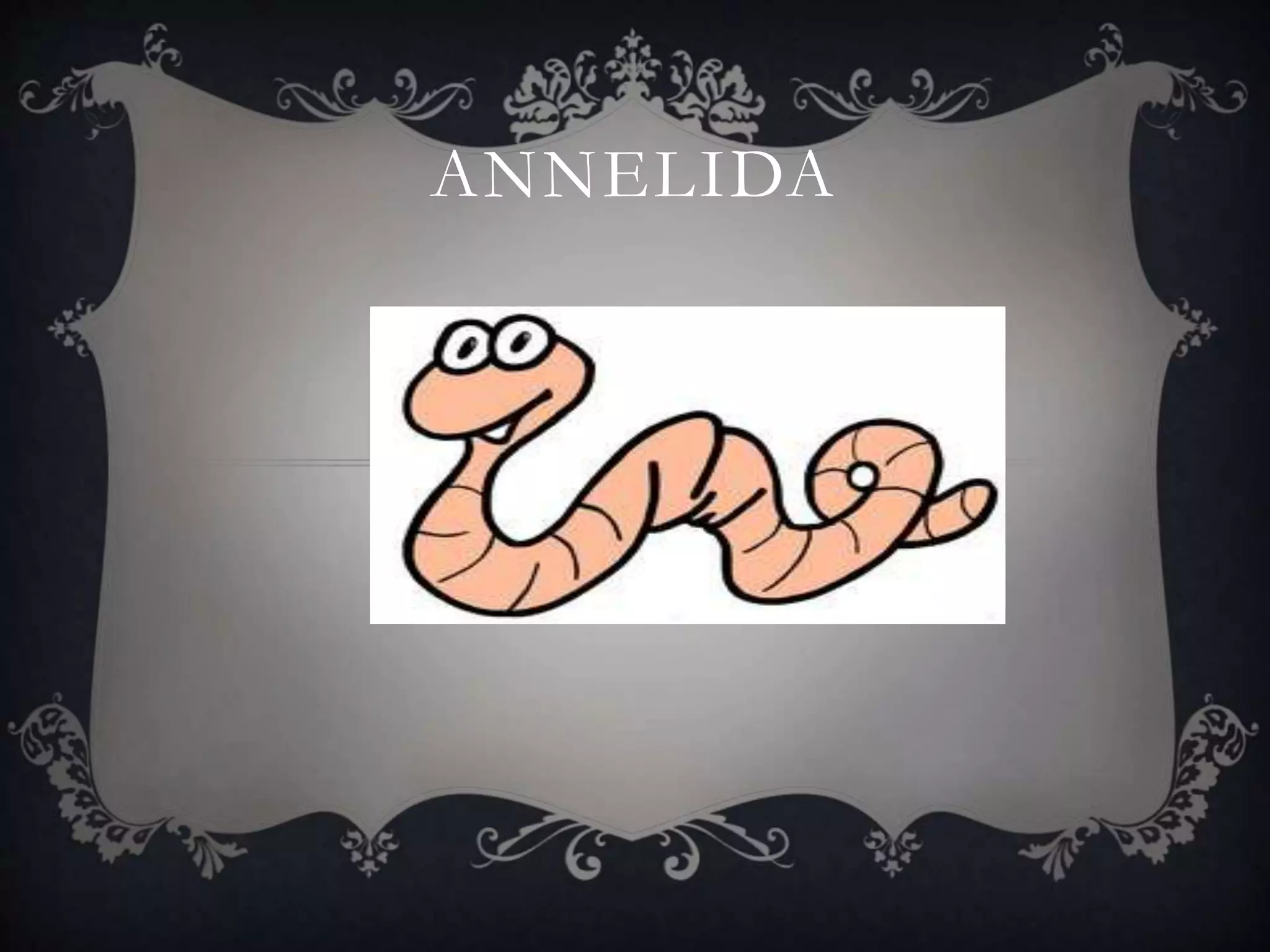
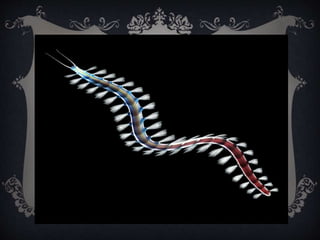
ANNELIDA
TOPICS TO BE DISCUSSED
 Introduction
 Unique characters
 General characters
 Morphology and anatomy
 Classification
 Harmful effects
 Benifits
INTRODUCTION
LINNAEUS placed all invertebrates except
insects in the taxon vermes.
LAMARCK established the taxon annelida.
He coined the term annelida from the latin word
annulus( tiny ring).
Cuvier united the annelids and the arthropods
under the taxon articulata.
UNIQUE CHARACTERS
Cephalization.
Metameric segmentation.
Schizocelom(true coelom).
Blood vascular system.
GENERAL CHARACTERS
They occur in all habitats(marine , freshwater,
terrestrial).
They are triploblastic( having three primary germ layers
i.e. Outer ectoderm, middle mesoderm and inner
endoderm).
They are bilaterally symmetrical(body can be divided
into two mirror images by the median sagittal plane).
They are schizocoelomate( true coelom) protostomes (
blastopore first develops into mouth).
They exhibit homonomous metamerism(body is divided into
linear series of similar segments , which are separated from one
another externally by intersegment groove and internally by
intersegment septa).
Body is divided into three regions-
 prostomium – false segment.
 trunk – contains segments.
 pygidium –anal segment.
Growth results from the addition of new segments from
teloblastic growth zone located just in front of the pygidium.
MORPHOLOGY AND
ANATOMY
INTEGUMENTARY SYSTEM:
 Body wall consists of cuticle , epidermis , dermis , musculature( circular and
longitudinal layers ) and a parietal peritoneum.
 Cuticle is produced by the underlying epidermis.
 Epidermis is formed of one cell thick ectodermal
Epithelial cells, they are :
Large gland cells- contains mucus and albumin secreting
cells.
Supporting cells-oval nucleus at the center and large in
number.
Basal cells-totipotent cells.
Receptor cells- these are sensory in function.
Chitinous bristles that project out from the epidermis
are called setae(s- shaped) . They provide grip on the
substratum.
COELOM
Coelom(perivisceral cavity) is a apace between alimentary canal
and body wall.
Coelom acts as a hydrostatic skeleton as it helps in locomotion.
Coelom consists of 4 types of cells:
 phagocytes-they have several membranous folds on the surface
and phagocytic in nature.
Chloragogen cells-contains yellowish granules called
chloragosomes.
Circular nucleated cells-has characteristic marking on their
surface.
Mucocytes-secrete mucus.
LOCOMOTION
 Locomotion has three stages-extension , contraction ,
and anchoring .
 Earthworms( on smooth surfaces) uses its mouth as a
sucker for locomotion.
EXCRETORY SYSTEM
o The excretory organs of earthworm are minute, coiled tube like
structure called Nephridia.
o The nephridia are ectodermal in origin.
TYPICAL NEPHRIDIA
o These are found in earthworms like Dravidia grandis.
o It consists of three parts. They are :
 Nephrostome – ciliated funnel
 Neck
 Body of Nephridia
o The body of nephridium is divide into :
 Ciliated - intracellular in origin
 Glandular- intracellular in origin
 Muscular regions – intercellular in origin
o Nephridia with nephrostomes are open nephridia.
o Nephridia without nephrostomes are closed.
o The nephridia which open out through nephridiophore are called
exonephric nephridia.
o The nephridia which open into the gut are called enteronephric
nephridia.
o Typical described above are absent in Pheretima.
o In Pheretima three types of nephridia. They are:
 Septal nephridia
 Integumentary nephridia
 Pharyngeal nephridia
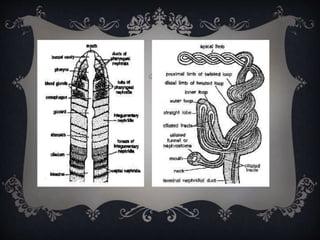
SEPTAL NEPHRIDIA
o The body of nephridium consists of short straight lobe, a long spirally
twisted loop with a narrow apical part and the terminal duct.
o Septal nephridia are open nephridia because nephrostome opens into
coelom.
o These are enteronephric nephridia because waste products are released
into lumen of intestine
INTEGUMENTARY NEPHRIDIA
o These are smallest nephridia hence called as
micronephridia(“ v” shaped structures )
o They are absent in the first two segments
o They are 200- 250 in each segment.
o These nephridia in the clitellar segments are called as forests of
nephridia.
o These are closed type because they donot have coelomic funnel.
o These are exonephric nephridia they open out independently
through the nephridiopores on the outer surface of body wall.
PHARYNGEAL NEPHRIDIA
o These nephridia occur in 4th, 5th and 6th segments lying on
either side of pharynx and oesophagus as paired bunches
o Hence they are called Tufted nephridia.
o The pair of ducts from nephridial bunches of 6th segment
opens into buccal cavity while those 4th and 5th segments
opened into pharynx.
o These are closed nephridia.
o These are enteronephric nephridia.
PHYSIOLOGY OF EXCRETION
o The chief nitrogenous waste products are Ammonia, Urea
and Creatinine.
o They are found in blood, coelomic fluid and excretory fluid.
o Eleocytes are collected by septal nephridia from coelomic
fluid.
o Urine is hypotonic to both blood and coelomic fluid.
o Nephridia play an important in osmoregulation.
o These are described as ureotelic animals.
NERVOUS SYSTEM
o Nervous system consists of two parts
 Central nervous system (CNS)
 Peripheral nervous system (PNS)
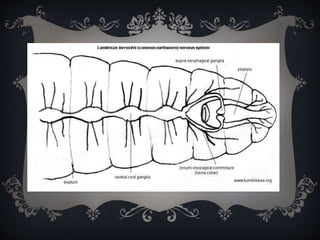
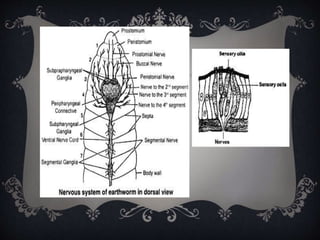
o CNS consists of brain, a pair of circum-pharyngeal connectives,
a pair of sub-pharyngeal ganglia and a double ventral ganglionated
nerve cord.
o The brain or supra-pharyngeal ganglia lies in the anterior part of
3rd segment dorsally in a groove separating buccal chamber and
pharnyx
o A pair of sub-pharyngeal ganglia lies in the 4th segment . It
is the centre of motor control
o A pair of circum-pharyngeal connectives, one on either side
of pharynx connects the brain and sub-pharyngeal ganglia.
o Thus a Nerve ring is formed around pharnyx.
o 4 giant axons are present on ventral nerve cord.
o In each segment behind the 4th segment ,there is a swelling
of nerve cord formed by a pair of segmental nephridia.
PERIPHERAL NERVOUS SYSTEM
o It includes nerves arising from the CNS and innervating
body parts.
o 8 to 10 nerves are connected to the brain on each side. they
arise from prostomium and wall of buccal chamber.
o The circum –pharyngeal connectives gives off nerves to
the body wall of 1st segment and the wall of buccal chamber.
o The sub-pharyngeal ganglia supply nerves to the different
structures in the 2nd ,3rd and 4th segments.
The paired ganglia in each segment, from 5th segment
to the last segment, give off nerves to 3 pairs of nerves.
These branches supply to the gut wall, bodywall and
internal organs of respective segment.
RECEPTORS
o The special nerve endings or cells whose function is to receive
stimuli are called Receptors.
o The different types of receptors are :
 epidermal receptors- tactile(tango receptors)
 Buccal receptors –Olfactory and Gustatory receptors.
 Photo receptors-it is a single cell containing nucleus and “ L”
shaped optic organelle (lens0 consisting of a hyaline substance.it is
called PHAEOSOME.
o Sensory hairs are absent
DIGESTIVE SYSTEM
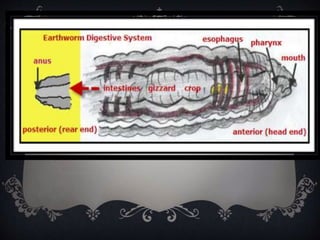
 The digestive system of annelids comprises of alimentary canal and
his associated glands.
 The alimentary canal consists of the following parts:-
 Mouth-It is present at the anterior end.
 Buccal cavity-it has a folded walls.
 Pharynx-it is pear shaped and has salivary
glands and pharyngeal gland cells which
produce mucus and proteolytic enzymes.
Esophagus-it occupies 4 segments(5th to 8th) and in the
8th segment it is modified to GIZZARD which helps in
grinding the food materials, so it is known as
GRINDING MILL.
Stomach-it is also glandular and helps in the digestion
of food by secreting proteolytic enzymes.
Intestine-it is divided in to 3 regions based on the
presence of TYPHLOSOLE.
Pre-typhlosolar region –it has intestinal caeca which
secrete amylase enzyme.
Typhlosolar region-this is the longest part of the intestine, it has
typhlosole.
Post-typhlosolar region-it is the terminal part of the intestine and
it is also called has rectum.
PROCESS OF DIGESTION
 Digestion is extracellular.
 Most of them are detrivores,some are carnivores and parasites.
 The undigested matter ejected by Earthworm is known as
WORM CASTINGS.
CIRCULATORY SYSTEM
They have closed type of blood vascular system.
In this respiratory pigment if present ,is dissolved in the
blood plasma unlike in chordates where it occurs in
certain blood corpuscles.
The common respiratory pigment is haemoglobin like
mammals.
 chlorocruorin(green) and haemoerythrin(pink or
violet)are also met in some polychaetes.
BLOOD GLANDS
These are the red coloured follicular bodies present in
the 4th,5th,and 6th segments.
These are red in colour owing to their vascular nature.
REPRODUCTIVE SYSTEM
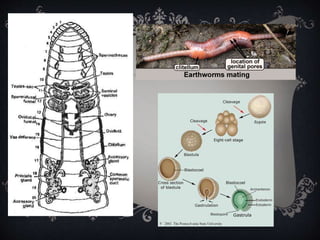
Earthworms are monoecious(bisexual and
hermaphrodites).
But cross fertilization occurs because of
relative positions of male and female genital
apertures and protandrous type of
hermaphroditism.
Male reproductive system contains
testis,testis-sacs,seminal vesicles,spermiducal
funnels, vasa deferentia,prostate
glands,accessory glands,copulatory papillae
and genital pores.
 Female reproductive system consists of a pair of ovaries, a pair
of oviducts and 4 pairs of spermatheca and female genital aperture
in 14th segment.
Cross fertilization occurs.
For the formation of cocoon a membranous girdle is formed by
the secretion of clitellar glands.
Fertilization occurs after the deposition of cocoon.
Development-cleavage is holoblastic
(complete),determinate,spiral and unequal type.
Leeches have internal fertilization.
What Are the Three Classes of
Phylum Annelida?
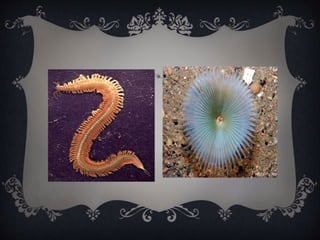
There are many classes of Phylum Annelida. One
major class is the Polychaeta, which are marine
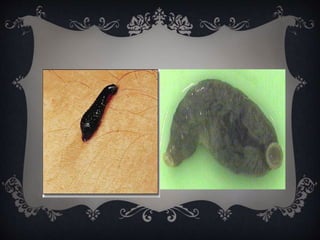
worms. Another class is Hirudinea, the class of
leeches. Another class is Oligochaeta which are
freshwater and terrestrial worms, like the
common earthworm
1. Subclass ERRANTIA
They are free swimming or crawling worms in which body
possesses numerous, identical segments and well-developed
parapodia and setae. There is a definite head, with an eversible
pharynx having jaws or teeth. The group includes swimming,
crawling, burrowing and tube-dwelling members. Ex. Nereis;
Polynoe; Aphrodite; Glycera; Eunice.
2. Subclass SEDENTARIA
They are tube dwelling worms that display a high degree
of segmental differentiation. Parapodia are reduced, with or
without modified setae. Prostomium without sensory structures
but has tentacles and palps or other feeding structures. Teeth or
jaws are generally absent. Ex. Arenicola; Terebella; Amphitrite;
Serpula.
Class OLIGOCHAETA
They are worms without a distinct head and
parapodia or suckers. There is a clitellum which
produces a cocoon during breeding season.
Pharynx is not eversible. They are hermaphrodite
and there is no larval stage. There are about
10,000 species. Locomotion is by small setae and
burrowing . Most of them are mud ingesting and
detritus feeders but few are predaceous, e.g.
Agriodrilus and Phagodrilus. There are two orders
under class Oligochaeta.
1. Order ARCHIOLIGOCHAETA
(=TUBIFICIDA)
Freshwater forms with worm-like body and setae
present in bundles. Eye spots may be present. Gizzard is
poorly developed. Generally live in muddy tubes. Ex.
Tubifex; Dero; Chaetogaster; Aelosoma; Nais; Stylaria;
Enchytraeus.
2. Order NEOLIGOCHAETA (=HAPLOTAXIDA)
Commonly known as earthworms, they are
terrestrial worms with well developed gizzard and without
eye spots. Clitellum well developed and female genital
opening on the 14th segment. Minute setae are used in
peristaltic locomotion and hydraulic skeleton is used for
Class HIRUDINEA
They are ectoparasites of vertebrates having definite
number of segments and annuli on each segment and without
parapodia. Suckers are present for attachment and locomotion.
They are hermaphrodite and deposit their eggs in cocoons.
There are 4 orders as follows:
1. Order ACANTHOBDELLIDA, Ex.
Acanthobdella. Parasitic on salmons.
2. Order RHYNCHOBDELLIDA, Ex. Pontobdella.
Aquatic leeches.
3. Order GNATHOBDELLIDA, Ex. Hirudo,
Hirudinaria. Common cattle leeches.
4. Order PHARYNGOBDELLIDA, Ex. Erpobdella.
Terrestrial predatory leeches.
Class ARCHIANNELIDA
They are primitive marine
worms, without distinct segmentation,
parapodia and setae. There are 2 or 3
tentacles on prostomium. Anus is
terminal. Larva is a typical trochophore.
Ex. Polygordius; Protodrilus, Nerilla;
Dinophilus.
HARMFUL EFFECTS
some of the members of the class
hirudinia are ectoparasites on human
beings and some animals
Some many contain harmful venom
BENIFITS
Earthworms are used as a bait for fishing.
They are also used as food for fish in aquarium.
Many animals like frogs,lizards,birds feed on the
earthworms.
In unani(treatment of diseases with the help of
animals)medicine earthworms are used to treat the
human diseases such as stones in the urinary bladderand
gout.
Earthworms are also called as FRIENDS OF
FARMERS as they continuosly make burrows in the soil
and increas the fertility.
Earthworms are also used in making manures such as
vermicompost(solid),and vermiwash (liquid)type of
manures.
Vermicompost is known to contain 60%of
nitrogen,5.04%of phosphorus,and 0.8%of proteins and
micronutrients.
Annelida
Annelida
Annelida
Annelida
Annelida

Annelida

  • 1.
  • 2.
    TOPICS TO BEDISCUSSED  Introduction  Unique characters  General characters  Morphology and anatomy  Classification  Harmful effects  Benifits
  • 3.
    INTRODUCTION LINNAEUS placed allinvertebrates except insects in the taxon vermes. LAMARCK established the taxon annelida. He coined the term annelida from the latin word annulus( tiny ring). Cuvier united the annelids and the arthropods under the taxon articulata.
  • 4.
  • 5.
    GENERAL CHARACTERS They occurin all habitats(marine , freshwater, terrestrial). They are triploblastic( having three primary germ layers i.e. Outer ectoderm, middle mesoderm and inner endoderm). They are bilaterally symmetrical(body can be divided into two mirror images by the median sagittal plane).
  • 6.
    They are schizocoelomate(true coelom) protostomes ( blastopore first develops into mouth). They exhibit homonomous metamerism(body is divided into linear series of similar segments , which are separated from one another externally by intersegment groove and internally by intersegment septa). Body is divided into three regions-  prostomium – false segment.  trunk – contains segments.  pygidium –anal segment. Growth results from the addition of new segments from teloblastic growth zone located just in front of the pygidium.
  • 7.
    MORPHOLOGY AND ANATOMY INTEGUMENTARY SYSTEM: Body wall consists of cuticle , epidermis , dermis , musculature( circular and longitudinal layers ) and a parietal peritoneum.  Cuticle is produced by the underlying epidermis.  Epidermis is formed of one cell thick ectodermal
  • 8.
    Epithelial cells, theyare : Large gland cells- contains mucus and albumin secreting cells. Supporting cells-oval nucleus at the center and large in number. Basal cells-totipotent cells. Receptor cells- these are sensory in function. Chitinous bristles that project out from the epidermis are called setae(s- shaped) . They provide grip on the substratum.
  • 9.
    COELOM Coelom(perivisceral cavity) isa apace between alimentary canal and body wall. Coelom acts as a hydrostatic skeleton as it helps in locomotion. Coelom consists of 4 types of cells:  phagocytes-they have several membranous folds on the surface and phagocytic in nature. Chloragogen cells-contains yellowish granules called chloragosomes. Circular nucleated cells-has characteristic marking on their surface. Mucocytes-secrete mucus.
  • 10.
    LOCOMOTION  Locomotion hasthree stages-extension , contraction , and anchoring .  Earthworms( on smooth surfaces) uses its mouth as a sucker for locomotion.
  • 11.
    EXCRETORY SYSTEM o Theexcretory organs of earthworm are minute, coiled tube like structure called Nephridia. o The nephridia are ectodermal in origin. TYPICAL NEPHRIDIA o These are found in earthworms like Dravidia grandis. o It consists of three parts. They are :  Nephrostome – ciliated funnel  Neck  Body of Nephridia
  • 12.
    o The bodyof nephridium is divide into :  Ciliated - intracellular in origin  Glandular- intracellular in origin  Muscular regions – intercellular in origin o Nephridia with nephrostomes are open nephridia. o Nephridia without nephrostomes are closed. o The nephridia which open out through nephridiophore are called exonephric nephridia. o The nephridia which open into the gut are called enteronephric nephridia. o Typical described above are absent in Pheretima.
  • 13.
    o In Pheretimathree types of nephridia. They are:  Septal nephridia  Integumentary nephridia  Pharyngeal nephridia SEPTAL NEPHRIDIA o The body of nephridium consists of short straight lobe, a long spirally twisted loop with a narrow apical part and the terminal duct. o Septal nephridia are open nephridia because nephrostome opens into coelom. o These are enteronephric nephridia because waste products are released into lumen of intestine
  • 14.
    INTEGUMENTARY NEPHRIDIA o Theseare smallest nephridia hence called as micronephridia(“ v” shaped structures ) o They are absent in the first two segments o They are 200- 250 in each segment. o These nephridia in the clitellar segments are called as forests of nephridia. o These are closed type because they donot have coelomic funnel. o These are exonephric nephridia they open out independently through the nephridiopores on the outer surface of body wall.
  • 15.
    PHARYNGEAL NEPHRIDIA o Thesenephridia occur in 4th, 5th and 6th segments lying on either side of pharynx and oesophagus as paired bunches o Hence they are called Tufted nephridia. o The pair of ducts from nephridial bunches of 6th segment opens into buccal cavity while those 4th and 5th segments opened into pharynx. o These are closed nephridia. o These are enteronephric nephridia.
  • 17.
    PHYSIOLOGY OF EXCRETION oThe chief nitrogenous waste products are Ammonia, Urea and Creatinine. o They are found in blood, coelomic fluid and excretory fluid. o Eleocytes are collected by septal nephridia from coelomic fluid. o Urine is hypotonic to both blood and coelomic fluid. o Nephridia play an important in osmoregulation. o These are described as ureotelic animals.
  • 18.
    NERVOUS SYSTEM o Nervoussystem consists of two parts  Central nervous system (CNS)  Peripheral nervous system (PNS) o CNS consists of brain, a pair of circum-pharyngeal connectives, a pair of sub-pharyngeal ganglia and a double ventral ganglionated nerve cord. o The brain or supra-pharyngeal ganglia lies in the anterior part of 3rd segment dorsally in a groove separating buccal chamber and pharnyx
  • 19.
    o A pairof sub-pharyngeal ganglia lies in the 4th segment . It is the centre of motor control o A pair of circum-pharyngeal connectives, one on either side of pharynx connects the brain and sub-pharyngeal ganglia. o Thus a Nerve ring is formed around pharnyx. o 4 giant axons are present on ventral nerve cord. o In each segment behind the 4th segment ,there is a swelling of nerve cord formed by a pair of segmental nephridia.
  • 20.
    PERIPHERAL NERVOUS SYSTEM oIt includes nerves arising from the CNS and innervating body parts. o 8 to 10 nerves are connected to the brain on each side. they arise from prostomium and wall of buccal chamber. o The circum –pharyngeal connectives gives off nerves to the body wall of 1st segment and the wall of buccal chamber. o The sub-pharyngeal ganglia supply nerves to the different structures in the 2nd ,3rd and 4th segments.
  • 21.
    The paired gangliain each segment, from 5th segment to the last segment, give off nerves to 3 pairs of nerves. These branches supply to the gut wall, bodywall and internal organs of respective segment.
  • 22.
    RECEPTORS o The specialnerve endings or cells whose function is to receive stimuli are called Receptors. o The different types of receptors are :  epidermal receptors- tactile(tango receptors)  Buccal receptors –Olfactory and Gustatory receptors.  Photo receptors-it is a single cell containing nucleus and “ L” shaped optic organelle (lens0 consisting of a hyaline substance.it is called PHAEOSOME. o Sensory hairs are absent
  • 25.
    DIGESTIVE SYSTEM  Thedigestive system of annelids comprises of alimentary canal and his associated glands.  The alimentary canal consists of the following parts:-  Mouth-It is present at the anterior end.  Buccal cavity-it has a folded walls.  Pharynx-it is pear shaped and has salivary glands and pharyngeal gland cells which produce mucus and proteolytic enzymes.
  • 26.
    Esophagus-it occupies 4segments(5th to 8th) and in the 8th segment it is modified to GIZZARD which helps in grinding the food materials, so it is known as GRINDING MILL. Stomach-it is also glandular and helps in the digestion of food by secreting proteolytic enzymes. Intestine-it is divided in to 3 regions based on the presence of TYPHLOSOLE. Pre-typhlosolar region –it has intestinal caeca which secrete amylase enzyme.
  • 27.
    Typhlosolar region-this isthe longest part of the intestine, it has typhlosole. Post-typhlosolar region-it is the terminal part of the intestine and it is also called has rectum. PROCESS OF DIGESTION  Digestion is extracellular.  Most of them are detrivores,some are carnivores and parasites.  The undigested matter ejected by Earthworm is known as WORM CASTINGS.
  • 29.
    CIRCULATORY SYSTEM They haveclosed type of blood vascular system. In this respiratory pigment if present ,is dissolved in the blood plasma unlike in chordates where it occurs in certain blood corpuscles. The common respiratory pigment is haemoglobin like mammals.  chlorocruorin(green) and haemoerythrin(pink or violet)are also met in some polychaetes.
  • 30.
    BLOOD GLANDS These arethe red coloured follicular bodies present in the 4th,5th,and 6th segments. These are red in colour owing to their vascular nature.
  • 31.
    REPRODUCTIVE SYSTEM Earthworms aremonoecious(bisexual and hermaphrodites). But cross fertilization occurs because of relative positions of male and female genital apertures and protandrous type of hermaphroditism. Male reproductive system contains testis,testis-sacs,seminal vesicles,spermiducal funnels, vasa deferentia,prostate glands,accessory glands,copulatory papillae and genital pores.
  • 32.
     Female reproductivesystem consists of a pair of ovaries, a pair of oviducts and 4 pairs of spermatheca and female genital aperture in 14th segment. Cross fertilization occurs. For the formation of cocoon a membranous girdle is formed by the secretion of clitellar glands. Fertilization occurs after the deposition of cocoon. Development-cleavage is holoblastic (complete),determinate,spiral and unequal type. Leeches have internal fertilization.
  • 34.
    What Are theThree Classes of Phylum Annelida? There are many classes of Phylum Annelida. One major class is the Polychaeta, which are marine worms. Another class is Hirudinea, the class of leeches. Another class is Oligochaeta which are freshwater and terrestrial worms, like the common earthworm
  • 36.
    1. Subclass ERRANTIA Theyare free swimming or crawling worms in which body possesses numerous, identical segments and well-developed parapodia and setae. There is a definite head, with an eversible pharynx having jaws or teeth. The group includes swimming, crawling, burrowing and tube-dwelling members. Ex. Nereis; Polynoe; Aphrodite; Glycera; Eunice. 2. Subclass SEDENTARIA They are tube dwelling worms that display a high degree of segmental differentiation. Parapodia are reduced, with or without modified setae. Prostomium without sensory structures but has tentacles and palps or other feeding structures. Teeth or jaws are generally absent. Ex. Arenicola; Terebella; Amphitrite; Serpula.
  • 37.
    Class OLIGOCHAETA They areworms without a distinct head and parapodia or suckers. There is a clitellum which produces a cocoon during breeding season. Pharynx is not eversible. They are hermaphrodite and there is no larval stage. There are about 10,000 species. Locomotion is by small setae and burrowing . Most of them are mud ingesting and detritus feeders but few are predaceous, e.g. Agriodrilus and Phagodrilus. There are two orders under class Oligochaeta.
  • 38.
    1. Order ARCHIOLIGOCHAETA (=TUBIFICIDA) Freshwaterforms with worm-like body and setae present in bundles. Eye spots may be present. Gizzard is poorly developed. Generally live in muddy tubes. Ex. Tubifex; Dero; Chaetogaster; Aelosoma; Nais; Stylaria; Enchytraeus. 2. Order NEOLIGOCHAETA (=HAPLOTAXIDA) Commonly known as earthworms, they are terrestrial worms with well developed gizzard and without eye spots. Clitellum well developed and female genital opening on the 14th segment. Minute setae are used in peristaltic locomotion and hydraulic skeleton is used for
  • 39.
    Class HIRUDINEA They areectoparasites of vertebrates having definite number of segments and annuli on each segment and without parapodia. Suckers are present for attachment and locomotion. They are hermaphrodite and deposit their eggs in cocoons. There are 4 orders as follows: 1. Order ACANTHOBDELLIDA, Ex. Acanthobdella. Parasitic on salmons. 2. Order RHYNCHOBDELLIDA, Ex. Pontobdella. Aquatic leeches. 3. Order GNATHOBDELLIDA, Ex. Hirudo, Hirudinaria. Common cattle leeches. 4. Order PHARYNGOBDELLIDA, Ex. Erpobdella. Terrestrial predatory leeches.
  • 40.
    Class ARCHIANNELIDA They areprimitive marine worms, without distinct segmentation, parapodia and setae. There are 2 or 3 tentacles on prostomium. Anus is terminal. Larva is a typical trochophore. Ex. Polygordius; Protodrilus, Nerilla; Dinophilus.
  • 41.
    HARMFUL EFFECTS some ofthe members of the class hirudinia are ectoparasites on human beings and some animals Some many contain harmful venom
  • 42.
    BENIFITS Earthworms are usedas a bait for fishing. They are also used as food for fish in aquarium. Many animals like frogs,lizards,birds feed on the earthworms. In unani(treatment of diseases with the help of animals)medicine earthworms are used to treat the human diseases such as stones in the urinary bladderand gout.
  • 43.
    Earthworms are alsocalled as FRIENDS OF FARMERS as they continuosly make burrows in the soil and increas the fertility. Earthworms are also used in making manures such as vermicompost(solid),and vermiwash (liquid)type of manures. Vermicompost is known to contain 60%of nitrogen,5.04%of phosphorus,and 0.8%of proteins and micronutrients.

Editor's Notes

  • #8 Compare the segmentation of taenia solium (psuedo metamerism)