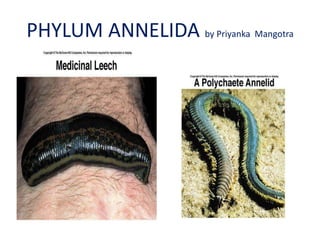
PHYLUM ANNELIDA by Priyanka Mangotra
ABOUT ANNELIDS
• Defining charac.- one or more pairs of
chitinous setae
• Complete digestive tract
• Closed circulatory system
• Ventral nervous system
• Segmented worms
For eg: earthworms, leeches, tubifex worms
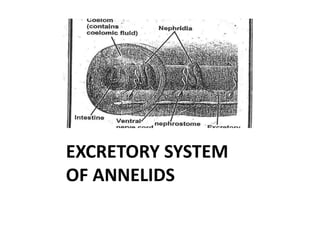
EXCRETORY SYSTEM
OF ANNELIDS
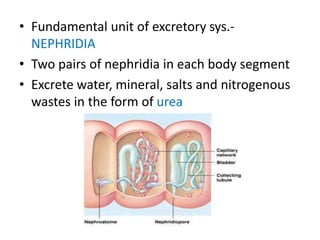
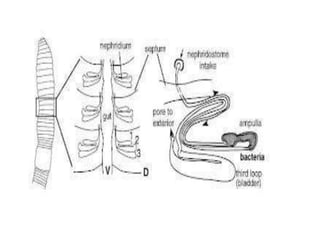
• Fundamental unit of excretory sys.NEPHRIDIA
• Two pairs of nephridia in each body segment
• Excrete water, mineral, salts and nitrogenous
wastes in the form of urea
SEGMENTAL ORGANS
• There are certain tubes called SEGMENTAL
organs, as they are repeated in successive
segments.
• Severe to convey the excretory/reproductive
products from coelom to the exterior
• They are divided into: NEPHRIDIA(derived from
ectoderm) & COELOMODUCTS(from mesoderm)
• Goodrich after careful embryological study
revealed that neph and coel were 2
morphologically diffrnt structures.
COELOMODUCTS
• Segmentally arranged wide tubes of
mesodermal origin
• Opens on one hand to the exterior by a genital
pore & on the other into the coelom by
relatively large ciliated funnel, the
COELOMOSTOME.

I.
II.
III.

FUNCTIONS OF COELOMODUCTS
Primarily as gonoducts
Secondarily as excretory organs
As reproductive funnels & ducts in
oligochaeta (earthworms)
IV. As the uriniferous tubules forming the
vertebrate kidney.
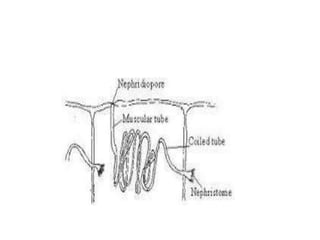
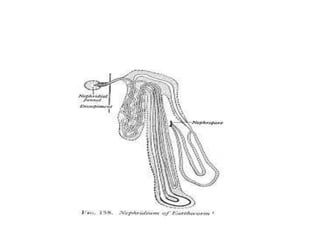
NEPHRIDIA
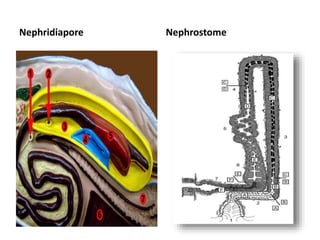
• Segmentally arranged coiled tubules of
ectodermal origin
• Ciliated internally & develped as
inpushings/invaginations from the ectoderm
so that they project into the coelom.
• Communicate on one hand with exterior
through laterally placed small apertures called
NEPHRIDIOPORES.
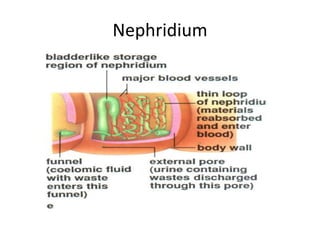
Nephridium
FUNCTIONS OF NEPHRIDIA
1. Primarily function as excretory.
2. Secondarily to convey the genital products to
the exterior
3. May as well play some role in maintaining
salt & water balance.
Nephridiapore

Nephrostome
TYPES OF NEPHRIDIA
•
•
•
•

Protonephridia(closed)
Metanephridia(opened)
Mega and micronephridia
Exo and enteronephridia
Protonephridia
• Closed type- seems to be more primitive type
• Terminates in the coelom as a blind tube
• Closed pre-septal end provided with peculiar
specialized excretory TUBE CELLS /
SOLENOCYTES.
• Found in Vanadis, Phyllodoce, Tomopteris, etc.
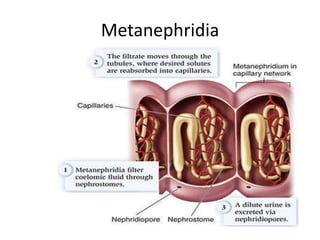
METANEPHRIDIA
• Opened type- far advanced
• Absence of solenocytes, its inner pre-septal end
opens into coelom by a ciliated funnel called
NEPHROSTOME.
• Thus open at both ends
• Exc. Wastes diffuse from coelomic fluid/ blood
into the lumen of the nephridial tubule &
discharged to the outside through
NEPHRIDIOPORE.
• Found in- polychaeta(Neanthes), oligochatea
(Lumbricus) & leeches
Metanephridia
MICRO & MEGA NEPHRIDIA
Micro/ mero nephridia
• Smaller but numerous in
each seg.
• Networks of fine tubes lying
on the body wall & septa in
each segment.
• Found in- Pheretima.

Mega/ holo nephridia
• Larger but generally one
pair per seg.
• Usually extend over two
segments & their
nephrostomes open into
the segs. Next in front.
• Found in- Polychaeta &
Hirudinea.
• Its said a pair of originally meganephridia has
broken up to form a large no. of
micronephridia.
• In Megascolex, micro & mega neph. Exist even
in same segment of worm.
• Serpula & other tubicolous worms- division of
labour exists
Anterior region- mega neph.- excretory in
function.
Posterior region- micro neph.- serve as
gonoduct.
EXO & ENTERO NEPHRIDIA
Exo/ecto nephridia
• Directly open to the exterior
• Nephridiopores present
• Such asMeganephridia of Nereis,
Hirudinaria & Lumbricus
Integumentary micronephridia
of Pheretima.

Entero nephridia
• Open into the excretory
canals / alimentary canals
• Nephridiopores absent
• Such asSeptal & pharyngeal nephridia
of Pheretima.
NEPHROMIXIA
• Compound segmental organs.
• Coelomoducts become fused partially / wholly
with nephridia to form nephromixia.
• Consist of ectoderm & mesoderm- serve for
both excretion & exit of gametes.
DEGREE OF COMBINATION
1. Protonephromixium• coelomoduct +protonephridium
• Convey both reproductive & excretory
products to the ext.
• Found in- Phyllodoce
2. Metanephromixium• Coelomoduct + metanephridium
• Found in- Hesione.
3. Mixonephridium• Coelomoduct + nephridium
• Funnel is formed by coelomoduct
• Duct formed by nephridium
• Occur in Arenicola.
4. Ciliated organs• Coelomoducts reduced to ciliated organs
• In Nereis, they are attached to the dorsolateral longitudinal muscles & known to open
externally.
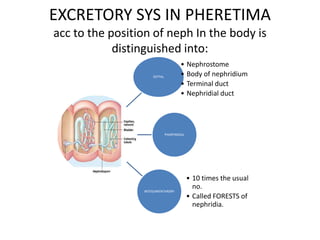
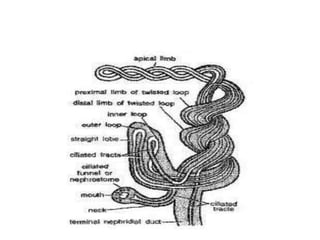
EXCRETORY SYS IN PHERETIMA
acc to the position of neph In the body is
distinguished into:
• Nephrostome
• Body of nephridium
• Terminal duct
• Nephridial duct

SEPTAL

PHARYNGEAL

INTEGUMENTARORY

• 10 times the usual
no.
• Called FORESTS of
nephridia.
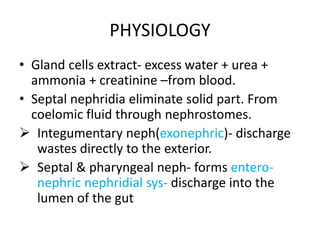
PHYSIOLOGY
• Gland cells extract- excess water + urea +
ammonia + creatinine –from blood.
• Septal nephridia eliminate solid part. From
coelomic fluid through nephrostomes.
 Integumentary neph(exonephric)- discharge
wastes directly to the exterior.
 Septal & pharyngeal neph- forms enteronephric nephridial sys- discharge into the
lumen of the gut
Special enteronephric nephridial arrangement
also serves for conservation of water / osmoregulation.
SELECTIVE RESORPTION- excretory fluid
discharged into pharynx moisten the food, as
the faeces become compacted water is
reabsorbed by intestine to be re-used by the
body. Reabsorption of salts also occurs during
fluid through the nephridia, this process is
called S.R.
Another means of excr.:
CHLORAGOGEN CELLS
• Yellow cells called chloragogen cells.
• Found in intestine & the dorsal blood vessel in
large no.
• Derived from the peritoneum/coelomic
epithelium of the alimentary canal.
• Take up nitrogenous waste products from the
blood capillaries of the gut & deposited as
yellow granules(guanin) in their cytoplasm.
• These cells are also concerned with
-deamination of proteins
-formation of ammonia
-synthesis of urea
Therefore, they are as the vital intermediary in
metabolism of earthworms as the liver in
vertebrates.
THANK YOU

Phylum annelida- excretion in annelida

  • 1.
    PHYLUM ANNELIDA byPriyanka Mangotra
  • 2.
    ABOUT ANNELIDS • Definingcharac.- one or more pairs of chitinous setae • Complete digestive tract • Closed circulatory system • Ventral nervous system • Segmented worms For eg: earthworms, leeches, tubifex worms
  • 3.
  • 4.
    • Fundamental unitof excretory sys.NEPHRIDIA • Two pairs of nephridia in each body segment • Excrete water, mineral, salts and nitrogenous wastes in the form of urea
  • 5.
    SEGMENTAL ORGANS • Thereare certain tubes called SEGMENTAL organs, as they are repeated in successive segments. • Severe to convey the excretory/reproductive products from coelom to the exterior • They are divided into: NEPHRIDIA(derived from ectoderm) & COELOMODUCTS(from mesoderm) • Goodrich after careful embryological study revealed that neph and coel were 2 morphologically diffrnt structures.
  • 6.
    COELOMODUCTS • Segmentally arrangedwide tubes of mesodermal origin • Opens on one hand to the exterior by a genital pore & on the other into the coelom by relatively large ciliated funnel, the COELOMOSTOME.
  • 7.
     I. II. III. FUNCTIONS OF COELOMODUCTS Primarilyas gonoducts Secondarily as excretory organs As reproductive funnels & ducts in oligochaeta (earthworms) IV. As the uriniferous tubules forming the vertebrate kidney.
  • 8.
    NEPHRIDIA • Segmentally arrangedcoiled tubules of ectodermal origin • Ciliated internally & develped as inpushings/invaginations from the ectoderm so that they project into the coelom. • Communicate on one hand with exterior through laterally placed small apertures called NEPHRIDIOPORES.
  • 10.
  • 12.
    FUNCTIONS OF NEPHRIDIA 1.Primarily function as excretory. 2. Secondarily to convey the genital products to the exterior 3. May as well play some role in maintaining salt & water balance.
  • 13.
  • 14.
  • 15.
    Protonephridia • Closed type-seems to be more primitive type • Terminates in the coelom as a blind tube • Closed pre-septal end provided with peculiar specialized excretory TUBE CELLS / SOLENOCYTES. • Found in Vanadis, Phyllodoce, Tomopteris, etc.
  • 16.
    METANEPHRIDIA • Opened type-far advanced • Absence of solenocytes, its inner pre-septal end opens into coelom by a ciliated funnel called NEPHROSTOME. • Thus open at both ends • Exc. Wastes diffuse from coelomic fluid/ blood into the lumen of the nephridial tubule & discharged to the outside through NEPHRIDIOPORE. • Found in- polychaeta(Neanthes), oligochatea (Lumbricus) & leeches
  • 17.
  • 18.
    MICRO & MEGANEPHRIDIA Micro/ mero nephridia • Smaller but numerous in each seg. • Networks of fine tubes lying on the body wall & septa in each segment. • Found in- Pheretima. Mega/ holo nephridia • Larger but generally one pair per seg. • Usually extend over two segments & their nephrostomes open into the segs. Next in front. • Found in- Polychaeta & Hirudinea.
  • 19.
    • Its saida pair of originally meganephridia has broken up to form a large no. of micronephridia. • In Megascolex, micro & mega neph. Exist even in same segment of worm. • Serpula & other tubicolous worms- division of labour exists Anterior region- mega neph.- excretory in function. Posterior region- micro neph.- serve as gonoduct.
  • 20.
    EXO & ENTERONEPHRIDIA Exo/ecto nephridia • Directly open to the exterior • Nephridiopores present • Such asMeganephridia of Nereis, Hirudinaria & Lumbricus Integumentary micronephridia of Pheretima. Entero nephridia • Open into the excretory canals / alimentary canals • Nephridiopores absent • Such asSeptal & pharyngeal nephridia of Pheretima.
  • 21.
    NEPHROMIXIA • Compound segmentalorgans. • Coelomoducts become fused partially / wholly with nephridia to form nephromixia. • Consist of ectoderm & mesoderm- serve for both excretion & exit of gametes.
  • 22.
    DEGREE OF COMBINATION 1.Protonephromixium• coelomoduct +protonephridium • Convey both reproductive & excretory products to the ext. • Found in- Phyllodoce
  • 23.
    2. Metanephromixium• Coelomoduct+ metanephridium • Found in- Hesione. 3. Mixonephridium• Coelomoduct + nephridium • Funnel is formed by coelomoduct • Duct formed by nephridium • Occur in Arenicola.
  • 24.
    4. Ciliated organs•Coelomoducts reduced to ciliated organs • In Nereis, they are attached to the dorsolateral longitudinal muscles & known to open externally.
  • 25.
    EXCRETORY SYS INPHERETIMA acc to the position of neph In the body is distinguished into: • Nephrostome • Body of nephridium • Terminal duct • Nephridial duct SEPTAL PHARYNGEAL INTEGUMENTARORY • 10 times the usual no. • Called FORESTS of nephridia.
  • 28.
    PHYSIOLOGY • Gland cellsextract- excess water + urea + ammonia + creatinine –from blood. • Septal nephridia eliminate solid part. From coelomic fluid through nephrostomes.  Integumentary neph(exonephric)- discharge wastes directly to the exterior.  Septal & pharyngeal neph- forms enteronephric nephridial sys- discharge into the lumen of the gut
  • 29.
    Special enteronephric nephridialarrangement also serves for conservation of water / osmoregulation. SELECTIVE RESORPTION- excretory fluid discharged into pharynx moisten the food, as the faeces become compacted water is reabsorbed by intestine to be re-used by the body. Reabsorption of salts also occurs during fluid through the nephridia, this process is called S.R.
  • 30.
    Another means ofexcr.: CHLORAGOGEN CELLS • Yellow cells called chloragogen cells. • Found in intestine & the dorsal blood vessel in large no. • Derived from the peritoneum/coelomic epithelium of the alimentary canal. • Take up nitrogenous waste products from the blood capillaries of the gut & deposited as yellow granules(guanin) in their cytoplasm.
  • 31.
    • These cellsare also concerned with -deamination of proteins -formation of ammonia -synthesis of urea Therefore, they are as the vital intermediary in metabolism of earthworms as the liver in vertebrates.
  • 32.