INVERTEBRATES (Zool-02506)
3(2-1)
Presented by: Nabeel Tahir
M.Phil. Zoology
Class: ADP 5 Semester
Annelida
The Metameric Body Form
General Characteristics
Characteristics of the phylum Annelida include:
• Body metameric, bilaterally symmetrical, and wormlike
• Protostome characteristics include spiral cleavage, trochophore larvae
(when larvae are present), and schizocoelous coelom formation
• Paired, epidermal setae
• Closed circulatory system
• Dorsal suprapharyngeal ganglia and ventral nerve cord(s) with ganglia
• Metanephridia (usually) or protonephridia
Relationships to Other Animals
• Analid are Protostomes.
• This diverse phylum originated at least as early as Precambrian times, more
than six hundred million years ago.
• Unfortunately, little evidence documents the evolutionary pathways that
resulted in the first annelids.
• A number of hypotheses account for annelid origins on the basis of coelom
1. If a schizocoelous origin of the coelom is correct, as many zoologists
believe, then the annelids evolved from ancient flatworm stock.
2. if an enterocoelous coelom origin is correct, then annelids evolved from
ancient diploblastic animals, and the triploblastic, acoelomate body may
have been derived from a triploblastic, coelomate ancestor.
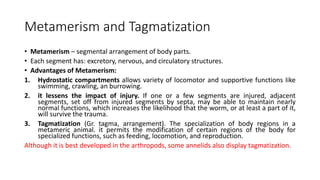
Metamerism and Tagmatization
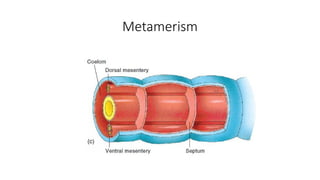
• Metamerism – segmental arrangement of body parts.
• Each segment has: excretory, nervous, and circulatory structures.
• Advantages of Metamerism:
1. Hydrostatic compartments allows variety of locomotor and supportive functions Iike
swimming, crawling, an burrowing.
2. it lessens the impact of injury. If one or a few segments are injured, adjacent
segments, set off from injured segments by septa, may be able to maintain nearly
normal functions, which increases the likelihood that the worm, or at least a part of it,
will survive the trauma.
3. Tagmatization (Gr. tagma, arrangement). The specialization of body regions in a
metameric animal. it permits the modification of certain regions of the body for
specialized functions, such as feeding, locomotion, and reproduction.
Although it is best developed in the arthropods, some annelids also display tagmatization.
Metamerism
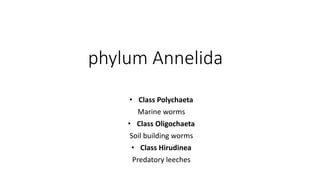
phylum Annelida
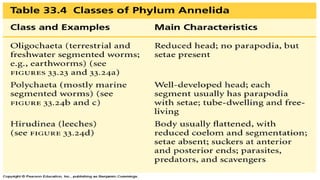
• Class Polychaeta
Marine worms
• Class Oligochaeta
Soil building worms
• Class Hirudinea
Predatory leeches
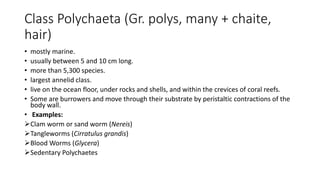
Class Polychaeta (Gr. polys, many + chaite,
hair)
• mostly marine.
• usually between 5 and 10 cm long.
• more than 5,300 species.
• largest annelid class.
• live on the ocean floor, under rocks and shells, and within the crevices of coral reefs.
• Some are burrowers and move through their substrate by peristaltic contractions of the
body wall.
• Examples:
Clam worm or sand worm (Nereis)
Tangleworms (Cirratulus grandis)
Blood Worms (Glycera)
Sedentary Polychaetes
External Structure and Locomotion
• Parapodia (Gr. para, beside + podion, little foot): lateral extensions supported by chitin
and numerous setae project from the parapodia
• Setae (L. saeta, bristle): are bristles secreted from invaginations of the distal ends of
parapodia. They aid locomotion by digging into the substrate and also hold a worm in its
burrow or tube.
• Prostomium (Gr. pro, before + stoma, mouth): is a lobe that projects dorsally and
anteriorly to the mouth and contains numerous sensory structures, including eyes,
antennae, palps.
• Nuchal organs: ciliated pits or grooves which are chemoreceptors for food detection .
• Peristomium (Gr. peri, around): The first body segment, that surrounds the mouth and
bears sensory tentacles or cirri.
• Cuticle: The epidermis of polychaetes consists of a single layer of columnar cells that
secrete a protective, nonliving cuticle.
• Some polychaetes have epidermal glands that secrete luminescent compounds.
External Structure of Polychaeta
Locomotion
In Water:
• When longitudinal muscles on one side of a segment contract, the
parapodial muscles on that side also contract, stiffening the parapodium
and protruding the setae for the power stroke.
• As a polychaete changes from a slow crawl to swimming, the period and
amplitude of undulatory waves increase.
In Soil:
• Burrowing polychaetes push their way through sand and mud by
contractions of the body wall or by eating their way through the substrate.
• In the latter, polychaetes digest organic matter in the substrate and
eliminate absorbed and undigestible materials via the anus.
Feeding and the Digestive System
• The digestive tract of polychaetes is a straight tube.
• Pharynx: when everted forms the proboscis;
• Crop: a storage sac
• Gizzard: grinding
• Intestine: long and straight.
• Organic matter is digested extracellularly, and the inorganic particles are passed through
the intestine and released as “castings.”
• Polychaeta can be:
-Predatory-usually burrow or live in coral crevices; some can have poison glands.
-Herbivores
-Scavangers
-Filter feeders- tube dwelling inhabit substrates rich in dissolved organic matter can absorb
as much as 20 to 40% of their energy requirements across their body wall as sugars and
other organic compounds.
Gas Exchange and Circulation
• Respiratory gases diffuse across body wall and parapodia (increase
surface area)
• Closed circulatory system
• Oxygen is carried by molecules called respiratory pigments- blood
colorless, green or red
• Dorsal aorta: lies just above the digestive tract and propels blood
from rear to front.
• Ventral aorta: lies ventral to the digestive tract and propels blood
from front to rear.
• Capillaries: Running between dorsal and ventral vessels.
Nervous and sensory functions
• Nervous systems are similar in all three classes of annelids.
• A pair of Suprapharyngeal ganglia controls motor and sensory functions like
feeding and forword motion.
connect to
• A pair of Subpharyngeal ganglia help mediate locomotor functions requiring
coordination of distant segments.
by
• Circumpharyngeal connectives that run dorsoventrally along either side of the
pharynx.
• Ventral nerve cord: with paired segmental ganglia in each segments; allows
escape response of segments.
• Segmental ganglia: coordinate swimming and crawling movements in isolated
segments
• 2-4 paires of eyes.
Excretion
• Excrete ammonia.
• Most of the excretory organs in annelids are active in regulating
water and ion balances.
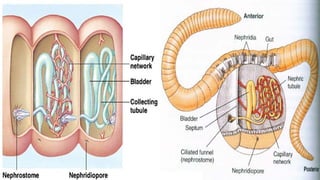
• Nephridia - excretory organs in annelids.
Two types of Nephridia
Protonephridia- tubule with a closed bulb at one end and a
connection to the outside of the body at the other end.
Metanephridia- open ciliated funnel (nephrostome) that projects
through an anterior septum into the coelom of an adjacent segment
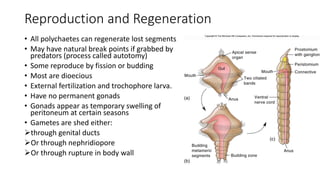
Reproduction and Regeneration
• All polychaetes can regenerate lost segments
• May have natural break points if grabbed by
predators (process called autotomy)
• Some reproduce by fission or budding
• Most are dioecious
• External fertilization and trochophore larva.
• Have no permanent gonads
• Gonads appear as temporary swelling of
peritoneum at certain seasons
• Gametes are shed either:
through genital ducts
Or through nephridiopore
Or through rupture in body wall
• Some polychaetes live most of the year
as sexually immature individuals =
atokes
• After living 1 or 2 years as benthic
organisms they become sexually
mature and swollen with gametes=
epitokes
• Head shrinks, body enlarges, gonads
develop and produce egg or sperm.
• Sometimes only part of the body makes
the transformation, breaks off and the
rest of the worm lives to repeat next
season.
E.g. palolo worm
• Males and females gather by the millions in one spot at night determined by phases
of the moon.
• Female releases pheromone. Pheromone excites male to circle about female.
• Swarms of epitokes appear at start of moon's last quarter in oct or nov.
• Sea is literally thick with epitokes.
• Just before sun rises, epitokes burst to release gametes.
• Anterior portion of worm returns to burrows.
Synchronous mating
• Ensure most eggs are fertilized,
• Predator saturation.
• Predators have a field day; but too many prey so some are always left to reproduce.
• Atokes safely in their burrows to repeat next year.
• A Samoan holiday to feast on epitokes.
Class Oligochaeta
• 3,000 species of earthworms
• Freshwater and terrestrial species
found throughout the world (some
are marine).
• Aquatic species: live in shallow
water, where they burrow in mud
and debris.
• Terrestrial species: live in soils with
high organic content and rarely
leave their burrows.
• eg. Aquatic "Earthworms“, Red
worm (tubifex), giant Palouse
earthworm
External structure
• Few, small setae
• Lack parapodia: get in the way because of burrowing
• The prostomium: consists of a small lobe or cone in front of the
mouth and lacks sensory appendages
• Clitellum: Girdlelike structure secretes mucus during copulation and
cocoon formation
• Cuticle: nonliving, covers the body.
Locomotion
• Have both circular and longitudinal
muscles.
• Move by antagonistic contractions of
these muscles.
• Bulging and elongating body
segments in waves cause the worm
to move forward.
• Small setae help anchor the worm.
• Small conical prostomium acts like a
wedge while burrowing, and soil is
swallowed (important for
decomposition).
Feeding and Digestive System
• Scavengers-fallen and decaying vegetation
• Mouth->muscular pharynx->esophagus
• Esophagus expanded form of stomach,
• Crop ( thin-walled storage structure),
• Gizzard (muscular grinding structure).
• Calciferous glands- evaginations of esophagus wall that rids the body
of excess calcium absorbed by food; regulates pH.
• Intestine- principle site of digestion and absorption
• Anus
Gas exchange:
• Diffusion across body wall.
Circulation:
• Closed circulatory system .
• Blood with respiratory pigments.
• Dorsal aorta and ventral aorta are contractile, main propulsive structures.
• Segmental vessels and capillaries serve intestine and body wall.
• Some segmental vessels contractile and propel blood between dorsal and ventral blood
vessels. E.g: Earthworm “hearts”.
Nervous functions:
• Similar to polychaetes
• Fusion of double ventral nerve cords
Sensory functions:
• Lack well-developed eyes
• Dermal light sense
• Negative phototaxis
• Well developed chemoreceptors and mechanical receptors.
Excretion:
• Metanephridia.
• Excretion.
• Water and ion regulation.
Chloragogen tissue: surrounds the dorsal blood vessel and lies over the dorsal surface of the intestine.
• Liverlike functions.
• Amino acid metabolism.
• Glycogen and fat synthesis from excess carbohydrates.
Reproduction and development:
• Monoecious.
• Mutual sperm exchange between copulating individuals ( can last 2-3 hours).
• Seminal vesicles store sperm prior to copulation.
• Seminal receptacles receive sperm during copulation.
• The cocoon of mucous and chitinous materials is formed by clitellum.
• Eggs, sperms and food (albumen) deposited cocoon where fertilization occurs and the cocoon is
deposited in moist soil.
• Spiral cleavage and direct development ( no larva).
• Freshwater oligochaetes can reproduce asexually which is usually followed by the regeneration of
missing segments.
Class Hirudinea
• 500 species of leeches
• Mostly freshwater but some are marine and terrestrial.
• Prey on small invertebrates or feed on body fluids of vertebrates
External structure
• Lack parapodia and head appendages.
• Setae are absent. Only on anterior segments in a few species,
• Leeches are dorsoventrally flattened and taper anteriorly.
• Anterior and posterior segments are usually modified into suckers
• They have 34 segments, but the segments are difficult to distinguish
externally because they have become secondarily divided.
• Several secondary divisions, called annuli, are in each true segment.
Locomotion
• Have lost metameric partitioning ,
resulting in single body cavity
• Coelomic sinuses replace blood
vessels in most leeches
• Move in looping motion or swim with
undulations
• Complex musculature (four types of
muscles)
• Oblique muscles is between the
circular and longitudinal muscle
layers
• Dorsoventral muscles are responsible
for the typical leech flattening.
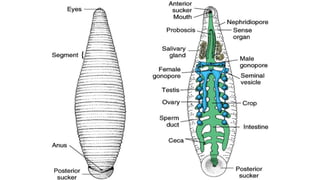
Feeding and the digestive system
• Feed on body fluids, blood of vertebrates or entire bodies of invertebrates.
• Ectoparasites.
• The mouth of a leech opens in the middle of the anterior sucker.
• The mouth is armed with three chitinous jaws or anterior digestive tract
modified into a protrusible proboscis.
• During feeding, a leech attaches to its prey by the anterior sucker and
either extends its proboscis into the prey or uses its jaws to slice through
host tissues.
• Salivary glands secrete an anticoagulant called hirudin that prevents blood
from clotting.
• Pharynx pumps blood and other body fluids into the leech.
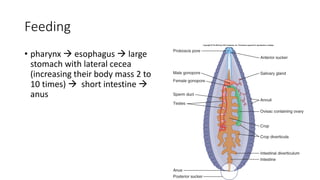
Feeding
• pharynx  esophagus  large
stomach with lateral cecea
(increasing their body mass 2 to
10 times)  short intestine 
anus
Gas exchange:
• Gas exchange by diffusion through body wall.
Circulation:
• Similar to oligochaetes.
• Coelomic sinuses replace vessels.
• Coelomic fluid takes over function of blood.
• Respiratory pigments lacking in most.
Nervous and sensory functions:
• Similar to other annelids.
• Ventral nerve cords unfused.
• Pigment cup photoreceptors.
• Negatively phototactic.
• Temperature sense in mammalian predatory leeches.
Excretion:
• 10 to 17 pairs of metanephridia.
• One pair of metanephridia per segment.
• Chloragogen tissue throughout body cavity.
Reproduction and Development:
• Monoecious.
• Sexual reproduction only.
• Clitellum present during spring breeding.
• Copulation as in oligochaetes.
INVERTEBRATES  Annelida.pdf

INVERTEBRATES Annelida.pdf

  • 1.
    INVERTEBRATES (Zool-02506) 3(2-1) Presented by:Nabeel Tahir M.Phil. Zoology Class: ADP 5 Semester
  • 2.
  • 3.
    General Characteristics Characteristics ofthe phylum Annelida include: • Body metameric, bilaterally symmetrical, and wormlike • Protostome characteristics include spiral cleavage, trochophore larvae (when larvae are present), and schizocoelous coelom formation • Paired, epidermal setae • Closed circulatory system • Dorsal suprapharyngeal ganglia and ventral nerve cord(s) with ganglia • Metanephridia (usually) or protonephridia
  • 4.
    Relationships to OtherAnimals • Analid are Protostomes. • This diverse phylum originated at least as early as Precambrian times, more than six hundred million years ago. • Unfortunately, little evidence documents the evolutionary pathways that resulted in the first annelids. • A number of hypotheses account for annelid origins on the basis of coelom 1. If a schizocoelous origin of the coelom is correct, as many zoologists believe, then the annelids evolved from ancient flatworm stock. 2. if an enterocoelous coelom origin is correct, then annelids evolved from ancient diploblastic animals, and the triploblastic, acoelomate body may have been derived from a triploblastic, coelomate ancestor.
  • 5.
    Metamerism and Tagmatization •Metamerism – segmental arrangement of body parts. • Each segment has: excretory, nervous, and circulatory structures. • Advantages of Metamerism: 1. Hydrostatic compartments allows variety of locomotor and supportive functions Iike swimming, crawling, an burrowing. 2. it lessens the impact of injury. If one or a few segments are injured, adjacent segments, set off from injured segments by septa, may be able to maintain nearly normal functions, which increases the likelihood that the worm, or at least a part of it, will survive the trauma. 3. Tagmatization (Gr. tagma, arrangement). The specialization of body regions in a metameric animal. it permits the modification of certain regions of the body for specialized functions, such as feeding, locomotion, and reproduction. Although it is best developed in the arthropods, some annelids also display tagmatization.
  • 6.
  • 8.
    phylum Annelida • ClassPolychaeta Marine worms • Class Oligochaeta Soil building worms • Class Hirudinea Predatory leeches
  • 9.
    Class Polychaeta (Gr.polys, many + chaite, hair) • mostly marine. • usually between 5 and 10 cm long. • more than 5,300 species. • largest annelid class. • live on the ocean floor, under rocks and shells, and within the crevices of coral reefs. • Some are burrowers and move through their substrate by peristaltic contractions of the body wall. • Examples: Clam worm or sand worm (Nereis) Tangleworms (Cirratulus grandis) Blood Worms (Glycera) Sedentary Polychaetes
  • 10.
    External Structure andLocomotion • Parapodia (Gr. para, beside + podion, little foot): lateral extensions supported by chitin and numerous setae project from the parapodia • Setae (L. saeta, bristle): are bristles secreted from invaginations of the distal ends of parapodia. They aid locomotion by digging into the substrate and also hold a worm in its burrow or tube. • Prostomium (Gr. pro, before + stoma, mouth): is a lobe that projects dorsally and anteriorly to the mouth and contains numerous sensory structures, including eyes, antennae, palps. • Nuchal organs: ciliated pits or grooves which are chemoreceptors for food detection . • Peristomium (Gr. peri, around): The first body segment, that surrounds the mouth and bears sensory tentacles or cirri. • Cuticle: The epidermis of polychaetes consists of a single layer of columnar cells that secrete a protective, nonliving cuticle. • Some polychaetes have epidermal glands that secrete luminescent compounds.
  • 11.
  • 12.
    Locomotion In Water: • Whenlongitudinal muscles on one side of a segment contract, the parapodial muscles on that side also contract, stiffening the parapodium and protruding the setae for the power stroke. • As a polychaete changes from a slow crawl to swimming, the period and amplitude of undulatory waves increase. In Soil: • Burrowing polychaetes push their way through sand and mud by contractions of the body wall or by eating their way through the substrate. • In the latter, polychaetes digest organic matter in the substrate and eliminate absorbed and undigestible materials via the anus.
  • 14.
    Feeding and theDigestive System • The digestive tract of polychaetes is a straight tube. • Pharynx: when everted forms the proboscis; • Crop: a storage sac • Gizzard: grinding • Intestine: long and straight. • Organic matter is digested extracellularly, and the inorganic particles are passed through the intestine and released as “castings.” • Polychaeta can be: -Predatory-usually burrow or live in coral crevices; some can have poison glands. -Herbivores -Scavangers -Filter feeders- tube dwelling inhabit substrates rich in dissolved organic matter can absorb as much as 20 to 40% of their energy requirements across their body wall as sugars and other organic compounds.
  • 15.
    Gas Exchange andCirculation • Respiratory gases diffuse across body wall and parapodia (increase surface area) • Closed circulatory system • Oxygen is carried by molecules called respiratory pigments- blood colorless, green or red • Dorsal aorta: lies just above the digestive tract and propels blood from rear to front. • Ventral aorta: lies ventral to the digestive tract and propels blood from front to rear. • Capillaries: Running between dorsal and ventral vessels.
  • 17.
    Nervous and sensoryfunctions • Nervous systems are similar in all three classes of annelids. • A pair of Suprapharyngeal ganglia controls motor and sensory functions like feeding and forword motion. connect to • A pair of Subpharyngeal ganglia help mediate locomotor functions requiring coordination of distant segments. by • Circumpharyngeal connectives that run dorsoventrally along either side of the pharynx. • Ventral nerve cord: with paired segmental ganglia in each segments; allows escape response of segments. • Segmental ganglia: coordinate swimming and crawling movements in isolated segments • 2-4 paires of eyes.
  • 19.
    Excretion • Excrete ammonia. •Most of the excretory organs in annelids are active in regulating water and ion balances. • Nephridia - excretory organs in annelids. Two types of Nephridia Protonephridia- tubule with a closed bulb at one end and a connection to the outside of the body at the other end. Metanephridia- open ciliated funnel (nephrostome) that projects through an anterior septum into the coelom of an adjacent segment
  • 21.
    Reproduction and Regeneration •All polychaetes can regenerate lost segments • May have natural break points if grabbed by predators (process called autotomy) • Some reproduce by fission or budding • Most are dioecious • External fertilization and trochophore larva. • Have no permanent gonads • Gonads appear as temporary swelling of peritoneum at certain seasons • Gametes are shed either: through genital ducts Or through nephridiopore Or through rupture in body wall
  • 22.
    • Some polychaeteslive most of the year as sexually immature individuals = atokes • After living 1 or 2 years as benthic organisms they become sexually mature and swollen with gametes= epitokes • Head shrinks, body enlarges, gonads develop and produce egg or sperm. • Sometimes only part of the body makes the transformation, breaks off and the rest of the worm lives to repeat next season.
  • 23.
    E.g. palolo worm •Males and females gather by the millions in one spot at night determined by phases of the moon. • Female releases pheromone. Pheromone excites male to circle about female. • Swarms of epitokes appear at start of moon's last quarter in oct or nov. • Sea is literally thick with epitokes. • Just before sun rises, epitokes burst to release gametes. • Anterior portion of worm returns to burrows. Synchronous mating • Ensure most eggs are fertilized, • Predator saturation. • Predators have a field day; but too many prey so some are always left to reproduce. • Atokes safely in their burrows to repeat next year. • A Samoan holiday to feast on epitokes.
  • 25.
    Class Oligochaeta • 3,000species of earthworms • Freshwater and terrestrial species found throughout the world (some are marine). • Aquatic species: live in shallow water, where they burrow in mud and debris. • Terrestrial species: live in soils with high organic content and rarely leave their burrows. • eg. Aquatic "Earthworms“, Red worm (tubifex), giant Palouse earthworm
  • 26.
    External structure • Few,small setae • Lack parapodia: get in the way because of burrowing • The prostomium: consists of a small lobe or cone in front of the mouth and lacks sensory appendages • Clitellum: Girdlelike structure secretes mucus during copulation and cocoon formation • Cuticle: nonliving, covers the body.
  • 27.
    Locomotion • Have bothcircular and longitudinal muscles. • Move by antagonistic contractions of these muscles. • Bulging and elongating body segments in waves cause the worm to move forward. • Small setae help anchor the worm. • Small conical prostomium acts like a wedge while burrowing, and soil is swallowed (important for decomposition).
  • 28.
    Feeding and DigestiveSystem • Scavengers-fallen and decaying vegetation • Mouth->muscular pharynx->esophagus • Esophagus expanded form of stomach, • Crop ( thin-walled storage structure), • Gizzard (muscular grinding structure). • Calciferous glands- evaginations of esophagus wall that rids the body of excess calcium absorbed by food; regulates pH. • Intestine- principle site of digestion and absorption • Anus
  • 30.
    Gas exchange: • Diffusionacross body wall. Circulation: • Closed circulatory system . • Blood with respiratory pigments. • Dorsal aorta and ventral aorta are contractile, main propulsive structures. • Segmental vessels and capillaries serve intestine and body wall. • Some segmental vessels contractile and propel blood between dorsal and ventral blood vessels. E.g: Earthworm “hearts”. Nervous functions: • Similar to polychaetes • Fusion of double ventral nerve cords Sensory functions: • Lack well-developed eyes • Dermal light sense • Negative phototaxis • Well developed chemoreceptors and mechanical receptors.
  • 31.
    Excretion: • Metanephridia. • Excretion. •Water and ion regulation. Chloragogen tissue: surrounds the dorsal blood vessel and lies over the dorsal surface of the intestine. • Liverlike functions. • Amino acid metabolism. • Glycogen and fat synthesis from excess carbohydrates. Reproduction and development: • Monoecious. • Mutual sperm exchange between copulating individuals ( can last 2-3 hours). • Seminal vesicles store sperm prior to copulation. • Seminal receptacles receive sperm during copulation. • The cocoon of mucous and chitinous materials is formed by clitellum. • Eggs, sperms and food (albumen) deposited cocoon where fertilization occurs and the cocoon is deposited in moist soil. • Spiral cleavage and direct development ( no larva). • Freshwater oligochaetes can reproduce asexually which is usually followed by the regeneration of missing segments.
  • 33.
    Class Hirudinea • 500species of leeches • Mostly freshwater but some are marine and terrestrial. • Prey on small invertebrates or feed on body fluids of vertebrates
  • 34.
    External structure • Lackparapodia and head appendages. • Setae are absent. Only on anterior segments in a few species, • Leeches are dorsoventrally flattened and taper anteriorly. • Anterior and posterior segments are usually modified into suckers • They have 34 segments, but the segments are difficult to distinguish externally because they have become secondarily divided. • Several secondary divisions, called annuli, are in each true segment.
  • 35.
    Locomotion • Have lostmetameric partitioning , resulting in single body cavity • Coelomic sinuses replace blood vessels in most leeches • Move in looping motion or swim with undulations • Complex musculature (four types of muscles) • Oblique muscles is between the circular and longitudinal muscle layers • Dorsoventral muscles are responsible for the typical leech flattening.
  • 36.
    Feeding and thedigestive system • Feed on body fluids, blood of vertebrates or entire bodies of invertebrates. • Ectoparasites. • The mouth of a leech opens in the middle of the anterior sucker. • The mouth is armed with three chitinous jaws or anterior digestive tract modified into a protrusible proboscis. • During feeding, a leech attaches to its prey by the anterior sucker and either extends its proboscis into the prey or uses its jaws to slice through host tissues. • Salivary glands secrete an anticoagulant called hirudin that prevents blood from clotting. • Pharynx pumps blood and other body fluids into the leech.
  • 38.
    Feeding • pharynx esophagus  large stomach with lateral cecea (increasing their body mass 2 to 10 times)  short intestine  anus
  • 39.
    Gas exchange: • Gasexchange by diffusion through body wall. Circulation: • Similar to oligochaetes. • Coelomic sinuses replace vessels. • Coelomic fluid takes over function of blood. • Respiratory pigments lacking in most. Nervous and sensory functions: • Similar to other annelids. • Ventral nerve cords unfused. • Pigment cup photoreceptors. • Negatively phototactic. • Temperature sense in mammalian predatory leeches.
  • 40.
    Excretion: • 10 to17 pairs of metanephridia. • One pair of metanephridia per segment. • Chloragogen tissue throughout body cavity. Reproduction and Development: • Monoecious. • Sexual reproduction only. • Clitellum present during spring breeding. • Copulation as in oligochaetes.