Shri Shankaracharya Mahavidyalaya, Junwani , Bhilai
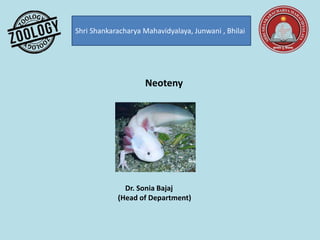
Neoteny
Dr. Sonia Bajaj
(Head of Department)
Difference between Neoteny and paedogenesis
• Neoteny is the phenomena in which the organism is in juvenile
stage and physiological (somatic growth) is slow down. But in
paedogenesis the larvae of the organism attains sexual maturity.
Here, the sexual reproduction is accelerated. Therefore, neoteny is
a feature of retarded growth and paedogenesis is of accelerated
growth.
• Neoteny can be found in humans and paedogenesis can be found
in amphibians (example -salamander).
Types of Neoteny
1. Total neoteny:
In this category the specimens become sexually mature at the larval stage but
retain larval characters, like (i) external gills, (ii) tail-fin, (iii) ill-developed eyes,
(iv) ill-developed fin on the back and (v) very weak limbs. Total neotenic
animals are paedo-genic. Ex. Ambystoma, Triton, Proteus, Necturus
2. Partial neoteny:
Partial neoteny involves the simple postponement of metamorphosis beyond
the normal period. Retardation of metamorphosis may be due to temporary
change in ecological condition or due to sudden physiological abnormality.
Ex. Alytes obstetricans, Hyla arborea, Bufo vulgaris, Bufo viridis, Rana
temporaria
Significance of Neoteny
Neoteny is looked upon as a consequence of adaptation to
neighboring environments where retention of larval gills and other
larval features may be advantageous.
Weissmann (1875) regarded neoteny as a case of reversion to
atavistic ancestral conditions by assuming that all amphibia were
originally gill-breathing aquatic creatures and that every feature seen
in a larva represented a phylogenetic stage and the axolotl as such is
a case of reversion to an ancestral stage.
References-
Modern text book -Kotpal
Jantu Vigyan- S.M. sexsena
Jantu Vigyan- Dr.H.N. Baijal