 Metamerism (i.e.,division of a body into
serially repeated sections along the
anterior/posterior axis) appears to have
evolved in the annelids as an adaptation to
burrowing. This occurs both externally and
internally.
 Primary locomotory structures in annelids
are Setae,Parapodia and Suckers
 Body muscles present below the epidermis
assists in locomotion.
Each segment is controlled
independently.
Metamerism permits modification of
body regions & creates hydrostatic
compartments that help in supportive
and locomotive functions.
Coelomic fluid functions as a
hydraulic skeleton against which the
muscles act to change the body
shape.
 Organs of locomotion are Parapodia -
(biramous appendages) with many
setae.-used both in creeping and in
swimming.
 Locomotion in polychaetes is by the
combined action of parapodia, body
musculature and to some extent the
coelomic fluid.
CLASS POLYCHAETA
(Gr., poly = many + chaete =
bristles)
 Each parapodium( biramous structure) -2 parts
 an upper or dorsal blade,the notopodium
a lower or ventral blade,the neuropodium
 Each of these is further divided into 2 lobes -an
upper and a lower.
 Dorsal margin of notopodium-short, cylindrical,
tactile appendage- dorsal cirrus.
 Ventral margin of the neuropodium - ventral cirrus.
 Both the notopodium & neuropodium have a
bundle of bristle;like setae or chaetae lodged in a
setigerous or chaetigerous sac.
 In the middle of each bundle of
setae & deeply embedded in the
parapodium is found stout, straight,
thick and dark coloured chitinous
rod the aciculum which projects
only a short distance bt does not
project beyond the outer edge or
the parapodium.
 At its inner end the aciculum has
attachad muscles by which
protrusion and retraction of the
parapodium occurs.
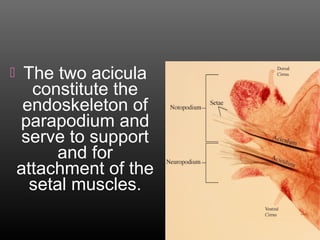
 The two acicula
constitute the
endoskeleton of
parapodium and
serve to support
and for
attachment of the
setal muscles.
SURFACE DWELLERS
Locomotion in free-moving polychaetes is by
the action of parapodia, body musculature
and coelomic fluid.
For ex, when a worm such as Neanthes
moves slowly the contractual force comes
from the sweeping movements of the
parapodia.
During locomotion each parapodium
performs two strokes:an effective or back
stroke and recovery or forward stroke.
In the effective stroke,the aciculum is
extended so that the parapodium is
lowered to come in contact with the
substratum and moves backwards
against the substratum.
In the recovery stroke, the aciculum
is retracted so that the parapodium is
lifted above and moves forward.
The combined effective and recovery
strokes of numerous parapodia
propel the worm forward.
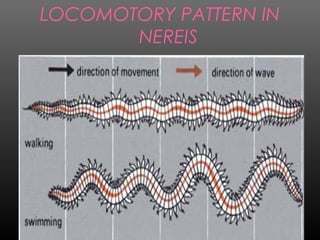
The parapodia of the two sides work
alternatively causing successive waves
along each side of the worm.
LOCOMOTORY PATTERN IN
NEREIS
FAST CRAWLING
Body undulations, which help the worm to
crawl or swim rapidly, are produced by
the contraction of longitudinal muscles
stimulated by the backward stroke of
parapodium of a particular segment.
These contractions coincide with the
alternating waves of parapodia on the two
sides.
The longitudinal muscles of one side
contract when the parapodia of that side
are moved, the muscles relax when
parapodia sweep backwards.
Polynoidae use their muscular parapodia
as efficient walking device.
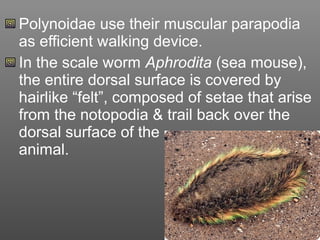
In the scale worm Aphrodita (sea mouse),
the entire dorsal surface is covered by
hairlike “felt”, composed of setae that arise
from the notopodia & trail back over the
dorsal surface of the
animal.
BURROWERS
Many polychaetes have become adapted
for burrowing.
Lumbrinerids and Capitellids, move
through the substratum by peristaltic
contractions. The circular muscle layer is
well developed, and the septa effectively
compartmentalize the coelomic fluid and
localize its skeletal function.
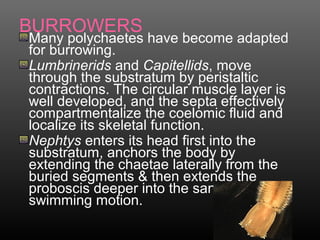
Nephtys enters its head first into the
substratum, anchors the body by
extending the chaetae laterally from the
buried segments & then extends the
proboscis deeper into the sand by a
swimming motion.
Highly efficient burrowers have secondarily lost most
of the intersegmental septa, or have septa that are
perforated (e.g.,Arenicola, Polyphysia).The loss of
complete septa means a loss of coelomic fluid from
one body region causes a corresponding gain in
another.
They have reduced parapodia;the chaetae ,or simply
the surface of the expanded portions of the body,
serve as anchor points.
In Polyphysia, peristaltic waves move constricted
body regions forward while the anchored parts
provide leverage; the constricted areas are reduced
both in diameter & in length by simultaneous
contraction of both the circular & longitudinal
muscles.
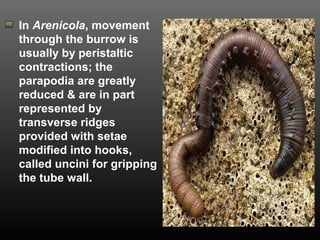
In Arenicola, movement
through the burrow is
usually by peristaltic
contractions; the
parapodia are greatly
reduced & are in part
represented by
transverse ridges
provided with setae
modified into hooks,
called uncini for gripping
the tube wall.
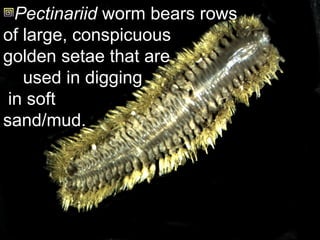
Pectinariid worm bears rows
of large, conspicuous
golden setae that are
used in digging
in soft
sand/mud.
Glycera, a long,
sleek worm,
burrows rapidly
using its large,
muscular proboscis
bearing hooks.
The proboscis is
thrust into the
substratum and
swelled;then the
body is drawn in by
contraction of the
proboscis muscles.
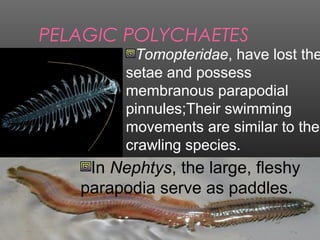
PELAGIC POLYCHAETES
Tomopteridae, have lost the
setae and possess
membranous parapodial
pinnules;Their swimming
movements are similar to the
crawling species.
In Nephtys, the large, fleshy
parapodia serve as paddles.
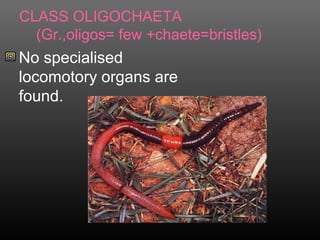
CLASS OLIGOCHAETA
(Gr.,oligos= few +chaete=bristles)
No specialised
locomotory organs are
found.
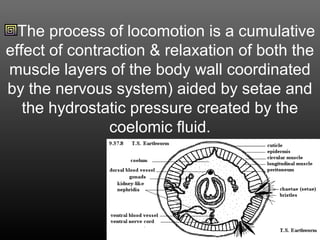
The process of locomotion is a cumulative
effect of contraction & relaxation of both the
muscle layers of the body wall coordinated
by the nervous system) aided by setae and
the hydrostatic pressure created by the
coelomic fluid.
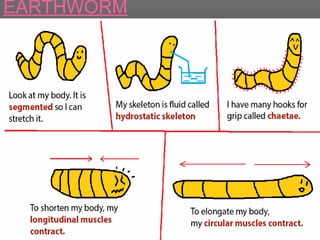
EARTHWORM
During forward movement, circular
muscles at the anterior end contract due
to an increase in the hydrostatic pressure
of the anterior segments; this wave-like
contraction then passes backwards.
This results the anterior region to extend
forward and at the same time making it
thinner in diameter.
The anterior end now grips the
substratum & the setae acts as hooks by
their posteriorly directed points.
When the wave of contraction nears the mid-
region of the body, circular muscles relax &
longitudinal muscles of the anterior end
contract, this shortens and thickens the
anterior end causing the posterior body of the
worm to be dragged forward.
The setae are extended to prevent backward
movement of the segment.
The wave of contraction of the longitudinal
muscles passes backwards.
Again a wave of contraction of circular muscle
starts from the anterior end before the first one
has reached to the posterior end.
Thus locomotion is brought about by
alternate contractions of circular &
longitudinal muscles causing wave of
thinning and thickening to pass backward.
This involves partly a pushing of the
anterior end and partly a pulling of the
posterior end, the setae playing an
accessory role.
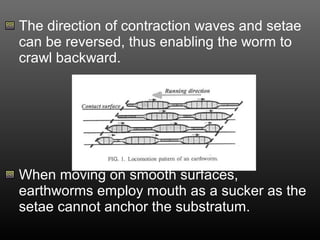
The direction of contraction waves and setae
can be reversed, thus enabling the worm to
crawl backward.
When moving on smooth surfaces,
earthworms employ mouth as a sucker as the
setae cannot anchor the substratum.
CLASS HIRUDINEA
(L., hirudo=leech)
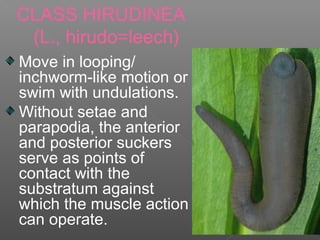
Move in looping/
inchworm-like motion or
swim with undulations.
Without setae and
parapodia, the anterior
and posterior suckers
serve as points of
contact with the
substratum against
which the muscle action
can operate.
INCHWORM-LIKE MOTION OFINCHWORM-LIKE MOTION OF
LEECHLEECH
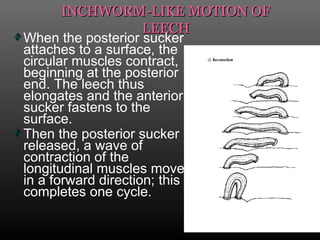
When the posterior sucker
attaches to a surface, the
circular muscles contract,
beginning at the posterior
end. The leech thus
elongates and the anterior
sucker fastens to the
surface.
Then the posterior sucker is
released, a wave of
contraction of the
longitudinal muscles moves
in a forward direction; this
completes one cycle.
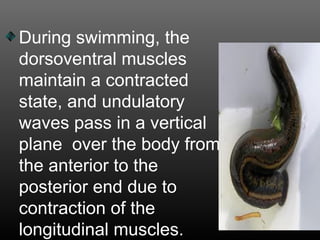
During swimming, the
dorsoventral muscles
maintain a contracted
state, and undulatory
waves pass in a vertical
plane over the body from
the anterior to the
posterior end due to
contraction of the
longitudinal muscles.
BIBLIOGRAPHY
[Brusca & Brusca, 1990] R.C. Brusca, & G.J.
Brusca, Invertebrates, Sinauer Associates,
1990.
Locomotion in annelids

Locomotion in annelids

  • 1.
     Metamerism (i.e.,divisionof a body into serially repeated sections along the anterior/posterior axis) appears to have evolved in the annelids as an adaptation to burrowing. This occurs both externally and internally.  Primary locomotory structures in annelids are Setae,Parapodia and Suckers  Body muscles present below the epidermis assists in locomotion.
  • 2.
    Each segment iscontrolled independently. Metamerism permits modification of body regions & creates hydrostatic compartments that help in supportive and locomotive functions. Coelomic fluid functions as a hydraulic skeleton against which the muscles act to change the body shape.
  • 3.
     Organs oflocomotion are Parapodia - (biramous appendages) with many setae.-used both in creeping and in swimming.  Locomotion in polychaetes is by the combined action of parapodia, body musculature and to some extent the coelomic fluid. CLASS POLYCHAETA (Gr., poly = many + chaete = bristles)
  • 4.
     Each parapodium(biramous structure) -2 parts  an upper or dorsal blade,the notopodium a lower or ventral blade,the neuropodium  Each of these is further divided into 2 lobes -an upper and a lower.  Dorsal margin of notopodium-short, cylindrical, tactile appendage- dorsal cirrus.  Ventral margin of the neuropodium - ventral cirrus.  Both the notopodium & neuropodium have a bundle of bristle;like setae or chaetae lodged in a setigerous or chaetigerous sac.
  • 5.
     In themiddle of each bundle of setae & deeply embedded in the parapodium is found stout, straight, thick and dark coloured chitinous rod the aciculum which projects only a short distance bt does not project beyond the outer edge or the parapodium.  At its inner end the aciculum has attachad muscles by which protrusion and retraction of the parapodium occurs.
  • 6.
     The twoacicula constitute the endoskeleton of parapodium and serve to support and for attachment of the setal muscles.
  • 8.
    SURFACE DWELLERS Locomotion infree-moving polychaetes is by the action of parapodia, body musculature and coelomic fluid. For ex, when a worm such as Neanthes moves slowly the contractual force comes from the sweeping movements of the parapodia. During locomotion each parapodium performs two strokes:an effective or back stroke and recovery or forward stroke.
  • 9.
    In the effectivestroke,the aciculum is extended so that the parapodium is lowered to come in contact with the substratum and moves backwards against the substratum. In the recovery stroke, the aciculum is retracted so that the parapodium is lifted above and moves forward.
  • 10.
    The combined effectiveand recovery strokes of numerous parapodia propel the worm forward. The parapodia of the two sides work alternatively causing successive waves along each side of the worm.
  • 11.
  • 12.
    FAST CRAWLING Body undulations,which help the worm to crawl or swim rapidly, are produced by the contraction of longitudinal muscles stimulated by the backward stroke of parapodium of a particular segment. These contractions coincide with the alternating waves of parapodia on the two sides. The longitudinal muscles of one side contract when the parapodia of that side are moved, the muscles relax when parapodia sweep backwards.
  • 13.
    Polynoidae use theirmuscular parapodia as efficient walking device. In the scale worm Aphrodita (sea mouse), the entire dorsal surface is covered by hairlike “felt”, composed of setae that arise from the notopodia & trail back over the dorsal surface of the animal.
  • 14.
    BURROWERS Many polychaetes havebecome adapted for burrowing. Lumbrinerids and Capitellids, move through the substratum by peristaltic contractions. The circular muscle layer is well developed, and the septa effectively compartmentalize the coelomic fluid and localize its skeletal function. Nephtys enters its head first into the substratum, anchors the body by extending the chaetae laterally from the buried segments & then extends the proboscis deeper into the sand by a swimming motion.
  • 15.
    Highly efficient burrowershave secondarily lost most of the intersegmental septa, or have septa that are perforated (e.g.,Arenicola, Polyphysia).The loss of complete septa means a loss of coelomic fluid from one body region causes a corresponding gain in another. They have reduced parapodia;the chaetae ,or simply the surface of the expanded portions of the body, serve as anchor points. In Polyphysia, peristaltic waves move constricted body regions forward while the anchored parts provide leverage; the constricted areas are reduced both in diameter & in length by simultaneous contraction of both the circular & longitudinal muscles.
  • 16.
    In Arenicola, movement throughthe burrow is usually by peristaltic contractions; the parapodia are greatly reduced & are in part represented by transverse ridges provided with setae modified into hooks, called uncini for gripping the tube wall.
  • 17.
    Pectinariid worm bearsrows of large, conspicuous golden setae that are used in digging in soft sand/mud.
  • 18.
    Glycera, a long, sleekworm, burrows rapidly using its large, muscular proboscis bearing hooks. The proboscis is thrust into the substratum and swelled;then the body is drawn in by contraction of the proboscis muscles.
  • 19.
    PELAGIC POLYCHAETES Tomopteridae, havelost the setae and possess membranous parapodial pinnules;Their swimming movements are similar to the crawling species. In Nephtys, the large, fleshy parapodia serve as paddles.
  • 20.
    CLASS OLIGOCHAETA (Gr.,oligos= few+chaete=bristles) No specialised locomotory organs are found.
  • 21.
    The process oflocomotion is a cumulative effect of contraction & relaxation of both the muscle layers of the body wall coordinated by the nervous system) aided by setae and the hydrostatic pressure created by the coelomic fluid.
  • 22.
  • 23.
    During forward movement,circular muscles at the anterior end contract due to an increase in the hydrostatic pressure of the anterior segments; this wave-like contraction then passes backwards. This results the anterior region to extend forward and at the same time making it thinner in diameter. The anterior end now grips the substratum & the setae acts as hooks by their posteriorly directed points.
  • 24.
    When the waveof contraction nears the mid- region of the body, circular muscles relax & longitudinal muscles of the anterior end contract, this shortens and thickens the anterior end causing the posterior body of the worm to be dragged forward. The setae are extended to prevent backward movement of the segment. The wave of contraction of the longitudinal muscles passes backwards. Again a wave of contraction of circular muscle starts from the anterior end before the first one has reached to the posterior end.
  • 26.
    Thus locomotion isbrought about by alternate contractions of circular & longitudinal muscles causing wave of thinning and thickening to pass backward. This involves partly a pushing of the anterior end and partly a pulling of the posterior end, the setae playing an accessory role.
  • 27.
    The direction ofcontraction waves and setae can be reversed, thus enabling the worm to crawl backward. When moving on smooth surfaces, earthworms employ mouth as a sucker as the setae cannot anchor the substratum.
  • 28.
    CLASS HIRUDINEA (L., hirudo=leech) Movein looping/ inchworm-like motion or swim with undulations. Without setae and parapodia, the anterior and posterior suckers serve as points of contact with the substratum against which the muscle action can operate.
  • 29.
    INCHWORM-LIKE MOTION OFINCHWORM-LIKEMOTION OF LEECHLEECH When the posterior sucker attaches to a surface, the circular muscles contract, beginning at the posterior end. The leech thus elongates and the anterior sucker fastens to the surface. Then the posterior sucker is released, a wave of contraction of the longitudinal muscles moves in a forward direction; this completes one cycle.
  • 30.
    During swimming, the dorsoventralmuscles maintain a contracted state, and undulatory waves pass in a vertical plane over the body from the anterior to the posterior end due to contraction of the longitudinal muscles.
  • 31.
    BIBLIOGRAPHY [Brusca & Brusca,1990] R.C. Brusca, & G.J. Brusca, Invertebrates, Sinauer Associates, 1990.