Phylum Annelida
Kaitlyn Anticoli and Madeline Avallon
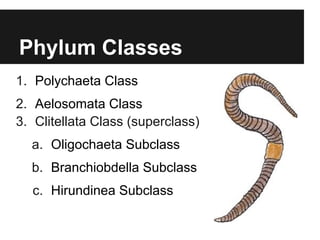
Phylum Classes
1. Polychaeta Class
2. Aelosomata Class
3. Clitellata Class (superclass)
  a. Oligochaeta Subclass
  b. Branchiobdella Subclass
  c. Hirundinea Subclass
Basic Characteristics
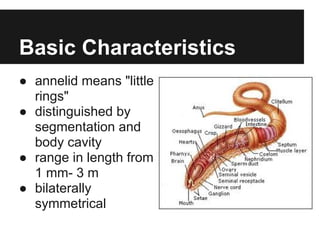
● annelid means "little
  rings"
● distinguished by
  segmentation and
  body cavity
● range in length from
  1 mm- 3 m
● bilaterally
  symmetrical
Basic Characteristics
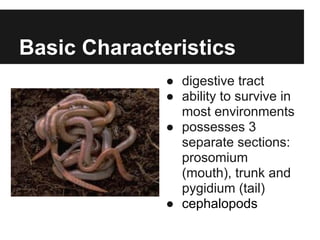
              ● digestive tract
              ● ability to survive in
                most environments
              ● possesses 3
                separate sections:
                prosomium
                (mouth), trunk and
                pygidium (tail)
              ● cephalopods
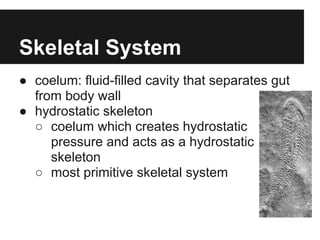
Skeletal System
● coelum: fluid-filled cavity that separates gut
  from body wall
● hydrostatic skeleton
  ○ coelum which creates hydrostatic
     pressure and acts as a hydrostatic
     skeleton
  ○ most primitive skeletal system
Circulatory System
● true closed circulatory system
● two main vessels are
  ○ dorsal blood vessel: blood moves
     anteriorly
  ○ ventral blood vessel: blood moves
     posteriorly
● aortic arches: "hearts"
  ○ dark, expanded structures on either side
     of the esophagus
  ○ only function in pumping blood from the
     dorsal to the ventral vessels
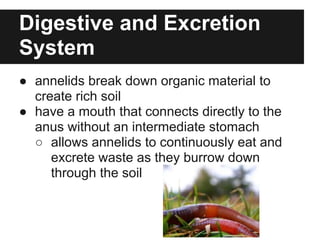
Digestive and Excretion
System
● annelids break down organic material to
  create rich soil
● have a mouth that connects directly to the
  anus without an intermediate stomach
  ○ allows annelids to continuously eat and
     excrete waste as they burrow down
     through the soil
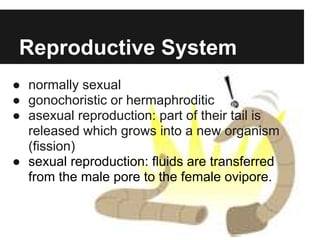
Reproductive System
● normally sexual
● gonochoristic or hermaphroditic
● asexual reproduction: part of their tail is
  released which grows into a new organism
  (fission)
● sexual reproduction: fluids are transferred
  from the male pore to the female ovipore.
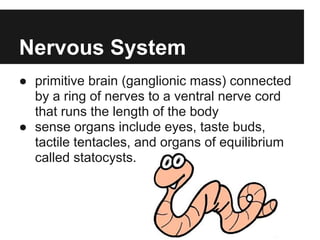
Nervous System
● primitive brain (ganglionic mass) connected
  by a ring of nerves to a ventral nerve cord
  that runs the length of the body
● sense organs include eyes, taste buds,
  tactile tentacles, and organs of equilibrium
  called statocysts.
Evolved Characteristics
● humans, like annelids, have a brain and
  nerve cord (spinal cord)
● frogs have a coelum
  ○ annelid coelum contains fluid that creates
     pressure and acts as hydrostatic skeleton
  ○ frog's coelum contains organs such as the
     lungs and is where lymph cirulates
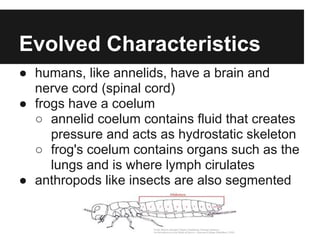
● anthropods like insects are also segmented
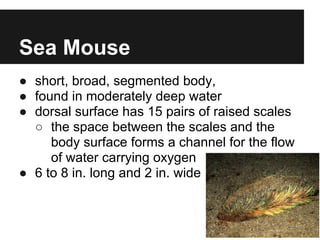
Sea Mouse
● short, broad, segmented body,
● found in moderately deep water
● dorsal surface has 15 pairs of raised scales
  ○ the space between the scales and the
     body surface forms a channel for the flow
     of water carrying oxygen
● 6 to 8 in. long and 2 in. wide
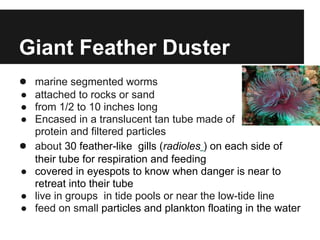
Giant Feather Duster
● marine segmented worms
● attached to rocks or sand
● from 1/2 to 10 inches long
● Encased in a translucent tan tube made of
  protein and filtered particles
● about 30 feather-like gills (radioles ) on each side of
  their tube for respiration and feeding
● covered in eyespots to know when danger is near to
  retreat into their tube
● live in groups in tide pools or near the low-tide line
● feed on small particles and plankton floating in the water
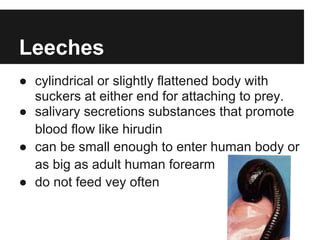
Leeches
● cylindrical or slightly flattened body with
  suckers at either end for attaching to prey.
● salivary secretions substances that promote
  blood flow like hirudin
● can be small enough to enter human body or
  as big as adult human forearm
● do not feed vey often
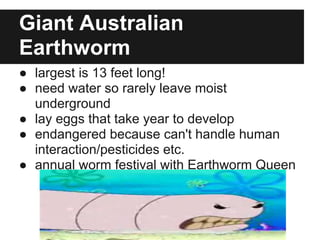
Giant Australian
Earthworm
● largest is 13 feet long!
● need water so rarely leave moist
  underground
● lay eggs that take year to develop
● endangered because can't handle human
  interaction/pesticides etc.
● annual worm festival with Earthworm Queen
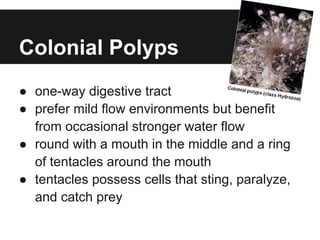
Colonial Polyps
● one-way digestive tract
● prefer mild flow environments but benefit
  from occasional stronger water flow
● round with a mouth in the middle and a ring
  of tentacles around the mouth
● tentacles possess cells that sting, paralyze,
  and catch prey
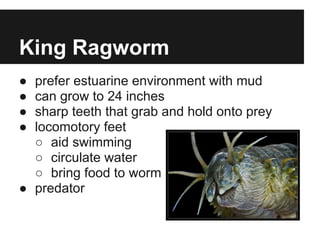
King Ragworm
● prefer estuarine environment with mud
● can grow to 24 inches
● sharp teeth that grab and hold onto prey
● locomotory feet
  ○ aid swimming
  ○ circulate water
  ○ bring food to worm
● predator

Phylum Annelida

  • 1.
  • 2.
    Phylum Classes 1. PolychaetaClass 2. Aelosomata Class 3. Clitellata Class (superclass) a. Oligochaeta Subclass b. Branchiobdella Subclass c. Hirundinea Subclass
  • 3.
    Basic Characteristics ● annelidmeans "little rings" ● distinguished by segmentation and body cavity ● range in length from 1 mm- 3 m ● bilaterally symmetrical
  • 4.
    Basic Characteristics ● digestive tract ● ability to survive in most environments ● possesses 3 separate sections: prosomium (mouth), trunk and pygidium (tail) ● cephalopods
  • 5.
    Skeletal System ● coelum:fluid-filled cavity that separates gut from body wall ● hydrostatic skeleton ○ coelum which creates hydrostatic pressure and acts as a hydrostatic skeleton ○ most primitive skeletal system
  • 6.
    Circulatory System ● trueclosed circulatory system ● two main vessels are ○ dorsal blood vessel: blood moves anteriorly ○ ventral blood vessel: blood moves posteriorly ● aortic arches: "hearts" ○ dark, expanded structures on either side of the esophagus ○ only function in pumping blood from the dorsal to the ventral vessels
  • 7.
    Digestive and Excretion System ●annelids break down organic material to create rich soil ● have a mouth that connects directly to the anus without an intermediate stomach ○ allows annelids to continuously eat and excrete waste as they burrow down through the soil
  • 8.
    Reproductive System ● normallysexual ● gonochoristic or hermaphroditic ● asexual reproduction: part of their tail is released which grows into a new organism (fission) ● sexual reproduction: fluids are transferred from the male pore to the female ovipore.
  • 9.
    Nervous System ● primitivebrain (ganglionic mass) connected by a ring of nerves to a ventral nerve cord that runs the length of the body ● sense organs include eyes, taste buds, tactile tentacles, and organs of equilibrium called statocysts.
  • 10.
    Evolved Characteristics ● humans,like annelids, have a brain and nerve cord (spinal cord) ● frogs have a coelum ○ annelid coelum contains fluid that creates pressure and acts as hydrostatic skeleton ○ frog's coelum contains organs such as the lungs and is where lymph cirulates ● anthropods like insects are also segmented
  • 11.
    Sea Mouse ● short,broad, segmented body, ● found in moderately deep water ● dorsal surface has 15 pairs of raised scales ○ the space between the scales and the body surface forms a channel for the flow of water carrying oxygen ● 6 to 8 in. long and 2 in. wide
  • 12.
    Giant Feather Duster ●marine segmented worms ● attached to rocks or sand ● from 1/2 to 10 inches long ● Encased in a translucent tan tube made of protein and filtered particles ● about 30 feather-like gills (radioles ) on each side of their tube for respiration and feeding ● covered in eyespots to know when danger is near to retreat into their tube ● live in groups in tide pools or near the low-tide line ● feed on small particles and plankton floating in the water
  • 13.
    Leeches ● cylindrical orslightly flattened body with suckers at either end for attaching to prey. ● salivary secretions substances that promote blood flow like hirudin ● can be small enough to enter human body or as big as adult human forearm ● do not feed vey often
  • 14.
    Giant Australian Earthworm ● largestis 13 feet long! ● need water so rarely leave moist underground ● lay eggs that take year to develop ● endangered because can't handle human interaction/pesticides etc. ● annual worm festival with Earthworm Queen
  • 15.
    Colonial Polyps ● one-waydigestive tract ● prefer mild flow environments but benefit from occasional stronger water flow ● round with a mouth in the middle and a ring of tentacles around the mouth ● tentacles possess cells that sting, paralyze, and catch prey
  • 16.
    King Ragworm ● preferestuarine environment with mud ● can grow to 24 inches ● sharp teeth that grab and hold onto prey ● locomotory feet ○ aid swimming ○ circulate water ○ bring food to worm ● predator