THE WORD COELENTERATE
MEANS “HOLLOW BODY CAVITY”.
History-
The term Phylum Coelenterata was
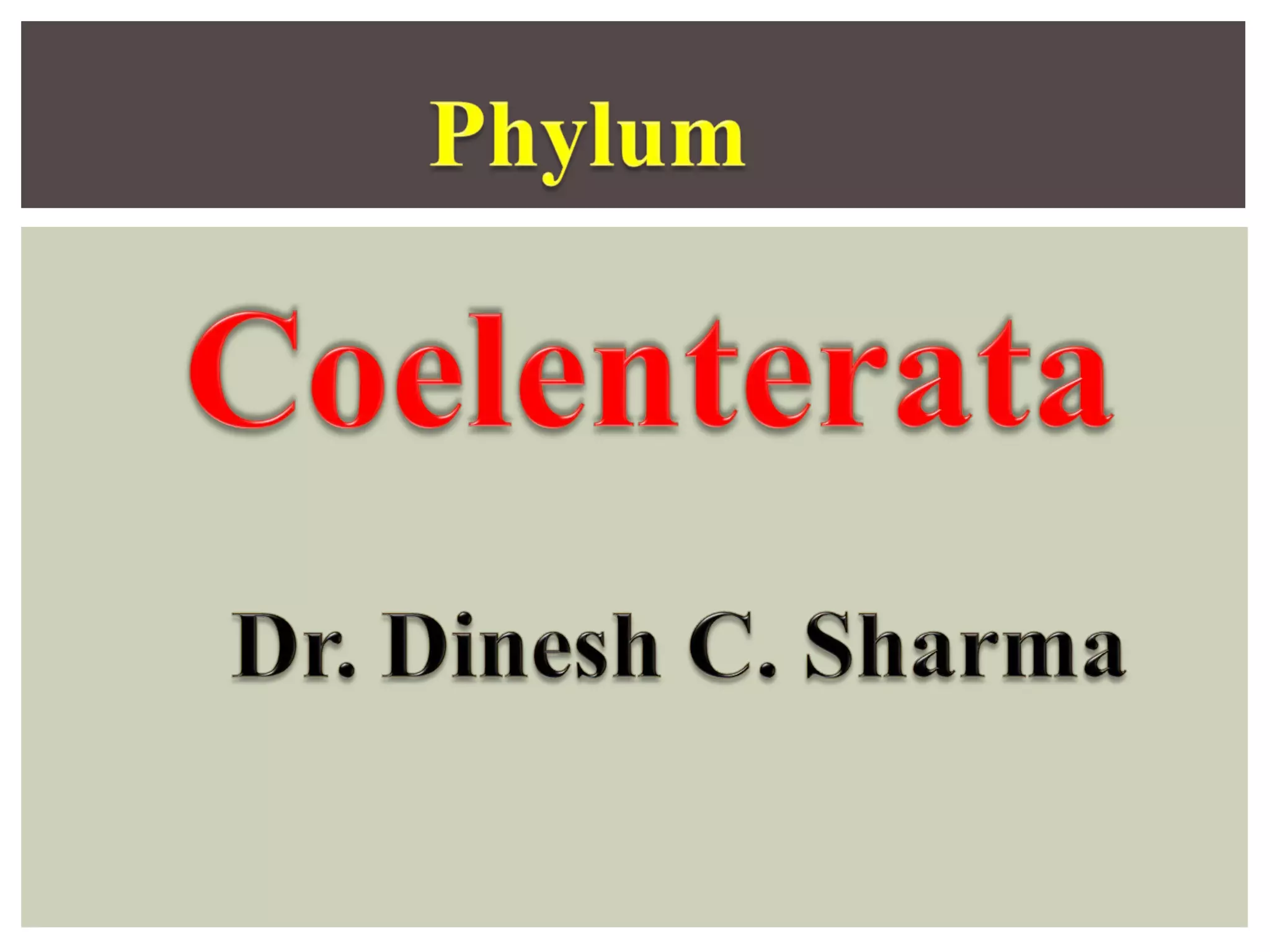
introduced by a German zoologist, Karl
Georg Friedrich (A)
Rudolf Leuckart (1822–1898) who split
Radiata into two phyla: Coelenterata and
Echinodermata.
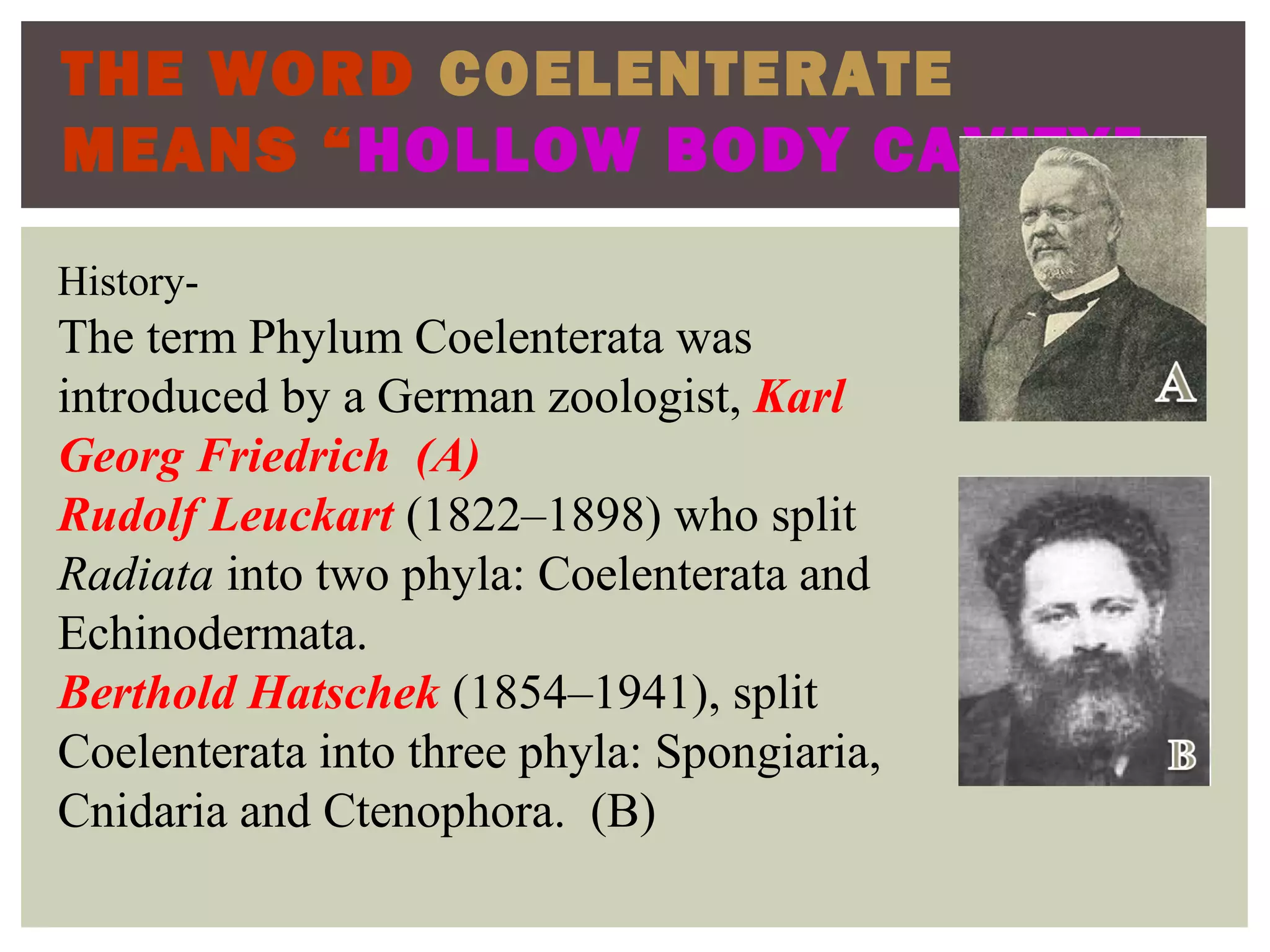
Berthold Hatschek (1854–1941), split
Coelenterata into three phyla: Spongiaria,
Cnidaria and Ctenophora. (B)
Habit and Habitat
Almost 99% of the cnidarians are marine forms.
These are distributed throughout the world.
• Most of them are situated on the shore of the sea
and are littoral.
• Some of these marine forms are active swimmers
and are pelagic in habitat
• Only a few are found in deep sea. The deep sea
forms are often luminescent and emit light.
• Freshwater cnidarians are very few. The most
common example of fresh water cnidarians is
Hydra.
Body Organization
Cnidarians are diploblastic, radially symmetrical animals with
tissue level of body organization. In few cnidarians, symmetry is
biradial because of the elongation of mouth. Because of the
symmetry, Cnidaria were earlier kept under Kingdom Radiata,
along with ctenophores.
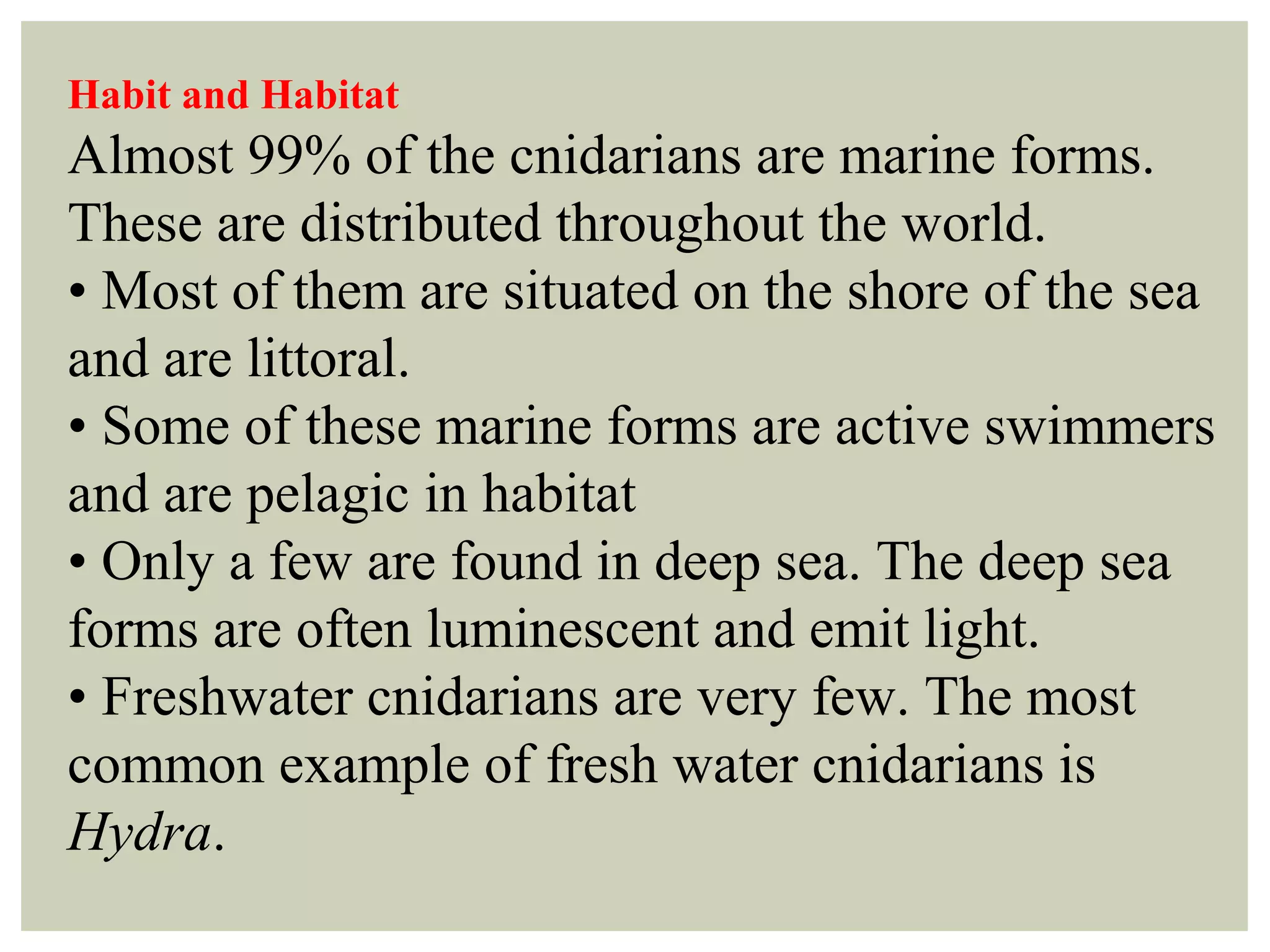
Largest: The largest noncolonial
Cnidarian is the Lion’s Mane Jellyfish,
Cyanea arctica*, (Bell-5.6 F diameter,
Tentacle legth-120 F) (A) & colonial
Cnidarian, Bubblegum Coral,
Paragorgia arborea (Hight 9.8 F, Its not a
coral)
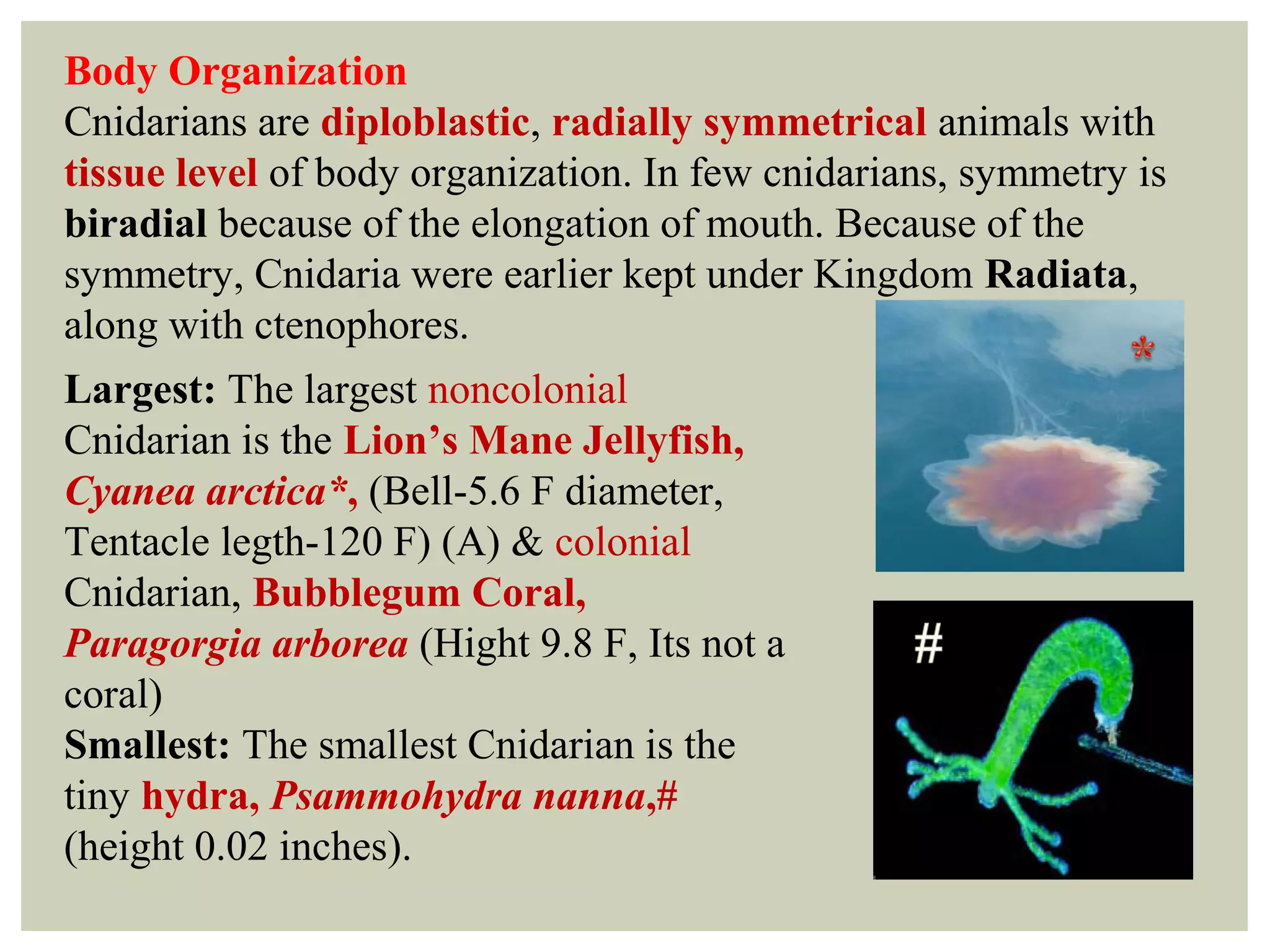
Smallest: The smallest Cnidarian is the
tiny hydra, Psammohydra nanna,#
(height 0.02 inches).
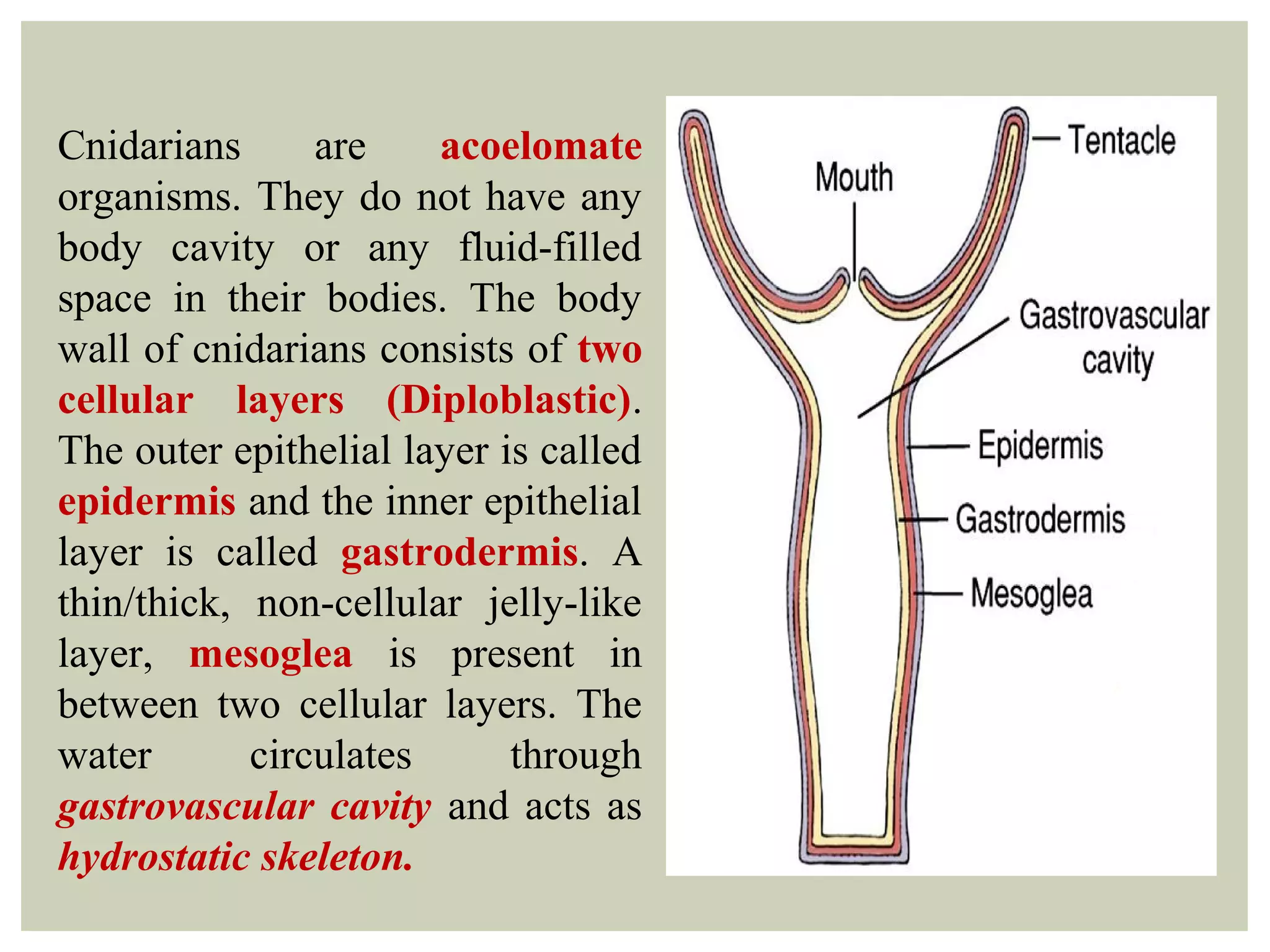
Cnidarians are acoelomate
organisms. They do not have any
body cavity or any fluid-filled
space in their bodies. The body
wall of cnidarians consists of two
cellular layers (Diploblastic).
The outer epithelial layer is called
epidermis and the inner epithelial
layer is called gastrodermis. A
thin/thick, non-cellular jelly-like
layer, mesoglea is present in
between two cellular layers. The
water circulates through
gastrovascular cavity and acts as
hydrostatic skeleton.
The Polyp form is usually sessile
and has a cylindrical body with a
mouth and tentacles at the
upper free end.
Example: Coral & Hydra
The habitat of coelenterates is
salt water but some of them live
in fresh water.
They do not have a complete
nervous system but they have
nerve net .
*Coelenterates have a sac like gut
which serves as mouth and is
surrounded by tentacles.
*Their respiration method is
similar to that of sponges. They
respire only by means of diffusion
across the cell membrane.
*Coelenterates have two definite
tissue layers; an ectoderm and an
endoderm. Mesoglia is filled
between them
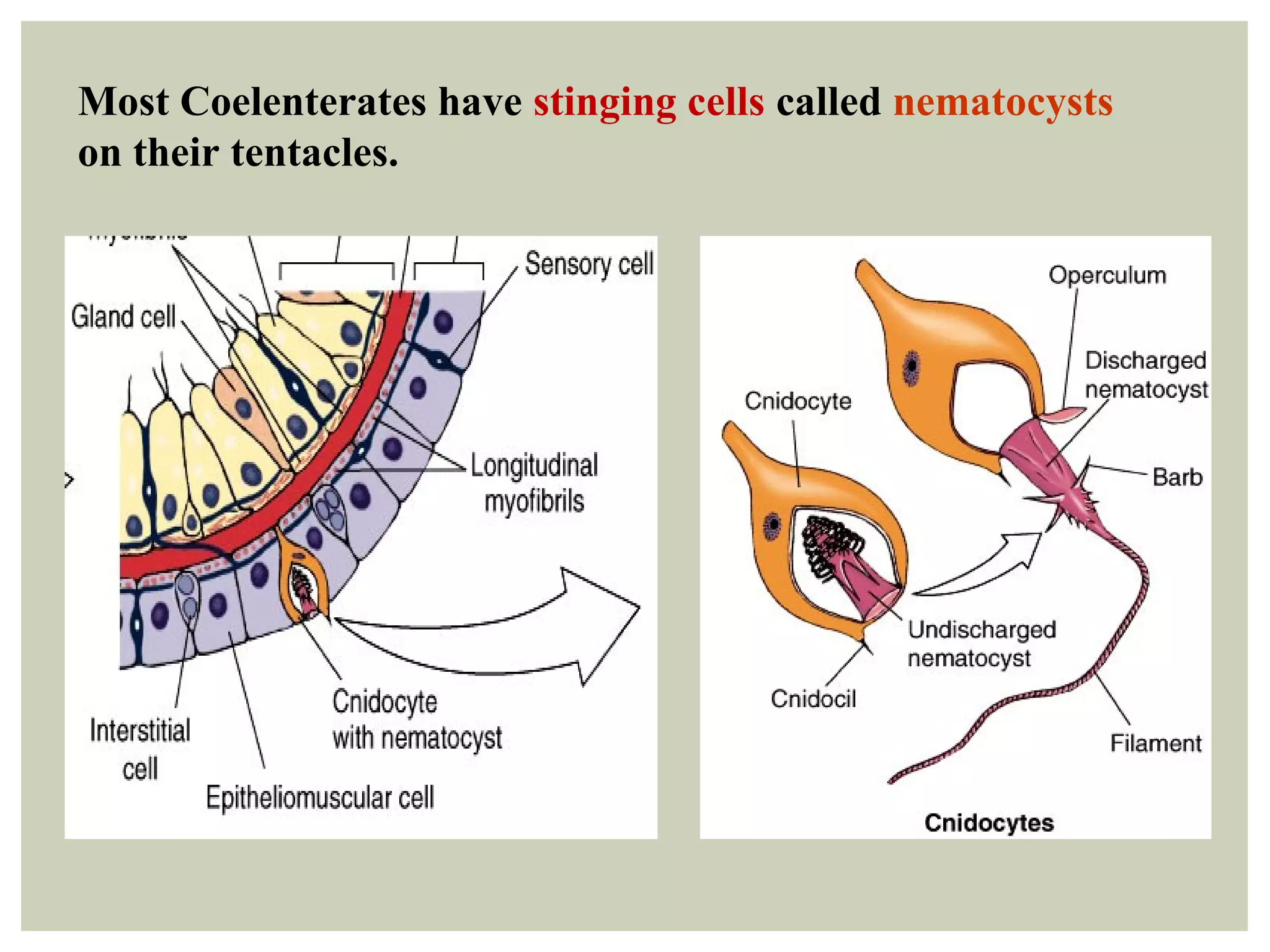
Most Coelenterates have stinging cells called nematocysts
on their tentacles.
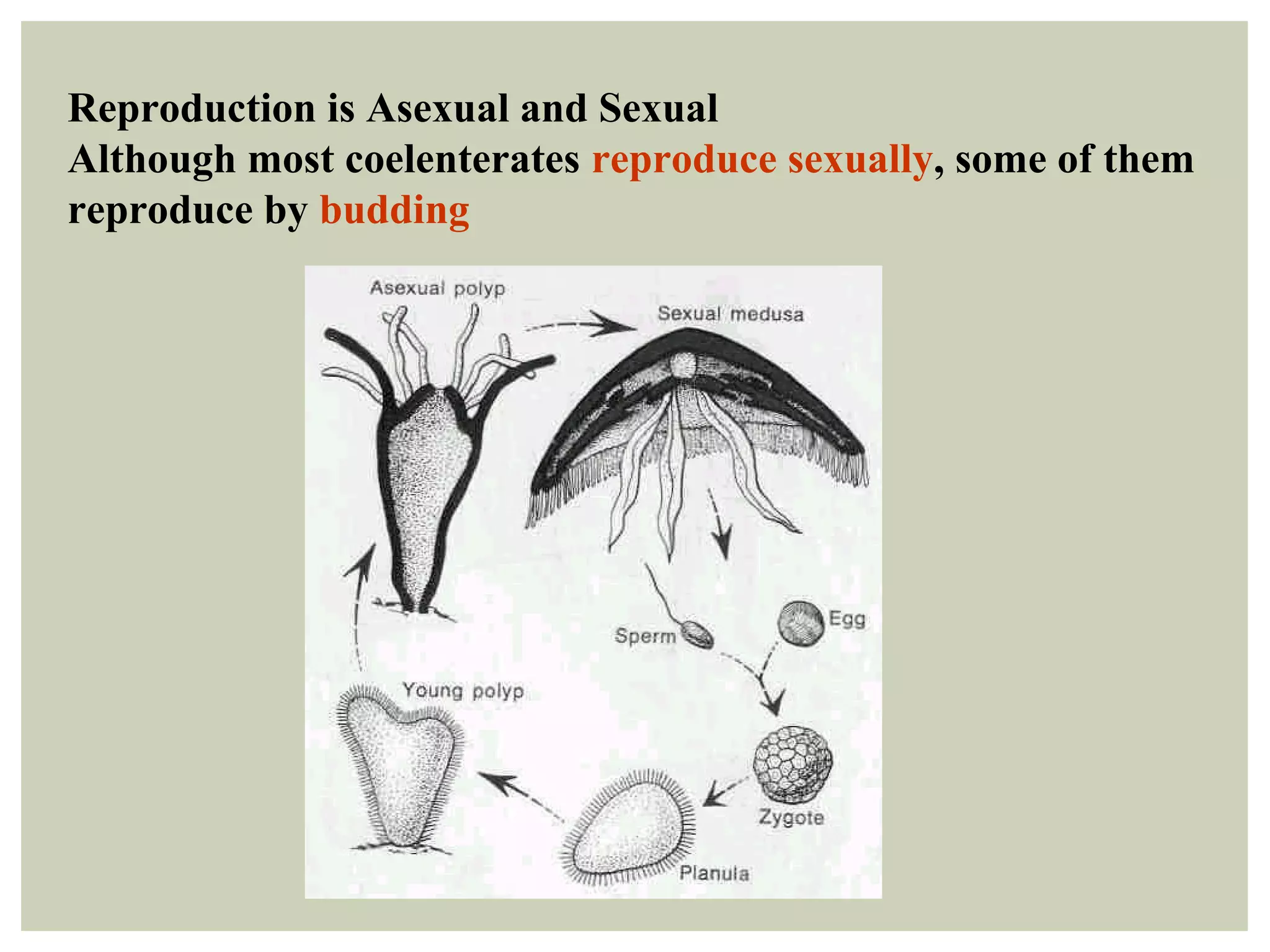
Reproduction is Asexual and Sexual
Although most coelenterates reproduce sexually, some of them
reproduce by budding
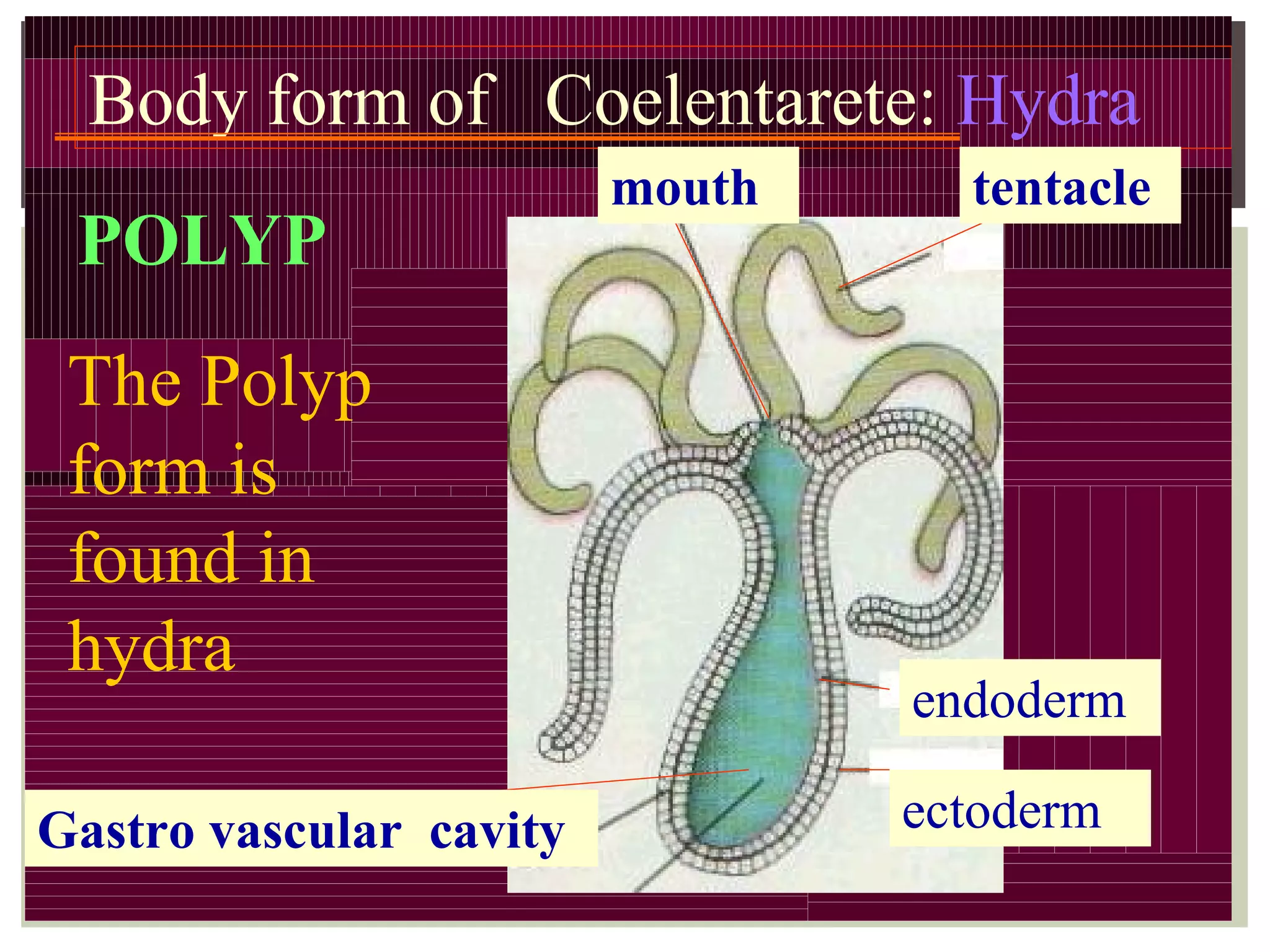
Body form of Coelentarete: Hydra
The Polyp
form is
found in
hydra
mouth tentacle
endoderm
ectodermGastro vascular cavity
POLYP
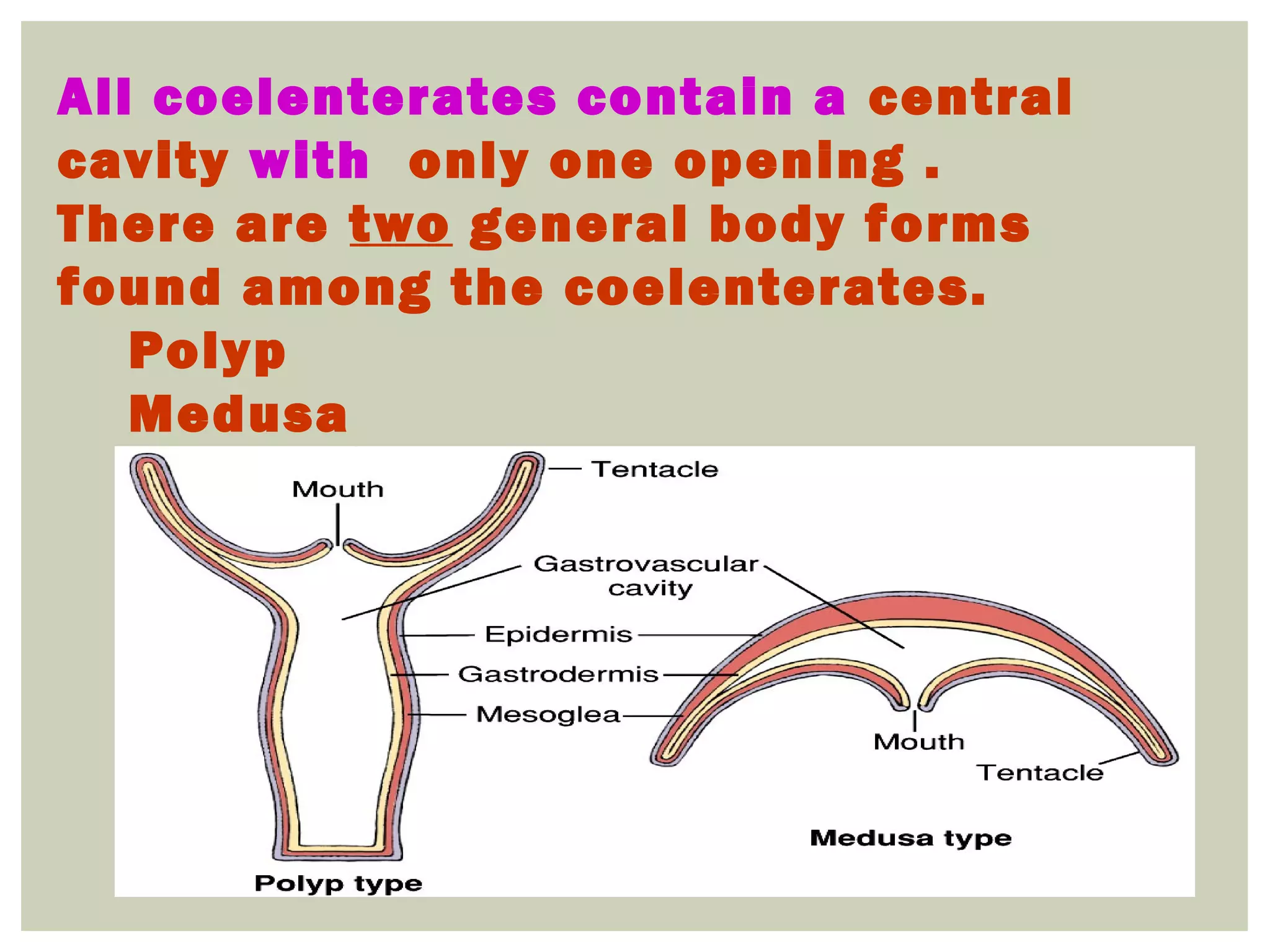
All coelenterates contain a central
cavity with only one opening .
There are two general body forms
found among the coelenterates.
Polyp
Medusa
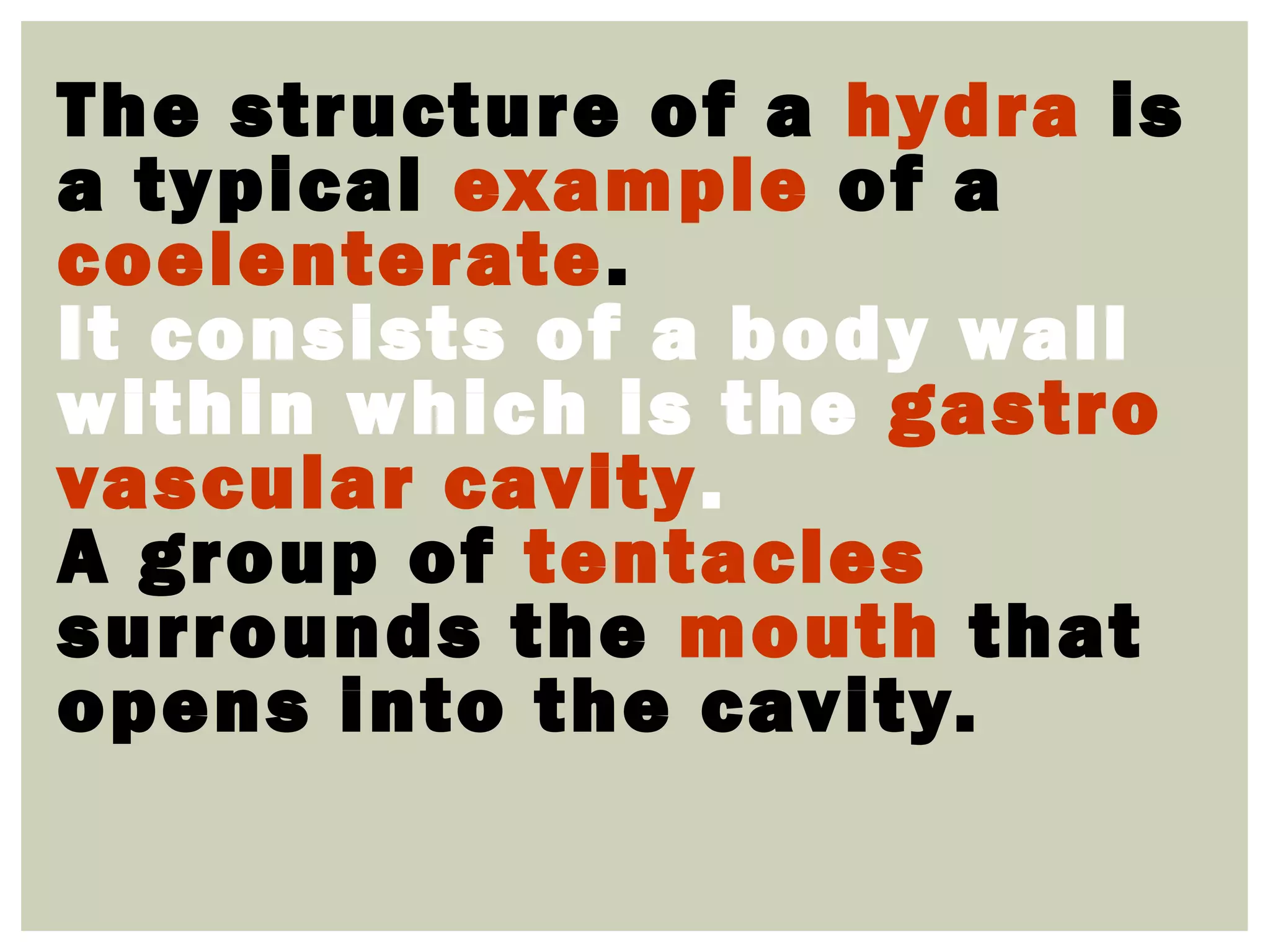
The structure of a hydra is
a typical example of a
coelenterate.
It consists of a body wall
within which is the gastro
vascular cavity.
A group of tentacles
surrounds the mouth that
opens into the cavity.
The body wall of
coelenterates has an
outer layer (ectoderm), an
inner layer (endoderm)
and an intermediate
layer, the mesoglia. The
intermediate layer
contains cells and jelly
like substances.
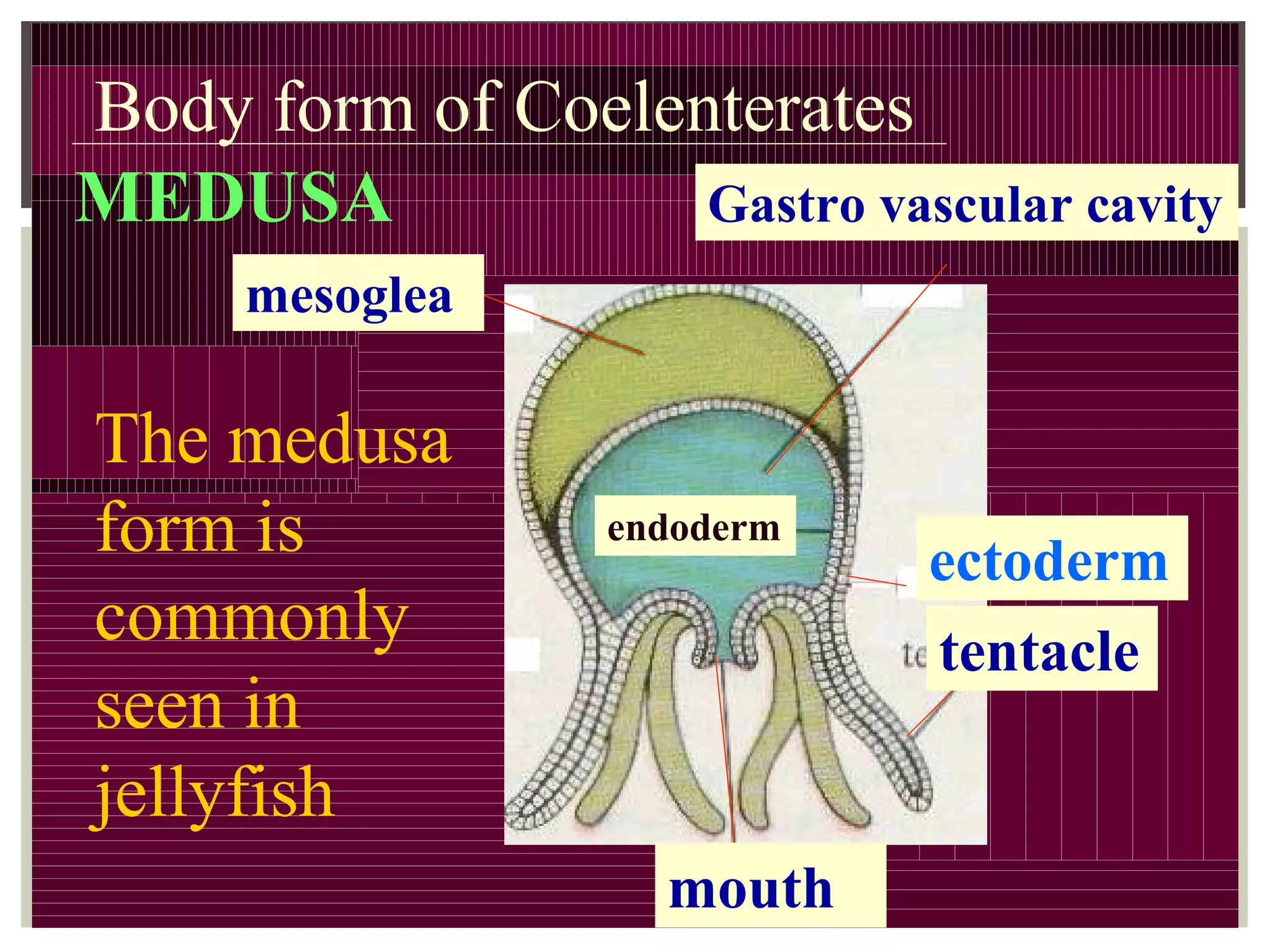
Body form of Coelenterates
tentacle
mouth
MEDUSA
mesoglea
endoderm
ectoderm
Gastro vascular cavity
The medusa
form is
commonly
seen in
jellyfish
The gastro vascular cavity serves
both as a circulatory and digestive
system.
It is surrounded by an inner layer of
the body that is made up of secretory
cells and columnar cells.
These cells have the ability to engulf
food particles. They are digested and
then diffuse form the body.
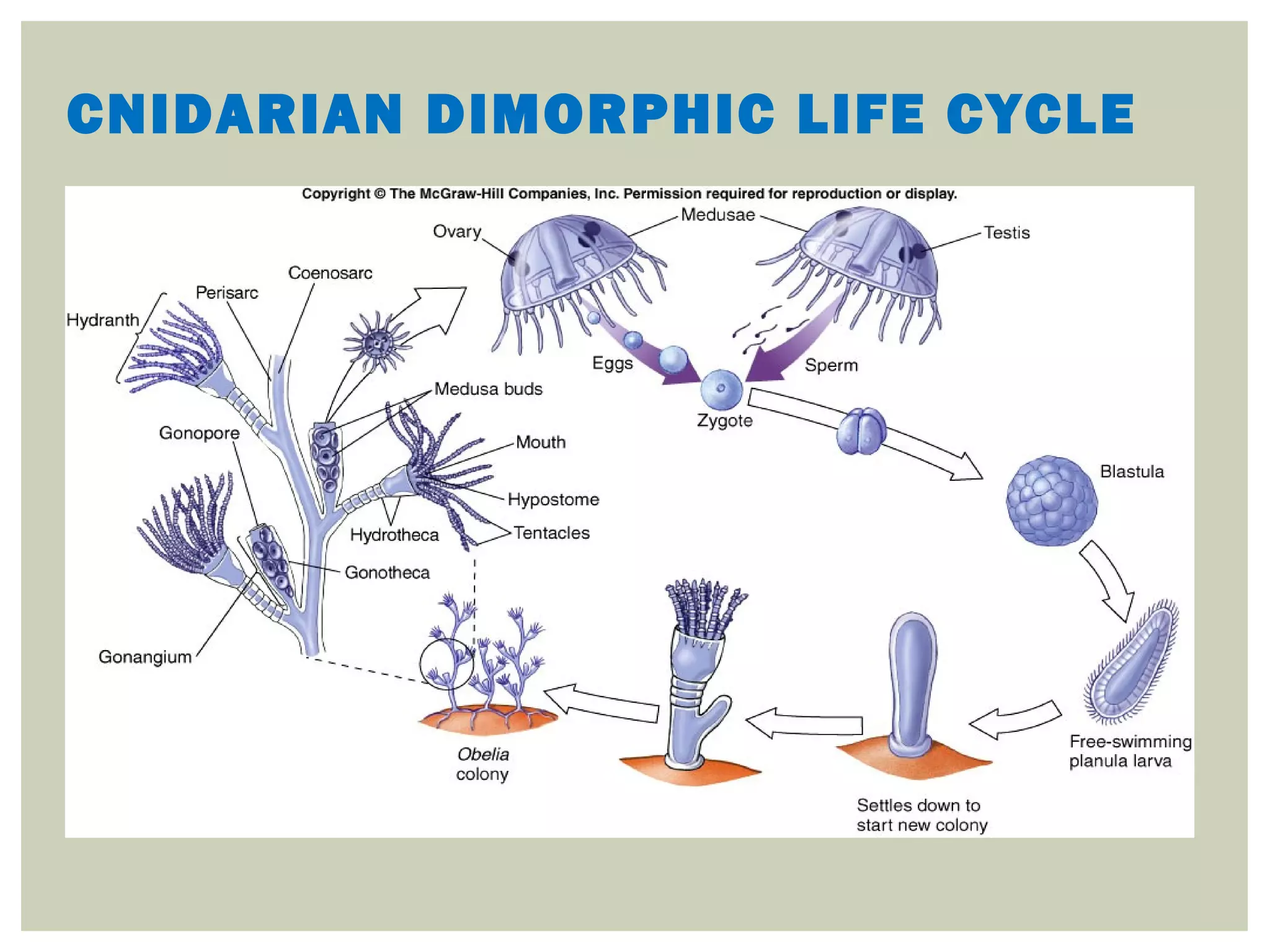
CNIDARIAN DIMORPHIC LIFE CYCLE
CLASSIFICATION OF PHYLUM
CNIDARIA
Phylum Cnidaria is divided into
three classes based on their
existence in different
morphological forms.
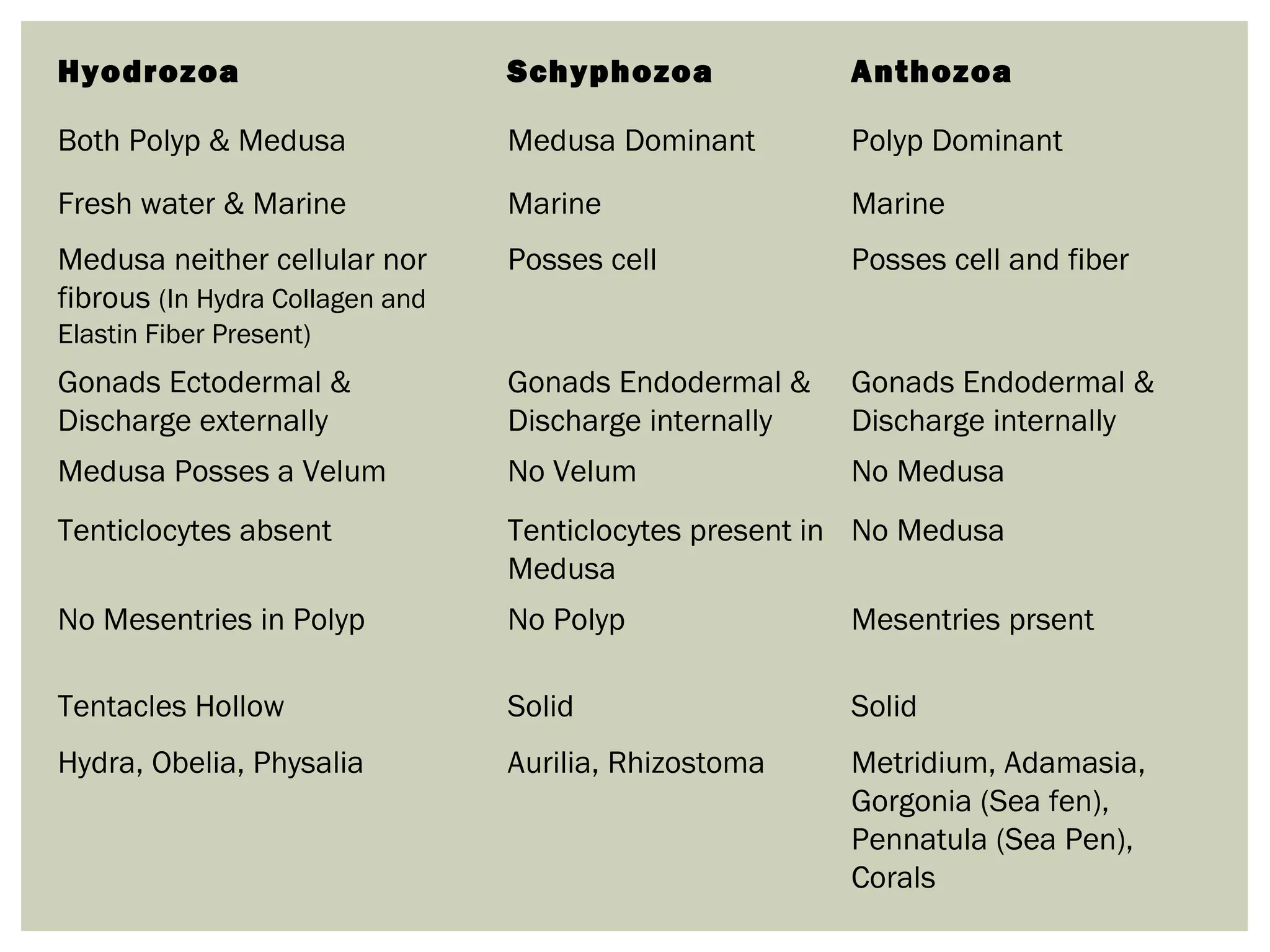
1-Hydrozoa
2-Scyphozoa
3-Anthozoa
Hyodrozoa Schyphozoa Anthozoa
Both Polyp & Medusa Medusa Dominant Polyp Dominant
Fresh water & Marine Marine Marine
Medusa neither cellular nor
fibrous (In Hydra Collagen and
Elastin Fiber Present)
Posses cell Posses cell and fiber
Gonads Ectodermal &
Discharge externally
Gonads Endodermal &
Discharge internally
Gonads Endodermal &
Discharge internally
Medusa Posses a Velum No Velum No Medusa
Tenticlocytes absent Tenticlocytes present in
Medusa
No Medusa
No Mesentries in Polyp No Polyp Mesentries prsent
Tentacles Hollow Solid Solid
Hydra, Obelia, Physalia Aurilia, Rhizostoma Metridium, Adamasia,
Gorgonia (Sea fen),
Pennatula (Sea Pen),
Corals
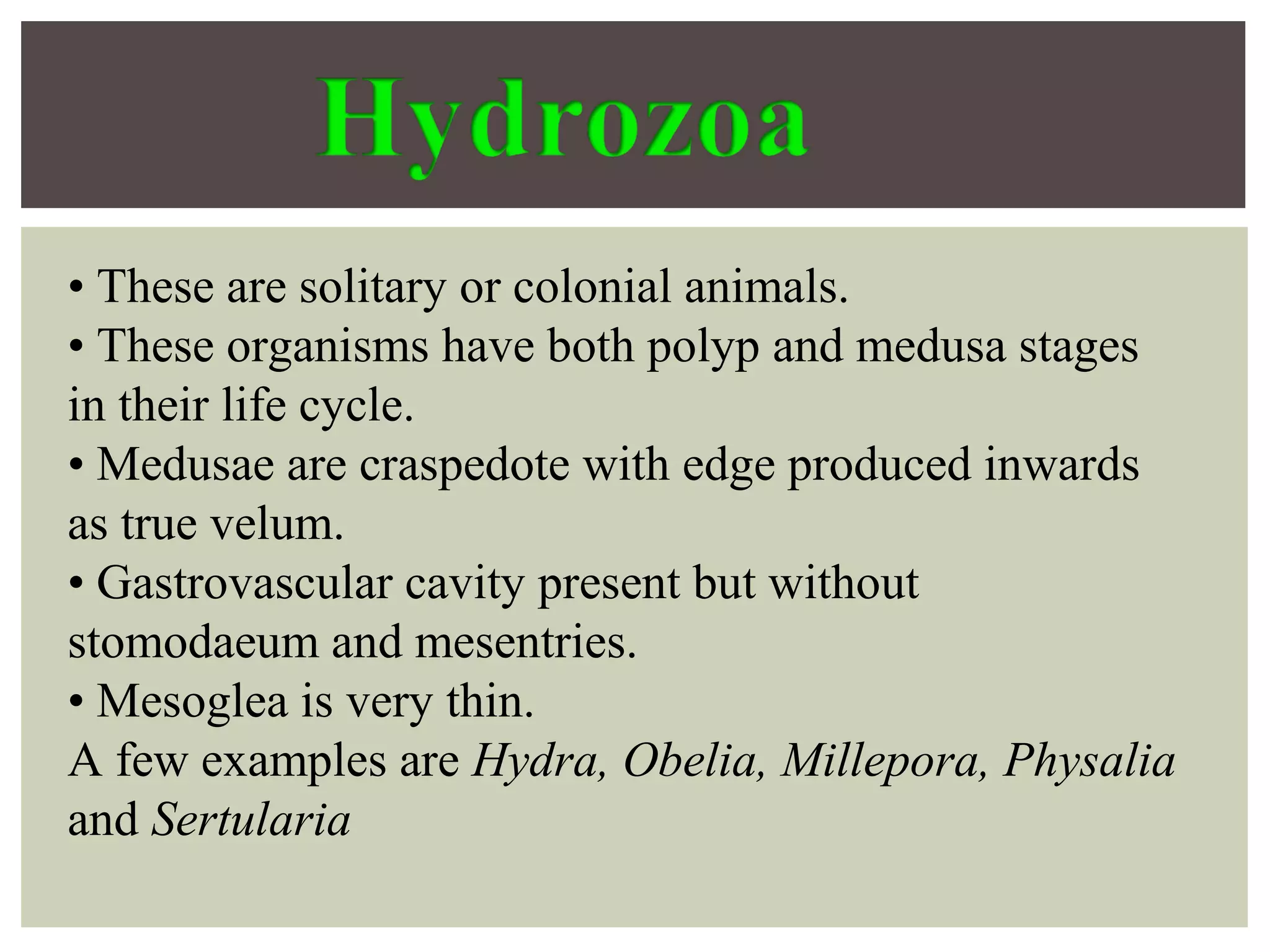
• These are solitary or colonial animals.
• These organisms have both polyp and medusa stages
in their life cycle.
• Medusae are craspedote with edge produced inwards
as true velum.
• Gastrovascular cavity present but without
stomodaeum and mesentries.
• Mesoglea is very thin.
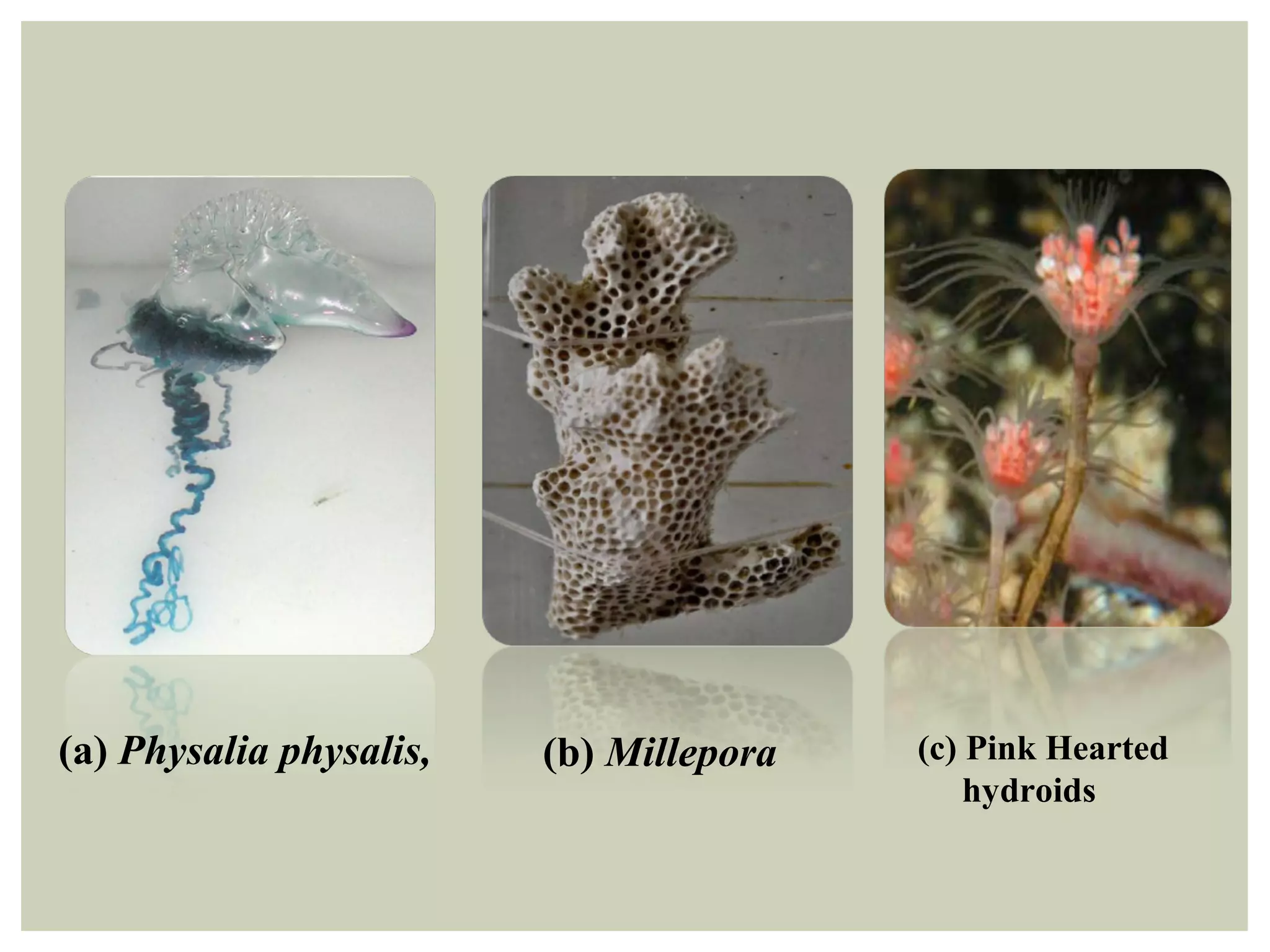
A few examples are Hydra, Obelia, Millepora, Physalia
and Sertularia
(c) Pink Hearted
hydroids
(a) Physalia physalis, (b) Millepora
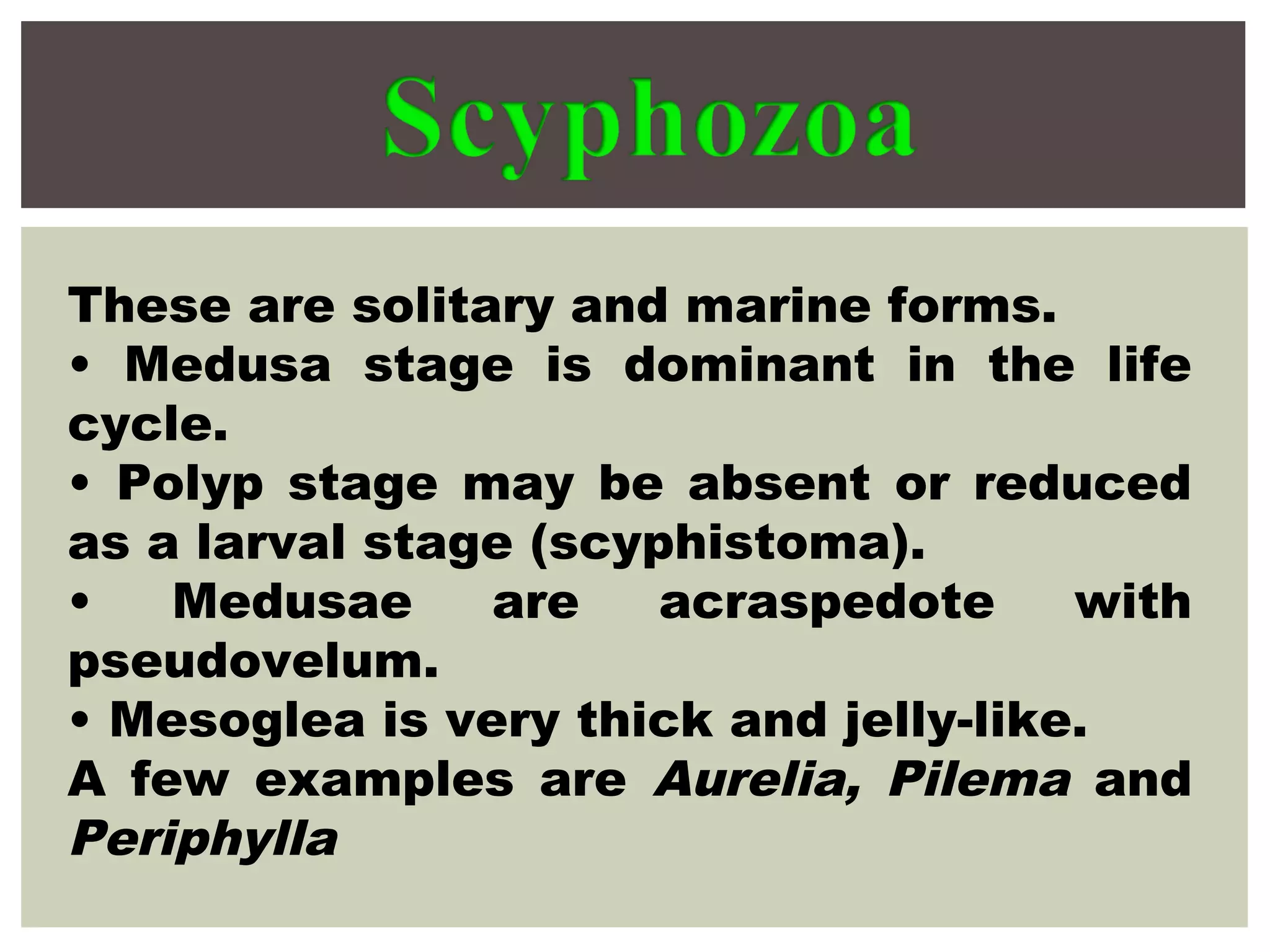
These are solitary and marine forms.
• Medusa stage is dominant in the life
cycle.
• Polyp stage may be absent or reduced
as a larval stage (scyphistoma).
• Medusae are acraspedote with
pseudovelum.
• Mesoglea is very thick and jelly-like.
A few examples are Aurelia, Pilema and
Periphylla
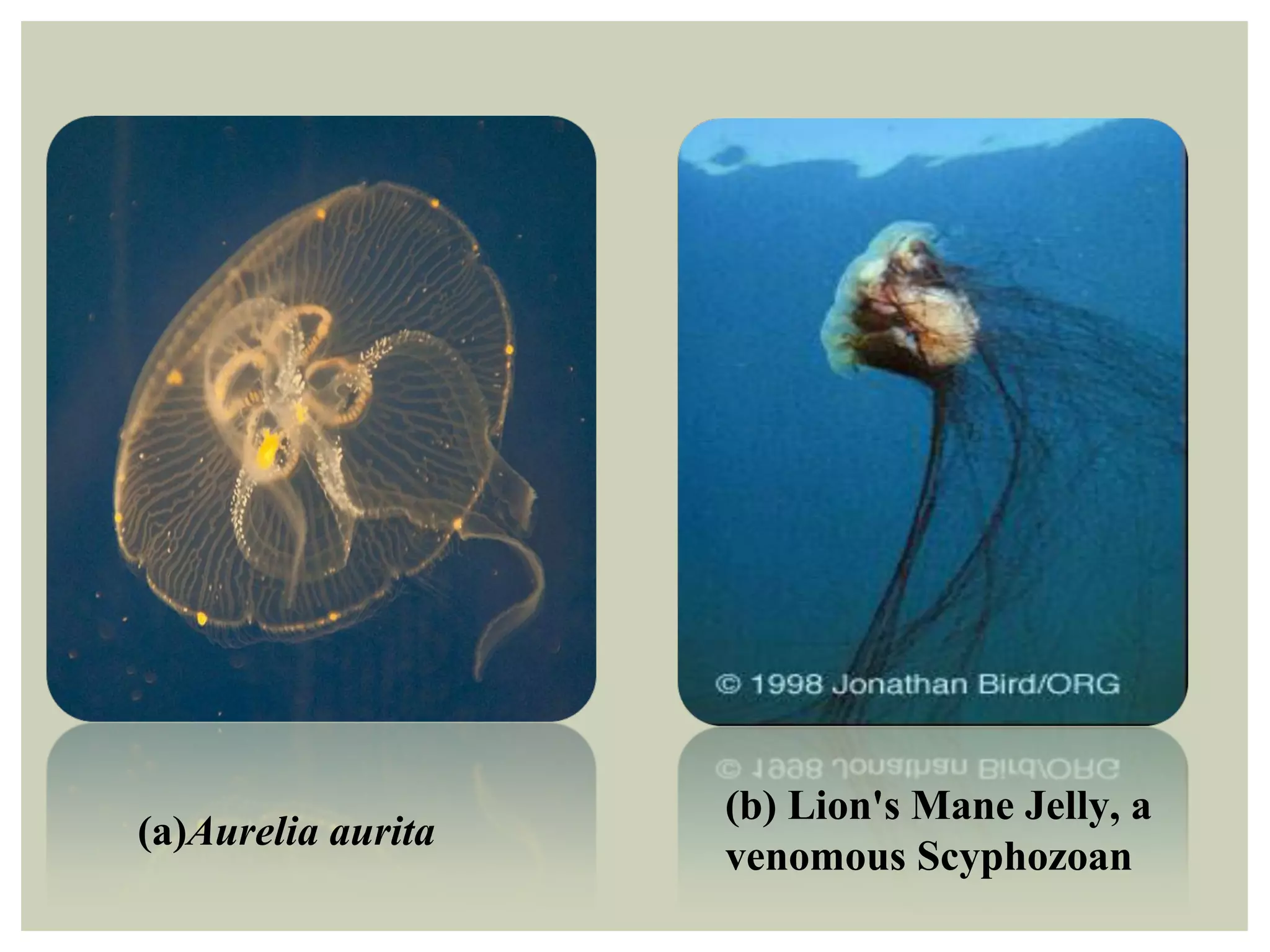
(a)Aurelia aurita
(b) Lion's Mane Jelly, a
venomous Scyphozoan
These are solitary or colonial animals which
exist in only polyp forms.
• Medusa stage is absent in the life cycle of
anthozoans.
• Gastrovascular cavity is well developed with
stomodaeum and mesentries beset with
nematocysts and gonads.
• They may be surrounded by calcareous
skeleton forming corals.
• Corals may reproduce by continous budding
and form large masses, coral reefs.
A few examples are Tubipora, Metridium,
Alcyonium and Gorgonia
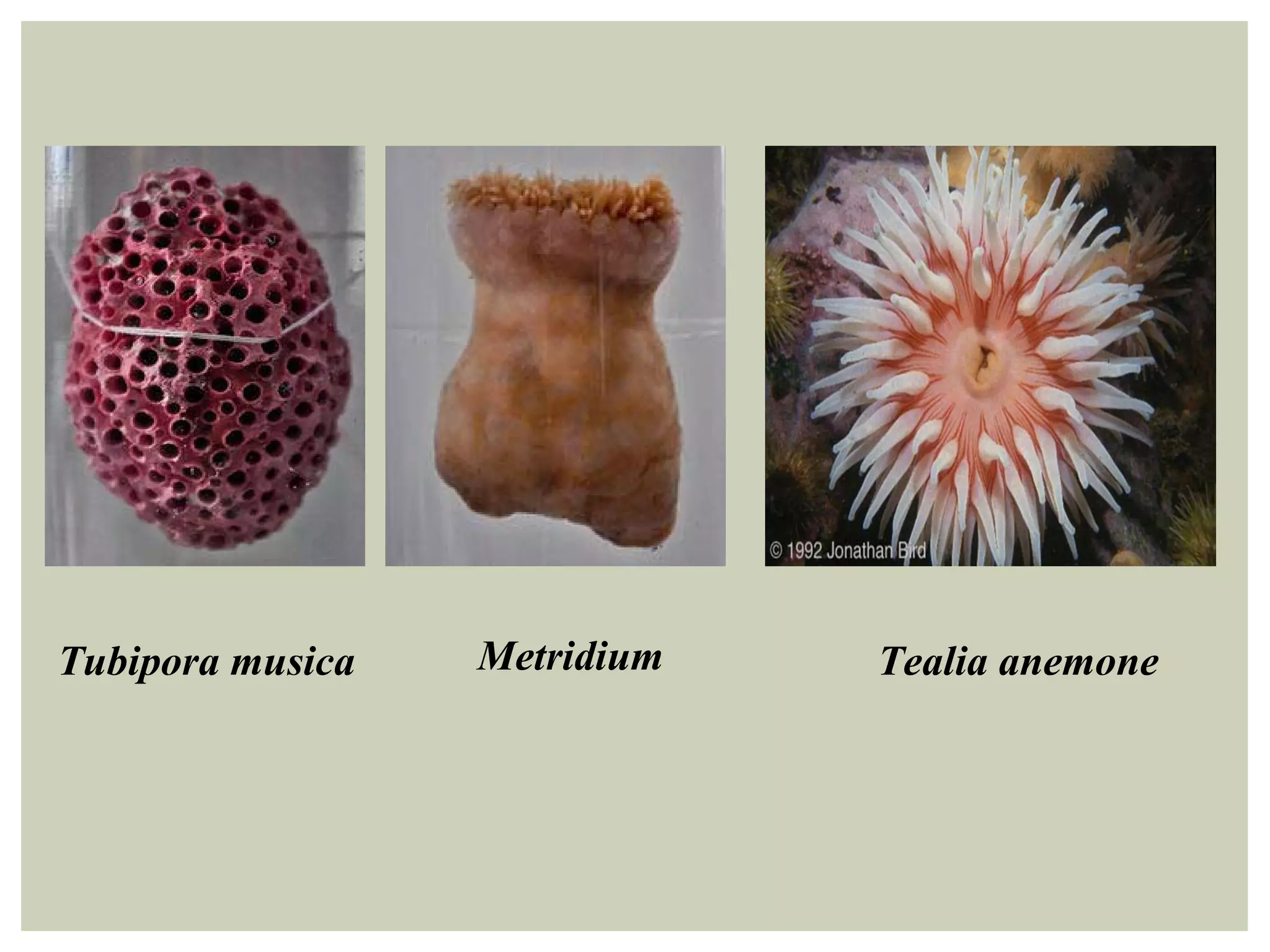
Tubipora musica Metridium Tealia anemone
GLOSSARY
• Radial synmmetry: The symmetry in which an animal can be divided into two equal halves along
any plane passing through the axis
• Cnidocytes: The cells of organs and defence in cnidarians
• Epidermis: Outer cellular epithelial layer of the body wall
• Gastrodermis: Inner cellular epithelial layer of the body wall
• Gastrovascular cavity: Central gut cavity lined by endoderm which has a dual function of
digestion and transportation of food
• Hydropropulsion: Propulsion of the medusa in upward direction by forcing water out of the body
through alternate contraction and expansion of muscles
• Hypnotoxin: The proteinaceous poisonous fluid filled in the nematocysts which is injected into
the prey for its capture
• Manubrium: A central tubular projection in the body of medusa which bears a quandrangular
mouth
• Medusa: Umbrella-like, free-swimming and sexual morphological form of cnidarians
• Mesoglea: Thin/thick, non-cellular jelly-like layer present in between two cellular layers of body
wall
• Polyp: Tubular, sessile and asexual morphological form of cnidarians
• Tentaculocysts: Modified tentacles that serve as the organs of balance and equilibrium
• Totipotent cells: The undifferentiated embryonic cells which are capable of differentiating to any
other kind of cell required by an organism

Coelenterates - classification and gen characters

  • 2.
    THE WORD COELENTERATE MEANS“HOLLOW BODY CAVITY”. History- The term Phylum Coelenterata was introduced by a German zoologist, Karl Georg Friedrich (A) Rudolf Leuckart (1822–1898) who split Radiata into two phyla: Coelenterata and Echinodermata. Berthold Hatschek (1854–1941), split Coelenterata into three phyla: Spongiaria, Cnidaria and Ctenophora. (B)
  • 3.
    Habit and Habitat Almost99% of the cnidarians are marine forms. These are distributed throughout the world. • Most of them are situated on the shore of the sea and are littoral. • Some of these marine forms are active swimmers and are pelagic in habitat • Only a few are found in deep sea. The deep sea forms are often luminescent and emit light. • Freshwater cnidarians are very few. The most common example of fresh water cnidarians is Hydra.
  • 4.
    Body Organization Cnidarians arediploblastic, radially symmetrical animals with tissue level of body organization. In few cnidarians, symmetry is biradial because of the elongation of mouth. Because of the symmetry, Cnidaria were earlier kept under Kingdom Radiata, along with ctenophores. Largest: The largest noncolonial Cnidarian is the Lion’s Mane Jellyfish, Cyanea arctica*, (Bell-5.6 F diameter, Tentacle legth-120 F) (A) & colonial Cnidarian, Bubblegum Coral, Paragorgia arborea (Hight 9.8 F, Its not a coral) Smallest: The smallest Cnidarian is the tiny hydra, Psammohydra nanna,# (height 0.02 inches).
  • 5.
    Cnidarians are acoelomate organisms.They do not have any body cavity or any fluid-filled space in their bodies. The body wall of cnidarians consists of two cellular layers (Diploblastic). The outer epithelial layer is called epidermis and the inner epithelial layer is called gastrodermis. A thin/thick, non-cellular jelly-like layer, mesoglea is present in between two cellular layers. The water circulates through gastrovascular cavity and acts as hydrostatic skeleton.
  • 6.
    The Polyp formis usually sessile and has a cylindrical body with a mouth and tentacles at the upper free end. Example: Coral & Hydra The habitat of coelenterates is salt water but some of them live in fresh water. They do not have a complete nervous system but they have nerve net .
  • 7.
    *Coelenterates have asac like gut which serves as mouth and is surrounded by tentacles. *Their respiration method is similar to that of sponges. They respire only by means of diffusion across the cell membrane. *Coelenterates have two definite tissue layers; an ectoderm and an endoderm. Mesoglia is filled between them
  • 8.
    Most Coelenterates havestinging cells called nematocysts on their tentacles.
  • 9.
    Reproduction is Asexualand Sexual Although most coelenterates reproduce sexually, some of them reproduce by budding
  • 10.
    Body form ofCoelentarete: Hydra The Polyp form is found in hydra mouth tentacle endoderm ectodermGastro vascular cavity POLYP
  • 11.
    All coelenterates containa central cavity with only one opening . There are two general body forms found among the coelenterates. Polyp Medusa
  • 12.
    The structure ofa hydra is a typical example of a coelenterate. It consists of a body wall within which is the gastro vascular cavity. A group of tentacles surrounds the mouth that opens into the cavity.
  • 13.
    The body wallof coelenterates has an outer layer (ectoderm), an inner layer (endoderm) and an intermediate layer, the mesoglia. The intermediate layer contains cells and jelly like substances.
  • 14.
    Body form ofCoelenterates tentacle mouth MEDUSA mesoglea endoderm ectoderm Gastro vascular cavity The medusa form is commonly seen in jellyfish
  • 15.
    The gastro vascularcavity serves both as a circulatory and digestive system. It is surrounded by an inner layer of the body that is made up of secretory cells and columnar cells. These cells have the ability to engulf food particles. They are digested and then diffuse form the body.
  • 16.
  • 17.
    CLASSIFICATION OF PHYLUM CNIDARIA PhylumCnidaria is divided into three classes based on their existence in different morphological forms. 1-Hydrozoa 2-Scyphozoa 3-Anthozoa
  • 18.
    Hyodrozoa Schyphozoa Anthozoa BothPolyp & Medusa Medusa Dominant Polyp Dominant Fresh water & Marine Marine Marine Medusa neither cellular nor fibrous (In Hydra Collagen and Elastin Fiber Present) Posses cell Posses cell and fiber Gonads Ectodermal & Discharge externally Gonads Endodermal & Discharge internally Gonads Endodermal & Discharge internally Medusa Posses a Velum No Velum No Medusa Tenticlocytes absent Tenticlocytes present in Medusa No Medusa No Mesentries in Polyp No Polyp Mesentries prsent Tentacles Hollow Solid Solid Hydra, Obelia, Physalia Aurilia, Rhizostoma Metridium, Adamasia, Gorgonia (Sea fen), Pennatula (Sea Pen), Corals
  • 19.
    • These aresolitary or colonial animals. • These organisms have both polyp and medusa stages in their life cycle. • Medusae are craspedote with edge produced inwards as true velum. • Gastrovascular cavity present but without stomodaeum and mesentries. • Mesoglea is very thin. A few examples are Hydra, Obelia, Millepora, Physalia and Sertularia
  • 20.
    (c) Pink Hearted hydroids (a)Physalia physalis, (b) Millepora
  • 21.
    These are solitaryand marine forms. • Medusa stage is dominant in the life cycle. • Polyp stage may be absent or reduced as a larval stage (scyphistoma). • Medusae are acraspedote with pseudovelum. • Mesoglea is very thick and jelly-like. A few examples are Aurelia, Pilema and Periphylla
  • 22.
    (a)Aurelia aurita (b) Lion'sMane Jelly, a venomous Scyphozoan
  • 23.
    These are solitaryor colonial animals which exist in only polyp forms. • Medusa stage is absent in the life cycle of anthozoans. • Gastrovascular cavity is well developed with stomodaeum and mesentries beset with nematocysts and gonads. • They may be surrounded by calcareous skeleton forming corals. • Corals may reproduce by continous budding and form large masses, coral reefs. A few examples are Tubipora, Metridium, Alcyonium and Gorgonia
  • 24.
  • 25.
    GLOSSARY • Radial synmmetry:The symmetry in which an animal can be divided into two equal halves along any plane passing through the axis • Cnidocytes: The cells of organs and defence in cnidarians • Epidermis: Outer cellular epithelial layer of the body wall • Gastrodermis: Inner cellular epithelial layer of the body wall • Gastrovascular cavity: Central gut cavity lined by endoderm which has a dual function of digestion and transportation of food • Hydropropulsion: Propulsion of the medusa in upward direction by forcing water out of the body through alternate contraction and expansion of muscles • Hypnotoxin: The proteinaceous poisonous fluid filled in the nematocysts which is injected into the prey for its capture • Manubrium: A central tubular projection in the body of medusa which bears a quandrangular mouth • Medusa: Umbrella-like, free-swimming and sexual morphological form of cnidarians • Mesoglea: Thin/thick, non-cellular jelly-like layer present in between two cellular layers of body wall • Polyp: Tubular, sessile and asexual morphological form of cnidarians • Tentaculocysts: Modified tentacles that serve as the organs of balance and equilibrium • Totipotent cells: The undifferentiated embryonic cells which are capable of differentiating to any other kind of cell required by an organism