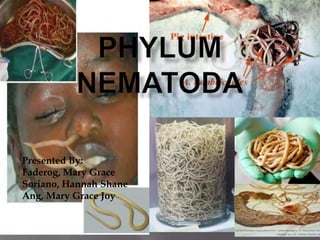
Presented By:
Faderog, Mary Grace
Soriano, Hannah Shane
Ang, Mary Grace Joy
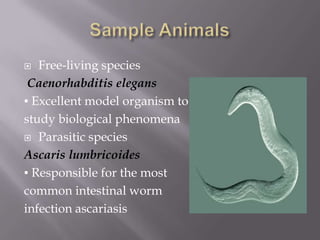
  Free-living species
 Caenorhabditis elegans
▪ Excellent model organism to
study biological phenomena
 Parasitic species

Ascaris lumbricoides
▪ Responsible for the most
common intestinal worm
infection ascariasis
Pseudocoelomate
(pseudo=false),becau
se they do not have
a true coelom. This
means that they do
have the peritoneal
cavity ( or gut), but it
is not lined with
mesoderm.
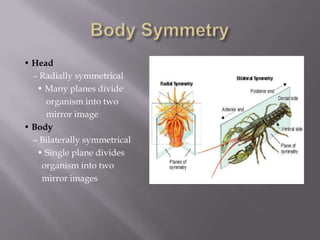
• Head
  – Radially symmetrical
   • Many planes divide
     organism into two
     mirror image
• Body
  – Bilaterally symmetrical
   • Single plane divides
    organism into two
    mirror images
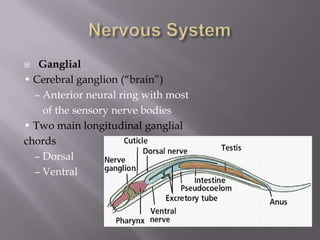
  Ganglial
• Cerebral ganglion (“brain”)
  – Anterior neural ring with most
    of the sensory nerve bodies
• Two main longitudinal ganglial
chords
  – Dorsal
  – Ventral
• Complete digestive tract with
specialized regions
   – Anterior mouth
   – Muscular and glandular pharynx
     (esophagus)
   – Long, straight midgut (intestine)
   – Rectum
   – Ventral anus
• Secretion of digestive enzymes by
phanyngeal glands
• Absorption of nutrients through
microvilli of midgut cells Excretory System
• canal along each side of
body regulates nutrients
and waste content

• excretes nitrogenous
waste in the form of
ammonia through body
Wall
• long muscles under the cuticle, aligned
  longitudinally under the epidermis, side to-side movement only (no
     crawling or lifting itself); free swimming looks like it
  is thrashing about aimlessly
• muscles activated by two nerves, one
  along ventral (belly) and one along
   dorsal (back)
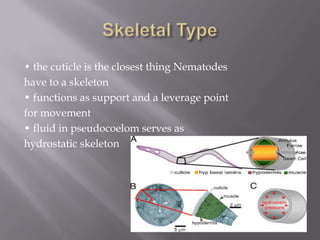
• the cuticle is the closest thing Nematodes
have to a skeleton
• functions as support and a leverage point
for movement
• fluid in pseudocoelom serves as
hydrostatic skeleton
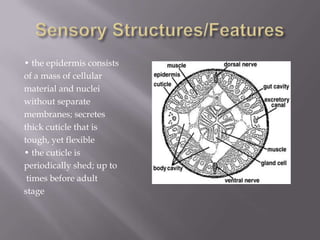
• the epidermis consists
of a mass of cellular
material and nuclei
without separate
membranes; secretes
thick cuticle that is
tough, yet flexible
• the cuticle is
periodically shed; up to
 times before adult
stage
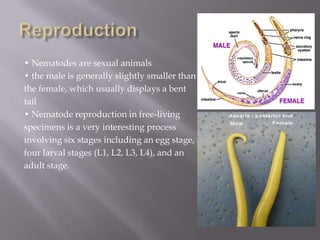
• Nematodes are sexual animals
• the male is generally slightly smaller than
the female, which usually displays a bent
tail
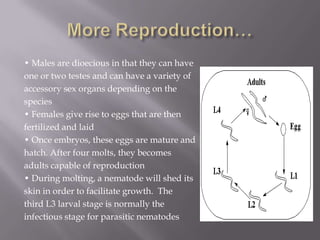
• Nematode reproduction in free-living
specimens is a very interesting process
involving six stages including an egg stage,
four larval stages (L1, L2, L3, L4), and an
adult stage.
• Males are dioecious in that they can have
one or two testes and can have a variety of
accessory sex organs depending on the
species
• Females give rise to eggs that are then
fertilized and laid
• Once embryos, these eggs are mature and
hatch. After four molts, they becomes
adults capable of reproduction
• During molting, a nematode will shed its
skin in order to facilitate growth. The
third L3 larval stage is normally the
infectious stage for parasitic nematodes
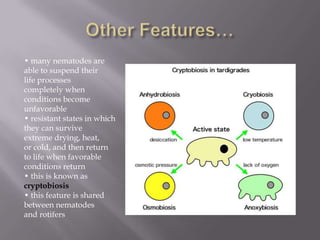
• many nematodes are
able to suspend their
life processes
completely when
conditions become
unfavorable
• resistant states in which
they can survive
extreme drying, heat,
or cold, and then return
to life when favorable
conditions return
• this is known as
cryptobiosis
• this feature is shared
between nematodes
and rotifers
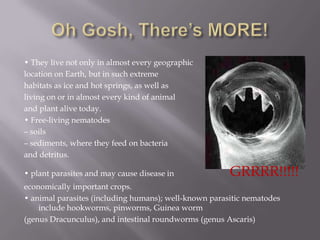
• They live not only in almost every geographic
location on Earth, but in such extreme
habitats as ice and hot springs, as well as
living on or in almost every kind of animal
and plant alive today.
• Free-living nematodes
– soils
– sediments, where they feed on bacteria
and detritus.

• plant parasites and may cause disease in             GRRRR!!!!!
economically important crops.
• animal parasites (including humans); well-known parasitic nematodes
    include hookworms, pinworms, Guinea worm
(genus Dracunculus), and intestinal roundworms (genus Ascaris)
   Ectoparasite of plants - lives outside the plant
   Endoparasite of plants - lives and breeds inside the plant having
    entered as a juvenile
   Saprophagous - juveniles and adults are free living, juveniles enter
    invertebrate animal host and cause no harm, but feed on dead tissues
    when the host dies.
   Zooparasitic juvenile stages only - juveniles parasitize a host organism
    and then leave when it becomes adult, the adult does not feed and may
    not have a functioning gut.
   Phytoparasitic juvenile, Zooparasitic adult - juvenile lives in a plant
    which is taken in by the animal host when it feeds. The adult then
    parasitizes the adult and infects the larvae of the host with juvenile
    worms which are then ready to enter and parasitize the plant host
    again.
   Zooparasitic adult females only - young live in the soil, males die after
    fertilizing females in the soil, pregnant females then enter the host
   Common name of phylum nematoda. They are among the most
    numerous of all animals.
   Round worms were given the name of nematodes because they
    resemble a thread.
   In Greek, “nematos” actually means thread hence why they are
    called nematodes.
   Roundworms are slender, unsegmented worms, with tapering
    end. They can be microscopic or up to a meter length.
   Most roundworms are free living, inhabiting soil, soil flats, aquatic
    sediments from polar to tropical regions.
   Still others are parasitic and live in host that include almost every
    kind of animal and plant.
   Unlike platyhelminthes , nematodes have a digestive tract with 2
    openings the body wall and the digestive tract, the body plan
    called “a tube within a tube”
   Cylindrical shaped
   Flexible non living cuticle
   Lack of motile cilia or flagella
   Lack of photonephridia
   Muscle of body wall run only longitudinally
   Carnivorous
   Other free living nematodes feed on phytoplankton
    such as diatoms, algae and fungi. Many terrestrial
    species feed on plant roots, penetrating the cells and
    sucking out the contents.
   Species that live in sediments and other aquatic
    environments ingesting particles of the substrate when
    they digest associated bacteria and / or organic
    material.
   Others feed more directly on dead organic material
    such as decomposing plants and animals or dung.
    Some in these environments feed on the bacteria or
    fungi that are feeding on the decomposing material.
   CLASS ADENOPHOREA (APHASMIDA; 12 ORDERS)
   Mainly free-living; without phasmids; amphids located
    posteriorly in the head region; sensory bristles and papillae on
    the head and body; excretory organ, when present, single-celled
    and without collecting tubules; males without lateral extensions
    of the tail region.
   Desmodora, Dioctophyme, Monhystera, Enoplus, Strongyloides, T
    richinella, Trichuris.
   CLASS SECERNENTEA (PHASMIDA; 8 ORDERS)
   Mostly terrestrial or parasitic; with phasmids;
    with amphids located anteriorly in the head region and opening
    and opening on lateral lips; excretory system includes collecting
    tubules; without somatic setae or papillae, except sometimes on
    the tail of males; Males often with lateral extensions of the tail
    region.
   Ancylostoma, Necator, Ascaris, Gnathostoma, Dracunculus, Filar
    ia, Camallanus, Wuchereria.

Phylum nematoda 1

  • 1.
    Presented By: Faderog, MaryGrace Soriano, Hannah Shane Ang, Mary Grace Joy
  • 2.
     Free-livingspecies Caenorhabditis elegans ▪ Excellent model organism to study biological phenomena  Parasitic species Ascaris lumbricoides ▪ Responsible for the most common intestinal worm infection ascariasis
  • 3.
    Pseudocoelomate (pseudo=false),becau se they donot have a true coelom. This means that they do have the peritoneal cavity ( or gut), but it is not lined with mesoderm.
  • 4.
    • Head – Radially symmetrical • Many planes divide organism into two mirror image • Body – Bilaterally symmetrical • Single plane divides organism into two mirror images
  • 5.
     Ganglial •Cerebral ganglion (“brain”) – Anterior neural ring with most of the sensory nerve bodies • Two main longitudinal ganglial chords – Dorsal – Ventral
  • 6.
    • Complete digestivetract with specialized regions – Anterior mouth – Muscular and glandular pharynx (esophagus) – Long, straight midgut (intestine) – Rectum – Ventral anus • Secretion of digestive enzymes by phanyngeal glands • Absorption of nutrients through microvilli of midgut cells Excretory System
  • 7.
    • canal alongeach side of body regulates nutrients and waste content • excretes nitrogenous waste in the form of ammonia through body Wall
  • 8.
    • long musclesunder the cuticle, aligned longitudinally under the epidermis, side to-side movement only (no crawling or lifting itself); free swimming looks like it is thrashing about aimlessly • muscles activated by two nerves, one along ventral (belly) and one along dorsal (back)
  • 9.
    • the cuticleis the closest thing Nematodes have to a skeleton • functions as support and a leverage point for movement • fluid in pseudocoelom serves as hydrostatic skeleton
  • 10.
    • the epidermisconsists of a mass of cellular material and nuclei without separate membranes; secretes thick cuticle that is tough, yet flexible • the cuticle is periodically shed; up to times before adult stage
  • 11.
    • Nematodes aresexual animals • the male is generally slightly smaller than the female, which usually displays a bent tail • Nematode reproduction in free-living specimens is a very interesting process involving six stages including an egg stage, four larval stages (L1, L2, L3, L4), and an adult stage.
  • 12.
    • Males aredioecious in that they can have one or two testes and can have a variety of accessory sex organs depending on the species • Females give rise to eggs that are then fertilized and laid • Once embryos, these eggs are mature and hatch. After four molts, they becomes adults capable of reproduction • During molting, a nematode will shed its skin in order to facilitate growth. The third L3 larval stage is normally the infectious stage for parasitic nematodes
  • 13.
    • many nematodesare able to suspend their life processes completely when conditions become unfavorable • resistant states in which they can survive extreme drying, heat, or cold, and then return to life when favorable conditions return • this is known as cryptobiosis • this feature is shared between nematodes and rotifers
  • 14.
    • They livenot only in almost every geographic location on Earth, but in such extreme habitats as ice and hot springs, as well as living on or in almost every kind of animal and plant alive today. • Free-living nematodes – soils – sediments, where they feed on bacteria and detritus. • plant parasites and may cause disease in GRRRR!!!!! economically important crops. • animal parasites (including humans); well-known parasitic nematodes include hookworms, pinworms, Guinea worm (genus Dracunculus), and intestinal roundworms (genus Ascaris)
  • 15.
    Ectoparasite of plants - lives outside the plant  Endoparasite of plants - lives and breeds inside the plant having entered as a juvenile  Saprophagous - juveniles and adults are free living, juveniles enter invertebrate animal host and cause no harm, but feed on dead tissues when the host dies.  Zooparasitic juvenile stages only - juveniles parasitize a host organism and then leave when it becomes adult, the adult does not feed and may not have a functioning gut.  Phytoparasitic juvenile, Zooparasitic adult - juvenile lives in a plant which is taken in by the animal host when it feeds. The adult then parasitizes the adult and infects the larvae of the host with juvenile worms which are then ready to enter and parasitize the plant host again.  Zooparasitic adult females only - young live in the soil, males die after fertilizing females in the soil, pregnant females then enter the host
  • 16.
    Common name of phylum nematoda. They are among the most numerous of all animals.  Round worms were given the name of nematodes because they resemble a thread.  In Greek, “nematos” actually means thread hence why they are called nematodes.  Roundworms are slender, unsegmented worms, with tapering end. They can be microscopic or up to a meter length.  Most roundworms are free living, inhabiting soil, soil flats, aquatic sediments from polar to tropical regions.  Still others are parasitic and live in host that include almost every kind of animal and plant.  Unlike platyhelminthes , nematodes have a digestive tract with 2 openings the body wall and the digestive tract, the body plan called “a tube within a tube”
  • 17.
    Cylindrical shaped  Flexible non living cuticle  Lack of motile cilia or flagella  Lack of photonephridia  Muscle of body wall run only longitudinally
  • 18.
    Carnivorous  Other free living nematodes feed on phytoplankton such as diatoms, algae and fungi. Many terrestrial species feed on plant roots, penetrating the cells and sucking out the contents.  Species that live in sediments and other aquatic environments ingesting particles of the substrate when they digest associated bacteria and / or organic material.  Others feed more directly on dead organic material such as decomposing plants and animals or dung. Some in these environments feed on the bacteria or fungi that are feeding on the decomposing material.
  • 19.
    CLASS ADENOPHOREA (APHASMIDA; 12 ORDERS)  Mainly free-living; without phasmids; amphids located posteriorly in the head region; sensory bristles and papillae on the head and body; excretory organ, when present, single-celled and without collecting tubules; males without lateral extensions of the tail region.  Desmodora, Dioctophyme, Monhystera, Enoplus, Strongyloides, T richinella, Trichuris.  CLASS SECERNENTEA (PHASMIDA; 8 ORDERS)  Mostly terrestrial or parasitic; with phasmids; with amphids located anteriorly in the head region and opening and opening on lateral lips; excretory system includes collecting tubules; without somatic setae or papillae, except sometimes on the tail of males; Males often with lateral extensions of the tail region.  Ancylostoma, Necator, Ascaris, Gnathostoma, Dracunculus, Filar ia, Camallanus, Wuchereria.