Platyhelminthes
Bollapalli Ashok Kumar
M.Sc.,B.Ed.,M.A(Lit)CSIR-NET,(Ph.D)
LECTURER IN ZOOLOGY
KRK Govt Degree & PG College
ADDANKI-523201
Phone:9652929696,9441635264
Email: ashokkumarzoology@gmail.com
Introduction
• triploblastic , acoelomate , bilaterally symmetrical
dorsoventrally flattened organisms
• Linnaeus included all invertebrates into one
group- Vermis except arthropods
• Leucart(1848) included all flat animals along with
nematodes and leeches into one group called
Apoda
• Later Minnot(1876) separated nematodes from
flat animals and named them as Platyhelminthes
General Characters- Platyhelminthes
• Dorso ventrally flattened
• Bilaterally symmetrical non segmentic
• Triploblastic animals . Mesenchymal tissue
supports as skeletal system and also helps in
transportation in some animals which lack
circulatory system
• These are with simple digestive system and
complex reproductive organs to suit parasitic life
General Characters- Platyhelminthes
• Aspidogaster has series of suckers on the body
• Entobdella has apair of sclerites in the centre
of the sucker
• Amphibdelloid has the compound structure in
which hooks move on opposite sides with
respective muscles
• Discocotile has four pairs clamps that help to
hold the host tissue
General Characters- Platyhelminthes
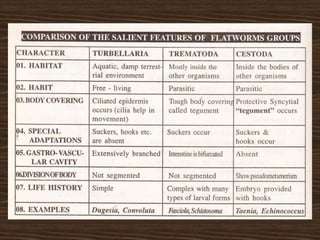
• Body wall in turbellarians is delicate and ciliated. In
trematodes and cestodes it is with cuticle and
suckers/ hooks/ both. In cestodes microvilli are also
present
• Alimentary canal is incomlete with mouth, pharynx
and intestine but anus is absent. In some animals
pharynx is simple, muscular and protrusible. The
intestine is tubular or sac like or posses two
diverticula
• Skeletal system, circulatory and respiratory sytems
are wanting
General Characters- Platyhelminthes
• Nervous system is much developed in free forms than
in parasites. Anteriorly a pair of ganglia or 1-3 pairs of
longitudinal nerve cords forms a nerve ring. In some
free forms nervous system is radially arranged which is
spread like a network just below the body wall
• Ocelli and statocysts are developed in free forms.
Polyclads and Triclads possess many ocelli on the body
or on the brain. In Rhabdocoel and Monogerians 2-4
pairs of ocelli are present. These are small dot like and
simple cup like structures which carry nerve towards
the brain. Statocysts are with calcium carbonate.
Statolyths are found in some Turbellarians to conduct
geotactile behaviour.
General Characters- Platyhelminthes
• Special excretory organs are present except in
Acoels and Polyclads. These are with flame cells
or flame sacs, excretory tubules. The flame cell
number and arrangement helps in classification
and identification of larval forms. Excretory
system is formed from protonephridia.
General Characters- Platyhelminthes
• Monoeciuos with complex reproductive system.
Seminal vesicles are meant to preserve the
sperms. The oviduct generally ends in cirrus or
with muscular penis
• Fertilisation is internal.
• Development is direct or indirect
• Some monogenians are vivparous. In some
animals, sexual reproduction and alternation of
generations are also seen.
General Characters- Platyhelminthes
• Mostly parasites. Many Turbellarians are free
forms. All tapeworms are parasites.
• Acoel animals are microscopic measuring
50mm long. Some Planarians measure 500mm
length. Flukes are 0.5 to 7.5mm long and
different tapeworms measure 3mm to 12
metres in length.
Classification- PLATYHELMINTHES
Basing on characters and habit
Platyhelminthes are classified into
three classes. They are
1. Turbellaria
2. Trematoda
3. Cestoda
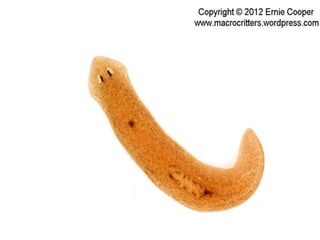
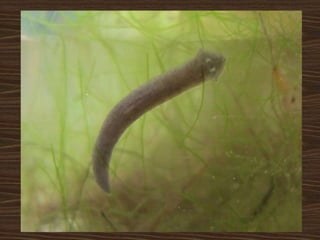
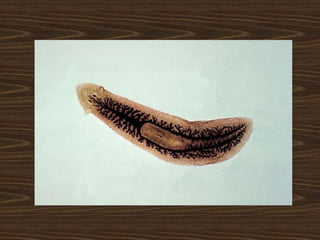
Class:1 TURBELLARIA
• Mostly free forms rarely simbionts/parasites
• Anterior end is with ocelli, sockers, antenna, sensory hair
indicating the head part
• Body has ciliated epidermis with rhabdite structure
• In some mouth is absent. If present it is on ventral side
• Simple life cycle with direct development
• In some asexual reproduction occurs
• Mullers larva may/ may not present
• Regeneration is very high
• Primarily found in water/ underwater/mud/sand/stones
• Includes 3000 species.
Class:1 TURBELLARIA
• This class includes Archopora and
Neopora which further include
Acoela,Polycladida, Rhabdocoela,
Temnocephala, Tricladella orders
• Eg: Convoluta, Planocera, Notoplana,
Thysanozoan, Microstomum,
Temnocephala, Planaria, Delora
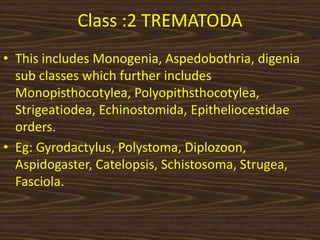
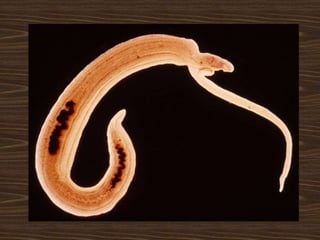
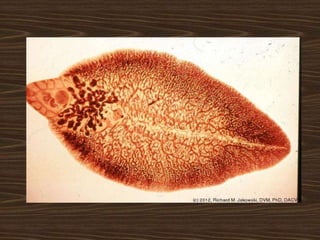
Class : 2 TREMATODA
• Flat leaf like, thin and live as ecto/ endo parasites
• Looses epidermis during development and gets
cuticular tegument. Rhabdites are absent
• Highly evolved acetabulum is at anterior and posterior
ends
• Mouth is anterior. In some animals intestine splits into
two diverticula
• Excretory system shows complex arrangement of tubes
• Life cycle may be simple/ complex
• Only one ovary is present
• Development is indirect with larval forms
Class :2 TREMATODA
• This includes Monogenia, Aspedobothria, digenia
sub classes which further includes
Monopisthocotylea, Polyopithsthocotylea,
Strigeatiodea, Echinostomida, Epitheliocestidae
orders.
• Eg: Gyrodactylus, Polystoma, Diplozoon,
Aspidogaster, Catelopsis, Schistosoma, Strugea,
Fasciola.
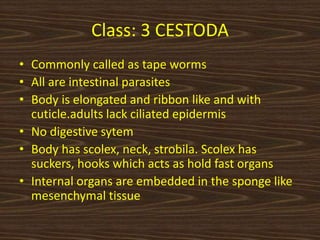
Class: 3 CESTODA
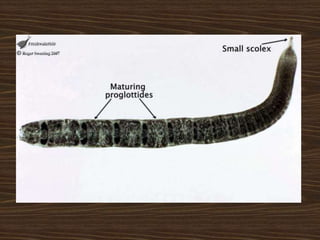
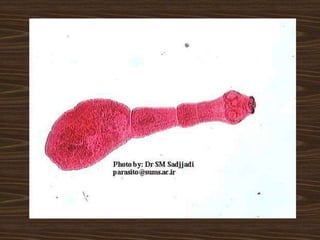
• Commonly called as tape worms
• All are intestinal parasites
• Body is elongated and ribbon like and with
cuticle.adults lack ciliated epidermis
• No digestive sytem
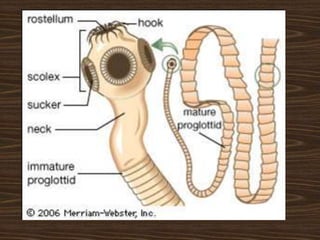
• Body has scolex, neck, strobila. Scolex has
suckers, hooks which acts as hold fast organs
• Internal organs are embedded in the sponge like
mesenchymal tissue
Class: 3 CESTODA
• Scolex internally has nerve ganglia, commissures
from which longitudinal nerves strech along the
body. The lateral nerves are very long
• Excretory system is formed by two pairs of
longitudinal tubes, flame sacs
• In each segment, 1-2 completely developed male
and female reproductive systems are present
• Embryo possess hooks. Life cycle is completed in
two or three hosts. Larval stages are present .
Class: 3 CESTODA
• This include cestodaria, Eucestoda sub classes
which further includes Amphilinidea,
Gyrocotylidea, Tetraphyllidea, Pseudophyllidea,
Trypanorhyncha, Proteocephala, Cyclophyllidea,
Diphyllidea, Nippotinidae, Lecanicephaloidea,
Aporea orders
• Eg: Echinococcus, Monogenia, Taenia,
Diphyllobothria, Tetrarhynchus, Proteocephalus,
Gangasia, Legula, Amphilina, Phyllobothrium etc.
Platyhelminthes
Platyhelminthes
Platyhelminthes
Platyhelminthes

Platyhelminthes

  • 1.
    Platyhelminthes Bollapalli Ashok Kumar M.Sc.,B.Ed.,M.A(Lit)CSIR-NET,(Ph.D) LECTURERIN ZOOLOGY KRK Govt Degree & PG College ADDANKI-523201 Phone:9652929696,9441635264 Email: ashokkumarzoology@gmail.com
  • 2.
    Introduction • triploblastic ,acoelomate , bilaterally symmetrical dorsoventrally flattened organisms • Linnaeus included all invertebrates into one group- Vermis except arthropods • Leucart(1848) included all flat animals along with nematodes and leeches into one group called Apoda • Later Minnot(1876) separated nematodes from flat animals and named them as Platyhelminthes
  • 3.
    General Characters- Platyhelminthes •Dorso ventrally flattened • Bilaterally symmetrical non segmentic • Triploblastic animals . Mesenchymal tissue supports as skeletal system and also helps in transportation in some animals which lack circulatory system • These are with simple digestive system and complex reproductive organs to suit parasitic life
  • 4.
    General Characters- Platyhelminthes •Aspidogaster has series of suckers on the body • Entobdella has apair of sclerites in the centre of the sucker • Amphibdelloid has the compound structure in which hooks move on opposite sides with respective muscles • Discocotile has four pairs clamps that help to hold the host tissue
  • 5.
    General Characters- Platyhelminthes •Body wall in turbellarians is delicate and ciliated. In trematodes and cestodes it is with cuticle and suckers/ hooks/ both. In cestodes microvilli are also present • Alimentary canal is incomlete with mouth, pharynx and intestine but anus is absent. In some animals pharynx is simple, muscular and protrusible. The intestine is tubular or sac like or posses two diverticula • Skeletal system, circulatory and respiratory sytems are wanting
  • 6.
    General Characters- Platyhelminthes •Nervous system is much developed in free forms than in parasites. Anteriorly a pair of ganglia or 1-3 pairs of longitudinal nerve cords forms a nerve ring. In some free forms nervous system is radially arranged which is spread like a network just below the body wall • Ocelli and statocysts are developed in free forms. Polyclads and Triclads possess many ocelli on the body or on the brain. In Rhabdocoel and Monogerians 2-4 pairs of ocelli are present. These are small dot like and simple cup like structures which carry nerve towards the brain. Statocysts are with calcium carbonate. Statolyths are found in some Turbellarians to conduct geotactile behaviour.
  • 7.
    General Characters- Platyhelminthes •Special excretory organs are present except in Acoels and Polyclads. These are with flame cells or flame sacs, excretory tubules. The flame cell number and arrangement helps in classification and identification of larval forms. Excretory system is formed from protonephridia.
  • 8.
    General Characters- Platyhelminthes •Monoeciuos with complex reproductive system. Seminal vesicles are meant to preserve the sperms. The oviduct generally ends in cirrus or with muscular penis • Fertilisation is internal. • Development is direct or indirect • Some monogenians are vivparous. In some animals, sexual reproduction and alternation of generations are also seen.
  • 9.
    General Characters- Platyhelminthes •Mostly parasites. Many Turbellarians are free forms. All tapeworms are parasites. • Acoel animals are microscopic measuring 50mm long. Some Planarians measure 500mm length. Flukes are 0.5 to 7.5mm long and different tapeworms measure 3mm to 12 metres in length.
  • 10.
    Classification- PLATYHELMINTHES Basing oncharacters and habit Platyhelminthes are classified into three classes. They are 1. Turbellaria 2. Trematoda 3. Cestoda
  • 11.
    Class:1 TURBELLARIA • Mostlyfree forms rarely simbionts/parasites • Anterior end is with ocelli, sockers, antenna, sensory hair indicating the head part • Body has ciliated epidermis with rhabdite structure • In some mouth is absent. If present it is on ventral side • Simple life cycle with direct development • In some asexual reproduction occurs • Mullers larva may/ may not present • Regeneration is very high • Primarily found in water/ underwater/mud/sand/stones • Includes 3000 species.
  • 12.
    Class:1 TURBELLARIA • Thisclass includes Archopora and Neopora which further include Acoela,Polycladida, Rhabdocoela, Temnocephala, Tricladella orders • Eg: Convoluta, Planocera, Notoplana, Thysanozoan, Microstomum, Temnocephala, Planaria, Delora
  • 16.
    Class : 2TREMATODA • Flat leaf like, thin and live as ecto/ endo parasites • Looses epidermis during development and gets cuticular tegument. Rhabdites are absent • Highly evolved acetabulum is at anterior and posterior ends • Mouth is anterior. In some animals intestine splits into two diverticula • Excretory system shows complex arrangement of tubes • Life cycle may be simple/ complex • Only one ovary is present • Development is indirect with larval forms
  • 17.
    Class :2 TREMATODA •This includes Monogenia, Aspedobothria, digenia sub classes which further includes Monopisthocotylea, Polyopithsthocotylea, Strigeatiodea, Echinostomida, Epitheliocestidae orders. • Eg: Gyrodactylus, Polystoma, Diplozoon, Aspidogaster, Catelopsis, Schistosoma, Strugea, Fasciola.
  • 20.
    Class: 3 CESTODA •Commonly called as tape worms • All are intestinal parasites • Body is elongated and ribbon like and with cuticle.adults lack ciliated epidermis • No digestive sytem • Body has scolex, neck, strobila. Scolex has suckers, hooks which acts as hold fast organs • Internal organs are embedded in the sponge like mesenchymal tissue
  • 21.
    Class: 3 CESTODA •Scolex internally has nerve ganglia, commissures from which longitudinal nerves strech along the body. The lateral nerves are very long • Excretory system is formed by two pairs of longitudinal tubes, flame sacs • In each segment, 1-2 completely developed male and female reproductive systems are present • Embryo possess hooks. Life cycle is completed in two or three hosts. Larval stages are present .
  • 22.
    Class: 3 CESTODA •This include cestodaria, Eucestoda sub classes which further includes Amphilinidea, Gyrocotylidea, Tetraphyllidea, Pseudophyllidea, Trypanorhyncha, Proteocephala, Cyclophyllidea, Diphyllidea, Nippotinidae, Lecanicephaloidea, Aporea orders • Eg: Echinococcus, Monogenia, Taenia, Diphyllobothria, Tetrarhynchus, Proteocephalus, Gangasia, Legula, Amphilina, Phyllobothrium etc.