The Muscular System Specialized tissue that enable the body and its parts to move.
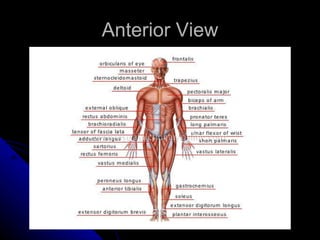
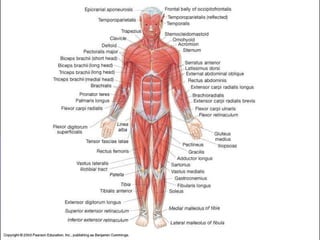
Anterior View
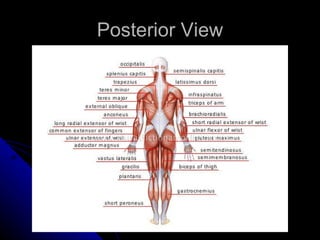
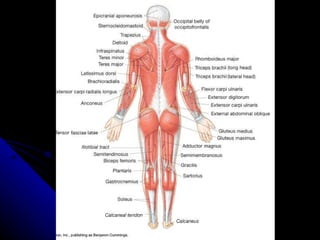
Posterior View
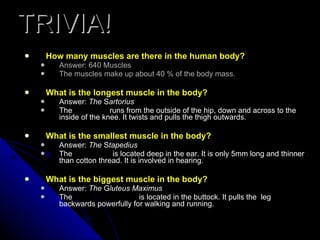
TRIVIA! How many muscles are there in the human body? Answer: 640 Muscles The muscles make up about 40 % of the body mass. What is the longest muscle in the body? Answer:  The  S artorius   The  Sartorius  runs from the outside of the hip, down and across to the inside of the knee. It twists and pulls the thigh outwards. What is the smallest muscle in the body? Answer:  The  S tapedius   The  Stapedius  is located deep in the ear. It is only 5mm long and thinner than cotton thread. It is involved in hearing. What is the biggest muscle in the body?   Answer:  The  G luteus Maximus The  Gluteus Maximus  is located in the buttock. It pulls the  leg backwards powerfully for walking and running.
Functions of the Muscles Movement Maintenance of posture and muscle tone Heat production Protects the bones and internal organs.
Muscle Classification Functionally Voluntarily – can be moved at will Involuntarily – can’t be moved intentionally Structurally Striated – have stripes across the fiber Smooth – no striations
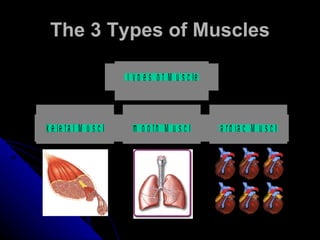
The 3 Types of Muscles
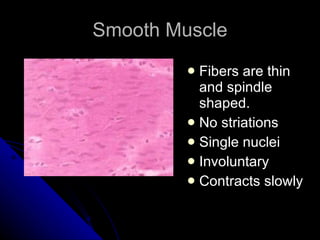
Smooth Muscle Fibers are thin and spindle shaped. No striations Single nuclei Involuntary Contracts slowly
Smooth Muscle They fatigue… but very slowly Found in the circulatory system Lining of the blood vessels Helps in the circulation of the blood Found in the digestive system Esophagus, stomach, intestine Controls digestion Found in the respiratory system Controls breathing Found in the urinary system Urinary bladder Controls urination
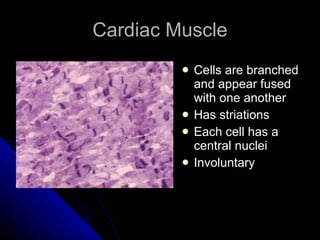
Cardiac Muscle Cells are branched and appear fused with one another Has striations Each cell has a central nuclei Involuntary
Cardiac Muscle Found ONLY in the heart Contractions of the heart muscles pump blood throughout the body and account for the heartbeat. Healthy cardiac muscle NEVER fatigues    or else…
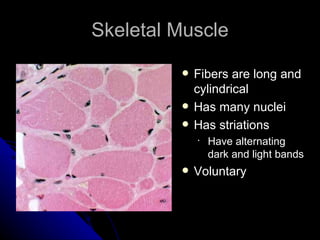
Skeletal Muscle Fibers are long and cylindrical Has many nuclei Has striations Have alternating dark and light bands Voluntary
Skeletal Muscle Attached to skeleton by tendons Causes movement of bones at the joints. And yes… they do fatigue  Muscle fatigue activity    what substance forms causing muscle fatigue???
Functions of Skeletal Muscle Movement – muscle move bones by pulling not pushing. Synergists  – any movement is generally accomplished by more than one muscle.  All of the muscles responsible for the movement are synergists.  The one that is most responsible for the movement is the  Prime Mover (agonist) .
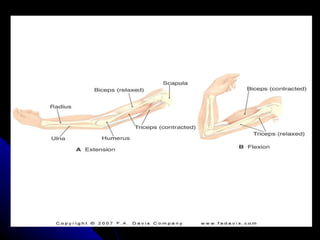
Functions of Skeletal Muscle Movement Antagonists  – muscles and muscle groups usually work in pairs  –  example the biceps flex your arm and its partner the triceps extend your arm. The two muscles are  antagonists , i.e. cause opposite actions.  –  when one contracts the other relaxes. Levators  – muscle that raise a body part.
 
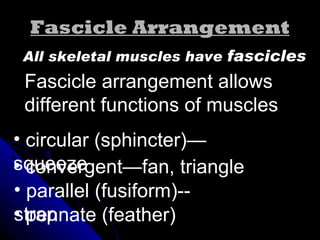
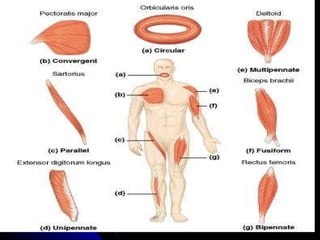
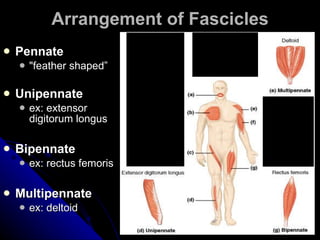
Fascicle Arrangement All skeletal muscles have  fascicles Fascicle arrangement allows  different functions of muscles parallel (fusiform)--strap pennate (feather) convergent—fan, triangle circular (sphincter)—squeeze
 
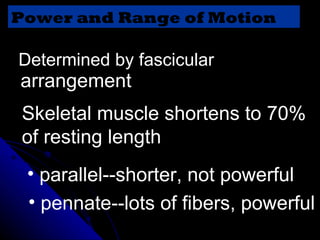
Determined by fascicular  arrangement  Skeletal muscle shortens to 70%  of resting length parallel--shorter, not powerful pennate--lots of fibers, powerful Power and Range of Motion
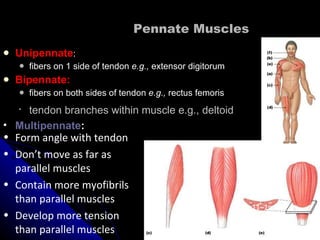
Pennate Muscles  Unipennate :  fibers on 1 side of tendon  e.g.,  extensor digitorum Bipennate:  fibers on both sides of tendon  e.g.,  rectus femoris Figure 11–1c, d, e tendon branches within muscle e.g., deltoid Multipennate : Form angle with tendon Don’t move as far as parallel muscles Contain more myofibrils than parallel muscles Develop more tension than parallel muscles
Functions of Skeletal Muscle Maintenance of posture or muscle tone We are able to maintain our body position because of tonic contractions in our skeletal muscles.  These contractions don’t produce movement yet hold our muscles in position. Heat production  – contraction of muscles produces most of the heat required to maintain body temperature.
Structure of Skeletal Muscle Composed of striated muscle cells (=muscle fibers) and connective tissue. Most muscles attach to 2 bones that have a moveable joint between them.  The attachment to the bone that does not move is the  origin .  The attachment to the bone that moves is the  insertion . Tendons  anchor muscle firmly to bones.  Tendons are made of dense fibrous connective tissue. Ligaments  connect bone to bone at a joint.
Structure of Skeletal Muscle Bursae  – small fluid filled sacs that lie between some tendons and the bones beneath them.  They are made of connective tissue and are lined with synovial membrane that secretes synovial fluid.
Structure of Skeletal Muscle Contribution of the nervous system Electrochemical impulses travel from the  frontal lobes  of the cerebrum via  motor nerves  to the muscle fibers and cause them to contract. Sensation is a function of the brain – impulses are integrated in the  parietal  lobes of the cerebrum (conscious muscle sense) and in the  cerebellum  (unconscious).  These activities promote  coordination .
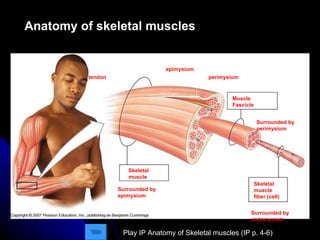
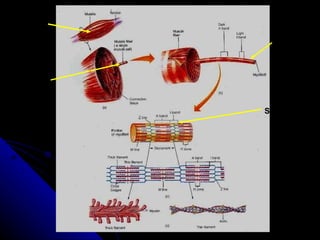
Anatomy of skeletal muscles Skeletal muscle fiber (cell) Muscle Fascicle Surrounded by   perimysium Surrounded by endomysium endomysium perimysium Skeletal muscle Surrounded by epimysium epimysium tendon Play IP Anatomy of Skeletal muscles (IP p. 4-6)
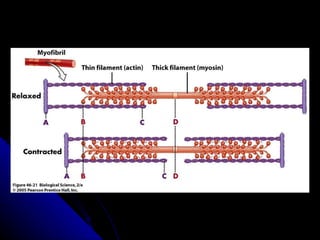
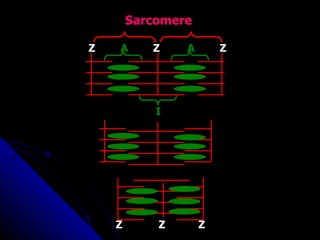
Structure of Skeletal Muscle Microscopic anatomy Muscle cells (fibers) are grouped in a highly organized way in the muscle. The membrane that surrounds the muscle cell is called the  sarcolemma . Muscle cells are filled with 2 types of fine threadlike proteins called myofilaments:  myosin  (thick) and  actin  (thin). These structures slide past each other causing the muscle cell to contract or shorten.  The myofilaments are arranged in the cells in small units called  sarcomeres .
Structure of Skeletal Muscle Neuromuscular junction Spot where the axon of a  motor nerve  nears the muscle fiber. The axon terminal does not touch the muscle but comes close.  The space between the axon and the muscle cell is called the  synapse . Within the terminal end of the axon are small sacs filled with a  neurotransmitter  called  acetylcholine .
Muscle Contraction Sequence Electrical impulse travels down a motor neuron.  When it reaches the end, acetylcholine (chemical) is released into the synapse. Acetylcholine bind to special receptors on the muscle cell and causes an electrical impulse to spread over the cell. The sarcomeres shorten and the muscle cell contracts.
MUSCLE MUSCLE FIBER MYOFIBRIL SARCOMERE
 
Sarcomere Z Z Z Z Z Z I A A
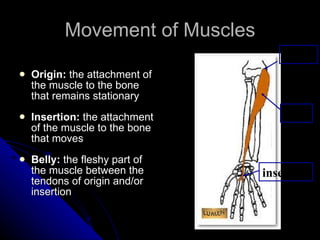
Movement of Muscles Origin:  the attachment of the muscle to the bone that remains stationary Insertion:  the attachment of the muscle to the bone that moves Belly:  the fleshy part of the muscle between the tendons of origin and/or insertion  origin insertion belly
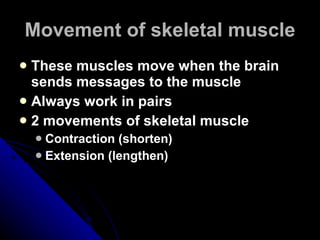
Movement of skeletal muscle These muscles move when the brain sends messages to the muscle Always work in pairs 2 movements of skeletal muscle Contraction (shorten) Extension (lengthen)
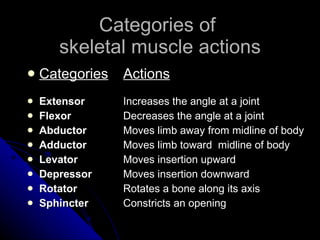
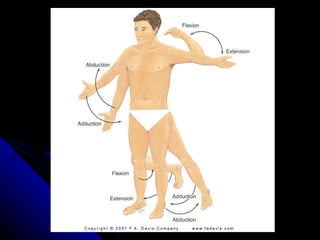
Categories of  skeletal muscle actions Categories   Actions Extensor    Increases the angle at a joint Flexor   Decreases the angle at a joint Abductor   Moves limb away from midline of body Adductor   Moves limb toward  midline of body Levator    Moves insertion upward  Depressor   Moves insertion downward Rotator   Rotates a bone along its axis Sphincter   Constricts an opening
 
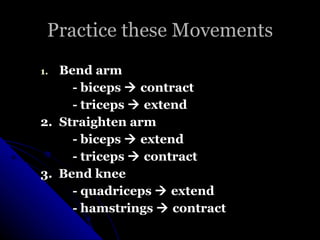
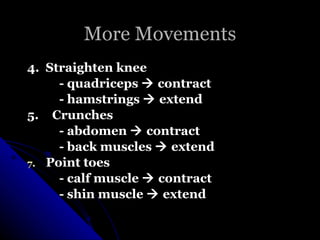
Practice these Movements Bend arm - biceps    contract - triceps    extend 2. Straighten arm - biceps    extend  - triceps    contract 3.  Bend knee - quadriceps    extend - hamstrings    contract
4.  Straighten knee   - quadriceps    contract   - hamstrings    extend 5.   Crunches - abdomen    contract - back muscles    extend Point toes - calf muscle    contract - shin muscle    extend More Movements
 
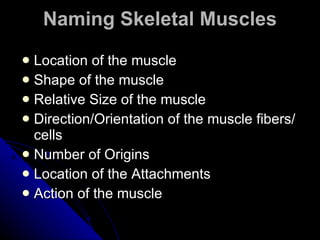
Naming Skeletal Muscles Location of the muscle Shape of the muscle Relative Size of the muscle Direction/Orientation of the muscle fibers/cells Number of Origins Location of the Attachments Action of the muscle
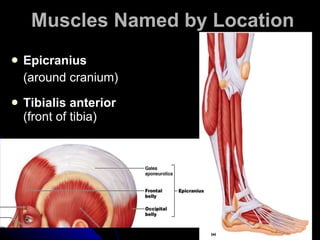
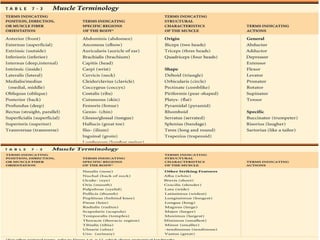
Muscles Named by Location   Epicranius   (around cranium) Tibialis anterior  (front of tibia)   tibialis anterior
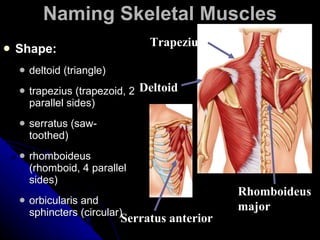
Naming Skeletal Muscles Shape:   deltoid (triangle) trapezius (trapezoid, 2 parallel sides) serratus (saw-toothed) rhomboideus (rhomboid, 4 parallel sides) orbicularis and sphincters (circular) Rhomboideus major Trapezius Deltoid Serratus anterior
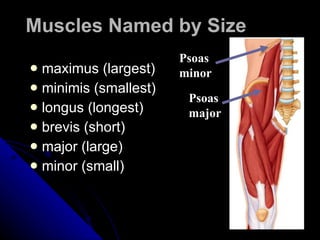
maximus (largest) minimis (smallest) longus (longest) brevis (short) major (large) minor (small) Muscles Named by Size Psoas major Psoas minor
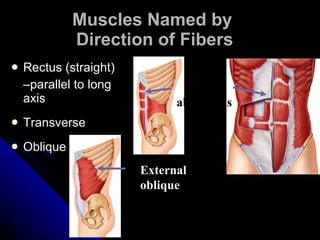
Muscles Named by  Direction of Fibers Rectus (straight)  – parallel to long axis Transverse Oblique Rectus abdominis External oblique
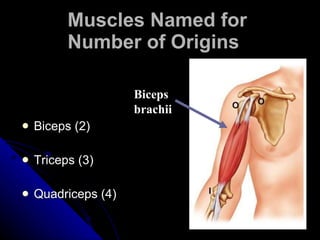
Biceps (2) Triceps (3) Quadriceps (4) Muscles Named for  Number of Origins Biceps brachii
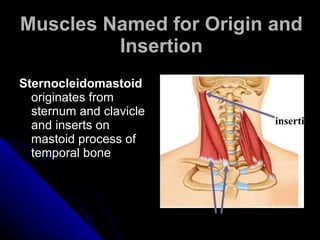
Muscles Named for Origin and Insertion Sternocleidomastoid  originates from sternum and clavicle and inserts on mastoid process of temporal bone origins insertion
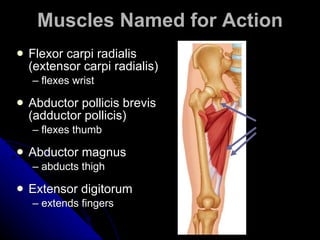
Muscles Named for Action Flexor carpi radialis (extensor carpi radialis)  –  flexes wrist Abductor pollicis brevis (adductor pollicis) –  flexes thumb Abductor magnus  –  abducts thigh Extensor digitorum  –  extends fingers Adductor magnus
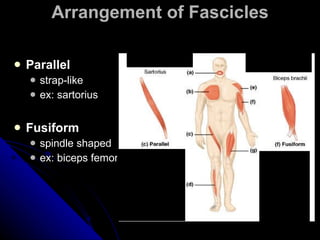
Arrangement of Fascicles Parallel   strap-like ex: sartorius Fusiform   spindle shaped ex: biceps femoris
Arrangement of Fascicles Pennate   "feather shaped” Unipennate ex: extensor digitorum longus Bipennate ex: rectus femoris  Multipennate ex: deltoid
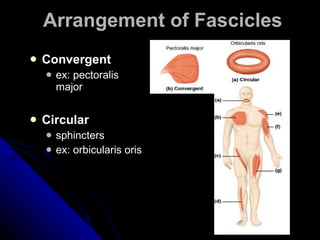
Arrangement of Fascicles Convergent ex: pectoralis major  Circular   sphincters ex: orbicularis oris
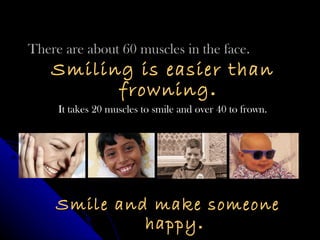
There are about 60 muscles in the face. Smiling is easier than frowning .   It takes 20 muscles to smile and over 40 to frown. Smile and make someone happy .
CLINICAL CORRELATION
Exercise-Induced Muscle Damage Intense exercise can cause muscle damage electron micrographs reveal torn sarcolemmas, damaged myofibrils an disrupted Z discs increased blood levels of myoglobin & creatine phosphate found only inside muscle cells Delayed onset muscle soreness 12 to 48 Hours after strenuous exercise stiffness, tenderness and swelling due to microscopic cell damage
Atrophy wasting away of muscles caused by disuse (disuse atrophy) or severing of the nerve supply (denervation atrophy) the transition to connective tissue can not be reversed Hypertrophy increase in the diameter of muscle fibers  resulting from very forceful, repetitive muscular activity and an increase in myofibrils, SR & mitochondria
Axial Musculature Arises from and inserts on the axial skeleton Positions the head and spinal column Moves the rib cage, assisting in breathing Axial musculature Originates and inserts on axial skeleton Appendicular musculature Stabilizes or moves components of the appendicular skeleton
 
 
Axial muscles organized into four groups Muscles of the head and neck Muscles of the vertebral column Oblique and rectus muscles Muscles of the pelvic floor
Muscles of the Head and Neck Muscles of facial expression Extrinsic eye muscles Muscles of mastication Muscles of the tongue Muscles of the pharynx Muscles of the anterior neck
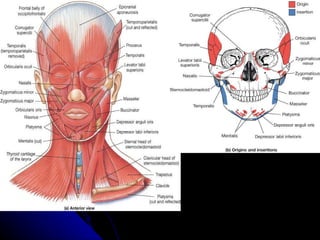
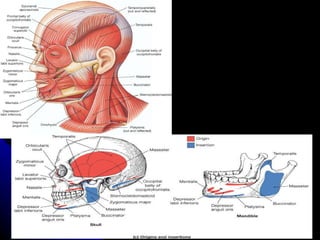
Muscles of Facial Expression Originate on surface of skull Largest group associated with mouth Orbicularis oris Buccinator Occipitofrontalis muscle Movement of eyebrows, forehead, scalp Platysma Skin of neck, depresses mandible
 
 
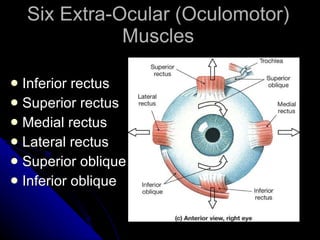
Six Extra-Ocular (Oculomotor) Muscles Inferior rectus Superior rectus Medial rectus Lateral rectus Superior oblique Inferior oblique
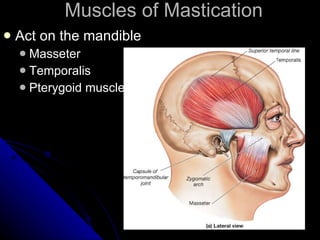
Muscles of Mastication Act on the mandible Masseter Temporalis Pterygoid muscles
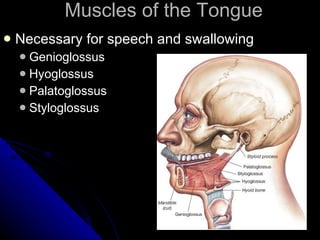
Muscles of the Tongue Necessary for speech and swallowing Genioglossus Hyoglossus Palatoglossus Styloglossus
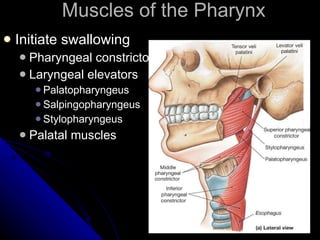
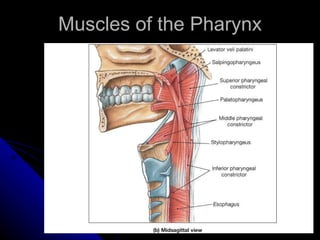
Muscles of the Pharynx Initiate swallowing Pharyngeal constrictors Laryngeal elevators Palatopharyngeus Salpingopharyngeus Stylopharyngeus Palatal muscles
Muscles of the Pharynx
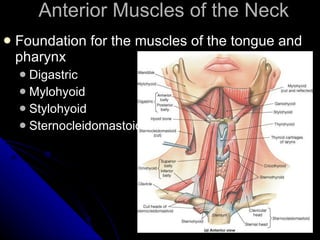
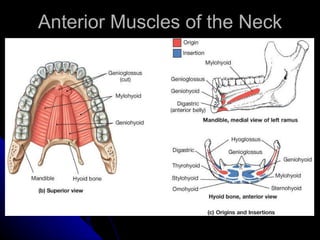
Anterior Muscles of the Neck Foundation for the muscles of the tongue and pharynx Digastric Mylohyoid Stylohyoid Sternocleidomastoid
Anterior Muscles of the Neck
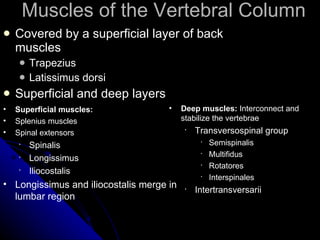
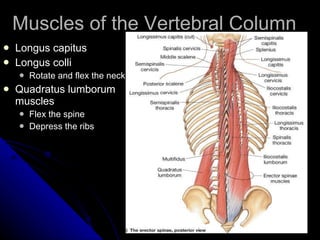
Muscles of the Vertebral Column Covered by a superficial layer of back muscles Trapezius Latissimus dorsi Superficial and deep layers Superficial muscles: Splenius muscles Spinal extensors Spinalis Longissimus Iliocostalis Longissimus and iliocostalis merge in lumbar region Deep muscles:  Interconnect and stabilize the vertebrae Transversospinal group Semispinalis Multifidus Rotatores Interspinales Intertransversarii
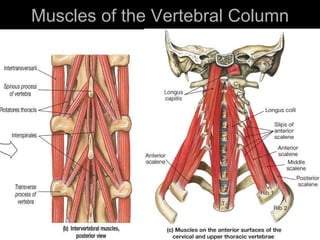
Muscles of the Vertebral Column Longus capitus Longus colli Rotate and flex the neck Quadratus lumborum muscles Flex the spine Depress the ribs
Muscles of the Vertebral Column
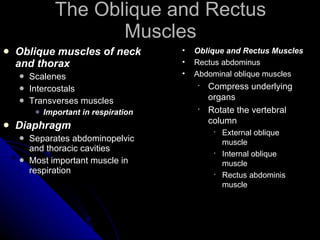
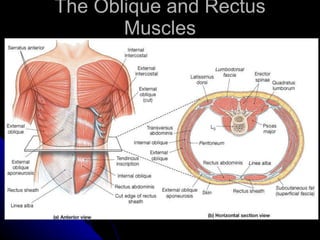
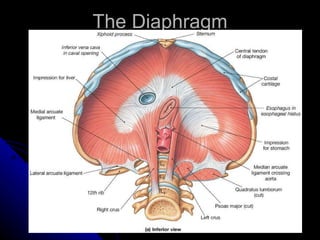
Oblique muscles of neck and thorax Scalenes Intercostals Transverses muscles Important in respiration Diaphragm   Separates abdominopelvic and thoracic cavities Most important muscle in respiration The Oblique and Rectus Muscles Oblique and Rectus Muscles   Rectus abdominus Abdominal oblique muscles  Compress underlying organs Rotate the vertebral column External oblique muscle Internal oblique muscle Rectus abdominis muscle
The Oblique and Rectus Muscles
The Diaphragm
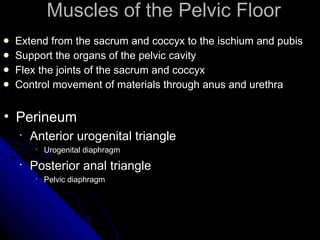
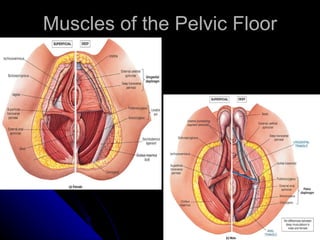
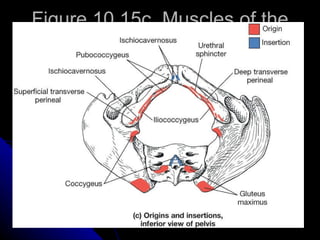
Muscles of the Pelvic Floor Extend from the sacrum and coccyx to the ischium and pubis Support the organs of the pelvic cavity Flex the joints of the sacrum and coccyx Control movement of materials through anus and urethra Perineum Anterior urogenital triangle Urogenital diaphragm Posterior anal triangle Pelvic diaphragm
Muscles of the Pelvic Floor
Figure 10.15c  Muscles of the Pelvic Floor
Appendicular musculature is responsible for Stabilizing pectoral girdle Stabilizing pelvic girdle Moving upper and lower limbs Four groups of muscles Muscles that position the pectoral girdle Muscles that move the arm Muscles that move the forearm and hand Muscles that move the hand and fingers
Muscles that move the pectoral girdle Trapezius muscle Affects position of pectoral girdle, neck, head Rhomboid muscles Adducts scapula Deep to trapezius Inserts on scapula Levator scapulae muscle Elevates scapula Serratus anterior muscle Abducts scapula Swings shoulder anteriorly Originates on ribs Subclavius and pectoralis minor muscles Arise along ventral surface of ribs Depress and protract shoulder
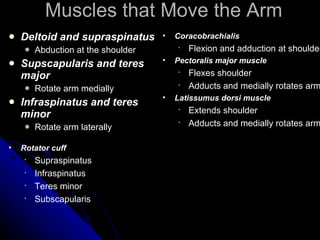
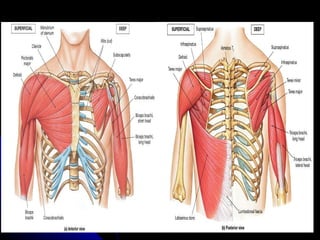
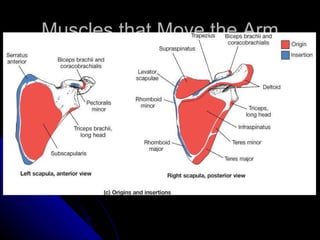
Muscles that Move the Arm Deltoid and supraspinatus Abduction at the shoulder Supscapularis and teres major Rotate arm medially Infraspinatus and teres minor Rotate arm laterally Rotator cuff   Supraspinatus Infraspinatus Teres minor Subscapularis Coracobrachialis Flexion and adduction at shoulder Pectoralis major muscle Flexes shoulder Adducts and medially rotates arm Latissumus dorsi muscle Extends shoulder Adducts and medially rotates arm
 
Muscles that Move the Arm
Muscles of the pelvic girdle and lower limbs Three groups Muscles that move the thighs Muscles that move the leg Muscles that move the foot and toes
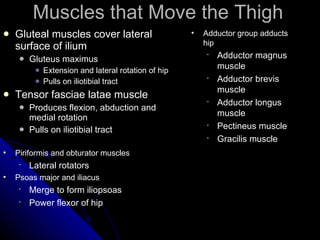
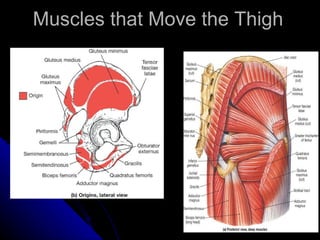
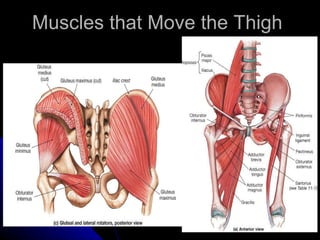
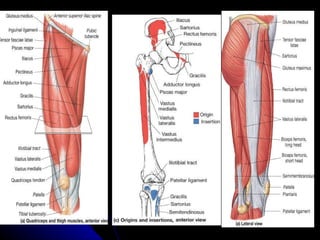
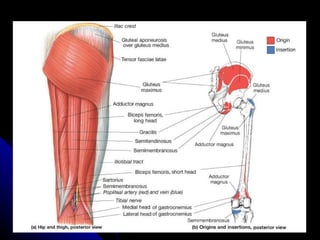
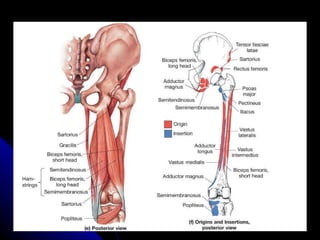
Muscles that Move the Thigh Gluteal muscles cover lateral surface of ilium Gluteus maximus Extension and lateral rotation of hip Pulls on iliotibial tract Tensor fasciae latae muscle Produces flexion, abduction and medial rotation Pulls on iliotibial tract Piriformis and obturator muscles Lateral rotators Psoas major and iliacus  Merge to form iliopsoas Power flexor of hip Adductor group adducts hip Adductor magnus muscle Adductor brevis muscle Adductor longus muscle Pectineus muscle Gracilis muscle
Muscles that Move the Thigh
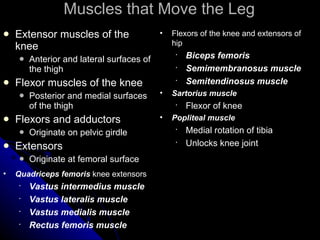
Muscles that Move the Leg Extensor muscles of the knee  Anterior and lateral surfaces of the thigh Flexor muscles of the knee Posterior and medial surfaces of the thigh Flexors and adductors Originate on pelvic girdle Extensors Originate at femoral surface Flexors of the knee and extensors of hip Biceps femoris Semimembranosus muscle Semitendinosus muscle Sartorius muscle Flexor of knee Popliteal muscle Medial rotation of tibia Unlocks knee joint Quadriceps femoris  knee extensors Vastus intermedius muscle Vastus lateralis muscle Vastus medialis muscle Rectus femoris muscle


Muscles that Move the Foot and Toes Gastrocnemius and soleus muscles Plantar flexion Tibialis anterior Dorsiflexion Fibularis muscles Eversion and plantar flexion Smaller muscles of calf and shin Position foot Move toes Precise control of phalanges Muscles on tarsal and metatarsal bones
Muscles that Move the Forearm and Hand Biceps brachii  Flexes elbow Supinates forearm Triceps brachii Extends elbow
Muscles that Move the Forearm and Hand Brachialis and brachioradialis Flex the elbow Anconeus muscle and triceps brachii Extend the elbow (oppose brachialis) Flexor carpi ulnaris, flexor carpi radialis, palmaris longus Flex the wrist Flexor carpi ulnaris adducts wrist Flexor carpi radialis abducts wrist Extensor carpi radialis muscle Abducts and extends wrist Extensor carpi ulnaris muscle Adducts and extends wrist Pronator teres, pronator quadratus muscles Pronate forearm without flexion or extension Suppinator muscle Opposes pronator muscles
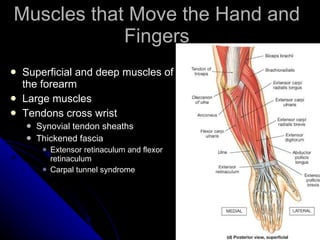
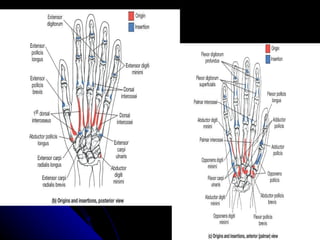
Muscles that Move the Hand and Fingers Superficial and deep muscles of the forearm  Large muscles Tendons cross wrist Synovial tendon sheaths Thickened fascia Extensor retinaculum and flexor retinaculum Carpal tunnel syndrome
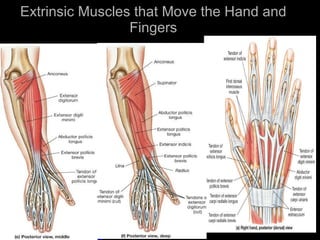
Extrinsic Muscles that Move the Hand and Fingers
 
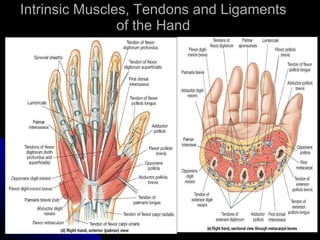
Intrinsic Muscles, Tendons and Ligaments of the Hand

Muscular System

  • 1.
    The Muscular SystemSpecialized tissue that enable the body and its parts to move.
  • 2.
  • 3.
  • 4.
    TRIVIA! How manymuscles are there in the human body? Answer: 640 Muscles The muscles make up about 40 % of the body mass. What is the longest muscle in the body? Answer: The S artorius The Sartorius runs from the outside of the hip, down and across to the inside of the knee. It twists and pulls the thigh outwards. What is the smallest muscle in the body? Answer: The S tapedius The Stapedius is located deep in the ear. It is only 5mm long and thinner than cotton thread. It is involved in hearing. What is the biggest muscle in the body? Answer: The G luteus Maximus The Gluteus Maximus is located in the buttock. It pulls the leg backwards powerfully for walking and running.
  • 5.
    Functions of theMuscles Movement Maintenance of posture and muscle tone Heat production Protects the bones and internal organs.
  • 6.
    Muscle Classification FunctionallyVoluntarily – can be moved at will Involuntarily – can’t be moved intentionally Structurally Striated – have stripes across the fiber Smooth – no striations
  • 7.
    The 3 Typesof Muscles
  • 8.
    Smooth Muscle Fibersare thin and spindle shaped. No striations Single nuclei Involuntary Contracts slowly
  • 9.
    Smooth Muscle Theyfatigue… but very slowly Found in the circulatory system Lining of the blood vessels Helps in the circulation of the blood Found in the digestive system Esophagus, stomach, intestine Controls digestion Found in the respiratory system Controls breathing Found in the urinary system Urinary bladder Controls urination
  • 10.
    Cardiac Muscle Cellsare branched and appear fused with one another Has striations Each cell has a central nuclei Involuntary
  • 11.
    Cardiac Muscle FoundONLY in the heart Contractions of the heart muscles pump blood throughout the body and account for the heartbeat. Healthy cardiac muscle NEVER fatigues  or else…
  • 12.
    Skeletal Muscle Fibersare long and cylindrical Has many nuclei Has striations Have alternating dark and light bands Voluntary
  • 13.
    Skeletal Muscle Attachedto skeleton by tendons Causes movement of bones at the joints. And yes… they do fatigue Muscle fatigue activity  what substance forms causing muscle fatigue???
  • 14.
    Functions of SkeletalMuscle Movement – muscle move bones by pulling not pushing. Synergists – any movement is generally accomplished by more than one muscle. All of the muscles responsible for the movement are synergists. The one that is most responsible for the movement is the Prime Mover (agonist) .
  • 15.
    Functions of SkeletalMuscle Movement Antagonists – muscles and muscle groups usually work in pairs – example the biceps flex your arm and its partner the triceps extend your arm. The two muscles are antagonists , i.e. cause opposite actions. – when one contracts the other relaxes. Levators – muscle that raise a body part.
  • 16.
  • 17.
    Fascicle Arrangement Allskeletal muscles have fascicles Fascicle arrangement allows different functions of muscles parallel (fusiform)--strap pennate (feather) convergent—fan, triangle circular (sphincter)—squeeze
  • 18.
  • 19.
    Determined by fascicular arrangement Skeletal muscle shortens to 70% of resting length parallel--shorter, not powerful pennate--lots of fibers, powerful Power and Range of Motion
  • 20.
    Pennate Muscles Unipennate : fibers on 1 side of tendon e.g., extensor digitorum Bipennate: fibers on both sides of tendon e.g., rectus femoris Figure 11–1c, d, e tendon branches within muscle e.g., deltoid Multipennate : Form angle with tendon Don’t move as far as parallel muscles Contain more myofibrils than parallel muscles Develop more tension than parallel muscles
  • 21.
    Functions of SkeletalMuscle Maintenance of posture or muscle tone We are able to maintain our body position because of tonic contractions in our skeletal muscles. These contractions don’t produce movement yet hold our muscles in position. Heat production – contraction of muscles produces most of the heat required to maintain body temperature.
  • 22.
    Structure of SkeletalMuscle Composed of striated muscle cells (=muscle fibers) and connective tissue. Most muscles attach to 2 bones that have a moveable joint between them. The attachment to the bone that does not move is the origin . The attachment to the bone that moves is the insertion . Tendons anchor muscle firmly to bones. Tendons are made of dense fibrous connective tissue. Ligaments connect bone to bone at a joint.
  • 23.
    Structure of SkeletalMuscle Bursae – small fluid filled sacs that lie between some tendons and the bones beneath them. They are made of connective tissue and are lined with synovial membrane that secretes synovial fluid.
  • 24.
    Structure of SkeletalMuscle Contribution of the nervous system Electrochemical impulses travel from the frontal lobes of the cerebrum via motor nerves to the muscle fibers and cause them to contract. Sensation is a function of the brain – impulses are integrated in the parietal lobes of the cerebrum (conscious muscle sense) and in the cerebellum (unconscious). These activities promote coordination .
  • 25.
    Anatomy of skeletalmuscles Skeletal muscle fiber (cell) Muscle Fascicle Surrounded by perimysium Surrounded by endomysium endomysium perimysium Skeletal muscle Surrounded by epimysium epimysium tendon Play IP Anatomy of Skeletal muscles (IP p. 4-6)
  • 26.
    Structure of SkeletalMuscle Microscopic anatomy Muscle cells (fibers) are grouped in a highly organized way in the muscle. The membrane that surrounds the muscle cell is called the sarcolemma . Muscle cells are filled with 2 types of fine threadlike proteins called myofilaments: myosin (thick) and actin (thin). These structures slide past each other causing the muscle cell to contract or shorten. The myofilaments are arranged in the cells in small units called sarcomeres .
  • 27.
    Structure of SkeletalMuscle Neuromuscular junction Spot where the axon of a motor nerve nears the muscle fiber. The axon terminal does not touch the muscle but comes close. The space between the axon and the muscle cell is called the synapse . Within the terminal end of the axon are small sacs filled with a neurotransmitter called acetylcholine .
  • 28.
    Muscle Contraction SequenceElectrical impulse travels down a motor neuron. When it reaches the end, acetylcholine (chemical) is released into the synapse. Acetylcholine bind to special receptors on the muscle cell and causes an electrical impulse to spread over the cell. The sarcomeres shorten and the muscle cell contracts.
  • 29.
    MUSCLE MUSCLE FIBERMYOFIBRIL SARCOMERE
  • 30.
  • 31.
    Sarcomere Z ZZ Z Z Z I A A
  • 32.
    Movement of MusclesOrigin: the attachment of the muscle to the bone that remains stationary Insertion: the attachment of the muscle to the bone that moves Belly: the fleshy part of the muscle between the tendons of origin and/or insertion origin insertion belly
  • 33.
    Movement of skeletalmuscle These muscles move when the brain sends messages to the muscle Always work in pairs 2 movements of skeletal muscle Contraction (shorten) Extension (lengthen)
  • 34.
    Categories of skeletal muscle actions Categories Actions Extensor Increases the angle at a joint Flexor Decreases the angle at a joint Abductor Moves limb away from midline of body Adductor Moves limb toward midline of body Levator Moves insertion upward Depressor Moves insertion downward Rotator Rotates a bone along its axis Sphincter Constricts an opening
  • 35.
  • 36.
    Practice these MovementsBend arm - biceps  contract - triceps  extend 2. Straighten arm - biceps  extend - triceps  contract 3. Bend knee - quadriceps  extend - hamstrings  contract
  • 37.
    4. Straightenknee - quadriceps  contract - hamstrings  extend 5. Crunches - abdomen  contract - back muscles  extend Point toes - calf muscle  contract - shin muscle  extend More Movements
  • 38.
  • 39.
    Naming Skeletal MusclesLocation of the muscle Shape of the muscle Relative Size of the muscle Direction/Orientation of the muscle fibers/cells Number of Origins Location of the Attachments Action of the muscle
  • 40.
    Muscles Named byLocation Epicranius (around cranium) Tibialis anterior (front of tibia) tibialis anterior
  • 41.
    Naming Skeletal MusclesShape: deltoid (triangle) trapezius (trapezoid, 2 parallel sides) serratus (saw-toothed) rhomboideus (rhomboid, 4 parallel sides) orbicularis and sphincters (circular) Rhomboideus major Trapezius Deltoid Serratus anterior
  • 42.
    maximus (largest) minimis(smallest) longus (longest) brevis (short) major (large) minor (small) Muscles Named by Size Psoas major Psoas minor
  • 43.
    Muscles Named by Direction of Fibers Rectus (straight) – parallel to long axis Transverse Oblique Rectus abdominis External oblique
  • 44.
    Biceps (2) Triceps(3) Quadriceps (4) Muscles Named for Number of Origins Biceps brachii
  • 45.
    Muscles Named forOrigin and Insertion Sternocleidomastoid originates from sternum and clavicle and inserts on mastoid process of temporal bone origins insertion
  • 46.
    Muscles Named forAction Flexor carpi radialis (extensor carpi radialis) – flexes wrist Abductor pollicis brevis (adductor pollicis) – flexes thumb Abductor magnus – abducts thigh Extensor digitorum – extends fingers Adductor magnus
  • 47.
    Arrangement of FasciclesParallel strap-like ex: sartorius Fusiform spindle shaped ex: biceps femoris
  • 48.
    Arrangement of FasciclesPennate "feather shaped” Unipennate ex: extensor digitorum longus Bipennate ex: rectus femoris Multipennate ex: deltoid
  • 49.
    Arrangement of FasciclesConvergent ex: pectoralis major Circular sphincters ex: orbicularis oris
  • 50.
    There are about60 muscles in the face. Smiling is easier than frowning . It takes 20 muscles to smile and over 40 to frown. Smile and make someone happy .
  • 51.
  • 52.
    Exercise-Induced Muscle DamageIntense exercise can cause muscle damage electron micrographs reveal torn sarcolemmas, damaged myofibrils an disrupted Z discs increased blood levels of myoglobin & creatine phosphate found only inside muscle cells Delayed onset muscle soreness 12 to 48 Hours after strenuous exercise stiffness, tenderness and swelling due to microscopic cell damage
  • 53.
    Atrophy wasting awayof muscles caused by disuse (disuse atrophy) or severing of the nerve supply (denervation atrophy) the transition to connective tissue can not be reversed Hypertrophy increase in the diameter of muscle fibers resulting from very forceful, repetitive muscular activity and an increase in myofibrils, SR & mitochondria
  • 54.
    Axial Musculature Arisesfrom and inserts on the axial skeleton Positions the head and spinal column Moves the rib cage, assisting in breathing Axial musculature Originates and inserts on axial skeleton Appendicular musculature Stabilizes or moves components of the appendicular skeleton
  • 55.
  • 56.
  • 57.
    Axial muscles organizedinto four groups Muscles of the head and neck Muscles of the vertebral column Oblique and rectus muscles Muscles of the pelvic floor
  • 58.
    Muscles of theHead and Neck Muscles of facial expression Extrinsic eye muscles Muscles of mastication Muscles of the tongue Muscles of the pharynx Muscles of the anterior neck
  • 59.
    Muscles of FacialExpression Originate on surface of skull Largest group associated with mouth Orbicularis oris Buccinator Occipitofrontalis muscle Movement of eyebrows, forehead, scalp Platysma Skin of neck, depresses mandible
  • 60.
  • 61.
  • 62.
    Six Extra-Ocular (Oculomotor)Muscles Inferior rectus Superior rectus Medial rectus Lateral rectus Superior oblique Inferior oblique
  • 63.
    Muscles of MasticationAct on the mandible Masseter Temporalis Pterygoid muscles
  • 64.
    Muscles of theTongue Necessary for speech and swallowing Genioglossus Hyoglossus Palatoglossus Styloglossus
  • 65.
    Muscles of thePharynx Initiate swallowing Pharyngeal constrictors Laryngeal elevators Palatopharyngeus Salpingopharyngeus Stylopharyngeus Palatal muscles
  • 66.
  • 67.
    Anterior Muscles ofthe Neck Foundation for the muscles of the tongue and pharynx Digastric Mylohyoid Stylohyoid Sternocleidomastoid
  • 68.
  • 69.
    Muscles of theVertebral Column Covered by a superficial layer of back muscles Trapezius Latissimus dorsi Superficial and deep layers Superficial muscles: Splenius muscles Spinal extensors Spinalis Longissimus Iliocostalis Longissimus and iliocostalis merge in lumbar region Deep muscles: Interconnect and stabilize the vertebrae Transversospinal group Semispinalis Multifidus Rotatores Interspinales Intertransversarii
  • 70.
    Muscles of theVertebral Column Longus capitus Longus colli Rotate and flex the neck Quadratus lumborum muscles Flex the spine Depress the ribs
  • 71.
    Muscles of theVertebral Column
  • 72.
    Oblique muscles ofneck and thorax Scalenes Intercostals Transverses muscles Important in respiration Diaphragm Separates abdominopelvic and thoracic cavities Most important muscle in respiration The Oblique and Rectus Muscles Oblique and Rectus Muscles Rectus abdominus Abdominal oblique muscles Compress underlying organs Rotate the vertebral column External oblique muscle Internal oblique muscle Rectus abdominis muscle
  • 73.
    The Oblique andRectus Muscles
  • 74.
  • 75.
    Muscles of thePelvic Floor Extend from the sacrum and coccyx to the ischium and pubis Support the organs of the pelvic cavity Flex the joints of the sacrum and coccyx Control movement of materials through anus and urethra Perineum Anterior urogenital triangle Urogenital diaphragm Posterior anal triangle Pelvic diaphragm
  • 76.
    Muscles of thePelvic Floor
  • 77.
    Figure 10.15c Muscles of the Pelvic Floor
  • 78.
    Appendicular musculature isresponsible for Stabilizing pectoral girdle Stabilizing pelvic girdle Moving upper and lower limbs Four groups of muscles Muscles that position the pectoral girdle Muscles that move the arm Muscles that move the forearm and hand Muscles that move the hand and fingers
  • 79.
    Muscles that movethe pectoral girdle Trapezius muscle Affects position of pectoral girdle, neck, head Rhomboid muscles Adducts scapula Deep to trapezius Inserts on scapula Levator scapulae muscle Elevates scapula Serratus anterior muscle Abducts scapula Swings shoulder anteriorly Originates on ribs Subclavius and pectoralis minor muscles Arise along ventral surface of ribs Depress and protract shoulder
  • 80.
    Muscles that Movethe Arm Deltoid and supraspinatus Abduction at the shoulder Supscapularis and teres major Rotate arm medially Infraspinatus and teres minor Rotate arm laterally Rotator cuff Supraspinatus Infraspinatus Teres minor Subscapularis Coracobrachialis Flexion and adduction at shoulder Pectoralis major muscle Flexes shoulder Adducts and medially rotates arm Latissumus dorsi muscle Extends shoulder Adducts and medially rotates arm
  • 81.
  • 82.
  • 83.
    Muscles of thepelvic girdle and lower limbs Three groups Muscles that move the thighs Muscles that move the leg Muscles that move the foot and toes
  • 84.
    Muscles that Movethe Thigh Gluteal muscles cover lateral surface of ilium Gluteus maximus Extension and lateral rotation of hip Pulls on iliotibial tract Tensor fasciae latae muscle Produces flexion, abduction and medial rotation Pulls on iliotibial tract Piriformis and obturator muscles Lateral rotators Psoas major and iliacus Merge to form iliopsoas Power flexor of hip Adductor group adducts hip Adductor magnus muscle Adductor brevis muscle Adductor longus muscle Pectineus muscle Gracilis muscle
  • 85.
  • 86.
  • 87.
    Muscles that Movethe Leg Extensor muscles of the knee Anterior and lateral surfaces of the thigh Flexor muscles of the knee Posterior and medial surfaces of the thigh Flexors and adductors Originate on pelvic girdle Extensors Originate at femoral surface Flexors of the knee and extensors of hip Biceps femoris Semimembranosus muscle Semitendinosus muscle Sartorius muscle Flexor of knee Popliteal muscle Medial rotation of tibia Unlocks knee joint Quadriceps femoris knee extensors Vastus intermedius muscle Vastus lateralis muscle Vastus medialis muscle Rectus femoris muscle
  • 88.
  • 89.
  • 90.
  • 91.
    Muscles that Movethe Foot and Toes Gastrocnemius and soleus muscles Plantar flexion Tibialis anterior Dorsiflexion Fibularis muscles Eversion and plantar flexion Smaller muscles of calf and shin Position foot Move toes Precise control of phalanges Muscles on tarsal and metatarsal bones
  • 92.
    Muscles that Movethe Forearm and Hand Biceps brachii Flexes elbow Supinates forearm Triceps brachii Extends elbow
  • 93.
    Muscles that Movethe Forearm and Hand Brachialis and brachioradialis Flex the elbow Anconeus muscle and triceps brachii Extend the elbow (oppose brachialis) Flexor carpi ulnaris, flexor carpi radialis, palmaris longus Flex the wrist Flexor carpi ulnaris adducts wrist Flexor carpi radialis abducts wrist Extensor carpi radialis muscle Abducts and extends wrist Extensor carpi ulnaris muscle Adducts and extends wrist Pronator teres, pronator quadratus muscles Pronate forearm without flexion or extension Suppinator muscle Opposes pronator muscles
  • 94.
    Muscles that Movethe Hand and Fingers Superficial and deep muscles of the forearm Large muscles Tendons cross wrist Synovial tendon sheaths Thickened fascia Extensor retinaculum and flexor retinaculum Carpal tunnel syndrome
  • 95.
    Extrinsic Muscles thatMove the Hand and Fingers
  • 96.
  • 97.
    Intrinsic Muscles, Tendonsand Ligaments of the Hand