Medical Terminology
Presenter: Dr. Rahul Sharma
Bpt ( JMI)
MSc.ANATOMY
AIIMS, RISHIKESH
01-05-2021 1
Contents
• Introduction
• Positions of body
• Anatomical planes
• Anatomical axis
• Terms Used in Relation to Trunk
• Terms related to body movements
Upper limb
Lower limb
Neck
• In trunk
• Muscle
• Term used in muscles
• Summary
• MCQs
• References
01-05-2021 2
Introduction
• Anatomy – science deals with structure of body, from macroscopic to
microscopic level
• Anatome = (Greek anatomē, 'dissection') is the branch of biology
concerned with the study of the structure of organisms and their
parts
• Anatomical Nomenclature = to eliminate unambiguous description of
thousands of structures is impossible without an extensive and often
highly specialized vocabulary.
01-05-2021 3
Approach To Study Anatomy
1. Regional anatomy
2. Systemic anatomy
3. Clinical (applied anatomy)
01-05-2021 4
Regional Anatomy
• Human body as major part or segment
01-05-2021 5
Surface Anatomy
• Provide knowledge , what lies under the skin.
01-05-2021 6
• By means of radio graphical, sectional anatomy and endoscopy
01-05-2021 7
Systemic Anatomy
Study of body’s organ systems work together to carry out complex
function.
1. Integumentary system
2. Skeletal system
3. Articular system
4. Muscular system
5. Nervous system
6. Circulatory system
7. Alimentary system
8. Respiratory system
9. Urinary system
10. Genital system
11. Endocrine system
01-05-2021 8
Clinical Anatomy(Applied Anatomy)
• Incorporates regional and systemic approaches.
• Important in role of solving clinical problem.
01-05-2021 9
Anatomical position
Anatomical position:
•person is standing straight
•Eyes looking forwards
• Both arms by the side of body
•palms facing forwards
• Both feet together, the position is
anatomical position
01-05-2021 10
Supine position
When a person is lying on her/his back, arms by the side,
palms facing upwards and feet put together, the position is
supine position
01-05-2021 11
Prone position
• Prone position: Person lying on his/her face, chest and
abdomen is said to be in prone position
01-05-2021 12
Lateral recumbent position
01-05-2021 13
Lithotomic position
Person lying on her back with legs up and feet supported
in straps. This position is mostly used during delivery of
the baby
01-05-2021 14
Fowler’s position
01-05-2021 15
Anatomical planes
• Plane – hypothetical plane used to transect body to locate structures
or direction of movement
• Axis – an imaginary line about which a body rotates
anatomical planes:
1) Sagittal plane
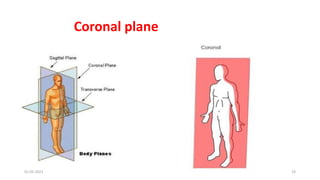
2) Coronal plane
3) Transverse plane
01-05-2021 16
01-05-2021 17
Sagittal plane
01-05-2021 18
Coronal plane
01-05-2021 19
Transverse plane
01-05-2021 20
Oblique plane
01-05-2021 21
Anatomical axis
• 3 axis :
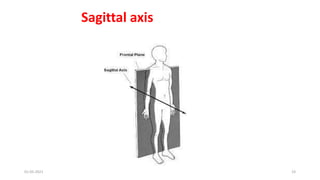
• 1) Sagittal axis
• 2) Frontal axis
• 3) Vertical axis
01-05-2021 22
Sagittal axis
01-05-2021 23
Frontal axis
01-05-2021 24
Vertical axis
01-05-2021 25
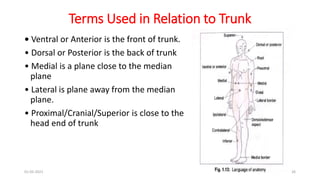
Terms Used in Relation to Trunk
• Ventral or Anterior is the front of trunk.
• Dorsal or Posterior is the back of trunk
• Medial is a plane close to the median
plane
• Lateral is plane away from the median
plane.
• Proximal/Cranial/Superior is close to the
head end of trunk
01-05-2021 26
• Distal/Caudal/Inferior is close to the lower
end of the trunk.
• Superficial is close to skin/towards
surface of body
• Deep away from skin/away from surface
of body.
01-05-2021 27
Laterality
• Ipsilateral on the same side of the body as another structure
• Contralateral on opposite side of body from another structure.
• Bilateral
• Unilateral
01-05-2021 28
• Invagination is projection inside.
• Evagination is projection outside
01-05-2021 29
Terms of Relation Commonly Used in Embryology
but sometimes in Gross Anatomy
• (a) Ventral - Towards the belly
• (b) Dorsal - Towards the back
• (c) Cranial or Rostral - Towards the head (l
• (d) Caudal - Towards the tail
01-05-2021 30
Terms related to upper trunk
In Upper limb
• Flexion: When two flexor surfaces are brought close to each other
e.g. elbow joint when front of arm and forearm are opposed to each other
• Extension: When extensor or dorsal surfaces are brought in as
much approximation as possible
e.g. straighten the arm and forearm at the elbow joint.
01-05-2021 31
• Abduction: When limb is taken away from the body.
• Adduction: When limb is brought close to the body.
01-05-2021 32
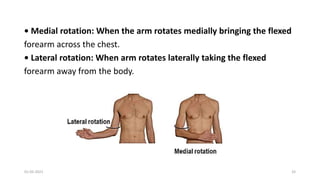
• Medial rotation: When the arm rotates medially bringing the flexed
forearm across the chest.
• Lateral rotation: When arm rotates laterally taking the flexed
forearm away from the body.
01-05-2021 33
• Supination: When the palm is facing forwards or upwards, as in
putting food in the mouth (Fig. 1.17).
• Pronation: When the palm faces backwards or downwards, as in
picking food with fingers from the plate
01-05-2021 34
• Adduction of digits/fingers: When all the fingers get together.
• Abduction: When all fingers separate.
The axis of movement of fingers is the line passing through the centre
of the middle finger.
01-05-2021 35
• Circumduction: It is movement of distal end of a part of the body
in a circle. A combination of extension, abduction, flexion and
adduction in a sequence is called circumduction as in bowling.
01-05-2021 36
• Opposition of thumb: When tip of thumb touches the tips of any
of the fingers.
• Circumduction of thumb: Movement of extension, abduction,
flexion and adduction in sequence.
01-05-2021 37
Lower Limb
• Flexion of thigh: When front of thigh comes in contact with front
of abdomen.
• Extension of thigh: When person stands erect.
01-05-2021 38
• Abduction: When thigh is taken away from the median plane.
• Adduction: When thigh is brought close to median plane.
01-05-2021 39
• Medial rotation: When thigh is turned medially.
• Lateral rotation: When thigh is turned laterally.
01-05-2021 40
• Flexion of knee: When back of thigh and back of leg come in
opposition.
• Extension of knee: When thigh and leg are in straight line as in
Standing.
01-05-2021 41
• Dorsiflexion of foot: When dorsum of foot is brought close to front
of leg and sole faces forwards (Fig. 1.18).
• Plantarflexion of foot: When sole of foot or plantar aspect of foot
faces backwards.
01-05-2021 42
• Inversion of foot: When medial border of foot is raised from the
ground (Fig. 1.18).
• Eversion of foot: When lateral border of foot is raised from the
01-05-2021 43
In the Neck
•Flexion: When face comes closer to chest.
• Extension: When face is brought away from the chest.
01-05-2021 44
• Lateral flexion: When ear is brought close to shoulder.
01-05-2021 45
• Rotation: When neck rotates so that chin goes to opposite side.
01-05-2021 46
• Protraction: When lower jaw slides forwards in its socket in the
temporal bone of skull.
• Retraction: When lower jaw slides backwards in its socket in the
temporal bone of skull
01-05-2021 47
In the Trunk
• Backward bending is called extension.
• Forward bending is flexion
• Sideward movement is lateral flexion.
• Sideward rotation is lateral rotation.
01-05-2021 48
Terms Used for Describing Muscles
• Origin: end of a muscle which is relatively fixed during its contraction
• Insertion: end of a muscle which moves during its contraction.
01-05-2021 49
Terms Used in Clinical Anatomy
Suffix is a word component added to the end of a word that changes or
modifies its usage, functioning or meaning.
01-05-2021 50
• itis = inflammation e.g. tonsillitis
• ectomy = excision, removal e.g. tonsillectomy
• otomy = opening and closing a hollow viscous or region
e.g. Hysterotomy
• tomy = act of cutting e.g. Osteotomy
• ostomy = to open a hollow organ e.g. Tracheostomy
• oma = a tumour e.g. Lipoma
• tripsy = to crush , breakdown e.g. Lithotripsy
• plasty = surgical repair e.g. Rhinoplasty
• desis = surgical fixation, fusion e.g. Arthrodesis
01-05-2021 51
4 rrh’s
• rrhagia = excessive flow, profuse blood discharge e.g menorrhagia
• rrhea= flow, discharge e.g. albuminorrhea
• rrhaphy = suture e.g herniorrhaphy
• rrhexis = rupture e.g. enterorrhexis
01-05-2021 52
MCQs
• Q1. Coronal plane divides the body into :
A) Equal right & left halves
B) Equal upper and lower halves
C) Equal anterior & posterior halves
D) Unequal right & left halves
• Ans. C
01-05-2021 53
MCQs
• Q.2) Thumb abduction & adduction occur in which plane?
• A) Frontal plane
• B) Sagittal plane
• C) Midsagittal plane
• D) Oblique plane
•
• Ans . B
01-05-2021 54
MCQs
• Q.3) Medial & lateral rotation movements of hip occurs in which
plane?
• A) Oblique plane
• B) Midsagittal plane
• C) Transverse plane
• D) Coronal plane
• Ans. C
01-05-2021 55
References
•Gray’s Anatomy 1st Edition
•Bd chaurasia book of general Anatomy
01-05-2021 56
THANK YOU
01-05-2021 57

Anatomical planes ppt

  • 1.
    Medical Terminology Presenter: Dr.Rahul Sharma Bpt ( JMI) MSc.ANATOMY AIIMS, RISHIKESH 01-05-2021 1
  • 2.
    Contents • Introduction • Positionsof body • Anatomical planes • Anatomical axis • Terms Used in Relation to Trunk • Terms related to body movements Upper limb Lower limb Neck • In trunk • Muscle • Term used in muscles • Summary • MCQs • References 01-05-2021 2
  • 3.
    Introduction • Anatomy –science deals with structure of body, from macroscopic to microscopic level • Anatome = (Greek anatomē, 'dissection') is the branch of biology concerned with the study of the structure of organisms and their parts • Anatomical Nomenclature = to eliminate unambiguous description of thousands of structures is impossible without an extensive and often highly specialized vocabulary. 01-05-2021 3
  • 4.
    Approach To StudyAnatomy 1. Regional anatomy 2. Systemic anatomy 3. Clinical (applied anatomy) 01-05-2021 4
  • 5.
    Regional Anatomy • Humanbody as major part or segment 01-05-2021 5
  • 6.
    Surface Anatomy • Provideknowledge , what lies under the skin. 01-05-2021 6
  • 7.
    • By meansof radio graphical, sectional anatomy and endoscopy 01-05-2021 7
  • 8.
    Systemic Anatomy Study ofbody’s organ systems work together to carry out complex function. 1. Integumentary system 2. Skeletal system 3. Articular system 4. Muscular system 5. Nervous system 6. Circulatory system 7. Alimentary system 8. Respiratory system 9. Urinary system 10. Genital system 11. Endocrine system 01-05-2021 8
  • 9.
    Clinical Anatomy(Applied Anatomy) •Incorporates regional and systemic approaches. • Important in role of solving clinical problem. 01-05-2021 9
  • 10.
    Anatomical position Anatomical position: •personis standing straight •Eyes looking forwards • Both arms by the side of body •palms facing forwards • Both feet together, the position is anatomical position 01-05-2021 10
  • 11.
    Supine position When aperson is lying on her/his back, arms by the side, palms facing upwards and feet put together, the position is supine position 01-05-2021 11
  • 12.
    Prone position • Proneposition: Person lying on his/her face, chest and abdomen is said to be in prone position 01-05-2021 12
  • 13.
  • 14.
    Lithotomic position Person lyingon her back with legs up and feet supported in straps. This position is mostly used during delivery of the baby 01-05-2021 14
  • 15.
  • 16.
    Anatomical planes • Plane– hypothetical plane used to transect body to locate structures or direction of movement • Axis – an imaginary line about which a body rotates anatomical planes: 1) Sagittal plane 2) Coronal plane 3) Transverse plane 01-05-2021 16
  • 17.
  • 18.
  • 19.
  • 20.
  • 21.
  • 22.
    Anatomical axis • 3axis : • 1) Sagittal axis • 2) Frontal axis • 3) Vertical axis 01-05-2021 22
  • 23.
  • 24.
  • 25.
  • 26.
    Terms Used inRelation to Trunk • Ventral or Anterior is the front of trunk. • Dorsal or Posterior is the back of trunk • Medial is a plane close to the median plane • Lateral is plane away from the median plane. • Proximal/Cranial/Superior is close to the head end of trunk 01-05-2021 26
  • 27.
    • Distal/Caudal/Inferior isclose to the lower end of the trunk. • Superficial is close to skin/towards surface of body • Deep away from skin/away from surface of body. 01-05-2021 27
  • 28.
    Laterality • Ipsilateral onthe same side of the body as another structure • Contralateral on opposite side of body from another structure. • Bilateral • Unilateral 01-05-2021 28
  • 29.
    • Invagination isprojection inside. • Evagination is projection outside 01-05-2021 29
  • 30.
    Terms of RelationCommonly Used in Embryology but sometimes in Gross Anatomy • (a) Ventral - Towards the belly • (b) Dorsal - Towards the back • (c) Cranial or Rostral - Towards the head (l • (d) Caudal - Towards the tail 01-05-2021 30
  • 31.
    Terms related toupper trunk In Upper limb • Flexion: When two flexor surfaces are brought close to each other e.g. elbow joint when front of arm and forearm are opposed to each other • Extension: When extensor or dorsal surfaces are brought in as much approximation as possible e.g. straighten the arm and forearm at the elbow joint. 01-05-2021 31
  • 32.
    • Abduction: Whenlimb is taken away from the body. • Adduction: When limb is brought close to the body. 01-05-2021 32
  • 33.
    • Medial rotation:When the arm rotates medially bringing the flexed forearm across the chest. • Lateral rotation: When arm rotates laterally taking the flexed forearm away from the body. 01-05-2021 33
  • 34.
    • Supination: Whenthe palm is facing forwards or upwards, as in putting food in the mouth (Fig. 1.17). • Pronation: When the palm faces backwards or downwards, as in picking food with fingers from the plate 01-05-2021 34
  • 35.
    • Adduction ofdigits/fingers: When all the fingers get together. • Abduction: When all fingers separate. The axis of movement of fingers is the line passing through the centre of the middle finger. 01-05-2021 35
  • 36.
    • Circumduction: Itis movement of distal end of a part of the body in a circle. A combination of extension, abduction, flexion and adduction in a sequence is called circumduction as in bowling. 01-05-2021 36
  • 37.
    • Opposition ofthumb: When tip of thumb touches the tips of any of the fingers. • Circumduction of thumb: Movement of extension, abduction, flexion and adduction in sequence. 01-05-2021 37
  • 38.
    Lower Limb • Flexionof thigh: When front of thigh comes in contact with front of abdomen. • Extension of thigh: When person stands erect. 01-05-2021 38
  • 39.
    • Abduction: Whenthigh is taken away from the median plane. • Adduction: When thigh is brought close to median plane. 01-05-2021 39
  • 40.
    • Medial rotation:When thigh is turned medially. • Lateral rotation: When thigh is turned laterally. 01-05-2021 40
  • 41.
    • Flexion ofknee: When back of thigh and back of leg come in opposition. • Extension of knee: When thigh and leg are in straight line as in Standing. 01-05-2021 41
  • 42.
    • Dorsiflexion offoot: When dorsum of foot is brought close to front of leg and sole faces forwards (Fig. 1.18). • Plantarflexion of foot: When sole of foot or plantar aspect of foot faces backwards. 01-05-2021 42
  • 43.
    • Inversion offoot: When medial border of foot is raised from the ground (Fig. 1.18). • Eversion of foot: When lateral border of foot is raised from the 01-05-2021 43
  • 44.
    In the Neck •Flexion:When face comes closer to chest. • Extension: When face is brought away from the chest. 01-05-2021 44
  • 45.
    • Lateral flexion:When ear is brought close to shoulder. 01-05-2021 45
  • 46.
    • Rotation: Whenneck rotates so that chin goes to opposite side. 01-05-2021 46
  • 47.
    • Protraction: Whenlower jaw slides forwards in its socket in the temporal bone of skull. • Retraction: When lower jaw slides backwards in its socket in the temporal bone of skull 01-05-2021 47
  • 48.
    In the Trunk •Backward bending is called extension. • Forward bending is flexion • Sideward movement is lateral flexion. • Sideward rotation is lateral rotation. 01-05-2021 48
  • 49.
    Terms Used forDescribing Muscles • Origin: end of a muscle which is relatively fixed during its contraction • Insertion: end of a muscle which moves during its contraction. 01-05-2021 49
  • 50.
    Terms Used inClinical Anatomy Suffix is a word component added to the end of a word that changes or modifies its usage, functioning or meaning. 01-05-2021 50
  • 51.
    • itis =inflammation e.g. tonsillitis • ectomy = excision, removal e.g. tonsillectomy • otomy = opening and closing a hollow viscous or region e.g. Hysterotomy • tomy = act of cutting e.g. Osteotomy • ostomy = to open a hollow organ e.g. Tracheostomy • oma = a tumour e.g. Lipoma • tripsy = to crush , breakdown e.g. Lithotripsy • plasty = surgical repair e.g. Rhinoplasty • desis = surgical fixation, fusion e.g. Arthrodesis 01-05-2021 51
  • 52.
    4 rrh’s • rrhagia= excessive flow, profuse blood discharge e.g menorrhagia • rrhea= flow, discharge e.g. albuminorrhea • rrhaphy = suture e.g herniorrhaphy • rrhexis = rupture e.g. enterorrhexis 01-05-2021 52
  • 53.
    MCQs • Q1. Coronalplane divides the body into : A) Equal right & left halves B) Equal upper and lower halves C) Equal anterior & posterior halves D) Unequal right & left halves • Ans. C 01-05-2021 53
  • 54.
    MCQs • Q.2) Thumbabduction & adduction occur in which plane? • A) Frontal plane • B) Sagittal plane • C) Midsagittal plane • D) Oblique plane • • Ans . B 01-05-2021 54
  • 55.
    MCQs • Q.3) Medial& lateral rotation movements of hip occurs in which plane? • A) Oblique plane • B) Midsagittal plane • C) Transverse plane • D) Coronal plane • Ans. C 01-05-2021 55
  • 56.
    References •Gray’s Anatomy 1stEdition •Bd chaurasia book of general Anatomy 01-05-2021 56
  • 57.