Cells to Tissues
• As human body develops from single to
multicellular, cells specialize.
• Body is interdependent system,
malfunction of one group of cells is
catastrophic.
• Cells specialize into types of tissues, then
interspersed into organs.
Tissues = groups of cells that are similar in
structure and function.
• Epithelium
– Coverings
– Linings of surfaces
• Connective
– Support
– Bone, ligaments, fat
• Muscle
– Movement
• Nervous
– Control
– Brain, nerves, spinal
cord
EPITHILIAL
TISSUE
Function of Epithelial Tissue
• Protection
– Skin protects from sunlight & bacteria & physical damage.
• Absorption
– Lining of small intestine, absorbing nutrients into blood
• Filtration
– Lining of Kidney tubules filtering wastes from blood plasma
• Secretion
– Different glands produce perspiration, oil, digestive
enzymes and mucus
Characteristics of Epithelial Tissue
• Form continuous sheets (fit like tiles)
• Apical Surface
– All epithelial cells have a top surface that borders
an open space – known as a lumen
• Basement Membrane
– Underside of all epithelial cells which anchors
them to connective tissue
• Avascularity (a = without)
– Lacks blood vessels
– Nourished by connective tissue
• Regenerate & repair quickly
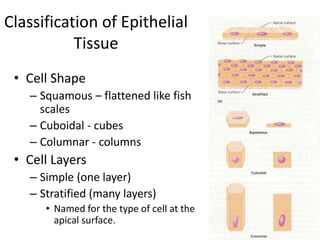
Classification of Epithelial
Tissue
• Cell Shape
– Squamous – flattened like fish
scales
– Cuboidal - cubes
– Columnar - columns
• Cell Layers
– Simple (one layer)
– Stratified (many layers)
• Named for the type of cell at the
apical surface.
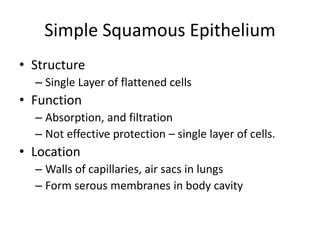
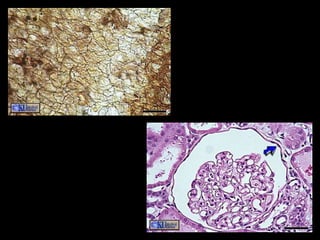
Simple Squamous Epithelium
• Structure
– Single Layer of flattened cells
• Function
– Absorption, and filtration
– Not effective protection – single layer of cells.
• Location
– Walls of capillaries, air sacs in lungs
– Form serous membranes in body cavity
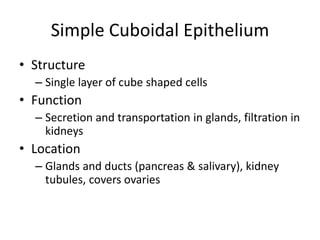
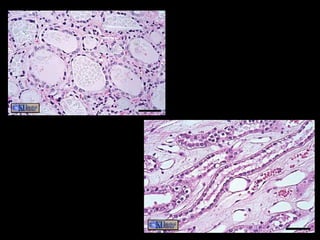
Simple Cuboidal Epithelium
• Structure
– Single layer of cube shaped cells
• Function
– Secretion and transportation in glands, filtration in
kidneys
• Location
– Glands and ducts (pancreas & salivary), kidney
tubules, covers ovaries
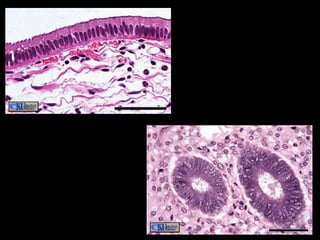
Simple Columnar Epithelium
• Structure
– Elongated layer of cells with nuclei at same level
• Function
– Absorption, Protection & Secretion
– When open to body cavities – called mucous membranes
• Special Features
– Microvilli, bumpy extension of apical surface, increase
surface area and absorption rate.
– Goblet cells, single cell glands, produce protective mucus.
• Location
– Linings of entire digestive tract
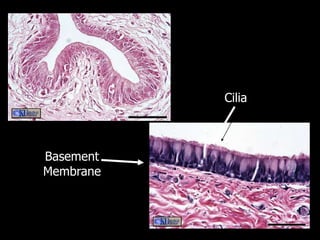
Pseudostratified Epithelium
• Structure
– Irregularly shaped cells with nuclei at different
levels – appear stratified, but aren’t.
– All cells reach basement membrane
• Function
– Absorption and Secretion
– Goblet cells produce mucus
– Cilia (larger than microvilli) sweep mucus
• Location
– Respiratory Linings & Reproductive tract
Cilia
Basement
Membrane
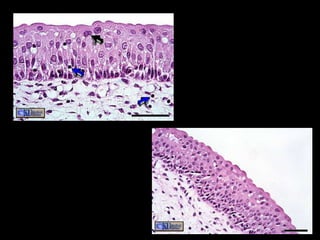
Stratified Squamous Epithelium
• Structure
– Many layers (usually cubodial/columnar at bottom
and squamous at top)
• Function
– Protection
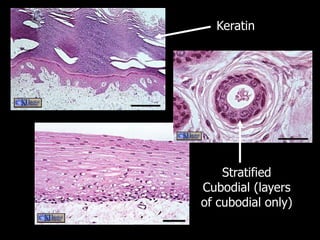
– Keratin (protein) is accumulated in older cells near
the surface – waterproofs and toughens skin.
• Location
– Skin (keratinized), mouth & throat
Keratin
Stratified
Cubodial (layers
of cubodial only)
Transitional Epithelium
• Structure
– Many layers
– Very specialized – cells at base are cuboidal or
columnar, at surface will vary.
– Change between stratified & simple as tissue is
stretched out.
• Function
– Allows stretching (change size)
• Location
– Urinary bladder, ureters & urethra
Glands
• One or more cells that make and secrete a product.
• Secretion = protein in aqueous solution: hormones,
acids, oils.
• Endocrine glands
– No duct, release secretion into blood vessels
– Often hormones
– Thyroid, adrenal and pituitary glands
• Exocrine glands
– Contain ducts, empty onto epithelial surface
– Sweat, Oil glands, Salivary glands, Mammary glands.
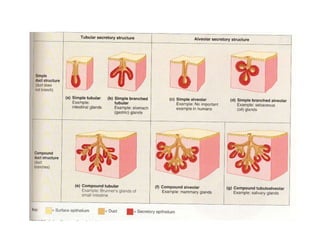
Shapes of Exocrine glands
Branching
 Simple – single, unbranched duct
 Compound – branched.
Shape: tubular or alveolar
 Tubular – shaped like a tube
 Alveolar – shaped like flasks or sacs
 Tubuloalveolar – has both tubes and sacs in
gland
Modes of Secretion
• (How the gland’s product is released)
• Merocrine
– Just released by exocytosis without altering the
gland at all.
– Ex: Sweat glands and salivary glands
• Holocrine
– The gland ruptures and releases secretion and
dead cells as well.
– Sebaceous (oil glands on the face) only example

Epithelial Tissue.ppt

  • 1.
    Cells to Tissues •As human body develops from single to multicellular, cells specialize. • Body is interdependent system, malfunction of one group of cells is catastrophic. • Cells specialize into types of tissues, then interspersed into organs.
  • 2.
    Tissues = groupsof cells that are similar in structure and function. • Epithelium – Coverings – Linings of surfaces • Connective – Support – Bone, ligaments, fat • Muscle – Movement • Nervous – Control – Brain, nerves, spinal cord
  • 3.
  • 4.
    Function of EpithelialTissue • Protection – Skin protects from sunlight & bacteria & physical damage. • Absorption – Lining of small intestine, absorbing nutrients into blood • Filtration – Lining of Kidney tubules filtering wastes from blood plasma • Secretion – Different glands produce perspiration, oil, digestive enzymes and mucus
  • 5.
    Characteristics of EpithelialTissue • Form continuous sheets (fit like tiles) • Apical Surface – All epithelial cells have a top surface that borders an open space – known as a lumen • Basement Membrane – Underside of all epithelial cells which anchors them to connective tissue • Avascularity (a = without) – Lacks blood vessels – Nourished by connective tissue • Regenerate & repair quickly
  • 6.
    Classification of Epithelial Tissue •Cell Shape – Squamous – flattened like fish scales – Cuboidal - cubes – Columnar - columns • Cell Layers – Simple (one layer) – Stratified (many layers) • Named for the type of cell at the apical surface.
  • 7.
    Simple Squamous Epithelium •Structure – Single Layer of flattened cells • Function – Absorption, and filtration – Not effective protection – single layer of cells. • Location – Walls of capillaries, air sacs in lungs – Form serous membranes in body cavity
  • 9.
    Simple Cuboidal Epithelium •Structure – Single layer of cube shaped cells • Function – Secretion and transportation in glands, filtration in kidneys • Location – Glands and ducts (pancreas & salivary), kidney tubules, covers ovaries
  • 11.
    Simple Columnar Epithelium •Structure – Elongated layer of cells with nuclei at same level • Function – Absorption, Protection & Secretion – When open to body cavities – called mucous membranes • Special Features – Microvilli, bumpy extension of apical surface, increase surface area and absorption rate. – Goblet cells, single cell glands, produce protective mucus. • Location – Linings of entire digestive tract
  • 13.
    Pseudostratified Epithelium • Structure –Irregularly shaped cells with nuclei at different levels – appear stratified, but aren’t. – All cells reach basement membrane • Function – Absorption and Secretion – Goblet cells produce mucus – Cilia (larger than microvilli) sweep mucus • Location – Respiratory Linings & Reproductive tract
  • 14.
  • 15.
    Stratified Squamous Epithelium •Structure – Many layers (usually cubodial/columnar at bottom and squamous at top) • Function – Protection – Keratin (protein) is accumulated in older cells near the surface – waterproofs and toughens skin. • Location – Skin (keratinized), mouth & throat
  • 16.
  • 17.
    Transitional Epithelium • Structure –Many layers – Very specialized – cells at base are cuboidal or columnar, at surface will vary. – Change between stratified & simple as tissue is stretched out. • Function – Allows stretching (change size) • Location – Urinary bladder, ureters & urethra
  • 19.
    Glands • One ormore cells that make and secrete a product. • Secretion = protein in aqueous solution: hormones, acids, oils. • Endocrine glands – No duct, release secretion into blood vessels – Often hormones – Thyroid, adrenal and pituitary glands • Exocrine glands – Contain ducts, empty onto epithelial surface – Sweat, Oil glands, Salivary glands, Mammary glands.
  • 20.
    Shapes of Exocrineglands Branching  Simple – single, unbranched duct  Compound – branched. Shape: tubular or alveolar  Tubular – shaped like a tube  Alveolar – shaped like flasks or sacs  Tubuloalveolar – has both tubes and sacs in gland
  • 22.
    Modes of Secretion •(How the gland’s product is released) • Merocrine – Just released by exocytosis without altering the gland at all. – Ex: Sweat glands and salivary glands • Holocrine – The gland ruptures and releases secretion and dead cells as well. – Sebaceous (oil glands on the face) only example