EPITHELIUM
Prepared by: Maryam Fida (o-1827)
■ Fertilization Cell  zygote
■ Differentiation
■ All tissues consist of cells and variable
amount of extracellular matrix (intercellular
substance)  synthesized by tissue cells and
exported into extracellular space
■ Four categories of tissues:
– Epithelial
– Connective
– Muscle
– Nerve
■ All organs of body  made up of two or more
tissues (parenchyma & stoma)
epithelium
■ A collection of closely packed cells with very small amount of
intercellular space between the cells.
■ Epithelium is avascular
■ It is supported by variable amount of loose connective tissue
which contains blood vessels
■ Between the epithelium & connective tissue is a sheet called
basement membrane or basal lamina.
■ Oxygen and Nourishment  Diffusion from the capillaries
present in underlying connective tissue
■ It consists of continuous sheets of cells
that cover exposed body surfaces. It also
lines internal cavities, such as those of the
digestive, respiratory, cardiovascular,
and genitourinary systems.
■ Epithelium covers the external and
internal surfaces of the body and forms
the parenchyma (functional part) of
various glands
■ Two main groups of epithelium are:
– Glandular epithelium
– Covering epithelium
Glandular epithelium
■ Some epithelial cells of the body are
specialized to produce substances
■ These substances are not used by cell
itself, but expelled to the extracellular
compartment
■ These are either:
– Secretions (sebaceous glands, pancreas &
salivary glands)
– Excretions (sweat glands)
Covering epithelium
■ Also called surface epithelium
■ It consist of one or more layers of cells
■ It may cover the external body surface or line the
tubular passages and cavities of the body
■ e.g
– Epidermis of skin
– Respiratory tract
– Digestive tract
– Urogenital tract
– Internal surface of heart, blood vessels
– Lining of body cavities (the pericardial, plural
& peritoneal cavities)
Classification of covering
epithelium
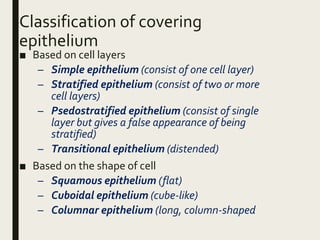
■ Based on cell layers
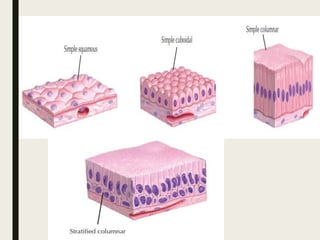
– Simple epithelium (consist of one cell layer)
– Stratified epithelium (consist of two or more
cell layers)
– Psedostratified epithelium (consist of single
layer but gives a false appearance of being
stratified)
– Transitional epithelium (distended)
■ Based on the shape of cell
– Squamous epithelium (flat)
– Cuboidal epithelium (cube-like)
– Columnar epithelium (long, column-shaped
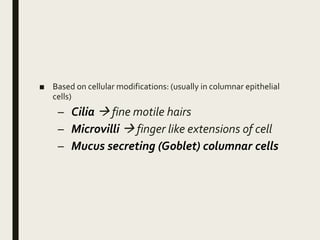
■ Based on cellular modifications: (usually in columnar epithelial
cells)
– Cilia  fine motile hairs
– Microvilli  finger like extensions of cell
– Mucus secreting (Goblet) columnar cells
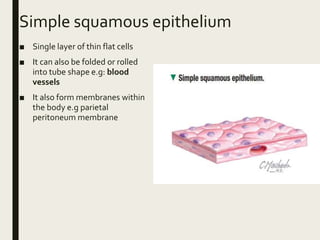
Simple squamous epithelium
■ Single layer of thin flat cells
■ It can also be folded or rolled
into tube shape e.g: blood
vessels
■ It also form membranes within
the body e.g parietal
peritoneum membrane
■ Major examples:
1. Endothelium which covers the internal surface of heart, blood
vessels and lymph vessels
2. Mesothelium  lines pericardial, pleural and peritoneal
cavities
3. The lining epithelium of the alveoli of the lung
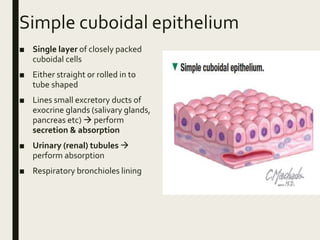
Simple cuboidal epithelium
■ Single layer of closely packed
cuboidal cells
■ Either straight or rolled in to
tube shaped
■ Lines small excretory ducts of
exocrine glands (salivary glands,
pancreas etc)  perform
secretion & absorption
■ Urinary (renal) tubules 
perform absorption
■ Respiratory bronchioles lining
■ The thyroid gland
■ In the eye, cells of pigmented
epithelium of the retina and epithelium
of the ciliary body are simple cuboidal
 these are specialized for ion
transport and secretion.
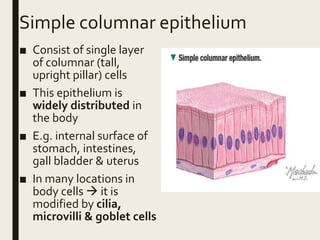
Simple columnar epithelium
■ Consist of single layer
of columnar (tall,
upright pillar) cells
■ This epithelium is
widely distributed in
the body
■ E.g. internal surface of
stomach, intestines,
gall bladder & uterus
■ In many locations in
body cells  it is
modified by cilia,
microvilli & goblet cells
■ Simple columnar ciliated epithelium
– Make up lining of female’s fallopianTube
(oviduct)  cilia push the egg
■ Simple columnar epithelium with
goblet cells
– Makes up lining of stomach, MUCUS 
coat inside lining of stomach to protect it
from the action of HCL
■ Simple columnar epithelium with
microvilli & goblet cells
– Lines the intestine
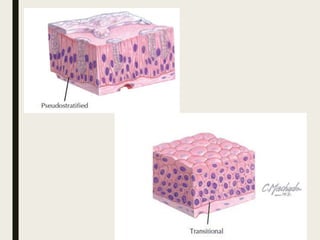
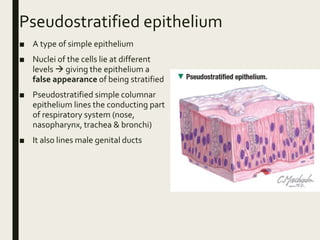
Pseudostratified epithelium
■ A type of simple epithelium
■ Nuclei of the cells lie at different
levels  giving the epithelium a
false appearance of being stratified
■ Pseudostratified simple columnar
epithelium lines the conducting part
of respiratory system (nose,
nasopharynx, trachea & bronchi)
■ It also lines male genital ducts
Stratified (multilaminar)
epithelium
■ Classified according to shape of cells in superficial layer
■ STRATIFIED SQUAMOUS EPITHELIUM
■ STRATIFIEDCUBOIDAL EPITHELIUM
■ STRATIFIEDCOLUMNAR EPITHELIUM
■ A special type of stratified epithelium  TRANSITIONAL
EPITHELIUM
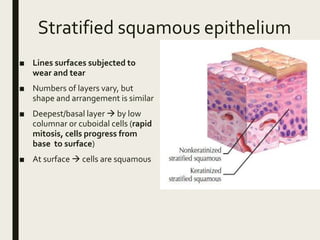
Stratified squamous epithelium
■ Lines surfaces subjected to
wear and tear
■ Numbers of layers vary, but
shape and arrangement is similar
■ Deepest/basal layer  by low
columnar or cuboidal cells (rapid
mitosis, cells progress from
base to surface)
■ At surface  cells are squamous
■ There are two types of superficial (surface) cells
 keratinized & non-keratinized
■ STRATIFIED SQUAMOUS KERATINIZED
EPITHELIUM
– At surfaces which are subjected to abrasion &
drying  the cytoplasm of superficial cells
accumulate large numbers of keratin filaments
– Best example is the epidermis which covers the
entire free surface of the body
■ STRATIFIED SQUAMOUS NON-KERATINIZED
EPITHELIUM
– Lines surfaces which are subjected to abrasion but
remain wet
– Contains little or no keratin
– Examples include epithelium of most of the oral
cavity, oropharynx & esophagus
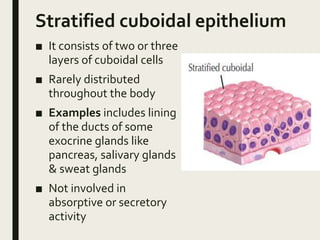
Stratified cuboidal epithelium
■ It consists of two or three
layers of cuboidal cells
■ Rarely distributed
throughout the body
■ Examples includes lining
of the ducts of some
exocrine glands like
pancreas, salivary glands
& sweat glands
■ Not involved in
absorptive or secretory
activity
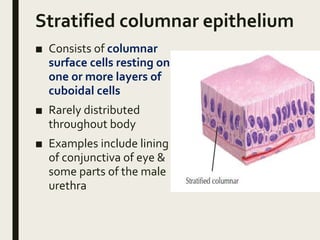
Stratified columnar epithelium
■ Consists of columnar
surface cells resting on
one or more layers of
cuboidal cells
■ Rarely distributed
throughout body
■ Examples include lining
of conjunctiva of eye &
some parts of the male
urethra
■ Unlike the stratified squamous
epithelium  the surface cells of
stratified cuboidal and stratified
columnar epithelium are not
continuously replaced by mitosis at
basal cell layer and no progress of cells
from the base to surface.
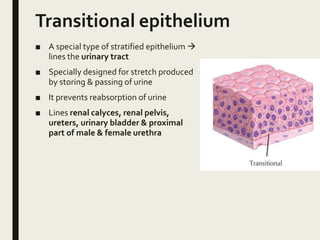
Transitional epithelium
■ A special type of stratified epithelium 
lines the urinary tract
■ Specially designed for stretch produced
by storing & passing of urine
■ It prevents reabsorption of urine
■ Lines renal calyces, renal pelvis,
ureters, urinary bladder & proximal
part of male & female urethra
BASEMENT MEMBRANE or BASAL
LAMINA
■ A thin layer of extracellular material present between epithelial
cells and the underlying connective tissue
■ It consist of:
– Collagen type IV
– Glycoproteins
■ Functions of basement membrane:
– Binds epithelial cells
– Provides support to epithelial cells
– Diffusion occurs through it  leading to
nourishment of epithelial cells
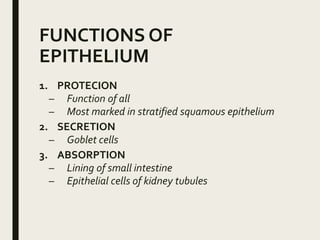
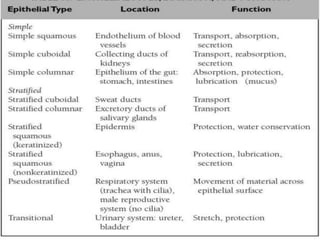
FUNCTIONS OF
EPITHELIUM
1. PROTECION
– Function of all
– Most marked in stratified squamous epithelium
2. SECRETION
– Goblet cells
3. ABSORPTION
– Lining of small intestine
– Epithelial cells of kidney tubules
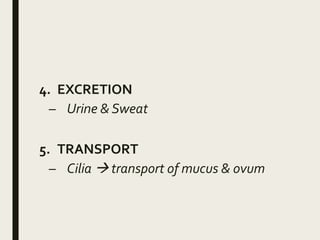
4. EXCRETION
– Urine & Sweat
5. TRANSPORT
– Cilia  transport of mucus & ovum
THANKYOU

Epithelium[1]

  • 1.
  • 2.
    ■ Fertilization Cell zygote ■ Differentiation ■ All tissues consist of cells and variable amount of extracellular matrix (intercellular substance)  synthesized by tissue cells and exported into extracellular space ■ Four categories of tissues: – Epithelial – Connective – Muscle – Nerve ■ All organs of body  made up of two or more tissues (parenchyma & stoma)
  • 3.
    epithelium ■ A collectionof closely packed cells with very small amount of intercellular space between the cells. ■ Epithelium is avascular ■ It is supported by variable amount of loose connective tissue which contains blood vessels ■ Between the epithelium & connective tissue is a sheet called basement membrane or basal lamina. ■ Oxygen and Nourishment  Diffusion from the capillaries present in underlying connective tissue
  • 4.
    ■ It consistsof continuous sheets of cells that cover exposed body surfaces. It also lines internal cavities, such as those of the digestive, respiratory, cardiovascular, and genitourinary systems. ■ Epithelium covers the external and internal surfaces of the body and forms the parenchyma (functional part) of various glands ■ Two main groups of epithelium are: – Glandular epithelium – Covering epithelium
  • 5.
    Glandular epithelium ■ Someepithelial cells of the body are specialized to produce substances ■ These substances are not used by cell itself, but expelled to the extracellular compartment ■ These are either: – Secretions (sebaceous glands, pancreas & salivary glands) – Excretions (sweat glands)
  • 6.
    Covering epithelium ■ Alsocalled surface epithelium ■ It consist of one or more layers of cells ■ It may cover the external body surface or line the tubular passages and cavities of the body ■ e.g – Epidermis of skin – Respiratory tract – Digestive tract – Urogenital tract – Internal surface of heart, blood vessels – Lining of body cavities (the pericardial, plural & peritoneal cavities)
  • 7.
    Classification of covering epithelium ■Based on cell layers – Simple epithelium (consist of one cell layer) – Stratified epithelium (consist of two or more cell layers) – Psedostratified epithelium (consist of single layer but gives a false appearance of being stratified) – Transitional epithelium (distended) ■ Based on the shape of cell – Squamous epithelium (flat) – Cuboidal epithelium (cube-like) – Columnar epithelium (long, column-shaped
  • 10.
    ■ Based oncellular modifications: (usually in columnar epithelial cells) – Cilia  fine motile hairs – Microvilli  finger like extensions of cell – Mucus secreting (Goblet) columnar cells
  • 11.
    Simple squamous epithelium ■Single layer of thin flat cells ■ It can also be folded or rolled into tube shape e.g: blood vessels ■ It also form membranes within the body e.g parietal peritoneum membrane
  • 12.
    ■ Major examples: 1.Endothelium which covers the internal surface of heart, blood vessels and lymph vessels 2. Mesothelium  lines pericardial, pleural and peritoneal cavities 3. The lining epithelium of the alveoli of the lung
  • 13.
    Simple cuboidal epithelium ■Single layer of closely packed cuboidal cells ■ Either straight or rolled in to tube shaped ■ Lines small excretory ducts of exocrine glands (salivary glands, pancreas etc)  perform secretion & absorption ■ Urinary (renal) tubules  perform absorption ■ Respiratory bronchioles lining
  • 14.
    ■ The thyroidgland ■ In the eye, cells of pigmented epithelium of the retina and epithelium of the ciliary body are simple cuboidal  these are specialized for ion transport and secretion.
  • 15.
    Simple columnar epithelium ■Consist of single layer of columnar (tall, upright pillar) cells ■ This epithelium is widely distributed in the body ■ E.g. internal surface of stomach, intestines, gall bladder & uterus ■ In many locations in body cells  it is modified by cilia, microvilli & goblet cells
  • 16.
    ■ Simple columnarciliated epithelium – Make up lining of female’s fallopianTube (oviduct)  cilia push the egg ■ Simple columnar epithelium with goblet cells – Makes up lining of stomach, MUCUS  coat inside lining of stomach to protect it from the action of HCL ■ Simple columnar epithelium with microvilli & goblet cells – Lines the intestine
  • 17.
    Pseudostratified epithelium ■ Atype of simple epithelium ■ Nuclei of the cells lie at different levels  giving the epithelium a false appearance of being stratified ■ Pseudostratified simple columnar epithelium lines the conducting part of respiratory system (nose, nasopharynx, trachea & bronchi) ■ It also lines male genital ducts
  • 18.
    Stratified (multilaminar) epithelium ■ Classifiedaccording to shape of cells in superficial layer ■ STRATIFIED SQUAMOUS EPITHELIUM ■ STRATIFIEDCUBOIDAL EPITHELIUM ■ STRATIFIEDCOLUMNAR EPITHELIUM ■ A special type of stratified epithelium  TRANSITIONAL EPITHELIUM
  • 19.
    Stratified squamous epithelium ■Lines surfaces subjected to wear and tear ■ Numbers of layers vary, but shape and arrangement is similar ■ Deepest/basal layer  by low columnar or cuboidal cells (rapid mitosis, cells progress from base to surface) ■ At surface  cells are squamous
  • 20.
    ■ There aretwo types of superficial (surface) cells  keratinized & non-keratinized ■ STRATIFIED SQUAMOUS KERATINIZED EPITHELIUM – At surfaces which are subjected to abrasion & drying  the cytoplasm of superficial cells accumulate large numbers of keratin filaments – Best example is the epidermis which covers the entire free surface of the body ■ STRATIFIED SQUAMOUS NON-KERATINIZED EPITHELIUM – Lines surfaces which are subjected to abrasion but remain wet – Contains little or no keratin – Examples include epithelium of most of the oral cavity, oropharynx & esophagus
  • 21.
    Stratified cuboidal epithelium ■It consists of two or three layers of cuboidal cells ■ Rarely distributed throughout the body ■ Examples includes lining of the ducts of some exocrine glands like pancreas, salivary glands & sweat glands ■ Not involved in absorptive or secretory activity
  • 22.
    Stratified columnar epithelium ■Consists of columnar surface cells resting on one or more layers of cuboidal cells ■ Rarely distributed throughout body ■ Examples include lining of conjunctiva of eye & some parts of the male urethra
  • 23.
    ■ Unlike thestratified squamous epithelium  the surface cells of stratified cuboidal and stratified columnar epithelium are not continuously replaced by mitosis at basal cell layer and no progress of cells from the base to surface.
  • 24.
    Transitional epithelium ■ Aspecial type of stratified epithelium  lines the urinary tract ■ Specially designed for stretch produced by storing & passing of urine ■ It prevents reabsorption of urine ■ Lines renal calyces, renal pelvis, ureters, urinary bladder & proximal part of male & female urethra
  • 25.
    BASEMENT MEMBRANE orBASAL LAMINA ■ A thin layer of extracellular material present between epithelial cells and the underlying connective tissue ■ It consist of: – Collagen type IV – Glycoproteins ■ Functions of basement membrane: – Binds epithelial cells – Provides support to epithelial cells – Diffusion occurs through it  leading to nourishment of epithelial cells
  • 26.
    FUNCTIONS OF EPITHELIUM 1. PROTECION –Function of all – Most marked in stratified squamous epithelium 2. SECRETION – Goblet cells 3. ABSORPTION – Lining of small intestine – Epithelial cells of kidney tubules
  • 27.
    4. EXCRETION – Urine& Sweat 5. TRANSPORT – Cilia  transport of mucus & ovum
  • 29.