EPITHELIAL
TISSUE
 Tissue is a group of similar cells, having same origin
and performing a specific function.
 For protection, filtration, absorption and secretion.
 The term tissue was given by Bichat.
 The study of tissue is known as histology. The
term histology was introduced by Mayer.
 In the hierarchical system of classification of animals,
tissue was first evolved in Coelenterates.
TISSUE
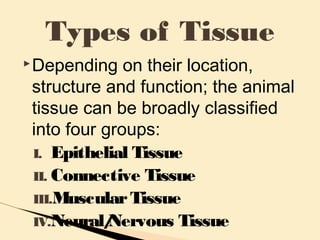
Depending on their location,
structure and function; the animal
tissue can be broadly classified
into four groups:
I. Epithelial Tissue
II. Connective Tissue
III.MuscularTissue
IV.Neural/Nervous Tissue
Types of Tissue
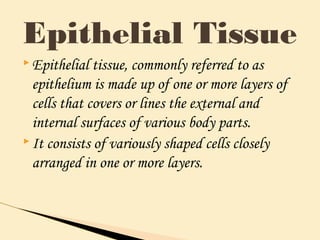
 Epithelial tissue, commonly referred to as
epithelium is made up of one or more layers of
cells that covers or lines the external and
internal surfaces of various body parts.
 It consists of variously shaped cells closely
arranged in one or more layers.
Epithelial Tissue
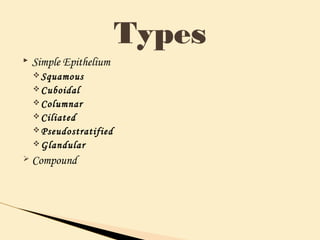
 Simple Epithelium
vSquamous
vCuboidal
vColumnar
vCiliated
vPseudostratified
vGlandular
Ø Compound
Types
 Are most common concerned with absorption,
secretion and filtration because simple epithelia
are usually very thin, protection is not one of their
specialties.
Simple Epithelium
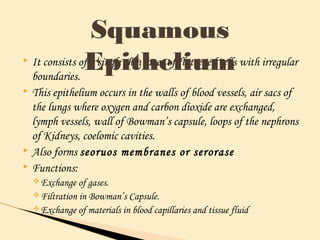
 It consists of a single thin layer of flattened cells with irregular
boundaries.
 This epithelium occurs in the walls of blood vessels, air sacs of
the lungs where oxygen and carbon dioxide are exchanged,
lymph vessels, wall of Bowman’s capsule, loops of the nephrons
of Kidneys, coelomic cavities.
 Also forms seoruos membranes or serorase
 Functions:
vExchange of gases.
vFiltration in Bowman’s Capsule.
vExchange of materials in blood capillaries and tissue fluid
Squamous
Epithelium
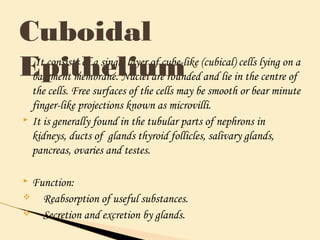
 It consists of a single layer of cube-like (cubical) cells lying on a
basement membrane. Nuclei are rounded and lie in the centre of
the cells. Free surfaces of the cells may be smooth or bear minute
finger-like projections known as microvilli.
 It is generally found in the tubular parts of nephrons in
kidneys, ducts of glands thyroid follicles, salivary glands,
pancreas, ovaries and testes.
 Function:
v Reabsorption of useful substances.
v Secretion and excretion by glands.
Cuboidal
Epithelium
 It consists of a single layer of tall and slender cells, lying on a
basement membrane.
 The intestinal mucosa bearing microvilli is called brush-bordered
columnar epithelium.
 It is found in the lining of the entire length of the stomach and
intestine.
 Epithelial membranes that form tat line cavities open to the body
exterior are called mucosase.
 Goblet Cells- produce lubricating mucus.
 Function:
v Absorption
v Secretion
Columnar
Epithelium
 If the columnar or cuboidal cells bear cilia on their free
surface, they are called ciliated epithelium.
 It is of two types: Ciliated cuboidal epithelium and Ciliated
columnar epithelium
 Function:
v It is responsible for passing of ovum through fallopian tube.
v In respiratory tract, it helps in expelling the mucus and particles
trapped in it, towards the pharynx.
Ciliated Epithelium
 A pseudostratified epithelium is a type of epithelium that,
though comprising only a single layer of cells, has its cell nuclei
positioned in a manner suggestive of stratified epithelia.
 Its cells are columnar but unequal in size.
 Pseudostratified non-ciliated columnar
epithelium tissue is found in urethra of
human male and in large ducts of certain
glands such as parotid gland.
 Pseudostratified ciliated columnar epithelium is found in
trachea and large bronchi.
Pseudostratified Epithelium
 It consists of more than one layer of cells.
 They provide protection to underlying tissues against
mechanical, chemical, thermal or osmotic stresses.
 It may be stratified or transitional.
Compound/Stratifie
d Epithelium
Ø Stratified Squamous Epithelium
Ø Stratified cuboidal
Ø Stratified Columnar epithelium
Ø Transitional Epithelium
Types
 The most common stratified epithelium in the body.
v Is found in sites that receive a good deal of abuse or friction,
such as the esophagus, the mouth, and the outer portion of the
skin.
v Stratified keratinized squamous epithelium covers the dry
surface of skin.
Stratified Squamous
Epithelium
Stratified Cuboidal Epithelium
Ø Typically has just two cell layers with the surface cells being
cuboidal in shape
Stratified Columnar epithelium
Ø Are columnar cells but its basal cells vary in size and shape.
q Both of these epithelia are fairly rare in our body,
found mainly in the ducts of large glands.
Stratified Cuboidal and
Stratified Columnar
epithelium
v Is highly modified, stratified squamous epithelium that forms
the lining of only few organs---the urinary bladder, the ureters,
and part of the urethra.
v It is much thinner and more stretchable than the stratified
epithelium.
v It lines the inner surface of the urinary bladder and ureters.
Transitional Epithelium
 These are specialized cells for secretion and are cuboidal or
columnar in outline.
 A gland consists of one or more cells that make and secrete a
particular product called secretion.
 Types of glands
v Cell Number :-
1) Unicellular glands e.g. goblet cells.
2) Multicellular Glands e.g. sweat gland, salivary glands.
v) Mode of pouring of secretion:-
1) Exocrine Glands e.g. salivary glands, tear glands.
2) Endocrine Glands e.g. thyroid, pituitary, adrenal.
Glandular Epithelium
Two major types of glands develop from
epithelial sheets:
a. Endocrine glands lose their connection to the
surface (duct); thus they are often called ductless
glands.
Example: thyroid, adrenals and pituitary
b. Exocrine glands retain their ducts, and their
secretions empty through the ducts to the epithelial
surface.
Example: sweat and oil glands, liver, and pancreas.
-The End-
Thank you 
Mitch H. Benairez

Epithelial tissue 1

  • 1.
  • 2.
     Tissue isa group of similar cells, having same origin and performing a specific function.  For protection, filtration, absorption and secretion.  The term tissue was given by Bichat.  The study of tissue is known as histology. The term histology was introduced by Mayer.  In the hierarchical system of classification of animals, tissue was first evolved in Coelenterates. TISSUE
  • 3.
    Depending on theirlocation, structure and function; the animal tissue can be broadly classified into four groups: I. Epithelial Tissue II. Connective Tissue III.MuscularTissue IV.Neural/Nervous Tissue Types of Tissue
  • 4.
     Epithelial tissue,commonly referred to as epithelium is made up of one or more layers of cells that covers or lines the external and internal surfaces of various body parts.  It consists of variously shaped cells closely arranged in one or more layers. Epithelial Tissue
  • 5.
  • 6.
     Are mostcommon concerned with absorption, secretion and filtration because simple epithelia are usually very thin, protection is not one of their specialties. Simple Epithelium
  • 7.
     It consistsof a single thin layer of flattened cells with irregular boundaries.  This epithelium occurs in the walls of blood vessels, air sacs of the lungs where oxygen and carbon dioxide are exchanged, lymph vessels, wall of Bowman’s capsule, loops of the nephrons of Kidneys, coelomic cavities.  Also forms seoruos membranes or serorase  Functions: vExchange of gases. vFiltration in Bowman’s Capsule. vExchange of materials in blood capillaries and tissue fluid Squamous Epithelium
  • 8.
     It consistsof a single layer of cube-like (cubical) cells lying on a basement membrane. Nuclei are rounded and lie in the centre of the cells. Free surfaces of the cells may be smooth or bear minute finger-like projections known as microvilli.  It is generally found in the tubular parts of nephrons in kidneys, ducts of glands thyroid follicles, salivary glands, pancreas, ovaries and testes.  Function: v Reabsorption of useful substances. v Secretion and excretion by glands. Cuboidal Epithelium
  • 9.
     It consistsof a single layer of tall and slender cells, lying on a basement membrane.  The intestinal mucosa bearing microvilli is called brush-bordered columnar epithelium.  It is found in the lining of the entire length of the stomach and intestine.  Epithelial membranes that form tat line cavities open to the body exterior are called mucosase.  Goblet Cells- produce lubricating mucus.  Function: v Absorption v Secretion Columnar Epithelium
  • 10.
     If thecolumnar or cuboidal cells bear cilia on their free surface, they are called ciliated epithelium.  It is of two types: Ciliated cuboidal epithelium and Ciliated columnar epithelium  Function: v It is responsible for passing of ovum through fallopian tube. v In respiratory tract, it helps in expelling the mucus and particles trapped in it, towards the pharynx. Ciliated Epithelium
  • 11.
     A pseudostratifiedepithelium is a type of epithelium that, though comprising only a single layer of cells, has its cell nuclei positioned in a manner suggestive of stratified epithelia.  Its cells are columnar but unequal in size.  Pseudostratified non-ciliated columnar epithelium tissue is found in urethra of human male and in large ducts of certain glands such as parotid gland.  Pseudostratified ciliated columnar epithelium is found in trachea and large bronchi. Pseudostratified Epithelium
  • 12.
     It consistsof more than one layer of cells.  They provide protection to underlying tissues against mechanical, chemical, thermal or osmotic stresses.  It may be stratified or transitional. Compound/Stratifie d Epithelium
  • 13.
    Ø Stratified SquamousEpithelium Ø Stratified cuboidal Ø Stratified Columnar epithelium Ø Transitional Epithelium Types
  • 14.
     The mostcommon stratified epithelium in the body. v Is found in sites that receive a good deal of abuse or friction, such as the esophagus, the mouth, and the outer portion of the skin. v Stratified keratinized squamous epithelium covers the dry surface of skin. Stratified Squamous Epithelium
  • 15.
    Stratified Cuboidal Epithelium ØTypically has just two cell layers with the surface cells being cuboidal in shape Stratified Columnar epithelium Ø Are columnar cells but its basal cells vary in size and shape. q Both of these epithelia are fairly rare in our body, found mainly in the ducts of large glands. Stratified Cuboidal and Stratified Columnar epithelium
  • 16.
    v Is highlymodified, stratified squamous epithelium that forms the lining of only few organs---the urinary bladder, the ureters, and part of the urethra. v It is much thinner and more stretchable than the stratified epithelium. v It lines the inner surface of the urinary bladder and ureters. Transitional Epithelium
  • 17.
     These arespecialized cells for secretion and are cuboidal or columnar in outline.  A gland consists of one or more cells that make and secrete a particular product called secretion.  Types of glands v Cell Number :- 1) Unicellular glands e.g. goblet cells. 2) Multicellular Glands e.g. sweat gland, salivary glands. v) Mode of pouring of secretion:- 1) Exocrine Glands e.g. salivary glands, tear glands. 2) Endocrine Glands e.g. thyroid, pituitary, adrenal. Glandular Epithelium
  • 18.
    Two major typesof glands develop from epithelial sheets: a. Endocrine glands lose their connection to the surface (duct); thus they are often called ductless glands. Example: thyroid, adrenals and pituitary b. Exocrine glands retain their ducts, and their secretions empty through the ducts to the epithelial surface. Example: sweat and oil glands, liver, and pancreas.
  • 19.
    -The End- Thank you Mitch H. Benairez

Editor's Notes

  • #2 <number>